Nixon, Richard M. (President)
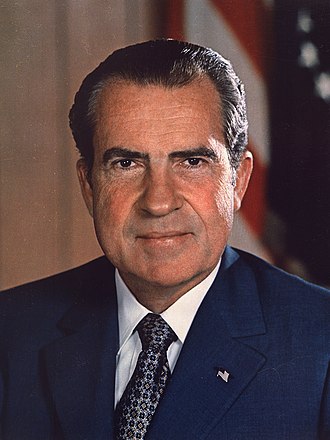
Richard M. Nixon served as the 37th President of the United States from January 1969 until his resignation in August 1974. In February 1971, he ordered the installation of a secret voice-activated taping system in the White House to preserve a historical record of his administration. Until the system's existence was revealed and dismantled in July 1973, the tapes captured Nixon directing major foreign policy initiatives, such as the opening to China, as well as his central role in the Watergate cover-up.
What Nixon talks about on the tapes
White House operations 4,718Presidential scheduling 2,225Public relations 1,784Presidential schedule 1,782Vietnam War 1,693Logistics 1,650Manolo Sanchez 1,626White House communications 1,400White House administration 1,399Presidential communication 1,243Henry Kissinger 1,191Foreign Policy 1,183
Conversations (21,010)
— Page 77 of 211President Nixon met with his personal secretary Rose Mary Woods and valet Manolo Sanchez to review administrative matters, including phone logs and upcoming scheduling requirements. The discussion addressed staffing concerns regarding the President’s impending trip to the People's Republic of China, specifically focusing on the involvement of USIA personnel and Henry Kissinger's decision-making process. The group also briefly touched upon recent public relations activities and upcoming swearing-in ceremonies.
President Nixon initiates a brief telephone call through the White House operator to connect with Special Counsel Charles W. Colson. The exchange serves solely as a logistical request to establish communication with a key staff member. No substantive policy discussions or decisions are recorded during this brief administrative interaction.
President Richard Nixon met with his personal aide, Manolo Sanchez, in the Old Executive Office Building to discuss administrative matters. The brief exchange focused primarily on the President's upcoming daily schedule. No major policy decisions or significant developments were recorded during this short briefing.
President Nixon held a brief, unscheduled meeting with an unidentified individual in his Old Executive Office Building workspace. Due to the lack of available transcripts or descriptive records, the specific subject matter and any resulting policy decisions remain undocumented. The encounter represents a routine but currently unrecoverable interaction within the President's daily agenda.
President Nixon initiated a brief, routine communication with the White House operator to facilitate a follow-up call. The interaction primarily served to manage telephonic logistics for subsequent executive business. No substantive policy matters or major strategic decisions were discussed during this short exchange.
President Nixon and Charles W. Colson discussed the Administration’s political standing, current polling trends, and potential threats from Democratic candidates. They evaluated a memorandum from Douglas Hallett concerning internal weaknesses and the media’s favorable coverage of Senator Edmund Muskie. Nixon expressed interest in shifting focus toward the State of the Union address while Colson recovered from an illness.
President Nixon met with H. R. Haldeman and Charles Colson to coordinate his upcoming schedule and manage political optics ahead of his trip to the People's Republic of China. The participants emphasized the need to prioritize critical domestic appearances and foreign policy briefings while limiting time-consuming social obligations. They also discussed potential changes to the administration’s public relations strategy, specifically regarding unemployment messaging and the frequency of televised press conferences, to better counter Democratic opposition and improve the President’s standing.
President Nixon initiates a request through the White House operator to place a telephone call to National Security Advisor Henry A. Kissinger. The exchange serves as a brief procedural step to facilitate direct communication between the President and his top foreign policy aide. No further policy discussion occurs during this short logistical interaction.
President Nixon met with his personal aide, Manolo Sanchez, for a brief discussion regarding political management and public messaging. The conversation centers on the need to strategically control the administration's programming and handle political adversaries, specifically mentioning George Romney. Nixon expresses confidence in his ability to manage Romney while reviewing the validity of ongoing political criticisms.
President Nixon held a private meeting in his Old Executive Office Building suite with an unidentified individual. The entirety of the recorded segment involves a brief, four-second withdrawal of material categorized as a personal returnable. No further substance or policy discussion is available due to the withdrawal and the absence of a transcript.
President Nixon and Alexander Haig held an informal meeting to discuss Haig's recent health status and recovery. The conversation also briefly touched upon ongoing military operations in Vietnam and the corresponding media coverage of the conflict. No formal policy decisions were recorded during this brief update.
President Nixon held a brief, informal check-in with the White House operator while located in his Executive Office Building workspace. The interaction functioned primarily as a technical or routine equipment verification. No substantive policy matters or major strategic decisions were addressed during this exchange.
President Nixon and Henry Kissinger discussed the progress of the administration's upcoming foreign policy report and strategies regarding the ongoing conflict in Vietnam. They analyzed the potential for a North Vietnamese offensive, agreeing that the timing may be intended by the Soviet Union to overshadow the President's upcoming trip to the People's Republic of China. The two also confirmed scheduling for Kissinger’s upcoming meeting with Soviet Ambassador Anatoliy Dobrynin and dismissed requests for further U.S. intervention in Laos, concluding that the administration should prioritize its domestic agenda during Nixon's upcoming stay at Camp David.
President Nixon and Henry Kissinger discuss scheduling logistics and strategic messaging regarding an upcoming diplomatic or military action. The two emphasize the importance of timing their response to avoid the appearance of reacting to an external message, settling on the 18th as a preferred date. Additionally, they touch upon personnel matters, specifically regarding an individual identified as 'Stan' who is being integrated into their operations.
President Nixon contacted the White House operator to facilitate a telephone connection with his aide, Stephen B. Bull. The interaction served as a brief administrative request to initiate communication between the President and a member of his staff. No further substantive policy matters were discussed during this exchange.
President Nixon and H. R. Haldeman discuss administrative coordination, including Nixon's upcoming meeting with Secretary of State William P. Rogers and the preparation of the State of the Union address. The President expresses a need to focus on domestic policy while distancing himself from certain external communications. Additionally, the conversation touches upon military concerns in Laos, specifically regarding armament requests and the logistical constraints of providing support.
President Nixon consulted with the White House operator to facilitate an outgoing call. This brief interaction served as a standard administrative precursor to initiating communication with an external party. No substantive policy discussions or significant political decisions occurred during this brief operational exchange.
President Nixon contacted his aide, Stephen B. Bull, to coordinate logistical arrangements for his imminent travel to Camp David. Nixon issued specific instructions for a helicopter to be prepared for departure within ten minutes. Bull acknowledged the request and committed to facilitating the presidential transport.
President Nixon met briefly with his personal aide, Stephen B. Bull, in the Old Executive Office Building. While no transcript exists for this one-minute interaction, the meeting served as a routine administrative or logistical check-in between the President and his staff. No specific policy decisions or significant developments were recorded during this brief exchange.
President Nixon contacted the White House operator to place a personal telephone call to First Lady Pat Nixon. The brief interaction served solely to facilitate this communication. No policy matters or substantive political topics were addressed during the exchange.
President Nixon consulted with the White House operator to discuss a memorandum authored by speechwriter Ray Price. The President expressed frustration with the discouraging nature of the document's content. This brief exchange reflects Nixon's ongoing engagement with staff communications and his internal reaction to policy or political feedback.
President Nixon and First Lady Pat Nixon discussed the success of a recent tea event hosted by the First Lady, which was attended by approximately 350 guests. The conversation centered on the positive feedback Mrs. Nixon received regarding her recent diplomatic trip to Africa. The pair also briefly touched upon their respective schedules, specifically mentioning the President's work on the State of the Union speech and his upcoming time at Camp David.
President Nixon and First Lady Pat Nixon briefly discussed the progress of a memorandum drafted by speechwriter Ray Price. The President expressed frustration that the fourth draft was excessive in length or content, leading him to adjust his schedule in response. This short exchange highlights the President's personal oversight of his upcoming administrative communications.
President Nixon met with his personal valet, Manolo Sanchez, in the Old Executive Office Building for a brief administrative interaction. During this short exchange, the President directed Sanchez to coordinate the arrival of his helicopter for an upcoming departure. No other substantive policy or political matters were recorded during this brief encounter.
President Nixon met with Rose Mary Woods and Alexander P. Butterfield to discuss administrative matters, including the handling of a specific letter and a speech draft. Following Butterfield’s departure, Stephen B. Bull joined the President to review scheduling arrangements regarding meetings with Vice President Spiro Agnew, a Joint Chiefs of Staff representative, and George Romney. The brief session focused on managing the President's immediate office workflows and upcoming appointments.
President Nixon and Vice President Spiro Agnew met to discuss strategies for addressing media leaks and the "right to know" movement within the liberal intellectual community, which they viewed as a threat to national security and executive authority. Agnew proposed legislation that would simplify the declassification of documents to gain public favor while establishing strict, legally shielded classification powers for the President that would be immune to judicial review. The two also coordinated Agnew’s upcoming campaign schedule, emphasizing a public relations approach that would allow him to critique the press and Democratic challengers in a controlled, non-abrasive manner, while also touching upon the ongoing Vietnam War and the political challenges of the upcoming election year.
President Nixon met with Vice President Spiro Agnew and staff member Stephen Bull to coordinate administrative scheduling and internal communications. The discussion centered on organizing a series of briefings involving John Ehrlichman, John Dean, and others to align key personnel on policy priorities. Nixon directed the participants to facilitate these discussions to ensure that the individuals involved were properly prepared for upcoming consultations.
President Nixon and John Ehrlichman met to coordinate an upcoming presentation by HUD Secretary George Romney regarding an urban revitalization initiative. They strategized on how to manage Romney's proposal by routing it through a Domestic Council meeting to solicit broader Cabinet feedback, thereby shielding the President from an immediate decision. Additionally, they discussed Romney's resistance to a proposed regionalization plan for Federal Executive Boards and made arrangements to secure publicity for a Soviet cultural group’s visit with First Lady Pat Nixon.
President Nixon met with George Romney, John Ehrlichman, and John Whitaker to discuss the administration's new "Operation TACLE" initiative, a national growth policy designed to address urban and rural decay through decentralized, competitive consortia. The President and Romney also addressed sensitive political matters, including the upcoming departures of cabinet members Maurice Stans and John Mitchell, as well as the need for coordination between Secretary of State William Rogers and National Security Advisor Henry Kissinger. Nixon emphasized his desire for Romney to remain in the cabinet while encouraging him to maintain a low-profile approach to sensitive housing issues during an election year.
President Richard Nixon met briefly with his personal valet, Manolo Sanchez, in the Oval Office. The two-minute interaction consisted primarily of personal matters, as indicated by the withdrawal of sensitive or private material from the archival record. No substantive policy discussions or administrative decisions were documented during this short encounter.
President Nixon contacted the White House operator to place a direct call to his Press Secretary, Ronald L. Ziegler. The brief interaction served exclusively as a logistical request to establish communication with a key staff member. No further policy or strategic matters were discussed during this brief exchange.
President Nixon directed Press Secretary Ronald Ziegler to investigate and address a television interview featuring First Lady Pat Nixon, which the President viewed as a "vicious" and "cheap shot" by journalist Barbara Walters. Nixon instructed Ziegler to consult with aide Connie Stuart regarding the broadcast and to confront Walters directly about the negative tone of the interview. Furthermore, the President established a new policy requiring total White House clearance and editorial control for any future television specials involving the First Lady to prevent unauthorized media access and poor coverage.
President Nixon contacted the White House operator to initiate a telephone call to his special counsel, Charles W. Colson. The brief exchange served solely as a logistical request to establish this communication line. No substantive policy matters or further instructions were recorded during the interaction.
President Nixon and Charles Colson discussed political strategy for the 1972 election, focusing heavily on undermining frontrunner Edmund Muskie. Nixon directed Colson to initiate a massive, coordinated campaign to associate Muskie with unpopular positions, specifically busing, the space shuttle, and opposition to J. Edgar Hoover. They also reviewed polling data and campaign logistics for upcoming primaries, emphasizing the need to keep Muskie’s support levels below 50% in states like New Hampshire.
President Nixon contacted the White House operator to place urgent telephone calls to two key associates. He specifically requested to reach Raymond K. Price, Jr. at his residence and John B. Connally. The brief exchange served as a logistical coordination to facilitate these high-level communications.
President Nixon and John B. Connally discussed a range of administrative and economic concerns, including a warning to keep Herbert Stein's public statements aligned with the administration's economic control strategy. They agreed that the Cabinet committee should focus on increasing the competitiveness of U.S. products rather than dwelling on potential failures or labor disputes. Additionally, Nixon requested that Connally develop a proposal for a national youth service program, which would provide non-military alternatives for civilian service at local, state, or federal levels.
President Nixon and H. R. Haldeman briefly conferred regarding the President's upcoming schedule, specifically focusing on a meeting with Neil H. McElroy. During the discussion, they addressed the necessity of ensuring John B. Connally's attendance at the session. The brief exchange concluded with the President confirming the inclusion of this item in his agenda.
President Nixon met with his personal secretary, Rose Mary Woods, and aide Stephen B. Bull to address routine administrative tasks and correspondence. The participants reviewed documents requiring the President’s signature, discussed the proper handling of presidential gifts such as custom flag cufflinks, and coordinated upcoming scheduling matters regarding Camp David. Stephen B. Bull joined the session briefly to assist with organizing gift inventories for official visitors.
President Nixon met with his aide, Stephen B. Bull, to manage the scheduling of an upcoming appointment with Press Secretary Ronald L. Ziegler. Bull updated the President on current time constraints, specifically noting the necessity to provide Nixon with a fifteen-minute window to review materials before the meeting. The conversation focused on clearing the President’s agenda to ensure he was adequately prepared for the subsequent briefing.
President Richard Nixon met with his valet, Manolo Sanchez, in the Oval Office for a brief, private discussion. The brief duration and the classification of the segment as a personal, returnable item indicate that the exchange was strictly private in nature rather than related to official government business or policy. No substantive political developments or administrative decisions resulted from this interaction.
President Nixon held a brief, unscheduled meeting with an unidentified individual in the Oval Office. The primary purpose of the gathering was to coordinate a subsequent meeting with Press Secretary Ronald L. Ziegler. The interaction concluded quickly when the visitor departed shortly before 10:34 am.
President Nixon and Press Secretary Ronald L. Ziegler met to coordinate the public communication strategy regarding upcoming U.S. troop withdrawals from Vietnam. They established a procedure where Nixon would deliver a brief announcement following an introduction by Ziegler, after which Secretary of Defense Melvin R. Laird would handle subsequent press questions. Ziegler committed to providing the President with a status report prior to the official announcement.
President Nixon met with Melvin Laird, Alexander Haig, and later Ronald Ziegler to coordinate the public messaging strategy for an upcoming announcement regarding U.S. troop withdrawals from Vietnam. The participants focused on framing the reduction as a sign of confidence in the progress of Vietnamization and the South Vietnamese military's defensive capabilities, while minimizing concerns over North Vietnamese tactical maneuvers. They also prepared responses for anticipated press questions concerning prisoners of war, the end of the U.S. ground combat role, and the potential future use of American air and sea power.
President Nixon, H.R. Haldeman, and Ronald Ziegler discussed various administrative concerns and public relations strategies, including potential leaks involving the Anderson papers and investigations into a cabinet official. The group evaluated Secretary of Defense Melvin Laird's recent successful press briefing on Vietnamization and the positive media reception of Pat Nixon's African trip. Additionally, Nixon and Haldeman strategized on how to manage Henry Kissinger's desire for a high-profile press conference regarding his foreign policy initiatives, ultimately favoring a more controlled, low-key interview with journalist Max Frankel to avoid unwanted media speculation.
President Nixon met with Vice President Agnew and members of the McElroy Commission and the Advisory Commission on Intergovernmental Relations (ACIR) to discuss the pressing issue of school finance reform. The discussion focused on the potential shift toward state-level funding to reduce reliance on regressive local property taxes, as well as the feasibility of implementing a Value Added Tax (VAT) as a federal revenue source to support educational equalization. Nixon directed both the McElroy Commission and the ACIR to prioritize the study of these funding models and their implications for intergovernmental relations and local school control.
President Nixon met with his personal aide, Stephen B. Bull, to review and finalize the President's upcoming daily schedule. The brief discussion focused on coordinating a meeting with H.R. Haldeman immediately preceding a scheduled swearing-in ceremony. Bull also presented a book for the President to sign as part of his administrative duties.
President Nixon hosted a swearing-in ceremony in the Oval Office for John E. Sheehan as a member of the Board of Governors of the Federal Reserve System. The event was attended by Sheehan’s family, Federal Reserve Chairman Arthur F. Burns, various governors, and several U.S. Senators, including John Sherman Cooper. Following the formal oath and a photographic session, the President engaged in a private discussion with Senator Cooper regarding the political landscape, including U.S. foreign policy toward the Vietnam War, upcoming trips to China and the Soviet Union, and international conflicts.
President Nixon and Stephen B. Bull briefly discussed administrative logistics regarding a school group from Ascension Academy and the handling of presidential gifts. The conversation touched upon managing press interest in these events and navigating political perceptions of the administration. They concluded by briefly addressing the necessity of managing political adversaries to maintain the administration's momentum.
President Nixon hosted a group of students and their teacher in the Oval Office to celebrate his birthday and engage in an informal, educational visit. During the meeting, the attendees recited poems, presented gifts to the President, and participated in a photo session. Nixon discussed his upcoming trip to the People's Republic of China, emphasizing the importance of international relations for the younger generation, and concluded by distributing souvenir pens to the students.
President Nixon held an Oval Office meeting with Stephen B. Bull, Edwin M. Fauver, and several guests to honor Fauver upon his retirement. The group engaged in brief social pleasantries and a photo session while Nixon presented the guests with official White House gifts, including a money clip and cufflinks. The encounter served as a gesture of appreciation for Fauver’s service before he transitioned into retirement.
President Nixon and Stephen B. Bull met briefly to review the President's afternoon schedule, specifically focusing on an upcoming meeting of the Neil H. McElroy Commission. They discussed the expected duration of the session and the potential participation of Vice President Spiro T. Agnew. The brief consultation served to address and manage logistics regarding schedule delays for the remainder of the day.
President Nixon met with Robert O. Anderson, J. Erik Jonsson, and other advisors to discuss the creation of an "Institute for National Goals," a project designed to help cities and the nation engage in long-term, consensus-based planning. The group explored using computer modeling and systems analysis to identify societal priorities, contrasting this pragmatic, goal-oriented approach with the perceived indecisiveness of traditional foundations and academic idealists. Nixon expressed support for the concept and directed his team to coordinate with George P. Shultz and David J. Mahoney to evaluate the initiative's feasibility, potential funding, and government role.
President Nixon met briefly with White House aide Stephen B. Bull to review his daily schedule, specifically regarding an upcoming appointment with Jon M. Huntsman. Following Bull's departure, the President spoke with his personal valet, Manolo Sanchez, to coordinate a request for food. These brief interactions reflect the administrative and logistical management of the President's immediate agenda and personal needs.
President Nixon met with Stephen B. Bull in the Oval Office to facilitate the delivery of specific items or documents. The brief exchange consists primarily of informal pleasantries as the materials are handed over to the President. No substantive policy discussions or major administrative decisions occurred during this interaction.
President Nixon met briefly with Alexander P. Butterfield, Stephen B. Bull, Ronald L. Ziegler, and Secret Service personnel to offer brief words of encouragement to the group. Following the departure of most participants, Nixon held a short, private discussion with Bull regarding the President's schedule and a request for a specific report. The interaction concluded shortly thereafter with Bull exiting the Oval Office.
President Nixon met with H. R. Haldeman and Stephen B. Bull to finalize logistical arrangements for his departure to the Executive Office Building and upcoming travel plans. The discussion focused on coordinating schedules and assessing the viability of a trip to Camp David in light of current weather conditions and transportation requirements. The meeting concluded with the President and Haldeman departing the Oval Office together.
H. R. Haldeman and President Nixon discussed logistical frustrations regarding a volatile event schedule, specifically highlighting the uncertainty of a planned appearance that had been repeatedly canceled and reinstated. The conversation touched upon the scheduling of John B. Connally and the strategic challenges of aligning appearances with the upcoming State of the Union address. Haldeman also initiated a request to contact Major General James D. Hughes to facilitate these administrative coordination efforts.
President Nixon met with his senior staff, including H. R. Haldeman, to address ongoing frustrations regarding the mismanagement of his daily schedule, the handling of sensitive staff briefings, and the need for stricter control over administrative operations. He expressed irritation with staff who deliberately misrepresented the time requirements of meetings, specifically citing Henry Kissinger’s performance, and emphasized the necessity of maintaining personal and professional discipline ahead of critical upcoming events like the State of the Union and the China trip. Nixon also clarified his stance on public relations, notably his decision to refuse portrait sittings until after his presidency and his skepticism toward further press commentary regarding foreign policy leaks.
President Nixon instructed the White House operator to connect him with Press Secretary Ronald L. Ziegler. Expressing clear frustration, the President remarked that he was in no mood to speak with his press aide. The brief exchange served solely as a logistical directive to initiate this internal communication.
President Nixon and Press Secretary Ronald Ziegler discuss the media reception of the latest U.S. troop withdrawal announcement and accompanying favorable coverage regarding the President's birthday and his recent meeting with Alexandria schoolchildren. They evaluate how the press is handling the Vietnam withdrawal announcement alongside related supplemental stories and intelligence concerning Soviet activity in the region. Nixon explicitly directs Ziegler to ensure that photographs of the school children are prominently featured in local newspapers.
H. R. Haldeman coordinates with Stephen B. Bull regarding logistical plans for the President’s travel to Camp David. The discussion focuses on determining the mode of transportation—helicopter or car—based on weather conditions at the destination in Thurmont, Maryland. Haldeman also confirms that Rose Mary Woods and Marjorie P. Acker are scheduled to accompany the President's party and instructs Bull to relay these arrangements to the relevant staff.
President Nixon contacted the White House operator to facilitate a telephone call to his daughter, Julie Nixon Eisenhower. The exchange served strictly as a procedural request to initiate this personal communication. No policy matters or additional substantive business were addressed during this brief connection.
President Nixon and John Ehrlichman met to coordinate the drafting of the upcoming State of the Union address and to express frustration regarding a meeting with Vice President Spiro Agnew. Nixon evaluated feedback on drafts written by Raymond Price and Elliot Richardson, emphasizing the need for a narrative focused on restoring public confidence in government amidst political division. The President also decided to incorporate personal reflections on his early congressional career and a reference to Harry S. Truman to frame his vision for the speech.
President Nixon met with Alexander P. Butterfield in the Old Executive Office Building to discuss administrative matters and potential staffing issues. The discussion touched upon the scheduling and involvement of speechwriter Raymond K. Price, Jr. No major policy decisions were finalized during this brief administrative briefing.
President Nixon and John D. Ehrlichman discuss the handling of supplementary notes drafted by Raymond K. Price, Jr. for the President's review. Nixon expresses frustration regarding the volume of material and the need to finalize his approach to these documents rather than delaying further. The conversation centers on the administrative burden of processing these drafts and the urgency of moving forward with the project.
President Nixon consulted with the White House operator regarding an incoming or missed telephone communication. The President instructed the operator to have the unidentified party return his call. No further substantive policy matters or official developments were addressed during this brief exchange.
President Nixon met with an unknown individual in the Old Executive Office Building for a brief, seven-second exchange. The conversation focused on a request for tobacco. No further significant policy matters or substantive political developments were recorded during this brief interaction.
President Nixon and H. R. Haldeman discussed personnel strategies and the management of economic appointments. Nixon directed Haldeman to coordinate with Pete Flanigan to secure cooperation from key figures regarding critical administrative roles, specifically assessing the suitability of Paul Volcker and Charls Walker. Additionally, the President decided to postpone the official announcement of Peter G. Peterson’s nomination as Commerce Secretary until the following week.
President Nixon speaks with the White House operator to facilitate a connection with his daughter, Julie Nixon Eisenhower. This brief logistical exchange serves to coordinate communication between the President and his family. The conversation functions solely as a bridge to a subsequent personal discussion.
President Nixon and Julie Nixon Eisenhower discuss the positive reception of First Lady Pat Nixon's recent television appearance. The President emphasizes that addressing challenging or unfriendly questions is essential for delivering an effective public performance. They conclude the brief exchange by coordinating plans for Julie’s upcoming visit.
President Nixon directed Alexander M. Haig, Jr. to come to his office in the Old Executive Office Building for an immediate meeting. The discussion focused on coordinating schedules and facilitating a rendezvous involving H.R. Haldeman and John N. Mitchell. This brief exchange served primarily as logistical coordination to finalize the timing of these internal consultations.
President Nixon met with his personal valet, Manolo Sanchez, in the Old Executive Office Building. The primary purpose of the brief interaction was for the President to request a supply of tobacco. The exchange concluded immediately following this logistical request.
President Nixon and Alexander Haig discuss the public perception and emotional state of Henry Kissinger, particularly regarding his recent struggles with press coverage and internal administrative pressures. The conversation touches upon the successful handling of a recent press conference by Secretary of Defense Melvin Laird and the management of a Soviet student's attempted defection in New York. Ultimately, Nixon and Haig express concern over Kissinger’s psychological stability and his capacity to withstand the intense political scrutiny expected during the upcoming 1972 campaign, emphasizing the necessity of supporting him to ensure the success of critical diplomatic negotiations with China and the Soviet Union.
President Nixon consulted with the White House operator regarding a business entity associated with the codename 'Sapphire.' The brief interaction served to facilitate communication or information gathering related to this specific corporate interest. No further substantive policy decisions were recorded during this exchange.
President Nixon met with William Safire to refine a high-stakes speech regarding secret negotiations to end the Vietnam War. They focused on drafting a clear, persuasive narrative that emphasizes the administration's commitment to peace and the specific details of their withdrawal and prisoner-of-war proposals. Nixon tasked Safire with coordinating the final language with Henry Kissinger while ensuring Secretary of State William Rogers is kept informed, all while managing the internal friction between his senior advisors.
President Nixon instructed the White House operator to facilitate a meeting with Raymond Price. The request served to summon Price to the President's office in the Old Executive Office Building for a consultation. No further substantive policy matters were recorded during this brief administrative exchange.
President Nixon met briefly with members of Henry Kissinger’s staff to coordinate on specific personnel or briefing materials. The discussion focused on confirming the review of documents or status updates involving individuals referred to as Thomas and Paul. The exchange functioned as a quick status check on ongoing diplomatic or administrative workflow tasks.
President Nixon and Henry Kissinger discuss the progress of a draft speech being prepared by William Safire. They evaluate the inclusion of specific diplomatic details, including the August 1971 ceasefire proposal and the two-phase timeline strategy. Kissinger instructs Safire to refine the text's nuances before finalizing the speech's introduction and conclusion.
President Nixon and Raymond Price met to conduct a final review and stylistic refinement of the upcoming State of the Union speech. They focused on restructuring the address to emphasize the winding down of the Vietnam War, promoting domestic programs, and framing the speech as a comprehensive record of the administration's achievements for a political year. The conversation also touched upon the strategic political landscape of the 1972 Democratic presidential primary, with the President assessing the relative strengths and vulnerabilities of candidates like Edmund Muskie, Hubert Humphrey, and George Wallace.
President Nixon received a brief communication from a White House operator regarding a message from Secretary of the Treasury John B. Connally. The operator informed the President that Connally had called and that Roger Breen had sent a response. This interaction served primarily as a status update on pending correspondence and administrative outreach.
President Nixon and John B. Connally discussed the Dallas Cowboys' recent Super Bowl victory and their impressive all-around performance. The conversation centered on analyzing the team's strengths, including the contributions of Coach Tom Landry and specific players. Nixon confirmed that he had personally called Coach Landry to offer his congratulations on the win.
President Nixon met with author Allen S. Drury to express his strong appreciation for a letter Drury wrote regarding the Washington press corps. Nixon praised the document as a truthful critique that would likely alienate Drury from mainstream journalists while earning respect from honest observers. The conversation served primarily as a private gesture of validation for Drury’s confrontational stance toward the media.
President Nixon met with Miami Dolphins head coach Don Shula to offer consolation following the team's recent loss to the Dallas Cowboys in Super Bowl VI. During their brief meeting, the President dictated a formal letter of encouragement, praising Shula’s leadership and the team’s impressive performance throughout the season. Nixon expressed his admiration for the Dolphins' competitive spirit and conveyed his confidence that the franchise would remain a top contender in future seasons.
President Nixon met with his personal valet, Manolo Sanchez, in the Oval Office to address administrative needs. The discussion focused on organizing and retrieving specific materials intended for the President’s briefcase kept in his Executive Office Building (EOB) office. The meeting concluded with Sanchez departing to handle these logistical preparations.
President Nixon met with H. R. Haldeman and various staff members, including Henry Kissinger and John Connally, to manage media relations, cabinet appointments, and urgent foreign policy challenges. A significant portion of the discussion addressed leaks regarding the Anderson Papers and the unauthorized disclosure of information by Yeoman Charles Radford, with the President expressing frustration over the administration's perceived passivity. Furthermore, Nixon and his aides evaluated the ongoing tensions between Secretary of State William Rogers and National Security Advisor Henry Kissinger, while finalizing the transition of Peter G. Peterson into the Commerce Department to bolster economic policy control. Throughout the meeting, the President emphasized the need to maintain strict operational control over sensitive negotiations and prepare for the upcoming state of the union address.
H. R. Haldeman coordinates with John B. Connally to schedule a meeting with President Nixon for that afternoon. Connally expresses flexibility in his schedule, offering to postpone or cancel existing internal appointments, including a courtesy call with the Yugoslav ambassador. The two finalize the meeting time for 4:00 p.m. at the President’s convenience.
President Nixon initiates a request for the White House operator to connect him with speechwriter Raymond K. Price, Jr. This brief administrative interaction serves as a bridge to a subsequent substantive discussion with Price. No further policy matters are addressed in this specific exchange.
President Nixon met with his personal aide, Manolo Sanchez, in the Old Executive Office Building. The conversation primarily involved personal matters, as evidenced by the withdrawal of an eleven-second segment classified as a personal returnable. No administrative or policy-related decisions were recorded during this brief interaction.
President Richard Nixon met with his personal valet, Manolo Sanchez, in the Old Executive Office Building. Due to the lack of an available transcript and the withdrawal of recording segments, the substance of the discussion remains undocumented. No significant policy decisions or historical developments were captured in the available records for this encounter.
President Nixon consulted with a White House operator to facilitate an outgoing call. The discussion served strictly administrative purposes to connect the President with another party. No substantive policy matters or significant decisions were recorded during this brief exchange.
President Nixon met with his valet, Manolo Sanchez, to briefly discuss personal matters. The conversation included a request for water and a report from Sanchez regarding his wife Tina's recent return from Spain. No significant political or policy decisions were documented during this short exchange.
President Nixon speaks briefly with the White House operator to confirm the recent return of an individual named Tina from Spain. This short interaction serves primarily as a status update regarding a personal acquaintance's travel schedule. No significant policy decisions or official White House actions were transacted during the exchange.
President Nixon consulted with his personal physician, General Walter R. Tkach, regarding the health of a family member, Tina, who had recently returned from Spain with the flu. Nixon requested that Tkach reach out to provide medical advice or assistance for her recovery. Tkach agreed to follow up and coordinate the necessary care.
President Nixon consulted with his longtime valet, Manolo Sanchez, regarding the aesthetic arrangement of items in his office. The discussion centered on the visual placement and presentation of objects within the room. No significant policy decisions were reached, as the brief exchange was limited to these personal preferences.
President Nixon and his valet, Manolo Sanchez, met briefly to discuss incidental personal matters and the care of the President's dog. The conversation was limited in scope, focusing on routine administrative details regarding the President's personal life. No major policy decisions or significant political developments resulted from this brief exchange.
President Nixon and H.R. Haldeman reviewed potential U.S. representation at the funeral of King Frederik IX of Denmark, discussing various candidates including John S. D. Eisenhower and Victor Borge. The conversation shifted to managing John Connally’s role within the administration, specifically addressing his sensitivities regarding White House staff interactions and his involvement in reviewing the State of the Union address. Nixon and Haldeman decided to handle the dissemination of the speech draft to Connally with care, coordinating a specific timeline to ensure control over the document's release and revisions.
President Nixon consulted with the White House operator to facilitate an outgoing communication. This brief interaction served as a procedural step to connect the President with a specific party for an undisclosed matter. No further substantive policy or strategic discussions occurred during this brief exchange.
President Nixon and John B. Connally discuss the final draft of the upcoming State of the Union address, which H.R. Haldeman is delivering to Connally for review. Nixon seeks Connally's feedback on the speech's tone and strategy, particularly regarding its defense against political attacks from Democrats and the inclusion of specific economic and policy points. The conversation also briefly touches on political optics related to the oil industry and the status of potential political rivals.
President Richard Nixon utilized this private session to rehearse the delivery of his 1972 State of the Union address. He practiced articulating key themes, including the necessity of bipartisan cooperation in Congress, the importance of maintaining national strength, and his foreign policy vision regarding defense spending and the transition toward a generation of peace. The rehearsal served to refine the rhetorical tone and substantive priorities of his upcoming legislative agenda.
President Nixon consulted with a White House operator to facilitate an outgoing telephone connection. This brief interaction served administrative purposes to manage the President's communications from the Old Executive Office Building. No further substantive policy matters or discussions were recorded during this brief exchange.