Nixon, Richard M. (President)
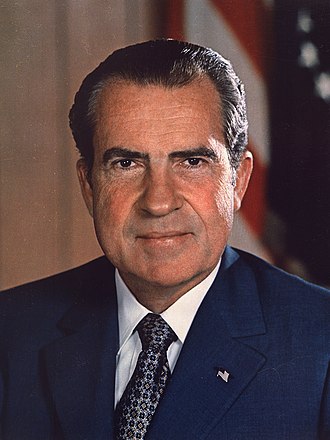
Richard M. Nixon served as the 37th President of the United States from January 1969 until his resignation in August 1974. In February 1971, he ordered the installation of a secret voice-activated taping system in the White House to preserve a historical record of his administration. Until the system's existence was revealed and dismantled in July 1973, the tapes captured Nixon directing major foreign policy initiatives, such as the opening to China, as well as his central role in the Watergate cover-up.
What Nixon talks about on the tapes
White House operations 4,718Presidential scheduling 2,225Public relations 1,784Presidential schedule 1,782Vietnam War 1,693Logistics 1,650Manolo Sanchez 1,626White House communications 1,400White House administration 1,399Presidential communication 1,243Henry Kissinger 1,191Foreign Policy 1,183
Conversations (21,010)
— Page 86 of 211President Nixon met briefly with Alexander P. Butterfield to discuss the scheduling of H. R. Haldeman. The President indicated that he needed to consult with Haldeman regarding an unspecified, non-critical matter. The brief exchange concluded with the necessary coordination regarding the Chief of Staff's availability.
President Nixon met with his aide, Stephen B. Bull, to coordinate his morning schedule. The primary focus of the brief discussion was determining the availability of the White House barber, Carl Parker. Bull committed to facilitating the appointment promptly before attending to other administrative tasks.
President Nixon met with his aide, Stephen B. Bull, to coordinate his daily schedule. The discussion primarily concerned the logistics of arranging a haircut appointment, with a focus on potentially scheduling the White House barber at the Carlton Hotel. No broader policy or administrative actions were taken during this brief exchange.
President Nixon consulted with Alexander P. Butterfield to coordinate a potential last-minute visit to a flood-stricken area in West Virginia while en route to Florida. The President emphasized the need to gather logistical details from staff—including Darrell M. Trent, General George A. Lincoln, and Senator Robert C. Byrd—without prematurely raising public expectations. Butterfield was tasked with confirming the feasibility and specific location of the stop to ensure a smooth, low-profile excursion.
President Richard M. Nixon met with Alexander P. Butterfield in the Oval Office to discuss administrative logistics and the ongoing operations of the White House. While the specific details of their discussion remain unrecorded in the available transcript, the brief exchange reflects the routine coordination between the President and his Deputy Assistant. No significant policy decisions or actionable directives are preserved in this recording.
President Nixon consulted with the White House operator to facilitate an outgoing call. This brief interaction served as a standard administrative precursor to connect the President with a desired party. No substantive policy matters or major decisions were recorded during this brief logistical exchange.
President Nixon and Charles Colson discuss the political implications of recent economic trends, specifically focusing on the upcoming January unemployment figures and stock market performance. The conversation also analyzes the volatility of the 1972 Democratic primaries, particularly the decline of Edmund Muskie's campaign and the potential impact of the busing issue on Democratic candidates. Nixon expresses satisfaction with the defeat of the Griffin Amendment, noting that it preserves his administration's flexibility to define its own legislative stance on the busing issue.
President Nixon and Charles Colson discuss the shifting dynamics of the 1972 Democratic presidential primaries, specifically focusing on the performance of candidates and the influence of the press. They analyze the impact of voter turnout among liberals and conservatives, while speculating on the potential entry of Senator Ted Kennedy into the race. The conversation concludes with administrative coordination regarding upcoming staff communication while the President prepares for a brief period of absence.
President Nixon met with his aide Stephen B. Bull in the Oval Office to briefly coordinate his daily schedule. The conversation centered on logistical arrangements for an appointment with the White House barber. No significant policy matters were discussed during this brief administrative encounter.
President Nixon and Stephen B. Bull met briefly to coordinate the scheduling of a meeting with John B. Connally. After evaluating timing constraints, they settled on a meeting time of 10:30 a.m. This brief administrative exchange ensured that the President’s agenda remained aligned with his upcoming appointments.
President Nixon and John Connally met to assess the national economic outlook and discuss the 1972 presidential campaign. Connally emphasized that despite some public anxiety regarding inflation and meat prices, the administration should remain steady rather than reactive, noting that key indicators like stock market performance and machine tool orders signaled improvement. They also analyzed the Democratic field, concluding that Edmund Muskie's campaign was effectively over, while anticipating that Edward Kennedy might emerge as the eventual challenger despite the political risks surrounding Chappaquiddick. The conversation underscored a strategic preference for maintaining a calm, confident administrative posture heading into the election year.
President Nixon and Alexander P. Butterfield discussed the logistical feasibility and political implications of a potential presidential trip to assess flood damage in West Virginia. Butterfield provided a detailed breakdown of flight times and the limited activity in the disaster zone, noting the presence of refugees and reconstruction crews. Ultimately, Nixon decided against the visit due to the lack of substantive purpose and the political sensitivity surrounding the cause of the dam failure. The conversation concluded with a brief mention of upcoming travel plans to Key Biscayne.
President Nixon met with his personal valet, Manolo Sanchez, in the Oval Office to request refreshments. The brief interaction focused on the President's desire for a cold Coca-Cola. No substantive policy matters or administrative decisions were addressed during this short exchange.
President Nixon and H.R. Haldeman discussed logistics for an upcoming staff trip to Florida, including potential visits to Disney World and the management of staff accommodations. They reviewed political strategy regarding the 1972 campaign, specifically polling data against Republican challengers Paul McCloskey and John Ashbrook, and evaluated the impact of the President's recent trip to the People's Republic of China. The conversation also touched on the administration's stance on Taiwan, the President's upcoming travel to the Soviet Union, and arrangements for sending gifts to family and staff members following the China visit.
President Nixon contacted the White House operator to place a call to First Lady Pat Nixon to discuss her current schedule. Upon learning she was already on another line, the President opted not to interrupt her conversation. No further action was taken, as Nixon instructed the operator that there was no urgency regarding the request.
President Nixon spoke with the White House operator to facilitate an outgoing call. This brief interaction served as a standard administrative step to connect the President to another party. No substantive policy discussions occurred during this routine telephonic bridge.
President Nixon requested that the White House operator place a telephone call to his aide, Ronald H. Walker. The brief interaction served solely to facilitate this administrative connection. No further policy discussions or substantive dialogue occurred during this exchange.
President Nixon consulted with the White House operator to check the availability of Ronald H. Walker for a planned telephone call. Upon learning that Walker was currently unavailable, the President decided to postpone the outreach until the following day due to his impending departure for Florida. No further actions were taken during this brief administrative exchange.
President Nixon and First Lady Pat Nixon discussed the public display of gifts received during the President's recent trip to China, agreeing that the items would generate significant public interest. Additionally, the conversation touched upon the logistics of Julie Nixon Eisenhower's travel schedule, including a delay in her departure and an upcoming phone call with the President.
President Nixon initiates a brief request for the White House operator to connect him with Ron Walker. This directive facilitates administrative communication between the President and a member of his staff. No further substantive policy or strategic discussions occur during this brief interaction.
President Nixon met with Stephen B. Bull to review his upcoming official schedule before shifting his focus to a private trip to Florida. He subsequently discussed logistics for this trip with his personal aide, Manolo Sanchez, specifically coordinating transportation arrangements and the travel requirements for his dogs. No major policy decisions were made during this brief meeting, which centered on personal travel planning.
President Nixon met with his aide Stephen B. Bull to review his upcoming daily schedule. The primary objective of the brief meeting was to coordinate preparations for a pending appointment with George P. Shultz. No major policy developments occurred, as the discussion focused strictly on administrative planning and logistical arrangements.
President Nixon met with his Deputy Assistant Alexander P. Butterfield in the Oval Office to conduct a brief review of the President’s upcoming daily schedule. The discussion focused on logistical coordination and the planning of presidential engagements. No major policy developments were recorded during this short administrative session.
President Nixon spoke with the White House operator to facilitate an outgoing call. This brief exchange served as an administrative necessity to connect the President with another party. No substantive policy discussions or significant political developments occurred during this brief telephonic interaction.
President Nixon met with his senior advisors, including George Shultz and Henry Kissinger, to review the domestic and political fallout following his historic trip to China. The conversation focused on managing the narrative surrounding the visit, specifically highlighting the favorable contrast between the President's statesmanlike conduct and the perceived desperation of Democratic presidential candidates. Beyond the China trip, the group discussed legislative priorities such as the foreign aid bill, the status of Radio Free Europe funding, and upcoming labor negotiations. Nixon expressed a desire to maintain stability in the economy and carefully navigate potential confrontations with organized labor leaders like George Meany.
President Nixon called Ronald H. Walker to commend him and his team for their successful logistical efforts during the President’s recent trip to the People’s Republic of China. Nixon acknowledged the demanding nature of the assignment and expressed pride in their performance while noting the Chinese officials' observations regarding the team's youth. The conversation concluded with Nixon encouraging the fatigued Walker to take a planned trip to Florida to recover his health.
President Nixon and his personal secretary, Rose Mary Woods, spoke briefly to discuss the recent death of Calvin E. Brumley, who suffered a fatal heart attack on March 4. The President offered his condolences and coordinated plans to place a sympathy call to the widow, Jayne Brumley. Additionally, the two checked in on Woods’s personal health status following her recent concerns.
President Nixon met with the Cabinet Committee on Education to deliberate on federal education policy, with a primary focus on the political and constitutional challenges surrounding school busing and desegregation. The discussion addressed the need for improved quality of education in inner-city and rural schools, the complexities of federal financing, and the potential implementation of tax credits for private education. The participants explored ways to balance integration mandates with community-based solutions, emphasizing the importance of school accountability and the development of a coherent administration strategy to address public concerns.
President Nixon and his personal secretary, Rose Mary Woods, briefly coordinated the President’s morning schedule regarding an upcoming meeting with H.R. Haldeman. Nixon provided instructions for Woods to facilitate a follow-up discussion once a presentation by Mr. Holland concluded. This exchange functioned primarily as an administrative adjustment to ensure the availability of key staff for internal deliberations.
President Nixon met with aide Stephen B. Bull to coordinate logistical arrangements for an upcoming trip. The discussion focused on scheduling details regarding H. R. Haldeman and plans to rendezvous in St. Paul. Bull confirmed the timeline for their meeting later that afternoon.
President Nixon arranges a meeting with Dr. Kittman while mindful of potential scheduling conflicts during breakfast hours. The conversation centers on coordinating the President’s daily schedule and ensuring the arrival of necessary personnel. This brief interaction reflects the logistical management required to prepare for upcoming briefings, including an anticipated session with Henry Kissinger.
President Nixon and Henry Kissinger met to discuss the positive domestic public reaction to the President's recent trip to the People's Republic of China, which they contrasted with the skepticism and criticism from political opponents and some media figures. They analyzed various media critiques of the Shanghai Communiqué, dismissing claims of secret deals and asserting that the administration achieved its strategic objectives without conceding Taiwan. Additionally, the pair coordinated their response to press inquiries and considered how to manage further reporting on the trip while maintaining momentum for potential diplomatic progress regarding Vietnam.
President Nixon met with H.R. Haldeman, John Ehrlichman, and other staff members to discuss political strategy, staffing concerns, and crisis management related to the ITT anti-trust controversy. The group focused on controlling the public relations fallout from the ITT affair, determining the President's upcoming travel and meeting schedule, and assessing the political impact of the China trip and current primary elections. Nixon expressed a desire to distance the White House from the ITT scandal, emphasizing that any necessary clarifications should come from the Justice Department rather than the President or his staff.
President Nixon consulted with an unknown participant to prepare for an upcoming meeting with Congressional leadership. The discussion focused on coordinating legislative strategy regarding welfare reform and revenue sharing. William E. Timmons and Clark MacGregor were identified as key figures necessary for advancing these administration policy priorities.
President Nixon held a brief, informal meeting with an unidentified individual to discuss scheduling matters. The conversation was limited in scope, concluding quickly without significant policy developments or substantive political debate. The interaction primarily served to coordinate upcoming calendar arrangements for the unknown participant.
President Nixon and unidentified participants engage in a brief, administrative exchange regarding the location and status of a specific individual. The discussion serves as a logistical coordination effort to locate this person for an unspecified purpose. No substantive policy or political decisions are addressed in this short segment.
President Nixon met with the Cabinet Committee on Education and the Council of Black Appointees to discuss the final report of the President’s Commission on School Finance. Participants examined the challenges of educational equity, focusing on funding disparities between urban and rural districts, the role of federal and state responsibilities, and the contentious issues of busing and support for non-public schools. The President expressed appreciation for the committee's research, and the discussion concluded with a commitment to further reviewing the commission's recommendations for legislative and policy implementation.
President Nixon consulted with his aide, Stephen B. Bull, regarding the current location and availability of John D. Ehrlichman. The brief exchange focused on locating Ehrlichman for an unscheduled meeting. Bull departed shortly thereafter to facilitate the interaction between the President and his domestic policy advisor.
President Nixon met with H.R. Haldeman and John Ehrlichman to discuss political strategy, including his administration's position on a busing moratorium and the status of his forthcoming meeting with the Cabinet Committee on Education. The group addressed internal staff tensions, specifically regarding Pat Buchanan's potential resignation over disagreements with the Shanghai Communiqué and his frustration with the administration's perceived failure to satisfy conservative interests. Additionally, the President and his advisors reviewed the escalating ITT antitrust controversy, evaluating the political risks associated with the Justice Department's settlement and allegations involving Dita Beard and Jack Anderson.
President Nixon held a brief, ten-minute meeting in the Oval Office with an unidentified male visitor. Due to the lack of an available transcript or audio clarity, the specific subject matter and any resulting policy decisions remain undocumented. Consequently, no substantive developments or action items can be verified from this encounter.
President Nixon and H. R. Haldeman met to coordinate the logistics and strategic approach for an upcoming meeting with Taiwanese Ambassador James C.H. Shen. The discussion focused on the urgency of the Ambassador's concerns regarding the Republic of China and the President's desire to gain a nuanced assessment of the diplomat's temperament. They also reviewed Henry Kissinger's role in the broader context of these diplomatic engagements.
President Nixon and Henry Kissinger met to coordinate administrative logistics and manage public relations regarding upcoming cabinet appearances and press engagements. The discussion centered on controlling the optics surrounding diplomatic interactions, specifically emphasizing that ambassadors should not be granted high-profile access to the White House. Nixon directed Kissinger to finalize specific memorandums and manage expectations for upcoming meetings with foreign representatives and administration officials.
President Nixon and H.R. Haldeman met to discuss ongoing administrative work and the management of recent polling data. The brief consultation focused on strategic adjustments to how incoming poll results should be utilized or refined. No definitive policy shifts were recorded, but the exchange centered on the tactical handling of political information.
President Richard Nixon met with an unidentified individual in the Oval Office to discuss aspects of his executive schedule. The brief ten-minute engagement focused on the management and coordination of presidential appointments and commitments. No specific policy actions or formal decisions are documented in the available records for this interaction.
President Nixon dictated a memorandum to the Secretary of State and other key agencies to establish strict guidelines regarding the recent summit with the People's Republic of China. He emphasized the need for a disciplined, restrained public messaging strategy across the bureaucracy to protect the delicate nature of the new bilateral relationship. Consequently, he ordered an immediate halt to any further commentary or elaboration on the substance of the talks or the official communiqué.
President Nixon and Henry Kissinger met to review and refine official public messaging following the President’s recent trip to the People’s Republic of China. The discussion focused on coordinating consistent talking points, specifically regarding the President's remarks at Andrews Air Force Base and Kissinger’s previous background briefings in Shanghai. To ensure administrative alignment, Nixon directed the drafting of a formal memorandum to Secretary of State William P. Rogers to dictate how officials should characterize the trip in future public statements.
President Nixon dictated a memorandum to the Secretary of State and other officials regarding the management of public messaging following his recent trip to the People’s Republic of China. He instructed that all official comments regarding the trip must be confined strictly to the framework established in his arrival remarks at Andrews Air Force Base on February 28, 1972. This directive served to ensure administrative consistency and control the narrative surrounding the diplomatic breakthrough.
President Nixon met with his personal secretary, Rose Mary Woods, to discuss administrative directives and his recent travel to Florida. The conversation touched upon the logistics of the trip, including weather conditions and the involvement of Julie Nixon Eisenhower. Additionally, the pair addressed the handling and placement of specific gifts and personal items within the office.
President Nixon and H. R. Haldeman met to review recent polling data assessing the public impact of the President’s historic trip to China. They analyzed approval ratings compared to Gallup and Harris polls, noting a solid, consistent level of support and a decline in disapproval. The discussion also covered voter sentiment on foreign policy issues and the perceived political efficacy of the summit, with the participants concluding that the trip provided a favorable benchmark despite some lingering skepticism regarding secret agreements.
President Nixon and HUD Secretary George Romney met to discuss the administration's urban policies and the potential for a non-partisan "Citizens for America" movement to address fundamental national issues. Romney, drawing on his experiences in Michigan, proposed a structure for building public consensus on housing, racial equity, and the "real city" concept, while acknowledging the political challenges of dealing with controversial topics in an election year. Nixon expressed support for Romney’s vision and the necessity of such advocacy, though both men agreed that any such initiative would need to remain independent of the upcoming presidential campaign.
President Nixon met with Alexander P. Butterfield to coordinate administrative tasks and manage the President's schedule. The discussion centered on the handling of specific correspondence, with the President instructing Butterfield to prioritize a formal letter over other pending paperwork. This interaction served to streamline workflow efficiency regarding office documentation and outgoing communication.
President Nixon instructed the White House operator to place an outgoing call to Jayne Brumley. The exchange served strictly as a logistical request to connect the President with this specific individual. No further policy or administrative matters were discussed during this brief communication.
President Nixon consulted with the White House operator to facilitate an outgoing call. This routine interaction served to connect the President with an external party via the White House switchboard. No further substantive policy matters or administrative decisions were captured during this brief exchange.
President Nixon met with his staff to manage the growing political fallout from the ITT antitrust case, specifically focusing on coordinating a formal statement for John N. Mitchell and managing the public narrative surrounding Dita Beard. Following these internal deliberations, the President met with James C. H. Shen, the Republic of China's ambassador, to address concerns regarding the administration's recent diplomatic outreach to the People's Republic of China. Nixon sought to reassure the Taiwanese government of the U.S. commitment to their security while emphasizing the need for patience and peaceful resolution in the region.
President Nixon called Jayne Brumley to offer his condolences following the death of her husband, Calvin E. Brumley. During the brief exchange, Nixon praised Calvin's work and noted that he had recently discussed the deceased's professional contributions with John B. Connally. The President also spoke briefly with the couple's son, Brian, and encouraged the family to remain resilient during their time of grief.
President Nixon contacted the White House operator to facilitate a telephone connection with National Security Advisor Henry A. Kissinger. This brief administrative exchange served as the precursor to a substantive policy or diplomatic discussion between the two men. No other topics were addressed during this short call.
President Nixon and Alexander P. Butterfield met to coordinate the scheduling and logistics of upcoming personal reunions. The conversation focused on organizing gatherings for the President's World War II service associates and his Duke Law School classmates. Nixon decided to prioritize the law school class reunion for June at the request of an associate, effectively pushing back other planned events.
President Nixon summoned John D. Ehrlichman to the Oval Office for a brief, five-minute meeting. While no transcript or detailed record of the dialogue exists, the encounter served as a direct consultation between the President and his chief domestic policy advisor. The meeting highlights the frequent, informal nature of communication between the two men during this period of the Nixon administration.
President Nixon met with his senior advisors and Henry Kissinger to navigate several political and diplomatic challenges, including the ongoing ITT controversy, the management of the 1972 presidential campaign, and the implications of his recent trip to the People's Republic of China. The group discussed strategies to handle public and congressional inquiries regarding potential conflicts of interest, with Nixon emphasizing a policy of non-comment on political issues. Additionally, Kissinger briefed the President on North Vietnamese stalling tactics in peace negotiations, which were potentially influenced by Chinese pressure, and reviewed the administration's delicate balancing act regarding Taiwan and Vietnam in foreign policy communications.
President Nixon and Henry Kissinger spoke briefly regarding the review of pending documents. The President directed Kissinger to examine specific materials for his subsequent consideration and feedback. This exchange reflects the routine administrative coordination between the two men concerning the President’s workflow and briefing requirements.
President Nixon contacted the White House operator to initiate a telephone call with his special counsel, Charles W. Colson. The brief communication served primarily as an administrative request to connect the two men for a private discussion. No further substantive policy matters were addressed during this specific exchange.
President Nixon and Charles Colson discuss the political fallout of the ITT controversy, dismissing it as a media-driven distraction that will soon fade. They also review the positive public reception of Nixon’s recent trip to the People's Republic of China, citing favorable polling and high approval ratings as evidence of its success. Finally, they analyze indicators of a strengthening national economy, specifically noting a surge in public market participation and encouraging reports from economic advisor Herbert Stein.
President Nixon and Henry Kissinger discussed a report from New York regarding the People’s Republic of China's (PRC) reaction to recent U.S. public statements on Taiwan and Vietnam. While the PRC expressed concern, they maintained a diplomatic tone and approved the visit of a U.S. House delegation via a new, formal public channel. The two leaders decided to brief Secretary of State William P. Rogers on these developments while cautioning him to exercise greater discretion in his rhetoric to avoid jeopardizing future diplomatic progress.
President Nixon and John Ehrlichman met to prepare for an upcoming session with Republican Congressional leadership regarding welfare reform, revenue sharing, and the ongoing ITT controversy. Nixon instructed Ehrlichman to lead the presentation on policy matters while avoiding direct engagement on the ITT scandal. They further discussed political strategy to discredit columnist Jack Anderson and manage the testimony of Dita Beard, focusing on evidence that the Republican Party had previously rejected ITT contributions.
President Nixon met with Vice President Agnew and Republican Congressional leaders to coordinate legislative strategy on key domestic priorities, specifically revenue sharing, welfare reform, and Social Security legislation. The discussion focused on overcoming legislative stalemates in the Ways and Means Committee and the Senate, particularly regarding the influence of Chairman Wilbur Mills and the need for a unified Republican stance. The President urged the leadership to maintain pressure for compromise bills that align with administration goals while avoiding fiscally irresponsible mandates during an election year.
President Nixon contacted the White House operator to place a personal telephone call to Timothy G. Elbourne. The exchange was strictly logistical, functioning solely to facilitate the connection between the President and the requested party. No further policy or substantive matters were discussed during this brief administrative interaction.
President Nixon met with H. Allen Smith, Clark MacGregor, and William E. Timmons to strategize on legislative priorities and congressional scheduling ahead of the upcoming national conventions. The participants discussed the feasibility of a constitutional amendment regarding school busing and coordinated efforts to finalize key appropriations bills before the Republican National Convention. Nixon emphasized the need for a small group of senior leaders to reach a consensus on legislative tactics to maximize efficiency during the tight three-to-four-month window before the party conventions.
President Nixon met with Alexander P. Butterfield to finalize logistics for an upcoming meeting with Secretary of Agriculture Earl L. Butz and Richard E. Lyng. The primary focus of the discussion was the timing and structure of the presentation regarding the National Advisory Committee on Child Nutrition report. They specifically coordinated the duration of the meeting and the scheduling of a subsequent press briefing.
President Nixon, Henry Kissinger, and H.R. Haldeman met to discuss the administration's strategic handling of the People's Republic of China, upcoming foreign policy challenges, and media narratives surrounding Secretary of State William Rogers. A significant portion of the conversation focused on the President’s frustration with negative press regarding the recent China trip and perceptions of the State Department’s morale and loyalty. The participants addressed the need to manage internal bureaucratic friction while maintaining a strong, unified image for upcoming international negotiations and domestic political stability.
President Nixon met with his aide Stephen B. Bull to coordinate logistical arrangements for an upcoming meeting with the National Advisory Committee on Child Nutrition. The brief discussion focused on planning a 15-minute session that included a photo opportunity and handshaking. Bull was tasked with facilitating the execution of these scheduling details.
President Nixon met with members of the National Advisory Committee on Child Nutrition to receive a formal report on the committee's two-year progress in managing national school lunch programs. The discussion highlighted the administration’s commitment to improving child nutrition and the logistical successes of the program in serving millions of students. Nixon expressed appreciation for the committee's efforts, distributed commemorative gifts, and briefly discussed the importance of government support for rural populations.
President Nixon calls Timothy G. Elbourne to formally express appreciation for his extensive 48-day work assignment supporting the recent presidential trip to the People's Republic of China. Nixon acknowledges the logistical challenges faced by Elbourne and his colleagues, lightheartedly noting the positive impression they left on their Chinese counterparts. This brief exchange serves as a gesture of presidential recognition for the staff involved in the mission's successful execution.
President Nixon consulted with the White House operator to facilitate an outgoing call. This routine interaction served to connect the President to a specific party, as indicated by a cross-reference to another recorded conversation. No substantial policy discussions or administrative decisions were documented during this brief exchange.
President Nixon met with H. R. Haldeman, John Ehrlichman, Henry Kissinger, and others to manage the fallout and public relations surrounding the recent trip to the People's Republic of China, specifically addressing Secretary of State William P. Rogers' perceived alienation from the process. The participants discussed strategies to neutralize negative press coverage and mitigate perceived leaks from the State Department, while also deliberating on the upcoming US-Soviet summit. Additionally, the conversation touched on various domestic political matters, including the ITT case, busing policy, 1972 campaign financing, and the political maneuvers of Democratic candidates.
President Nixon met with his aide Stephen B. Bull to coordinate the scheduling and logistical arrangements for an upcoming meeting with General Motors chairman Richard C. Gerstenberg. Accompanied by John D. Ehrlichman, the session was planned to include a photo opportunity with the executive. The participants briefly discussed the protocols for Gerstenberg’s arrival and his entry into the Oval Office.
President Nixon and his valet, Manolo Sanchez, discuss the logistics of the President’s upcoming schedule and movements within the White House complex. The conversation centers on whether to transport a briefcase to the Executive Office Building and the timing of a planned meeting with Richard C. Gerstenberg. Nixon ultimately decides to cross to the EOB and coordinates his itinerary to accommodate the pending appointment.
President Nixon met with General Motors executives James M. Roche and Richard C. Gerstenberg, alongside John D. Ehrlichman and George P. Shultz, to discuss administration relations and corporate matters. The conversation briefly touched upon Nixon’s recent trip to the People's Republic of China, as well as antitrust concerns regarding GM. The participants also addressed a recent New York Times article comparing the Nixon administration's handling of GM to previous policies under the Johnson administration, while briefly noting production and productivity trends.
President Nixon initiates a brief telephone exchange with the White House operator to request a connection with Representative William M. Colmer. This administrative call serves as the precursor to a subsequent conversation between the President and the congressman. No further policy discussions or substantive developments occur during this brief operator-assisted request.
President Nixon held a brief, three-second meeting with an unidentified individual in his Old Executive Office Building suite. Due to the extremely short duration of the exchange and the lack of available transcripts, the specific subject matter and any potential decisions remain unknown. The interaction constitutes a formal record of an unclassified visitor meeting with the President.
President Nixon met with his personal valet, Manolo Sanchez, in the Old Executive Office Building to review logistical details regarding his daily schedule. The brief discussion centered on managing the President's upcoming appointments and personal itinerary. No significant policy decisions were recorded during this informal administrative check-in.
President Nixon interacts briefly with the White House operator to address a scheduling matter. The President notes that an individual is waiting to meet with him, signaling a transition between official appointments. This brief exchange facilitates the logistics of the President's immediate schedule.
President Nixon met with his aide Stephen B. Bull in the Old Executive Office Building to coordinate the President's daily schedule. The primary focus of the discussion was arranging a formal meeting between Nixon and George P. Shultz. The conversation concluded with Bull managing the logistical requirements for this upcoming appointment.
President Nixon and H. R. Haldeman discussed logistics for upcoming campaign appearances, specifically focusing on the New Hampshire primary and a Veterans of Foreign Wars Congressional Award Dinner. Nixon expressed a desire to avoid being interrupted by election result updates during his travel and scheduled events. Haldeman coordinated the President's departure plans and outlined the press briefing strategy for responding to the primary outcomes through Ronald Ziegler and Gerald Warren.
President Nixon called Congressman William M. Colmer to express his personal regret regarding the Representative's decision to retire from public office. The President acknowledged Colmer’s long-standing service and influence as a prominent Southern legislator, inviting him to a White House reception to honor his career. They also discussed the need for new, effective leadership in Congress and coordinated the scheduling of a final luncheon in Colmer's honor.
President Nixon contacted Representative William M. Colmer to express his regret regarding the Congressman's decision not to seek reelection. During the discussion, Nixon proposed hosting a reception to honor Colmer’s service to the country. The two also touched upon the future of the House, with Nixon encouraging Colmer to help identify and mentor capable successors among the newer members of Congress.
President Nixon instructed the White House operator to place an outgoing call to Senator Abraham A. Ribicoff. This administrative interaction served as a logistical step to initiate direct communication between the President and the Senator. No further substantive policy discussion took place during this brief exchange.
President Nixon instructed the White House operator to place a telephone call to Senator Abraham A. Ribicoff. The operator informed the President that Ribicoff was currently at the Mayo Clinic in Rochester, Minnesota, attending to his critically ill wife. Nixon confirmed his desire to proceed with reaching the Senator despite his location.
President Nixon contacted the White House operator to request a telephone connection with General Alexander M. Haig, Jr. This brief administrative interaction served as the necessary logistical step to facilitate direct communication with Haig. No further substantive policy matters were discussed during this brief exchange.
President Nixon initiates a brief request for the White House operator to place a telephone call to Senator Redcroft. This administrative exchange reflects the routine orchestration of the President's daily communication schedule. No substantive policy matters or further developments occur within this brief recorded interaction.
President Nixon interacts with a White House operator regarding a personal financial or administrative matter involving a payment. The brief exchange concerns the status of a transaction related to individuals identified as the "wellers." No further policy or significant political actions are initiated during this short communication.
President Nixon and Alexander Haig coordinate the scheduling of an upcoming meeting with Henry Kissinger at the Executive Office Building. The conversation briefly reviews Secretary of State William P. Rogers' recent, successful press conference regarding foreign policy and his role in the Peking summit. Nixon also discusses his firm rejection of State Department involvement in his meetings with heads of state, emphasizing the need to maintain presidential control over diplomatic proceedings.
President Nixon and Alexander Haig discuss the return of Henry Kissinger and coordination issues between the National Security Council and the Department of State. Nixon expresses strong resistance to the idea of allowing a State Department official to join his team, emphasizing the need to maintain control over his advisory structure. The discussion touches upon broader geopolitical strategy, noting the distinct leadership dynamics between Soviet leader Leonid Brezhnev and Chinese Premier Zhou Enlai.
President Nixon initiated this telephone call to Senator Abraham A. Ribicoff to offer his personal sympathies regarding the severe illness of the Senator’s wife, Ruth Siegel Ribicoff. The conversation served as a gesture of bipartisan goodwill, with the President conveying that the White House leadership was thinking of the family. Nixon also requested that the Senator extend best wishes from both himself and First Lady Pat Nixon during this difficult time.
President Nixon met briefly with Senator Abraham Ribicoff to offer personal condolences regarding the recent death of Mrs. Ribicoff. The conversation served as a gesture of sympathy and political goodwill between the two figures. No substantive policy matters or administrative decisions were addressed during this exchange.
President Nixon met with Press Secretary Ronald Ziegler to coordinate White House messaging on domestic policy, the upcoming busing decision, and the ITT controversy. Following Ziegler's departure, Henry Kissinger joined the President to discuss foreign policy strategy, specifically addressing ongoing frustrations with Secretary of State William P. Rogers. The two leaders explored the potential for replacing Rogers and debated the political risks of personnel changes within the State Department during delicate international negotiations.
President Nixon contacted the White House operator to facilitate a telephone connection with his Chief of Staff, H.R. Haldeman. This brief interaction served solely as a logistical request to initiate a high-level administrative communication. No substantive policy matters were discussed during this exchange.
President Nixon met with Alexander P. Butterfield to coordinate administrative logistics regarding his upcoming schedule and legislative priorities. They specifically discussed arrangements for a briefing with George P. Shultz and reviewed a busing proposal submitted by William E. Timmons. This brief interaction focused on streamlining the President's engagement with key policy issues and staff scheduling.
President Nixon met with John Connally, George Shultz, and Herbert Stein to coordinate administration strategy on key economic policy issues, particularly rising concerns over Social Security, the federal budget deficit, and minimum wage legislation. The group discussed maintaining a hard-line stance against excessive spending increases, including a potential 20% Social Security hike that they viewed as inflationary, while also preparing contingency plans to address a possible longshoremen's strike. Nixon emphasized the necessity of a unified administration position that favors economic discipline and reaffirmed his refusal to return to currency convertibility.
President Nixon met with his aide, Stephen B. Bull, for a brief logistical discussion regarding the President's upcoming schedule. The primary focus of the meeting was to finalize arrangements for an imminent appointment with Secretary of State William P. Rogers. The conversation served as a routine administrative coordination to ensure the President's daily agenda remained on track.
President Nixon and H.R. Haldeman discussed concerns regarding low morale at the State Department and the perceived marginalization of Secretary of State William P. Rogers following the China summit. They addressed the need to improve Rogers' public image, the upcoming Moscow trip, and the importance of ensuring Rogers plays a visible, substantive role in foreign policy to counter press narratives. The President also discussed the need to manage bureaucratic resistance and maintain control over trip logistics and public announcements to ensure they remain centrally directed from the White House.