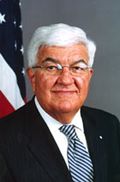
Korologos, Thomas C.
Thomas C. Korologos was a key legislative liaison for the Nixon administration, playing a prominent role in the White House Office of Congressional Relations during the taping period. He joined the administration in April 1971 as a Special Assistant to the President, focusing primarily on Senate relations. In January 1972, he was promoted to Deputy Assistant to the President for Congressional Relations to further advocate for the administration's agenda on Capitol Hill. His title was updated to Deputy Assistant to the President for Legislative Affairs in January 1974, a role he held until Nixon's resignation in August 1974.
President Nixon met with his legislative aides, including Thomas C. Korologos, Max L. Friedersdorf, and William E. Timmons, to acknowledge their work in the Senate and present them with gifts. The brief session included a photo opportunity with the White House photographer to commemorate the staff members' contributions. Following their departure, Ronald L. Ziegler joined the President to briefly discuss a photograph of Nixon's great-great-grandfather, Milhous.
President Nixon met with a group of Greek-American supporters, accompanied by White House staffer Thomas Korologos, to discuss their history of political support and current advocacy. The conversation touched upon Julie Nixon Eisenhower’s recent visit to Athens and the diplomatic efforts of U.S. Ambassador Henry J. Tasca. During the brief, cordial session, the participants presented the President with commemorative gifts, including cuff links and golf balls, while Nixon acknowledged their loyalty and shared anecdotes about his political career.
President Nixon met with various aides and technicians to prepare for and broadcast a televised national address, followed by a meeting with a group of Senators and staff to discuss his recent Supreme Court nominations. During the session, the President focused on the qualifications of his nominees, Lewis F. Powell and William H. Rehnquist, emphasizing the importance of the Supreme Court's role in the government. The conversation concluded with the President greeting and presenting gifts to the television, lighting, and sound crews who assisted with his broadcast.
President Nixon met with Vice President Agnew and Republican congressional leaders to discuss strategy regarding his recent speech on Vietnam and the administration's upcoming FY 1973 budget. The President and Henry Kissinger briefed the attendees on the Vietnam peace negotiations, emphasizing that the U.S. had made comprehensive offers while denouncing North Vietnamese intransigence and political maneuvering. Economic advisors, including George Shultz and Herbert Stein, presented the administration's fiscal plans, highlighting the importance of balancing the budget while supporting a transition to a peacetime economy through controlled spending and wage-price stabilization. Participants agreed on the necessity of maintaining a firm stance on defense and economic policy to solidify public support and improve the administration's negotiating leverage.
President Nixon met with a bipartisan group of legislators and administration officials to discuss a coordinated strategy to address public opposition to forced busing for school desegregation. The participants evaluated various legal and legislative remedies, including executive intervention in pending court cases, the passage of restrictive legislation, and the potential adoption of a constitutional amendment. The meeting concluded without a final decision, as the President tasked his staff and advisors with synthesizing these diverse perspectives into a unified, formal policy proposal for the administration.
President Nixon, Henry Kissinger, and Senator James L. Buckley met to discuss the geopolitical implications of the President's upcoming trip to the People's Republic of China and the broader execution of the Nixon Doctrine in Asia. Senator Buckley provided observations from his recent Far East tour, highlighting the need to reassure U.S. allies—particularly Japan, South Korea, and Taiwan—regarding American security commitments amidst changing strategic balances. The conversation also touched upon military operations in Vietnam, the potential for North Vietnamese offensives, and domestic policy issues, including federal housing and the ongoing conflict in Northern Ireland.
President Nixon met with a bipartisan group of Congressional leaders to discuss his upcoming historic trip to the People's Republic of China. The President sought to build support for the mission, briefing the group on communication protocols with Peking and his strategy for managing the international and domestic implications of the visit. The discussion emphasized the goal of establishing a new dialogue with the PRC to foster long-term global stability and balance regional power dynamics.
President Nixon met with a bipartisan group of Congressional leaders to provide a firsthand report on his recent diplomatic mission to the People's Republic of China (PRC). During the briefing, the President discussed his interactions with Chinese leadership, the strategic importance of establishing communication channels, and the complex geopolitical dynamics concerning Taiwan and the broader Pacific region. The meeting emphasized the necessity of maintaining trust and diplomatic dialogue to navigate future international relations and manage long-term foreign policy objectives.
President Nixon met with Vice President Agnew and Republican Congressional leaders to coordinate legislative strategy on key domestic priorities, specifically revenue sharing, welfare reform, and Social Security legislation. The discussion focused on overcoming legislative stalemates in the Ways and Means Committee and the Senate, particularly regarding the influence of Chairman Wilbur Mills and the need for a unified Republican stance. The President urged the leadership to maintain pressure for compromise bills that align with administration goals while avoiding fiscally irresponsible mandates during an election year.
President Nixon met with bipartisan Congressional leaders, administration officials, and cabinet members to advocate for a legislative moratorium on court-ordered busing to achieve racial balance in schools. Nixon argued that current judicial mandates were causing societal turmoil and urged Congress to act immediately to stop new busing orders while advancing his broader 'Equal Educational Opportunities Act.' The administration proposed a two-pronged strategy involving an immediate legislative moratorium followed by a long-term commitment to compensatory education funding to improve school quality, specifically for low-income and minority students.
President Nixon met with Republican congressional leaders and cabinet officials to strategize on the administration's legislative agenda, specifically focusing on revenue sharing, welfare reform, and the Equal Educational Opportunities Act. The discussion addressed the political and procedural challenges of implementing a busing moratorium and the importance of countering Democratic criticism regarding the economy. Nixon emphasized the need for a unified party strategy to leverage economic accomplishments and maintain pressure on Democratic opponents leading into the 1972 election cycle.
President Nixon met with Republican congressional leadership to coordinate administration talking points on sensitive domestic and foreign policy issues. The discussion focused primarily on the ongoing military situation in Vietnam, emphasizing the success of Vietnamization, the importance of maintaining public support, and the necessity of keeping political opposition from undermining the war effort. Additionally, the President and his advisors briefed members on key legislative priorities, specifically the administration's stance against forced busing and efforts to address rising food prices and drug-related crime. The participants discussed strategies for distributing these fact sheets and maintaining a unified front to influence public perception and legislative outcomes.
President Nixon met with Republican congressional leadership to coordinate strategy on key domestic and foreign policy issues during an election year. The discussion focused on distributing fact sheets regarding economic improvements, crime reduction, and unemployment to bolster support, while also strategizing to defeat restrictive anti-war amendments in Congress. Additionally, the President announced his decision to appoint an acting FBI director to ensure institutional stability following the death of J. Edgar Hoover, aiming to shield the bureau from partisan political controversy.
President Nixon met with bipartisan Congressional leaders to discuss the upcoming Soviet summit and the administration's strategic approach to international relations. The discussion focused on complex issues including trade, Most Favored Nation (MFN) status for the Soviet Union, and the potential for bilateral cooperation despite ideological differences. Nixon emphasized the importance of maintaining a unified stance to ensure the success of the negotiations while managing domestic political expectations.
General Alexander M. Haig, Jr. convened a meeting with administration officials, including representatives from the State Department, Department of Defense, and the NSC, to establish strict coordination protocols for public communications following a potential arms limitation agreement in Moscow. Participants were instructed to centralize all public statements and congressional briefings through White House channels to ensure consistency and to minimize unauthorized commentary until the President returned. The group also discussed creating target lists of supporters and preparing rationale papers to manage public and legislative reception of the agreement once it was officially announced.
President Nixon met with Vice President Agnew and key Republican Congressional leaders to coordinate legislative strategy on critical administration priorities, specifically revenue sharing, the defense procurement bill, and Vietnam-related war powers resolutions. The discussion focused on overcoming Democratic resistance to the President’s revenue-sharing program and maintaining a firm legislative stance on maintaining military strength. Nixon emphasized that American foreign policy, including negotiations with the Soviet Union, remains contingent upon the credibility of U.S. defenses and a unified national commitment.
President Nixon met with Vice President Agnew and Republican Congressional leaders to analyze the current political landscape and formulate electoral strategies heading into the 1972 campaign. A significant portion of the discussion focused on the perceived bias of the media in their treatment of Democratic candidate George McGovern compared to historical GOP figures like Barry Goldwater. Nixon encouraged leadership to coordinate closely on legislative and campaign messaging, noting that the Republican party must remain disciplined to capitalize on the internal divisions within the Democratic party.
President Nixon met with Henry Kissinger, Senator John Stennis, and White House staff to coordinate legislative strategy regarding defense policy and the Vietnam War. The discussion focused on securing support for the military procurement bill and countering congressional efforts, such as the Mansfield amendment, that sought to limit the administration's leverage in Vietnam negotiations. Nixon and Kissinger also updated Stennis on recent diplomatic communications with the Soviet Union and China to ensure a unified front in upcoming SALT II and defense authorization hearings.
President Nixon met with his senior advisors and Cabinet members, including Elliot Richardson and Caspar Weinberger, to evaluate the legislative strategy for H.R. 1, the administration's welfare reform bill. The participants debated whether to maintain a firm stance on the original proposal or pursue a compromise with Senator Ribicoff to improve the chances of Senate passage before the Democratic National Convention. Nixon expressed concern that moving toward a compromise might blur the administration's policy distinctions from Democratic nominee George McGovern, while his advisors argued that failing to act could lead to the collapse of the legislation. Ultimately, the President deferred a final decision, requesting further analysis on the political and budgetary implications of the potential concessions.
President Nixon met with Republican members of the Senate Finance Committee to discuss the legislative impasse surrounding welfare reform (H.R. 1) and upcoming fiscal challenges. The participants evaluated the political feasibility of passing administration-backed legislation, expressing concerns over the influence of liberal amendments, rising costs, and the lack of support from Chairman Russell Long. Ultimately, the group discussed strategies for managing the impending debt ceiling extension and the threat of an unpopular Social Security increase, with the President firming his stance on vetoing non-budgetary spending items.
President Nixon met with a large delegation of mayors and local government officials to strategize on securing the passage of federal revenue sharing legislation in the Senate. Nixon emphasized the necessity of a bipartisan, non-restrictive bill and cautioned the attendees against allowing extraneous amendments—such as welfare reform—to jeopardize the legislation's chances before the upcoming Republican convention. The participants expressed their gratitude for the administration's leadership and pledged to lobby key senators to ensure the bill remained clean and reached the President's desk without delay.
President Nixon met with Senator Russell Long, Governor Edwin Edwards and his family, and other staff members in the Oval Office. The meeting included a formal photograph session and discussions about upcoming Senate votes, particularly on national defense and foreign policy, with an emphasis on Southern Democratic support. They also discussed presidential gifts, including cuff links and ashtrays, and a potential road construction project in Louisiana.
President Nixon met with a large group of Republican Congressional leaders to coordinate legislative strategy and discuss the administration's economic record ahead of the upcoming election. The conversation focused on countering Senator George McGovern's economic proposals, with the President and his advisors emphasizing that the administration's policies had fostered recovery, reduced inflation, and increased civilian employment. Key action items included distributing briefing materials to counter Democratic attacks, pushing for a government spending ceiling to avoid future tax increases, and planning strategy for upcoming votes on controversial appropriation bills and foreign aid legislation.
President Nixon met with Hugh Scott, Gerald Ford, and other key staff to coordinate a political strategy for challenging Democratic nominee George McGovern's economic platform. The group focused on framing McGovern's proposed welfare and budget policies as fiscally irresponsible, arguing that they would necessitate massive tax increases and significantly expand welfare rolls. Nixon instructed his team to emphasize the importance of a $250 billion spending ceiling and expressed his commitment to using the presidential veto to combat excess government spending.
President Nixon met with Vice President Agnew and Republican Congressional leaders to coordinate legislative strategy ahead of the upcoming election, specifically focusing on the status of pending bills and the management of the Congressional schedule. Key priorities included securing a federal spending ceiling, advancing revenue sharing, and emphasizing anti-busing legislation as a must-pass measure to counter Democratic-led policies. The President urged the leadership to maintain a unified front on fiscal restraint, framing opposition to Republican economic proposals as reckless and warning that Democrats should bear the political cost for failing to curb government spending.
Senator Peter H. Dominick and Thomas C. Korologos met with President Nixon to present a commemorative gift from Nancy Dominick and discuss political strategy. The conversation emphasized the importance of leveraging the Senator’s extensive campaign experience to benefit the administration’s electoral goals. The session concluded with a brief photograph opportunity facilitated by Oliver F. Atkins.
President Nixon met with his economic advisors Arthur Burns and George Shultz, later joined by John Ehrlichman, to deliberate on fiscal policy and political messaging during the 1972 election season. The discussion centered on establishing a federal spending ceiling, managing the national debt, and formulating a strategy to counter Democratic candidate George McGovern's tax proposals. Nixon and his team specifically sought to differentiate their economic stance from their opponent by framing their own initiatives as "tax reform" while avoiding any perception of a general tax increase.
President Nixon met with his administration officials, including Elliot Richardson and John Ehrlichman, to discuss the political feasibility of passing welfare reform (H.R. 1) before the 1972 election. Given the lack of time and the potential for a hostile or obstructionist legislative environment, the participants concluded that passing a comprehensive welfare bill was unlikely and that aggressive pressure on Congress would be counterproductive. Nixon decided that the administration should maintain its formal support for H.R. 1 while simultaneously pivoting to a strategy of aiming for a decisive election mandate, intending to reintroduce the reform package in the next Congress under more favorable conditions.
President Nixon met with a delegation from the Order of American Hellenic Educational Progressive Association (AHEPA) to accept a commemorative gold medal marking the organization's 50th anniversary. During the brief visit, the group participated in a photo session, and the President shared personal reflections on his 1947 trip to Greece and the resilience of the Greek people. The meeting concluded with an exchange of gifts, as Nixon presented the delegation members with silver medals and presidential cuff links.
President Nixon met with his economic advisors and Republican Senate leadership to coordinate a strategy for securing congressional support for a federal spending ceiling. The discussion focused on the necessity of controlling runaway federal expenditures and the potential use of the presidential veto to enforce a $250 billion spending limit. Nixon and his team evaluated the legislative outlook for the debt limit bill, including strategies for handling amendments and managing potential political fallout regarding domestic programs.
President Nixon met with a bipartisan group of Congressional leaders to provide a detailed briefing on the recently finalized Vietnam Peace Agreement and its implementing protocols. Henry Kissinger explained the strategic nuances of the agreement, including the status of North and South Vietnam, the mechanisms for the International Control Commission, and the timeline for the withdrawal of U.S. forces and the release of prisoners of war. The President emphasized the necessity of bipartisan Congressional support to ensure the agreement's stability and signaled that the administration would work with Congress to frame a positive resolution regarding the end of the war.
President Nixon met with Republican congressional leadership to outline his fiscal strategy for the 1974 budget, emphasizing the necessity of expenditure control to avoid tax increases and curb inflation. Nixon and his advisors discussed the use of budget impoundments to maintain a spending ceiling of $269 billion, framing this approach as a critical move for economic prosperity despite the anticipated pushback from special interest groups. The meeting concluded with a call for Republican leaders to unify behind the administration's fiscal restraint and to clearly communicate that budget cuts are essential for maintaining national economic stability.
President Nixon met with Vice President Agnew and a broad bipartisan group of Congressional leaders to outline the administration's 1974 federal budget and economic strategy. Economic advisors Herbert Stein and George Shultz presented data highlighting a strong 1972 economy and stressed the necessity of fiscal discipline to curb inflation and maintain growth. The President urged Congress to support his proposed spending ceilings, emphasizing the need to avoid the inflationary deficits experienced during the late 1960s, while briefly acknowledging progress toward a Vietnam peace settlement.
President Nixon met with David R. Young, Jr., George H. W. Bush, William E. Timmons, Thomas C. Korologos, Stephen B. Bull, and Senator Ted Stevens to discuss the upcoming Alaskan congressional election and potential candidacy options. The group reviewed campaign strategies, including the use of aviation for outreach and the political landscape regarding taxes, prices, and the Office of Economic Opportunity. The session also served as an opportunity for official photography and brief coordination on legislative matters involving Senator Stevens.
President Nixon met with William E. Timmons and Thomas C. Korologos to discuss legislative strategy, focusing on upcoming budget vetoes and garnering congressional support. The group examined messaging tactics, specifically regarding the Vietnam War, and the development of a 'loyalist list' of both Republican and Democratic members to cultivate for future legislative fights. Nixon emphasized the need for an aggressive, unified stance against the opposition's budgetary agenda and discussed plans for a White House reception to reward supportive legislators.
President Nixon met with Republican congressional leaders to discuss his administration's legislative priorities, focusing primarily on securing support for a fiscally responsible budget. He emphasized the necessity of cutting spending and utilizing presidential vetoes to combat inflation and avoid tax increases, framing these actions as essential for the nation's economic stability. Additionally, the President and the leaders engaged in an extensive review of recent foreign policy, specifically highlighting the significance of the Vietnam cease-fire and the strategic importance of U.S. global leadership.
President Nixon met with his congressional leadership, including Hugh Scott and Gerald Ford, to discuss the administration's legislative strategy, specifically focusing on the management of upcoming vetoes and the difficulty of securing Senate support compared to the House. The group reviewed efforts to promote public awareness of administration programs, the political implications of specific budget cuts, and strategies to recruit Democratic candidates to the Republican Party for the 1974 election cycle. Additionally, Nixon emphasized the need to handle the trade bill with the Soviet Union delicately to accommodate both the administration's foreign policy goals and the concerns of the Jewish community regarding Soviet emigration.
President Nixon and Republican congressional leaders met to discuss the administration's legislative agenda, specifically focusing on the "New Federalism" approach to governance. The President emphasized shifting decision-making power from the federal bureaucracy to local and state authorities through programs like the Better Communities Act and the Responsive Government Act. Additionally, the conversation addressed a robust crime-fighting package, including proposed federal death penalty statutes and mandatory sentences for major drug traffickers, while positioning these initiatives as essential to restoring national law and order.
President Nixon met with Republican Congressional leaders and economic advisors to discuss strategies for addressing rising food prices, inflation, and the ongoing transition of the wage-price stabilization program. Key topics included the administration's efforts to increase food supplies and imports, the management of labor-management relations, and the necessity of maintaining party unity to sustain presidential vetoes on spending legislation. The meeting underscored the administration's focus on economic control and the importance of Congressional support in implementing fiscal policy.
President Nixon met with Vice President Agnew and a bipartisan group of Congressional leaders to outline the administration's proposed foreign trade legislation. The discussion focused on securing presidential authority to negotiate trade agreements, implementing safeguards for domestic industries, and establishing pension and unemployment insurance reforms. Nixon emphasized the necessity of shifting away from a 'one-way street' trade policy to protect American workers and leverage better terms with international partners, while urging caution against attaching human rights conditions to Most Favored Nation (MFN) status for the Soviet Union to avoid jeopardizing broader diplomatic and arms control initiatives.
President Nixon met with William Timmons and Thomas Korologos to refine their strategy for managing Congressional relations and legislative outreach. The discussion focused on diversifying the attendance at upcoming bipartisan leadership meetings to include a broader range of committee members while strategically inviting select liberal Republicans to maintain a sense of inclusivity. Additionally, the participants discussed the logistics of presenting a television set to Congress, current efforts to sustain presidential vetoes, and concerns regarding Senator Lowell Weicker’s conduct during the L. Patrick Gray confirmation hearings.
President Nixon met with Vice President Agnew and a bipartisan group of Congressional leaders to address the nation's growing energy needs and proposed legislative solutions. The discussion focused on mitigating potential future shortages by balancing environmental protections with domestic production efforts, including natural gas deregulation, expanded offshore oil leasing, and the completion of the Alaska pipeline. The President and his cabinet members emphasized the importance of developing a cohesive national energy strategy to maintain independence and discussed the foreign policy implications of relying on foreign oil exports. The administration sought Congressional cooperation for pending energy legislation and signaled an intent to increase research and development funding for alternative fuel sources like coal and nuclear power.
President Nixon met with Vice President Agnew, Secretary of State Rogers, USAID Administrator John A. Hannah, and a bipartisan group of Congressional leaders to secure support for the administration's foreign aid and security assistance requests. The discussion covered the implementation of the Nixon Doctrine, the strategic importance of military and development aid to maintain stability in Southeast Asia, the Middle East, and Latin America, and the necessity of burden-sharing with allies. Nixon emphasized that maintaining U.S. strength and diplomatic engagement was vital for ongoing negotiations regarding arms reduction and global peace, warning against unilateral reductions that could weaken the U.S. negotiating position.
In this meeting, President Nixon addressed his Cabinet and senior staff regarding the recent departures of top aides H.R. Haldeman and John Ehrlichman, framing the transition as a necessary move to restore stability amidst the escalating Watergate investigation. Nixon emphasized the importance of maintaining public trust, directed the staff to cooperate fully with investigators, and insisted that the White House avoid any appearance of a cover-up. Cabinet members and staff discussed the administration’s focus on governance, foreign policy, and economic management, reaffirming their collective commitment to the President's agenda despite the political crisis.
President Nixon met with a broad group of Republican Congressional leaders to propose the creation of a bipartisan, independent commission on federal election reform. The President outlined the commission's broad mandate to study and recommend improvements to campaign financing, ethics, disclosure rules, and potentially the length of election campaigns. Nixon emphasized that the commission, which would include both public members and Congressional representatives, should serve as a catalyst for practical reform and generate public support for legislative action without preempting the authority of existing Congressional committees. The meeting focused on establishing a non-partisan framework to address the inefficiencies and technical challenges identified in previous election laws.
President Nixon met with Republican congressional leadership to discuss administration strategy regarding pending agricultural legislation and the proposed Alaska pipeline. The President and his team emphasized the shift toward an export-driven agricultural policy and sought consensus on managing the Senate's version of the farm bill, noting the political risks of introducing a standalone administration proposal. Regarding the Alaska pipeline, the President and Secretary Morton argued for immediate legislative approval to address urgent domestic energy shortages, asserting that current supply crises were exacerbated by previous delays and that alternative Canadian routes were not currently viable. Finally, the President urged the leaders to maintain support for his foreign policy initiatives, highlighting recent successes in Vietnam, China, and the USSR while stressing the need for continued operational security to protect sensitive ongoing negotiations.
President Nixon met with bipartisan Congressional leaders, Vice President Agnew, and key cabinet members to discuss U.S. foreign policy developments in Latin America, Southeast Asia, and Europe. Secretary of State William Rogers briefed the group on his recent tour of eight Latin American nations, emphasizing improved diplomatic relations despite complex issues regarding oil, inflation, and expropriation. Henry Kissinger provided an update on ongoing negotiations in Paris aimed at reinforcing the Vietnam ceasefire, while he and the President outlined a new strategy for strengthening Atlantic alliances, stressing the need to link economic, political, and defense policies to ensure future international stability.
President Nixon met with Vice President Agnew and Republican congressional leadership to solidify legislative strategy and enhance communication between the White House and Capitol Hill. Key discussions included Henry Kissinger’s briefing on recent negotiations in Iceland regarding the 'Year of Europe' and the progress of the Vietnam Peace Accord. The group also addressed the need for improved coordination on pending legislation, political appointments, and the management of vetoes to maintain party unity in the face of domestic challenges.
President Nixon met with Vice President Agnew, cabinet members, and a bipartisan group of Congressional leaders to announce an upcoming economic policy address and discuss the administration's new strategy to combat inflation. The President detailed a 60-day price freeze—excluding wages and raw agricultural products—and sought legislative assistance regarding export controls on food and gasoline supply allocations. Additionally, the President arranged for key Congressional leaders to receive ongoing briefings from administration officials during the upcoming summit with Soviet leader Leonid Brezhnev to ensure better oversight of the resulting agreements.
President Nixon met with Vice President Agnew, Secretary of State William Rogers, Henry Kissinger, and bipartisan congressional leaders to discuss recent foreign policy breakthroughs and the administration's ongoing diplomatic strategy. The discussion focused on the significance of newly negotiated agreements with the Soviet Union, specifically regarding the prevention of nuclear war and the management of bilateral relations. Nixon emphasized that these diplomatic efforts represent a move toward global stability and stressed the necessity of maintaining bipartisan support as his administration continues these critical negotiations with Soviet leadership.