Moore, Richard A.
Richard A. Moore served as a senior advisor and legal counsel during the Nixon administration. At the start of the White House taping period in February 1971, he was serving as Special Assistant to Attorney General John Mitchell, a role he had held since July 1970. In April 1971, Moore transitioned to the White House to serve as Special Counsel to the President, providing public relations and legal advice to Nixon until the president's resignation in August 1974. During the taping period, he participated in several recorded conversations and later became a prominent witness before the Senate Watergate Committee in July 1973, testifying that he believed Nixon was unaware of the cover-up prior to March 1973.
President Nixon met with representatives from the Navy League of the United States to accept an honorary membership and discuss the importance of maintaining naval superiority. During the brief session, the group presented the President with a model of a statue of Admiral David G. Farragut, highlighting the Admiral's Spanish heritage. Nixon utilized the platform to emphasize his commitment to national defense and to discourage calls for unilateral disarmament.
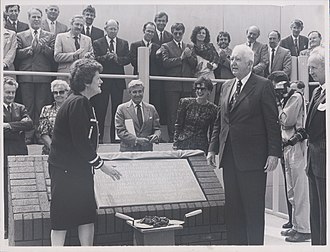
President Nixon met with Richard A. Moore, Antonina Uccello, and Mary Lou Grier for a ceremonial visit involving gift exchanges and discussion of the President's public image. Following this, Nixon consulted with Press Secretary Ronald L. Ziegler regarding the administration’s strategy for handling press inquiries about the recent "ping-pong diplomacy" outreach to the People's Republic of China. The conversation concluded with Nixon and Moore reviewing the efficacy of recent speeches and the importance of maintaining an appropriate tone and frequency in television appearances to avoid perceived overexposure.
President Nixon met with Senator John G. Tower and associates to discuss federal assistance for the severe drought affecting Texas, Oklahoma, and New Mexico. The participants strategized on legislative relief measures, including loan forgiveness and expanded Small Business Administration support, to address the political risks the drought posed to the administration. Additionally, Nixon agreed to record a 30-40 second video message for Tower's upcoming decade-of-service dinner in Dallas and discussed the broader political optics of his administration's response to the crisis.
President Nixon met with H.R. Haldeman and Alexander Haig to discuss the critical need for a major policy announcement to strengthen his position against mounting congressional pressure regarding the Vietnam War. They evaluated the political impact of potential developments, including a Strategic Arms Limitation Talks (SALT) agreement and diplomatic initiatives involving China and the USSR. Ultimately, Nixon emphasized that he required a decisive, high-profile move to bolster his support in the Senate, deciding to prioritize a meeting with South Vietnamese President Nguyen Van Thieu as a key strategic action. The conversation concluded with a brief meeting involving Charles Rhyne and Richard Moore regarding the potential for a presidential initiative to promote international law.
President Nixon met with his legislative aides, including Thomas C. Korologos, Max L. Friedersdorf, and William E. Timmons, to acknowledge their work in the Senate and present them with gifts. The brief session included a photo opportunity with the White House photographer to commemorate the staff members' contributions. Following their departure, Ronald L. Ziegler joined the President to briefly discuss a photograph of Nixon's great-great-grandfather, Milhous.
President Nixon met with his Cabinet and key advisors to announce a major breakthrough in Strategic Arms Limitation Talks (SALT) with the Soviet Union, culminating in a joint statement to be released simultaneously in both nations. The agreement establishes a framework to prioritize limiting anti-ballistic missile (ABM) systems while pursuing parallel measures for offensive weapons. Nixon emphasized that the breakthrough was achieved by maintaining a strong U.S. defense posture, and he urged his administration to avoid public speculation or detailed commentary that could complicate sensitive ongoing negotiations.
President Nixon initiates a brief telephone call to Richard A. Moore to coordinate a meeting. The President requests that Moore immediately relocate from the Executive Office Building to the Oval Office for an in-person discussion. No policy matters or substantive political issues are addressed during this brief logistical exchange.
President Nixon and Richard A. Moore held a brief, informal exchange to coordinate a subsequent meeting. Nixon requested that Moore come to his office in the Old Executive Office Building for further discussion. This interaction served primarily as a logistical arrangement to facilitate a more substantive conversation.
President Nixon met with Richard Moore, John Mitchell, and Alexander Butterfield to discuss the selection process for upcoming Supreme Court vacancies. Nixon expressed frustration with the American Bar Association's influence and affirmed his intention to bypass them to avoid leaks and public criticism of his nominees' ideologies. The group evaluated several candidates, including Lewis Powell, Howard Baker, William Rehnquist, and William French Smith, ultimately favoring a strategy to nominate highly qualified conservatives to preempt opposition. Additionally, the President discussed concerns regarding negative press coverage of his personal finances involving Charles Rebozo and strategized on managing political messaging regarding the Vietnam War and POW issues.
President Nixon and Richard A. Moore discuss the political fallout from the American Bar Association (ABA) rating Mildred L. Lillie as unqualified for the Supreme Court, with plans to leak the ABA's contradictory acknowledgment that she was nonetheless the best-qualified woman available. The President also seeks confirmation of John Ehrlichman’s support for William H. Rehnquist as a potential fallback candidate should Howard H. Baker, Jr. decline the nomination. Nixon expresses a clear intention to bypass the ABA's approval process for the Rehnquist appointment.
President Nixon and Richard A. Moore discuss the status of potential judicial nominees for the Supreme Court, specifically weighing the qualifications of candidates like Mildred Lillie. Nixon expresses frustration over opposition to certain nominees and identifies Senator Howard Baker as a top contingency choice if his primary preferences do not move forward. The brief meeting concludes with Nixon instructing Moore to conduct further vetting on the suitability of specific candidates.
President Nixon, H. R. Haldeman, and Richard A. Moore met to prepare for a public address regarding the President’s nominations of William H. Rehnquist and Lewis F. Powell, Jr. to the Supreme Court. The discussion focused on refining the speech text, emphasizing the nominees' judicial philosophies, and gathering background data on their professional qualifications and legal backgrounds. The participants also considered how to frame these appointments to the press and the public to ensure a favorable reception of the nominees' credentials and legal experience.
President Nixon consulted Richard A. Moore to confirm the age of William H. Rehnquist during the lead-up to his Supreme Court nomination. Moore verified that Rehnquist was 47 years old, born in 1924, and discussed his military service background. The President concluded the brief call by inviting Moore to the Oval Office to review a pending document.
President Nixon met with Richard A. Moore for a brief discussion regarding ongoing administrative or political matters. Although the recording is extremely short and lacks a formal transcript, the meeting serves as a point of contact between the President and his aide during a period of intense White House activity. No specific policy shifts or major directives were recorded during this one-minute interaction.
President Nixon met with Richard A. Moore and Rose Mary Woods to rehearse and refine a televised speech regarding his nominations for the Supreme Court. The discussion focused on articulating the President’s judicial philosophy, specifically his preference for judicial conservatism, while incorporating a quote from commentator Walter Lippmann to support his stance. The participants also addressed the logistics of notifying key stakeholders and the drafting process for the broadcast, which aimed to clarify the administration's approach to judicial appointments.
President Nixon and Richard A. Moore discussed the recent backlash and media speculation surrounding his Supreme Court nominations, specifically addressing leaks and the public reaction to his decision-making process. The President also held a telephone conversation with Mexican President Luis Echeverria Alvarez to lobby for Mexico's support during a critical upcoming United Nations vote regarding the status of Taiwan. Throughout the meeting, the participants emphasized the importance of maintaining confidentiality in high-level executive decisions and strategized on how to manage negative press coverage.
President Nixon met with retail executives Gordon Metcalf and William Batten, along with George Shultz and other staff, to review economic performance, retail sales trends, and the potential impact of wage-price controls. The discussion shifted toward the American political system, specifically addressing the President’s staunch opposition to tax-funded political campaign check-offs. Nixon expressed his intent to leverage his veto power if necessary to prevent the inclusion of these campaign financing provisions in pending tax legislation.
Following a formal ceremony in the Oval Office to recognize the commissions of new Supreme Court Justices Lewis F. Powell, Jr. and William H. Rehnquist, President Nixon transitioned into a private session with his staff. The discussion focused on national security concerns, specifically the ongoing investigation into intelligence leaks involving Navy Yeoman Charles E. Radford, the Joint Chiefs of Staff, and Henry Kissinger. Nixon and his advisors resolved to neutralize the threat posed by Radford by utilizing the legal pressure of potential criminal prosecution to ensure his silence, while simultaneously using the incident as a pretext to restructure security operations within the Joint Chiefs and the National Security Council.
President Nixon and Richard A. Moore reviewed the President's recent television interview with Dan Rather, comparing it unfavorably to his previous appearance with Howard K. Smith. They discussed specific inquiries Rather raised regarding the administration's political timing on Vietnam, foreign summits, and economic policy, as well as the President’s traditional views on social nomenclature like the term "Ms." The two concluded the meeting by assessing the strategic value of such televised interviews versus traditional press conferences for the administration's public image.
President Nixon met with representatives from the Boy Scouts of America (BSA) to receive the organization's annual report and an honorary membership card. During the meeting, BSA leaders briefed the President on key initiatives, including the Save Our American Resources (SOAR) environmental program and the anti-drug initiative, Operation Reach. The participants presented the President with commemorative medals designed by Norman Rockwell and held a brief photograph session to acknowledge the group's leadership and youth outreach achievements.
President Nixon directed Richard A. Moore to facilitate a media strategy following the death of J. Edgar Hoover to distance the administration from L. Patrick Gray III. Nixon instructed Moore to place a human-interest story emphasizing the deep, 25-year personal friendship between Nixon and Hoover to contrast it with his purely professional, non-personal relationship with Gray. The President also ordered a total media blackout regarding CBS reporters, specifically citing animosity toward the network.
President Nixon directs Richard A. Moore to plant a story with major television networks or wire services to clarify the nature of his professional relationships following the recent death of J. Edgar Hoover. Nixon emphasizes the need to frame his history with Hoover as a uniquely close personal friendship while explicitly defining his relationship with acting FBI director L. Patrick Gray as strictly professional and non-political. The objective is to utilize the Hoover narrative to distance the administration from Gray and counter media speculation regarding his personal involvement with government associates.
President Nixon met with a large group of broadcast industry executives and administration officials to discuss regulatory and legislative challenges facing the industry. Key topics included the burden of proof in license renewal processes, the impact of Federal Communications Commission (FCC) and Federal Trade Commission (FTC) regulations on operations, and concerns regarding network news bias. The discussion focused on seeking potential legislative solutions to protect broadcasters from costly legal challenges and to stabilize the regulatory environment for private enterprise.
President Nixon met with H.R. Haldeman, Stephen Bull, and Richard Moore to discuss the ongoing political and legal fallout following the recent Watergate break-in. The participants evaluated the administration's strategic response to the burgeoning scandal, focusing on controlling the narrative and managing potential investigations. The discussion centered on containment measures and internal assessments of how to mitigate the damage caused by the unauthorized entry at the Democratic National Committee headquarters.
President Nixon met with Irish official Patrick Hillery and members of his delegation to discuss bilateral issues, primarily aviation landing rights at Shannon Airport and the political situation in Northern Ireland. The President emphasized his personal attention to the airline negotiations and reiterated the U.S. commitment to avoiding unnecessary intervention in the Northern Irish conflict while expressing sympathy for the ongoing violence. The conversation concluded with a broader philosophical discussion on leadership, the importance of personal reflection and vacation, and the President's reflections on historical figures like Disraeli and Gladstone.
President Nixon and Richard A. Moore discuss the strategy for managing public and press perceptions regarding the establishment of a memorial fund for Roberto Clemente. Nixon instructs Moore to coordinate a White House staff donation to accompany his own contribution to the fund, ensuring that his personal initiative in the project is clearly communicated to the press. They agree that Moore will brief John Galbreath and reporters on the President's role in spearheading the fund to ensure the administration receives proper recognition for the effort.
President Nixon and Richard A. Moore discuss organizing a financial contribution to a memorial fund associated with John Kenneth Galbraith. Nixon instructs Moore to initiate the effort with a symbolic personal donation and to encourage other White House staff members to contribute. The conversation focuses on establishing momentum for the fund and coordinating how the President's support will be communicated to organizers.
President Nixon met with Pittsburgh Pirates players Dave Giusti and Stephen Blass, alongside team executive Daniel M. Galbreath and aide Richard A. Moore, to discuss the creation of a memorial fund for Roberto Clemente, who recently died in a tragic plane crash while delivering aid to earthquake victims in Nicaragua. The President expressed strong support for the initiative, suggesting that the fund should be used to build schools or baseball facilities to honor Clemente’s humanitarian legacy and commitment to children. Nixon advised the group on organizational strategies, including incorporating the fund for tax-deductibility and soliciting contributions from the public and professional sports figures to ensure broad participation.
President Nixon met with the Nolde family, including the widow and children of a fallen soldier, to express his condolences and gratitude for their sacrifice during the Vietnam War. During the visit, Nixon presented the family with gifts, discussed the importance of peace and the dignity of military families, and arranged for them to receive a private tour of the White House and Capitol. The meeting served as a gesture of presidential support, honoring the service member's legacy while providing his family with a personal encounter with the administration.
President Nixon and his Cabinet met to launch a strategic public relations campaign, titled the Presidential Spokesmen program, aimed at pressuring Congress to support his budget priorities and oppose spending-heavy legislation. Nixon urged his officials to frame the budget debate not as a constitutional conflict, but as a direct choice between the economic interests of the 'New American Majority' and the fiscal irresponsibility of the opposition. The session included briefings on foreign policy, defense spending, and law enforcement, emphasizing the need for administration spokesmen to maintain a positive, disciplined narrative while avoiding defensive posturing on 'false issues.'
President Nixon met with John Dean, Ronald Ziegler, and Richard Moore to strategize the administration's public response to intensifying Watergate inquiries and impending Senate hearings. The discussion centered on managing potential executive privilege claims, addressing congressional subpoenas, and formulating a consistent narrative regarding White House staff involvement and campaign tactics like those of Donald Segretti. Ultimately, the participants weighed the risks of transparency against the dangers of further exposing staff vulnerabilities, with Nixon emphasizing the need for legalistic, non-committal answers to deflect political pressure.
President Nixon met with Richard A. Moore and John W. Dean, III to strategize on managing the escalating legal and political challenges posed by the Ervin Committee and various lawsuits related to the Watergate scandal. The discussion centered on maintaining executive privilege, handling potential subpoenas for White House staff, and crafting a public relations strategy that emphasizes cooperation while asserting executive authority. Nixon specifically explored using historical precedents, such as the Alger Hiss case and the Truman administration's non-cooperation with Congress, to justify the White House's resistance to legislative overreach.
President Nixon, John Dean, and Richard Moore met in the Oval Office to strategize following a press conference, focusing on managing the ongoing Watergate investigation and congressional inquiries. The discussion centered on maintaining an assertive stance against the Senate's Ervin Committee, particularly regarding executive privilege and the separation of powers. Nixon drew parallels between current events and his 1948 investigation of Alger Hiss, using the historical precedent to justify his refusal to disclose sensitive raw FBI files or allow staff testimony. The group also evaluated the political risks associated with potential subpoenas for White House staff, such as Dwight Chapin and Charles Colson, ultimately aiming to utilize legal court tests to delay testimony and control the administration's narrative.
President Nixon met with John Dean and Richard Moore to develop a public relations and legal strategy regarding the growing Watergate scandal. The participants discussed the potential risks of various disclosure methods, the limits of executive privilege, and the necessity of maintaining control over testimony to avoid political damage. They considered adopting a policy of appearing cooperative with inquiries while carefully limiting the scope of information released to protect the confidentiality of the presidency.
President Nixon met with H.R. Haldeman, John Dean, and Richard Moore to discuss administration messaging, the importance of maintaining a unified strategy against political opponents, and the ongoing Watergate investigations. The President expressed frustration with the lack of leadership and backbone among his staff and the Republican political class, emphasizing that he and his team must seize the initiative through a more vigorous public relations counterattack. They specifically focused on coordinating a response to the Senate's Ervin Committee by preparing written interrogatories and shifting public focus toward potential Democratic abuses, such as past improper uses of the FBI.
President Nixon and Richard A. Moore met to discuss the escalating Watergate investigation, specifically focusing on the roles of John Dean and John Mitchell. They examined the potential legal liabilities arising from the cover-up, the solicitation of hush money for E. Howard Hunt, and the risk that Dean might turn against the administration to secure immunity. Nixon expressed frustration over the perceived ineptitude of his subordinates and the potential for a damaging narrative regarding obstruction of justice, ultimately emphasizing the need to keep the administration's involvement shielded from the ongoing investigations.
President Nixon and Richard A. Moore discussed the narrative surrounding the La Costa meeting, focusing on framing the President's directives regarding Donald Segretti as legitimate attempts to formulate political strategy rather than obstruction. They reviewed the involvement of key figures including John Mitchell, John Dean, H.R. Haldeman, and John Ehrlichman, particularly regarding the distribution of funds to Watergate defendants. Nixon sought to clarify and distance his inner circle from potential legal culpability by emphasizing that his subordinates did not knowingly participate in illegal activities.
In this meeting, President Nixon addressed his Cabinet and senior staff regarding the recent departures of top aides H.R. Haldeman and John Ehrlichman, framing the transition as a necessary move to restore stability amidst the escalating Watergate investigation. Nixon emphasized the importance of maintaining public trust, directed the staff to cooperate fully with investigators, and insisted that the White House avoid any appearance of a cover-up. Cabinet members and staff discussed the administration’s focus on governance, foreign policy, and economic management, reaffirming their collective commitment to the President's agenda despite the political crisis.
President Nixon and Richard A. Moore met to coordinate their narratives regarding the Watergate scandal and address the potential threat posed by John W. Dean III’s testimony. They reviewed past conversations and meetings to solidify the President’s position that he lacked prior knowledge of the cover-up and to frame the administration’s actions as a legitimate attempt to uncover the truth. The discussion focused on discrediting Dean, managing the fallout of the ongoing Senate hearings, and preparing a legal strategy to defend the administration while distancing Nixon from the illegal activities of his subordinates.
President Nixon met with Richard A. Moore to discuss administrative matters, specifically focusing on the delivery of sensitive documentation. The brief exchange touched upon the President's upcoming schedule and related logistics. No major policy shifts or strategic decisions were finalized during this interaction.