Nixon, Richard M. (President)
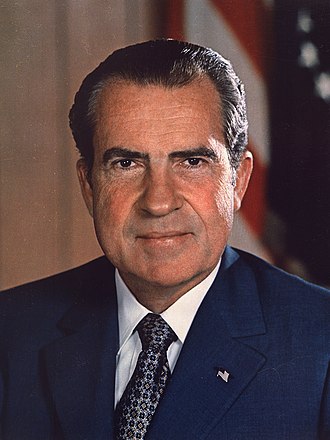
Richard M. Nixon served as the 37th President of the United States from January 1969 until his resignation in August 1974. In February 1971, he ordered the installation of a secret voice-activated taping system in the White House to preserve a historical record of his administration. Until the system's existence was revealed and dismantled in July 1973, the tapes captured Nixon directing major foreign policy initiatives, such as the opening to China, as well as his central role in the Watergate cover-up.
What Nixon talks about on the tapes
White House operations 4,718Presidential scheduling 2,225Public relations 1,784Presidential schedule 1,782Vietnam War 1,693Logistics 1,650Manolo Sanchez 1,626White House communications 1,400White House administration 1,399Presidential communication 1,243Henry Kissinger 1,191Foreign Policy 1,183
Conversations (21,010)
— Page 111 of 211President Nixon consulted with the White House operator to facilitate an outgoing call. The brief exchange focused on technical difficulties or logistical delays in establishing the requested connection. The interaction concluded with the President emphasizing the urgency of his communication needs.
President Richard Nixon met with H.R. Haldeman to coordinate the administration's response to the recent break-in at the Democratic National Committee headquarters at the Watergate complex. The discussion focused on leveraging the Central Intelligence Agency to impede the ongoing FBI investigation by claiming the inquiry threatened national security interests. This meeting resulted in a critical directive to obstruct justice, marking a pivotal moment in the administration's effort to conceal its involvement in the scandal.
President Nixon held a brief administrative interaction with the White House operator to facilitate a telephonic connection. This recording functions primarily as a logistical bridge to a substantive discussion with another party. No policy decisions or political deliberations occurred during this brief exchange.
President Nixon met with H.R. Haldeman and Charles Colson to discuss the ongoing fallout from the Watergate break-in, specifically the FBI's investigation and the risks of it uncovering CIA connections or sensitive political associations. The participants analyzed the political landscape and current polling data to strategize for the upcoming election against George McGovern. They ultimately decided to prioritize aggressive negative campaigning against McGovern, concluding that focusing on the opponent's weaknesses was more effective for swaying undecided voters than emphasizing the administration's own policy achievements.
President Nixon and Charles W. Colson discussed the strategic timing of a forthcoming phone call from Colson to John B. Connally. The conversation focused on providing Connally with advance notice regarding news on import quotas and coordinating the announcement within the current political calendar. They aimed to manage the message as a temporary, controlled situation.
President Nixon consulted with the White House operator to determine the current location of Nelson A. Rockefeller. The President sought to establish contact with Rockefeller to facilitate a return call. This brief administrative interaction served as a coordination step for the President's ongoing communications.
President Nixon met with Donald Rumsfeld, H. R. Haldeman, Herbert Stein, and a production crew from the Wolper Organization to coordinate the filming of an upcoming documentary. The discussion focused on logistical instructions regarding the President's movements and camera placement within the White House. Additionally, the group touched upon the President’s past interactions with the Brookings Institution and his upcoming schedule at Camp David.
President Nixon initiates a request to the White House operator to place a telephone call to George P. Shultz. This brief interaction serves as a routine administrative step to facilitate a direct conversation between the President and his Director of the Office of Management and Budget.
President Nixon directs the White House operator to facilitate a series of communications, specifically requesting a call with George P. Shultz. The operator updates the President on the status of a previous request involving Governor Nelson Rockefeller, who is currently attempting to contact his secretary, Ann Whitman, from New Mexico. The exchange serves as a logistical coordination effort to establish these specific administrative and political connections.
President Nixon held a wide-ranging series of meetings with advisors and staff to discuss economic policy, pending legislation, and emergency disaster responses. Key discussions included plans to reduce government stockpiles, the political implications of food prices and busing legislation, and the federal government's mobilization efforts following Hurricane Agnes and the Rapid City flooding. The session also incorporated administrative coordination for upcoming film projects involving the President and members of the Wolper Organization.
President Nixon and George P. Shultz discussed the necessity of managing international economic and monetary concerns, specifically following recent developments regarding the British pound. Nixon instructed Shultz to conduct a diplomatic tour of Europe to engage directly with key leaders, including Edward Heath and Georges Pompidou, to emphasize the importance of U.S. relations and current policy positions. Additionally, Nixon directed Shultz to coordinate with the British Ambassador to ensure that U.S. intentions were clearly communicated to the British government.
President Nixon consulted with the White House operator to arrange a telephone call with New York Governor Nelson Rockefeller. Upon learning that Rockefeller was currently traveling to Santa Fe, New Mexico, and that his aide Ann Whitman was also unavailable, the President decided to postpone the request. No further action was taken, and Nixon instructed the operator to cancel the immediate attempt to reach the Governor.
President Nixon and Henry Kissinger met at Camp David to debrief on Kissinger’s recent trip to the People's Republic of China and coordinate strategy for upcoming Vietnam peace negotiations. Kissinger reported positive developments, including China's pressure on North Vietnam to negotiate and the North Vietnamese agreement to resume plenary and private sessions in mid-July. The two also discussed the 1972 election, specifically framing George McGovern's candidacy as a threat to national stability, and reviewed broader foreign policy maneuvers involving the Soviet Union, Iran, and European security.
President Nixon contacted the Camp David operator to facilitate a personal phone call. He specifically requested to be connected with Amanda Campbell. The exchange served as a logistical coordination for the President's private communication.
President Nixon initiates a brief telephonic request through the Camp David operator to be connected with Commander Campbell. This administrative exchange serves the primary purpose of facilitating communication between the President and military or security staff. No further substantive discussion occurs during this short contact.
President Nixon and Craig S. Campbell coordinate the logistics for a presidential visit to the flood-stricken Susquehanna River area in Pennsylvania. Following recommendations from John Ehrlichman and Ron Ziegler, they determine the destination of Steelton and settle on a 10:00 am departure time. It is further decided that the press will accompany the President on the aircraft for the duration of the trip.
President Nixon consulted with Craig S. Campbell regarding the logistical feasibility and travel time associated with an upcoming trip. The brief exchange focused on evaluating the difficulties of navigating a specific, unspecified area to determine if the travel demands were efficient. No definitive policy decisions were reached, as the conversation served primarily as a logistical inquiry to assist the President in managing his schedule.
President Nixon contacted the Camp David operator to facilitate an urgent telephone connection with Dr. Charles G. Zubrod. Nixon provided the operator with specific details regarding Dr. Zubrod’s current location at the International Hotel at Kennedy Airport in New York. The conversation focused exclusively on securing this communication link before the doctor departed his location.
President Nixon consulted with a Camp David operator to track the movements of Charles G. Zubrod. The President confirmed details regarding Zubrod’s check-out time and his scheduled 10:15 a.m. flight to Paris. Following this confirmation, Nixon requested that the operator facilitate a subsequent call to Charles W. Colson.
President Nixon contacted the Camp David operator to facilitate administrative communications. The brief interaction served as a logistical bridge for the President to place further calls from the Aspen Lodge. No substantive policy discussions or significant political developments occurred during this brief exchange.
President Nixon coordinates urgent travel logistics with the Camp David operator regarding an individual departing on a flight to Paris. The President confirms the flight details for Pan Am 118 and requests that the operator facilitate a connection with Mr. Colston. This brief exchange serves to manage immediate communication and scheduling needs while the President is stationed at Camp David.
President Nixon and Charles Colson discussed political strategy for the 1972 campaign, focusing on delegitimizing Democratic challenger George McGovern by highlighting his extreme platform positions. They reviewed current economic policy concerns, including inflation and the Cost of Living Council's management of government meat procurement, while agreeing to minimize direct engagement with businessmen. Furthermore, the President directed Colson to ensure that administration talking points regarding recent press conferences were effectively distributed and utilized by surrogates.
President Nixon and Charles W. Colson met at Camp David to discuss administration strategy regarding economic policy, media management, and the political opposition. Nixon expressed frustration with the business community's performance and emphasized the need for Treasury Secretary George Shultz to take a more aggressive, visible role in economic matters. The two also strategized on utilizing the controversial elements of George McGovern's platform, such as abortion and defense cuts, to mobilize voters through targeted campaign materials.
President Nixon contacted the Camp David operator to facilitate an urgent communication link. The primary purpose of the brief telephone exchange was to request a direct call to H. R. Haldeman. This action served to initiate administrative coordination between the President and his Chief of Staff.
President Nixon attempted to initiate a telephone connection through the Camp David operator. The brief exchange focused exclusively on establishing this communication link. No substantive policy discussions or administrative decisions occurred during this interaction.
President Nixon met with his personal valet, Manolo Sanchez, at the Aspen Lodge to coordinate arrangements for his lunch. The discussion focused on the timing of the meal and the specific preparation of tomatoes. No policy matters were addressed, as the brief exchange was limited to these logistical requests.
The Camp David operator contacted President Nixon to provide a logistics update regarding H. R. Haldeman’s travel schedule. The operator confirmed that Haldeman was en route to the retreat and estimated his arrival time at 1:30 pm. This exchange served solely to facilitate the coordination of the President's staff and internal security protocols.
President Nixon held a brief, informal check-in with the Camp David operator while at the Aspen Lodge. The exchange consisted of routine pleasantries regarding his well-being and the status of his accommodations. No substantive policy matters or administrative decisions were addressed during this interaction.
Archival review of this recording confirms that no discernible conversation took place between President Nixon and the unknown individual at Camp David. Despite its designation as a formal conversation, the audio consists only of unintelligible sounds or silence. Consequently, no substantive topics were discussed and no official decisions were reached during this period.
President Nixon consulted with the Camp David operator to facilitate administrative communications while stationed at the retreat. He requested a phone call to Herbert Stein and inquired about the whereabouts of H. R. Haldeman. Additionally, the President arranged a meeting with Mr. Holloman, confirming his availability upon the aide's arrival at the site.
President Nixon and H. R. Haldeman coordinated their schedules for a meeting at Camp David following Haldeman's arrival. After acknowledging the delay in reaching Herbert Stein, the two agreed to discuss pending administrative business once Haldeman finished lunch. The brief exchange served primarily to establish the logistical framework for their upcoming consultation.
President Nixon and H. R. Haldeman coordinate a meeting at Camp David to discuss pending administrative business following their respective lunches. The brief exchange serves as a logistical prelude to a more substantive policy or strategy session. No specific decisions were finalized during this opening segment of the conversation.
President Nixon met with his personal valet, Manolo Sanchez, at Camp David to discuss menu arrangements for the evening meal. The two reviewed preferences for the President and his son-in-law, David Eisenhower, specifically deciding on pork chops prepared with tomato sauce. The brief exchange served to finalize culinary plans for the household.
President Nixon contacted Herbert Stein via the Camp David operator to relay instructions regarding Arthur Burns’s upcoming trip to Argentina. Nixon expressed skepticism toward the existing ban on Argentine beef imports, which is officially justified by concerns over foot-and-mouth disease, but feared domestic political backlash if Burns prematurely promised a policy change. Stein was directed to verify the trade constraints with Earl Butz and ensure that Burns was briefed on the sensitivity of the issue before meeting with Argentine officials.
President Nixon and H. R. Haldeman met at Camp David to strategize for an upcoming televised press conference, focusing on techniques to maintain control through shorter answers and a more controlled format. They also discussed logistics for the 1972 Republican National Convention, specifically regarding family schedules and hotel accommodations for the First Family, while evaluating the political implications of George McGovern's campaign. Additionally, the President issued instructions to Herbert Stein regarding Argentine beef imports and expressed relief regarding the status of the Watergate investigation.
President Nixon consulted with Herbert Stein to provide cautionary instructions regarding Federal Reserve Chairman Arthur Burns' upcoming trip to Argentina. Nixon expressed skepticism regarding the long-standing health justifications for restricting Argentine beef imports and tasked Stein with coordinating with Secretary of Agriculture Earl Butz to ensure Burns did not inadvertently make unsustainable trade promises. This conversation served to manage potential diplomatic fallout and domestic political complications surrounding international trade policies.
President Nixon requested that the Camp David operator initiate an international telephone call to Dr. Charles G. Zubrod in Paris. The brief exchange served as a logistical instruction to facilitate this specific connection. No further policy or administrative matters were addressed during the brief interaction.
President Nixon initiates a request to the Camp David operator to place a long-distance call to a doctor located in Paris. This brief administrative interaction facilitates a specific external communication for the President while he is working from the Aspen Lodge. No further substantive policy matters are addressed in this short exchange.
President Nixon met with his valet, Manolo Sanchez, at the Aspen Lodge in Camp David to address immediate personal needs. The brief interaction focused on the President's logistical requests regarding refreshments, specifically scotch and soda, and preparations for firewood and his upcoming dinner. No substantive policy or political matters were discussed during this short administrative exchange.
President Nixon contacted the Camp David operator to facilitate a telephone call to Congressman Thomas G. Abernethy. The operator informed the President that Abernethy was currently at the Bethesda Naval Hospital. This brief exchange served as an administrative arrangement to connect the President with the hospitalized legislator.
President Nixon contacted the Camp David operator to facilitate an urgent telephone connection to his special counsel, Charles W. Colson. The brief exchange served as a procedural request to initiate this communication channel while the President was stationed at Camp David. No further policy or substantive matters were discussed during this connection attempt.
President Nixon initiates a call to Congressman Thomas Abernathy, who is currently receiving care at the Bethesda Naval Hospital. The conversation is facilitated by the Camp David operator to connect the President with the congressman. The primary purpose of this interaction is for the President to reach out to the hospitalized legislator.
President Nixon held a brief exchange with the Camp David operator while at the Aspen Lodge. The conversation consisted of casual remarks regarding the aesthetic quality and atmosphere of the presidential retreat. No official policy decisions or substantive government actions were discussed during this brief interaction.
President Nixon and Charles Colson analyzed the state of the 1972 Democratic presidential primary, focusing on George McGovern's campaign strategy and his perceived vulnerabilities. They discussed the political fallout from McGovern's left-leaning platform, potential issues for the upcoming Democratic National Convention, and opportunities for Nixon to attract support from Catholics, labor unions, and "Middle America." Additionally, they reviewed recent messaging efforts, including Nixon’s recent public statements on busing and the political benefits of framing the Vietnam War negotiations around McGovern’s positions.
President Nixon and Charles Colson discuss strategies to undermine George McGovern's 1972 presidential campaign ahead of the Democratic National Convention. They focus on exploiting perceived political vulnerabilities, specifically McGovern's stances on Cuba, Chile, and the Vietnam War. Nixon emphasizes the importance of framing McGovern as an agent of the intellectual elite whose policies potentially sabotage peace negotiations by encouraging the North Vietnamese to wait for his election.
President Nixon met with his personal valet, Manolo Sanchez, at the Aspen Lodge study to discuss logistical arrangements at Camp David. The conversation focused on the President's upcoming schedule and the transition of his activities to Birch Lodge. The brief exchange primarily served to coordinate the President's movements and onsite accommodations.
President Nixon held an informal meeting at the Aspen Lodge study at Camp David with an unidentified individual. The brief exchange centered on a dismissive remark regarding the origins of a third party, reflecting the President's personal sentiments on the matter. No substantial policy decisions or significant administrative actions were recorded during this brief encounter.
President Nixon dictates a memorandum to Charles Colson aimed at countering George McGovern's recent attempt in the Washington Post to align his campaign with the military and foreign policy legacy of Dwight D. Eisenhower. Nixon argues that McGovern’s policies of unilateral disarmament and surrender in Vietnam are antithetical to Eisenhower’s strategies of containment and massive retaliation, which relied on American military superiority. To address this, Nixon directs Colson to secure a rebuttal letter from figures like Arthur Radford for publication in the Post and suggests a critical speech by Barry Goldwater to discredit McGovern’s association with Eisenhower.
President Nixon and First Lady Pat Nixon met at Camp David to briefly discuss logistical arrangements and readiness for an upcoming trip. The exchange focused on confirming the departure timeline and ensuring that all necessary preparations were being addressed. The brief conversation served as a check-in on travel coordination rather than a substantive policy discussion.
President Nixon met with Marjorie P. Acker to discuss administrative tasks related to his personal files. Specifically, the conversation centered on Acker’s assistance in typing a list of baseball greats for the President. The brief meeting concluded after these clerical arrangements were finalized.
President Nixon held a brief, undocumented telephone conversation with an unidentified individual during a period of intense public scrutiny following the Watergate break-in. Due to the lack of a transcript, the specific substance of the exchange remains unknown, though it reflects the President's routine of conducting private, unrecorded-style consultations during the early stages of the scandal. This interaction serves as a historical example of the gaps within the archival record regarding sensitive communications from the summer of 1972.
President Nixon met with an unknown woman in the Oval Office to address administrative matters regarding office supplies. The brief encounter concluded before 8:57 am, with no further record of the discussion details. The meeting remained focused strictly on logistical or procurement-related issues.
President Nixon met with his personal valet, Manolo Sanchez, in the Oval Office to address administrative matters regarding the President’s daily schedule. The discussion served as a routine coordination session between the President and his staff member. No further policy or political developments were recorded during this brief encounter.
President Nixon met with Terry L. Decker in the Oval Office to discuss recreational activities at Camp David. The conversation focused on Decker’s recent trip, specifically mentioning bowling sessions involving Julie Nixon Eisenhower and Dwight David Eisenhower, II. Additionally, the pair touched upon matters relating to the location of Woodsfield, Ohio.
President Nixon and Henry Kissinger met to analyze the ongoing military situation in Vietnam, specifically focusing on North Vietnamese offensives and South Vietnamese counter-operations. The discussion encompassed political strategy regarding the 1972 election, including criticisms of George McGovern’s defense proposals and the impact of the Watergate scandal on the administration. They also reviewed personnel issues, such as the potential replacement of General John D. Lavelle and staffing for diplomatic posts, while coordinating their messaging for upcoming press engagements.
President Nixon met with his aide Stephen B. Bull in the Oval Office to provide administrative instructions. While the specific details of the directives remain unrecorded, the interaction reflects the daily management of executive tasks and scheduling within the White House. Bull exited the meeting shortly thereafter to carry out the President's orders.
President Nixon and H. R. Haldeman met to discuss the administration's response to escalating political scandals, including the Watergate break-in, ITT allegations, and criticism from the liberal press. They addressed the erratic behavior of Martha Mitchell and reviewed internal management strategies, such as drafting responses to critical media stories and coordinating staff appointments. Additionally, the conversation covered upcoming legislative priorities, specifically the debt limit and budget planning, alongside public relations efforts regarding presidential statements on meat prices and sports-related press releases.
President Nixon consulted with a White House operator to facilitate an outgoing call. This brief interaction served as a standard administrative maneuver to connect the President with another party. No policy discussions or significant political developments occurred during this administrative bridge.
President Nixon met with John D. Ehrlichman to discuss scheduling arrangements and administrative matters. Following a six-minute private discussion that remains withdrawn from the record, the President utilized the White House operator to facilitate a return telephone call. No substantive policy developments were documented during this brief administrative session.
President Nixon contacted the White House operator to place an outgoing call to Michael Maye. The brief exchange served as a routine administrative request to facilitate direct communication with Maye. No further policy discussions or significant developments occurred during this brief request for assistance.
President Nixon consulted with the White House operator to facilitate communication regarding Michael Maye's current location. This coordination was driven by the need to discuss an upcoming Pay Board meeting. The exchange served as an administrative necessity to ensure the President's schedule remained aligned with key staff engagements.
President Nixon contacted the White House operator to facilitate an official telephone connection with George P. Shultz. The brief exchange served as a routine administrative request to place a call to the Secretary of the Treasury. This interaction underscores the standard protocol for the President's telephonic communications during the workday.
President Nixon met with Henry Cabot Lodge, Charles Colson, and Henry Kissinger to review recent presidential press coverage, including his return from the Soviet Union and comparisons between George McGovern and Dwight Eisenhower. The discussion focused heavily on Lodge’s diplomatic experiences and personal relationship with the Vatican, particularly concerning the influence and support of American Cardinals. Furthermore, the group evaluated potential future diplomatic appointments for the Lodge family and discussed various strategic administrative staffing assignments.
President Nixon met with Stephen B. Bull to review and organize his daily schedule. The discussion centered on upcoming appointments with Henry A. Kissinger and Peter M. Flanigan. No significant policy decisions were recorded during this administrative briefing.
President Nixon met with Peter Flanigan, Henry Kissinger, George Shultz, and H.R. Haldeman to discuss high-level diplomatic appointments and the restructuring of the Council on International Economic Policy (CIEP). The group deliberated on potential candidates for various ambassadorial posts, specifically evaluating qualifications for assignments in Spain, Pakistan, and other nations. Furthermore, the President provided directives regarding international economic strategy, including concerns over World Bank loans to Iraq and India and the formation of an executive committee to streamline CIEP operations.
President Nixon and George Shultz discuss the administration's stance on World Bank loans to nations that have acted against United States interests, specifically citing Chile, Iraq, and India. Nixon instructs Shultz to ensure the Treasury Department maintains a firm policy regarding these loan approvals, expressing particular concern over the involvement of World Bank head Robert McNamara. Peter Flanigan is tasked with coordinating with Shultz to ensure consistent enforcement of this directive across the administration.
President Nixon contacted the White House operator to facilitate a telephone connection with special counsel Charles W. Colson. This brief administrative interaction served as the mechanism to initiate a direct line of communication between the President and a key advisor. The call functioned solely as a logistical step for the President to reach his staff member.
President Nixon met with H.R. Haldeman, Ronald Ziegler, and Stephen Bull to coordinate administrative details, including the retirement ceremony for General William C. Westmoreland. The discussion shifted to the roles and functions of the President’s military and civilian aides during presidential travel, specifically comparing them to advance men. Additionally, the group briefly addressed potential media concerns regarding the Westmoreland event and current developments involving John and Martha Mitchell.
President Nixon hosted General William C. Westmoreland, his family, and various military officials in the Oval Office to formally recognize the General’s service. The primary purpose of the meeting was the presentation of the Distinguished Service Medal to Westmoreland. Nixon expressed his appreciation for the General's contributions before the group concluded the visit with a tour of the White House.
President Nixon and H. R. Haldeman convened in the Oval Office to discuss the handling of a landscape painting received as a gift from the Soviet Union. The primary objective was to determine the appropriate administrative procedure for cataloging or displaying the artwork. No further policy or political developments were recorded regarding this exchange.
President Nixon and H.R. Haldeman discuss the political fallout and press coverage surrounding the Watergate break-in, specifically focusing on the involvement of John Mitchell and his wife, Martha. Nixon expresses concerns about the potential damage to his campaign and the administrative challenges of managing the investigation, while firmly ruling out the idea of making Mitchell a scapegoat. The conversation also shifts to logistical planning for the President's upcoming travel schedule, including potential appearances related to the 18-year-old vote, vocational education centers, and Bicentennial-themed radio addresses.
President Nixon and his valet, Manolo Sanchez, engage in a personal conversation regarding a third party's ongoing health and domestic difficulties. Nixon offers sympathetic encouragement to Sanchez regarding his well-being and future travel plans to the Midwest. The dialogue reflects a supportive, personal dynamic between the President and a trusted staff member rather than formal administrative or policy business.
President Richard M. Nixon met with his personal valet, Manolo Sanchez, in his Old Executive Office Building workspace. Due to the lack of an available transcript and the brevity of the recorded interaction, the specific agenda remains unidentified. The discussion occurred within the private, informal context of the President’s working relationship with his staff.
President Nixon held a brief administrative interaction with the White House operator while working from the Old Executive Office Building. The exchange served to facilitate telephonic communication, as the operator assisted the President in placing or connecting an outgoing call. No substantive policy discussions or major strategic decisions occurred during this brief procedural contact.
President Nixon and Charles Colson held a brief telephone conversation to coordinate their schedules and communications. The discussion centered on aligning their agendas and arranging a subsequent, more substantive meeting. No specific policy actions were finalized, as the primary purpose was to facilitate further internal planning.
President Nixon held a brief one-minute meeting with Charles W. Colson to address urgent administrative matters. While the lack of a transcript obscures the specific substance of the dialogue, the encounter reflects the ongoing private consultations between Nixon and his special counsel during the post-Watergate break-in period. No significant policy decisions were documented during this short exchange.
President Richard Nixon and Charles W. Colson met to discuss strategies for countering negative press coverage, particularly articles in the Washington Post and Newsweek that compared the administration's policies unfavorably to those of Dwight D. Eisenhower. The pair strategized on placing rebuttals through friendly media surrogates, such as Patrick Buchanan, to challenge the legitimacy of these critiques. Additionally, they briefly touched upon the political implications of the Watergate break-in and reviewed campaign tactics to address economic concerns, such as meat prices, in anticipation of the 1972 election.
President Nixon met with Charles Colson and Stephen Bull to coordinate preparations for an upcoming engagement with national veterans leaders. The discussion also addressed a critical Washington Post article, prompting a decision to involve Alexander Haig in the administration's subsequent press response. Additionally, the participants briefly reviewed updates regarding Henry Kissinger and adjustments to the President's immediate schedule.
President Nixon met with various national veteran organization leaders to solicit support for his administration's national defense and foreign policies, specifically regarding the ongoing Vietnam War and recent diplomatic overtures to Beijing and Moscow. Nixon emphasized the necessity of maintaining military strength and a robust nuclear deterrent to remain a credible negotiator during future arms control talks and to uphold international commitments. He defended his decision to mine Haiphong harbor as a crucial strategic move to ensure a favorable conclusion to the war and urged the attendees to support a policy that avoids complacency in the face of communist expansion.
President Nixon met with his economic and policy advisors, including George P. Shultz, Herbert Stein, and John D. Ehrlichman, to deliberate on fiscal strategy, federal spending constraints, and the administration's legislative priorities. The discussion focused on managing the federal budget for fiscal years 1973 through 1975, specifically addressing inflation, revenue sharing, welfare reform, and potential veto strategies to control congressional expenditures. The participants also explored the political ramifications of proposed spending cuts and tax policy adjustments ahead of the upcoming election cycle.
President Richard M. Nixon met with his personal valet, Manolo Sanchez, in the Oval Office to discuss personal or administrative matters. The brief encounter involved a mention of an individual named Beverly Kaye and a reference to New York. No significant policy decisions or substantive political actions were recorded during this short exchange.
President Nixon met with his senior staff, including Ronald Ziegler, H. R. Haldeman, and John Ehrlichman, to coordinate press strategy and finalize his upcoming schedule. The discussion covered various administrative topics such as television audio issues, revenue sharing, and the management of high-profile political figures like Martha Mitchell. Furthermore, the group evaluated the political landscape, including campaign personnel shifts and pending legislative priorities like the debt ceiling and welfare reform.
President Nixon met with his aide Stephen B. Bull to review and finalize the details of his upcoming schedule. The primary focus of the discussion was the coordination of a forthcoming meeting with a group of Senators. Bull received instructions regarding the logistical arrangements for this session, which was slated to occur in the Cabinet Room.
President Nixon met with Republican members of the Senate Finance Committee to discuss the legislative impasse surrounding welfare reform (H.R. 1) and upcoming fiscal challenges. The participants evaluated the political feasibility of passing administration-backed legislation, expressing concerns over the influence of liberal amendments, rising costs, and the lack of support from Chairman Russell Long. Ultimately, the group discussed strategies for managing the impending debt ceiling extension and the threat of an unpopular Social Security increase, with the President firming his stance on vetoing non-budgetary spending items.
President Richard Nixon and his aide Stephen B. Bull met briefly in the Oval Office to coordinate the President's upcoming schedule. The discussion focused on logistical preparations for press photography sessions and the planning of an imminent meeting with several Senators. No major policy decisions were recorded during this brief administrative briefing.
President Nixon met with HEW Secretary Elliot Richardson and medical experts, including John Millis and Theodore Cooper, to discuss the U.S.-Soviet Union Cooperative Health Program regarding cancer and heart disease research. The discussion focused on international data sharing, the impact of diet and lifestyle on cardiovascular health, and the importance of public health education initiatives. The President emphasized prioritizing medical research funding and promoting wellness awareness, ultimately tasking the group with preparing recommendations for future health policy and educational outreach.
President Nixon met with key staff members, including H. R. Haldeman, Henry Kissinger, and Ronald Ziegler, to manage his public schedule and coordinate campaign strategy for the 1972 election. The participants discussed legislative priorities, public relations efforts regarding the economy and Vietnam, and political outreach to counter George McGovern's candidacy. Additionally, the President devoted time to finalizing an article on baseball greats, coordinating with staff to ensure the accuracy of historical statistics and names.
President Nixon contacted the White House operator to facilitate a telephone connection with his Press Secretary, Ronald L. Ziegler. This brief administrative interaction served as a standard request to initiate communication between the President and a key member of his staff. No further substantive discussion occurred during this exchange.
President Nixon contacted the White House operator to facilitate a call to Press Secretary Ronald L. Ziegler. During the brief exchange, the President diverted to discuss the spelling of former Philadelphia Phillies pitcher Jim Konstanty's name. The call served primarily as an administrative request to connect with his staff.
President Nixon consulted Press Secretary Ronald Ziegler to verify the spelling of former Philadelphia Phillies pitcher Jim Konstanty's name. This inquiry was part of the President’s ongoing effort to compile a personal list of baseball greats. Ziegler was tasked with double-checking the spelling to ensure accuracy for the President's records.
President Nixon met with his personal secretary, Rose Mary Woods, and personal aide, Manolo Sanchez, for a mid-afternoon administrative session in the Oval Office. The discussion focused on managing the President's personal scheduling, logistical requirements, and routine office operations. No major policy developments or political decisions were recorded during this brief personnel coordination meeting.
President Nixon consulted with the White House operator to verify the spelling of former Philadelphia Phillies pitcher Jim Konstanty's name. The President's inquiry was prompted by his intent to place a telephone call to Reverend Billy Graham. This brief exchange served as a preparatory step for the President's upcoming personal communication.
President Richard M. Nixon met with his personal valet, Manolo Sanchez, in the Old Executive Office Building. The conversation primarily focused on administrative matters regarding the President’s daily schedule. No significant policy decisions or major developments were recorded during this brief interaction.
President Nixon held an brief administrative meeting with a White House operator to facilitate an outgoing telephone connection. This interaction reflects the routine procedural management of the President's communications during the workday. No substantive policy discussions or significant political developments occurred during this brief exchange.
President Nixon consulted with an unknown individual to review the outcomes and audience reception of a recent meeting with broadcasters. The discussion also addressed international trade logistics, specifically focusing on meat quotas involving Australia and Poland. The participants further evaluated the impact of Polish ham purchases and the role of the Polish ambassador in these economic negotiations.
President Nixon and Reverend Billy Graham engaged in a telephone conversation primarily focused on personal rapport and mutual support. The dialogue included casual exchanges regarding baseball trivia, specifically concerning pitcher Jim Konstanty, before transitioning to a discussion centered on Graham’s ongoing political and personal backing of the President. The conversation served to reaffirm the alliance between the two figures during a period of significant political stress.
President Nixon met with Reverend Billy Graham to exchange pleasantries following Graham's recent travels. The discussion touched upon media influence at the local level and included a brief, ambiguous administrative directive regarding trade quotas and diplomatic gestures. No major policy decisions were reached, as the meeting served primarily as a personal check-in between the two.
President Nixon and H. R. Haldeman convened in the Old Executive Office Building for a brief administrative consultation. The discussion centered on routine scheduling and the management of ongoing White House operations. No formal policy decisions or major strategic shifts were recorded during this short briefing.
President Nixon met with his personal valet, Manolo Sanchez, in the Old Executive Office Building to discuss administrative tasks. The brief interaction primarily concerned the delivery of a folder regarding an upcoming reception. Charles W. Colson was also present, and Stephen B. Bull was noted in relation to the proceedings.
President Nixon met with H. R. Haldeman and Charles Colson to review the guest list and logistical arrangements for an upcoming White House reception for broadcasters. The participants evaluated the political leanings of specific media figures, aiming to ensure that invitees were sympathetic or at least neutral toward the administration’s goals. Beyond the event planning, the group discussed the strategic advantages of incumbency for the reelection campaign, specifically through the use of federal resources like social security mailers and National Park materials to boost the President's image.