Nixon, Richard M. (President)
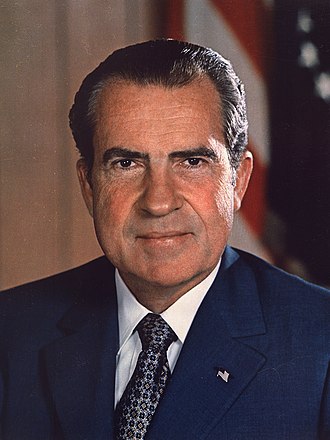
Richard M. Nixon served as the 37th President of the United States from January 1969 until his resignation in August 1974. In February 1971, he ordered the installation of a secret voice-activated taping system in the White House to preserve a historical record of his administration. Until the system's existence was revealed and dismantled in July 1973, the tapes captured Nixon directing major foreign policy initiatives, such as the opening to China, as well as his central role in the Watergate cover-up.
What Nixon talks about on the tapes
White House operations 4,718Presidential scheduling 2,225Public relations 1,784Presidential schedule 1,782Vietnam War 1,693Logistics 1,650Manolo Sanchez 1,626White House communications 1,400White House administration 1,399Presidential communication 1,243Henry Kissinger 1,191Foreign Policy 1,183
Conversations (21,010)
— Page 128 of 211President Nixon met with his personal valet, Manolo Sanchez, at the Aspen Lodge study at Camp David. The conversation was brief and is identified in the record as containing personal, returnable material. No substantive political or policy discussions are documented in the available record for this interaction.
President Nixon utilized the Camp David telephone system to coordinate a brief scheduling adjustment through the facility operator. The primary objective of the call was to facilitate a direct conversation with White House aide Charles W. Colson. No substantive policy matters were addressed during this short administrative exchange.
President Nixon held a brief exchange with the Camp David operator to address routine administrative or telephonic concerns regarding the facility's operations. The interaction served as a logistical check-in while the President was stationed at the Aspen Lodge. No significant policy developments or strategic decisions resulted from this brief communication.
President Nixon and Charles W. Colson discussed political strategy for the 1972 campaign, focusing specifically on how to counter Democratic nominee George S. McGovern. They analyzed McGovern's vulnerabilities regarding his defense budget proposals and his position on amnesty for Vietnam War draft evaders. The President directed Colson to emphasize that deserters must 'pay the penalty' for their actions, regardless of the war's conclusion, to effectively attack McGovern's credibility with the public.
President Nixon and Charles Colson discuss the political necessity of maintaining a hardline stance against Vietnam War draft evaders and deserters. They agree on the importance of demanding that these individuals face legal penalties for their actions, even after the war concludes. The conversation focuses on leveraging this rhetoric as a strategy to enforce patriotic standards and public accountability.
President Nixon contacted the White House operator to initiate a telephone call to his special counsel, Charles W. Colson. The brief exchange served solely as a request to connect with Colson for an unstated purpose. No further substantive discussion occurred between the President and the operator.
President Nixon and Charles Colson discuss strategies to neutralize political controversies regarding the administration's Soviet grain deals and ongoing 1972 campaign developments. They agree to expedite an FBI report to clear any suspicions of scandal while emphasizing the economic benefits of grain sales to farmers. Additionally, they discuss the campaign performance of George McGovern, noting with satisfaction the negative confrontations he has faced during plant visits, particularly regarding his stance on amnesty and Vietnam policy.
President Nixon initiates a brief telephone call through the White House operator to contact his daughter, Julie Nixon Eisenhower. The primary purpose of this communication is to facilitate a personal conversation between the President and his daughter. No further policy or administrative business is discussed during this short administrative request.
President Nixon held a brief, administrative telephone conversation with a White House operator. The exchange consisted of a short, classified segment that was subsequently withdrawn from public release. No substantive policy discussions or executive decisions were recorded during this brief communication.
President Nixon held a brief, routine administrative interaction with the White House operator to facilitate telephonic communications. The conversation functioned as a standard logistical check, typical of the President's daily management of his executive office operations. No substantive policy discussions or major decisions occurred during this brief exchange.
President Nixon consulted with the White House operator to facilitate a telephone connection. The brief exchange focused exclusively on administrative communication logistics. No substantive policy matters or further actions were recorded during this interaction.
President Nixon met with his aide Stephen B. Bull to review and finalize the details of his upcoming schedule. The primary focus of the discussion was confirming arrangements for an impending meeting with National Security Advisor Henry A. Kissinger. Following this brief briefing, the session concluded as Bull departed the Oval Office.
President Nixon met with an unidentified individual to discuss scheduling arrangements for upcoming political meetings. The conversation focused on coordinating logistical details, including the potential for a follow-up telephone call. No substantive policy matters or strategic decisions were addressed during this brief interaction.
President Nixon met with Stephen B. Bull to review logistical details regarding his upcoming dinner at John B. Connally’s residence. The discussion focused on coordinating with the 'Democrats for Nixon' group and assessing the roles of various campaign leaders compared to the existing staff. This brief meeting served as a final preparation for the President's engagement with the organization.
President Nixon met with Stephen B. Bull and Rose Mary Woods to discuss the feasibility of hosting a performance by members of the Bohemian Grove at the White House. While acknowledging that Secret Service security requirements and presidential duties preclude his personal attendance at the Grove's events, Nixon enthusiastically supported the idea of inviting the group to perform in the East Room after the 1973 inauguration. The discussion focused on the logistics of the event, including dinner arrangements and the potential for a themed campfire-style production.
President Nixon and Henry Kissinger met to discuss strategies for managing international relations and domestic political optics ahead of the 1972 election. They reviewed plans to use cultural exchanges with the People's Republic of China to boost the President's image, addressed the need for more effective, personalized presidential correspondence, and strategized on personnel changes to neutralize bureaucratic opposition within the Arms Control and Disarmament Agency and the State Department. Furthermore, they coordinated efforts to manage Jewish leaders and Israeli officials regarding regional stability, terrorism concerns, and military aid, while also planning to publicly condemn the exploitation of American prisoners of war by anti-war activists.
President Nixon met with Alexander P. Butterfield to coordinate upcoming scheduling priorities and media appearances. The discussion centered on recording a film clip for Reverend Leon Sullivan’s minority-focused television program and managing the President’s travel and workload, including a firm directive to clear his schedule of substantive meetings to prepare for IMF and other public appearances. Additionally, the pair briefly touched on administrative matters, including potential meetings with economist Milton Friedman and chess champion Bobby Fischer.
President Nixon and Stephen B. Bull met to finalize the President's upcoming daily schedule and coordinate logistics for various visitors, including Gale Sayers, Frank van der Linden, and the Imperial Potentate of the Shrine of North America. The discussion focused on managing photo opportunities and ensuring preparation for meetings, specifically regarding a book by van der Linden. Nixon also instructed Bull to manage copies of books and administrative materials for staff accessibility.
President Nixon met with his aide, Stephen B. Bull, to provide specific instructions regarding the interior decoration of the Oval Office. The primary focus of the brief discussion was the President's desire to retain a Liberty Bell ornament within the room. No further policy or administrative matters were addressed during this short exchange.
President Nixon met with journalist Frank van der Linden and aide Kenneth Clawson to receive a copy of van der Linden's book, *Nixon's Quest for Peace*. The discussion focused on the role of the press, with Nixon distinguishing between the necessary bias of columnists and the objective reporting responsibilities of news journalists. The participants also shared anecdotes and commentary regarding political figures, the influence of alcohol on public conduct, and the professional risks journalists face regarding their personal behavior.
President Nixon and Stephen B. Bull met to finalize arrangements for a forthcoming Oval Office meeting regarding House Resolution 2. The discussion focused on coordinating the attendance of key Congressional members, specifically F. Edward Hebert, Leslie C. Arends, Charles E. Bennett, and Durward G. Hall. The President also ensured that pens were prepared for the participating legislators as part of the formal proceedings.
President Nixon met with Secretary of Defense Melvin Laird and various congressional leaders to discuss the signing of the Uniformed Services Health Provisions Revitalization Act (HR 2) and the promotion of defense-related legislation. The conversation transitioned into campaign strategy for the 1972 election, with Nixon and Laird analyzing the political implications of George McGovern's defense platform and coordinating appearances to target specific demographics in key states like Massachusetts and Wisconsin. Additionally, they praised the public speaking skills of Brigadier General Daniel 'Chappie' James Jr. and discussed administrative efforts to bolster military support through strategic announcements, such as new contracts for the Quincy shipyards.
President Nixon and Henry Kissinger met to discuss managing domestic political pressure from Jewish organizations regarding Soviet emigration policies in the context of broader US-Soviet trade negotiations. Kissinger advised against the President directly calling activists, suggesting instead that they facilitate meetings between those groups and Secretary of State William Rogers to keep the administration at a distance. The pair also criticized what they perceived as a hypocritical double standard in American foreign policy and media coverage regarding human rights crises in Burundi, Pakistan, and Bangladesh, ultimately deciding to recall the U.S. Ambassador to Burundi.
President Nixon hosted a bipartisan group of Congressional members and Department of Defense officials in the Cabinet Room for the formal signing of HR 10670, a bill establishing a survivor benefit plan for retired military personnel. The discussion emphasized the necessity of providing military families with benefits comparable to those in the Foreign Service and other civilian sectors. The President utilized the event to express his administration's gratitude for Congressional support and to stress the importance of national respect for those serving in an all-volunteer armed force.
President Nixon and Stephen B. Bull met to coordinate logistics for a White House signing ceremony featuring Senators J. Glenn Beall, Jr. and Lloyd M. Bentsen. The discussion focused on scheduling a photograph session with the senators and finalizing the mechanics of the bill-signing process. Nixon confirmed his intent to personally utilize a specific pen for the official signing.
President Nixon met with Representatives J. Glenn Beall, Jr., Charles S. Gubser, and Otis G. Pike, along with Robert W. Nolan, primarily to discuss the legislative significance of House Resolution 10670. The group focused on the bill's implications for Social Security benefits and revenue sharing, specifically highlighting the importance of the President's signature on the legislation for retirees. The brief meeting also included a photography session and informal discussion regarding the political careers and election cycles of the attendees.
President Nixon and Stephen B. Bull meet to address a sudden power failure in the Oval Office and the subsequent failure of the backup generator system. Bull informs the President that he has initiated emergency measures to restore power and notes the difficulty in locating staff member Robert J. Brown during the blackout. The brief exchange focuses on resolving this infrastructure crisis and confirming the status of the President's schedule.
President Nixon met briefly with Alexander P. Butterfield to coordinate H.R. Haldeman’s immediate availability. The conversation focused on the logistics of Haldeman’s current location and schedule. No substantive policy matters were discussed during this brief administrative exchange.
President Nixon met with H.R. Haldeman, Stephen B. Bull, and Manolo Sanchez to coordinate his upcoming campaign travel schedule and manage the timing of key administrative announcements. The discussion focused on synchronizing public appearances, such as the SALT agreement signing and various trade-related press conferences, with political outreach efforts in states like Texas. Nixon also criticized R. Sargent Shriver’s planned political activities in Texas, dismissing them as ineffective, while confirming the itinerary for his own upcoming trip involving local Democratic representatives.
President Nixon met with Representative Robert R. Casey and John E. Nidecker to express his appreciation for the Congressman's political support. The discussion touched on recent renovations to the U.S. Capitol, with the President drawing comparisons between the adequacy of American official guest facilities and those of foreign nations. The meeting concluded with Nixon presenting commemorative presidential gifts to his visitors.
President Nixon and H.R. Haldeman met to discuss various political and administrative matters, including the waning impact of the Vietnam War on the 1972 election, strategies for post-election personnel reorganization, and plans to build a stronger political establishment. They also discussed managing public perception regarding Nixon's foreign policy initiatives, specifically his visits to China and the Soviet Union, and explored the potential of using military leaders like Daniel "Chappie" James Jr. as political surrogates to reach white voters. Finally, the pair addressed a recent break-in at Dr. John Lungren's office concerning the President's medical records, deciding to treat the incident with transparency to neutralize any potential political fallout.
President Nixon contacted the White House operator to place an outgoing call, but ultimately canceled the request. After briefly interacting with the switchboard staff, the President decided not to proceed with his intended communication to Stephen B. Bull. No substantive policy matters or further actions resulted from this brief administrative exchange.
President Nixon and personal secretary Rose Mary Woods discuss the security breach at the office of Dr. John C. Lungren and compare George McGovern’s shifting campaign positions to those of Barry Goldwater. Nixon expresses concern regarding the motivations behind the break-in while analyzing the political volatility caused by McGovern's frequent policy changes. The pair discusses these strategic developments in the context of the ongoing presidential campaign.
President Nixon held a meeting with his valet, Manolo Sanchez, in the Old Executive Office Building. The recorded portion of the conversation consists entirely of a withdrawn segment classified as a personal returnable item. No substantive administrative or policy-related developments were captured in the available audio.
President Nixon and H.R. Haldeman discuss the political implications of a break-in at the office of Dr. John C. Lungren, the President's personal physician. They deliberate on how to leverage the incident for public relations purposes and draw strategic parallels between this intrusion and the ongoing Watergate scandal. The discussion emphasizes the need to control the narrative surrounding the break-in and ensure the story is disseminated effectively to the public.
President Nixon met with his valet, Manolo Sanchez, in the Old Executive Office Building to coordinate administrative logistics. During this brief interaction, the President issued instructions regarding the arrival of Charles Colson. The meeting served to facilitate a subsequent discussion between Nixon and his special counsel.
President Nixon met with Charles Colson and H.R. Haldeman to coordinate political strategy and manage negative press coverage during the 1972 election campaign. The participants discussed handling sensitive issues, including the recent break-in at Dr. John Lungren's office to recover Nixon's medical files, the political fallout of George McGovern's Vietnam stance, and public relations maneuvers involving grain sales and tax policies. The group emphasized the need to preemptively frame controversial stories to avoid the appearance of a cover-up and considered ways to leverage McGovern's campaign weaknesses.
President Nixon and H.R. Haldeman discuss the urgent need to address the burglary of John C. Lungren’s office to avoid the appearance of a cover-up. They express concern that failing to report the incident promptly or waiting too long could lead to public suspicion regarding the administration's involvement or potential tampering with presidential files. Ultimately, Nixon directs Haldeman to obtain a quick report from FBI Director L. Patrick Gray III and insists that the matter must be disclosed immediately if it is to be handled properly.
President Nixon contacted the White House operator to facilitate a personal telephone call to his daughter, Julie Nixon Eisenhower. The operator promptly acknowledged the President's request to reach her. This brief exchange served solely as a logistical coordination for the President to initiate private communication with his family.
President Nixon and his personal secretary, Rose Mary Woods, discuss the recent break-in at the office of Dr. John C. Lungren, Nixon’s personal physician. The participants exchange views on the bizarre nature of the incident and analyze potential theories regarding the perpetrator's motives. The brief discussion serves to address the President's assessment of the security breach and gather Woods's perspective on the developing situation.
President Nixon and his personal secretary, Rose Mary Woods, discuss the procurement of a specific gift for an unidentified female recipient. The conversation focuses on ensuring the suitability of the item as a presidential gift to avoid potential duplication. The brief exchange concludes with confirmation that the selected gift is appropriate for the individual in question.
President Nixon met with his aide Stephen B. Bull to review and refine upcoming scheduling details, including a planned visit to Laredo, Texas. The discussion focused on logistical arrangements for various appearances, such as a trip to John B. Connally's ranch, a stop at Rio Grande High School, and interactions with sports figures. The two sought to finalize the itinerary and associated site arrangements for these campaign-related events.
President Nixon met with his personal aide, Manolo Sanchez, in the Old Executive Office Building for a private discussion. Due to the lack of a transcript and the existence of withdrawn personal materials, the specific substance of the dialogue remains unrecorded in the public historical record. The meeting concluded when the two men exited the office together.
President Nixon contacted the White House operator to initiate an urgent telephone call to National Security Advisor Henry Kissinger. The brief interaction served solely as a logistical request to establish communication with Kissinger. No further policy discussions occurred during this specific exchange.
President Nixon expressed strong dissatisfaction to Henry Kissinger regarding the State Department’s passive response to political violence in Uganda and Burundi. Decrying what he perceived as a double standard in dealing with African regimes, Nixon ordered the immediate evacuation of all Americans from Uganda and demanded the recall of U.S. Ambassador Thomas Patrick Melady. He further directed that the Burundi ambassador be expelled, signaling a shift toward more aggressive diplomatic actions in the region.
President Nixon held a brief, informal telephone conversation with his daughter, Julie Nixon Eisenhower. The discussion served as a personal check-in between the two family members. No substantive policy decisions or political developments were recorded during this exchange.
President Nixon and H.R. Haldeman discuss the logistics of installing a small refrigerator in a White House closet for Tricia Nixon Cox. Haldeman confirms he has coordinated with Tricia and White House valet Manolo Sanchez regarding the specific location for the appliance. The two agree that the installation should proceed the following day, tasking Chief Usher Rex Scouten with the necessary carpentry work to prepare the space.
President Nixon initiates a request for the White House operator to connect him with special counsel Charles W. Colson. This brief interaction serves as a routine administrative step to facilitate a direct conversation between the President and a key advisor. The call serves no broader policy purpose beyond establishing this specific line of communication.
President Nixon and Charles Colson discuss a Washington Star column by Crosby S. Noyes that draws a favorable comparison between the Watergate scandal and the Daniel Ellsberg case. They aim to shift the public narrative by challenging George McGovern to explain his support for Ellsberg’s theft of government documents in the context of his Watergate criticism. Nixon and Colson also speculate that McGovern’s recent silence on the Watergate affair stems from unfavorable polling data and potential concerns regarding Democratic political misconduct.
President Nixon instructed the White House operator to place a telephone call to John F. Griner, the head of the American Federation of Government Employees. The request was intended to facilitate direct communication with the union leader, though no further discussion occurred during this brief administrative interaction. The President's primary objective was to establish contact with the labor representative for undisclosed purposes.
President Nixon met with his aide, Stephen B. Bull, to coordinate a briefing or private discussion. The primary purpose of the meeting was for the President to initiate a request to schedule a follow-up session with Charles W. Colson. Bull acknowledged the request before departing the Oval Office three minutes later.
President Nixon met with H.R. Haldeman and Charles Colson to coordinate logistics for an upcoming trip to Texas and to assess the 1972 presidential campaign. The discussion centered on countering George McGovern's focus on the Vietnam War through favorable economic data and foreign policy achievements, such as upcoming arms control agreements. Additionally, Nixon directed his staff to maintain a firm stance regarding Jewish political groups and Soviet trade relations, dismissing the need to condition trade deals on political pandering.
President Nixon met with representatives of the Almas Shriners to discuss their charitable hospital network and fundraising activities, including football-related events. During the brief session, which included a photo opportunity, the President presented gifts to the attendees and their wives. The group also touched upon the President’s travel schedule and briefly discussed political support in Indiana.
President Nixon instructed the White House operator to place an outgoing call to Charles W. Colson. This brief administrative exchange served as the precursor to a direct consultation between the President and his Special Counsel. The interaction highlights the standard procedure for routing priority communications through the White House switchboard.
President Nixon contacted the Camp David operator to facilitate a telephone connection with special counsel Charles W. Colson. The brief interaction served exclusively as a logistical request to initiate a high-level administrative communication. No substantive policy discussions or policy developments occurred during this exchange.
President Nixon contacted the Camp David operator to facilitate a telephone connection with his National Security Advisor, Henry Kissinger. This brief interaction served solely as a logistical request to initiate a high-level communication. No further substantive policy matters were discussed during this specific exchange.
President Nixon contacted the Camp David operator to issue a directive regarding the coordination of local law enforcement. He explicitly instructed the operator to initiate contact with the police. No further details regarding the nature of the request were captured in this brief exchange.
President Nixon and Henry Kissinger discussed a range of foreign policy issues, beginning with concerns about a decline in Vietnam bombing sorties, which Nixon ordered to be investigated by the Joint Chiefs of Staff. They also reviewed diplomatic maneuvers regarding North Vietnam, the status of POWs, and the President’s upcoming meeting with Jewish leaders in New York to address concerns about Israel and Soviet emigration policy. Additionally, Nixon expressed deep frustration with the State Department's handling of the mass killings in Burundi and demanded a comprehensive report on the situation.
President Nixon met with an unknown individual at the Aspen Lodge to coordinate logistics regarding First Lady Pat Nixon's return schedule to Camp David. During the brief discussion, the President was also notified that Henry Kissinger had placed a telephone call, prompting a need to verify the timing of the First Lady's arrival. The meeting concluded immediately following the notification of Kissinger's message.
President Nixon contacted the Camp David operator to facilitate a communications dispatch. The brief exchange focused on coordinating the delivery of materials to the President's location. No further policy or administrative decisions were documented during this short operational interaction.
President Richard Nixon met with his daughter, Julie Nixon Eisenhower, at the Aspen Lodge at Camp David. The interaction was brief and classified as a personal, returnable communication. No policy matters or substantive political decisions were recorded during this session.
President Nixon and Henry Kissinger discuss domestic political strategy ahead of the 1972 election, focusing on managing relations with Jewish leaders and neutralizing political opponents. The conversation also addresses frustrations regarding military operations, with Nixon demanding a full investigation into low sortie counts in Vietnam. Furthermore, Nixon expresses deep concern over the mass killings in Burundi and orders an urgent report, criticizing the State Department’s perceived indifference toward the humanitarian crisis.
President Nixon communicated with the Camp David operator to initiate an urgent telephone call to Charles W. Colson. When the operator reported that Colson could not be immediately located, the President opted to abandon the attempt and instructed the operator to call him back later. No substantive policy matters were addressed during this brief administrative exchange regarding the logistics of reaching a staff member.
President Richard Nixon met with his daughter, Julie Nixon Eisenhower, at the Aspen Lodge at Camp David. The nature of their discussion is not documented as the entirety of the audio recording was withdrawn for personal privacy reasons. Consequently, no substantive policy matters, political developments, or actionable decisions are available for public record.
President Nixon contacted the Camp David operator from the Aspen Lodge study to address an unspecified communication matter. The brief exchange focused on establishing a connection, during which the President instructed the operator to return his call. No substantial policy discussions or administrative decisions were recorded during this brief interaction.
President Richard M. Nixon met with his longtime valet, Manolo Sanchez, at the Aspen Lodge during a stay at Camp David. The discussion was private in nature and does not involve public policy or formal governmental business. Given the personal relationship between the two, the conversation appears to have focused on private matters or personal assistance.
President Nixon and Charles Colson strategized on how to leverage the 1972 campaign issues of amnesty and drug policy to contrast the administration's stance with that of George McGovern. They discussed painting McGovern as 'soft' on marijuana legalization and desertion, specifically coordinating efforts to emphasize that deserters must face penalties for their actions. The President approved ongoing efforts to keep these topics in the public discourse, including support for legislative proposals regarding citizenship revocation for those who fled the country.
President Nixon and Charles Colson discuss campaign strategies to challenge George McGovern’s positions on amnesty for Vietnam War draft evaders and the legalization of marijuana. Nixon emphasizes the need for a unified administration stance that advocates for strict penalties and the potential revocation of citizenship for those who fled the country. By framing these issues as moral and legal imperatives, the two aim to pressure McGovern into an unpopular position that will alienate moderate voters.
President Nixon contacted the Camp David operator to facilitate a telephone connection with his National Security Advisor, Henry Kissinger. This brief interaction served solely as a logistical request to establish communication with Kissinger regarding official business. No further policy discussions or substantive developments occurred during this exchange.
President Nixon initiates a brief request to be connected with his National Security Advisor, Henry Kissinger. The exchange serves solely as a logistical communication with the Camp David operator to facilitate this high-level contact. No substantive policy discussions or decisions are recorded during this brief administrative interaction.
President Nixon and Henry Kissinger discuss concerns regarding the safety of British citizens in Uganda amid political instability and the potential for a massacre. Nixon expresses deep frustration with the State Department's perceived pro-African bias and lack of transparency, particularly regarding atrocities in Burundi and past policy failures in Nigeria. To address the crisis, they decide to coordinate a secret, low-key logistics and evacuation plan with the British via General Andrew Goodpaster and a civilian Defense Department official, while also planning to gather intelligence from the Belgian ambassador.
President Nixon and Henry Kissinger discuss strategies for addressing instability in Uganda and the humanitarian crisis in Burundi, reflecting Nixon's intense frustration with the Department of State's perceived bias and lack of communication. Nixon directs Kissinger to coordinate secret contingency planning with the British to ensure the safety of foreign nationals in Uganda and to obtain an independent, private assessment of the situation in Burundi from the Belgian ambassador. Additionally, Nixon expresses deep irritation regarding leaks from the Arms Control and Disarmament Agency, promising to purge the bureaucracy following the upcoming election.
President Nixon contacted the Camp David operator to facilitate an urgent telephone connection with his aide, Charles W. Colson. The exchange served exclusively as a logistical request to bridge the communication to the White House staffer. No substantive policy discussions or administrative decisions were addressed during this brief administrative interaction.
President Nixon contacted the Camp David operator to issue an administrative request regarding the coordination of local law enforcement. He directed the operator to initiate a call to the police, though the specific purpose or incident prompting the outreach remains unspecified in the brief recording. The interaction served as a functional communication between the President and site staff to facilitate external security or logistical support.
President Richard Nixon met with First Lady Pat Nixon and their daughter, Julie Nixon Eisenhower, at the Aspen Lodge in Camp David. While the majority of the brief interaction remains classified due to its personal nature, the session functioned as a private family gathering. No policy decisions or administrative actions were recorded during this segment of the meeting.
President Nixon and Charles Colson discussed campaign strategy and the perceived weaknesses of George McGovern's candidacy, focusing on the effectiveness of highlighting "gut issues" like amnesty, busing, and the President's veto of the clean water bill. They analyzed polling data from Macomb County, Michigan, which suggested Nixon was making significant inroads with traditionally Democratic voters, and reaffirmed the campaign's decision to avoid becoming distracted by peripheral issues like Watergate or the Soviet wheat deal. Ultimately, the two agreed that maintaining a clear, firm stance on divisive policy issues would continue to consolidate Nixon's support among the "silent majority" despite any polling volatility.
President Nixon and Charles Colson discussed campaign strategy and public perception ahead of the 1972 election, focusing on the political advantages of maintaining a firm stance against amnesty for Vietnam War draft evaders. They also strategized on how to frame the administration’s response to Larry O'Brien’s complaints about network airtime by emphasizing that network decisions are independent. Additionally, Nixon highlighted the importance of appealing to blue-collar voters and the "silent majority" through decisive executive actions, such as his planned veto of a water bill, while dismissing the long-term electoral impact of minor controversies like Watergate.
President Nixon contacted the Camp David operator to facilitate a personal phone call to his daughter, Tricia Nixon Cox. The brief exchange served solely as a logistical request to connect the President to his daughter. No further policy or administrative matters were discussed.
President Nixon met with his daughter, Julie Nixon Eisenhower, at the Aspen Lodge study at Camp David. The discussion consisted primarily of personal matters, as indicated by the withdrawal of the recorded segment for privacy reasons. No substantive policy or administrative decisions were documented in this brief exchange.
President Nixon and Julie Nixon Eisenhower met privately at the Aspen Lodge in Camp David. Because the recording content is currently withheld for personal reasons, no specific policy or political decisions were documented. This interaction remains a private, familial exchange between the President and his daughter.
President Nixon initiates a brief administrative request while stationed at Aspen Lodge to secure a connection with a specific individual. The conversation is strictly logistical in nature, involving only the President and the Camp David operator. No substantive policy discussions occur, as the exchange serves exclusively to facilitate telephonic communication.
President Richard Nixon spoke with his daughter, Tricia Nixon Cox, while at Camp David. The brief communication was identified as a personal call, resulting in no substantive policy developments or administrative action items. Due to the withdrawn status of the recording, the specific details of their discussion remain restricted from the public record.
President Richard Nixon met with his daughter, Tricia Nixon Cox, during a weekend stay at Camp David. As this brief interaction lacks a transcript, the specific substance remains unknown beyond their social meeting. The nature of the discussion is categorized as a personal engagement between the President and a family member.
President Richard Nixon met with his personal valet, Manolo Sanchez, at the Aspen Lodge at Camp David. The discussion primarily involved personal matters or private logistical arrangements, as indicated by the withdrawal of the segment from the public record. No substantive policy decisions or administrative actions were documented during this brief encounter.
President Richard Nixon met with his personal valet, Manolo Sanchez, during a retreat at the Aspen Lodge in Camp David. The conversation, which lacked an available transcript, was brief and focused on personal matters rather than substantive policy or administrative affairs. The interaction concluded with the withdrawal of a short, personal segment of the recording.
President Richard M. Nixon met with his personal valet, Manolo Sanchez, at the Aspen Lodge during a weekend retreat at Camp David. The conversation, for which no transcript is available, consisted entirely of a brief, withdrawn segment classified as a personal returnable item. Consequently, no substantive policy matters or administrative decisions were recorded during this interaction.
President Nixon held an informal meeting with his daughter, Julie Nixon Eisenhower, and his valet, Manolo Sanchez, at the Aspen Lodge in Camp David. The discussion remained private, as evidenced by the withdrawal of the recorded segment for personal reasons. No administrative or political actions were documented during this social gathering.
President Richard Nixon met with his valet, Manolo Sanchez, at the Aspen Lodge in Camp David. The discussion remained private, with the only recorded segment consisting of a withdrawn, personal interaction. No substantive policy matters or official administrative actions were recorded during this brief engagement.
President Nixon contacted the Camp David operator to facilitate an outgoing call to his personal secretary, Rose Mary Woods. The brief exchange served as a routine administrative request to connect the President with his staff. No substantive policy matters or major political developments were addressed during this connection process.
President Nixon and H. R. Haldeman met to coordinate upcoming campaign communications, strategy for navigating anti-war demonstrations in California, and the analysis of recent public opinion polling. They discussed the administration's messaging on economic policy and the importance of ensuring press coverage through controlled releases of presidential statements and speeches. Additionally, they reviewed poll results concerning the Watergate scandal and various campaign issues, while strategizing on how to handle reports of break-ins at the office of Dr. John C. Lungren.
President Nixon and his personal secretary, Rose Mary Woods, engaged in a brief telephone conversation while the President was at Camp David. The exchange primarily centered on a personal matter involving the return of specific items. Due to the withdrawal of the primary portion of the recording for privacy reasons, no significant policy or political decisions are reflected in the available documentation.
President Richard Nixon met with his daughter, Julie Nixon Eisenhower, for a private visit at the Aspen Lodge during a stay at Camp David. As the recording contains no transcript and is marked by a withdrawn personal segment, the discussion remains historically inaccessible. The encounter served as a brief personal interaction between the President and his daughter during a period of intense presidential activity.
President Richard Nixon met with his daughter, Julie Nixon Eisenhower, for a private discussion at the Aspen Lodge study at Camp David. The conversation, which included a brief segment of withdrawn personal material, appears to have been an informal family visit. No substantive policy matters or official administrative decisions are recorded as occurring during this exchange.
President Nixon and his personal secretary, Rose Mary Woods, discussed personnel management and the public perception of the President's recent work at Camp David. The conversation centered on the job performance of press secretary Ronald Ziegler and the necessity of maintaining a disciplined, composed public image during the 1972 election campaign. Nixon expressed high regard for Ziegler's “cool” demeanor and effectiveness in handling press interactions, while Woods emphasized the importance of public messaging regarding the President’s focus on economic policy and speech preparation.
President Nixon and Henry Kissinger met to discuss managing the public narrative regarding North Vietnam's recent release of three American prisoners of war (POWs). Nixon directed his staff to counter George McGovern's criticisms by presenting the facts through press secretary Ron Ziegler rather than engaging in direct political combat. Additionally, the pair coordinated future diplomatic and military strategy, with Kissinger outlining his plan to warn North Vietnamese negotiators that continued exploitation of POWs for propaganda would result in severe U.S. repercussions, including intensified bombing campaigns post-election.
President Nixon met with his personal secretary, Rose Mary Woods, to request the retrieval of a specific document he previously asked her to copy. The brief exchange focused on locating and returning this particular draft or file to the President's desk. No further policy or political discussions were recorded during this interaction.
President Nixon and his personal secretary, Rose Mary Woods, met to discuss the formatting and finalization of a speech draft. The brief exchange focused on administrative instructions regarding indentation and editing procedures. The interaction concluded with the two sharing a brief toast before Woods departed the Oval Office.
President Nixon met with Ronald Ziegler and Henry Kissinger to coordinate public messaging, campaign strategy, and foreign policy initiatives. They finalized plans for a Cabinet-level anti-terrorism committee to bolster the administration's image ahead of the President's meeting with Jewish leaders. Additionally, they strategized on how to address the 1972 election, emphasizing a disciplined response to George McGovern's comments on POWs and reinforcing the President’s commitment to supporting Israel through arms policy rather than public rhetoric.
President Nixon met with his aide, Stephen B. Bull, to coordinate administrative logistics regarding H.R. "Bob" Haldeman's schedule. The discussion centered on planning for a specific political meeting involving the Chief of Staff. This brief interaction served to facilitate the internal management of the President's senior staff agenda.
President Nixon met with his aide Stephen B. Bull to coordinate the timing and logistics of upcoming appointments. The discussion focused primarily on the schedules of H.R. Haldeman and Charles W. Colson, specifically regarding an ongoing political meeting. Bull provided updates on the meeting's status to ensure the President's schedule remained synchronized with his senior staff.