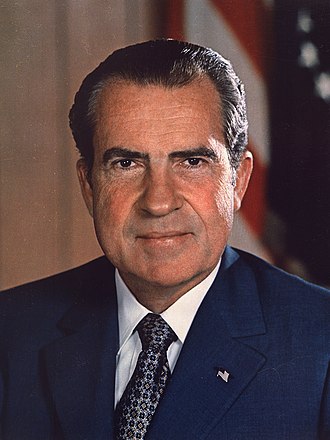
Nixon, Richard M. (President)
Richard M. Nixon served as the 37th President of the United States from January 1969 until his resignation in August 1974. In February 1971, he ordered the installation of a secret voice-activated taping system in the White House to preserve a historical record of his administration. Until the system's existence was revealed and dismantled in July 1973, the tapes captured Nixon directing major foreign policy initiatives, such as the opening to China, as well as his central role in the Watergate cover-up.
What Nixon talks about on the tapes
White House operations 4,718Presidential scheduling 2,225Public relations 1,784Presidential schedule 1,782Vietnam War 1,693Logistics 1,650Manolo Sanchez 1,626White House communications 1,400White House administration 1,399Presidential communication 1,243Henry Kissinger 1,191Foreign Policy 1,183
Conversations (21,010)
— Page 129 of 211President Nixon met with his aide Stephen B. Bull to discuss the scheduling and activities of Charles W. Colson. The conversation focused on managing Colson's upcoming agenda and coordinating his future appearances. No major policy decisions were recorded during this brief administrative briefing.
President Nixon met with Alexander P. Butterfield to finalize guest lists for upcoming state dinners, specifically honoring Alexander F. Douglas-Home and Soviet diplomat Andrei Gromyko. The discussion focused on balancing the number of Soviet and American attendees, ensuring appropriate Cabinet-level representation, and limiting the presence of White House staff at the events. Nixon provided specific directives regarding guest substitutions, including the potential inclusion of John Hay Whitney and the removal of Peter G. Peterson and George H.W. Bush from certain slots to manage the total headcount and organizational flow.
President Richard Nixon met with his valet, Manolo Sanchez, in the Oval Office for a brief, private discussion. The recording primarily consists of a withdrawn segment categorized as a personal, returnable matter. No significant policy decisions or official administrative actions are documented during this interaction.
President Nixon, H.R. Haldeman, and Stephen Bull discussed personnel management and potential budget cuts for various government agencies. The President expressed a desire to significantly reduce the budgets of policy-creating agencies, such as the Arms Control and Disarmament Agency, by 50% through attrition rather than layoffs. They also touched upon personnel management within the White House itself, specifically regarding lower-level staff like stenographers and waiters, contrasting it with cuts at higher levels.
President Nixon and H. R. Haldeman met briefly to discuss the aftermath of the President's recent speech before the International Monetary Fund. The two men coordinated on strategies to manage public reception, specifically referencing the role of Treasury Secretary George P. Shultz and the influence of the New York Times. The discussion focused on maintaining a controlled pace regarding upcoming policy announcements to ensure favorable media coverage.
President Nixon met with a delegation from the Order of American Hellenic Educational Progressive Association (AHEPA) to accept a commemorative gold medal marking the organization's 50th anniversary. During the brief visit, the group participated in a photo session, and the President shared personal reflections on his 1947 trip to Greece and the resilience of the Greek people. The meeting concluded with an exchange of gifts, as Nixon presented the delegation members with silver medals and presidential cuff links.
President Nixon consulted with Alexander P. Butterfield and Stephen B. Bull regarding a brief appearance to greet staff from the Finance Committee for the Re-election of the President. He also conferred with John D. Ehrlichman to discuss the structure of the Cabinet Committee to Combat Terrorism. The President ultimately decided that the FBI should be included in the committee, citing the bureau's superior intelligence capabilities.
President Nixon met with Stephen B. Bull to finalize preparations for a meeting with representatives from the Finance Committee of the Committee for the Re-election of the President (CRP), including Maurice Stans. The discussion focused on the distribution of presidential gifts to major corporate donors. Nixon concluded the brief session by expressing his intent to personally meet with the committee members.
President Nixon met with Clark MacGregor, Maurice Stans, and a large group of staff from the Finance Committee of the Committee to Re-elect the President in the Cabinet Room. The meeting served as a morale-boosting session or formal gathering for the campaign’s fundraising team. Due to the presence of a withdrawn item spanning over seven minutes, the specific substantive discussions remain restricted or were largely ceremonial in nature.
President Nixon and Stephen B. Bull met to briefly review the President’s upcoming schedule, including a photograph session with Republican congressional candidates and a meeting with Dr. Charles A. Hoffman. During the discussion, they addressed a personnel matter regarding an individual's health status, with Nixon suggesting the individual be removed from their current position if they were not expected to recover from cancer. The exchange served as a quick logistical coordination of presidential appointments and staffing concerns.
President Nixon met with his aide, Stephen B. Bull, to discuss the scheduling and coordination of Dr. Charles A. “Carl” Hoffman. The brief meeting focused on managing logistical arrangements regarding Hoffman's upcoming itinerary. No further policy or significant political actions were recorded during this short engagement.
President Nixon and H. R. Haldeman discussed strategies to improve the quality and impact of presidential communication, specifically targeting the reduction of speech lengths to ensure messages are concise, memorable, and pithy. Nixon expressed frustration with the "mental laziness" of excessively long drafts produced by staff and established a strict 1,000 to 1,500-word limit for written remarks. They further decided to prioritize short radio addresses over frequent television appearances for routine administrative actions, such as veto messages, to effectively communicate policy decisions to the public.
President Nixon met with a group of Republican political candidates and advisor Harry Dent to discuss campaign strategy and national policy. The discussion touched upon shared military experiences in the South Pacific during World War II, as well as current political issues in South Carolina. The participants specifically focused on the administration's foreign policy initiatives regarding China, the Soviet Union, and Japan, framing them as key themes for the upcoming election.
President Nixon and Stephen B. Bull briefly discussed the President's daily schedule and logistical arrangements regarding a preceding meeting with representatives from the American Medical Association, specifically Dr. Charles A. Hoffman. The exchange served as a routine administrative coordination of the President's appointments. No policy decisions were recorded during this short transition.
President Nixon met with Dr. Charles A. Hoffman and administration officials to discuss strategies for addressing the medical profession's public relations challenges and the potential implementation of catastrophic health insurance. The conversation focused on the necessity of countering the Kennedy health insurance plan, improving rural physician distribution, and establishing international medical research cooperation, particularly with the Soviet Union and China. The participants also shared personal anecdotes regarding medical history and family health to emphasize the urgency of refining the U.S. healthcare system to protect citizens from financial ruin due to severe chronic illness.
President Richard M. Nixon met with his personal aide, Manolo Sanchez, at the Old Executive Office Building for a brief discussion. The conversation was limited to personal matters, as evidenced by the withdrawal of the recorded content under personal returnable status. No significant policy decisions or administrative actions were documented during this brief encounter.
President Richard M. Nixon met with his personal valet, Manolo Sanchez, in the Old Executive Office Building. The conversation, which largely consists of routine interaction, concludes shortly after the President expresses gratitude. No substantive policy matters or major historical developments were recorded during this brief exchange.
President Nixon met with his personal valet, Manolo Sanchez, to facilitate logistical coordination within the White House. During the brief interaction, the President instructed Sanchez to summon Charles W. Colson for an upcoming meeting. This exchange served to manage the President's immediate schedule and transition between administrative engagements.
President Nixon and Stephen B. Bull met to coordinate scheduling logistics for an upcoming event involving the Earl and Lady Cromer. The President emphasized the need to accommodate the guests' existing itinerary, specifically requesting that their planned presentation not disrupt any previously scheduled luncheons or engagements. Bull was instructed to manage the timing to ensure the meeting fit conveniently into all participants' schedules.
President Nixon met with Charles W. Colson and Stephen B. Bull to coordinate logistics for a scheduled meeting with labor leader Thomas W. “Teddy” Gleason. The discussion centered on the arrangements for the Oval Office gathering and an accompanying photograph session with Oliver F. Atkins. The meeting concluded shortly before the scheduled engagement with Gleason took place.
President Nixon met with International Longshoremen's Association (ILA) leaders Thomas W. Gleason and John Bowers, along with White House staff, to discuss labor support for his policies and upcoming trade agreements with the Soviet Union. The discussion centered on the maritime industry, the potential economic benefits of increased trade, and the President's commitment to national defense and maintaining an open-door policy with labor unions. Nixon successfully sought to solidify the ILA's backing for his administration's diplomatic strategy, while addressing union concerns regarding foreign competition and the release of prisoners of war.
President Nixon met with his aide Stephen B. Bull to coordinate the President's upcoming schedule. The brief discussion focused on arranging meetings with Charles W. Colson and H.R. Haldeman. Bull facilitated these administrative updates before departing the Oval Office.
President Nixon met with Charles Colson and Stephen Bull to discuss political messaging for his 1972 reelection campaign and the staffing philosophy of his administration. Nixon critiqued the language used in upcoming public statements regarding immigration and terrorism, insisting on avoiding divisive racial and religious categorizations. Furthermore, the President emphasized the need to surround himself with tougher, more street-smart advisors—particularly from the labor movement—who are not easily influenced by the liberal media or elite intellectual circles.
President Nixon and an unidentified individual meet to verify the status of documentation related to an official statement. The primary focus of the brief exchange is ensuring that the requested copy of a specific section of the statement has been successfully delivered. This interaction highlights the administrative oversight of outgoing communications during the President's daily operations.
President Nixon met with an unidentified individual in the Old Executive Office Building to facilitate a requested tour of the White House. The brief exchange involved an administrative request for access, seemingly involving a Mr. Duquette. No further policy or strategic developments are recorded in this fragment of the meeting.
President Nixon met with his personal valet, Manolo Sanchez, to discuss administrative matters and personal logistics. The brief discussion primarily centered on the scheduling and movements of Charles W. Colson. No major policy decisions were recorded during this interaction.
President Nixon met with Charles Colson and Patrick Buchanan to discuss electoral strategy and campaign messaging for the 1972 election. They focused on building a coalition among working-class voters by emphasizing shared values and the importance of work, while simultaneously crafting efforts to distance Democratic opponent George McGovern from radical anti-war demonstrators. Additionally, the participants touched on upcoming judicial appointments and the political management of the Watergate scandal as a campaign issue.
President Nixon and H.R. Haldeman discussed whether Vice President Spiro Agnew should cancel a campaign appearance in Texas to return to Washington for a potential tie-breaking vote on the Brooke Amendment to the foreign aid bill. Although staff opinions were divided on the probability of a tie, Nixon expressed concern that Agnew would suffer significant political criticism if he were absent during a pivotal Senate vote. Ultimately, the President decided that Agnew should play it safe and return to the capital, while instructing staff to arrange a suitable substitute speaker for the Texas event.
President Nixon contacted the White House operator to facilitate an urgent connection to his Chief of Staff, H.R. Haldeman. This brief administrative interaction served as a logistical step to initiate a direct line of communication between the President and his key advisor. No further substantive discussion occurred before the transition of the call.
President Nixon and H. R. Haldeman discussed the scheduling logistics for Vice President Spiro Agnew’s attendance at an upcoming Senate vote on the Edward W. Brooke amendment. They analyzed whether Agnew could balance a planned breakfast appearance in Texas with the necessary arrival time for the 2:00 p.m. vote in Washington. Haldeman committed to exploring whether the Vice President could reschedule his morning commitment to ensure his timely return for the legislative session.
President Nixon met with an unknown woman in the Oval Office to discuss the logistics of an upcoming presidential trip. During the brief interaction, the President requested a comprehensive schedule or package for the travel. The exchange concluded with the individual informing Nixon that the necessary documentation was not yet prepared.
President Nixon met with his aide Stephen B. Bull to coordinate the President's upcoming travel schedule. The discussion focused on logistical planning and the itinerary for a forthcoming trip. This interaction reflects the routine administrative management required to facilitate executive domestic and international engagements.
President Nixon met with Alexander P. Butterfield to briefly review and discuss the upcoming schedule for Chief of Staff H.R. Haldeman. The meeting served as a routine administrative coordination of the President's inner circle appointments and logistical planning. No major policy decisions were recorded during this two-minute exchange.
President Nixon met with H.R. Haldeman and other aides to coordinate logistics for his upcoming trip to New York, specifically focusing on a sensitive meeting with Jewish leaders and potential risks regarding news leaks. The group discussed political campaign strategies, including the management of Vice President Agnew's schedule and the importance of monitoring congressional hearings related to Watergate and ITT. Additionally, Nixon expressed frustration with the lack of loyalty from political pundits and business executives who received administration support, deciding to restrict future personal favors to journalists and business figures.
President Nixon met with John Ehrlichman, Robert Merriam, and Lewis Engman to review the progress of an Advisory Commission on Intergovernmental Relations (ACIR) study concerning national fiscal policy, school financing, and property tax reform. The discussion focused on the urgent need to address the heavy property tax burden on the elderly—which the President characterized as a national scandal—and evaluated the potential for implementing a federal "circuit breaker" relief program. Nixon instructed the team to keep their findings confidential until after the 1972 election and requested that the Treasury Department conduct a parallel study on their recommendations to maintain strategic flexibility.
President Nixon met with United Paper Makers International Union leader Joseph P. Tonelli and members of his administration, including Secretary of Labor James D. Hodgson, to discuss labor relations and union support for the administration's policies. Tonelli expressed strong approval of Nixon's foreign policy and his approach to economic stabilization, while the group discussed specific legislative concerns regarding pulp and paper industry trade. They also addressed the importance of establishing the National Commission for Industrial Peace to improve labor dispute resolution as an alternative to economic strikes.
President Nixon met with his aide Stephen B. Bull to coordinate logistical details and media restrictions for his upcoming schedule, specifically regarding meetings with building trades representatives and Jewish leaders. Seeking to maintain a fast pace, the President explicitly prohibited all photography during these sessions to minimize time expenditures and exposure. Bull confirmed that there would be no individual coverage or official photographic documentation for these specific groups.
President Nixon met with Alexander P. Butterfield to coordinate the President's upcoming schedule and administrative agenda. The discussion primarily focused on preparations for a forthcoming meeting with the British Ambassador, George R.S. Baring, the Earl of Cromer. Additionally, the two reviewed logistical arrangements for various document signings and policy proposals to be finalized before the meeting concluded.
President Nixon and Alexander P. Butterfield met to coordinate upcoming administrative logistics, including the President's schedule and official social obligations. They reviewed guest lists for formal dinners honoring Sir Alec Douglas-Home and Andrei Gromyko, ensuring appropriate attendance and political representation. Additionally, the President provided instructions regarding the distribution, inscription, and handling of photographs taken during a recent meeting at John B. Connally’s ranch.
President Nixon and H.R. Haldeman reviewed congressional strategy regarding a potential tie vote on an 'end the war' bill, speculating on the role of Vice President Agnew in breaking a deadlock. The discussion transitioned to the President's upcoming speech at the International Monetary Fund meeting, where they criticized the influence of Henry Kissinger and the establishment media, particularly journalist Marvin Kalb. Following Stephen Bull's entry, the group finalized scheduling details for meetings with labor leaders and a photo session with the British Ambassador.
President Nixon met with his aide, Stephen B. Bull, to coordinate preparations for an upcoming meeting with the leaders of building trades unions. The primary objective was to ensure the appropriate distribution of commemorative pins and cuff links as gifts for the union presidents in attendance. This brief planning session served to finalize logistical arrangements for the President's engagement with organized labor representatives.
President Nixon met with leaders of various building trades unions to discuss their ongoing collaboration with his administration and their formal endorsement of his re-election. The participants addressed labor-management relations, the future of wage and price controls, and the administration’s commitment to providing union representation in high-level government positions. Nixon praised the group for their support of his foreign policy and national security objectives, while the labor leaders reaffirmed their commitment to the President despite the neutrality stance held by the broader AFL-CIO.
President Nixon and First Lady Pat Nixon hosted the British Ambassador, George R. S. Baring (The Earl of Cromer), and his wife in the Oval Office for a diplomatic courtesy visit. The discussion primarily centered on the exchange of commemorative gifts, including a medal and a box associated with St. Paul’s Cathedral and architect Christopher Wren. The participants also reminisced about the President’s past visits to London and briefly compared the differences in campaign finance and electoral processes between the United States and the United Kingdom.
President Nixon held a brief, six-minute meeting in the Oval Office with an unidentified male visitor. Aside from a three-second segment categorized as a personal returnable, the substantive content of this interaction remains unavailable. No transcript exists to clarify the nature of the discussion or any resulting policy actions.
President Richard M. Nixon met with his aide Stephen B. Bull in the Oval Office to discuss the professional schedule of Charles W. Colson. The brief consultation focused on organizing and reviewing Colson’s upcoming commitments and logistical planning. No further administrative actions or policy decisions were recorded during this session.
President Nixon met with H.R. Haldeman and Charles Colson to discuss political strategy for the 1972 election, focusing specifically on managing campaign demonstrations and public perception. They analyzed the effectiveness of local Republican efforts to frame protest activities—such as those targeting Nixon’s California trip—as direct operations of the George McGovern campaign. Additionally, the group reviewed the support of business and labor sectors, dismissed critical press coverage regarding aerospace industry ties, and assessed how the President’s international diplomatic visits to the Soviet Union and China continued to bolster his public image.
President Nixon instructed the White House operator to place a telephone call to Edward W. Carter, the chairman of Broadway-Hale Stores. The purpose of the outreach was to follow up on a fundraising dinner held in Los Angeles the previous evening. No further actions or policy decisions were discussed during this brief administrative request.
President Nixon consulted with the White House operator to manage his evening communications schedule. After receiving an update regarding the delayed travel plans of Edward W. Carter, the President decided to postpone his outreach to Carter until the following morning. Concurrently, Nixon directed the operator to place a new call to David Packard in San Francisco.
President Nixon initiates a request through the White House operator to place a telephone call to Bernard J. “Bunny” Lasker in New York City. The brief exchange serves as a logistical coordination for the President to reach the prominent financier and political donor. No substantive policy matters are discussed as the conversation is limited to facilitating this connection.
President Nixon directed the White House operator to place a telephone call to businessman Edward W. Carter. Nixon specified that Carter could be reached at the Madison Hotel. The conversation concluded with the operator confirming the request and preparing to initiate the connection.
President Nixon met with the Cost of Living Council to review the administration’s economic performance and coordinate strategy regarding inflation, labor relations, and food prices ahead of the 1972 election. Council members, including George Shultz and Donald Rumsfeld, discussed measures to protect Social Security recipients from illegal rent increases and highlighted the relative success of U.S. wage and price controls compared to foreign nations. The President directed his team to maintain an affirmative, disciplined public messaging campaign, emphasizing that the U.S. was achieving growth and reduced inflation without the reliance on wartime spending seen in the 1960s.
President Nixon, Henry Kissinger, and Maurice Schumann met to coordinate diplomatic strategy regarding the Vietnam War and US-French relations. The discussion focused on the ongoing Paris Peace Talks, with Nixon and Kissinger emphasizing that they were approaching the limit of possible concessions before the upcoming presidential election. They expressed a desire to resolve the conflict to pivot the administration’s focus toward strengthening the Atlantic community and broader foreign policy goals in 1973. Additionally, they reviewed technical aspects of monetary policy and the potential for increased cooperation with France in facilitating a diplomatic breakthrough with North Vietnam.
President Nixon met with Alexander P. Butterfield to review and finalize the guest lists for upcoming state dinners honoring British Foreign Secretary Sir Alexander F. Douglas-Home and Soviet Foreign Minister Andrei A. Gromyko. The discussion focused on coordinating the attendance of various cabinet members and political officials, including Melvin Laird, Richard Kleindienst, and Elliot Richardson. The session concluded with the President confirming administrative details regarding the invitations and confirming the status of preparations.
President Nixon met with Alexander P. Butterfield to coordinate scheduling logistics regarding upcoming diplomatic engagements. The brief discussion focused on the President’s meeting with British Foreign Secretary Sir Alec Douglas-Home, as well as the respective schedules of Henry Kissinger and William P. Rogers. No major policy decisions were reached, as the conversation remained restricted to administrative calendar management.
President Nixon met with Alexander Butterfield and Stephen Bull to coordinate logistics for several upcoming diplomatic and official engagements, including a visit with Sir Alexander Douglas-Home and a trip to Atlanta. The discussion also addressed scheduling requests from Arthur Burns, specifically concerning a follow-up conversation regarding Nixon's recent speech to the International Monetary Fund. The participants evaluated the timing of these various meetings and the availability of key staff members like Peter Flanigan to manage related administrative details.
President Nixon and Federal Reserve Chairman Arthur F. Burns met to discuss the international reception of U.S. economic policies, the challenges of managing money supply and interest rates, and the broader contrast between American and British labor discipline. The discussion also covered potential future travel itineraries for Burns to countries including Indonesia and Japan, as well as coordination regarding an upcoming meeting with British Foreign Secretary Sir Alec Douglas-Home. Stephen B. Bull joined briefly to assist with scheduling logistics for the President and Burns.
President Nixon met with Stephen B. Bull to coordinate his upcoming scheduling requirements, specifically regarding appointments and motorcade logistics. They discussed the timing for an October 5, 1972, meeting with Dr. W. Kenneth Riland and reviewed necessary preparations involving staff members H.R. Haldeman and Charles W. Colson. The discussion also touched upon the taping system's schedule and logistics related to the Opportunities Industrialization Centers.
President Nixon, H. R. Haldeman, Charles Colson, and Alexander Butterfield met to coordinate campaign strategy, focusing on press relations, counter-messaging against George McGovern, and the political fallout of the US-Soviet grain deal. They discussed using surrogates to attack McGovern on issues like defense spending and welfare, while strategizing on how to handle the media's coverage of the administration and the Watergate scandal. Additionally, the President reviewed his upcoming campaign schedule, emphasizing the importance of motorcades and targeted appearances in key battleground states to project strength and efficiency.
President Nixon met with his valet, Manolo Sanchez, in the Old Executive Office Building for a brief, personal interaction. Due to the extremely limited duration and the lack of a substantive transcript, no significant policy matters or administrative decisions were documented during this exchange. The encounter reflects the routine personal assistance provided to the President by his staff.
President Nixon inquired about the status of a developing news story regarding Fort Wayne, Indiana. The brief discussion suggests the President was closely monitoring local media reports or political developments originating from that region. No specific decisions or further actions were recorded in this brief exchange.
President Nixon met with unidentified individuals in his Old Executive Office Building office to coordinate his daily schedule. Due to the lack of substantive audio content in the recording, no specific policy decisions or significant developments were captured. The conversation remains restricted to brief, non-informative exchanges regarding the President's upcoming commitments.
President Richard Nixon met with his personal valet, Manolo Sanchez, in his Old Executive Office Building workspace. The brief interaction consisted of personal, non-substantive matters that were subsequently withdrawn from the public record. No policy discussions or significant administrative decisions were recorded during this engagement.
President Nixon met with his aide Stephen B. Bull to review a pending speech draft. The discussion focused on determining the appropriate length for the address, as the two assessed the timing requirements for the text. This interaction highlights the President's direct oversight of his communications strategy during the 1972 campaign period.
President Nixon and Henry Kissinger met to discuss the strategic status of the ongoing Vietnam peace negotiations and the upcoming trip of General Alexander Haig to consult with South Vietnamese President Nguyen Van Thieu. The discussion focused on navigating complex political scenarios, including the potential for Thieu's resignation and the tension surrounding proposed changes to the South Vietnamese constitution and electoral processes. Nixon also expressed significant frustration regarding the inadequate supply of high-performance aircraft to the South Vietnamese military, attributing the shortfall to institutional opposition from the Department of Defense and military branches.
President Nixon met with Beurt and Cory SerVaas to discuss Indiana politics, the future of the Saturday Evening Post, and a proposed employment policy. The SerVaases suggested utilizing the draft board system to classify and place the handicapped and hard-core unemployed into the labor force. Additionally, they reviewed the challenges of securing advertising support for the Post, which the SerVaases argued was hindered by a liberal bias within major advertising agencies.
President Nixon met with his aide Stephen B. Bull to coordinate logistical preparations for an upcoming meeting with British Foreign Secretary Sir Alexander Douglas-Home. The discussion also involved Henry Kissinger, likely regarding his role in facilitating the diplomatic encounter. The conversation focused on the scheduling and administrative arrangements necessary for the President to engage with the British official.
President Nixon met with Alexander P. Butterfield to finalize logistical arrangements for an upcoming state dinner honoring Sir Alexander F. Douglas-Home. The discussion centered on room selection and seating configurations, specifically navigating the usage of the Red and Blue Rooms for the small group. They agreed on a plan to maintain the group's proximity at the table to facilitate conversation throughout the event.
President Nixon met with Sir Alexander F. Douglas-Home and Henry Kissinger to discuss the necessity of strengthening communication and cooperative action within the Atlantic Alliance. The participants explored geopolitical concerns, specifically Soviet military expansion, the role of conventional forces, and the long-term strategic implications of the Sino-Soviet split. Nixon emphasized the importance of maintaining a united front with NATO allies while addressing internal domestic challenges, including inflation and the 1972 presidential election.
President Nixon met with his senior aides and advisors to discuss a broad range of political and foreign policy issues, including congressional strategy regarding a spending ceiling and potential budget vetoes. The group examined the political impact of the recent U.S.-Soviet grain deal and reviewed recent polling data ahead of the 1972 election. Additionally, Henry Kissinger and Alexander Haig provided an update on ongoing Vietnam peace negotiations and finalized plans for Haig's upcoming mission to Saigon to consult with President Nguyen Van Thieu.
President Nixon and Stephen B. Bull reviewed the presidential schedule to coordinate meetings with key senior staff and advisors. The discussion focused on organizing upcoming briefings with John D. Ehrlichman regarding domestic policy, as well as H.R. Haldeman. Additionally, they arranged a session with Henry Kissinger and Alexander Haig to discuss the status of their current schedules and preparations for a forthcoming trip.
President Nixon met with Stephen B. Bull to review and coordinate upcoming appointments and travel logistics. The discussion focused on finalizing the daily schedules for key administration officials, specifically John D. Ehrlichman, Alexander M. Haig, Jr., and Henry A. Kissinger. This administrative check-in ensured that the President remained informed of his staff's movements and departures from the White House.
President Nixon met with Alexander P. Butterfield and Stephen B. Bull to discuss the scheduling and administrative arrangements regarding Charles W. Colson. The brief conversation served to coordinate logistics for Colson’s upcoming activities. No major policy decisions were recorded during this short administrative review.
President Nixon consulted with the White House operator to facilitate an outgoing call. This routine interaction served as a technical step to connect the President with another party for official communications. No significant policy discussions or substantive developments occurred during this brief exchange.
President Nixon met with his aide Stephen B. Bull in the Oval Office to discuss the scheduling of Charles W. Colson. The brief exchange focused on coordinating the logistics of Colson's upcoming appointments. The discussion was interrupted when the recording concluded prematurely.
President Richard Nixon held a brief telephone conversation with Edward W. Carter, a prominent businessman and chairman of Broadway-Hale Stores. The communication, which lasted under three minutes, remained largely opaque due to the immediate withdrawal of the transcript content. No specific policy decisions or substantive developments are documented in the available record.
President Nixon initiates a request for the White House operator to place a telephone call to speechwriter Raymond K. Price, Jr. This brief administrative interaction serves to connect the President with a key member of his staff for undisclosed purposes. No further substantive discussion or policy decisions occur during this exchange.
President Nixon met with H.R. Haldeman, Manolo Sanchez, and Stephen B. Bull to discuss the aesthetics of the White House grounds. The group focused specifically on the appearance of the trees and flowers surrounding the property. No significant policy decisions were made during this brief observation of the exterior environment.
President Nixon, H.R. Haldeman, and Henry Kissinger discussed strategies to manage media coverage, influence corporate advertising toward conservative outlets, and address political campaign logistics ahead of the 1972 election. The group explored ways to leverage administrative influence to discourage White House staff from attending a Washington Post dedication event hosted by Katharine Graham. Finally, Kissinger briefed the President on a new message from the Democratic Republic of Vietnam, which emphasized that upcoming negotiations represent a critical juncture for either achieving a peace agreement or facing a prolonged conflict.
President Nixon, Henry Kissinger, and Senator Henry "Scoop" Jackson met to coordinate strategies on national defense, force structure, and personnel appointments. The discussion emphasized the necessity of maintaining credible conventional forces, particularly given Soviet naval and military expansion, and identified concerns regarding staff disloyalty and incompetence within the Arms Control and Disarmament Agency (ACDA). Furthermore, they strategized on legislative maneuvers regarding the Jackson Amendment on Soviet Jewry, aiming to pressure the Soviet Union on exit visas without disrupting broader trade and diplomatic negotiations.
President Nixon met with staff members Stephen B. Bull, Alexander P. Butterfield, and Marjorie P. Acker to review daily scheduling logistics and coordinate upcoming personal arrangements. A primary objective was coordinating a potential visit for his brother, Edward C. Nixon, to Camp David, alongside discussions regarding the President’s pending telephone call to the ailing diplomat Charles E. Bohlen. The participants also managed routine administrative tasks, including lunch planning and staff scheduling for H.R. Haldeman and First Lady Pat Nixon.
President Nixon met with H.R. Haldeman and Henry Kissinger to strategize for the upcoming 1972 election, discuss public relations regarding the Vietnam War and POW returns, and plan for an upcoming diplomatic visit from Soviet Foreign Minister Andrei Gromyko. Nixon emphasized a rigid media strategy for Kissinger, demanding that briefings remain focused on one topic at a time to avoid conflicting headlines. The participants also reviewed campaign materials, including imagery of anti-war demonstrations, and solidified logistical plans for Gromyko’s meetings at the White House and Camp David to discuss potential peace settlements and arms control agreements.
President Nixon instructed the White House operator to place an emergency telephone call to Ambassador Charles E. “Chip” Bohlen at the Washington Medical Center. The President sought to reach the ailing diplomat directly to offer personal support. He further directed that if Bohlen was incapacitated, the operator should connect him instead with Bohlen's wife.
President Nixon, Charles Colson, and other staff members met to discuss strategies for the 1972 reelection campaign, focusing heavily on undermining Democratic challenger George McGovern. The group analyzed unfavorable polling data and coordinated the use of media surrogates, including popular athletes and sportscasters, to attack McGovern’s credibility and policy positions. Additionally, Nixon directed staff to maintain a firm stance against critical news organizations like The Washington Post and The New York Times, while discussing tactical responses to upcoming political debates.
President Nixon called veteran diplomat Charles E. "Chip" Bohlen to express his well wishes following reports of Bohlen's hospitalization. During the exchange, Nixon also mentioned a planned private dinner at Camp David for Soviet Foreign Minister Andrei A. Gromyko and fondly recalled their past collaborative work under the Christian A. Herter Committee. The conversation served primarily as a personal gesture of support and appreciation for Bohlen’s long-standing service to the country.
President Nixon contacted the Camp David switchboard operator to facilitate an administrative request while staying at the retreat. The brief interaction focused on operational coordination between the President and the facility staff. No substantial policy or political matters were addressed during this connection.
President Nixon and Charles Colson reviewed 1972 reelection campaign strategy, focusing heavily on mobilizing blue-collar and ethnic support through union leaders. The two analyzed various polling data from sources like Gallup and Harris to gauge George McGovern's standing and the impact of the Thomas Eagleton affair. They also discussed regional political shifts, particularly in Rhode Island, and expressed concern regarding media bias and the specific cultural issues fueling anti-McGovern sentiment.
President Nixon and Charles Colson met at Camp David to discuss political strategy and administrative coordination ahead of the 1972 election. The dialogue focused on managing campaign messaging and addressing specific political liabilities facing the administration. While the available recording is incomplete, the discussion underscores the ongoing efforts by the President and his special counsel to exert control over executive branch operations during the final stretch of the campaign.
President Nixon initiated a brief telephone request through the Camp David operator to be connected with domestic affairs advisor John D. Ehrlichman. The primary purpose of the communication was to establish contact for a follow-up discussion regarding administrative matters. No substantive policy negotiations or strategic developments occurred during this brief request for a line transfer.
President Nixon consulted with the Camp David operator regarding the status of the telephone system in the Aspen Lodge. This brief interaction served as a logistical check of the communications infrastructure at the presidential retreat. No policy matters or significant administrative decisions were recorded during this brief technical exchange.
President Nixon and John Ehrlichman discuss administrative matters regarding Raymond Price's schedule and the development of an upcoming radio address. The core of their conversation centers on a proposal to move a revenue sharing event from the White House to a historical venue in Philadelphia, such as Independence Hall, to symbolically align the administration's "New American Revolution" agenda with the nation's founding sites. Ehrlichman is tasked with investigating the logistics of this proposal, including the feasibility of hosting hundreds of guests at a National Park Service site.
President Nixon and John Ehrlichman discuss the logistics and symbolism of choosing a location for a significant upcoming event. Nixon expresses a desire to host the proceedings at a venue with greater historical gravitas than the White House, specifically suggesting Constitution Hall in Philadelphia to underscore themes of revolutionary change. Ehrlichman is tasked with exploring the feasibility of this site as an alternative, weighing the public relations impact against traditional venue expectations.
President Nixon initiated a brief telephone request through the Camp David operator to connect with his Chief of Staff, H.R. Haldeman. This administrative interaction highlights the logistical process used by the President to facilitate high-level communication while working from the Camp David retreat. No substantive policy discussions occurred during this exchange.
President Nixon directed H.R. Haldeman to arrange a private meeting with John Connally and George Christian early the following week to discuss campaign plans and evaluations. Nixon emphasized his preference for a separate dialogue with Connally, requesting that the meeting be scheduled to avoid interfering with Connally's previously arranged taping sessions. The discussion also included a brief review of ongoing telephoning poll priorities across various key states.
President Nixon and H. R. Haldeman coordinate a future meeting with John Connally to discuss his personal plans and future political alignment. Nixon requests that this dialogue remain separate from other scheduled commitments to ensure Connally’s ongoing training remains unaffected. Haldeman is tasked with notifying Connally to arrange the session for early in the upcoming week.
President Nixon communicated with the Camp David operator to facilitate an incoming telephone call from special counsel Charles W. Colson. The exchange served primarily as a brief procedural connection to transition the President to a direct conversation with his aide. No substantive policy matters or decisions were discussed during this brief logistical interaction.
President Nixon and Charles Colson review favorable polling data and the stagnant state of George McGovern's campaign as the 1972 election approaches. They discuss the effectiveness of advertising strategies targeting Democratic voters, specifically focusing on welfare and amnesty issues. The conversation concludes with an assessment of the campaign's momentum and coordination with H.R. Haldeman regarding regional ad placements.
President Nixon met with special counsel Charles W. Colson at Camp David to discuss sensitive administrative or political matters. Given the withdrawal of an item from the official record, the discussion likely touched upon confidential strategy or personnel issues pertinent to the 1972 re-election campaign. The brief nature of the interaction suggests a targeted consultation rather than a wide-ranging policy review.
President Richard Nixon met with First Lady Pat Nixon at the Aspen Lodge during their time at Camp David. While a portion of the discussion was withheld for personal privacy, the meeting occurred within the context of their private residency at the retreat. No formal policy decisions or administrative actions are associated with this brief, informal exchange.
President Richard Nixon met with his daughter, Julie Nixon Eisenhower, for a brief personal visit at the Aspen Lodge in Camp David. The interaction, which was recorded by the Camp David hard wire system, consisted entirely of a private conversation that has been withdrawn from the public record. No official policy matters or administrative decisions were documented in connection with this meeting.
President Richard Nixon met with his personal aide, Manolo Sanchez, in the Aspen Lodge study at Camp David. The interaction served as a routine engagement between the President and his long-time valet. Due to the withdrawal of the recorded material for personal reasons, no specific policy or administrative developments are available for review.