Nixon, Richard M. (President)
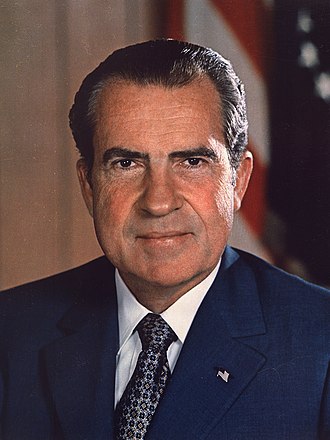
Richard M. Nixon served as the 37th President of the United States from January 1969 until his resignation in August 1974. In February 1971, he ordered the installation of a secret voice-activated taping system in the White House to preserve a historical record of his administration. Until the system's existence was revealed and dismantled in July 1973, the tapes captured Nixon directing major foreign policy initiatives, such as the opening to China, as well as his central role in the Watergate cover-up.
What Nixon talks about on the tapes
White House operations 4,718Presidential scheduling 2,225Public relations 1,784Presidential schedule 1,782Vietnam War 1,693Logistics 1,650Manolo Sanchez 1,626White House communications 1,400White House administration 1,399Presidential communication 1,243Henry Kissinger 1,191Foreign Policy 1,183
Conversations (21,010)
— Page 14 of 211President Nixon instructed the White House operator to add Werner P. Gullander, the head of the National Association of Manufacturers (NAM), to his official call list. This brief administrative communication facilitated direct communication between the President and a key figure in the business community. No further policy discussions or significant decisions were recorded during this interaction.
President Nixon clarifies the spelling and professional affiliation of William Gullander, an executive with the National Association of Manufacturers (NAM), for White House records. The interaction serves to ensure administrative accuracy regarding the President's recent correspondence or telephonic contact. No broader policy or political matters were addressed during this brief clerical exchange.
President Nixon spoke with National Association of Manufacturers President Werner P. Gullander to secure continued private sector support for his welfare reform agenda. The discussion focused on emphasizing the administration's strict work requirements, which mandate that able-bodied recipients accept any available employment, including menial labor. Gullander confirmed that business leaders were increasingly aligned with these policy goals, signaling a reduction in previous opposition to the President's initiatives.
President Nixon directs the White House operator to place an outgoing telephone call to Crosby S. Noyes, a journalist with the Washington Star. This brief communication serves solely as an administrative request to facilitate direct contact with the press. No substantive policy discussions or further actions are recorded during this exchange.
President Nixon called John F. Griner, president of the American Federation of Government Employees (AFGE), to commend him for his leadership in ensuring federal employees reported to work during recent protests. The two discussed their mutual disdain for the protesters, with Nixon praising Griner’s refusal to be intimidated by what he termed a "rat pack" and Griner expressing his intention to discipline local union chapters that participated in the unrest. Both parties agreed that law enforcement handled the situation effectively and shared suspicions regarding the involvement of outside agitators in the demonstrations.
President Nixon consulted with the White House operator to facilitate an outgoing connection. The interaction was purely administrative, serving as the necessary logistical step to place a telephone call to an external party. No substantive policy discussions or executive decisions occurred during this brief exchange.
President Nixon met with assistant Peter M. Flanigan in the Old Executive Office Building to discuss ongoing administrative priorities and personnel matters. While no transcript is available, the meeting focused on the implementation of economic policies and executive oversight handled by Flanigan's office. This discussion served to coordinate strategy regarding White House initiatives during a period of significant domestic policy development.
President Nixon initiates a brief communication through the White House operator to facilitate an external connection. The interaction serves as a logistical bridge, as the President requests assistance in reaching another party. No substantive policy discussions or administrative decisions are recorded during this brief exchange.
President Nixon met with his aide Stephen B. Bull to coordinate scheduling and administrative logistics for upcoming political and federal project initiatives. The discussion focused on establishing high-level meetings with Caspar Weinberger regarding budget oversight and arranging private appointments with several individuals, including John Greiner of the American Federation of Law Enforcement and Peter Grace. Nixon directed Bull to finalize these arrangements, emphasizing the need for brief, exclusive sessions with his guests.
President Nixon consulted with a White House operator to facilitate an outgoing communication. This brief interaction served administrative purposes, as the President utilized the operator's services to initiate a phone call. No substantive policy discussions or significant political developments occurred during this brief exchange.
President Nixon consulted with the White House operator to facilitate an outgoing call. This routine interaction served as a technical intermediary step for the President to initiate communications with another party. No substantive policy matters or major decisions were recorded during this brief administrative exchange.
President Nixon met with Alvin Snyder to formally commend him for his effective work and contributions to administration messaging. The President expressed appreciation for Snyder's efforts in circulating key information and conducting broadcasts with presidential allies. Nixon encouraged Snyder to maintain his current pace, emphasizing that the administration’s public relations efforts remained critical.
President Nixon consulted with a White House operator to facilitate an outgoing call. This interaction served purely as an administrative function to connect the President with another party. No substantive policy discussions or major decisions were recorded during this brief exchange.
President Nixon consulted with a White House operator regarding an unspecified incoming call. The brief exchange identifies the nature of the communication as relating to an ongoing crisis or development in Asia. No further substantive actions or strategic decisions were recorded during this brief administrative interaction.
President Nixon interacts with a White House operator to facilitate a connection for an outgoing telephone call. The exchange is purely procedural and serves to initiate communication with an external party. No substantive policy discussions or administrative decisions occur during this brief interaction.
President Richard Nixon met with National Association of Manufacturers President Werner P. Gullander to discuss the administration's economic policies and business-government relations. The conversation focused on addressing prevailing concerns within the industrial sector regarding economic stability and regulatory pressures. As no transcript is available, specific administrative actions or policy outcomes resulting from this dialogue remain undocumented.
President Nixon speaks with a White House operator to provide feedback on recent logistical support regarding a meeting with Dr. Gullamder of the National Association of Manufacturers. The President expresses his appreciation for the operator’s effective handling of these arrangements, noting that he had received positive reports from Charles Colson. No further policy decisions were made during this brief exchange.
President Nixon met with his personal aide, Manolo Sanchez, to personally commend him for his effective work on behalf of the administration. During the discussion, Nixon praised Sanchez’s contributions to welfare reform and other key policy initiatives, acknowledging the appreciation felt by the White House staff. The conversation concluded with Nixon encouraging Sanchez to maintain his dedication and vigor for the administration's ongoing objectives.
President Nixon met with American Federation of Government Employees president John F. Griner to express gratitude for the union's support regarding administration welfare reform initiatives. Nixon emphasized the necessity of strict work requirements, insisting that able-bodied recipients perform manual labor to transition off welfare rolls. The discussion served to solidify the alliance between the administration and the union leadership on these policy goals despite potential internal political friction.
President Nixon held a brief, unscheduled meeting in the Oval Office with an unidentified individual. The interaction was limited to a brief greeting, lasting less than one minute before the visitor departed. No substantive policy discussions or administrative actions were recorded during this encounter.
President Nixon met with his aide Stephen B. Bull in the Oval Office to review the details of his upcoming daily schedule. The primary focus of the discussion concerned the timing and coordination of meetings with Peter M. Flanigan and Caspar Weinberger. No further policy or strategic developments were recorded during this brief administrative briefing.
President Nixon consulted with a White House operator regarding an incoming call from Dr. Charles Chasler. Due to time constraints or competing priorities, the President declined to take the call at that moment. He subsequently instructed the operator to hold his incoming calls for the time being.
President Nixon met with key advisors and congressional leadership to strategize on economic stimulation and political coalition-building. The discussion prioritized directing federal funds and public works projects—particularly in California—to combat unemployment and secure electoral support. Concurrently, Nixon and his aides explored strategies to form a coalition of Republicans and conservative Southern Democrats in Congress to advance key administration goals, including the revival of the Supersonic Transport (SST) program and countering anti-war legislative efforts.
President Nixon met with John B. Connally and George P. Shultz to discuss the international monetary crisis and the political strategy for securing Congressional approval for the Supersonic Transport (SST) and Lockheed funding. Nixon emphasized his refusal to sacrifice the domestic economy to stabilize the dollar, asserting that the administration should maintain a firm stance while allowing European nations to manage their own monetary issues. Furthermore, the participants strategized on building a coalition of Republicans and Southern Democrats to advance the administration's legislative agenda, specifically focusing on the upcoming appropriations votes.
President Nixon initiated this call to personally thank Dr. Charles Chasler for a letter describing his volunteer medical service in Vietnam. Nixon commended Chasler's humanitarian work with Vietnamese children and expressed appreciation for the patriotic example set by Chasler's three sons serving in the ROTC. The President briefly reaffirmed his administration's commitment to resolving the Vietnam conflict in a manner that would honor the sacrifices made by individuals like Chasler.
President Nixon directs the White House operator to initiate a telephone call to Dr. Charles Chasler. This brief exchange serves as the administrative bridge to connect the President with the doctor. No further substantive discussion occurs during this short segment.
President Nixon met briefly with his personal valet, Manolo Sanchez, in the Oval Office. The exchange lasted less than one minute and involved only brief, perfunctory remarks. No substantive policy matters or official decisions were discussed during this interaction.
President Nixon consulted with the White House operator to facilitate an outgoing connection. The brief exchange served as an administrative step to place a telephone call to an unnamed party. No substantive policy matters or major developments were recorded during this short interaction.
President Nixon met with H.R. Haldeman, John Ehrlichman, and Ronald Ziegler to coordinate the administration's response to the anti-war "May Day" protests in Washington, D.C., and to strategize on key legislative priorities. The participants discussed public relations efforts regarding the recent mass arrests, specifically aiming to project a unified, firm stance of support for local law enforcement. Additionally, Nixon directed efforts to secure sufficient support in Congress for the Supersonic Transport (SST) funding bill, linking its success to future technological defense initiatives like the B-1 bomber program.
President Nixon instructed the White House operator to place a telephone call to Mrs. Jerry V. Wilson, the wife of the Washington, D.C. Chief of Police. The brief exchange served as a logistical step to facilitate direct communication between the President and Mrs. Wilson. No substantive policy discussions occurred during this coordination of the call.
President Nixon placed a telephone call to Mrs. Jerry V. Wilson to personally offer congratulations on the occasion of their 15th wedding anniversary. During the brief exchange, Nixon expressed his high regard for her husband’s professional performance as Chief of the Metropolitan Police Department. He concluded the call by asking Mrs. Wilson to relay his formal commendation to her husband for his service to both the city and the nation.
President Nixon requested that the White House operator place a telephone call to his National Security Advisor, Henry Kissinger. This brief administrative exchange served solely as an operational step to facilitate direct communication between the President and Kissinger. No further policy discussions occurred during this interaction.
President Nixon and Henry Kissinger discussed sensitive foreign policy developments, including progress in communications with the Soviet Union regarding arms control negotiations and potential summit timing. They also coordinated strategies for managing public announcements regarding relations with the People's Republic of China and Vietnam-related negotiations. Additionally, the pair addressed domestic political concerns, specifically planning for upcoming meetings with POW families and assessing the viability of transitioning to a volunteer army.
President Nixon contacted the White House operator to facilitate a personal telephone call to his daughter, Tricia Nixon. The interaction served as a brief administrative request to connect the President to his family member. No policy matters or significant government business were discussed during this brief exchange.
President Richard Nixon and his personal secretary, Rose Mary Woods, held an informal consultation in the Oval Office to discuss personal or administrative matters. The brief and fragmented dialogue centers on an unidentified third party’s assessment of expectations or specific information. No formal decisions were finalized during this exchange, as the conversation remains incomplete.
President Richard Nixon spoke with his daughter, Tricia Nixon Cox, in a brief personal telephone call. The conversation was primarily social in nature, serving as a check-in between family members. No substantive policy matters or official presidential decisions were addressed during this short exchange.
President Nixon contacted the White House operator to facilitate a telephone connection to special counsel Charles W. Colson. The call served as a routine administrative request to bridge communication between the President and one of his key political advisors. No further substantive details regarding the purpose or content of the intended conversation with Colson were captured in this brief exchange.
President Nixon initiates a brief telephonic inquiry with the White House operator to determine the whereabouts of special counsel Charles W. Colson. The exchange serves as a routine administrative request to locate a key staff member for official business. No substantive policy discussions or major decisions occurred during this brief communication.
President Nixon and Charles Colson discuss strategies to leverage public support for the administration in the wake of anti-war demonstrations. They specifically examine the role of Peter J. Brennan and the potential for a 'hardhat' labor mobilization to counter protesters, including a proposed march on Wall Street. Additionally, the pair discusses the political implications of Edward M. Kennedy's involvement in recent demonstrations and the perceived need for congressional allies to speak out in support of the administration.
President Richard Nixon and his daughter, Tricia Nixon Cox, engaged in a brief telephone conversation. The exchange appears to be personal in nature, reflecting typical familial interaction during the President's tenure. No substantive policy matters or historical developments were recorded in the accessible portion of this communication.
President Nixon initiates a brief telephone call through the White House operator to contact Representative Gerald R. Ford. The exchange serves solely as an administrative connection to facilitate a direct conversation between the President and the Congressman. No substantive policy matters are addressed during this brief operational request.
President Nixon contacted the White House operator to facilitate a telephone connection with his Chief of Staff, H.R. Haldeman. This brief administrative exchange served solely to initiate communication with a key advisor. No substantive policy discussions or decisions occurred during this brief request for assistance.
President Nixon and Alexander P. Butterfield discussed the administration of Camp David, specifically focusing on the usage of the facility by staff members and Cabinet officials. They reviewed logistical concerns regarding guest access and the potential overuse of the presidential retreat by insistent personnel. Nixon expressed a desire for more oversight regarding scheduling and access protocols to manage the facility's limited resources effectively.
President Nixon and H.R. Haldeman discuss administrative adjustments to cancer research legislation to ensure direct presidential oversight, as well as strategies to address Deputy Secretary of Defense David Packard's threatened resignation over the Lockheed decision. Nixon emphasizes his intent to take a personal lead on the cancer initiative to bypass bureaucratic inefficiencies within HEW and the NIH. Regarding Packard, they confirm that John Connally is actively working to persuade him to remain in his post by emphasizing his past contributions and the potential for upcoming policy successes.
President Nixon held a brief administrative interaction with the White House operator to facilitate an outgoing call. This communication served to establish a connection for the President to conduct official business following the operator's assistance. No substantive policy discussions occurred during this brief exchange.
President Nixon and H.R. Haldeman reviewed the President's upcoming schedule, focusing on the "Salute to Agriculture" event and strategies for congressional outreach regarding the Supersonic Transport (SST) and war-related resolutions. The two discussed domestic political tactics, including the potential for polling public sentiment on war protests and managing the optics of POW/MIA casualty reports. Nixon also directed staff to take a more aggressive, "workmanlike" approach to administrative initiatives, such as the cancer program and breeder reactor funding, to ensure the White House receives proper political credit.
President Nixon received a status update from the White House operator regarding the availability of Congressman Gerald R. Ford, who was attending a breakfast meeting. Upon learning that Ford could be reached, the President directed the operator to have Ford return his call in approximately fifteen minutes. No substantive policy matters were discussed during this brief administrative exchange.
President Nixon and Congressman Gerald Ford discussed legislative strategy regarding the funding of the Supersonic Transport (SST) and upcoming appropriations bills. They explored linking the SST vote to other legislative priorities, such as Lockheed funding, to pressure key members of Congress. Additionally, the President urged Ford to utilize new polling data to sway lawmakers against the pending end-the-war resolution by emphasizing public opposition to a hasty withdrawal.
President Nixon met with Stephen B. Bull and an unknown individual to coordinate the logistics and scheduling for an upcoming agriculture exhibit appearance. The discussion focused on managing the President's itinerary, including a planned interaction with Dr. Norman E. Borlaug. The participants reviewed the physical layout of the exhibit and the specific sequence of events to ensure the appearance proceeded as planned.
President Nixon met with Secretary of Agriculture Clifford M. Hardin, agronomist Norman E. Borlaug, and aide John C. Whitaker to discuss administrative details regarding an upcoming agriculture exhibit. The brief meeting focused primarily on scheduling logistics and the potential impact of weather on the event's proceedings. No major policy decisions were recorded during the short interaction.
President Nixon met with Secretary of Agriculture Clifford Hardin and Nobel Laureate Norman Borlaug, later joined by Clark MacGregor and Congressmen H. R. Gross and Jack R. Miller, to discuss U.S. agricultural aid programs and global food production. The participants emphasized the importance of training local scientists in developing nations and long-term technical assistance over short-term financial aid. A significant portion of the discussion centered on the urgent need to address rapid population growth in countries like India, Pakistan, and Mexico as a prerequisite for global stability. The meeting also included informal exchanges regarding a gift from the National Pork Producers’ Council and a discussion on the health of former Pakistani President Ayub Khan.
President Nixon instructed the White House operator to facilitate a telephone call with former Pakistani President Mohammed Ayub Khan, who was reportedly hospitalized in Cleveland for surgery. Nixon directed the operator to coordinate with General Alexander M. Haig, Jr. to determine the specific medical facility and assess Ayub Khan's availability to receive the call. This outreach served as a diplomatic gesture toward the former Pakistani leader.
President Nixon consulted with the White House operator regarding logistical arrangements for an upcoming medical procedure, including the hospital and attending physicians. He directed the operator to coordinate with General Haig to finalize these details. Additionally, the President briefly touched upon concerns regarding administrative or financial policies that could impact institutional stability.
President Nixon met with H. R. Haldeman and Ronald Ziegler to discuss administrative strategies for managing public perception regarding Vietnam War protests, upcoming economic data, and the Peace Corps. A primary focus was developing a firm communications strategy to commend law enforcement and law-abiding citizens while condemning the tactics of anti-war demonstrators in Washington, D.C. The President also touched upon legislative lobbying for the Supersonic Transport (SST) program and coordinated with staff regarding the timing and delivery of critical documents related to international negotiations.
President Nixon met with H.R. Haldeman and Alexander Haig to discuss the critical need for a major policy announcement to strengthen his position against mounting congressional pressure regarding the Vietnam War. They evaluated the political impact of potential developments, including a Strategic Arms Limitation Talks (SALT) agreement and diplomatic initiatives involving China and the USSR. Ultimately, Nixon emphasized that he required a decisive, high-profile move to bolster his support in the Senate, deciding to prioritize a meeting with South Vietnamese President Nguyen Van Thieu as a key strategic action. The conversation concluded with a brief meeting involving Charles Rhyne and Richard Moore regarding the potential for a presidential initiative to promote international law.
President Nixon initiated this call to extend warm personal greetings and well wishes to former Pakistani President Mohammed Ayub Khan, who was visiting the United States for medical treatment. The two men discussed Ayub Khan’s pending surgery at a Cleveland medical institution and reflected on their longstanding personal relationship and past diplomatic visits. Nixon used the opportunity to reaffirm his enduring support for Pakistan during a period of national difficulty and to convey solidarity on behalf of himself and the First Lady.
President Nixon met with his legislative aides, including Thomas C. Korologos, Max L. Friedersdorf, and William E. Timmons, to acknowledge their work in the Senate and present them with gifts. The brief session included a photo opportunity with the White House photographer to commemorate the staff members' contributions. Following their departure, Ronald L. Ziegler joined the President to briefly discuss a photograph of Nixon's great-great-grandfather, Milhous.
President Nixon hosted actor and comedian Arte Johnson and his wife for a brief, informal meeting in the Oval Office, which included an initial photo session with a White House photographer. The conversation focused on lighthearted pleasantries, including discussions about Southern California geography, the San Diego Zoo, and the President’s home in San Clemente. Nixon also presented the Johnsons with official presidential gifts and engaged in casual banter regarding their respective backgrounds and professional work.
President Nixon met with his aide Stephen B. Bull to coordinate logistical details regarding the President's upcoming schedule. The primary focus of the brief discussion was determining the specific location and arrangements for an impending meeting with Treasury Secretary John B. Connally. Following these instructions, Bull promptly exited the Oval Office to facilitate the requested scheduling updates.
President Nixon, Treasury Secretary John Connally, and Press Secretary Ronald Ziegler met to coordinate the administration's public messaging regarding ongoing economic challenges and international monetary policy. They discussed the necessity of maintaining a firm, positive stance on the stability of the U.S. dollar amid global speculation and emphasized the urgency of improving U.S. industrial competitiveness, particularly in the steel sector. Connally also outlined his planned public statements addressing labor and management responsibility to ensure the long-term health of the American economy.
President Nixon met with H. R. Haldeman to discuss political strategy, focusing on upcoming public opinion polls regarding Vietnam and the orchestration of publicity efforts to counter congressional efforts to force a withdrawal. They reviewed logistical plans for the President’s potential visit to the Gateway National Bank project and discussed the political benefits of attending the NATO Conference on Cities in Indianapolis. The conversation also touched upon the President’s travel schedule and the strategic value of appearing at major cultural events, such as the Indianapolis 500, to connect with middle-American audiences.
President Nixon and John Ehrlichman coordinate a strategy to thank supporters who participated in recent demonstrations, a proposal Nixon had previously discussed with H.R. Haldeman. The pair plans to finalize the logistics of these meetings, determining whether to slot the supporters and a separate session with George Shultz around 2:30 or 3:00 p.m. Nixon delegates the final scheduling decisions to Ehrlichman and Haldeman, instructing them to act promptly.
President Nixon requested that the White House operator place a telephone call to journalist Crosby S. Noyes of the Washington Star. This brief administrative interaction served as the initiation of a personal communication between the President and the reporter. No further substantive policy matters were discussed during this connection.
President Nixon contacted journalist Crosby S. Noyes to express personal appreciation for his recent columns regarding foreign policy. The two discussed the public reception of Noyes' work and the nature of political criticism in Washington. Nixon emphasized his belief that the ultimate success of his foreign policy initiatives would validate the substance of Noyes' supportive commentary.
President Nixon and Alexander Butterfield met to finalize the President's schedule for May 7, 1971, focusing on logistics for upcoming public appearances. The discussion centered on managing press access and determining the President’s level of involvement in remarks for the "Salute to Agriculture" and an appearance on the "Glen Campbell Show." They reached decisions to keep press presence minimal, specifically limiting photo coverage and briefings during the musical entertainment portion of the show to maintain control over the President's public image.
President Nixon and Alexander P. Butterfield met to coordinate administrative logistics, specifically regarding the distribution of White House gifts for members of Congress. The discussion covered the inventory of items such as key chains, paperweights, and golf balls, as well as the engraving of the President's signature on cufflinks and tie clasps. Additionally, the pair addressed scheduling concerns involving Charles W. Colson and established strict access restrictions regarding specific visitors.
President Nixon met with the Commission on Financial Structure and Regulation to discuss the progress of their comprehensive study on the U.S. financial system. The conversation focused on the necessity of reform to ensure economic stability, with particular attention given to the modernization of banking, savings and loan institutions, and insurance companies. Nixon urged the commission to avoid maintaining the status quo, explicitly encouraging them to investigate controversial topics like the Federal Reserve’s structure and monetary policy. The meeting concluded with an emphasis on the commission's upcoming work schedule and a reaffirmation of the administration's support for their final recommendations.
President Nixon met with Charles Colson, Ronald Ziegler, and Stephen Bull to discuss public perception of the administration's firm handling of recent anti-war protests in Washington, D.C. The participants reviewed strategies for countering criticism from political opponents and the media, specifically focusing on documenting evidence of communist support behind the demonstrations. Additionally, they coordinated plans to leverage political allies, such as labor leader Peter Brennan, to mobilize public support and ensure the administration’s narrative regarding the restoration of order remained dominant.
President Nixon coordinates with his personal secretary, Rose Mary Woods, regarding the preparation of a draft document intended for John K. Andrews, Jr. The two discuss the status of a specific quote and the timeline for delivering the text to Andrews for further editing. Nixon instructs Woods to provide the draft to Andrews so that he may begin work that evening, with the President planning to review the progress by 9:00 p.m. to offer additional guidance.
President Nixon and his personal secretary, Rose Mary Woods, coordinate their schedules regarding the timing of upcoming clerical work. Woods offers to stay late to finish typing documents, but the President dismisses the suggestion and confirms that no work will be required until the following morning. They conclude the call by agreeing to resume tasks after 10:00 am.
President Nixon and H. R. Haldeman coordinated upcoming administrative communications and scheduling priorities. They discussed the positive twenty-year trend in farm disposable income and the President’s desire to publicly acknowledge the D.C. police for their management of recent demonstrations. Additionally, the pair confirmed a meeting between the President and Attorney General John N. Mitchell.
President Nixon contacted the White House operator to facilitate a telephone connection with his Chief of Staff, H.R. Haldeman. This brief communication served strictly as a logistical bridge to initiate a direct conversation between the President and his top aide. No substantive policy matters or administrative decisions were addressed during this exchange.
President Nixon and H.R. Haldeman briefly discussed the ongoing crisis surrounding the Lockheed Corporation's financial stability. The conversation focused on the potential resignation of Deputy Secretary of Defense David Packard amidst the government's deliberations over a corporate bailout. No final policy resolution was reached during this brief exchange, which centered primarily on personnel implications regarding the Lockheed decision.
President Nixon contacted the White House operator to facilitate a telephone connection with his domestic affairs advisor, John D. Ehrlichman. The interaction serves strictly as a procedural administrative exchange to initiate a professional consultation between the President and a key staff member. No substantive policy discussions or decisions occurred during this brief request for a call transfer.
President Nixon and John Ehrlichman discussed the competitive status of the Japanese transistor radio industry within the United States market. The brief exchange focused on evaluating Japanese market share relative to domestic production capabilities. No specific policy actions were finalized, but the discussion highlighted presidential concern regarding foreign dominance in the American electronics sector.
President Nixon instructed the White House operator to place outgoing calls to Representative Edith Green and Senator Barry Goldwater. This administrative exchange served to facilitate direct communication between the President and these prominent political figures. The operator proceeded to initiate these connections as requested to support the President's legislative or political outreach efforts.
President Nixon consulted with the White House operator to determine the whereabouts of Congresswoman Edith Green. The brief exchange served as an administrative effort to locate the representative for further communication. No substantive policy decisions were made during this logistical coordination.
President Richard Nixon met with his personal secretary, Rose Mary Woods, in the Oval Office to discuss administrative or personal matters. Due to the lack of a transcript for this brief encounter, the specific dialogue remains undocumented. The meeting serves as a record of their routine office interactions during this period of the Nixon administration.
President Nixon consulted with the White House operator to facilitate communication with specific legislators. The discussion centered on arranging outreach or coordination involving Congresswoman Edith Green of Oregon and Senator Barry Goldwater. The interaction served as a brief administrative step to connect the President with these key political figures.
President Nixon consulted with a White House operator to facilitate an outgoing communication. The interaction focused on the mechanical process of connecting a telephone call. No substantive policy discussions or significant political developments occurred during this brief logistical exchange.
President Richard M. Nixon and Representative Edith Green engaged in a brief telephone conversation to discuss scheduling arrangements. The dialogue focused on coordinating Green's availability for future meetings. The conversation concluded without significant political developments beyond the logistical planning of her calendar.
President Nixon met with Representative Edith Green to express his gratitude for her courageous public defense of the administration's policies. The conversation focused on the necessity of maintaining order in Washington, D.C., with Nixon specifically praising the restraint and firmness displayed by police during recent civil unrest. Nixon acknowledged that his agenda relied on bipartisan support and commended Green for her willingness to break with her party on these contentious issues.
President Nixon consulted with the White House operator to facilitate an outgoing call to Senator Barry M. Goldwater. This administrative interaction served as a logistical bridge to connect the President with the Senator for a subsequent discussion. No substantive policy matters were addressed during this brief exchange.
President Nixon consulted with the White House operator to coordinate a call regarding Senator Barry Goldwater’s schedule. The primary objective was to reach Goldwater’s secretary to confirm the Senator’s current location and availability. The interaction served as a logistical step to facilitate direct communication between the President and the Senator.
President Nixon initiates a brief administrative interaction with the White House operator to place an outgoing call. The discussion serves as a routine procedural step to facilitate communication through the White House switchboard. No substantive policy matters or historical developments were recorded during this brief exchange.
President Nixon interacts with the White House operator to facilitate a personal arrangement regarding a scheduled event. The brief dialogue focuses on the logistics of obtaining a photograph for an upcoming engagement. No major policy decisions or significant administrative actions are addressed during this exchange.
President Nixon contacted Betty Garcia to inquire about the current location, health status, and schedule of Senator Barry M. Goldwater. This brief telephonic exchange focused on gathering logistical intelligence regarding the Senator's activities. The conversation serves primarily as a status update on Goldwater's availability.
President Nixon and Betty Garcia held a brief, informal exchange regarding a recent interaction with a senator and his supportive stance on administration associates. Nixon expressed personal frustration regarding the senator's physical conduct during a meeting while simultaneously acknowledging his reliable political loyalty. The conversation concluded with Nixon offering well wishes for Garcia's upcoming rest and recovery from a shoulder injury.
President Nixon and Alexander P. Butterfield met to finalize logistical arrangements for a dinner event involving agricultural representatives. Nixon expressed a strong desire to streamline the reception process by minimizing physical contact and restricting time spent in formal conversation with attendees. Consequently, the President decided on a truncated greeting strategy where he and the First Lady would greet guests briefly upon entry before promptly departing.
President Nixon and H.R. Haldeman review a wide-ranging agenda of administrative tasks, public relations strategies, and pending legislative goals. They discuss the potential for a presidential proclamation regarding a Prisoner of War event, the status of the Supersonic Transport (SST) funding, and managing the White House press and public opinion in the face of ongoing demonstrations. Additionally, Nixon expresses dissatisfaction with certain Cabinet members' performance and emphasizes the need for stronger, more loyal advocacy for his policies, specifically praising John Connally's aggressive support.
President Nixon and Stephen B. Bull prepared for an upcoming bill signing ceremony in the Cabinet Room regarding the establishment of a telephone bank. The discussion centered on coordinating logistics for the event, including the anticipated participation of various congressional members and representatives from the National Telephone Cooperative Association, such as Eldon M. Snowden. The participants concluded their brief meeting by transitioning to the event location.
President Nixon hosted a bipartisan group of congressional members and administration officials in the Cabinet Room for the ceremonial signing of the Telephone Bank Bill (S. 70). The meeting featured general discussion regarding rural telecommunications policy, the recognition of Agriculture Day, and the presentation of commemorative gifts. Attendees also engaged in casual conversation concerning the President's upcoming schedule and domestic matters.
President Nixon met with his aide Stephen B. Bull in the Oval Office to coordinate the President's upcoming schedule. The primary focus of the brief discussion was arranging a meeting between the President and Herbert G. Klein. The conversation concluded with Bull departing the office two minutes after the meeting began.
President Nixon met with Rose Mary Woods and others to coordinate his upcoming travel schedule and discuss the performance of his cabinet members. He praised John Connally for his strong, decisive leadership while criticizing Secretary of State William P. Rogers for his perceived lack of assertiveness and political fortitude. Later, the President met with political cartoonist Bob Murphy to discuss campaign memorabilia and the role of political expression in America versus restricted regimes.
President Nixon met with his aide Stephen B. Bull to discuss personal administrative matters, specifically regarding the President's office in the Executive Office Building and the display of political cartoons. The two also reviewed the President's upcoming schedule, focusing on an appointment with W. Richard Howard. This brief exchange served to coordinate logistics concerning Howard's background, including his family connections and his professional association with Charles W. Colson.
President Nixon met with Stephen Bull, W. Richard Howard, Marcia Howard, and Mr. Northrup for a brief courtesy call, during which White House photographer Northrup utilized an experimental camera to document the meeting. The participants exchanged pleasantries and discussed the distribution of presidential gifts, including cufflinks and the presidential seal. The conversation also briefly touched upon the personality and White House performances of entertainer Pearl Bailey.
President Nixon held a brief, six-minute meeting in the Oval Office to return an unspecified phone call. The identity of the other participant remains unrecorded, and the lack of a surviving transcript precludes any determination of the substantive topics discussed. Consequently, no specific policy decisions or action items can be identified from this interaction.
President Nixon and H. R. Haldeman met to discuss a wide-ranging agenda, including the restructuring of the cancer research program, current unemployment statistics, and upcoming presidential scheduling. They reviewed foreign policy, specifically focusing on the administration’s China initiative and strategic arms negotiations, while agreeing to ignore pressure from public anti-war demonstrations. Nixon emphasized the need for administrative control over federal bureaucracies and finalized plans for his upcoming travel and press conference strategy.
President Nixon met with his personal aide, Manolo Sanchez, to briefly discuss logistical arrangements regarding the President’s transition to his office in the Executive Office Building (EOB). The conversation focused on operational details concerning the workspace, leading to the immediate departure of both individuals to relocate. This brief interaction served as a logistical coordination point for the President's daily work movements.
President Nixon consulted with the White House operator to facilitate an outgoing call to Charles W. Colson. The brief interaction served strictly as a connection mechanism for the President to reach his special counsel. No substantive policy matters or tactical discussions occurred during this operator-assisted exchange.