Nixon, Richard M. (President)
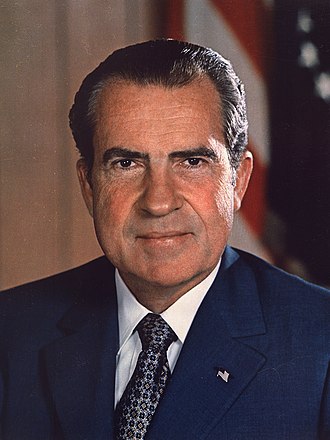
Richard M. Nixon served as the 37th President of the United States from January 1969 until his resignation in August 1974. In February 1971, he ordered the installation of a secret voice-activated taping system in the White House to preserve a historical record of his administration. Until the system's existence was revealed and dismantled in July 1973, the tapes captured Nixon directing major foreign policy initiatives, such as the opening to China, as well as his central role in the Watergate cover-up.
What Nixon talks about on the tapes
White House operations 4,718Presidential scheduling 2,225Public relations 1,784Presidential schedule 1,782Vietnam War 1,693Logistics 1,650Manolo Sanchez 1,626White House communications 1,400White House administration 1,399Presidential communication 1,243Henry Kissinger 1,191Foreign Policy 1,183
Conversations (21,010)
— Page 141 of 211President Nixon and Stephen B. Bull met to coordinate the logistics for the upcoming signing ceremony of the 1973 Appropriations Act. The discussion focused on locating Alexander P. Butterfield to confirm the status of the legislation and determining the appropriate timing for the event. The participants also considered the necessity of an official photograph session to accompany the signing process.
President Nixon met with Alexander P. Butterfield and Stephen B. Bull to review his daily schedule and coordinate the logistics for upcoming executive actions. The participants focused on the signing ceremony for the 1973 Appropriations Act, specifically addressing the timing of the event and the coordination of press wire services and photography. The discussion also touched upon the physical arrangement of the office and the whereabouts of Press Secretary Ronald Ziegler.
President Nixon met with Alexander P. Butterfield to coordinate administrative logistics regarding his upcoming schedule and specific departmental reports. The discussion encompassed the Commerce Department's Office of Minority Business Enterprise annual report and the planning of a meeting with conservative Jewish editors. Additionally, the pair addressed personal matters, including the handling of a coin display case and potential personnel inquiries involving associates in New York.
President Nixon and Stephen B. Bull met to briefly review administrative details regarding an upcoming presidential trip and finalize the associated scheduling. The discussion focused on coordinating Ronald L. Ziegler’s press briefings to ensure the official messaging aligned with the travel itinerary. No major policy decisions were made, as the conversation served primarily to manage logistical arrangements and staff preparations.
President Richard Nixon met briefly with his personal valet, Manolo Sanchez, in the Old Executive Office Building. The meeting centered on a routine exchange of instructions and requests regarding the President's personal schedule or administrative needs. No major policy matters were addressed, as the interaction was limited to the functional duties of the President's staff.
President Nixon met with H.R. Haldeman and Henry Kissinger to navigate the delicate political and diplomatic challenges surrounding the Vietnam peace negotiations just days before the 1972 election. The discussion focused on analyzing Hanoi’s recent public statements, the diplomatic fallout involving South Vietnamese President Nguyen Van Thieu, and the risks of a potential 'build-up and let-down' effect among American voters. The participants assessed the impact of the peace talks on the campaign, specifically weighing the optics of a settlement against George McGovern's electoral strategy and current polling data.
President Nixon contacted the White House operator to facilitate a telephone connection. The primary purpose of the brief exchange was to place a call to Stephen B. Bull. No further substantive policy matters were addressed during this interaction.
President Nixon contacted the White House operator to place a personal telephone call to First Lady Pat Nixon. The brief interaction served as a logistical request for the operator to connect the President to his wife. No substantive political or policy discussions took place during this brief communication exchange.
President Richard Nixon met with his personal valet, Manolo Sanchez, in the Old Executive Office Building. The brief interaction, lasting less than ten minutes, consisted primarily of personal matters that were subsequently withdrawn from the public record. No official policy decisions or political developments were recorded during this time.
President Nixon consulted with the White House operator to facilitate an outgoing call. The brief exchange focused on establishing a telephonic connection to an external party. No substantive policy discussions or major developments occurred during this administrative interaction.
President Nixon met with his personal valet, Manolo Sanchez, to coordinate the logistics of his afternoon schedule. During the brief interaction, the President confirmed his plans to return to the Oval Office by approximately 2:30 pm. No other substantive policy or political matters were addressed during this exchange.
President Nixon requested that the White House operator place a phone call to a specific party. The brief interaction focused on facilitating telephonic communication through the White House switchboard. No substantive policy discussions or complex developments occurred during this administrative exchange.
President Richard Nixon and First Lady Pat Nixon engaged in a brief personal telephone exchange. The conversation consisted entirely of private matters, as noted by the withdrawal of the recording segment from the public record. No official business or policy decisions were documented during this short interaction.
President Richard Nixon met briefly with First Lady Pat Nixon in his Old Executive Office Building suite. Given the duration of only one minute and the absence of a transcript, the meeting served as a routine personal interaction rather than a substantive policy discussion. No significant presidential actions or strategic decisions were recorded during this brief exchange.
President Nixon and Stephen B. Bull spoke to coordinate the logistics for an afternoon signing ceremony and an associated photograph session. Nixon instructed Bull to schedule the photograph session for 3:00 pm. Bull confirmed the arrangement and finalized the plan to meet the President shortly thereafter.
President Nixon met with his aide, Stephen B. Bull, for a brief exchange regarding a specific definition of freedom. The conversation appears to be a follow-up or a continuation of remarks initiated in a prior discussion. No further policy decisions or substantive administrative actions were recorded during this one-minute interaction.
President Nixon and H. R. Haldeman met in the Old Executive Office Building to discuss internal administrative matters and strategy during the final week of the 1972 presidential campaign. The majority of the conversation consists of a personal, non-recordable segment that was subsequently withdrawn from the public archive. No transcript is available to verify the specific subjects addressed during the remainder of the interaction.
President Nixon and Alexander P. Butterfield met to coordinate the President's immediate administrative schedule. They prioritized the signing of the 1973 Appropriations Act to ensure its swift completion. The discussion concluded with a focus on finalizing this legislative action and arranging a subsequent meeting with Henry Kissinger.
President Nixon met with his aide, Stephen B. Bull, to review the President’s upcoming daily schedule. The discussion centered on finalizing arrangements for the signing ceremony of the 1973 Appropriations Act. Additionally, the two coordinated logistics regarding the President’s pending engagement with Henry A. Kissinger.
President Nixon and H.R. Haldeman reviewed logistics for upcoming presidential travel, focusing on campaign appearances at O'Hare International Airport and potential trips to Oklahoma and North Carolina. They weighed the strategic benefits of specific crowd locations and decided to finalize and announce the Illinois schedule immediately while keeping other travel plans tentative. The discussion also included a brief interlude involving Stephen B. Bull regarding a signing ceremony for the 1973 Appropriations Act.
President Nixon met with a White House photographer and members of the press to conduct a photo session following the signing of the 1973 Appropriations Act. The discussion focused on the ceremonial distribution of pens used during the signing and the details of various legislative bills approved or vetoed by the President. Alexander P. Butterfield was also referenced during the brief proceedings.
President Nixon met with his aide Stephen B. Bull to coordinate the President's upcoming schedule. The brief discussion centered on managing the President's professional calendar, with specific attention directed toward an upcoming engagement involving National Security Advisor Henry Kissinger. No other substantive policy matters were addressed during this short administrative check-in.
President Nixon and H.R. Haldeman discussed the consolidation of various media materials, including radio tapes, television footage, and correspondence, for archival purposes. The President explicitly instructed Haldeman to ensure that his personal radio tapes were included in this collection. This exchange reflects the administration's focus on managing and documenting the President's public record.
President Nixon and Henry Kissinger discussed the status of ongoing peace negotiations with North Vietnam, focusing on their commitment to securing a definitive peace agreement rather than an armistice. They evaluated current public and media reaction to the administration's firm stance, noting the potential for political advantage leading up to the upcoming election. The President and Kissinger also coordinated plans to manage future diplomatic communications and signaled their intent to maintain military pressure until a satisfactory resolution is finalized.
President Nixon and Stephen B. Bull concluded a brief administrative interaction in the Oval Office. The exchange consisted of short pleasantries regarding their next meeting. No substantive policy matters or official decisions were recorded during this brief encounter.
President Nixon, H.R. Haldeman, and Ronald Ziegler met to discuss campaign strategy and public perception regarding the Vietnam peace negotiations, recent polling data, and political corruption allegations. The President expressed frustration with the opposition's focus on controversial social issues and emphasized a commitment to achieving a "peace without surrender" rather than rushing an agreement before the election. They also coordinated details for the President’s upcoming travel schedule and refined their media messaging approach, specifically advising staff to avoid being overly defensive or "objectively" honest when countering political attacks.
President Nixon and Charles Colson met to discuss campaign strategy and domestic political issues just days before the 1972 election. They reviewed the status of Vietnam peace negotiations, agreeing that a settlement should not be announced prior to the election to avoid domestic political interference. Additionally, the pair strategized on post-election plans to challenge television media outlets through FCC regulatory actions and discussed their low opinion of the liberal media's election coverage.
President Nixon consulted with an unidentified staff member regarding the public relations strategy for a scheduled Halloween event. The discussion centered on promoting the party, with specific focus on ensuring media coverage for a display featuring Tricia Nixon Cox. The President requested that Richard A. Moore and Ronald L. Ziegler coordinate the promotional efforts to maximize the event's visibility.
President Nixon and Charles Colson met to discuss campaign strategy and public relations efforts leading up to the 1972 election, specifically focusing on the influence of Vietnam peace negotiations on voter sentiment. The two evaluated recent polling data, including insights from Albert Sindlinger and George Gallup, while coordinating messaging for the President's upcoming national address. Additionally, they reviewed antagonistic media coverage from the Washington Post and strategized how to handle persistent political attacks regarding the Watergate scandal and campaign corruption.
President Nixon initiates a brief administrative request for the White House operator to connect him with Press Secretary Ronald L. Ziegler. The interaction serves solely as a logistical bridge to facilitate direct communication with his staff. No substantive policy discussions or major decisions occurred during this brief exchange.
President Nixon and Press Secretary Ronald Ziegler discuss media coverage of the administration's stance on Vietnam peace negotiations, specifically emphasizing the President's commitment to avoiding being stampeded into a premature agreement. They note that the news networks have downplayed Hanoi’s recent statements regarding deadlines, while also expressing disappointment that Nelson Rockefeller’s recent efforts have not received significant television coverage. The discussion centers on shaping the administration's public narrative and monitoring the effectiveness of their messaging across major broadcast networks.
President Nixon contacted the White House operator to initiate a telephone call to his special counsel, Charles W. Colson. The interaction served as a brief administrative request to facilitate direct communication with a key staff member. No further substantive discussion took place during this brief exchange.
President Nixon and Charles W. Colson discussed final 1972 re-election campaign strategies, focusing on leveraging public support to strengthen the President's hand in upcoming international negotiations with Vietnam, the Soviet Union, and China. Nixon emphasized the necessity of framing the election as a crucial vote of confidence that would be closely monitored by global powers. Additionally, they evaluated recent media successes regarding legislation for senior citizens and coordinated plans for saturating radio broadcasts to maintain electoral momentum.
President Nixon contacted the White House operator to facilitate a private telephone call to his daughter, Tricia Nixon Cox. The brief exchange served solely as a logistical request to establish the connection. No other policy matters or administrative developments were discussed during the interaction.
President Nixon held a brief, informal telephone conversation with his daughter, Tricia Nixon Cox. The exchange consisted of personal pleasantries and lacked substantive policy or political discussion. No official decisions or significant developments occurred during this brief interaction.
President Nixon and his daughter, Tricia Nixon Cox, briefly discuss the logistics of an upcoming film screening. The President consults with Tricia regarding the preparation of the film by White House projectionist Paul Fisher and the attendance of Patrick and Shelley Buchanan. The conversation serves as a brief coordination call to ensure the details of the personal event are arranged.
President Nixon met with Marjorie P. Acker to discuss administrative coordination regarding his upcoming "Look to the Future" radio and television address. The conversation focused on clarifying instructions for Acker regarding the handling of sensitive Vietnam War-related materials intended for Henry Kissinger and speechwriter Raymond K. Price, Jr. Nixon directed Acker to consult with the appropriate staff to resolve confusion over the clearance and routing of these specific segments.
President Nixon consults with speechwriter Raymond K. Price, Jr. regarding the status of missing material from Henry Kissinger intended for an upcoming televised address on Vietnam. Disturbed by the delay, the President directs Price to contact Kissinger immediately to expedite the delivery of the requested text. Nixon also notes his upcoming schedule, including a meeting with Cardinal John Krol, emphasizing the need to integrate Kissinger's contribution into his speech preparations by that afternoon.
President Nixon and speechwriter Raymond K. Price, Jr. confer briefly to coordinate the drafting of a short speech segment or document. The President instructs Price to finalize the text after reviewing a colleague’s submission to ensure the material aligns with broader objectives. The discussion centers on immediate administrative drafting tasks and the necessity for efficient communication regarding the document's structure.
President Nixon contacted the White House operator to facilitate a personal phone call to professional football player Sonny Jurgensen. The President requested that the operator locate Jurgensen, who was reportedly a patient at Georgetown Hospital at the time. This brief exchange served solely to initiate the connection for this specific communication.
President Nixon contacted the White House operator to facilitate a telephone connection with speechwriter Raymond K. Price, Jr. This brief administrative interaction served as a logistical step to initiate a direct conversation between the President and a key member of his communications staff. No further substantive discussion occurred during this call beyond the request for the operator's assistance.
President Nixon consulted with the White House operator regarding the status of professional football player Sonny Jurgensen. The operator informed the President that Jurgensen was currently hospitalized at Georgetown University Hospital. This brief exchange served to confirm the athlete's location for the President.
President Nixon spoke briefly with a White House operator to facilitate an outgoing call. No substantive policy matters or political discussions were recorded during this brief administrative exchange. The interaction served solely as a technical connection to initiate communication with another party.
President Nixon and speechwriter Raymond K. Price, Jr. discuss necessary revisions to an upcoming television address regarding Vietnam, specifically criticizing current drafts as inadequate. Nixon directs Price to consult with Press Secretary Ronald L. Ziegler to better align the speech with his recent strategic briefings. Price is instructed to refine the material and meet with the President later that day for further review.
President Nixon met with speechwriter Raymond K. Price, Jr. to coordinate follow-up efforts regarding discussions held with an individual named Saylor. Nixon expressed a desire to delve deeper into specific topics previously touched upon during a briefing session. The brief exchange focused on establishing better communication alignment between the two men and scheduling further collaboration.
President Nixon contacted the White House operator to initiate a telephone call to speechwriter Raymond K. Price, Jr. The brief interaction served solely as a functional request to connect with his advisor. No further substantive policy matters were discussed during this exchange.
President Nixon initiated a brief contact with the White House operator to facilitate an outgoing call. The interaction served primarily as a logistical bridge to connect the President with another party. No substantive policy discussions or significant political developments occurred during this brief exchange.
President Nixon coordinated with speechwriter Raymond K. Price, Jr. to prepare for an upcoming televised address. Nixon directed Price to consult with Ronald Ziegler regarding specific thematic points, dismissing a draft prepared by Henry Kissinger as inadequate for his intended message. The two agreed to meet at 10:00 am to further refine the speech's structure and core arguments.
President Nixon and speechwriter Raymond K. Price, Jr. engaged in a brief discussion to reschedule an earlier meeting due to a conflict with an appointment involving "Coral." The President directed Price to coordinate with "Cigar" and encouraged him to speak with Ross to gain a better sense of the current situation. The brief exchange focused primarily on logistics and setting a new time for the two to consult.
President Nixon called Washington Redskins quarterback Sonny Jurgensen at the hospital to express his personal sympathies following a recent injury. During the conversation, the President discouraged Jurgensen from retiring, urging him to continue his football career by highlighting his unique talent and competitive spirit. Nixon cited the example of other athletes returning from injury to encourage Jurgensen to pursue a comeback.
President Nixon held a brief telephone conversation with Christian A. "Sonny" Jurgensen to offer encouragement following Jurgensen's recent hospitalization due to an injury. Nixon expressed sympathy regarding the incident and urged Jurgensen to maintain his morale and competitive spirit despite the setback. The conversation served primarily as a gesture of personal support rather than a discussion of administrative or policy matters.
President Nixon met with Marjorie P. Acker to discuss the drafting of his upcoming radio and television address titled "Look to the Future." The brief session also addressed the scheduling of a follow-up meeting with speechwriter Patrick J. Buchanan to refine the address. This consultation served to coordinate the President's public communications strategy as the administration prepared for the impending broadcast.
President Nixon met with Patrick J. Buchanan to discuss campaign strategy, press relations, and managing the political fallout from the 1972 presidential election. The two focused on countering the perceived double standards of the liberal media, which they argued were shielding George McGovern from accountability while unfairly attacking the Nixon administration. Nixon directed Buchanan to orchestrate a public counterattack, emphasizing the need to frame the election as a repudiation of radical ideologies—such as busing, welfare, and permissive social policies—rather than just a critique of the McGovern campaign's style.
President Nixon and Raymond K. Price, Jr. discussed the communication strategy for the final stretch of the 1972 presidential campaign, specifically evaluating the effectiveness of public rallies versus radio addresses. The President expressed frustration with disruptive hecklers and emphasized the need for controlled, broadcast-based messaging to reach a broader audience. A primary focus was finalizing a major speech titled 'Look to the Future,' where Nixon refined his rhetoric on 'peace with honor' regarding Vietnam, underscoring his refusal to be rushed into a settlement agreement by election-year deadlines.
President Nixon initiates a brief request for the White House operator to facilitate a meeting with his Special Counsel, Charles W. Colson. The President directs that the meeting take place at the Executive Office Building (EOB). No further substantive policy matters were discussed during this brief administrative exchange.
President Nixon initiates a request for the White House operator to place a telephone call to John A. Scali. This brief interaction serves as a logistical bridge to connect the President with his contact. No further substantive policy matters were discussed during this specific transmission.
President Nixon instructed the White House operator to draft a proposal regarding a specific building project. This brief interaction served as a directive for administrative support in documenting or formalizing plans for the structure. The conversation concluded immediately after the President issued the request.
President Nixon initiates a brief communication with the White House operator to facilitate an outgoing call. The President confirms his readiness to connect, requesting assistance to establish a line for an upcoming conversation. No substantive policy discussions or complex directives occur during this short administrative exchange.
President Nixon consulted with John A. Scali regarding a personal phone call the President made to professional football player Sonny Jurgensen to offer encouragement following a professional setback. Nixon expressed concern about the optics of the gesture and explicitly instructed Scali to keep the call private. He authorized Scali to confirm the conversation only if the information were to leak to the public, emphasizing that he did not want to appear to be exploiting the athlete's situation.
President Nixon consulted with John A. Scali regarding a personal matter involving a potential future commitment. The brief exchange centered on Nixon’s recent conversation with professional football player Sonny Jurgensen and the President's deliberation over an unspecified offer or request. Nixon ultimately expressed a desire to keep the matter private, concluding the discussion without any further formal action.
President Nixon instructed the White House operator to connect a call to former Boston Mayor John F. Collins. This outreach was initiated at the request of special counsel Charles W. Colson. The call was directed to be routed specifically to the President’s office telephone.
President Nixon met with Henry Kissinger and Charles Colson to coordinate strategy for his 'Look to the Future' radio address and manage the final stretch of the 1972 presidential campaign. Discussions centered on Vietnam negotiations, with the President emphasizing the need to avoid a rushed settlement for political gain, and on countering George McGovern through aggressive messaging on social issues like busing and welfare. The group reviewed campaign tactics, including analyzing public sentiment in response to violent demonstrators in Boston and utilizing radio to maintain electoral pressure.
President Nixon directs the White House operator to contact Mr. Holloman and request his presence at a meeting in the Executive Office Building. This brief administrative exchange serves to coordinate a session between the President and a key staff member. No further substantive details regarding the purpose or agenda of the meeting are provided.
President Nixon held a brief meeting with his longtime valet, Manolo Sanchez, at the Old Executive Office Building. The interaction was limited to the delivery of refreshments to the President. No substantive political or policy matters were discussed during this brief interval.
President Nixon and H.R. Haldeman met to coordinate final logistical and strategic planning for the closing stages of the 1972 presidential campaign. The discussion focused on scheduling upcoming travel and campaign appearances in states like North Carolina and New Mexico, while also addressing technical preparations and staging requirements for a televised address. The two also assessed media coverage and public opinion polls to refine their messaging in the final days before the election.
President Nixon instructed the White House operator to contact Charles W. Colson. The President requested that Colson report to his office in the Executive Office Building for a meeting. This administrative request facilitated a direct, immediate consultation between Nixon and his Special Counsel.
President Nixon spoke with the White House operator to facilitate a telephonic connection. This brief exchange served as a logistical step to initiate an outgoing call to another party. No substantive policy discussions or executive decisions occurred during this connection attempt.
President Nixon and Charles Colson met to discuss campaign strategy and the political climate just days before the 1972 presidential election. The discussion focused on recent public demonstrations in Boston, the perceived shift in support among blue-collar voters, and the electoral outlook in Massachusetts. The pair assessed the influence of figures like Ted Kennedy and George McGovern while evaluating key campaign issues, including the economy and voter motivation, to ensure a decisive victory.
President Nixon met with Zosimo Monson in the Old Executive Office Building for an brief, informal discussion. Due to the lack of a substantial recorded transcript, the specific purpose and substantive outcomes of the meeting remain unclear. The conversation appears to have been limited to brief greetings before the participant departed.
President Nixon and John Ehrlichman met to coordinate the content and strategy for an upcoming radio address titled “The Birthright of an American Child.” The discussion focused on refining a ten-point policy agenda to be presented during the speech. Nixon instructed Ehrlichman to take the necessary time to carefully review and finalize these specific goals to ensure the message was effectively crafted.
President Nixon met with his personal valet, Manolo Sanchez, in the Old Executive Office Building. The brief interaction focused on the service of coffee and concluded with the President dismissing Sanchez for the remainder of the day. No substantive policy matters or major administrative decisions were recorded during this engagement.
President Nixon met with his aide, Stephen B. Bull, at the Old Executive Office Building to discuss administrative tasks and logistical arrangements. While the specific transcript is unavailable, the meeting focused on the internal management of presidential affairs and the handling of sensitive materials. The session concluded with Bull departing the office to execute the administrative directives provided by the President.
President Nixon and John Ehrlichman met to strategize for the final days of the 1972 presidential campaign, focusing on the use of radio addresses to communicate directly with the public while avoiding the hostility of traditional campaign rallies. They discussed the administration's platform, including domestic policy issues and racial topics, and coordinated the development of a series of speeches. A significant portion of the conversation centered on managing the ongoing Watergate scandal, with Nixon and Ehrlichman exploring the potential for a White House-led internal investigation to control the narrative and minimize political damage following the election.
President Nixon met with an unidentified individual in the Old Executive Office Building to discuss an unspecified matter. The dialogue recorded is fragmentary and inconclusive, consisting largely of an administrative request for refreshments. No substantive policy decisions or political developments were captured in this brief exchange.
President Nixon and Henry Kissinger deliberate on potential diplomatic emissaries to South Vietnamese President Nguyen Van Thieu, considering figures such as William F. Buckley Jr. The discussion shifts to evaluating the qualifications and suitability of high-level diplomatic appointees, specifically debating the effectiveness of Ambassador Kenneth Rush. The conversation highlights the administration's strategic search for an envoy capable of managing delicate negotiations with the South Vietnamese government.
President Nixon and John Ehrlichman met to discuss the potential reorganization of the executive branch and the status of leadership within the Justice Department. The conversation focused on the tenure of FBI Director L. Patrick Gray and Attorney General Richard G. Kleindienst, specifically addressing their performance and the political ramifications of their potential retention or resignation. Ehrlichman provided updates on congressional and press reactions, while the two weighed the impact of a departmental overhaul on these personnel decisions.
President Nixon met with Henry Kissinger and later John Cardinal Krol to discuss the sensitive status of Vietnam peace negotiations and U.S.-Poland relations. Nixon and Kissinger evaluated the difficult diplomatic position of South Vietnamese President Nguyen Van Thieu, specifically addressing Thieu's resistance to a proposed settlement and the potential for a letter from the U.S. to compel his cooperation. Meanwhile, Cardinal Krol shared insights from his recent visit to Poland, highlighting the endurance of the Roman Catholic Church under communist rule and the Polish people's yearning for greater independence from Soviet influence. The conversation concluded with discussions on the necessity of maintaining pressure on North Vietnam while navigating the delicate geopolitical balance required to secure a peace agreement after the 1972 election.
President Nixon met with Raymond K. Price, Jr., and consulted with Henry Kissinger via telephone to finalize a draft of his upcoming "Look to the Future" speech. The discussion primarily focused on refining the Vietnam section of the address, specifically addressing the ongoing peace negotiations, South Vietnamese President Nguyen Van Thieu's concerns regarding U.S. withdrawal, and the planned cease-fire terms. Nixon provided revisions on the speech's tone and length to ensure the administration's stance on the conflict and political platform was clearly communicated before the 1972 election.
President Nixon instructed the White House operator to connect him with Charles W. Colson for a meeting. This brief exchange served as a procedural request to initiate a direct consultation with one of his key advisors. No substantive policy matters were discussed during this initial administrative communication.
President Nixon met with his senior advisors to strategize for the final days of the 1972 presidential campaign, focusing on polling analysis, press engagement, and the handling of hecklers at campaign events. Much of the session was dedicated to reviewing and revising the text of the President's upcoming "Look to the Future" speech, specifically addressing the sensitive Vietnam War section and the ongoing peace negotiations. Nixon emphasized the importance of delivering the speech at a deliberate, measured pace to effectively convey his vision for the future, domestic achievements, and his foreign policy legacy.
President Nixon contacted the White House operator to place a direct call to his Press Secretary, Ronald L. Ziegler. The conversation served solely as a logistical request to facilitate communication with a key member of his staff. No further substantive policy matters or decisions were discussed during this brief exchange.
President Nixon contacted the White House operator to place a personal telephone call to First Lady Pat Nixon. This brief exchange served as a routine administrative request to facilitate communication between the President and his wife. No substantive political or policy matters were discussed during this connection.
President Nixon, H.R. Haldeman, Henry Kissinger, and other staff members met to finalize the President's upcoming "Look to the Future" campaign speech and coordinate media strategy for the final days of the 1972 election. The discussion focused on television airtime purchases, speech pacing and editing, and managing campaign appearances in the context of ongoing Vietnam peace negotiations. The President also addressed organizational plans for the Republican National Committee and broader GOP candidate support efforts.
President Richard Nixon engaged in a brief telephone conversation with First Lady Pat Nixon. The discussion consisted entirely of personal matters, as indicated by the withdrawal of the segment under privacy and personal returnable guidelines. No official policy decisions or administrative actions were recorded during this exchange.
President Nixon initiated a request to the White House operator to place a telephone call to Thomas A. Pappas. This brief exchange served solely as an administrative instruction to connect the President with Pappas for an unrecorded subsequent conversation. No further substantive policy matters or decisions were discussed during this brief interaction.
President Nixon instructed the White House operator to manage outgoing communications with political associates Thomas A. Pappas and Charles W. Colson. After the operator reported that Pappas was unavailable, Nixon requested a follow-up attempt for that call in thirty minutes. He then directed the operator to immediately connect him with Colson instead.
President Nixon and Charles Colson discuss campaign strategy in the final days before the 1972 election, focusing on the political benefits of recent confrontations between campaign hecklers and supporters. They agree that these incidents, along with their narrative surrounding Vietnam peace negotiations, are damaging Senator George McGovern's momentum and public image. Additionally, they discuss utilizing favorable economic data regarding wholesale prices and framing the election as a vital vote of confidence for the President's diplomatic efforts with the Soviet Union and China.
President Nixon dictated a memorandum for his personal files during this session in the Old Executive Office Building. The recording consists primarily of a segment designated as a personal, returnable item. No additional participants were present, and no further details regarding the substantive content are publicly available.
President Nixon and H.R. Haldeman met to coordinate the President's upcoming schedule and communications strategy. The discussion focused on managing logistics for an upcoming telephone call with Senator John G. Tower, as well as travel plans involving Chicago and Rhode Island. The pair concluded by confirming the finalized arrangements for these presidential engagements.
President Nixon utilized this session in his Old Executive Office Building office to dictate a memorandum for his personal records. The recording serves as a formal documentation of administrative or political matters, though the specific substance remains classified under a withdrawn item. This dictation functions as a continuation of his earlier efforts to memorialize key reflections or procedural instructions.
President Nixon met with an unidentified individual in the Old Executive Office Building to conduct a brief private discussion. The recording captures a seven-second segment that was subsequently withdrawn for personal reasons, leaving the primary substance of the meeting inaccessible. No significant administrative or policy decisions were documented during the remainder of the session.
President Nixon and his daughter, Julie Nixon Eisenhower, discuss the political roles and contributions of key Republican figures in Congress. The President highlights the significance of Congressman Les Arends as an indispensable leader regarding national defense policy and contrasts his role with that of Congressman Gerald Ford. The conversation serves as an informal assessment of these House leaders' loyalty and their strategic importance to the administration's goals.
President Nixon met briefly with his daughter, Julie Nixon Eisenhower, in his office to discuss personal matters. The conversation was informal and focused on family updates rather than official government business. No significant policy decisions or administrative actions were recorded during this short encounter.
President Nixon contacted the White House operator to facilitate a communication request. The primary purpose of this brief call was to place a telephone connection to Stephen B. Bull. No further administrative or policy discussions were recorded during this interaction.
President Nixon contacted the White House operator to place an outgoing call to his personal secretary, Rose Mary Woods. The brief exchange served as a procedural request to facilitate this communication. No further policy or administrative business was discussed during this short connection.
President Nixon instructed the White House operator to be more assertive or bold in her telephone operations. This brief directive served to set a tone for communication protocols within the Executive Office Building. No further substantive matters were addressed during this short exchange.
President Nixon consulted with the White House operator to facilitate an outgoing call. The brief exchange focused on establishing a connection with another party. No substantive policy discussions or major decisions occurred during this brief administrative interaction.
President Nixon consulted with his aide, Stephen B. Bull, to coordinate adjustments to his daily schedule and upcoming obligations. The two finalized plans for a 5:00 PM campaign taping session, with the President explicitly requesting that stand-ins be used for technical preparations until his arrival. Additionally, they rescheduled an appointment with Dr. W. Kenneth Riland for 5:30 PM and confirmed a haircut for the President at 12:30 PM.
President Nixon and Stephen B. Bull briefly coordinate logistics regarding an upcoming meeting and the potential involvement of an individual named Rylan. The President explicitly instructs Bull to schedule Rylan for 5:30 pm and expresses his intent to avoid personal participation in the earlier session. The discussion focuses on managing meeting protocols, including the use of stand-ins and verification procedures for the proceedings.
President Nixon consulted with a White House operator to facilitate a connection regarding internal administrative or personal communications. The dialogue focused on coordinating a call involving Rose Mary Woods and Marjorie P. Acker. No substantive policy decisions were made during this brief operational exchange.