Nixon, Richard M. (President)
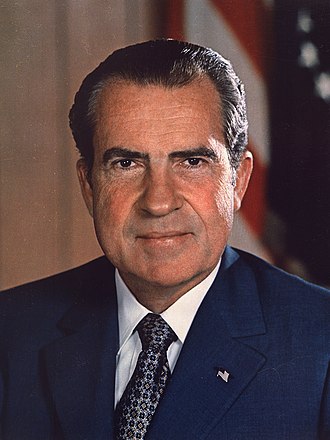
Richard M. Nixon served as the 37th President of the United States from January 1969 until his resignation in August 1974. In February 1971, he ordered the installation of a secret voice-activated taping system in the White House to preserve a historical record of his administration. Until the system's existence was revealed and dismantled in July 1973, the tapes captured Nixon directing major foreign policy initiatives, such as the opening to China, as well as his central role in the Watergate cover-up.
What Nixon talks about on the tapes
White House operations 4,718Presidential scheduling 2,225Public relations 1,784Presidential schedule 1,782Vietnam War 1,693Logistics 1,650Manolo Sanchez 1,626White House communications 1,400White House administration 1,399Presidential communication 1,243Henry Kissinger 1,191Foreign Policy 1,183
Conversations (21,010)
— Page 140 of 211President Richard Nixon met with Henry Kissinger to briefly coordinate the National Security Advisor's upcoming schedule. The discussion focused on logistical planning for a forthcoming high-level meeting. No substantive policy decisions were reached during this brief exchange.
President Nixon held a brief administrative interaction with a White House operator to facilitate an outgoing call. The discussion served as a procedural necessity for connecting the President to a third party. No substantive policy matters or official decisions were recorded during this brief bridge in the communication process.
President Nixon consulted with his aide, Stephen B. Bull, to clarify the logistics of an ethnic press reception scheduled for later that day. Bull confirmed that the event was set for 5:00 p.m. and would be hosted by First Lady Pat Nixon. The President concluded the call by instructing Bull to provide a reminder before the event to ensure his attendance despite a busy schedule.
President Nixon consults with his aide, Stephen B. Bull, regarding the details and scheduling of an upcoming meeting with the ethnic press. Nixon requests that Bull provide a reminder for the 5:00 p.m. appointment to ensure he remains aware of the commitment despite his busy schedule. The brief exchange serves as a logistical check-in to coordinate the President's late-afternoon calendar.
President Nixon directs the White House operator to summon Patrick J. Buchanan for a meeting at the Executive Office Building. This brief exchange serves as an administrative directive to coordinate a direct consultation with a key staff member. No further policy or strategic matters were discussed during this request.
President Nixon directs the White House operator to summon Pat Buchanan to his office in the Old Executive Office Building. This brief directive facilitates a follow-up consultation with his aide. No further substantive details are provided in this specific recording.
President Nixon, Patrick Buchanan, and Henry Kissinger met to strategize an aggressive public relations campaign in the final days before the 1972 election. Nixon instructed his team to produce a 'White Paper' that would contrast his administration's 'peace with honor' approach to Vietnam against the 'peace with surrender' policies of George McGovern, while also countering media narratives regarding Watergate and administration campaign practices. The participants emphasized the need to frame the recent Vietnam peace negotiations as a successful, hard-won achievement driven by the President's firm May 1972 policies, rather than as a rushed election-year political maneuver.
President Nixon met briefly with his valet, Manolo Sanchez, in the Old Executive Office Building. The primary purpose of the meeting was to coordinate the President's schedule regarding a forthcoming appointment with H.R. "Bob" Haldeman. The exchange concluded quickly, with Sanchez departing shortly thereafter.
President Nixon instructed the White House operator to contact Charles W. Colson. The President requested that Colson report to his office in the Executive Office Building for a meeting. This directive initiated a subsequent discussion between the two men.
President Nixon contacted the White House operator to place an outgoing call to Deputy Assistant to the President Dwight L. Chapin. The exchange served as a routine administrative request to facilitate communication with a key staff member. No further policy or substantive matters were discussed during this brief connection.
President Nixon and Dwight L. Chapin engaged in a brief telephone conversation regarding personal matters. Due to the withdrawal of the discussion content for security or privacy reasons, no specific policy decisions or political actions were recorded. The exchange serves as a record of administrative communication between the President and his Deputy Assistant.
President Nixon held a brief administrative interaction with a White House operator in the Executive Office Building. The exchange served as a logistical contact point, likely to facilitate a subsequent communication or connect a call. No substantive policy matters or major developments were recorded during this brief administrative check-in.
President Nixon initiates a brief request for the White House operator to connect him with a specific individual named David. This interaction serves as a routine administrative bridge to facilitate a direct communication line for the President. No further substantive policy matters or decisions were recorded during this brief exchange.
President Nixon met with his Deputy Assistant, Dwight L. Chapin, for a brief discussion in the Old Executive Office Building. While no transcript is available for this two-minute exchange, the meeting occurred during the final stages of the 1972 presidential campaign. The brief duration suggests an administrative check-in or the communication of urgent tactical instructions regarding campaign logistics or scheduling.
President Nixon and Charles Colson coordinated efforts to gauge public sentiment regarding potential Vietnam peace negotiations through various polling contacts. Colson engaged with Dick Howard to analyze recent poll data from Albert Sindlinger while simultaneously arranging a briefing with pollster Louis Harris. These actions underscore the administration's focus on monitoring domestic reactions to foreign policy developments in the final stages of the 1972 election campaign.
President Nixon met with Charles Colson, H.R. Haldeman, and Henry Kissinger to strategize for the final weeks of the 1972 presidential campaign. The discussion centered on monitoring polling data, countering George McGovern’s platform—particularly regarding Vietnam—and maintaining a strong public image of "peace with honor." Nixon emphasized the importance of aggressive political messaging, including the use of surrogates and media tactics to neutralize negative press and emphasize the administration's foreign policy achievements.
President Nixon met with his aide, Stephen B. Bull, to review and finalize details regarding the President’s upcoming daily schedule. The discussion focused specifically on the inclusion of Harold Lee within the day's appointments. Following the brief consultation, Bull departed the Oval Office to facilitate these administrative arrangements.
President Nixon and H.R. Haldeman discuss the political landscape regarding public opposition, specifically focusing on the intensity of anti-war sentiment among student demonstrators. The conversation centers on the controversy surrounding amnesty, with the President concluding that the general public strongly opposes the concept despite the advocacy of activist groups. They also touch upon broader cultural and political tensions, noting the hostile slogans and diverse grievances—ranging from environmental concerns to abortion—expressed by protesters at institutions like Harvard.
President Nixon met with Alexander P. Butterfield to finalize administrative tasks regarding the President's daily schedule and pending document signings. The discussion focused on the processing of specific legislative items, including a memorandum of disapproval for a vetoed bill and House Resolution 1. The session concluded with instructions for the scheduling of these formal actions.
President Nixon and Stephen B. Bull met briefly to review the President's upcoming daily schedule. The discussion focused on logistics, specifically concerning an appointment with Harold Lee. The meeting concluded immediately after these administrative details were addressed.
President Nixon met with Harold Lee to discuss international relations, specifically emphasizing the strategic importance of engaging with the People's Republic of China to maintain a balance of power against the Soviet Union. The conversation touched upon the future of U.S.-Japan security arrangements, the expected conclusion of the Vietnam War, and the administration's political standing among American voters heading into the 1972 election. Nixon articulated his pragmatic approach to foreign policy, noting the necessity of focusing on mutual interests rather than trust when dealing with global adversaries.
President Nixon and Press Secretary Ronald L. Ziegler held a brief meeting to coordinate logistics regarding the President's radio address scheduled for that day. They discussed media coverage, specifically focusing on the wire service reports and a forthcoming photographic session with the press. The conversation functioned primarily as a final scheduling update to ensure synchronized press engagement following the broadcast.
President Nixon met with members of the Committee on the Health Services Industry, along with administration officials including Herbert Stein and Donald Rumsfeld, to address the escalating costs of medical care. The discussion centered on balancing price controls with the need to maintain quality, specifically debating how to curb the proliferation of unnecessary services and the duplication of facilities without stifling the voluntary health system. Nixon emphasized the administration's goal of fostering cooperation with the medical profession to ensure federal health spending remains efficient and avoids a shift toward socialized medicine.
President Nixon instructed the White House operator to place an outgoing call to Secretary of Agriculture Earl L. Butz. This brief communication served strictly as a request for administrative assistance to facilitate the connection. No substantive policy discussions occurred during this exchange.
President Nixon met with various staff and visitors, including H.R. Haldeman and John Ehrlichman, to coordinate end-of-campaign activities and legislative priorities. Key decisions included the veto of the Older Americans bill and the strategic timing of further bill signings to maintain positive press coverage. The group also discussed campaign surrogates, including Senator Robert Dole, and planned polling efforts to gauge public sentiment on the Vietnam War and presidential approval ratings.
President Nixon and Secretary of Agriculture Earl L. Butz discuss the favorable reception of the President's recent farm radio address and coordinate plans to distribute the recording to key electoral battleground states. Butz confirms that the Committee to Re-elect the President is actively mobilizing farm support in states like Ohio, Illinois, and Wisconsin, while focusing on California's Central Valley. The two men also observe that the political impact of the Watergate scandal is significantly less pronounced in the Western states than in the Eastern media.
President Richard Nixon met with H.R. Haldeman in the Old Executive Office Building to review the President's upcoming daily schedule and agenda. The discussion focused on coordinating upcoming engagements and managing time commitments during the final weeks of the 1972 campaign season. No specific policy decisions were finalized during this logistical review session.
President Nixon met with his personal valet, Manolo Sanchez, in the Old Executive Office Building to conduct routine administrative duties. The brief discussion primarily concerned the selection of the President's upcoming meal, specifically focusing on steak and salad preferences. This interaction reflects the standard daily logistical arrangements managed by White House staff to support the President's schedule.
President Nixon met with his personal valet, Manolo Sanchez, in the Old Executive Office Building. The brief discussion primarily concerned scheduling, specifically Sanchez's request for a meeting with special counsel Charles W. Colson. No further significant policy matters or administrative decisions were recorded during this brief encounter.
President Nixon met with Charles W. Colson to analyze 1972 presidential campaign strategy in light of favorable polling data and the political implications of Vietnam negotiations. The discussion focused on framing the election as a clear choice between the administration's foreign policy achievements and George McGovern's perceived radicalism. The pair discussed coordinating media messaging, including potential television advertisements and the use of favorable polling trends, to solidify the President's landslide lead before concluding the meeting with a brief scheduling update from Stephen B. Bull.
President Nixon met with Senator Robert J. Dole and Charles W. Colson to devise campaign strategies for the final stretch of the 1972 presidential election. The discussion focused on countering George McGovern's campaign, managing the fallout from anti-war protests and hecklers, and framing the Vietnam peace negotiations as a victory for peace with honor rather than surrender. Additionally, the participants addressed public perception regarding the Watergate break-in, attempting to minimize its political impact by characterizing it as a misguided security operation.
President Nixon met with a delegation of Spanish-speaking campaign surrogates and administration officials to discuss Hispanic representation in the federal government and political outreach efforts for the 1972 election. Emphasizing his commitment to merit-based recruitment, Nixon urged the attendees to inspire Hispanic youth by demonstrating that progress is achievable through participation in the existing system. The participants shared their experiences regarding the administration's impact on their communities, specifically highlighting successes in urban mass transportation and economic advancement, while reinforcing their support for the President’s reelection.
President Nixon hosted Phillip V. Sanchez and his wife, Josefina, in the Oval Office for a brief photo session and gift presentation. During the meeting, the President presented Josefina Sanchez with a presidential seal pin and praised the couple, specifically noting the administration's appreciation for Phillip Sanchez’s work. The encounter concluded with a short interaction regarding the President's schedule with Stephen B. Bull.
President Nixon and Press Secretary Ronald Ziegler coordinated logistics for a requested film segment for the television adaptation of Theodore H. White's 'The Making of the President.' Nixon approved a five-minute silent filming session aboard Air Force One with Al Wasserman, while strictly prohibiting any interviews. Furthermore, the two discussed managing the press pool during upcoming trips to Ohio and California, with Nixon opting to personally engage with specific journalists during transit.
President Nixon met with Prime Minister Souvanna Phouma of Laos, accompanied by Henry Kissinger and Ambassador William Sullivan, to discuss the implications of the impending Vietnam peace settlement on the Laotian conflict. Phouma expressed concern that a ceasefire in Vietnam might allow North Vietnamese forces to exploit a timing lag to increase military pressure on Laos, and he requested continued U.S. military assistance to maintain defensive capabilities. Nixon reaffirmed U.S. commitment to regional stability and the independence of Southeast Asian nations, while both leaders agreed on the necessity of maintaining skepticism regarding North Vietnamese intentions despite any formal agreements.
President Nixon and H. R. Haldeman met to discuss the scheduling of upcoming national defense radio speeches and to review insights from Haldeman’s recent conversation with Billy Graham. The discussion focused on the political climate, including the impact of the Vietnam peace initiative, concerns regarding North Vietnam's potential interference with the 1972 election, and campaign strategy. Toward the end of the meeting, Stephen Bull joined the President to coordinate a reception for ethnic press and Heritage group leaders, emphasizing the need for efficiency in the President's schedule.
President Nixon requested that the White House operator locate Manolo Sanchez and ask him to come to the Lincoln Sitting Room. This brief communication served to facilitate a personal meeting between the President and his longtime valet. No other policy matters or substantive discussions were addressed during this exchange.
President Nixon contacted the White House operator to determine the location of his personal valet, Manolo Sanchez. Upon learning that Sanchez was away from the residence, the President briefly inquired about his whereabouts and acknowledged the situation. The brief exchange concluded with the President confirming he would manage his current needs with alternative assistance.
President Nixon met with his personal secretary, Rose Mary Woods, and unidentified staff to finalize revisions for a radio address scheduled for October 29, 1972. The discussion focused on crafting a critique of his opponent's national defense proposals by contrasting the status of U.S. nuclear forces in 1962 against the state of affairs in 1969. Nixon emphasized the necessity of highlighting the Soviet Union's nuclear buildup during a period of American inaction, directing staff to incorporate these points into the final speech draft.
President Nixon met with key advisors, including H.R. Haldeman, Henry Kissinger, and Charles Colson, to coordinate political messaging and media strategy in the final stretch of the 1972 presidential campaign. The discussion centered on countering recent CBS news reports regarding Watergate, managing public expectations for a Vietnam peace settlement, and finalizing the President’s radio speech schedule. Nixon emphasized the importance of aggressive, disciplined political messaging, instructing his team to ensure that surrogates and administration officials remained unified in their efforts to contrast his administration's position with George McGovern's campaign platforms.
President Nixon initiates a brief telephonic request through the White House operator to reach special counsel Charles W. Colson. This communication serves as an administrative effort to establish direct contact with a key advisor for an unspecified discussion. No further dialogue occurs beyond the initial connection request.
President Nixon and Charles Colson discuss campaign strategy in the final stretch of the 1972 election, focusing on leveraging recent public opinion polls and exploiting George McGovern's controversial comments regarding the election results. They evaluate the political benefits of highlighting the President’s recent rhetoric on national unity compared to McGovern's perceived lack of sportsmanship. Additionally, Colson updates the President on his plans to pursue a libel lawsuit against the Washington Post, and the two discuss maintaining leverage over CBS regarding coverage and interview requests.
President Nixon contacted the White House operator to place a personal telephone call to his daughter, Tricia Nixon Cox. This brief administrative interaction served solely to facilitate a private family communication. No substantive political or policy discussions took place during this exchange.
President Nixon held a brief meeting with an unidentified individual in the Old Executive Office Building. Due to the withdrawal of the primary content as a personal, returnable item, no substantive policy discussions or significant developments were recorded. The encounter concluded shortly after the participant offered a brief remark, leaving no clear record of the meeting's purpose.
President Richard Nixon met with his valet, Manolo Sanchez, in the Old Executive Office Building for a brief morning discussion. While the specific substance of the dialogue remains restricted due to the withdrawal of personal materials, the interaction highlights the routine, informal proximity maintained between the President and his personal staff. No significant policy decisions or official government actions were recorded during this brief encounter.
President Nixon met with his personal valet, Manolo Sanchez, in the Old Executive Office Building to review the day's upcoming itinerary. The brief discussion focused on coordinating the President's scheduled meetings with key staff members Charles W. Colson and H.R. Haldeman. No substantive policy decisions were recorded during this brief administrative briefing.
President Richard Nixon utilized this private meeting to dictate a formal memorandum for the record. The session served as an administrative action to document his perspectives or directives regarding ongoing sensitive matters. Given the classified status and withdrawal of the content, the recording remains restricted from public review.
President Nixon consulted with Alexander Haig regarding Henry Kissinger's whereabouts and potential availability to discuss ongoing developments. The conversation focused on coordinating the President's schedule and evaluating the latest updates from the Vietnam negotiations. Nixon ultimately requested that Haig meet with him personally to deliberate on these sensitive matters.
President Nixon met with Marjorie P. Acker in the Old Executive Office Building to discuss matters related to his official schedule. The brief conversation centered on administrative arrangements and the coordination of upcoming commitments. No major policy decisions were recorded during this interaction.
President Nixon met with Alexander Haig to outline the administration's strategic messaging regarding the ongoing Vietnam War negotiations and the impending 1972 election. They contrasted Nixon's "peace with honor" approach, which prioritized South Vietnamese self-determination and military sustainability, against George McGovern's plan, which they characterized as a surrender that would trigger a communist bloodbath. The discussion also addressed the need to manage President Thieu’s suspicions regarding Henry Kissinger and considered the potential dispatch of alternative representatives to secure a final agreement.
President Nixon met with an unknown staff member to coordinate scheduling logistics for key aides and upcoming travel. The discussion focused on arranging a meeting between the President and Charles W. Colson, as well as the travel itinerary for H.R. Haldeman. Nixon also addressed his own immediate schedule, specifically referencing a helicopter transport to Camp David.
President Nixon initiated a brief communication with the White House operator to facilitate an outgoing call. The discussion was purely administrative in nature, serving as a logistical bridge to connect the President to another party. No substantive policy matters or decisions were recorded during this brief exchange.
President Richard Nixon and his daughter, Tricia Nixon Cox, engaged in a brief personal telephone conversation. The exchange, which was officially recorded by the White House taping system, functioned as a private familial check-in rather than a deliberation on government policy or administrative business. No political or official decisions were documented during this short interaction.
President Nixon held a brief meeting with his daughter, Tricia Nixon Cox, in his office at the Old Executive Office Building. While the specific details of their discussion remain unrecorded, the interaction reflects the President's personal engagement with his family during the peak of his reelection campaign. No official policy decisions or administrative actions were documented during this short exchange.
President Nixon contacted the White House operator to facilitate a personal telephone call to his daughter, Tricia Nixon Cox. The conversation was strictly administrative in nature, serving as the bridge to initiate the private communication. No substantive policy matters or political topics were addressed during this brief exchange.
President Nixon met with Rose Mary Woods and spoke briefly with Tricia Nixon Cox to coordinate logistical details regarding his impending departure for Camp David and his upcoming schedule. The discussion primarily focused on administrative matters, including the handling of dictabelts for the President's private files and requests for revisions to a speech draft on urban policy prepared by Raymond K. Price, Jr. Woods was tasked with managing campaign surrogate schedules and ensuring the prompt delivery of speech materials for the President's review.
President Richard Nixon held a brief telephone conversation with his daughter, Tricia Nixon Cox. The recording consists entirely of a withdrawn segment classified as personal and returnable. No substantive policy matters or administrative decisions were documented in this interaction.
President Nixon met with his aide Stephen B. Bull to coordinate his daily schedule and upcoming logistical arrangements. The discussion focused on managing meetings with H.R. Haldeman and Charles W. Colson, as well as the President's planned travel to Camp David. They also reviewed preparations for his impending radio address regarding national defense policy and reviewed details from the previous day’s campaign trip.
President Nixon and Henry Kissinger discussed strategies for managing public and political perceptions of the ongoing Vietnam peace negotiations. Nixon emphasized the need to preemptively dismiss media claims that the proposed settlement amounted to a coalition government, coordinating efforts to have Vice President Agnew and conservative allies like the Buckleys publicly defend the administration's position. They also assessed the probability of a North Vietnamese walk-out and agreed that the administration should maintain a firm stance to ensure a favorable peace settlement.
President Nixon and Henry Kissinger discussed strategies to manage public perception and media support regarding the potential conclusion of the Vietnam War. They focused on leveraging influential figures such as William F. Buckley and Joe Alsop to shape the narrative within conservative circles. Nixon emphasized that the administration's goal extended beyond merely ending the war to achieving a lasting peace through a successful summit.
President Nixon and Alexander Haig met to refine the diplomatic messaging regarding ongoing Vietnam peace negotiations. The discussion focused on drafting a letter to South Vietnamese President Nguyen Van Thieu to explicitly clarify that the proposed agreement would not constitute a coalition government. This effort sought to manage Thieu's concerns and ensure the integrity of the U.S. negotiating position as the peace process progressed.
President Nixon communicated briefly with the White House operator to conclude a call or interaction. Due to the withdrawal of the primary segment of the recording for privacy reasons, no substantive policy or political discussions are available for analysis. The brief exchange consists of closing pleasantries.
President Nixon held a brief telephone communication with the White House operator. The interaction consisted of a functional exchange regarding call connectivity. No substantive policy matters or executive decisions were addressed during this brief connection.
President Nixon met with H.R. Haldeman and Charles Colson to coordinate campaign strategy and counter negative press regarding corruption allegations ahead of the 1972 election. The participants discussed the distribution of a "white paper" to editors and broadcasters to defend the administration's record and address criticisms concerning the U.S.-Soviet wheat deal and other controversies. Additionally, Nixon emphasized his hardline stance against amnesty for draft evaders and reiterated the importance of maintaining an accurate public record of his campaign's activities.
President Nixon met with his aide Stephen B. Bull to coordinate personal administrative matters. The brief discussion focused on managing the President's schedule regarding his daughters, Julie Nixon Eisenhower and Tricia Nixon Cox. Additionally, Nixon requested refreshments, which Bull acknowledged before departing.
President Nixon met with his daughter Julie Nixon Eisenhower and his daughter and son-in-law, Tricia and Edward Cox, for a brief five-minute visit at the Old Executive Office Building. The recording of this encounter is currently restricted as a withdrawn personal item. Consequently, no substantive discussions or official developments are available for historical review.
President Nixon met with his personal valet, Manolo Sanchez, to discuss logistical details regarding the President's upcoming schedule. The conversation focused on coordination and administrative arrangements for Nixon’s professional commitments. No major policy decisions were reached, as the discussion remained centered on routine staffing and appointment management.
President Richard Nixon met to rehearse a formal address centered on the necessity of maintaining American military strength and global leadership. The speech outlines his administration's foreign policy philosophy, arguing against the erosion of U.S. defense capabilities and emphasizing that national power is essential for global peace and the protection of allies like Israel. Nixon frames the preservation of military superiority as a moral and strategic imperative to ensure the 1970s serve as an era of peace rather than a decline in American influence.
President Nixon met with his personal valet, Manolo Sanchez, in the Old Executive Office Building. The brief interaction centered on the handling of a briefcase. No significant policy decisions were recorded during this brief encounter.
H. R. Haldeman briefs President Nixon on a proposed settlement strategy regarding the Common Cause campaign finance litigation, which would involve disclosing five million dollars in pre-March 1972 contributions to mitigate the negative publicity of Hugh Sloan's imminent testimony. Ehrlichman, along with Maurice Stans and John Dean, argues that settling now and postponing further litigation until after the election is the best way to cut losses. Nixon expresses concern over the public relations impact but ultimately authorizes the team to proceed if they believe it is the most viable option. Additionally, Haldeman and Nixon briefly discuss the distribution of a White House white paper to the press, with the President requesting to limit the release to Vice President Agnew's statements.
President Nixon and John V. Brennan coordinated logistics with the Camp David operator to facilitate an incoming telephone connection. The participants focused on managing the phone lines and ensuring the operator was prepared to bridge the call immediately upon the President's return to the study. The discussion was strictly operational, centering on the technical handling of communication lines for an impending conversation.
President Nixon, John V. Brennan, and the Camp David operator coordinated technical arrangements to facilitate a private phone call between the President and Senator John G. Tower. The participants discussed the feasibility of monitoring or patching into the call, ultimately confirming that the requested line access was not technically possible. No substantive policy matters were addressed, as the brief exchange focused solely on the logistics of the connection.
President Nixon contacted Senator John G. Tower via a telephone hookup to address a gathering of Texas supporters during the final stretch of the 1972 presidential campaign. Nixon praised Tower’s legislative record, specifically highlighting his support for national defense, fiscal responsibility, and the administration’s goal of 'peace with honor.' The President used the call to solidify political support in Texas and emphasize the necessity of Tower’s continued presence in the Senate for his upcoming second term.
President Nixon held a brief phone conversation with Senator John G. Tower to address a reception held in the Senator's honor. After coordinating technical logistics with John V. Brennan and the Camp David operator, Nixon personally called Tower to offer a strong endorsement of his legislative record. The President emphasized Tower's importance to both Texas and the nation, expressing his anticipation of working together during a second term.
President Nixon met with H.R. Haldeman at the Aspen Lodge study to discuss the President's upcoming schedule. The conversation was brief and procedural, primarily focused on organizing the President's immediate movements and agenda while at Camp David. No significant policy decisions or major strategic developments were captured during this brief exchange.
President Nixon met with First Lady Pat Nixon at the Aspen Lodge in Camp David for a brief, informal discussion. The conversation was marked by a significant portion of time being withdrawn from public record, indicating the inclusion of personal or sensitive subject matter. No specific policy decisions or public developments were recorded in the available documentation for this meeting.
President Nixon contacted the Camp David operator to facilitate a telephone connection with his National Security Advisor, Henry Kissinger. This brief interaction served as a logistical bridge to initiate high-level diplomatic or administrative deliberations. No substantive policy discussions occurred during this exchange, as its sole purpose was to establish communication with Kissinger.
President Nixon and H.R. Haldeman met at Camp David to coordinate the administration's political response to impending Vietnam peace negotiations and potential North Vietnamese actions. They discussed using Secretary of State William Rogers to publicly criticize George McGovern's position on renegotiating peace terms to clarify the administration's stance before the upcoming election. Additionally, the pair reviewed media coverage regarding Watergate-related allegations, adjusted the President's upcoming speech schedule, and finalized the decision to sign H.R. 1 while vetoing other legislation concerning aging and urban issues.
President Nixon initiates a brief request to the Camp David operator to connect a telephone call to Dr. Kester. The exchange serves solely as a logistical communication to facilitate further outreach. No substantive policy discussions or decisions are recorded during this brief administrative interaction.
President Nixon and Henry Kissinger discussed the pending delivery of a message from North Vietnam and the administration's strategic response regarding the ongoing peace negotiations. Nixon emphasized his commitment to securing a lasting, satisfactory agreement over a rushed one and planned to articulate this position in a forthcoming Chicago speech. The two also coordinated political strategy, directing Vice President Spiro Agnew to criticize George McGovern's proposal to end aid to South Vietnam while deciding to delay any public statements from Secretary of State William Rogers until the content of the North Vietnamese message was confirmed.
President Nixon and Henry Kissinger discuss the ongoing Vietnam peace negotiations and the potential for a public backlash due to inflated media expectations. They weigh the necessity of securing a durable, long-term peace agreement against pressure to reach a quick settlement before the election. Nixon decides to personally handle public messaging in an upcoming Chicago speech rather than deploying Secretary of State William Rogers, while also authorizing Vice President Agnew to criticize George McGovern’s position on South Vietnamese aid.
President Nixon contacted the Camp David operator to request an outgoing call to his Chief of Staff, H.R. Haldeman. This brief administrative interaction served as a logistical step to facilitate direct communication with his top aide. No further policy or strategic matters were discussed during this request.
President Nixon initiates a brief communication with the Camp David operator to request a connection to an individual named Holler. This administrative exchange serves the practical purpose of facilitating presidential telecommunications while Nixon is stationed at the Aspen Lodge. No substantive policy discussions or major decisions occur during this brief administrative request.
President Nixon and H. R. Haldeman discussed managing the messaging surrounding pending Vietnam peace negotiations while awaiting a crucial communication from North Vietnam. They decided to prevent Secretary of State William P. Rogers from making public statements until the message was received to avoid premature speculation. Conversely, they authorized Vice President Spiro Agnew to aggressively attack Senator George McGovern's position on aid to South Vietnam to maintain political pressure. Ultimately, the President emphasized the need for poise and restraint to project stability despite domestic distractions like the Watergate scandal.
President Nixon and H.R. Haldeman discuss the timing and messaging strategy surrounding pending foreign policy communications from Henry Kissinger. Fearing premature speculation or emotional reactions, Nixon mandates that Secretary of State William Rogers withhold public comment until the message is received. Haldeman is instructed to coordinate with Charles Colson to ensure the administration maintains a composed, disciplined narrative regarding the potential agreement.
President Nixon instructed the Camp David operator to re-attempt a failed phone call to Chicago Mayor Richard J. Daley. If the Mayor remained unreachable, the President directed the operator to locate and connect him with Colonel Jack Reilly instead. The conversation served as an administrative directive to ensure the President maintained a channel of communication with his contacts in Chicago.
President Nixon met with H.R. Haldeman at Camp David to discuss the tactical cancellation of a scheduled Chicago trip following a deadly train accident, prioritizing optics and security over campaign appearances. The two reviewed status updates on Vietnam peace negotiations, strategizing how to manage public perception should talks with North Vietnam falter, including plans for a potential presidential television address. Additionally, the President and his staff coordinated on various administrative and legal matters, including the handling of a Common Cause lawsuit regarding campaign donor disclosures.
President Richard Nixon called Chicago Mayor Richard J. Daley to express his personal condolences following a fatal commuter train accident in Chicago. During the discussion, Nixon informed the Mayor of his decision to cancel an upcoming trip to the city to avoid appearing insensitive, a move supported by the cancellation of a local parade. The two leaders briefly discussed the rescue efforts, with Nixon offering the assistance of Secretary of Transportation John Volpe to investigate the cause of the tragedy.
President Nixon requested that the White House operator connect him with his Chief of Staff, H.R. Haldeman. This brief administrative interaction served as a logistical step to facilitate direct communication between the President and his top aide. No further policy or strategic matters were discussed during this connection attempt.
President Nixon communicated with the White House operator to manage his schedule and direct outgoing calls. Upon learning that H.R. Haldeman was still en route from Camp David, the President canceled the attempt to reach him. He subsequently instructed the operator to initiate a call to Charles W. Colson instead.
President Nixon and Charles Colson coordinated the administration's media strategy for the final week of the 1972 election, focusing on Vice President Spiro Agnew’s upcoming appearances and rebuttals to George McGovern. They discussed criticizing McGovern’s position on renegotiating the Vietnam peace settlement and emphasized framing any potential North Vietnamese obstruction as an unacceptable attempt to interfere in American domestic politics. Additionally, they reviewed media coverage and planned further messaging through administration officials like William Rogers and Melvin Laird to maintain a firm, pro-negotiation stance.
President Nixon engaged in a brief telephone conversation with an unidentified individual while working from his office in the Old Executive Office Building. The recording captures only the closing moments of the exchange, consisting of a standard farewell. No substantive policy discussions, political strategy, or administrative decisions are audible in this segment of the tape.
President Nixon and Henry Kissinger discussed the delicate status of Vietnam peace negotiations and the challenge of managing public and political perceptions of the potential agreement just days before the 1972 election. They analyzed North Vietnamese signaling, the complexities of drafting a durable settlement, and the need to reassure conservative critics who feared the deal might mirror failed previous agreements. The two focused on developing a public relations strategy for the administration, including potential media briefings by Kissinger, to clarify the U.S. commitment to achieving a high-quality, long-term peace rather than a premature settlement.
President Nixon consulted with an unidentified individual regarding his official daily schedule. The discussion focused on coordinating the President's upcoming time commitments and logistical arrangements. No significant policy decisions were recorded during this brief administrative exchange.
President Nixon met with his senior staff, including H.R. Haldeman and Ronald Ziegler, to discuss the ongoing negotiations for a Vietnam peace settlement, emphasizing the necessity of a durable agreement that avoids the pitfalls of previous accords. The discussion also covered campaign strategy, including the management of candidate endorsements and media relations, as well as the political fallout from the Watergate scandal. Additionally, the President reviewed his upcoming schedule, which included meetings with Nelson Rockefeller and security concerns regarding a planned trip to Chicago.
President Nixon met with his aide Stephen B. Bull in the Old Executive Office Building to discuss the President's upcoming daily schedule. The brief meeting focused on administrative coordination and logistical planning for the President's obligations. No major policy decisions were recorded during this short appointment.
President Nixon and Ronald Ziegler discussed the messaging strategy regarding ongoing Vietnam peace negotiations, specifically addressing premature media reports of an imminent agreement. Nixon emphasized that the administration would not be pressured by deadlines or the upcoming election to finalize a deal, prioritizing the attainment of a durable peace that guarantees South Vietnam's right to self-determination. They coordinated on how to publicly dismiss unauthorized reports while maintaining that negotiations with Henry Kissinger would conclude only when the terms were satisfactory.
President Nixon met with Henry Kissinger and Nelson Rockefeller to coordinate the administration’s public posture regarding stalled Vietnam peace negotiations ahead of the 1972 election. They discussed North Vietnamese attempts to force a hasty settlement, the status of key sticking points such as troop withdrawals and administrative structures, and the timing of a potential press briefing by Kissinger. Nixon decided to maintain a firm stance against being stampeded into a premature agreement, opting to portray the administration as protecting the national interest while exposing North Vietnamese intransigence.
President Nixon met with Stephen B. Bull to coordinate the scheduling of an upcoming bill signing ceremony for the 1973 Appropriations Act. The discussion focused on finalizing the logistics for the event, including the inclusion of a formal photograph session. Bull received instructions to manage the arrangements and prepare the necessary documentation for the signing.
President Nixon met with an unknown woman in the Oval Office to briefly discuss his upcoming schedule. The conversation focused on preparations for the signing of the 1973 Appropriations Act. No substantive policy decisions were reached during this short interaction before the participant departed.