Nixon, Richard M. (President)
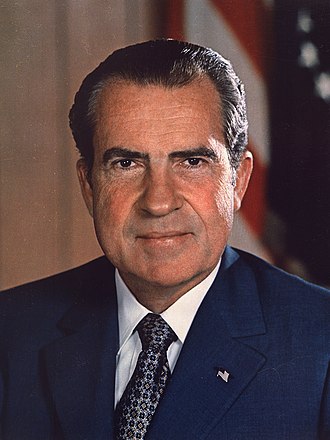
Richard M. Nixon served as the 37th President of the United States from January 1969 until his resignation in August 1974. In February 1971, he ordered the installation of a secret voice-activated taping system in the White House to preserve a historical record of his administration. Until the system's existence was revealed and dismantled in July 1973, the tapes captured Nixon directing major foreign policy initiatives, such as the opening to China, as well as his central role in the Watergate cover-up.
What Nixon talks about on the tapes
White House operations 4,718Presidential scheduling 2,225Public relations 1,784Presidential schedule 1,782Vietnam War 1,693Logistics 1,650Manolo Sanchez 1,626White House communications 1,400White House administration 1,399Presidential communication 1,243Henry Kissinger 1,191Foreign Policy 1,183
Conversations (21,010)
— Page 156 of 211President Nixon and his valet, Manolo Sanchez, met briefly in the Old Executive Office Building to watch the Rose Bowl Parade on television. The discussion centered on the broadcast and clarifying the nature of the televised event. No significant policy decisions were made during this informal interaction.
President Nixon met with his personal valet, Manolo Sanchez, to discuss the President's personal schedule for New Year's Day. The brief conversation centered on the Rose Bowl Parade, reflecting the informal nature of the interaction. No significant policy decisions were recorded during this exchange.
President Nixon and Charles Colson held a wide-ranging discussion about White House public relations strategies, Congressional relations, and the political landscape following the 1972 election. They analyzed the effectiveness of the President's public image, focusing on the balance between maintaining professional "aloofness" and connecting with supporters, while debating the efficacy of social interactions with Congress compared to the previous Johnson administration. The conversation also touched on the strengths and weaknesses of potential future political candidates, including John Connally and Spiro Agnew, and reviewed the need to better manage press relations and internal staff communications.
President Nixon contacted the White House operator to place a call to his aide, Stephen B. Bull. During this brief interaction, the President also requested that tea be brought to him. No further substantive policy matters were discussed in this exchange.
President Nixon initiated a series of telephone calls through the White House operator to coordinate meetings with key personnel. He requested to speak with Chief Justice Warren E. Burger and subsequently consulted with Stephen B. Bull regarding updates to his daily schedule. The conversation concluded with a request for Gerald L. Warren to be contacted.
President Nixon met with John McKay to dictate a congratulatory letter regarding the University of Southern California’s recent Rose Bowl victory over Ohio State University. The conversation focused on praising McKay’s coaching prowess and the historical significance of his team’s performance. Nixon specifically highlighted his admiration for the team's exceptional quality and success during the collegiate football season.
President Nixon dictated a congratulatory letter to Ohio State football coach Woody Hayes following the team's appearance in the Rose Bowl. The President lauded the competitive spirit of the team despite their loss to the University of Southern California and expressed confidence in Hayes's future leadership. Additionally, the correspondence included high praise for the Ohio State University marching band’s halftime performance.
President Nixon met with his aide, Stephen B. Bull, to briefly discuss administrative matters. The primary focus of the discussion concerned the scheduling and availability of Alexander M. Haig, Jr. No major policy decisions were recorded during this short interaction.
President Nixon met with his personal valet, Manolo Sanchez, to provide specific instructions regarding the management of presidential property. The President directed Sanchez to move a designated Lincoln-related item from the Oval Office to the Executive Office Building. This brief exchange served to coordinate the logistical relocation of office contents.
President Nixon met with an unknown woman in the Oval Office to address administrative matters regarding official correspondence. The discussion focused on the processing and signing of dictated letters, specifically referencing John McKay and Wayne "Woody" Hayes. No major policy decisions were reached during this brief session, which was primarily dedicated to routine executive tasks.
President Nixon met with Stephen B. Bull to coordinate the scheduling and return of key White House staff members, including H.R. Haldeman, Henry Kissinger, and John Ehrlichman. During the discussion, they addressed the whereabouts of Alexander Haig and reviewed the President's upcoming schedule at the Executive Office Building. Additionally, Nixon placed a brief call to the White House operator to request a conversation with Chief Justice Warren E. Burger.
President Nixon consulted with Manolo Sanchez regarding his eyeglasses before meeting with Gerald L. Warren to coordinate administrative and ceremonial duties. The participants discussed the drafting of a presidential statement on the death of Roberto Clemente and noted the cancellation of inaugural festivities in Puerto Rico. Additionally, Nixon reviewed protocol for the upcoming Harry S. Truman memorial service, confirming that he would not deliver a eulogy and delegating the handling of the event to the State Department.
President Richard Nixon and Chief Justice Warren E. Burger engaged in a wide-ranging, informal conversation to exchange New Year's greetings and discuss their respective work habits. The two men touched upon judicial philosophy, specifically criticizing the 'redeeming social purpose' standard in pornography rulings, and shared views on the necessity of age limits for congressional members to ensure political renewal. Additionally, they coordinated logistical details for the upcoming 1973 presidential inauguration, confirming that Burger would administer the oath of office for both the President and Vice President.
President Nixon and Chief Justice Warren E. Burger engaged in a casual, wide-ranging discussion covering holiday activities, the complexities of judicial decision-making, and contemporary social issues. They also touched upon the ages of Congressional members and potential strategies for future Republican campaign leadership, including the appointments of George H.W. Bush and Bill Brock. The conversation concluded with administrative logistics regarding the upcoming inauguration and Burger’s role in administering the oaths of office.
President Nixon contacted the White House operator to request a telephone connection with his personal aide, Stephen B. Bull. This brief administrative exchange served as a routine communication to facilitate further coordination with staff. No substantive policy matters were discussed during this brief request.
President Nixon dictates a formal public statement honoring Roberto Clemente following the baseball legend's recent death in a plane crash. The President emphasizes the widespread admiration and respect Clemente earned from sports fans worldwide. This tribute highlights the President's efforts to officially recognize Clemente's legacy as one of the era's preeminent athletes.
President Nixon met with Stephen B. Bull to coordinate the White House's official response and the President's level of participation regarding the upcoming memorial service for Harry S. Truman. Nixon instructed Bull to bypass speculative public statements and instead develop a concrete, simplified plan for his attendance. The President emphasized that the official press response, to be funneled through Deputy Press Secretary Gerald Warren, should present a unified strategy rather than highlighting a lack of invitation or personal intent.
President Nixon utilized this session to dictate a formal statement regarding the sudden death of baseball legend Roberto Clemente. The President expressed his personal condolences and reflected on the tragedy of the athlete's passing. This recording serves as part of a broader administrative effort to document the executive branch's official response to the incident.
President Nixon dictates a formal tribute to Roberto Clemente, highlighting his selfless character and humanitarian spirit. The President emphasizes Clemente's tragic death while on a mission of mercy to deliver relief supplies to victims of the devastating earthquake in Managua, Nicaragua. This recording serves as a drafting session for a public statement intended to honor Clemente's legacy of generosity.
President Nixon met with Stephen B. Bull to address the lack of clear White House coordination regarding the upcoming memorial service for Harry S. Truman. Concerned by potential confusion and mishandled press inquiries, Nixon questioned why the State Department appeared to be leading arrangements rather than the White House. He directed Bull to clarify the situation and coordinate an official statement to ensure the public understands the nature of the religious service and the planned delivery of a eulogy.
President Nixon met with his aide Stephen B. Bull in the Oval Office to provide brief administrative instructions. The conversation primarily concerned the office of speechwriter Raymond K. Price, Jr. No major policy developments resulted from this brief exchange.
President Nixon and Stephen B. Bull spoke to coordinate administrative details regarding Alexander Haig’s upcoming arrival and the funeral arrangements for baseball legend Roberto Clemente. Nixon inquired about the status of services for Clemente in Puerto Rico, noting that inaugural activities for the new governor had already been curtailed. Bull agreed to gather further information on the memorial service and report back to the President.
President Nixon contacted the White House operator to facilitate an immediate telephone connection with his aide, Stephen B. Bull. This brief administrative interaction served solely as a logistical request to initiate a follow-up conversation with a member of the presidential staff. No substantive policy matters were discussed during this brief exchange.
President Nixon directed his aide, Stephen B. Bull, to facilitate the recording and distribution of a presidential statement regarding the death of baseball icon Roberto Clemente. Nixon specified that the message should be produced as an audio tape intended for radio broadcast rather than television. The President instructed Bull to ensure the distribution occurred promptly once the recording was completed at the White House.
Charles W. Colson coordinated with Press Secretary Gerald L. Warren to expedite the release of an official presidential statement regarding the death of baseball legend Roberto Clemente. The participants prioritized the immediate recording and distribution of the statement to radio outlets, prompting Warren to delay his scheduled press briefing to ensure the tape could be broadcast promptly. The conversation also briefly touched upon humanitarian efforts for Nicaragua earthquake victims and the health of Rose Mary Woods.
President Nixon met with Stephen B. Bull, Rose Mary Woods, and Marjorie P. Acker to review administrative and scheduling matters. The group discussed the President's attendance at the upcoming Harry S. Truman memorial service and protocols for receiving foreign officials, as well as the scheduling of a bipartisan congressional meeting regarding wage and price controls. Additionally, the President and his staff organized the inventory and placement of various Christmas gifts, including wine, antique artifacts, and personal items.
President Nixon and Stephen B. Bull discussed logistical arrangements for the upcoming memorial service for Harry S. Truman, focusing specifically on diplomatic protocol and reception requirements. Nixon expressed skepticism toward Henry Kissinger's recommendation for a broader diplomatic reception, ultimately deciding to limit his personal involvement to meetings with visiting heads of state to avoid an unmanageable guest list. They also briefly touched upon scheduling a separate meeting regarding wage and price controls with congressional leaders, including Mike Mansfield and William Proxmire.
President Nixon and Stephen B. Bull discussed the scheduling of various high-level courtesy calls and diplomatic meetings, including visits from foreign heads of state recommended by Henry Kissinger. The pair established strict time limits for these appointments to ensure efficiency while managing the logistics for upcoming events, such as the Harry S. Truman memorial service. Additionally, they reviewed potential domestic meetings, including a requested visit with J. Bennett Johnston, Jr., to foster political cooperation.
President Richard Nixon met with his valet, Manolo Sanchez, in the Oval Office to discuss administrative logistics regarding the President's upcoming schedule. The conversation focused on coordination for the President's activities at the Executive Office Building and general updates on local weather conditions. This brief interaction served to organize the President’s transition between office locations and manage his immediate logistical requirements.
President Nixon met with William Timmons and Stephen Bull to coordinate strategy for upcoming congressional outreach and the transition into his second term. The participants discussed plans for an initial bipartisan congressional briefing on economic policy, as well as a separate reception for newly elected freshman representatives. Nixon emphasized the importance of maintaining strict confidentiality in meetings with Democratic leadership and directed his staff to streamline the timing and structure of these official gatherings.
President Nixon met with his aide Stephen B. Bull in the Oval Office to discuss administrative logistics. The primary purpose of the brief interaction was the President's request for the presence of William E. Timmons. No further developments were recorded during this short meeting.
President Nixon and William E. Timmons met to coordinate strategy regarding congressional relations and manage potential political fallout from Democratic caucus efforts to pass an 'end the war' resolution. The President expressed frustration with partisan interference during sensitive Vietnam negotiations and discussed the timing of future meetings with congressional leaders, including Mike Mansfield and Carl Albert, to mitigate legislative challenges. Additionally, they reviewed Republican personnel issues, focusing on the need for effective leadership in the House and the party's general struggle with the advanced age and perceived ineffectiveness of several veteran legislators.
President Nixon instructed the White House operator to facilitate two administrative actions during his workday. He requested that Special Counsel Charles W. Colson report to his office in the Executive Office Building for a meeting. Additionally, he directed the operator to connect him via telephone with William E. Timmons, the assistant to the president for legislative affairs.
President Nixon met with Charles Colson and Stephen Bull to discuss press relations, specifically the coverage of Henry Kissinger and John Scali regarding Vietnam. A significant portion of the conversation focused on logistics and public relations strategy for the upcoming memorial service for Harry S. Truman, including confirming the attendance of various political figures and heads of state. Nixon also deliberated on his role in the Roberto Clemente Memorial Fund and his personal charitable contributions, aiming to refine his public image.
President Nixon and William Timmons coordinated the logistics and protocol for an upcoming bipartisan leadership meeting and a reception for freshman Congressmen scheduled for January 5, 1973. They finalized the attendee list—including the Vice President, the Speaker of the House, and the Chief Justice—and established the receiving line order. Additionally, the President directed that reminder cards be sent to invitees despite the late notice and emphasized that the tone of the reception should remain informal.
President Nixon contacted the White House operator to facilitate a telephone connection with Stephen B. Bull. The brief communication functioned solely as an administrative request to reach specific staff personnel. No substantive policy discussions or decisions occurred during this exchange.
President Nixon instructed Stephen B. Bull to ensure press secretary Gerald Warren did not confirm his attendance at the upcoming Harry S. Truman memorial service, as the President preferred to keep his schedule flexible. Nixon expressed doubt about the necessity of his personal attendance, noting that he had already paid his respects in Independence and preferred to have Vice President Spiro Agnew represent the administration. Additionally, the President confirmed that Agnew should attend the bipartisan leadership breakfast and directed that his meeting with Michael Mansfield be relocated to the Oval Office.
President Nixon initiated a brief telephone communication through the White House operator to contact Stephen B. Bull. The purpose of this call was to facilitate a direct conversation between the President and his aide. No further policy or strategic developments occurred during this administrative exchange.
President Nixon consulted with Stephen B. Bull to clarify the attendance of the Truman family at the upcoming memorial service for former President Harry S. Truman. Bull confirmed that while Bess Truman would not be attending, Margaret Truman Daniel and Clifton Daniel were planning to participate. The President directed Bull to finalize the confirmation of these attendance plans immediately.
President Nixon contacted the White House operator to facilitate a direct communication with his aide, Stephen B. Bull. The brief exchange served as a logistical step to initiate a follow-up conversation with Bull. No further substantive policy matters were addressed during this short administrative interaction.
President Nixon consulted Stephen B. Bull regarding former President Lyndon B. Johnson’s attendance at an upcoming memorial service for Harry S. Truman. Nixon expressed concern that his own attendance was contingent upon Johnson's presence, intending to avoid the event if the former president did not attend. Bull was tasked with confirming Johnson’s status through his former press secretary, Tom Johnson, to finalize Nixon's schedule.
Charles W. Colson contacted Deputy Press Secretary Gerald L. Warren to manage press speculation regarding President Nixon's potential attendance and involvement in the memorial service for Harry S. Truman. The discussion addressed inquiries from reporter Frank Cormier, who erroneously speculated that the President might deliver a eulogy. Colson directed Warren to discourage these rumors and maintain a non-committal stance, as the event was primarily intended for congressional representatives.
President Nixon and Charles Colson met to discuss managing the administration's public relations strategy, specifically regarding the upcoming funeral of Harry S. Truman and the President's image. The discussion touched upon navigating antiwar sentiment and media coverage of US bombing campaigns in Vietnam, with Colson providing input on how to frame these sensitive topics. They emphasized the public's desire for normalcy and the need to effectively communicate the administration's policy positions to counter domestic criticism.
President Nixon met with Stephen B. Bull to discuss legislative strategy and ongoing congressional relations. The conversation specifically addressed a report from William E. Timmons regarding interactions with Speaker of the House Carl B. Albert. The exchange served as a brief administrative update on the administration's efforts to manage relations with key congressional leadership.
President Nixon met with Senate Majority Leader Mike Mansfield to discuss upcoming bipartisan Congressional leadership meetings, administrative reorganization, and the status of Vietnam peace negotiations. Nixon emphasized the need for strict confidentiality regarding the sensitive peace talks while requesting Mansfield’s assistance in managing Congressional pressure. The two leaders also coordinated on procedural matters, including the handling of Cabinet confirmations and the structure of future legislative communication.
President Nixon met with his aide, Stephen B. Bull, to discuss administrative matters within the Oval Office. The primary focus of the brief session was a specific request regarding William E. Timmons, then serving as the Assistant to the President for Legislative Affairs. The meeting concluded quickly following the discussion of this personnel or scheduling objective.
President Nixon and William Timmons discussed strategies for managing congressional opposition, particularly regarding the Vietnam War and efforts by antiwar Democrats to challenge administration policy. They focused on navigating the upcoming Democratic caucus, coordinating future meetings with Speaker Carl Albert and Senator Mike Mansfield, and maintaining a unified front against anti-administration resolutions. Additionally, they reviewed logistical arrangements for a reception for new Republican members of Congress, deciding to include Democratic leadership to foster better relations.
President Nixon met with his aide, Stephen B. Bull, to coordinate logistics regarding the attendance of former President Lyndon B. Johnson at a memorial service for Harry S. Truman. The President directed Bull to relay specific instructions to Charles W. Colson to ensure Johnson was properly informed of the arrangements and discouraged from attending. The brief exchange focused on managing these sensitive high-level protocol matters.
President Nixon instructed the White House operator to initiate a telephone call to former President Lyndon B. Johnson. This brief exchange served as an administrative request to establish direct communication with the former administration. No further policy discussions or significant developments were captured during this short transmission.
President Nixon and Charles W. Colson discussed political strategy and personnel matters, focusing on public relations management regarding the Harry S. Truman memorial service and the President's Vietnam War policy. They weighed the political risks and benefits of the President's attendance at various public events, ultimately coordinating a low-key approach to avoid political exploitation. Additionally, they reviewed organizational staffing for the second term, including the reassignment of White House personnel and the importance of maintaining an enthusiastic and disciplined political apparatus to counter Democratic opposition.
President Nixon and former President Lyndon B. Johnson engaged in a brief, informal New Year's exchange primarily to coordinate their response regarding attendance at the upcoming public memorial service for Harry S. Truman. The two leaders agreed that having already paid their personal respects in Independence, Missouri, both would skip the public Washington event to avoid any appearance of exploitation or diplomatic slight. During the call, Nixon expressed support regarding ongoing Vietnam peace negotiations, while Johnson discussed his recent health struggles following the Cotton Bowl and his appreciation for Nixon's continued friendship.
President Nixon contacted the White House operator to initiate a telephone call to Charles W. Colson. This brief administrative interaction served as a logistical step to facilitate direct communication between the President and his special counsel. No further substantive discussion occurred during this recording segment.
President Nixon and Charles Colson discussed strategies for maintaining Henry Kissinger's morale ahead of his upcoming Paris trip, emphasizing the need to project confidence and solidarity within the administration. They evaluated the political landscape regarding Vietnam negotiations, noting that recent Congressional actions were less threatening than anticipated and potentially useful for public leverage. Additionally, they coordinated a messaging plan for the bipartisan leadership meetings, prioritizing an optimistic economic outlook while preparing to defend the administration against any congressional obstruction.
President Nixon contacted the White House operator to place a personal telephone call to his longtime valet and personal aide, Manolo Sanchez. The President provided specific instructions to reach Sanchez at his residence, stipulating that the attempt should be abandoned if he was not immediately available. This brief exchange highlights the President's informal reliance on White House staff for personal communication.
President Nixon met with his personal aide, Stephen B. Bull, to conduct a comprehensive review of his upcoming daily schedule and manage logistical priorities. The discussion centered on coordinating travel and meeting logistics for Henry Kissinger and Alexander Haig, as well as addressing funeral arrangements and various awards ceremonies involving the Teamsters and media organizations. Nixon explicitly directed Bull to clear his schedule of non-essential ceremonial obligations following the upcoming inauguration to reduce his workload.
President Nixon met with his aide Stephen B. Bull in the Oval Office to discuss administrative logistics and scheduling. The primary focus of the brief meeting was the President's request for the immediate presence of Henry A. Kissinger. Bull proceeded to facilitate this request, marking the extent of the documented interaction.
President Nixon met with Ronald Ziegler and Henry Kissinger to coordinate the administration's public and congressional messaging regarding ongoing Vietnam peace negotiations and recent military actions. They discussed refuting media narratives of presidential indecisiveness by emphasizing the consistency of the "May 8th policy" and the necessity of pressure tactics to achieve a "peace with honor." Nixon also expressed his deep resentment toward critical members of the press, academia, and Congress, instructing staff to exclude hostile media outlets from White House social functions while preparing to consolidate negotiating authority ahead of further Paris talks.
President Nixon consulted with his personal secretary, Rose Mary Woods, to arrange a retirement or appreciation gift for Alexander M. Haig, Jr. He requested that Woods prepare an inscribed music box to be presented to Haig during a scheduled ceremony at the White House where Haig would receive the Distinguished Service Medal. The president specified that the gift's inscription should convey gratitude for Haig's dedicated service to the nation.
President Nixon and H. R. Haldeman met to review White House staffing, administrative protocols for the upcoming second term, and the logistical planning for the 1973 Inauguration. They discussed the President’s frustrations regarding staff interference in policy areas outside their purview, particularly concerning the Vietnam War, and reaffirmed the need for disciplined messaging from administration officials. The conversation also centered on streamlining the Inauguration schedule, including reducing the length of the parade and inaugural luncheon, and finalizing the selection of clergy for the various ceremonies.
President Nixon met with H. R. Haldeman and John Ehrlichman to discuss a wide-ranging set of administrative tasks, including second-term staff reorganization, the reassignment of various White House personnel, and the streamlining of the President's schedule. A significant portion of the discussion addressed concerns over potential Watergate involvement by staffers like Charles Colson and the necessity of managing internal information flows, including the President's news summaries. They also reviewed diplomatic and domestic challenges, specifically evaluating Henry Kissinger's recent morale, his relationship with the press, and the political fallout from the recent bombing campaigns in North Vietnam.
President Nixon spoke with Senate leaders Mike Mansfield and Hugh Scott to acknowledge the formal reconvening of the Senate and confirm the readiness of both chambers for legislative action. The participants coordinated their upcoming schedules, confirming a Friday morning bipartisan meeting to address domestic policy and an evening reception for new members of Congress. Nixon signaled the imminent transmittal of executive branch nominations and legislative messages to the Senate to facilitate the new session's workflow.
President Nixon met with H. R. Haldeman, Stephen Bull, and Ronald Ziegler to discuss a strategic shift in the administration's public relations and political outreach for the second term. They emphasized moving away from trying to appease critics and the liberal press, focusing instead on projecting executive strength and conducting events on the President's own terms. Key organizational decisions included streamlining White House social events to reduce administrative costs and demands, refining the process for handling Congressional and donor relations, and implementing a new protocol for press interactions and gift-giving.
President Nixon instructed the White House operator to place a telephone call to Richard A. Moore. This brief exchange served as a logistical bridge to facilitate a direct communication between the President and his special counsel. No substantive policy matters were discussed during this request.
President Richard Nixon met with his personal valet, Manolo Sanchez, in the Oval Office to discuss personal services and domestic arrangements. The conversation focused on the routine logistical needs of the White House residence. No major policy decisions or historical developments were recorded during this brief encounter.
President Nixon consulted with the White House operator during an afternoon meeting in the Oval Office to address administrative communication needs. The discussion focused on coordinating outgoing calls and managing internal switchboard operations. No specific policy decisions were recorded during this brief administrative interaction.
President Nixon and Stephen B. Bull discussed the scheduling and logistics of an upcoming dinner engagement. The conversation specifically addressed the confirmation of Alexander M. Haig, Jr.'s acceptance of the President's invitation. The pair reviewed the timing for the event to ensure proper planning for the evening.
President Nixon and Richard A. Moore discuss the strategy for managing public and press perceptions regarding the establishment of a memorial fund for Roberto Clemente. Nixon instructs Moore to coordinate a White House staff donation to accompany his own contribution to the fund, ensuring that his personal initiative in the project is clearly communicated to the press. They agree that Moore will brief John Galbreath and reporters on the President's role in spearheading the fund to ensure the administration receives proper recognition for the effort.
President Nixon and Richard A. Moore discuss organizing a financial contribution to a memorial fund associated with John Kenneth Galbraith. Nixon instructs Moore to initiate the effort with a symbolic personal donation and to encourage other White House staff members to contribute. The conversation focuses on establishing momentum for the fund and coordinating how the President's support will be communicated to organizers.
President Nixon instructed the White House operator to place calls to Congressman Gerald R. Ford and Tip O'Neill. The President initiated this outreach in response to previous calls he had received from both men. This communication suggests an effort to engage with key congressional leadership regarding urgent legislative or political business.
President Nixon met with his valet, Manolo Sanchez, in the Oval Office to receive refreshments. This brief interaction served as a routine moment of personal service for the President during his workday. No substantive policy discussions or administrative actions were recorded during this encounter.
President Nixon met with William E. Timmons and Stephen B. Bull to coordinate his upcoming legislative outreach efforts. The discussion centered on facilitating phone calls to congressional leaders, specifically Tip O'Neill and Gerald Ford. These interactions served as part of the administration's strategy for maintaining communication with key members of Congress.
President Nixon consulted with a White House operator to facilitate an outgoing call. This brief interaction served an administrative purpose to establish a connection with a party outside the Oval Office. No substantive policy discussions or decisions were recorded during this brief bridge to a separate conversation.
President Nixon met with his aide, Stephen B. Bull, to overhaul the management of his daily schedule and limit the number of unnecessary ceremonial meetings. Nixon expressed frustration with routine requests from outside groups, such as teachers and truck drivers, and directed Bull to restrict engagements to those that serve the administration's strategic goals rather than the visitors' interests. The President instructed that meetings should be strictly limited to one per day, prioritizing efficiency and exclusivity to protect his time.
President Nixon held a brief, informal call with newly elected Democratic majority leader Tip O'Neill and Representative Gerald Ford to congratulate O'Neill on his new role. The conversation served to coordinate the congressional schedule, specifically confirming upcoming bipartisan breakfast meetings and attendance at both Hale Boggs' funeral and Harry S. Truman's memorial service. Additionally, the President clarified his intent to deliver the State of the Union as a written message rather than a formal address to Congress, citing the proximity to his second inaugural address.
President Nixon met with House Majority Leader Tip O'Neill and House Minority Leader Gerald Ford to foster rapport and discuss upcoming legislative agenda items. The President informed the congressional leaders of his decision to prioritize his inaugural address over a traditional State of the Union address to avoid redundant messaging. Nixon extended an invitation to both men for a follow-up breakfast meeting to further coordinate on the administration's legislative priorities.
President Nixon and Stephen B. Bull reviewed the President’s upcoming schedule of meetings and photo sessions. They discussed the logistics for hosting Senator J. Bennett Johnston’s group, David M. Abshire, and various guests including baseball players and the 'Truck Driver of the Year.' Nixon provided instructions on trimming the guest list, specifically noting that Abshire's attendance was not required for the session.
President Nixon held a brief, social meeting in the Oval Office with Senator J. Bennett Johnston, Jr., his family, and guests. The primary purpose of the gathering was to facilitate a formal photograph session with the family, coordinated by White House photographer Oliver F. Atkins. During the visit, the President provided informal conversation regarding the history of the Oval Office, his family's philanthropic projects, and pleasantries regarding the Senator's recent election.
President Nixon met with his aide, Stephen B. Bull, for a brief administrative check-in regarding the President's daily schedule. The discussion centered on arrangements for an upcoming meeting with David M. Abshire. No further policy decisions were recorded during this brief encounter.
President Nixon met with David M. Abshire and William E. Timmons to discuss Abshire’s departure from the State Department to lead the Georgetown Center for Strategic and International Studies. The participants explored ways to leverage the Center to counter the influence of liberal-leaning institutions like the Brookings Institution and the Ford Foundation in foreign policy discourse. Nixon emphasized the need to improve the foreign policy knowledge and effectiveness of Republican legislators through specialized travel and structured briefings to ensure stronger support for his administration's agenda.
President Nixon met with Curtis C. Stapp, the 1973 'Driver of the Year,' his family, and Donald F. Rodgers to celebrate the professional accomplishments of the trucking industry. The discussion touched upon the importance of driver health screenings, road courtesy, and the general state of the Teamsters Union. Nixon also engaged in casual conversation regarding sports and golf, acknowledging the political support he received from Teamsters President Frank E. Fitzsimmons.
President Nixon met with his aide Stephen B. Bull to coordinate upcoming logistical arrangements and manage his presidential schedule. The discussion centered on managing appointments with specific individuals, including Richard A. Moore, professional baseball players Willie Stargell and Stephen Blass, and representatives from the trucking industry. The meeting served to finalize these brief interactions as part of the President's public relations outreach efforts.
President Nixon met with Stephen B. Bull in the Oval Office to coordinate logistics for an upcoming meeting involving Daniel M. Galbreath and several professional baseball players. Bull facilitated the scheduling arrangements for these visitors. The brief discussion focused exclusively on the protocol and timing for the arrival of the baseball guests.
President Nixon met with Pittsburgh Pirates players Dave Giusti and Stephen Blass, alongside team executive Daniel M. Galbreath and aide Richard A. Moore, to discuss the creation of a memorial fund for Roberto Clemente, who recently died in a tragic plane crash while delivering aid to earthquake victims in Nicaragua. The President expressed strong support for the initiative, suggesting that the fund should be used to build schools or baseball facilities to honor Clemente’s humanitarian legacy and commitment to children. Nixon advised the group on organizational strategies, including incorporating the fund for tax-deductibility and soliciting contributions from the public and professional sports figures to ensure broad participation.
President Nixon met with his aide, Stephen B. Bull, in the Oval Office to review and organize the President’s upcoming daily schedule. The discussion focused on logistical planning and administrative coordination of White House activities. No specific policy decisions or significant developments were recorded during this brief administrative exchange.
President Nixon and Stephen B. Bull discussed logistical arrangements for Henry Kissinger's upcoming meetings with Anatoliy Dobrynin. Additionally, the President directed an initiative to pivot promotional efforts for the Roberto Clemente Memorial Fund, requesting that the Advertising Council secure free airtime. Nixon specifically instructed that NFL Commissioner Pete Rozelle replace standard volunteer advertisements with spots supporting the earthquake relief fund during the upcoming Super Bowl broadcast.
President Nixon and Stephen B. Bull met to coordinate the President's upcoming schedule. The discussion centered on arrangements for an impending meeting with Henry Kissinger. No further substantive actions or developments beyond these scheduling logistics were recorded.
President Nixon met with his aide Stephen B. Bull in the Oval Office to coordinate his official schedule. The discussion centered on managing upcoming appointments with key advisors, specifically H. R. Haldeman and Henry A. Kissinger. This brief administrative consultation served to organize the President's priorities and meeting logistics for the day.
President Richard Nixon met with his valet, Manolo Sanchez, in the Oval Office for a brief, informal interaction. The discussion centered on the personal consumption of food. No significant policy decisions or administrative actions resulted from this routine encounter.
President Nixon and Henry Kissinger met to evaluate strategic options for concluding the Vietnam War amidst mounting congressional pressure and domestic controversy over bombing operations. They compared two primary approaches: "Option One," which involved pursuing an agreement similar to the stalled October 1972 proposal, and "Option Two," a more aggressive stance involving sustained military force. Ultimately, they leaned toward Option One, aiming to secure a deal while preparing to manage the political fallout and potential resistance from South Vietnamese President Thieu. Nixon decided to consult with bipartisan congressional leadership to reinforce his administration's position of seeking an honorable peace.
President Richard Nixon met with his valet, Manolo Sanchez, in the Oval Office. The brief interaction focused on the provision of refreshments. No major policy developments or administrative decisions were recorded during this session.
President Nixon and H. R. Haldeman met to review the President's public schedule and discuss long-term political strategy, specifically the goal of institutionalizing a 'Nixon coalition' to replace the existing Roosevelt-era political establishment. They evaluated potential personnel changes, including various ambassadorial and agency appointments, while emphasizing the need to keep the President visible and active in the public eye through controlled, high-impact events. Additionally, they critiqued the current press conference format, opting for a move toward more direct engagement with the American public outside of Washington, D.C., rather than relying on the traditional White House press corps.
President Nixon contacted the White House operator to facilitate a telephone connection with his special counsel, Charles W. Colson. The brief exchange served purely administrative purposes to initiate official communication between the President and a key advisor. No substantive policy matters or political strategies were discussed during this request.
President Nixon coordinated a follow-up telephone communication with Charles W. Colson through the White House operator. The brief exchange served to confirm Colson's transit status and establish a timeframe for the President to initiate a return call once Colson arrived home. No substantive policy matters were addressed beyond logistical planning for this private consultation.
President Nixon and Charles Colson discussed strategies for managing congressional relations, particularly the need to maintain pressure on Republican leadership and resist yielding to legislative whining. The conversation centered on the importance of assertive political maneuvering, with both men agreeing that the President should personally encourage House Minority Leader Gerald Ford to replace Robert Wilson as Chairman of the Republican Congressional Campaign Committee to ensure timely recruitment for future elections. Additionally, they reviewed various public relations operations, including efforts to discredit critical media outlets like CBS and the Washington Post, and highlighted the importance of using political leverage against dissenting Republicans like William Saxbe.
President Nixon contacted the White House operator to facilitate a telephone connection with Charles W. Colson. This brief administrative interaction served as a directive to initiate a conversation with his special counsel. The exchange focused exclusively on the logistical request to reach Colson.
President Nixon and Stephen B. Bull discussed logistical arrangements, including an offer of the Blair House to Margaret Truman and her children. They also reviewed the President’s daily schedule, specifically addressing requested meetings involving John Ehrlichman, Gerard C. Smith, and Elliot L. Richardson. The discussion focused on coordinating the timing of these engagements with key staff and cabinet members.
President Nixon met with Stephen B. Bull and Manolo Sanchez to coordinate his daily schedule and manage administrative logistics. The discussion focused on facilitating upcoming calls with John Ehrlichman, Henry Kissinger, and Alexander Haig, as well as arranging a meeting with H.R. Haldeman. Additionally, Nixon provided instructions regarding the handling of private files for filing by Rose Mary Woods.
President Nixon initiates a brief request for the White House operator to connect him with Charles Colson. This interaction serves as a functional administrative step to facilitate a direct communication between the President and a key aide. The conversation reflects the routine procedural efforts taken by the President to coordinate staff consultations.
President Nixon and Charles Colson discuss an upcoming meeting with prominent attorney Edward Bennett Williams, who had recently reached out to the White House following Nixon's public support of the Washington Redskins. Nixon instructs Colson to remain firm regarding the Washington Post’s coverage of the Watergate scandal, while using the meeting to signal that the administration expects Williams to distance himself from the paper's personal attacks on the President. The conversation highlights the administration's desire to leverage political pressure and potential investigations into Williams' tax returns to encourage his cooperation or neutrality.
President Nixon and Charles Colson discuss efforts to cultivate a relationship with attorney Edward Bennett Williams, emphasizing the necessity of discretion and indirect communication. Nixon expresses his desire to maintain a positive rapport with Williams despite potential political tensions and public scrutiny. The discussion centers on leveraging Williams's influence and connections while ensuring his involvement remains confidential.