Nixon, Richard M. (President)
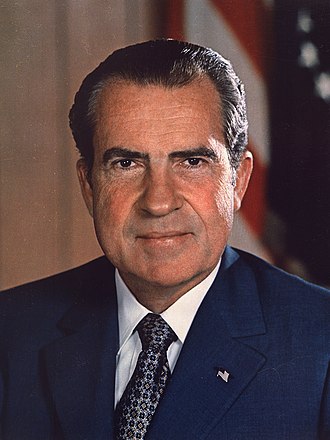
Richard M. Nixon served as the 37th President of the United States from January 1969 until his resignation in August 1974. In February 1971, he ordered the installation of a secret voice-activated taping system in the White House to preserve a historical record of his administration. Until the system's existence was revealed and dismantled in July 1973, the tapes captured Nixon directing major foreign policy initiatives, such as the opening to China, as well as his central role in the Watergate cover-up.
What Nixon talks about on the tapes
White House operations 4,718Presidential scheduling 2,225Public relations 1,784Presidential schedule 1,782Vietnam War 1,693Logistics 1,650Manolo Sanchez 1,626White House communications 1,400White House administration 1,399Presidential communication 1,243Henry Kissinger 1,191Foreign Policy 1,183
Conversations (21,010)
— Page 157 of 211President Nixon initiates a brief telephone call through the White House operator to contact Charles W. Colson. The exchange is purely logistical, serving as a directive to place the call for the President. No substantive policy matters or further decisions are addressed during this brief operational connection.
President Nixon received an invitation to attend an informal awards ceremony honoring Alexander M. Haig, Jr. The participant emphasized that the gathering would be small, limited to only a few of Haig's close associates. This brief exchange served as a social request for the President's attendance at the upcoming event.
President Nixon held a brief administrative interaction with the White House operator to facilitate a telephonic connection. This routine engagement served to initiate a communication bridge for an unrecorded or separate external discussion. No substantive policy matters or major strategic decisions were documented during this short exchange.
President Nixon and Charles Colson discuss strategy for Colson's upcoming meeting with prominent trial lawyer Edward Bennett Williams. Nixon instructs Colson to flatter Williams by acknowledging his professional reputation before pivoting to confront him about his involvement in the Watergate case, specifically questioning his decision to represent the Democratic National Committee on a personal basis. The pair also coordinate efforts to gauge Williams' true intentions regarding the Watergate investigation and potential hidden motives behind his recent correspondence with the President.
President Nixon and Charles Colson discuss the nuances of legal or professional representation, specifically debating the ethics of representing an individual on a personal basis while engaging in aggressive rhetoric. The participants contemplate how to frame a client's public stance to avoid the appearance of personal grievances or specific demands. The conversation ends abruptly with instructions to move forward with their established approach.
President Nixon instructed the White House operator to place a telephone call to Paul Martin, a journalist affiliated with U.S. News and World Report. The brief exchange served solely to facilitate this communication request. No further substantive policy matters or decisions were discussed during this interaction.
President Nixon directs the White House operator to place a telephone call to Paul L. Martin of U.S. News & World Report. This administrative exchange serves as a request to initiate contact with the journalist for communication purposes. No further substantive discussions occur during this brief connection.
President Nixon met with Stephen B. Bull to provide specific instructions regarding the guest list for an upcoming social event at the White House. The President directed that the usual attendees from the press, specifically women reporters, be excluded except for wire service representatives. Nixon further instructed Bull to coordinate with Ronald Ziegler to ensure new members of Congress and their wives were included on the guest list.
President Nixon called Paul L. Martin to offer personal well-wishes ahead of Martin’s upcoming eye surgery. The conversation served as a brief gesture of support, with Nixon reflecting on Martin’s loyalty and assistance during the 1960 election campaign. The two also engaged in lighthearted banter regarding political affiliations and the influence of Georgetown social circles.
President Nixon met with his senior advisors, including H. R. Haldeman and Henry Kissinger, to coordinate White House press strategy, manage staff morale, and discuss the status of Vietnam peace negotiations. Nixon emphasized his desire for a disciplined administration that would avoid unauthorized media contacts and prioritize loyalist staffing appointments, particularly in the Defense Department and research sectors. A significant focus was placed on the sensitivity of the Paris peace talks, with Nixon maintaining a firm stance on the necessity of an honorable settlement and expressing frustration with the defense establishment's overlapping intelligence and tactical structures.
President Nixon met with Henry Kissinger, William Rogers, Melvin Laird, Admiral Thomas Moorer, and Colonel Richard Kennedy to coordinate the administration's public relations and congressional strategy regarding Vietnam. The participants discussed the military effectiveness of recent bombing campaigns, the necessity of countering negative media reports by highlighting North Vietnamese civilian destruction, and the importance of maintaining a unified front. Nixon directed his team to avoid a defensive posture and to provide briefings for key congressional allies using photographic evidence of military targets, while stressing that the administration must remain cautious about disclosures until upcoming negotiations conclude.
President Nixon met with Stephen B. Bull to finalize logistical details and media management for an upcoming award ceremony honoring Alexander M. Haig, Jr. The discussion focused on controlling press access during the event and perfecting the delivery of the official citation, which had been vetted by Melvin R. Laird. Henry A. Kissinger joined the brief session to coordinate the preparation of a statement regarding Secretary of State William P. Rogers.
President Nixon hosted a ceremony in the Oval Office to honor General Alexander M. Haig, Jr. with the Defense Distinguished Service Medal. The event, attended by Haig’s family and high-ranking administration officials, served as a formal recognition of Haig’s significant contributions to national security and his diplomatic efforts, including his work supporting Henry Kissinger. The gathering concluded with photo opportunities and brief discussions regarding Haig's transition out of his White House role.
President Nixon and Press Secretary Ronald Ziegler reviewed Gerald Warren’s recent press briefing and assessed public reaction to the December 1972 bombing campaign in North Vietnam. Nixon dismissed critical congressional and media sentiment, arguing that Washington’s hostility toward his war policies was detached from the sentiments of the broader American public. The two men concluded the meeting by shifting their focus to upcoming staffing and reorganization plans for the second term.
President Nixon and Stephen B. Bull discussed a scheduling misunderstanding regarding an upcoming meeting with Secretary of Defense Elliot L. Richardson. Nixon clarified his preference for meeting durations, specifying that all appointments should be limited to thirty minutes unless he explicitly directs otherwise. Additionally, the President requested a meeting with Henry Kissinger to be arranged.
President Nixon and Stephen B. Bull reviewed the President’s daily schedule and finalized protocols for upcoming meetings with foreign dignitaries. The discussion focused on establishing strict guidelines for interactions with heads of state, specifically limiting meetings while granting exceptions for Carlos P. Romulo and Vice President Yen Chia-Kan of the Republic of China. Additionally, the President issued explicit instructions to close the attendance list for an upcoming reception, prohibiting any further additions to the guest list.
President Nixon met with incoming Secretary of Defense Elliot Richardson and National Security Advisor Henry Kissinger to outline the President's expectations for a major overhaul of the Department of Defense. Nixon emphasized the need to dismantle the existing management systems, reduce the number of assistant secretaries, eliminate bureaucratic duplication, and assert civilian control over the military establishment. He also directed Richardson to prioritize strategic thinking over administrative brokering, specifically highlighting the importance of reevaluating defense spending, intelligence operations, and R&D programs in coordination with the National Security Council.
President Nixon met with his personal valet, Manolo Sanchez, to discuss mundane domestic arrangements regarding a food order. The brief interaction focused on logistical details related to the President's personal staff support. No significant policy developments or strategic decisions were recorded during this brief encounter.
President Nixon met with H. R. Haldeman and Stephen B. Bull to coordinate upcoming logistical requirements for his executive schedule. The discussion focused on arrangements for meetings with Gerard C. Smith and Vice President Yen Chia-kan of the Republic of China. The participants finalized details regarding a photo session involving Henry Kissinger and addressed administrative preferences for managing the President’s daily calendar.
President Nixon and Henry Kissinger met with Gerard C. Smith to discuss Smith's transition out of government and his future plans involving international research councils. The conversation covered the development of a collaborative executive committee focused on US, European, and Japanese relations, with a particular emphasis on the critical role of energy security and the necessity of constructively integrating Japan into Middle Eastern diplomacy. Nixon expressed his support for Smith's new endeavors and promised to lend presidential backing to the formation of the research council, while also discussing the historical context of global governance and the League of Nations.
President Nixon met with H.R. Haldeman and Stephen Bull to discuss administrative logistics and presidential scheduling. The conversation focused on refining protocol arrangements for upcoming events, managing the President's public appearances to ensure more efficient time management, and addressing personnel matters within various agencies. Nixon also instructed Haldeman to secure and maintain control over his private memoranda recordings.
President Nixon contacted the White House operator to facilitate a telephone connection with his aide, Stephen B. Bull. This brief administrative interaction served as a routing request to reach the staff member for an unspecified purpose. No substantive policy discussions occurred during this exchange.
President Nixon held a brief, informal meeting with his personal valet, Manolo Sanchez, in the Old Executive Office Building. The interaction consisted primarily of social greetings rather than substantive policy discussions or administrative business. The conversation concluded with a standard farewell, marking no significant political or executive developments.
President Nixon met with his personal valet, Manolo Sanchez, in the Old Executive Office Building. The brief interaction, which took place while the President was reviewing his official schedule, focused on mundane personal matters. No significant policy decisions or strategic developments were recorded during this exchange.
President Nixon and Henry Kissinger met to finalize scheduling arrangements for an upcoming visitor expected at 4:30 p.m. The brief discussion served to coordinate the logistics of the President's calendar and confirm the timing for the arrival of the undisclosed guest. No further substantive policy matters were recorded in this segment of the conversation.
President Nixon met with his valet, Manolo Sanchez, to discuss personal logistical matters and scheduling arrangements. The conversation focused on the movements and activities of First Lady Pat Nixon and Julie Nixon Eisenhower. The exchange functioned primarily as a brief coordination of family affairs rather than a discussion of formal policy.
President Nixon consulted with a White House operator to facilitate a telephonic connection. This brief interaction served administrative purposes to establish a communication link with an unspecified third party. No substantive policy matters or political discussions were recorded during this brief exchange.
President Nixon met with his personal valet, Manolo Sanchez, in the Old Executive Office Building to discuss the arrival of First Lady Pat Nixon and Julie Nixon Eisenhower. The brief interaction focused on the logistics and coordination surrounding their visit to the office. No further policy-related actions or significant administrative decisions were recorded during this segment.
President Nixon contacted Stephen B. Bull to coordinate administrative scheduling details for his late afternoon. Nixon requested a 5:30 p.m. appointment with the barber and confirmed that a meeting with John D. Ehrlichman and H.R. Haldeman was set for 3:00 p.m. These arrangements ensured the President's personal schedule and high-level staff consultations remained organized for the remainder of the day.
President Nixon met with his aide, Stephen B. Bull, to coordinate a personal grooming appointment. The President explicitly requested that Bull summon the White House barber. This brief administrative interaction concluded with the arrangement of the service.
President Nixon met with John Ehrlichman, H.R. Haldeman, and Henry Kissinger to discuss executive branch reorganization, judicial and FBI appointments, and legislative strategy. The President emphasized the need to streamline executive functions by empowering cabinet-level counselors and reducing the White House staff to improve efficiency and minimize concerns regarding executive privilege. Additionally, the group addressed the ongoing Vietnam peace negotiations and the importance of maintaining a unified stance with key administration officials as they prepared to brief Congress on these domestic and foreign policy priorities.
President Nixon contacted the White House operator to facilitate an urgent communication. The primary purpose of this brief exchange was to request a telephone connection with his aide, Stephen B. Bull. No further administrative or policy discussions occurred during this brief request.
President Nixon met with his valet, Manolo Sanchez, to clarify logistical details regarding the arrival schedule of Pat Nixon and Julie Nixon Eisenhower. The discussion focused on confirming whether the First Lady and her daughter would be arriving in Anchorage or at the residence on the 6th or 7th of January. Additionally, the President briefly addressed personal administrative matters, specifically coordinating a haircut appointment.
President Nixon communicated with a White House operator to facilitate an outgoing call. The brief exchange served as a routine administrative request to connect the President with an intended recipient. No substantive policy discussions or major decisions occurred during this brief interaction.
President Nixon met with Charles Colson, Henry Kissinger, and other staff members to discuss political messaging, legislative relations with Congress, and the strategic direction of his administration. The participants addressed the difficulties of maintaining secrecy during delicate negotiations, particularly concerning military actions and public perception of the war effort. The conversation reflects the President's frustration with congressional opposition and his intent to navigate these political challenges through careful control of the administration's public narrative.
President Nixon contacted his aide, Stephen B. Bull, to request a scheduling adjustment regarding his upcoming barber appointment. He asked Bull to notify the barber that he would arrive 15 minutes late and would require only a quick service to accommodate the barber's evening departure plans. Bull confirmed he would convey these instructions immediately.
President Nixon contacted the White House operator to initiate a telephone call to Charles W. Colson. The brief exchange served as an administrative request to connect the President with his special counsel. No further substantive discussion occurred during this communication.
President Nixon and Charles Colson discuss strategies to manage public and congressional opinion regarding the ongoing Vietnam peace negotiations. Nixon expresses deep frustration with his senior staff, particularly H.R. Haldeman and John Ehrlichman, for failing to effectively rally Republican support and maintain discipline on Capitol Hill. To bolster his position, Nixon directs Colson to have Melvin Laird brief key loyalists—specifically John Rhodes—on the success of the President's recent bombing campaign in bringing North Vietnam back to the negotiating table.
President Nixon and Stephen B. Bull met to discuss administrative changes, specifically focusing on the resignation of Science Advisor Edward E. David, Jr. The President also reviewed his upcoming schedule, which included meetings with Israeli President S. Zalman Shazar and National Security Advisor Henry Kissinger. Nixon expressed his desire to streamline his agenda and effectively manage the transition following David's departure.
President Nixon met with his aide Stephen B. Bull in the Oval Office to facilitate a brief administrative interaction. The primary focus of the discussion involved the logistics of Nixon’s upcoming engagement with National Security Advisor Henry Kissinger. No further substantive policy or political developments were recorded during this short meeting.
President Nixon, H. R. Haldeman, Henry Kissinger, and Ronald Ziegler met to discuss the administration's Vietnam strategy, focusing on congressional management and public relations in the lead-up to critical peace negotiations. Nixon and Kissinger evaluated the political fallout from recent bombing campaigns and their impact on Senate support, with the President emphasizing the need for congressional allies to defend his policy while avoiding public disclosures that might jeopardize potential diplomatic breakthroughs. They also addressed personnel matters and the ongoing frustration with the legislative branch's efforts to influence war policy, ultimately deciding to maintain a disciplined public stance while coordinating more effectively with loyalists in Congress.
President Nixon met with his personal valet, Manolo Sanchez, to discuss personal administrative matters. The brief interaction primarily concerned the disposal of household items and the potential replacement of a bathrobe. This informal exchange highlights the routine personal tasks managed by the President's support staff during his time in the Old Executive Office Building.
President Nixon met with his aide, Stephen B. Bull, to coordinate his upcoming schedule and travel arrangements. The discussion focused on logistics for a planned trip to Camp David with family members and staff, as well as the potential for a meeting with Bob Hope regarding a USO award. Additionally, the pair addressed administrative details concerning the President's upcoming birthday celebrations and inaugural preparations.
President Nixon contacted the White House operator to facilitate an urgent communication with his aide, Stephen B. Bull. This brief exchange served exclusively as a logistical step to initiate a follow-up conversation with a key member of the President's staff. No substantive policy matters were addressed during this transition.
President Nixon instructed the White House operator to facilitate telephone calls to Press Secretary Ronald L. Ziegler and aide Stephen B. Bull. The President inquired about Ziegler's availability following his current briefing duties. This brief administrative exchange served to coordinate direct communication with key members of his staff.
President Nixon met with Charles Colson to discuss administration strategies regarding the Vietnam peace negotiations, congressional relations, and the ongoing Watergate investigations. A primary focus was managing public and political fallout from the U.S. bombing campaigns in North Vietnam and coordinating with bipartisan leaders. The participants also explored legal developments surrounding the Watergate burglars, specifically E. Howard Hunt, including potential justifications for clemency and maintaining deniability for the White House.
President Nixon consulted with the White House operator to facilitate an outgoing call. The discussion served as a routine administrative interaction to establish a connection with a third party. No substantive policy matters or major decisions were recorded during this brief exchange.
President Nixon consulted with a White House operator regarding the logistical management of his telecommunications. The discussion focused on the necessity of reviewing and potentially revising current operating procedures. No further substantive details were recorded, leaving the specific nature of the desired changes to the communication system unelaborated.
President Nixon and the White House operator coordinated the President's schedule regarding Press Secretary Ronald L. Ziegler’s ongoing press briefing. The President requested that the operator facilitate a follow-up call to aide Stephen B. Bull once the briefing concluded. This brief interaction served primarily as a logistical check to manage the President's communication flow and staff availability.
President Nixon consulted with the White House operator to facilitate an outgoing telephone connection. This brief administrative interaction served the primary purpose of managing the President's immediate communication needs. No substantive policy discussions or significant decisions were recorded during this exchange.
In this meeting, President Nixon and Charles Colson discussed a wide range of administrative and political concerns, including congressional relations, press strategy, and economic indicators. The conversation touched upon the management of the Watergate scandal, the ongoing Vietnam peace negotiations, and the President's upcoming schedule. The participants coordinated efforts to maintain bipartisan support in Congress and managed public perception surrounding administration officials and staff.
President Nixon instructed his aide, Stephen B. Bull, to strictly limit press coverage for the upcoming reception for freshman congressmen and bipartisan leadership. He explicitly prohibited photographers, including official White House photographer Ollie Atkins, from documenting the event to ensure it remained a strictly social gathering. The two agreed that coverage would be restricted to a small writing pool, excluding any photographic presence.
President Nixon and Charles Colson coordinate with William E. Timmons regarding the strategy for an upcoming congressional meeting and reception. They instruct Timmons to personally attend the evening gathering of freshman congressmen and bipartisan leadership to manage the optics of the event. Additionally, they discuss the status of a meeting with Mike Mansfield, ultimately deciding to prioritize the evening reception over other scheduling concerns.
President Nixon and Press Secretary Ronald Ziegler met briefly to coordinate administrative matters and discuss the President's upcoming schedule. The discussion touched upon the logistics of a bipartisan congressional reception and the potential political implications of managing executive spending authorities. The pair sought to align their messaging regarding the administration's current legislative and social obligations.
President Nixon held a brief meeting with an unidentified individual in the Old Executive Office Building to discuss his schedule. The conversation concluded without a documented transcript, leaving the specific details and outcomes of the session unknown. No further actions or significant policy decisions were recorded during this brief administrative interaction.
President Richard M. Nixon met with an unidentified individual in his Old Executive Office Building office to address materials designated for the President’s briefcase. The discussion focused on the preparation and selection of these specific documents for the President's personal review or official use. No further details regarding the identity of the participant or the nature of the briefcase contents are available in the current record.
President Richard M. Nixon met with his personal aide, Manolo Sanchez, at the Old Executive Office Building to discuss personal or administrative logistical matters. The brief discussion centered specifically on a request regarding kitchen arrangements. No further substantive policy developments were recorded during this interaction.
President Nixon held a brief meeting with an unidentified individual in the Old Executive Office Building. The conversation primarily consisted of the President expressing his appreciation to the visitor. No substantive policy matters or administrative decisions were recorded during this exchange.
President Nixon initiated a brief call through the White House operator to contact an individual identified as Mr. Segret. The primary purpose of this interaction was to facilitate a connection with this specific party. No further policy discussions or significant executive decisions were recorded during this brief exchange.
President Nixon met with his aide, Stephen B. Bull, to discuss the logistical management of courtesy calls with foreign officials, specifically focusing on time constraints and press access. Nixon expressed frustration regarding unauthorized public announcements by press secretary Ronald Ziegler promising press presence at these meetings, which conflicted with the President’s desire for tighter scheduling and privacy. The discussion centered on curbing unnecessary press exposure and enforcing strict fifteen-minute limits for these diplomatic encounters.
President Nixon and Press Secretary Ronald Ziegler held a brief meeting to coordinate the timing and logistics of press photography opportunities. They specifically discussed arrangements involving Israeli television and the participation of John D. Ehrlichman and John Lynch. The session served to align the administration's public image management regarding upcoming media coverage.
President Nixon met with Israeli President S. Zalman Shazar and Ambassador Yitzhak Rabin to reaffirm the strength of U.S.-Israel relations and discuss regional stability. The conversation covered shared concerns regarding terrorism, the pursuit of peace with neighboring Arab states, and the importance of a united Jerusalem. The participants also touched upon U.S. efforts regarding Soviet emigration and preparations for an upcoming February 1973 meeting with Prime Minister Golda Meir.
President Nixon met briefly with his personal aide, Stephen B. Bull, to address administrative and logistical arrangements for upcoming visits. Their discussion focused on the provision of cars for guests and the scheduling of official photographs involving Press Secretary Ronald Ziegler and White House photographer Ollie Atkins. Additionally, they briefly touched upon the procurement of an ashtray for Edward E. David, Jr. and the associated costs of ceremonial pins.
President Nixon met with Dr. Edward E. David, Jr. to discuss David’s upcoming departure from government service to join Gould, Incorporated in the Chicago area. The President expressed his appreciation for David's work and proposed that David remain available for future advisory assignments, particularly concerning national energy policy and organizational strategy. They also discussed their mutual concerns regarding Senator Edward M. Kennedy's influence on science policy and the potential legislative overreach of the Office of Technology Assessment.
President Nixon and Stephen B. Bull briefly met to coordinate the logistics for an upcoming meeting with South Korean Prime Minister Kim Chong-pil. They specifically discussed the necessity of utilizing an interpreter and the impact this requirement would have on the meeting's scheduled duration. The President emphasized the need for precise timing to ensure the agenda remained on schedule despite the additional time required for translation.
President Nixon met with South Korean Prime Minister Kim Chong-pil and other officials to reaffirm the U.S.-ROK alliance and discuss ongoing regional security challenges. The conversation focused on South Korea’s dialogue with North Korea, the modernization of ROK forces, and South Korea’s role in the Vietnam War negotiations. Nixon emphasized the importance of achieving an honorable end to the conflict in Vietnam to maintain congressional support for foreign aid, while expressing interest in South Korea's internal constitutional amendments and the restoration of their National Assembly.
President Nixon met with Irish Prime Minister Jack Lynch to discuss the ongoing sectarian violence in Northern Ireland, the potential for a peaceful settlement, and Irish-American trade relations. The discussion covered the political complexities involving the British government, the status of the UDA and IRA, and specific civil aviation disputes regarding landing rights and North Atlantic tariffs. Nixon directed Peter Flanigan to review the aviation and investment concerns, and the two leaders agreed to frame their public statements as a constructive, ongoing diplomatic review of these sensitive bilateral issues.
President Nixon met with his aide Stephen B. Bull to coordinate logistical details regarding the President's upcoming schedule. The primary focus of the brief discussion involved arrangements for a scheduled meeting with Carlos P. Romulo. No major policy decisions were reached, as the conversation served primarily as an administrative update.
President Nixon met with Philippine diplomat Carlos P. Romulo and Colonel Richard T. Kennedy to discuss the geopolitical landscape in Asia and the ongoing negotiations to end the Vietnam War. Nixon expressed his support for President Ferdinand Marcos's recent implementation of martial law as a necessary tool to maintain order in a developing nation. The discussion also covered the importance of maintaining an American presence in Asia to balance Soviet and Chinese influence, as well as upcoming administrative changes regarding U.S. ambassadors and educational loan agreements.
President Nixon met with his aide Stephen B. Bull to review the logistics of his upcoming schedule. The primary focus of the brief discussion was determining the appropriate duration for the President's meeting with Yen Chia-kan, the Vice President of the Republic of China. This consultation ensured the presidential calendar was finalized for the high-level diplomatic engagement.
President Nixon and Stephen B. Bull met briefly to discuss the scheduling and duration of an upcoming meeting with Yen Chia-kan, the Vice President of the Republic of China. The two consulted on the expected length of the engagement, ultimately determining it should last approximately 15 to 20 minutes. This interaction served to finalize administrative logistics for the high-level diplomatic visit.
President Nixon met with Yen Chia-Kan and other Republic of China representatives to discuss the economic progress, political development, and regional security concerns of Taiwan. The conversation covered Taiwan's agricultural and industrial growth, as well as the necessity of continued U.S. military support and diplomatic coordination. Additionally, Nixon updated the delegation on the difficult status of Vietnam peace negotiations, emphasizing his intent to secure a favorable settlement that maintains American credibility in Asia.
President Nixon met briefly with his valet, Manolo Sanchez, in the Oval Office. The exchange consists of informal pleasantries and brief logistical confirmation before the two conclude their meeting. No substantive policy matters or official developments are addressed in this short encounter.
President Richard Nixon met briefly with Alexander P. Butterfield to inquire about the current whereabouts of John D. Ehrlichman. The short exchange served primarily as a status check on a key staff member's location. No further policy matters or significant administrative decisions were recorded during this two-minute interaction.
President Nixon met with staff member Terry L. Decker to discuss her professional future and her desire to transition from her White House role into a career in the finance sector in New York. Nixon offered candid observations about the competitive, high-cost nature of living in New York compared to Washington, D.C., while acknowledging her need to establish a professional trajectory before age thirty. He ultimately advised her to consult with his longtime secretary, Rose Mary Woods, regarding the challenges and realities of such a career shift.
President Nixon and Press Secretary Ronald Ziegler discussed the strategic messaging regarding upcoming cuts to the White House staff and the broader administrative reorganization. They focused on framing these staff reductions—specifically targeting presidential appointees—as part of a move toward government efficiency by shifting activities from the White House to individual departments. Nixon emphasized the 'one window' concept, intended to simplify communication for Congress and the public by consolidating oversight for complex policy areas into centralized councils.
President Nixon and Stephen B. Bull met to coordinate logistics and protocol for an upcoming White House reception for members of Congress. The discussion centered on the event schedule, the arrangement of the reception line, and the proper hierarchy for attendees, including the Vice President, the Speaker of the House, and the Chief Justice. Additionally, they evaluated the role of the congressional liaison office, specifically the involvement of William E. Timmons, to ensure the event proceeded efficiently.
President Nixon met with John Ehrlichman and later Henry Kissinger to discuss public perception of the Vietnam War negotiations, the administration's strategy for managing Congressional criticism, and the government's approach to domestic reorganization. Nixon and his advisors emphasized the necessity of maintaining a firm stance in peace negotiations while framing the conflict as a defense of South Vietnamese civilians against North Vietnamese aggression. The group also evaluated the impact of international criticism—specifically from Canada regarding U.S. bombing campaigns—and determined that while the administration would not be deterred, they would explore methods to exert diplomatic and economic pressure on such critics.
President Nixon met with his personal aide, Stephen B. Bull, in the Oval Office to discuss logistical arrangements involving a presidential helicopter. The brief discussion focused on transit protocols and administrative coordination required for the President's upcoming travel. No major policy decisions were reached during this short operational check-in.
President Nixon and Charles Colson discussed the need to reinvigorate the White House's "attack apparatus" to counter partisan criticism from Congressional Democrats regarding Vietnam policy and press relations. Frustrated by the lack of aggressive public relations efforts following the 1972 campaign, Nixon instructed Colson to coordinate with H.R. Haldeman to reorganize staff duties and re-establish a team of "gut fighters" capable of managing the administration's messaging. Additionally, they reviewed intelligence on Henry Kissinger’s unauthorized contacts with journalists, with Nixon ordering continued monitoring of Kissinger’s telephone calls through the FBI.
President Nixon and Charles Colson discuss the need for a more aggressive, combat-oriented strategy to counter partisan Democratic attacks in Congress regarding the Vietnam War. Nixon expresses frustration with his administration's perceived weakness in public relations and congressional relations, specifically criticizing staff members for failing to effectively message his administration's foreign policy goals. Consequently, Nixon tasks Colson with assembling a more combative team to push back against the media and political opposition while investigating potential unauthorized leaks from within the administration, including those involving Henry Kissinger.
President Nixon contacted the Camp David operator to facilitate an urgent telephone call to National Security Advisor Henry Kissinger. The brief interaction served as a logistical step to establish communication between the President and his top foreign policy aide. No further policy discussions were recorded during this brief administrative request.
President Nixon met with his daughter, Julie Nixon Eisenhower, at Camp David to discuss his personal schedule and upcoming commitments. During the brief interaction, the President apologized for a delay in their meeting. The conversation primarily focused on coordinating plans for dinner.
President Nixon contacted the Camp David operator from the Aspen Lodge to request assistance with a phone call. This brief interaction served a purely administrative purpose to facilitate the President's telephonic communications while at the retreat. No substantive policy matters or major decisions were addressed during this exchange.
President Nixon directs Henry Kissinger to adopt a cold, confrontational demeanor during an upcoming meeting with Senator Mike Mansfield to pressure him regarding Congressional opposition to the Vietnam War. Nixon insists that Kissinger blame Mansfield and other Democrats for jeopardizing peace negotiations by threatening to cut off war funding, warning that the President will publicly address the nation to assign blame if the Senate persists. The President emphasizes that Kissinger must abandon conciliatory tactics and clearly communicate that Senate actions have undermined the administration's leverage in ongoing talks.
President Nixon directs Henry Kissinger to take an icy, confrontational stance with Senator Mike Mansfield regarding congressional interference in Vietnam peace negotiations. Nixon tasks Kissinger with informing Mansfield that his legislative actions have jeopardized the potential for an honorable peace and forced the President to consider a national televised address to hold Congress accountable. This strategy aims to shift public blame toward Senate Democrats for any future failure in the ongoing peace talks.
President Nixon contacted the Camp David operator to facilitate a telephone connection with his close friend and confidant, Charles “Bebe” Rebozo. The President provided specific instructions to reach Rebozo, specifying his preference to speak only if a standard phone line was available rather than a radio-equipped location. This brief exchange served as an administrative request to coordinate personal communications during the President’s stay at Camp David.
President Nixon consulted with the Camp David operator to establish communication protocols for reaching a specific individual. The discussion focused on identifying viable contact methods, specifically determining whether the party could be reached via radio or if a standard telephone line was required. No substantive policy matters were addressed, as the conversation served purely as a logistical coordination for an outgoing call.
President Nixon calls his close friend Bebe Rebozo, who is currently in Key Biscayne with John Mitchell, to personally invite him to Camp David for the upcoming weekend. The conversation confirms logistics for Rebozo's travel and addresses the President's commitment to eventually host an associate of Mitchell's at the White House. The two men discuss their personal schedules and express mutual support regarding their social and political circles.
President Nixon invited his close confidant Bebe Rebozo to Camp David for the upcoming weekend to celebrate Nixon's birthday with movies and social time. The two discussed logistical arrangements for Rebozo's travel, including the use of a courier or helicopter to bypass potential inclement weather. Additionally, they briefly inquired about the well-being of a mutual acquaintance named John before concluding the call.
President Nixon instructed the Camp David operator to facilitate a telephone call to his Chief of Staff, H.R. Haldeman. Nixon specified that the operator should reach out to Haldeman at home but avoid interrupting him if he were out to dinner. This brief exchange served as a logistical request to establish direct communication with a key advisor.
President Nixon contacted the Camp David operator to request a telephone connection with an individual identified as Mr. Hogan. He provided specific instructions to reach Hogan at home but to avoid interrupting him if he was out to dinner. This brief interaction served solely as a logistical request to facilitate a direct communication.
President Nixon and H. R. Haldeman discussed the necessity of strengthening the administration's public relations and political operations to counter anticipated Democratic opposition in Congress and potential interference with Vietnam peace negotiations. The President emphasized the need to coordinate key personnel—specifically Ronald Ziegler, William Timmons, and Clark MacGregor—to move from a defensive posture to a more proactive political strategy. Additionally, Nixon reviewed ongoing efforts to manage congressional leadership roles and party activities, including the recruitment of Clarence J. Brown Jr. for candidate development and the repositioning of Robert Dole and George H. W. Bush.
President Richard Nixon met with his daughter, Julie Nixon Eisenhower, at the Aspen Lodge at Camp David. The conversation was personal in nature, consisting of a short segment that has been identified as a returnable personal item. Due to the withdrawal of this material, no substantive policy or political developments were recorded.
President Nixon contacted the Camp David operator to facilitate a telephone connection with his personal secretary, Rose Mary Woods. He specified that if Woods were unavailable at the office, he would alternatively accept a call with Marjorie P. Acker. The operator acknowledged the request and proceeded to place the call as instructed.
President Nixon consulted with the Camp David operator regarding the status of communication lines to the White House. The operator informed the President that there was no answer from Rose Mary Woods' office. Consequently, the discussion focused on the necessity and feasibility of attempting to reach Woods at her private residence.
President Nixon instructed his personal secretary, Rose Mary Woods, to arrange for a gift to be delivered to Madame Chiang Kai-shek at the Republic of China embassy in honor of the visiting Vice President of Taiwan. Nixon specified that the gift, which was intended to come from Mrs. Nixon, should be sent to the ambassador for delivery. The two also briefly confirmed the duration of the Vice President's visit and discussed local weather conditions.
President Nixon contacted the Camp David operator to facilitate an urgent telephone connection with National Security Advisor Henry Kissinger. This brief administrative exchange served as the precursor to a high-level policy consultation. No further discussion occurred during this recording as the operator proceeded to place the requested call.
President Nixon initiates a brief administrative communication with the Camp David operator from the Aspen Lodge study. The interaction functions as a routine logistical check within the presidential residence. No substantive policy discussions or significant political developments occur during this brief exchange.
President Nixon and Henry Kissinger discussed the status of Vietnam peace negotiations and the potential for Chinese and Soviet influence on Hanoi's leadership. They evaluated the persistent demands for changes in the agreement and the role of North Vietnamese negotiator Le Duc Tho. Nixon instructed Kissinger to utilize presidential messaging to strengthen his bargaining position during upcoming sessions.