Nixon, Richard M. (President)
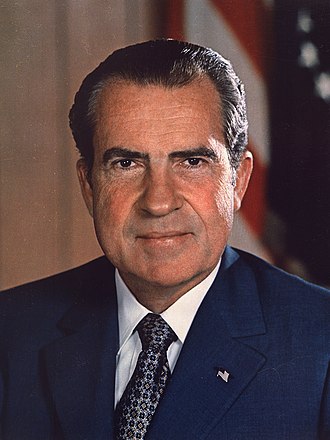
Richard M. Nixon served as the 37th President of the United States from January 1969 until his resignation in August 1974. In February 1971, he ordered the installation of a secret voice-activated taping system in the White House to preserve a historical record of his administration. Until the system's existence was revealed and dismantled in July 1973, the tapes captured Nixon directing major foreign policy initiatives, such as the opening to China, as well as his central role in the Watergate cover-up.
What Nixon talks about on the tapes
White House operations 4,718Presidential scheduling 2,225Public relations 1,784Presidential schedule 1,782Vietnam War 1,693Logistics 1,650Manolo Sanchez 1,626White House communications 1,400White House administration 1,399Presidential communication 1,243Henry Kissinger 1,191Foreign Policy 1,183
Conversations (21,010)
— Page 158 of 211President Nixon and Henry Kissinger conferred at Camp David to coordinate their messaging strategies regarding ongoing diplomatic or policy negotiations. Nixon emphasized his confidence in Kissinger’s previous communications and granted him full authorization to utilize and reference existing administration policy statements as needed. The brief discussion served to align their public posture and ensure consistency in their upcoming correspondence.
President Nixon contacted the Camp David operator to facilitate an urgent connection with General Alexander M. Haig, Jr. This brief administrative interaction served as a logistical step to initiate a high-level consultation. No substantive policy discussions occurred during the exchange, as it was strictly limited to establishing contact with the General.
President Nixon met with his personal valet, Manolo Sanchez, at the Aspen Lodge during a weekend retreat at Camp David. The discussion primarily concerned the location and retrieval of the President's eyeglasses. No policy matters or administrative decisions were addressed during this brief personal interaction.
President Nixon communicated with the Camp David operator to facilitate a telephone connection. The brief exchange focused exclusively on establishing the administrative link required for the President to place a call from the Aspen Lodge. No substantive policy discussions or policy-related decisions were recorded during this technical interaction.
President Nixon and Alexander Haig discuss the status of ongoing Vietnam peace negotiations and the psychological state of Henry Kissinger amid intense congressional and media criticism. Nixon justifies the recent bombing campaign as a necessary strategic leverage, and both men express cautious optimism that North Vietnam will seek a settlement by the end of the month. The conversation concludes with a directive for Haig to prepare for a potential mission to South Vietnam to present an ultimatum to President Nguyen Van Thieu regarding the final settlement terms.
President Nixon and Alexander Haig discuss the ongoing Paris Peace negotiations and the need to bolster Henry Kissinger's resolve amidst external pressures from Congress and the media. Nixon expresses concern that Kissinger is becoming overly susceptible to these influences, emphasizing the necessity of maintaining a firm bargaining position regarding Vietnam. Ultimately, Nixon insists that if a diplomatic settlement cannot be reached, the administration must be prepared to pursue a decisive military course of action.
President Nixon held an informal gathering with his wife, Pat Nixon, and daughter, Julie Nixon Eisenhower, at the Aspen Lodge in Camp David. The discussion, which was redacted due to its private nature, represents a moment of personal interaction between the President and his family. No policy-related decisions or official government actions were recorded during this segment of the tape.
President Richard Nixon met with First Lady Pat Nixon at Camp David to discuss personal matters and the President's upcoming schedule. The conversation included a brief mention of Charles G. “Bebe” Rebozo, a close associate of the President. The recording serves primarily as a record of informal domestic and social coordination during the presidential retreat.
President Nixon held an informal gathering with his close friend Bebe Rebozo and personal aide Manolo Sanchez at the Aspen Lodge during a retreat at Camp David. The discussion consisted of casual conversation and personal reflection rather than formal policy deliberation. No significant political decisions or administrative actions were recorded during this informal engagement.
President Nixon and Stephen B. Bull met to review the President's upcoming schedule and coordinate administrative logistics, specifically regarding meetings with key staff members like John Ehrlichman, H.R. Haldeman, and Charles Colson. Nixon instructed Bull to proactively manage short, routine meetings and photo opportunities to prevent scheduling backlogs. Additionally, the pair discussed the status of Ehrlichman's trip to Vietnam and managed communications regarding the President's availability.
President Nixon and Stephen B. Bull reviewed upcoming presidential scheduling requirements, specifically regarding the second inauguration and diplomatic visits. The discussion focused on coordinating the attendance of special envoys, including Japan’s Eisaku Sato, and determining the appropriate venues for meetings with British Prime Minister Edward Heath and the Earl of Cromer. Nixon weighed the logistics of hosting these officials at either Camp David or the White House, ultimately finalizing scheduling preferences for the late January timeframe.
President Nixon and Rose Mary Woods met to discuss a wide-ranging agenda of administrative, personal, and inaugural arrangements. They addressed technical logistics such as cassette tape organization and transcription, along with sensitive personnel decisions regarding White House staff and public relations strategies for the First Lady. Additionally, they reviewed potential inaugural activities and identified key appointments, emphasizing the importance of managing press relations and staffing to ensure the effective operation of the East Wing.
President Nixon met with his personal valet, Manolo Sanchez, for a brief informal conversation. The primary subject of the discussion was the upcoming birthday of Charles G. “Bebe” Rebozo. The exchange was social in nature and did not involve significant policy decisions or administrative directives.
President Richard M. Nixon met with his personal aide, Stephen B. Bull, to discuss upcoming administrative matters and personnel coordination. The primary focus of the brief interaction was the preparation and content of an impending press briefing by White House Press Secretary Ronald L. Ziegler. No formal policy decisions were recorded during this brief exchange, which functioned primarily as a logistical check-in regarding media relations.
President Nixon and Ronald L. Ziegler met to discuss a comprehensive strategy for managing press relations during the second term, focusing on marginalizing the influence of the Washington-based media establishment. They analyzed tactics for handling social events, church services, and formal press conferences to minimize adversarial coverage and break the perceived intimidation of the press corps. Nixon emphasized a desire to shift toward more subtle, controlled interactions and directed Ziegler to prioritize the cultivation of alternative media relationships while keeping the administration's strategic goals insulated from hostile outlets.
President Nixon met with his personal valet, Manolo Sanchez, in the Oval Office to receive refreshments. This brief interaction served as a routine service call during the President’s morning schedule. No policy discussions or administrative decisions occurred during this exchange.
President Nixon met with H.R. Haldeman and John Ehrlichman to discuss high-level staffing, Cabinet appointments, and managing relations with a hostile Congress. The group addressed strategies for the upcoming inaugural, including a simplified Cabinet swearing-in process and limiting White House social events. Additionally, they reviewed potential candidates for various agency roles, the future of L. Patrick Gray at the FBI, and the need to maintain distance from the ongoing Watergate investigation.
President Nixon contacted the White House operator to place a call to Press Secretary Ronald L. Ziegler. The brief interaction served solely as a logistical request to connect the President with his staff member. No further substantive policy matters or decisions were discussed during this exchange.
President Nixon and Ronald Ziegler coordinate strategy for a press interview regarding the President's upcoming 60th birthday. They decide to limit the scope of the discussion to personal birthday reflections and age-related perspectives, specifically avoiding a broader retrospective on his first term or political philosophy. To project an image of a working President, they arrange for the interview to take place in the Executive Office Building rather than the Oval Office, while directing photographer Ollie Atkins to handle the official documentation of the event.
President Nixon and Press Secretary Ronald Ziegler briefly consult regarding the public release of a photograph and the necessity of coordinating staff logistics between the Executive Office Building and the White House. The pair confirms their intent to proceed with disseminating information regarding a specific pedestal, while dismissing rumors or inaccurate reports as untrue. The discussion concludes with the President emphasizing the need for Executive Office of the President staff to relocate their workspace to the immediate vicinity for better operational efficiency.
President Nixon initiates a brief request for the White House operator to place a call to Stephen B. Bull. This administrative exchange serves to facilitate direct communication between the President and his aide. No further policy or substantive matters are addressed during this short connection.
President Nixon communicated with a White House operator to facilitate an outgoing call. The interaction was brief and functional, serving only to connect the President to another party. No substantive policy discussions or significant political decisions occurred during this exchange.
President Nixon consulted with Stephen B. Bull to coordinate his upcoming daily schedule and manage the logistics for an official visit from British Prime Minister Edward Heath. The President provided specific instructions for meetings regarding wage and price controls with George Shultz, John Ehrlichman, and Herbert Stein, while also finalizing details for appointments involving Kenneth Cole, Frederic Malek, and Roy Ash. Regarding the Heath visit, Nixon outlined a preferred itinerary featuring a formal White House dinner followed by informal meetings at Camp David, emphasizing a desire to keep the American delegation strictly limited to avoid unnecessary State Department or bureaucratic presence.
President Nixon met with his aide Stephen B. Bull to coordinate the scheduling of upcoming meetings, specifically requesting the inclusion of George Shultz and John Hurt. Nixon emphasized a desire for careful logistical planning to ensure specific interactions took place at controlled times while avoiding unauthorized or conflicting appointments. He expressed a strong preference for maintaining strict control over the composition of meeting participants to preserve administrative order.
President Nixon met with an unidentified individual in his Old Executive Office Building suite for a brief discussion. The meeting, which lasted approximately fifteen minutes, included the provision of refreshments. No record of the substantive content of this conversation exists, as the segment was restricted and no transcript is available.
President Nixon and Press Secretary Ronald L. Ziegler met briefly to coordinate logistics for an upcoming interaction with the press. The discussion focused primarily on the arrangement of the room, specifically determining the seating configuration for the reporters in attendance. This meeting served as a final preparation step to ensure the professional management of the media engagement.
President Nixon met with press members Helen Thomas and Frances Lewine, along with press secretary Ronald Ziegler and others, for an informal discussion that touched upon the President's personal reflections and observations on public service. The conversation covered a wide array of topics, including age requirements for political office and the judiciary, the physical and emotional burdens of the presidency, and the importance of maintaining interaction with younger generations. The participants also shared personal anecdotes and birthday greetings, concluding with a brief interaction regarding family photographs in the office.
President Nixon met with his personal valet, Manolo Sanchez, in the Old Executive Office Building. The primary focus of the brief encounter was to coordinate the President's upcoming schedule, specifically regarding a planned meeting with Charles W. Colson. Sanchez departed immediately following this administrative check-in.
President Nixon met with Charles Colson, Ronald Ziegler, and Col. Richard T. Kennedy to review administrative strategy, political optics, and upcoming agenda items for his second term. The discussion touched on the President's press relations, the management of the wholesale price index, and staff responsibilities, while also addressing ongoing concerns regarding the Vietnam peace negotiations and the political fallout of the 1972 election. Nixon and his advisors emphasized the need to consolidate political support and effectively counter criticism from Democrats and the press as they transitioned into the second administration.
President Nixon directs the White House operator to facilitate a meeting with Colonel Richard T. Kennedy. The President specifically requests that Kennedy relocate to the Executive Office Building to conduct the discussion. This exchange serves as a brief administrative directive to coordinate a secure consultation.
President Nixon and Col. Richard T. Kennedy met to assess the volatile military and political landscape surrounding a potential Vietnam cease-fire. The discussion focused on evaluating local political dynamics and the efficacy of previous reporting regarding the conflict's damage. Ultimately, Nixon directed Kennedy to present these findings to the White House press corps the following day to better manage public perception.
President Richard Nixon met with his longtime personal valet, Manolo Sanchez, at the Old Executive Office Building. The conversation primarily consisted of informal personal interaction or routine assistance, as the available records contain no substantive policy discussions. Due to the lack of a transcript for this segment, no specific political developments or executive actions were documented.
President Nixon and H. R. Haldeman met to discuss various personnel and administrative matters, including the nomination of George D. Webster, potential diplomatic assignments for L. Patrick Gray and William D. Ruckelshaus, and planning for the 1973 inaugural church service. They reviewed the status of Webster's nomination amid concerns over his past financial practices and tax payments, ultimately considering alternatives. The conversation also touched upon sensitive political intelligence regarding Anna C. Chennault and 1968 election-related activities, as well as the ongoing second-term reorganization of White House staff.
President Nixon initiates a request through the White House operator to place a telephone call to Congressman John J. McFall of California. The conversation is strictly procedural, serving as a brief administrative coordination to connect the President with the legislator. No substantive policy discussions occur during this exchange.
President Nixon initiates a brief communication with the White House operator to facilitate a connection with a congressman. The exchange focuses on establishing a line with Congressman John, likely for an urgent legislative or political consultation. This interaction serves as a routine administrative step to manage the President's official outreach and scheduling requirements.
President Nixon receives a brief update from the White House operator regarding the schedule of Congressman John J. McFall. The exchange concludes with the operator offering birthday greetings to the President. No substantive policy matters or administrative decisions are addressed during this short call.
President Nixon held a brief, routine administrative interaction with the White House operator to facilitate communication. This exchange functioned primarily as a procedural check for connectivity within the White House switchboard system. No substantive policy matters or executive decisions were addressed during this brief connection.
President Nixon met with his aide Stephen B. Bull in the Oval Office to conduct a review of his daily schedule. The primary focus of the discussion concerned upcoming engagements with Press Secretary Ronald L. Ziegler and Soviet Ambassador Anatoliy F. Dobrynin. This briefing served as a routine administrative coordination of the President's morning agenda.
In this recording, President Nixon reflects on his recent birthday and discusses press relations, the personal impact of media coverage on his family, and his daily work-life balance. He also evaluates the status of Vietnam peace negotiations, expressing skepticism regarding the North Vietnamese and emphasizing the necessity of securing a ceasefire that addresses concerns over POWs and MIAs. The discussion includes considerations of military options and the political challenges of managing congressional relations during this sensitive period of administration reorganization.
President Nixon met with Rose Mary Woods and Press Secretary Ronald L. Ziegler to discuss personal administrative tasks, the management of press relations, and upcoming media strategies. The President addressed recent inaccurate press coverage, specifically criticizing reporting regarding his administration's staffing decisions and internal power dynamics. The participants also evaluated the benefits of low-key media engagements versus formal interviews and finalized plans for how the administration would handle press inquiries regarding the Vietnam settlement and wage-price controls during the transition period.
President Nixon met with H. R. Haldeman and other staff to discuss administrative restructuring, press strategy, and the implementation of a new audio recording system. The participants addressed the potential reassignment of Herbert Klein to a Counselor for Communications role to maintain his utility to the administration, while also reviewing the status of upcoming Cabinet confirmations and Watergate-related concerns involving Egil Krogh. Additionally, Nixon directed staff to install transcription equipment at various locations to enhance the president’s ability to record personal notes and historical documentation.
President Nixon telephoned Representative John J. McFall to offer congratulations on his selection as House Democratic Whip. The conversation served primarily as a professional courtesy, briefly bridging the two men's shared California backgrounds and humble upbringings in agriculture. Nixon concluded the brief exchange by expressing interest in meeting McFall again during a future congressional leadership session.
President Nixon initiates a brief telephone call to connect with Secretary of Housing and Urban Development George W. Romney. The President instructs the White House operator to place the call to Romney's office. No substantive policy discussions occur as the recording captures only the administrative request to establish the connection.
President Nixon met with George Shultz, Herbert Stein, and John Ehrlichman to strategize on economic messaging and upcoming policy announcements, specifically regarding the Cost of Living Council and rising food prices. They discussed plans to implement targeted administrative actions—such as reducing export subsidies and adjusting stockpiles—to mitigate inflation while framing congressional overspending as the primary threat to the nation's economic prosperity. Nixon emphasized the need for an aggressive public relations campaign to highlight the administration's economic record and to shift the political burden for potential fiscal instability onto the Democratic-controlled Congress.
President Nixon met with staff and officials, including Maurice J. Williams and Col. Richard T. Kennedy, to discuss relief efforts in Nicaragua and the status of Vietnam peace negotiations. During the meeting, Nixon received a birthday gift from his staff and praised Williams for his coordination of disaster relief, advising him on how to characterize these efforts to the press. Following these discussions, Nixon shifted the focus to the Vietnam peace talks, expressing skepticism about the North Vietnamese negotiators' sincerity and reiterating his preference for a negotiated agreement over a unilateral military withdrawal.
In this meeting, President Nixon and his staff, particularly Frederic Malek and Roy Ash, focused on the management reorganization of the federal government for his second term. Nixon emphasized the critical need for absolute loyalty among appointees to ensure that government agencies act in accordance with presidential directives, specifically noting the importance of controlling the IRS and staffing departments with loyalists. Additionally, the President reviewed economic messaging strategies for the upcoming budget, instructed his team to minimize unnecessary paperwork, and discussed sensitive developments regarding potential Vietnam peace negotiations, tasking Henry Kissinger and Alexander Haig with maintaining absolute secrecy.
President Nixon consulted with a White House operator to facilitate a telephone call to Lenore L. Romney. The operator provided an update regarding the travel itinerary of Secretary George W. Romney, noting his current presence in Texas and his scheduled arrival in Dallas that evening. Nixon’s primary objective for this interaction was to arrange a direct line of communication with Mrs. Romney.
President Nixon consulted with a White House operator to coordinate a time to reach Lenore Romney and her husband, George Romney. The operator provided updates regarding the couple's separate speaking engagements at the Washington Hilton and their expected arrival times at home. Nixon decided to postpone his outreach, opting to call back later in the day once the Romneys had returned.
President Nixon directs the White House operator to place a telephone call to entertainer Bob Hope. The brief exchange serves as a logistical coordination to facilitate communication between the President and the celebrity. No further policy or administrative matters are addressed during this brief connection.
President Nixon met with his valet, Manolo Sanchez, in the Old Executive Office Building for a brief, informal discussion. Their exchange focused primarily on the President’s schedule and concerns regarding the current time as reflected on his watch. No major policy developments occurred during this brief administrative check-in.
President Nixon held a brief, non-substantive interaction with a White House operator to facilitate a telephone connection. The exchange was strictly logistical in nature, serving as a functional step to initiate a subsequent communication. No policy matters or significant executive decisions were discussed during this brief contact.
President Richard Nixon met with his personal valet, Manolo Sanchez, in the Old Executive Office Building to discuss the President's upcoming schedule. The conversation primarily focused on logistical planning and the coordination of official activities. No specific policy decisions or significant historical developments were documented in the available segments of this interaction.
President Nixon met with his personal valet, Manolo Sanchez, in the Old Executive Office Building to review upcoming scheduling matters. The discussion centered on coordinating logistics with Press Secretary Ronald L. Ziegler regarding the President's calendar. No major policy decisions were recorded during this brief administrative exchange.
In this telephone call, Bob Hope offers birthday greetings to President Nixon and discusses his recent USO tours, including positive feedback from military leadership regarding the President’s Vietnam policy. Hope also expresses his disapproval of congressional anti-war efforts and advocates for the President to award Adolph Zukor the Presidential Medal of Freedom. Nixon directs Hope to coordinate the Zukor recommendation with Leonard Garment and agrees to watch Hope’s upcoming television special after being prompted by a reminder.
President Nixon and entertainer Bob Hope engaged in a informal, wide-ranging conversation that covered television ratings for Hope's past Christmas specials and brief administrative tasks. The discussion included lighthearted banter regarding personal projects and media appearances, as well as a request for Hope to contact Leonard Grinde to facilitate a specific professional matter. The call concluded with the President acknowledging receipt of information and directing coordination through his staff.
President Nixon directed the White House operator to instruct Leonard Garment to contact entertainer Bob Hope. The call was initiated to facilitate the exchange of information that Hope wished to provide to the administration. The operator confirmed the directive and prepared to relay the request to Garment.
President Nixon consulted with the White House operator to facilitate an outgoing call. This brief interaction served the purely administrative purpose of connecting the President to another party. No substantive policy discussions or decisions occurred during this brief exchange.
President Nixon and Press Secretary Ronald Ziegler met to discuss the potential acquisition of the Washington Star by Francis L. Dale and the strategic importance of media relations for the administration. They evaluated the newspaper's market position relative to the Washington Post and explored the implications of television deregulation and press policy. The conversation reflected the President’s desire to influence media coverage and his focus on managing the administration's broader public image.
President Nixon initiates a brief telephone request through the White House operator to be connected with his close friend, Charles G. "Bebe" Rebozo. The brief exchange serves strictly as an administrative call to facilitate this communication. No further policy or substantive matters were discussed during this connection.
President Nixon held a brief, informal exchange with a White House operator. The conversation consisted of a personal, affectionate remark from the President. No substantive policy matters or administrative decisions were addressed during this interaction.
President Nixon attempted to reach Charles G. “Bebe” Rebozo through the White House operator to discuss his whereabouts. Upon learning that Rebozo was out of the building, Nixon directed the operator to have Rebozo return the call once he returned. No substantive policy matters were addressed during this brief administrative exchange.
President Nixon instructed the White House operator to place an outgoing telephone call to Lenore L. Romney. This brief communication served solely to facilitate the connection for the President's intended conversation with Mrs. Romney. No further substantive discussion or policy decisions took place during this brief administrative exchange.
President Nixon requested that the White House operator connect him to an unspecified party to continue a previous discussion. The brief interaction served as a logistical bridge between the President and a follow-up conversation. No substantive policy matters or decisions were finalized during this exchange.
President Nixon met with his personal aide, Manolo Sanchez, in the Old Executive Office Building. While the specific nature of the discussion remains undefined due to the transcript's lack of substantive dialogue, the meeting served as a brief personal interaction between the President and a member of his domestic staff. No formal policy decisions or significant administrative actions were recorded during this brief encounter.
President Nixon consulted with the White House operator to facilitate an outgoing call. The interaction was limited to the technical coordination required to connect the President to another party. No substantive policy discussions or significant political decisions occurred during this brief administrative exchange.
President Nixon and his daughter, Julie Nixon Eisenhower, spoke briefly to exchange birthday greetings and coordinate plans for an upcoming evening party. During the call, they discussed recent positive press coverage of the President by Helen Thomas and Frances Lewine, as well as the family dogs. Additionally, they reached a consensus regarding the departure of Constance Stuart from the White House staff, with Julie confirming that her mother agreed it was time for Stuart to move on to a new position.
President Nixon and his daughter, Julie Nixon Eisenhower, held a brief, informal meeting to discuss the drafting of a personal narrative or story. The conversation focused on narrative structure and the effective inclusion of specific characters, particularly the role of an 'oppressed' individual, to strengthen the work's impact. The exchange concluded with a mutual agreement on the suggested approach for developing the project.
President Nixon and John Ehrlichman briefly discussed the President’s upcoming schedule and administrative agenda. The conversation focused on managing meetings with new Cabinet officials, specifically mentioning Elliot L. Richardson. No substantive policy decisions were reached during this brief exchange.
President Nixon instructed the White House operator to continue attempting to reach Lenore Romney by telephone. The President clarified that the matter was not urgent and requested that the operator try again in approximately thirty minutes. No further policy or substantive business was discussed during this brief administrative check-in.
President Nixon held a brief administrative interaction with the White House operator. The conversation consisted solely of standard procedural communication, concluding with a mutual farewell. No substantive policy matters or official developments were addressed during this exchange.
President Nixon met with his valet, Manolo Sanchez, in the Old Executive Office Building to discuss the President's upcoming daily schedule. The primary focus of the brief interaction was the coordination of an impending meeting with Charles W. Colson. No major policy decisions were reached during this short logistical exchange.
President Nixon met with H.R. Haldeman, Charles Colson, and other senior advisors to discuss staffing appointments, media relations, and legal developments concerning the Watergate scandal. The participants focused on identifying candidates for key government positions, including the IRS commissioner, and debated the management of the administration’s public image amid mounting investigative pressures. Additionally, they reviewed potential risks associated with the ongoing Watergate legal proceedings and the potential for congressional inquiries resulting from upcoming trials.
President Nixon called Lenore Romney to convey his personal praise for a recent speech given by her husband, HUD Secretary George Romney, at a National Association of Home Builders conference. Nixon commended Secretary Romney’s courageous decision to address controversial housing subsidy policies, framing the move as a necessary action for the administration. Lenore Romney acknowledged the effort her husband put into the speech and promised to relay the President’s appreciation upon his return.
H. R. Haldeman coordinates with Stephen B. Bull to arrange an unannounced, low-profile excursion for President Nixon and Charles G. “Bebe” Rebozo on the White House South Grounds. Haldeman specifies strict security and aesthetic requirements for the vehicle, including the necessity of a seat divider and the removal of presidential flags. Additionally, he instructs that Press Secretary Ronald L. Ziegler be notified of the President's departure only after the thirty-minute drive is already underway.
John D. Ehrlichman and President Nixon discuss the scheduling of brief, purposeful meetings with key administration officials to solidify staffing for the second term. They identify the three new counselors, VA administrator Donald E. Johnson, and CEQ leadership under Russell E. Train as priority contacts to confirm their status and provide direction. Ehrlichman is tasked with coordinating these brief, substantive check-ins through H.R. Haldeman to ensure the administrative transition proceeds efficiently.
President Nixon contacted the White House operator to initiate a telephone call to his close friend and confidant, Charles G. "Bebe" Rebozo. The brief exchange served as a request to place the call, though the transcript does not record the subsequent conversation between the two men. This request highlights Nixon's ongoing reliance on Rebozo for personal counsel during his presidency.
President Nixon and his close associate Bebe Rebozo coordinated a brief, private automobile excursion to depart from the White House South Grounds. They agreed to keep the trip secluded, opting not to invite any additional companions, and aimed to conclude their drive in time to return for dinner. This discussion focused solely on the logistics of the President's personal schedule and local travel arrangements.
President Nixon dictated a formal birthday acknowledgement letter addressed to Steven B. Bull. In the message, Nixon expressed his appreciation for Bull’s long-standing friendship and steadfast support throughout his career. The President also reflected on his advancing age and confirmed his expectation to see Bull at the upcoming 1973 inauguration ceremony.
President Nixon met with H.R. Haldeman, Stephen Bull, and staff members to discuss details regarding the President's 60th birthday celebration, the upcoming inauguration, and long-term staffing reorganization. The group reviewed the success of a surprise birthday film featuring football highlights and discussed the necessity of strictly limiting guests at inaugural events to avoid uncontrollable crowd sizes and political optics issues. Additionally, Nixon emphasized his desire to move toward more informal White House gatherings, while Haldeman provided updates on personnel appointments and strategies for handling the skeptical Washington press corps.
President Nixon held a brief, private session in the Oval Office with an unidentified individual. While no transcript exists to detail the specifics of the dialogue, the meeting occurred during a period of intense focus on the conclusion of the Vietnam War and domestic policy planning. The nature of the encounter remains speculative due to the lack of available documentation regarding the participant’s identity or the specific agenda items addressed.
President Nixon and H. R. Haldeman discussed a variety of personnel, political, and foreign policy matters, including the pending Vietnam peace settlement and staff management. They reviewed potential appointments for the Department of Justice and the Federal Trade Commission, emphasizing the importance of loyalty and the political implications of these choices. Additionally, the President and Haldeman mapped out a strategy to handle the public announcement of the Vietnam negotiations while managing Henry Kissinger’s schedule and press relations during the upcoming inauguration. They also addressed legislative strategies regarding David Eisenhower’s potential congressional run and other personnel logistics for the second term.
President Nixon initiates a request for the White House operator to place a telephone call to Colonel Richard T. Kennedy. The brief interaction serves solely to facilitate this communication link. No further policy discussions or significant developments occur during this brief exchange.
President Nixon met with his personal valet, Manolo Sanchez, in the Old Executive Office Building. The brief interaction focused on domestic provisions, specifically the delivery of marmalade. No substantive policy matters or administrative decisions were recorded during this segment of the meeting.
President Richard Nixon met with his personal valet, Manolo Sanchez, and an unidentified individual in the Executive Office Building. The recording contains no substantive discussion of policy or administrative matters due to the segment being restricted under a deed of gift. Consequently, the meeting remains historically obscure with no identifiable action items or significant political developments preserved in the record.
President Richard M. Nixon met with his personal secretary, Rose Mary Woods, in the Old Executive Office Building to review the President’s administrative schedule. The discussion focused on coordinating a specific phone call and confirming the President's precise location for upcoming commitments. No major policy decisions were reached, as the meeting served primarily as an operational check-in regarding the President's itinerary.
President Nixon held a brief administrative interaction with a White House operator to facilitate an outgoing telephone connection. The conversation serves primarily as a logistical bridge to initiate a subsequent call. No substantive policy discussions or significant political decisions were recorded during this brief exchange.
President Nixon consulted with Colonel Richard T. Kennedy regarding the status of ongoing Vietnam peace negotiations. The President requested an immediate briefing upon the arrival of the latest report from the recently concluded session, which was expected shortly. They agreed that Kennedy would personally deliver the documentation to the Executive Office Building once it became available to ensure the President remained informed of any developments.
President Nixon consulted with Col. Richard T. Kennedy regarding the status and delivery of a pending report. The discussion emphasized the necessity of obtaining the report before finalizing plans or altering strategic direction. Nixon confirmed he would receive the document once its preparation was completed.
President Nixon consulted with the White House operator in an attempt to reach Secretary of Defense Melvin R. Laird. The conversation was intended to facilitate a direct communication between the two officials. Ultimately, the attempt to connect with Laird proved unsuccessful and the call was canceled.
H. R. Haldeman and President Nixon discussed an incoming report and procedural proposal from Henry Kissinger regarding ongoing Vietnam peace negotiations in Paris. Nixon expressed significant concern that if Kissinger traveled to Hanoi to initial the settlement agreement, the President’s subsequent television announcement would appear anticlimactic and diminish his control over the narrative. Consequently, Nixon requested a meeting with Haldeman and Alexander Haig to strategize on timing and procedure, while also briefly touching upon personnel appointments for his second-term administration.
President Nixon and H.R. Haldeman discuss administrative concerns, scheduling, and the strategic importance of controlling the administration's public narrative. The conversation touches on staffing challenges regarding legal personnel and the difficulty of managing expectations when engaging with the press. Nixon emphasizes the necessity for the White House to maintain a proactive stance and be the first to speak on official matters to ensure the administration's position is clearly understood by the American public.
President Nixon met with Stephen B. Bull to coordinate his upcoming schedule and prioritize his immediate workload. The President requested that his meeting with John D. Ehrlichman be rescheduled due to pressing national security matters requiring his full attention. Nixon also indicated he would accept a specific phone call, provided the caller was identified as urgent.
President Nixon and H. R. Haldeman briefly review the President's upcoming daily schedule and internal staff movements. The discussion centers on coordinating meetings involving John Ehrlichman, Stephen Bull, and Charles Colson to ensure the President remains fully briefed on ongoing administrative matters. No major policy decisions are reached, as the participants focus on logistics and the management of executive appointments.
President Nixon spoke with entertainers Dan Rowan and Dick Martin to express his personal appreciation for a humorous birthday skit they produced for his 60th birthday. The discussion included lighthearted banter about the skit’s writer, Paul Keyes, and the President's plan to share the performance with his White House staff. The call concluded with a brief analysis of the upcoming Super Bowl, specifically comparing the strengths of the Miami Dolphins and the Washington Redskins.
President Nixon met briefly with comedians Dan Rowan and Dick Martin to offer praise for a recent performance and discuss the production of a humorous skit for an upcoming event. The conversation shifted to sports analysis, where the trio speculated on the competitive advantages of the Miami Dolphins versus the Washington Redskins in the lead-up to Super Bowl VII. Nixon concluded the call by encouraging the entertainers to use their platform to showcase the scale and spirit of the United States to the public.
President Nixon contacted the White House operator to place an outgoing call to Mrs. Muriel Berlin, the wife of Hearst Corporation executive Richard Berlin. The President provided the operator with instructions to locate and connect him with Mrs. Berlin in New York City. The primary purpose of the communication was to facilitate this specific personal or professional outreach.
President Nixon dictated a memorandum for his files to document personal and administrative matters, including the status of Vietnam peace negotiations and upcoming staff scheduling. He also reflected on recent social events, specifically reviewing details and gifts from his recent birthday party hosted with his family and White House staff. Additionally, the President noted logistical discussions regarding the acquisition of a property and the management of Oval Office furnishings.
President Nixon and H.R. Haldeman met to coordinate staffing decisions for the second-term administration and address controversial federal hiring quotas. Nixon expressed strong opposition to existing executive orders mandating university hiring quotas, directing that they be changed to avoid alienating academic and public opinion. Additionally, the pair reviewed personnel placements for various agencies, including the Justice Department and the Office of Emergency Preparedness, while briefly touching on the status of Vietnam peace negotiations.
President Nixon met with his personal aide, Manolo Sanchez, in the Old Executive Office Building to discuss administrative details regarding his daily schedule. The conversation focused on the logistics and whereabouts of Alexander M. Haig. No significant policy decisions were recorded during this brief administrative exchange.
President Nixon met with Alexander Haig and H. R. Haldeman to coordinate the final stages of the Vietnam peace settlement and address internal administration concerns. The discussion focused on managing the logistics of the agreement, specifically timing the public announcement and Haig’s mission to secure South Vietnamese President Nguyen Van Thieu's cooperation regarding the ceasefire. Additionally, the group reviewed second-term staff appointments and debated the political impact of federal quota policies, with Nixon emphasizing a desire to revise executive orders to better align with his administration's public stance against mandatory hiring quotas.