Nixon, Richard M. (President)
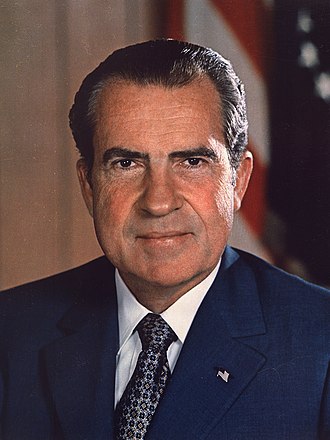
Richard M. Nixon served as the 37th President of the United States from January 1969 until his resignation in August 1974. In February 1971, he ordered the installation of a secret voice-activated taping system in the White House to preserve a historical record of his administration. Until the system's existence was revealed and dismantled in July 1973, the tapes captured Nixon directing major foreign policy initiatives, such as the opening to China, as well as his central role in the Watergate cover-up.
What Nixon talks about on the tapes
White House operations 4,718Presidential scheduling 2,225Public relations 1,784Presidential schedule 1,782Vietnam War 1,693Logistics 1,650Manolo Sanchez 1,626White House communications 1,400White House administration 1,399Presidential communication 1,243Henry Kissinger 1,191Foreign Policy 1,183
Conversations (21,010)
— Page 175 of 211President Nixon consulted with an unidentified individual regarding a scheduled or prospective phone call to Adele Rogers St. Johns. The brief discussion centered on the logistics of the call, including the timing and potential concerns regarding service or protocol. No significant policy decisions were reached during this short interaction.
President Nixon hosted a meeting with family members of Frank Tummillo and federal agent Thomas Devine to present the Henry L. Manfredi Award and honor the service of law enforcement officers in the war on narcotics. During the ceremony, Nixon drew parallels between the fight against drug traffickers and the war in Vietnam, emphasizing the importance of legislative measures, including potential death penalty provisions for drug pushers. Following the departure of the families, Nixon and Attorney General Richard Kleindienst transitioned to a brief discussion regarding upcoming administrative scheduling and the status of pending crime legislation.
President Nixon met with Stephen B. Bull to coordinate his upcoming schedule, including meetings with Congressional leaders, a planned farewell call to John J. McCloy regarding his resignation from the Arms Control and Disarmament Agency, and a briefing with Hermann Kahn. The conversation also covered administrative details for the President’s public events, specifically regarding the handling of drug enforcement personnel and protocol for White House reception lines. Nixon provided instructions to Bull on streamlining these social duties to improve efficiency and personal comfort during official engagements.
President Nixon initiated a brief telephone communication through the White House operator to place an outgoing call to Adele Langston Rogers, the wife of Secretary of State William P. Rogers. The primary purpose of this contact was to facilitate personal communication between the President and Mrs. Rogers. No policy matters or administrative decisions were addressed during this brief exchange.
President Richard M. Nixon met with his personal valet, Manolo Sanchez, in the Old Executive Office Building to attend to personal matters. The brief interaction focused on the management of private items and domestic assistance within the executive offices. No major policy decisions were documented during this exchange.
President Richard Nixon met with his personal valet, Manolo Sanchez, in the Old Executive Office Building to discuss administrative matters regarding the President's daily schedule. The brief exchange primarily focused on coordinating an upcoming telephone call. No significant policy decisions were recorded during this routine operational interaction.
President Nixon dictated a memorandum for his files, reviewing a diverse range of administrative and political concerns, including foreign policy analysis, domestic economic challenges, and law enforcement initiatives. He assessed media coverage regarding his trip to the People's Republic of China, discussed the presentation of the Hank Manfredi Award, and deliberated on public perceptions of food prices and integration policies. The recording captures the President’s process of organizing his thoughts on staff management, press relations, and the administrative structure of the White House.
President Nixon consulted with a White House operator to facilitate an outgoing call. This interaction served primarily as a logistical step to connect the President with a third party. No substantive policy matters or major decisions were recorded during this brief administrative exchange.
President Nixon dictated a memorandum for his personal files to record his assessment of current administrative challenges. The discussion focused primarily on domestic public opinion, specifically regarding the ongoing concerns surrounding returning prisoners of war and federal budgetary priorities. This reflection served to formalize the President's perspective on these critical political issues as of early 1973.
President Nixon consulted with Adele Rogers regarding his strategy to utilize Cabinet wives as political surrogates to support his administration's legislative and budgetary agenda. Nixon expressed his desire to leverage the wives' influence while acknowledging that participation would vary based on individual circumstances. To further this objective, he announced plans for a formal briefing and dinner for Cabinet members and their spouses at Camp David scheduled for late April or early May.
President Richard Nixon met briefly with Adele Rogers for a social courtesy call to offer his well wishes for an upcoming event. Their conversation was informal and lacked substantive policy discussion, primarily involving brief pleasantries. The meeting concluded quickly with Nixon expressing his regards before Rogers departed.
President Nixon and H. R. Haldeman met to discuss upcoming administrative scheduling and logistics. The dialogue reflects a brief transition period during the workday, as the two men coordinated the President's immediate agenda. No major policy decisions were reached during this short, procedural exchange.
President Nixon met with H.R. Haldeman and briefly John Ehrlichman to strategize on public relations, presidential travel, and the administration's political narrative. The discussion focused on how to improve the President's approval ratings amidst economic concerns and domestic policy issues, with a specific emphasis on effectively communicating accomplishments and countering media criticism. Key decisions included planning future travel to Latin America and regional locations to dominate the public dialogue, as well as refining the President's upcoming schedule and appearance strategy to maximize political impact.
President Nixon and John Ehrlichman coordinate preparations for an upcoming Cost of Living Council meeting, emphasizing the need for realistic goals, deadlines, and direct reporting through the OMB. They discuss personnel issues regarding Attorney General Richard Kleindienst’s attendance, ultimately agreeing to have Donald Santarelli represent the Justice Department. The conversation also briefly touches on the progress of a draft for an upcoming veterans speech and a speculative proposal for a wrap-up address to a joint session of Congress.
President Nixon met with Stephen B. Bull to review a list of individuals, specifically inquiring about those who remained. The brief exchange focused on vetting personnel or associates, as evidenced by the President's request to identify the remaining names. No specific decisions were finalized during this short window, though the discussion served as a follow-up on staffing or administrative personnel matters.
President Nixon met with Colonel Robinson Risner, a recently returned prisoner of war, to discuss the conditions of his captivity in North Vietnam and the strategic rationale behind U.S. bombing campaigns. Risner provided detailed accounts of the brutal torture, isolation, and psychological tactics employed by North Vietnamese guards, as well as the POWs' resilient efforts to maintain communication and morale. The conversation also touched upon the necessity of providing reconstruction aid to North Vietnam as a pragmatic tool to guarantee the ceasefire and maintain U.S. influence, and the President sought Risner’s perspective on handling the small number of POWs accused of collaboration.
President Nixon met with his aide Stephen B. Bull to review his daily schedule and manage routine administrative tasks, including signing disaster assistance documents for Texas. The two discussed a scheduled telephone call from Julie Nixon Eisenhower and logistics regarding the President’s upcoming meetings with returning Prisoners of War. No major policy shifts occurred, as the session focused primarily on managing the President's public engagements and correspondence.
President Nixon met with Captain Jeremiah A. Denton, Jr. to discuss the experiences of American Prisoners of War (POWs) and plan a welcoming reception at the White House. The conversation focused on the personal resilience of POWs, the importance of an honorable conclusion to the Vietnam War, and the strategic necessity of U.S. involvement in global affairs to counter Soviet and Chinese influence. Nixon also solicited Denton's insights on the psychological endurance required during captivity and finalized logistical arrangements for an upcoming dinner honoring the returned servicemen.
President Richard M. Nixon met with former POW Jeremiah A. Denton, Jr. to discuss the Vietnam War, the strategic necessity of the 1972 bombing campaigns, and the broader implications of U.S. foreign policy and military credibility. They examined the domestic challenges facing the administration, particularly the moral and political opposition from the "leader class" and the media, which they contrasted with the patriotism of the "average man" and returning POWs. The conversation served as both a strategic debriefing on the war's conclusion and a discussion regarding Denton's plans to write a book reflecting on the American character and the need for moral renewal.
President Nixon met with an unidentified individual in the Oval Office to discuss logistical concerns regarding seating arrangements or internal access. The brief exchange suggests a focus on the necessity of relocating to an exterior space to address an ongoing issue. No major policy decisions or high-level strategic shifts were recorded during this segment of the meeting.
President Nixon met with an unknown individual to request a copy of a letter authored by Captain Jeremiah A. Denton, Jr. The discussion centered exclusively on obtaining this specific document for the President's review. No other substantive policy matters or further actions were recorded during this brief exchange.
President Nixon met with an unidentified individual in the Oval Office to discuss the preparation and delivery of a specific speech and letter. The conversation focused on the logistical coordination of these communications, though the transcript remains largely undefined. No significant policy decisions or further actions were recorded during this brief, undocumented exchange.
President Nixon met with Stephen B. Bull and an unidentified individual in the Oval Office to discuss administrative logistics and daily scheduling matters. The brief encounter focused on reviewing the President’s upcoming agenda and managing office operations. No substantive policy decisions were recorded during this portion of the tape.
President Nixon and Republican congressional leaders met to discuss the administration's legislative agenda, specifically focusing on the "New Federalism" approach to governance. The President emphasized shifting decision-making power from the federal bureaucracy to local and state authorities through programs like the Better Communities Act and the Responsive Government Act. Additionally, the conversation addressed a robust crime-fighting package, including proposed federal death penalty statutes and mandatory sentences for major drug traffickers, while positioning these initiatives as essential to restoring national law and order.
President Nixon met with George H. W. Bush to discuss Republican candidate recruitment and election strategy for the 1974 cycle. The two reviewed primary race scenarios, including potential endorsements and the necessity of managing internal party conflicts, specifically regarding House and Senate campaigns. They also discussed the administration's policy on dispersing campaign funds through a candidate trust fund and reviewed controversial ambassadorial appointment processes.
President Nixon met with his aide Stephen B. Bull to coordinate logistical details for his upcoming schedule, specifically focusing on a reception for Foreign Service wives and a meeting with John J. McCloy. The President expressed a desire to minimize press visibility regarding these events, particularly concerning the involvement of the First Lady. Bull provided input on timing adjustments to better manage the sequence of these engagements.
President Nixon and H. R. Haldeman met to assess the President's public image, declining approval ratings, and communication strategies regarding the federal budget and congressional relations. They reviewed polling data concerning economic policies and public support for the administration's budget impoundments versus congressional spending. Additionally, they discussed logistical adjustments to the President's schedule and the handling of ongoing political crises, including the Watergate investigation and the confirmation hearings of L. Patrick Gray III.
President Nixon held a ceremony in the Oval Office to present awards to various federal employees and government agency representatives for their public service. Accompanied by H. R. Haldeman and several cabinet members, the President recognized individuals from departments including Agriculture, Treasury, Defense, and the Atomic Energy Commission. During his remarks, Nixon praised the recipients for prioritizing public service over private financial gain, emphasizing that the intrinsic rewards of their work provided a satisfaction that private enterprise could not match.
President Nixon met with representatives of the National Association of Retarded Children (NARC), including the 1972 poster child Renee Vincent, to highlight the importance of supporting individuals with intellectual disabilities. The meeting served as a photo opportunity and an occasion for the guests to present the President with a commemorative poster for his future presidential library. Nixon expressed personal support for the organization’s mission, emphasizing the progress made in societal attitudes toward mental retardation and the importance of continued advocacy.
President Nixon met with John W. Dean III to discuss sensitive administrative or legal matters. While the transcript is fragmentary, the meeting centered on internal White House counsel concerns and the handling of ongoing investigations. No specific action items are recorded due to the fragmentary nature of the available transcript.
President Nixon held an brief, unrecorded discussion with an unidentified individual, potentially H.R. Haldeman, in the Oval Office. Due to the lack of a preserved transcript or documented content, the specific subject matter and any resulting administrative actions remain unknown. This encounter serves as a placeholder within the presidential record, highlighting the limitations of the archival data for this specific session.
President Nixon and John Ehrlichman discussed the upcoming 3:00 p.m. meeting with Cabinet officers, specifically focusing on the administration's stance on food prices. Nixon directed Ehrlichman to include members of the stockpile group and emphasized his intention to aggressively confront the attendees regarding these economic concerns. This meeting served as a strategic planning session for managing Cabinet expectations and policy messaging.
President Nixon and Stephen B. Bull discussed the logistics of organizing, distributing, and storing the President's personal golf club sets across various locations, including the White House and Burning Tree Country Club. They specifically addressed the need to maintain a complete set of clubs for use at the White House while coordinating with Donald Kendall regarding offers to provide additional equipment. The conversation concluded with instructions to transfer a complete set of clubs to Burning Tree.
President Nixon, H.R. Haldeman, and John Dean met to coordinate the administration's response to mounting Watergate-related inquiries and the upcoming confirmation hearings for L. Patrick Gray as FBI Director. The group discussed the political strategy for handling tough questions, specifically deciding to maintain a firm stance on executive privilege by refusing to allow White House staff to testify formally while remaining willing to provide written information. Additionally, they debated whether to utilize damaging information held by former FBI official William C. Sullivan regarding past Democratic political abuses to shift the focus away from the White House and onto the opposition.
President Richard Nixon met briefly with his personal valet, Manolo Sanchez, in the Old Executive Office Building. The discussion focused on logistical matters involving the delivery of an item, specifically a table. No significant policy decisions or substantive political developments occurred during this short exchange.
President Richard Nixon met with his valet, Manolo Sanchez, in the Old Executive Office Building to handle personal arrangements. The brief interaction focused on the President's lunch, specifically consisting of fresh fruit and cottage cheese. No major policy discussions or significant political developments occurred during this brief encounter.
President Nixon met with his personal aide, Manolo Sanchez, to discuss administrative matters and the President's upcoming schedule. The conversation focused on coordination for a planned meeting with Press Secretary Ronald L. Ziegler. The brief exchange served to facilitate the transition between the President's internal briefings and his subsequent official engagements.
President Nixon directs the White House operator to connect him to an unidentified party. This brief interaction serves as a functional request to facilitate a follow-up communication. The exchange concludes with the operator initiating the requested connection.
President Nixon met with his personal valet, Manolo Sanchez, in the Old Executive Office Building. The brief interaction consisted primarily of a polite exchange of pleasantries and expressions of gratitude. No substantive policy discussions or significant political developments occurred during this brief encounter.
President Nixon and Press Secretary Ronald L. Ziegler held a brief, cryptic discussion regarding the management of public perception and the status of certain unspecified information. The exchange centered on controlling narratives and building momentum for the administration's messaging. While the transcript is fragmented, the President emphasized the necessity of maintaining internal secrecy while coordinating the timing of their public disclosures.
President Richard M. Nixon met with his personal valet, Manolo Sanchez, in the Old Executive Office Building to discuss the President's upcoming schedule. This brief meeting served as a routine administrative coordination between the President and his staff member regarding his daily agenda. No further details regarding specific decisions or policy matters are available from this recorded exchange.
President Nixon held a meeting with an unidentified individual, potentially identified in records as Manolo Sanchez, in the Old Executive Office Building. Due to the lack of available transcripts and the minimal nature of the recorded audio, the specific substance of the discussion remains unclear. The encounter concluded with a brief exchange of acknowledgments before the visitor departed.
President Nixon directed Press Secretary Ronald L. Ziegler to place a telephone call to an unidentified woman. During the exchange, Nixon instructed Ziegler to frame the call as being made at the President’s suggestion to relay a specific message or inquiry. They also briefly discussed logistical arrangements, including the potential recording of the conversation and the provision of technical equipment.
President Nixon dictates a memorandum for the record detailing recent engagements with Senator Russell B. Long and Ambassador Daniel P. Moynihan. The discussion centers on strengthening congressional relations, addressing U.S.-India diplomatic tensions regarding Indira Gandhi, and managing public relations strategies for veto messages and administration policy. Nixon also reflects on his 1972 electoral victory and evaluates the performance of various staff members and Cabinet officials.
President Nixon met with Alexander M. Haig, Jr. and briefly with Ronald L. Ziegler to discuss the post-Vietnam War landscape, focusing on the treatment of returning prisoners of war (POWs) and the efficacy of the recent bombing campaigns. Nixon expressed deep dissatisfaction with the quality of strategic advice from the State Department and Policy Planning Board, instructing Haig to cultivate a new, deeper cadre of creative military thinkers outside of the traditional bureaucratic structure. The conversation underscored Nixon's desire to maintain a strong, unconventional foreign policy stance while minimizing the influence of press and public criticism on his decision-making process.
President Nixon and Henry Kissinger met to coordinate foreign policy strategy, specifically addressing the management of congressional visits to the People’s Republic of China to ensure the administration retains control over these diplomatic channels. They also evaluated military risks in Southeast Asia, discussing the timing of potential bombing campaigns against North Vietnamese infiltration along the Ho Chi Minh Trail and the status of cease-fire violations in Cambodia and Laos. Ultimately, the discussion centered on utilizing the President's reputation for unpredictability to pressure North Vietnam while securing the return of American prisoners of war.
President Nixon met with his Cabinet and key administration officials to address the national crisis of rising food prices and related supply chain bottlenecks. The discussion focused on agricultural production, the impact of labor costs on retail food prices, and the implementation of strategic stockpiling policies to stabilize the market. The President instructed his team to prioritize the transportation of farm produce, explore measures to increase production, and maintain clear accountability through regular reporting to manage public concern and inflation.
President Nixon met with an unidentified individual to facilitate a brief administrative exchange or handover. The discussion appears limited to the successful transfer of specific materials or documents as the parties exited the Oval Office. No substantive policy matters or strategic decisions were captured during this short, procedural interaction.
President Nixon utilized this session to record a formal memorandum for his files regarding ongoing administrative and personnel matters. The dictation touched upon several internal issues, including personnel appointments involving Charles Colson and George Shultz, logistics regarding a new presidential aircraft, and follow-up requirements for a meeting with Alexander Haig. This record-keeping activity served as a brief administrative update on White House operations and personnel management.
President Nixon and H. R. Haldeman met briefly in the Old Executive Office Building to coordinate the President's upcoming schedule. The primary focus of the discussion concerned the President's availability for a pending meeting. The participants successfully finalized the arrangements to accommodate the necessary attendees.
President Nixon utilized this session to dictate notes regarding various administrative and foreign policy matters. The recording covers diverse subjects including trade relations with Canada involving Peter M. Flanigan, U.S. diplomatic positions on India and Pakistan, and preparations for a meeting with Senator Russell B. Long. Additionally, Nixon addressed housekeeping items such as his upcoming vacation schedule and pending congressional legislation concerning veterans.
President Nixon met with his aide Stephen B. Bull to review and discuss the President's upcoming schedule. The brief interaction focused on logistical coordination and the status of pending appointments. No major policy decisions were recorded during this administrative check-in.
President Nixon and H. R. Haldeman convened to address a broad range of administrative, political, and crisis-management issues, including cabinet-level personnel appointments at the Department of Labor and the pending selection of a new FBI Director. The participants evaluated strategies for managing the unfolding Watergate scandal, specifically debating the merits of executive privilege and potential legal exposure for figures like John Mitchell. Additionally, the President discussed the public relations management of the recently returned Vietnam POWs and finalized plans to award a Medal of Freedom to filmmaker John Ford.
President Nixon and Henry Kissinger met with John J. McCloy to discuss the future of the Arms Control Advisory Committee and broader U.S. foreign policy challenges. The participants evaluated potential candidates for the committee—including David Packard and William Scranton—while expressing frustration over bureaucratic resistance and the tendency of some members to leak information or lobby against administration policy. Nixon emphasized his desire to move beyond passive reactions and actively shape world events, specifically addressing concerns regarding the shift in the balance of power in Western Europe, the need to maintain strong defense capabilities, and the implications of the Vietnam settlement.
President Nixon met with Congressman William J. B. Dorn and White House staffers Kenneth R. Cole, Jr. and Max L. Friedersdorf to discuss the administration's legislative priorities concerning veterans' affairs and the defense budget. Nixon emphasized the importance of maintaining military strength to ensure successful international negotiations and urged against unilateral defense spending cuts that could jeopardize peace efforts. Regarding veterans' legislation, the group addressed the need to support disabled and Vietnam-era veterans while avoiding "budget-busting" provisions in congressional bills, with Nixon expressing a desire to work closely with Dorn to reach acceptable compromises and avoid a presidential veto.
President Nixon held a brief, unscheduled meeting in the Oval Office with one or more unidentified individuals. Due to the lack of available transcripts or descriptive metadata, the specific nature of the discussion remains undocumented and restricted. No substantive developments or policy decisions can be attributed to this encounter based on currently available records.
President Nixon and H. R. Haldeman briefly coordinate a meeting involving John Ehrlichman. The discussion focuses on logistical arrangements for an upcoming appointment with specific attendees. No substantive policy matters or major developments are addressed in this short exchange.
President Nixon met with H.R. Haldeman and John Ehrlichman to coordinate administration strategy regarding ongoing Watergate investigations and to manage the President’s public messaging. The participants discussed the necessity of maintaining a firm stance on executive privilege while emphasizing full cooperation through sworn written statements to congressional committees. Additionally, they reviewed plans for upcoming speeches, personnel appointments, and strategies to address inflation and spending concerns by framing the administration’s agenda as a divestiture of power from the executive branch back to Congress.
President Nixon dictated a memorandum for his files, addressing administrative matters and potential personnel appointments. The discussion included references to a recent meeting with John J. McCloy, from whom the President solicited advice and recommendations regarding the selection of a new chairman, specifically considering David Packard for the role. The President also touched upon staffing concerns and broader political outlooks related to future elections.
President Nixon contacted the White House operator to initiate a telephone call to White House Counsel John W. Dean, III. This brief exchange served as a logistical instruction for the operator to connect the President with Dean. No substantive discussion of policy or political matters occurred during this administrative request.
President Nixon received a status update from the White House operator regarding John W. Dean, III's arrival at the executive offices. The exchange served to coordinate a meeting, with the operator confirming that Dean had requested to be connected to the President immediately upon his arrival. No substantive policy matters were discussed, as the brief call functioned solely to facilitate internal communication.
President Nixon requested that the White House operator connect him to an outside party to facilitate official communications. The brief interaction focused solely on administrative logistics regarding telephone connectivity. No significant policy discussions occurred during this exchange, as the conversation served as a functional task for the operator.
President Nixon interacted with the White House operator in the Executive Office Building to facilitate a telephone connection. The brief exchange served as a routine administrative task to initiate a formal call to an unidentified party. No substantive policy discussions or major decisions were recorded during this brief communication sequence.
President Nixon dictated a memorandum for the file regarding political and administrative matters. The recording touches upon strategic considerations concerning press relations, the ongoing situation in Vietnam, and interactions with Senator Pete V. Domenici and various members of Congress. John D. Ehrlichman is also identified as a participant in the broader discussion surrounding these executive priorities.
President Nixon met with an unknown individual to coordinate administrative arrangements and logistical communications. The discussion primarily focused on scheduling appointments or relaying messages involving John D. Ehrlichman, Henry Kissinger, and an individual identified as Mr. Miller. The interaction concluded with the participants confirming the necessary contact information to ensure these directives were successfully passed on to the appropriate secretarial staff.
President Nixon dictates a memorandum for his files, reflecting on recent consultations and administrative matters. He notes the value of advice received during a meeting with John J. McCloy and reviews his recent engagements, including meetings with a prisoner of war’s wife and discussions regarding foreign service personnel. Additionally, the President coordinates with H.R. Haldeman and John Ehrlichman on the review and drafting of documents concerning congressional relations and his reelection strategy.
President Nixon and John Dean discuss the administration's strategy for responding to an invitation from the Senate Judiciary Committee regarding Dean's potential testimony during L. Patrick Gray III’s confirmation hearings. Nixon directs Dean to coordinate with Press Secretary Ron Ziegler to prepare for an upcoming press briefing, specifically emphasizing the need to manage public perception without appearing to block or whitewash the investigation. The President further instructs Dean to avoid involving H.R. Haldeman and John Ehrlichman in the planning due to their direct involvement in the Watergate scandal, tasking Dean instead with formulating a response that preserves constitutional executive privilege while maintaining flexibility for future procedural options.
President Nixon and John Dean confer briefly to discuss a strategy regarding the gathering and dissemination of statistical data related to political tactics and Republican Party messaging. Nixon instructs Dean to independently evaluate the provided information and determine the best course of action, expressing his desire to remain removed from the granular details of the process. The conversation concludes with Nixon delegating the responsibility of synthesizing these views and procedural steps to Dean.
President Nixon met with his personal valet, Manolo Sanchez, in the Old Executive Office Building. The brief interaction focused on routine domestic services, specifically the handling of refreshments and administrative tasks involving a memorandum. No significant policy decisions were recorded during this private exchange.
President Nixon dictated a memorandum for the file regarding a variety of administrative and policy matters. The discussion covered public relations strategies for domestic policy, the status of Vietnam War objectives and U.S. troop withdrawals, and the performance of the Justice Department and FBI. Nixon also reviewed personnel and scheduling concerns, specifically regarding the roles of H.R. Haldeman, John Ehrlichman, and William Rogers, while noting potential awards for customs agents.
President Nixon dictates a letter to Hobart D. Lewis praising Captain Jeremiah A. Denton, Jr. and the resilience of returning Vietnam prisoners of war. Alongside this tribute, the President expresses concern regarding the perceived moral deterioration of the United States. Furthermore, Nixon discusses strategies for addressing government spending, specifically targeting the Office of Economic Opportunity as he seeks to counter negative public perception regarding fiscal waste.
President Nixon and Henry Kissinger met to evaluate ongoing cease-fire violations by North Vietnam and determine the appropriate U.S. response. They discussed potential retaliatory measures, including the threat of renewed bombing, while balancing domestic political concerns and the need to ensure the viability of the South Vietnamese government. Additionally, they reviewed reports from recently released POWs regarding their treatment and the psychological impact of U.S. bombing campaigns on their captors, ultimately reaffirming the need for a firm posture against North Vietnamese aggression.
President Nixon met with John Dean, Ronald Ziegler, and Richard Moore to strategize the administration's public response to intensifying Watergate inquiries and impending Senate hearings. The discussion centered on managing potential executive privilege claims, addressing congressional subpoenas, and formulating a consistent narrative regarding White House staff involvement and campaign tactics like those of Donald Segretti. Ultimately, the participants weighed the risks of transparency against the dangers of further exposing staff vulnerabilities, with Nixon emphasizing the need for legalistic, non-committal answers to deflect political pressure.
President Nixon met with Customs officials and staff, including Vernon D. Acree, to acknowledge a significant heroin seizure and commend the agents' efforts in drug interdiction. The discussion focused on the impact of drug trafficking on American lives, with Nixon highlighting the need for stricter drug laws, including mandatory sentencing and limited probation. The President also emphasized the importance of aggressive federal enforcement and expressed his personal appreciation for the agents' work and risks.
President Nixon initiates a brief telephone call through the White House operator to contact John A. Scali, who served as the U.S. Ambassador to the United Nations. The primary purpose of this interaction was to secure a direct line of communication with the Ambassador for an unspecified objective. No further substantive discussion occurs during this short exchange as the operator processes the request.
President Nixon held a brief, informal exchange with a White House operator. The conversation focused on social pleasantries and the operator's well-being. No substantive policy decisions or administrative actions were recorded during this interaction.
President Nixon called John A. Scali to offer his well wishes before Scali assumed his new role as the U.S. Ambassador to the United Nations. During the brief exchange, the President also extended congratulations regarding Scali’s recent marriage to his wife, Denise. The conversation served primarily as a formal and personal gesture of encouragement as Scali prepared for his upcoming diplomatic assignment.
President Nixon held a brief, informal meeting in the Oval Office with an unidentified individual, possibly a member of the Navy. The conversation consisted of a single directive from the President to convey a message of encouragement for the unnamed subject to "keep on living." No other substantive policy or political discussions were captured during this short encounter.
President Nixon and H. R. Haldeman met to coordinate the White House's public relations strategy, focusing on managing upcoming veteran-related events, Prisoners of War (POW) ceremonies, and appearances by the President. They discussed the logistics of balancing high-profile social events with press access, specifically aiming to mitigate negative press while maintaining a controlled public image. Additionally, the pair evaluated the effectiveness of recent presidential communication strategies, debating the merits of televised press conferences versus speeches to Congress to regain control over domestic policy narratives.
President Nixon contacted the White House operator to facilitate a telephone connection with White House Counsel John W. Dean, III. The brief exchange served as a routine administrative request to initiate official communication between the President and his legal advisor. No further substantive details regarding the purpose of the call to Dean were recorded in this segment.
President Nixon consulted with the White House operator to facilitate an outgoing connection to an unspecified party. The brief interaction served as a technical coordination step to initiate a telephone call. No substantive policy discussions or significant political developments occurred during this brief exchange.
President Nixon held a brief, two-minute meeting in the Old Executive Office Building with an unidentified individual. Due to the lack of an available transcript and the brevity of the encounter, the specific subject matter and any resulting directives remain undocumented. The interaction concluded with the unknown participant departing shortly after the meeting began.
President Nixon and John Dean coordinate their schedules following a press briefing by Ronald Ziegler. Nixon instructs Dean to consult with Richard Moore regarding lunch plans and prepares to meet with both men afterward. The brief discussion serves primarily to arrange a subsequent meeting to address undisclosed sensitive matters.
President Nixon and John Dean engaged in a brief, informal exchange regarding the schedule and availability of Ron Ziegler. The conversation focuses on coordinating a follow-up meeting once Ziegler completes his current briefing duties. No substantive policy matters were addressed during this short administrative interaction.
President Nixon met with Richard A. Moore and John W. Dean, III to strategize on managing the escalating legal and political challenges posed by the Ervin Committee and various lawsuits related to the Watergate scandal. The discussion centered on maintaining executive privilege, handling potential subpoenas for White House staff, and crafting a public relations strategy that emphasizes cooperation while asserting executive authority. Nixon specifically explored using historical precedents, such as the Alger Hiss case and the Truman administration's non-cooperation with Congress, to justify the White House's resistance to legislative overreach.
President Nixon contacted the White House operator to request a telephone connection with Press Secretary Ronald L. Ziegler. This brief administrative exchange served as an initiation for an upcoming private discussion between the President and his press secretary. No further substantive policy matters were addressed during this short procedural interaction.
President Nixon met with his personal valet, Manolo Sanchez, to address logistical issues regarding the recording equipment. The discussion centered on technical frustrations concerning the failure to capture a complete recording on a Dictabelt. Consequently, Nixon issued direct instructions for Rose Mary Woods to resolve the matter and manage the recording process moving forward.
President Richard Nixon met with his valet, Manolo Sanchez, in the Old Executive Office Building to review the President's upcoming schedule. The discussion centered on managing logistical details for the President’s Tuesday calendar. The primary outcome was Nixon’s instruction regarding the delegation of tasks necessary to finalize these scheduling arrangements.
President Nixon utilized this session to dictate a memorandum for the official record concerning an event held the previous day. The correspondence specifically documents a reception hosted for the wives of American Foreign Service Officers. This action serves to archive administrative details regarding recent White House social events.
President Nixon met with his personal valet, Manolo Sanchez, in the Old Executive Office Building to coordinate administrative details. The primary focus of the brief discussion was the scheduling of the President’s upcoming appointments, specifically regarding a planned visit with his barber. No significant policy decisions were recorded during this routine meeting.
President Nixon dictated a memorandum for his personal file regarding ongoing political developments. The discussion focused on legislative relations with Congress and the public and press reception concerning the return of American prisoners of war. This administrative task served to document the President's perspective on the administration's current strategic priorities.
President Nixon met with his personal valet, Manolo Sanchez, in the Old Executive Office Building to handle private or administrative matters. The brief encounter focused on the provision of refreshments for the President. No major policy discussions or significant political developments were recorded during this segment.
President Nixon dictated a letter of appreciation to Captain J. D. Elliot following a recent presidential visit to the USS Albany. The discussion reflected on the quality of the U.S. armed services, specifically emphasizing the importance of troop discipline and the dedication of commissioned officers. Nixon also shared personal anecdotes regarding his own educational experiences to underscore the value of high standards and rigorous leadership.
President Nixon interacted with a White House operator in a brief, informal exchange recorded in the Executive Office Building. The dialogue consists of trivial, non-substantive banter that appears unrelated to official government business or policy. No significant decisions or political developments occurred during this brief interaction.
President Nixon held a brief meeting with an unidentified individual in the Old Executive Office Building. The sparse record indicates the discussion involved specific instructions or a 'kickoff' related to an undisclosed project or initiative. Due to the limited available documentation and redacted content, the broader context of these objectives remains unclear.
President Nixon and Press Secretary Ronald Ziegler coordinate a brief follow-up meeting to discuss pending administrative or press-related matters. The two agree to postpone their review until the following day, with Nixon emphasizing that he is under no immediate time pressure. This exchange serves as a logistical scheduling check to facilitate a more substantive policy or communications briefing.
President Nixon and Press Secretary Ronald Ziegler held a brief, informal check-in regarding scheduling matters. The discussion centered on clarifying a four-week timeline for upcoming administrative activities. No substantive policy decisions were reached during this short interaction.
President Nixon contacted the White House operator to facilitate a telephone connection with his personal secretary, Rose Mary Woods. The primary purpose of the call was to request that the operator bridge the line to Woods's office located in the Executive Office Building. The interaction concluded once the connection process was initiated.
President Nixon initiated a telephone call through the White House operator to contact White House Counsel John W. Dean, III. This brief administrative exchange served as the precursor to a direct consultation between the two men. No substantive policy matters were discussed during this specific operator-assisted connection.
President Nixon met with an unknown individual in the Old Executive Office Building to facilitate the delivery of a Dictabelt intended for his personal secretary, Rose Mary Woods. The brief exchange focused solely on the administrative transfer of this recording media. No further policy or political discussions were recorded during this session.