Nixon, Richard M. (President)
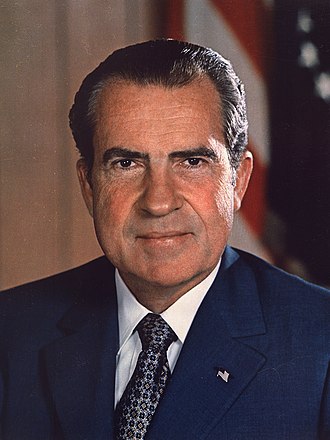
Richard M. Nixon served as the 37th President of the United States from January 1969 until his resignation in August 1974. In February 1971, he ordered the installation of a secret voice-activated taping system in the White House to preserve a historical record of his administration. Until the system's existence was revealed and dismantled in July 1973, the tapes captured Nixon directing major foreign policy initiatives, such as the opening to China, as well as his central role in the Watergate cover-up.
What Nixon talks about on the tapes
White House operations 4,718Presidential scheduling 2,225Public relations 1,784Presidential schedule 1,782Vietnam War 1,693Logistics 1,650Manolo Sanchez 1,626White House communications 1,400White House administration 1,399Presidential communication 1,243Henry Kissinger 1,191Foreign Policy 1,183
Conversations (21,010)
— Page 174 of 211President Nixon and H. R. Haldeman met to discuss a wide-ranging agenda of personnel, public relations, and scheduling matters, including salary adjustments for staff and strategies for upcoming events. They focused on optimizing the President's image by managing interactions with Vietnam POWs, coordinating high-profile "stag" dinners with key "New Establishment" figures, and organizing state visits for leaders such as Lee Kuan Yew. Additionally, they reviewed long-term political objectives for the 1974 election cycle, emphasizing a shift toward emphasizing "Square America" values and delegating domestic battles to surrogates while the President maintains the stature of a global peacemaker.
President Nixon, George Shultz, and Henry Kissinger met to discuss international economic and diplomatic strategy, specifically focusing on the upcoming European monetary crisis and U.S.-Soviet relations. The group strategized how Shultz should handle European leaders, such as Helmut Schmidt, by providing leadership on currency stability without committing to unsustainable massive interventions. Regarding the Soviet Union, the participants agreed to prioritize trade and rapprochement while tactfully avoiding public focus on the issue of Soviet Jewry to ensure the success of pending trade agreements and upcoming summits. Additionally, the President provided guidance on managing relations with France during its upcoming elections and discussed administrative appointments and labor-management initiatives.
President Nixon met with members of the National Security Council and other senior officials to discuss the strategic balance of power between the U.S. and the USSR, specifically in anticipation of the SALT II negotiations. The discussion focused on the impact of qualitative and quantitative disparities in throw-weight, bombers, and MIRV technology on U.S. and Soviet first- and second-strike capabilities. Nixon emphasized the importance of maintaining an appearance of strategic equivalence to preserve the confidence of U.S. allies and domestic support, directing his team to refine their negotiating strategy without rushing into a premature moratorium on weapons testing.
President Nixon met with Stephen B. Bull to review administrative items and prioritize pending tasks. The discussion included an update on a telephone communication involving entertainer Bob Hope. No significant policy decisions were made, and Bull was instructed to handle the remaining correspondence.
President Nixon and Stephen B. Bull discussed the protocol for managing meetings with departing staff members and senior departmental officials. The President outlined criteria for granting exit interviews, specifically distinguishing between those moving to other government positions versus those leaving the administration entirely. They also addressed the inclusion of personal friends in farewell photograph sessions as part of these transitions.
President Nixon and Henry Kissinger met to review the President's performance in a recent National Security Council meeting and discuss upcoming foreign policy maneuvers. They analyzed complex strategic issues, including the potential for a nuclear test ban, Soviet missile throw-weight advantages, and the impact of the Trident program on future negotiations. Additionally, they coordinated a strategy for releasing military contracts to Pakistan, emphasizing the need to manage diplomatic friction with India and prioritize broader geopolitical interests involving the People's Republic of China.
President Nixon and Henry Kissinger met with a Pakistani delegation led by Mustafa Khar and Aziz Ahmed to discuss strengthening U.S.-Pakistan relations following the 1971 India-Pakistan War. The participants addressed the ongoing deadlock between India and Pakistan regarding the repatriation of prisoners of war, the recognition of Bangladesh, and concerns over Soviet influence and military buildup in the region. Nixon and Kissinger expressed a commitment to providing military aid to Pakistan but emphasized the need for a cautious, incremental approach to navigate domestic political opposition in Congress and the media.
President Nixon met with an unknown individual to coordinate adjustments to his official schedule. The discussion focused primarily on the logistics of rescheduling appointments, specifically regarding a meeting with Tony Martin. The parties reached a consensus to delay the start of the subsequent engagement to 1:00 p.m. due to ongoing preparation requirements.
President Nixon prepares to meet with Soviet Ambassador Anatoliy F. Dobrynin, who is waiting in an aide's office. The brief discussion with an unidentified staff member serves to coordinate the logistics and timing for this diplomatic encounter. The conversation concludes with the President confirming his readiness to proceed with the meeting immediately.
President Nixon and Stephen B. Bull reviewed the final draft of a forthcoming presidential speech addressing crime and drug policy. The pair discussed the integration of contributions from John D. Ehrlichman and members of the Cabinet into the text. Additionally, they coordinated a potential telephone call and a subsequent meeting between the President and comedian Bob Hope.
President Nixon met with Henry Kissinger and Soviet Ambassador Anatoliy Dobrynin to finalize arrangements for Leonid Brezhnev’s upcoming visit to the United States. The participants discussed the summit's itinerary, including social events at San Clemente and Camp David, while emphasizing the importance of a successful outcome to solidify US-USSR relations. They also addressed major policy objectives, specifically negotiating a binding agreement on the prevention of nuclear war and managing strategic arms limitations.
President Nixon met with several departing White House staff members and their spouses to express his personal appreciation for their service. During the brief session, which included a group photograph, the President discussed the staff's future career transitions into various federal agencies and the private sector. The conversation focused on individual placements, such as Allen Kaupinen's move to the GSA and Jane Eberle’s transition to the State Department, while acknowledging their ongoing contributions to the administration.
President Nixon met with entertainer Tony Martin to discuss Martin's continued political support and the national climate surrounding the return of American prisoners of war (POWs). The conversation focused on the need to better honor Vietnam veterans in hospitals, with Martin proposing a "Lest We Forget" entertainment tour to ensure these veterans are not overshadowed by the focus on POWs. Nixon and Martin also exchanged pleasantries regarding personal events, and Martin shared his experiences touring the country and his ongoing loyalty to the President's administration.
President Nixon held a brief, informal meeting in the Oval Office with an unidentified individual while consuming a lunch of cottage cheese. The recorded segment captures a cursory exchange regarding the location of certain financial documents. No significant policy decisions or substantive administrative developments were recorded during this brief encounter.
President Nixon met with an unidentified individual in the Oval Office to discuss matters regarding the President’s official schedule. Due to the lack of available transcripts or descriptive metadata, the specific nature of these logistical arrangements remains undocumented. No significant policy decisions or administrative actions were recorded for this encounter.
President Nixon met with an unidentified male visitor in the Oval Office to discuss a personnel-related decision regarding a female individual. During the exchange, the President indicated his intent to allow the individual to leave her position. No further details regarding the identity of the parties or the specific professional context were preserved in the available record.
President Nixon met with an unidentified individual, addressed as Monty, to discuss the utilization of an unnamed female associate. The brief interaction serves as a directive regarding personnel or resource management. No further substantive details regarding the context of this assignment were recorded.
President Nixon met with H.R. Haldeman, Stephen Bull, and Ronald Ziegler to manage a wide array of administrative, political, and public relations tasks, including scheduling future events and evaluating recent White House hosting efforts. A significant portion of the discussion focused on coordinating upcoming private meetings between the President and POWs, specifically Captain Jeremiah Denton and Colonel Robinson Risner, to ensure these encounters remained low-profile yet impactful. Additionally, the group reviewed the political maneuvering surrounding John Connally’s impending party switch from Democrat to Republican, with Nixon advising caution to insulate Connally from ongoing Watergate-related controversies.
President Nixon met with entertainer Bob Hope to discuss plans for a national televised tribute to returning prisoners of war (POWs) and the potential establishment of a scholarship fund for the children of Vietnam veterans. Nixon emphasized his administration's desire to honor these servicemen while avoiding exploitative fundraising tactics, instead suggesting a coordinated event involving celebrities and potential network broadcasts. The conversation also touched upon the President's recent golf activities, foreign policy developments regarding China, and lighthearted anecdotes about Hope's recent travels.
President Nixon contacted the White House operator to facilitate an urgent communication with National Security Advisor Henry A. Kissinger. This interaction served as an administrative bridge to initiate a direct line of consultation between the President and his advisor regarding ongoing national security or foreign policy matters. The primary objective was to establish this connection for immediate follow-up discussions.
President Nixon consulted with Henry Kissinger regarding the logistical requirements for comedian Bob Hope’s proposed visit to the People's Republic of China. Kissinger confirmed he had already received film footage from Hope and requested a formal letter detailing the specific objectives and materials associated with the entertainer's trip. This documentation was deemed necessary to finalize arrangements and maintain the positive rapport Kissinger had established with Chinese officials.
President Nixon met with comedian Bob Hope, advisor John Ehrlichman, and journalist Newbold Noyes, Jr. to discuss the challenges of communicating the administration's policies and accomplishments to the public. The participants addressed the perceived "hard-line" image of the administration, with Noyes encouraging the President to adopt a more reconciliatory tone to unify the country and address domestic social issues. Nixon defended his record on issues like housing and civil rights desegregation, while expressing his frustration with the press's reluctance to report on these efforts, leading to a broader conversation about the role of the presidency in shaping the national mood and legacy.
President Nixon and aide Stephen B. Bull discussed logistical arrangements for the President's personal property, specifically the relocation of his golf clubs between various sites, including Burning Tree Golf Club and his Florida and California residences. They also reviewed aspects of the President's upcoming schedule, focusing on family plans at Camp David and administrative details regarding press photos and staff meetings. The conversation highlights the intersection of official schedule management and the coordination of the President's private affairs.
President Nixon met briefly with an unidentified individual in the Oval Office for a conversation accompanied by refreshments. The limited recording captures only a preliminary request from the visitor to speak with the President again. No substantive policy discussions or significant executive decisions are documented during this brief encounter.
President Nixon met with William E. Timmons and Stephen B. Bull to prepare for an upcoming visit from a group of freshman Republican congressmen. The discussion focused on bolstering party unity, encouraging fiscal restraint regarding the federal budget, and strategizing on how to maintain support for potential presidential vetoes. Nixon decided to use the meeting to express his appreciation for their legislative efforts, emphasizing personal rapport and the administration's readiness to assist these new members in navigating congressional procedures.
President Nixon met with a large group of Republican freshman members of the House of Representatives to cultivate support for his legislative agenda, specifically focusing on budget discipline, fiscal responsibility, and the use of the presidential veto. During the discussion, Nixon framed his foreign policy approach as one of strength and mutual respect, citing recent successes in relations with the Soviet Union and China as evidence of the need for a robust defense posture. The President encouraged the representatives to maintain party unity on key votes and emphasized his commitment to assisting in their reelection efforts.
President Nixon met with an unidentified Navy Chief in the Oval Office for a brief, informal encounter. The primary purpose of the meeting was to offer refreshments to the guest. No substantive policy matters or administrative decisions were recorded during this short exchange.
President Nixon and H. R. Haldeman met to discuss personnel matters, the administration's public image, and strategy for managing Congress. They assessed potential roles for individuals like David Packard and discussed the political challenges of relying on administrative assistants for legislative liaison work. Additionally, they reviewed criticisms of the President's perceived coldness and explored the difficulties of humanizing his image in a hostile media environment.
President Nixon held an evening meeting in the Oval Office with an unidentified individual. The discussion, which remains largely redacted or unrecorded due to the restrictive nature of the archival segment, pertains to the return of a specific person. No further details regarding policy, strategy, or broader administrative developments are discernable from the available record.
President Nixon held a brief, private meeting in the Oval Office with an unidentified individual. Due to the lack of a transcript and the restriction of segments under a deed of gift, the specific purpose and content of the discussion remain undocumented. The interaction concluded without any publicly verifiable decisions or official action items.
President Nixon and John Dean discussed strategies for managing negative press coverage and testimony related to the Watergate scandal, specifically focusing on the activities of Dwight Chapin and L. Patrick Gray. They sought to frame allegations of sabotage as mere innuendo and worked to influence the Senate confirmation hearings by planting specific questions regarding the FBI's investigation into the DNC bugging. Dean confirmed he was coordinating with Senator Edward Gurney to ensure these strategic questions were introduced during the proceedings to counter the prevailing media narrative.
President Nixon held a brief, informal meeting with an unidentified individual, during which Henry Kissinger also made an appearance. The interaction consisted primarily of brief pleasantries exchanged in German. No substantive policy discussions or executive decisions were recorded during this segment of the tape.
President Nixon, Henry Kissinger, and Stephen Bull met to coordinate the President’s schedule, streamline upcoming National Security Council (NSC) meetings, and address sensitive foreign policy matters. The discussion centered on managing U.S. obligations to Pakistan and India, with Kissinger advising the release of previously blocked military contracts to fulfill long-standing commitments. Additionally, the participants reviewed the logistics of U.S. troop withdrawals in Vietnam and the importance of timing those departures to maintain leverage for the release of prisoners of war.
President Nixon instructed the White House operator to place a telephone call to Congressman Donald E. Young of Alaska. The President sought to connect with the newly elected representative to address formal business. The operator was directed to attempt the call despite the possibility that the congressman had not yet arrived at his office.
President Nixon consulted with the White House operator to facilitate contact with Congressman Donald E. Young. Upon learning that Young was in Juneau, Alaska, and scheduled to arrive in Washington, D.C. the following day, Nixon decided against attempting to reach him in Alaska. The conversation concluded with the President choosing to delay communication until the Congressman reached the capital.
President Nixon initiated a brief communication via the White House operator to facilitate an outgoing call. This interaction served primarily as a logistical step to connect the President with another party. No substantive policy discussions or policy-related developments were recorded during this brief administrative exchange.
President Nixon met with aide Stephen B. Bull to coordinate his daily schedule and manage upcoming administrative tasks. The discussion focused on logistical arrangements for presidential speeches on crime and drugs, as well as the scheduling of meetings involving cabinet members and the Cost of Living Council. Additionally, the pair addressed appointments with White House Fellows and members of Congress, with the President emphasizing the need for efficiency in managing his time and personal interactions.
President Nixon held a brief, informal exchange with a White House operator regarding the logistics of managing his communications. The discussion centered on the timing of relayed messages, specifically addressing a notification that arrived during the late night hours. No major policy decisions were made, as the interaction focused primarily on operational administrative procedures.
President Nixon met with his aide Stephen B. Bull to review and refine the day's schedule of appointments and media obligations. The discussion focused on coordinating the logistics for several high-level meetings, including sessions with Federal Regional Council Chairmen, the Cabinet, and the White House Photographers Association. Nixon also addressed potential adjustments to his availability, expressing uncertainty regarding his ability to attend certain commitments due to competing priorities.
President Nixon and Stephen B. Bull met to discuss administrative protocols and the logistics of upcoming White House meetings. The discussion centered on establishing proper procedures for scheduling, specifically focusing on the hierarchical distinctions between staff assistants and officers. Nixon sought to clarify attendee protocols involving senior aides like H. R. Haldeman and John D. Ehrlichman to streamline executive operations.
President Nixon summoned Stephen B. Bull to the Oval Office for a private administrative meeting. While specific details of the discussion remain undocumented due to the lack of a transcript, the interaction served as a formal briefing or request for action initiated by the President. Bull departed shortly after the meeting concluded, following Nixon’s directives.
President Nixon met with his aide Stephen B. Bull to review and coordinate the President's upcoming schedule. The discussion centered on logistics for the Federal Regional Council Chairmen's meeting, specifically addressing how Roy L. Ash would handle the announcement regarding the President's attendance. This interaction served to finalize administrative preparations and public messaging for the President’s appearances.
President Nixon and Press Secretary Ronald Ziegler met to coordinate logistics for an upcoming radio address and discuss the administration's public messaging strategy. They reviewed the presentation of economic policy, including the roles of Herbert Stein and John Ehrlichman, while evaluating the media impact of recent Watergate-related allegations against Donald Segretti. The participants concluded that television coverage of the Segretti controversy was less prominent than reports on food prices, prompting discussions on how to better manage press narratives.
President Nixon met with Stephen B. Bull to coordinate the finalization of a speech addressing crime and drug policy. The discussion focused on John D. Ehrlichman’s edits and the urgency of meeting a deadline for the President’s signature. The brief meeting concluded after an unidentified individual joined the group to discuss logistics regarding the President’s schedule and location.
President Nixon and his Cabinet met to launch a strategic public relations campaign, titled the Presidential Spokesmen program, aimed at pressuring Congress to support his budget priorities and oppose spending-heavy legislation. Nixon urged his officials to frame the budget debate not as a constitutional conflict, but as a direct choice between the economic interests of the 'New American Majority' and the fiscal irresponsibility of the opposition. The session included briefings on foreign policy, defense spending, and law enforcement, emphasizing the need for administration spokesmen to maintain a positive, disciplined narrative while avoiding defensive posturing on 'false issues.'
President Nixon met with RNC Chair George H.W. Bush and Janet J. Johnston to discuss Republican Party strategy, personnel, and upcoming electoral goals. They reviewed internal leadership races, specifically addressing tensions between Clarence J. Brown and Robert H. Michel, and discussed the President's stance on intervening in internal party contests. Additionally, the group strategized on recruitment, focusing on potential party-switching candidates in Virginia and the broader political implications of recruiting high-profile figures like John Connally to the Republican cause.
President Nixon met with the group of outgoing White House Fellows to discuss their experiences, the value of their tenure, and the broader responsibilities of public service. During the session, he emphasized the critical relationship between a strong domestic economy and effective foreign policy while advocating for the divestiture of federal power to state and local governments. Nixon concluded by encouraging the Fellows to pursue careers in government, stressing the need for competent and responsible leadership at all levels.
President Nixon met with departing U.S. Ambassador to France John N. Irwin II and General Brent Scowcroft to discuss Irwin's mission and the strategic importance of U.S.-French relations. Nixon emphasized his desire for close personal and political cooperation with French President Georges Pompidou, particularly regarding East-West relations, global economic stability, and the inclusion of Japan in international consultations. The President underscored his commitment to strengthening alliances following breakthroughs with the USSR and China, tasking Irwin with conveying high-level American respect for French leadership and intellect.
President Nixon contacted the White House operator to facilitate communication with his aide, Stephen B. Bull. The brief interaction served as a logistical request to place a telephone call to Bull. No further policy or substantive matters were addressed during this exchange.
President Nixon met with an unknown individual and later Stephen B. Bull to coordinate administrative tasks and logistical planning. Discussions centered on the President's upcoming schedule, including appointments and a potential meeting with Secretary of State William P. Rogers, as well as the finalization of a speech regarding crime and drug abuse. Specific action items included clearing the President's Monday schedule and reviewing the final draft of the law enforcement address.
President Nixon held a brief, informal meeting with an unidentified individual in the Oval Office. The conversation involved scheduling concerns and personnel coordination, specifically touching upon the activities of Press Secretary Ronald L. Ziegler and advisor John D. Ehrlichman. The discussion focused primarily on managing upcoming press briefings and internal administrative arrangements.
President Nixon consulted with his aide Stephen B. Bull regarding the content and preparation of an upcoming presidential speech. The discussion focused specifically on the inclusion of additional remarks concerning law enforcement officers. This exchange highlights the administration's strategic emphasis on messaging related to domestic policy and public order.
President Nixon and Stephen B. Bull coordinated scheduling logistics for an upcoming meeting with Secretary of State William P. Rogers, with Henry Kissinger also under consideration. The discussion focused on finalizing a time slot between 2:00 and 2:30 PM, while briefly touching upon golf arrangements and potential delays concerning the Cost of Living Council. Bull was tasked with confirming the logistics to ensure the meeting proceeded as planned.
President Nixon held a brief, routine administrative exchange with a White House operator. The conversation functioned as a standard telecommunications check, primarily involving instructions for placing or managing a specific call. No substantive policy discussions or significant political developments occurred during this brief contact.
President Nixon instructed Stephen Bull to arrange for General Brent Scowcroft to substitute for Henry Kissinger in a scheduled meeting if Kissinger remains unavailable. The President emphasized the need to verify Kissinger's status upon his expected return. Bull acknowledged these instructions and moved to facilitate the change in the administrative schedule.
President Richard Nixon met with his personal aide, Stephen B. Bull, for a brief administrative interaction in the Oval Office. The discussion served as a logistical transition point, linking directly to a subsequent, more substantive meeting recorded under conversation number 37-67. No major policy decisions or significant developments occurred during this brief exchange.
President Nixon and Stephen B. Bull met to review and revise the text of an upcoming speech concerning law enforcement policy. The discussion focused on substantive edits, including the removal of references to the assault of police officers and the addition of material distinguishing federal jurisdiction from local authority. Specifically, they debated the comparison between federal officers and prison guards, with Nixon directing Bull to consult David R. Gergen for further clarification.
President Nixon met with an unidentified woman in the Oval Office to provide instructions regarding a law enforcement-related speech. The discussion focused on specific requirements for the typing of the document. The meeting concluded after these administrative directives were issued.
President Nixon met with Ronald Ziegler and Stephen Bull to coordinate administration messaging on several fronts, including Watergate, upcoming legislative priorities, and public relations strategies. They discussed maintaining a strategy of silence regarding Watergate while preparing a televised address to highlight domestic policy, specifically mandatory drug penalties and law enforcement support. Additionally, they planned the optics and scheduling for an upcoming meeting with Secretary of State William Rogers to project a focus on peace and international affairs.
President Nixon met with an unknown female staff member to review and edit drafts of an upcoming speech and press conference materials. The discussion focused on the administrative handling of these documents, including necessary revisions and their subsequent distribution. The conversation concluded with the President finalizing the logistics for the preparation of these official texts.
President Nixon met with an unidentified woman in the Oval Office to facilitate the review and distribution of speech materials. Their discussion focused on the preparation and handling of physical copies of a forthcoming address, specifically addressing plans for its television broadcast. The meeting concluded after the transfer of these documents was finalized.
President Nixon met with his aide Stephen B. Bull to finalize a television address concerning federal law enforcement initiatives. The discussion centered on reviewing and incorporating the President's specific handwritten edits into the draft speech. Bull was tasked with ensuring these revisions were properly integrated into the final typed manuscript for the upcoming broadcast.
President Nixon met with his aide Stephen B. Bull to review and refine a draft of an upcoming speech. The discussion centered on specific revisions to the text and coordination regarding the logistics of the television taping for the address. Ultimately, the President provided his formal approval of the document to finalize the preparations.
President Nixon held a brief, private meeting with an unidentified individual in the Oval Office. The record indicates the session included only the service of refreshments, with no substantive policy or political discussions documented. The encounter concluded without any recorded developments or action items.
President Nixon met with his personal secretary, Rose Mary Woods, and an unidentified individual to coordinate administrative tasks and White House social functions. The discussion focused on managing guest lists for upcoming state dinners—specifically for Italian Prime Minister Giulio Andreotti and potential events for Leonid Brezhnev—while balancing the inclusion of key political contributors and various ethnic groups. Additionally, Nixon addressed scheduling matters, personal correspondence, and the importance of securing high-quality entertainment for these high-profile social events.
President Nixon instructed the White House operator to place an outgoing telephone call to his close friend and confidant, Charles G. "Bebe" Rebozo. The brief exchange served exclusively to initiate this communication. No further substantive policy matters or decisions were discussed during this short interaction.
President Nixon, Manolo Sanchez, and H. R. Haldeman met briefly to discuss logistical arrangements regarding the President's schedule and travel. Nixon inquired about traffic conditions for travel to Camp David and requested specific historical copies of his daily schedules for the 7th, 8th, and 9th of March. The conversation concluded with instructions to provide these documents, including additional copies intended for his daughters, Tricia Nixon Cox and Julie Nixon Eisenhower.
President Nixon held a brief, routine administrative interaction with the White House operator to facilitate an outgoing call. No substantive policy matters or political discussions were addressed during this short exchange. The conversation served exclusively as a functional step in the President’s telephonic communication process.
President Nixon and his advisors discussed strategic communication, particularly the need for effective framing and "phrasemaking" for the administration’s legislative agenda, including a forthcoming crime speech. The participants reviewed the status of high-level ambassadorial appointments, aiming to balance career diplomats with political appointees and prioritizing the inclusion of minority representatives. Additionally, Nixon and Kissinger finalized plans regarding the release of prisoners from the People's Republic of China, emphasizing the need to manage the announcement to maximize political credit and handle sensitive diplomatic back-channel communications.
President Nixon consulted with his close friend Charles G. "Bebe" Rebozo regarding internal salary adjustments, confirming that compensation had already increased from 28 to 32 since their previous review. Nixon noted that he had tasked H.R. Haldeman with investigating the matter to ensure the pay structure remained appropriate. Additionally, Rebozo shared that a telegram from the President, facilitated by Rose Mary Woods, had been successfully delivered to Desi Arnaz prior to his emergency brain surgery.
Henry Kissinger contacts the White House operator to facilitate a telephone call to William Downey. Kissinger directs the operator to retrieve Downey’s contact information from his office files to complete the connection. This administrative exchange reflects the routine logistical processes required to manage official communications for the National Security Advisor.
President Nixon and Henry Kissinger spoke with William Downey to inform him that the People's Republic of China, following negotiations with Chou En-lai, had agreed to release his brother, John T. Downey, on the following Monday. The participants discussed the timing of the official White House announcement scheduled for 3:00 p.m. and acknowledged the urgency of the release due to concerns regarding the health of John Downey’s mother. The call concluded with William Downey expressing gratitude for the administration's successful intervention.
President Nixon directs the White House operator to place a telephone call to Connecticut Governor Thomas J. Meskill. This brief exchange serves solely as an administrative instruction to initiate communication with the governor. No further substantive policy matters or decisions were discussed during this connection.
President Nixon calls Governor Thomas J. Meskill to share the positive news that his direct appeal to Chou En-Lai successfully secured the release of American prisoner John T. Downey. Nixon explains that the release was prompted by the poor health of Downey’s mother and notes that the People's Republic of China has also agreed to release two additional U.S. flyers the following Wednesday. Nixon instructs Meskill to inform his office immediately before the official White House announcement to prevent media leaks.
President Nixon met with his economic advisors to address rising inflation, specifically focusing on the political and economic instability caused by soaring food prices and labor's wage demands. He instructed his team to aggressively bypass bureaucratic resistance and increase the supply of commodities by selling off federal stockpiles and grain surpluses to stabilize the market. Nixon emphasized the need for a more visible and proactive administration stance, including the possibility of issuing a white paper on the food situation to reassure the public and unions.
President Nixon utilized time in the Oval Office to record a video segment for a radio address focused on his proposed revisions to the federal criminal code. His remarks emphasized a hardline stance on law enforcement, advocating for mandatory tougher penalties for drug offenses and the reinstatement of the death penalty for serious crimes like hijacking and terrorism. Following the recording, the President engaged in informal discussions regarding the recent release of prisoner John T. Downey and general administrative logistics.
President Nixon initiates a routine administrative request through the White House operator to be connected with his Chief of Staff, H. R. Haldeman. This brief interaction serves as a bridge to facilitate further internal communication between the President and his senior aide. No substantive policy discussions or decisions are recorded during this brief exchange.
President Nixon and H.R. Haldeman discuss the recent Gridiron Dinner, focusing on George McGovern's well-received performance and the general atmosphere of the event. Nixon expresses a desire to keep McGovern politically relevant to avoid his sudden removal from the scene. Additionally, they coordinate strategy regarding upcoming public events for released Prisoners of War (POWs), specifically deciding to manage the schedule to avoid overexposure and potential public fatigue with the heroes.
President Nixon initiates a request to the White House operator to place a telephone call to domestic policy advisor John D. Ehrlichman. The primary purpose of this brief interaction is to facilitate direct communication between the President and a key staff member. No further policy or administrative developments occur during this specific bridge to the subsequent conversation.
President Nixon and the White House operator coordinated the arrival of John D. Ehrlichman to the office. The operator informed the President that Ehrlichman was currently in transit. Nixon instructed the operator to have Ehrlichman contact him immediately upon his arrival.
President Nixon contacted the White House operator to facilitate a direct communication with the Usher’s Office. The brief interaction served solely as a request to be connected to the staff responsible for the management of the Executive Residence. No further substantive policy matters or administrative decisions were addressed during this exchange.
President Nixon contacted Ray M. Hare to issue a specific directive regarding the maintenance of the White House interior. The President ordered the immediate removal of a television set that had been temporarily placed in the Queen's Room. This action was taken to ensure the room was properly prepared for upcoming public tours.
President Nixon and John Ehrlichman coordinated administrative strategies, focusing on a directive for subordinates to identify and address government surpluses across departments like Defense and the GSA. They discussed the political optics of the President’s recent public statements, noting media coverage and the utility of highlighting how outlets like the Washington Post chose to ignore presidential initiatives. Additionally, they reviewed political messaging regarding the 'new majority,' criticized the media’s failure to report on the administration's positive outreach to minority leaders, and agreed to shift the tone of Secretary Earl Butz’s public comments on food prices to appear more empathetic to consumers.
President Nixon and H. R. Haldeman discuss the successful reception of the President's recent radio address on crime, agreeing that the medium effectively bypassed hostile press coverage by forcing reporters to focus on the substance of the speech rather than extraneous side issues. They conclude that radio addresses provide a superior platform for conveying direct messages to the public compared to live local events, which are often marred by protesters or distracting peripheral stories. Moving forward, Nixon directs his staff to use this direct radio strategy for future policy initiatives, specifically aiming to clarify the administration’s position on Vietnam veterans and distinguish them from those labeled as 'freeloaders.'
President Nixon contacts the White House operator to place an urgent follow-up call to H.R. "Bob" Haldeman. The brief exchange serves as a procedural request to facilitate communication with his Chief of Staff. No further policy or administrative matters are addressed during this brief telephone interaction.
President Nixon and H. R. Haldeman discuss the potential appointment of publisher Thomas Vail as the U.S. Ambassador to West Germany. Nixon emphasizes his preference for Vail’s political loyalty and editorial support over other potential businessman candidates, despite anticipated resistance from Secretary of State William P. Rogers and Henry Kissinger. Haldeman is directed to contact Vail to gauge his interest in the position before formally proceeding with the nomination.
President Nixon contacted the White House operator to initiate an urgent telephone call to Charles W. Colson. This brief communication served solely as a request for assistance in connecting the President to his special counsel. No further substantive policy matters or tactical decisions were discussed during this specific exchange.
President Nixon attempted to reach Charles Colson by telephone to discuss unspecified business, but the White House operator was unable to locate him at either his residence or office. After being informed of the unsuccessful attempts, the President decided to postpone the communication. No substantive policy matters were addressed during this brief administrative exchange.
President Nixon initiates a request for the White House operator to place a telephone call to his advisor, Patrick J. Buchanan. The brief exchange serves as a functional directive to facilitate communication between the President and his staff. No further substantive policy matters or political discussions occur during this short administrative interaction.
President Nixon and Patrick Buchanan discuss the positive press coverage surrounding the President's recent radio address on crime and law enforcement. The two agree that advocating for the death penalty and criticizing lenient judges and probation officers is a politically advantageous strategy that resonates with both their base and urban Democrats. Additionally, the President outlines his plan to deflect inquiries regarding the Watergate scandal during upcoming press conferences by refusing to comment on ongoing Senate committee hearings.
President Nixon initiates a brief request for the White House operator to place a personal telephone call to his daughter, Julie Nixon Eisenhower. This interaction reflects standard administrative procedure for facilitating the President's private communications. No substantive political or policy matters were discussed during this brief exchange.
President Nixon consulted with a White House operator to initiate contact with his daughter, Julie Nixon Eisenhower. After being informed that Julie was unavailable, the operator coordinated with the Secret Service to arrange for a return call to the President. The conversation concluded with Nixon acknowledging the plan to connect later.
President Nixon and his daughter, Julie Nixon Eisenhower, held a personal conversation covering various family matters, scheduling, and current events. Nixon discussed his recent radio address regarding capital punishment, specifically referencing the need to hold perpetrators accountable for the killing of a U.S. ambassador in Sudan. They also reviewed Senator John C. Stennis’s recovery progress, planned upcoming family activities for the First Lady's birthday, and anticipated the completion of the White House bowling alley renovations.
President Nixon and Charles Colson discuss Colson's recent trip to Israel and Romania, where they reflect on Nixon's strong international stature and the importance of foreign travel for perspective. The conversation shifts to the ongoing Watergate investigation, with both men strategizing on how to handle the pressure from the Washington Post, the Senate Ervin hearings, and executive privilege claims. Additionally, they touch upon domestic issues, including the administration's hard-line stance on crime and law enforcement, and share ideas for future political maneuvers, such as a potential effort to take over the Washington Post.
President Nixon dictated a memorandum to H.R. Haldeman outlining a strategy to utilize the presidential box at the Kennedy Center for outreach. The plan instructs Haldeman and William E. Timmons to coordinate the attendance of members of Congress, cabinet officers, and White House staff over a 60-day period. This initiative aimed to foster political relations by ensuring the box was consistently occupied by influential guests.
President Nixon held a meeting in the Oval Office with an unidentified individual, during which Rose Mary Woods served as the recording secretary for the session. While the specific transcript is unavailable, the meeting took place amidst a period of intense focus on administrative management and internal White House operations. The engagement concluded before 9:30 am, though the substantive content of the discussion remains undocumented due to the lack of a surviving transcript.
President Nixon held a brief, high-level discussion with an unidentified male visitor in the Oval Office. The dialogue, which appears to conclude with a directive regarding Henry A. Kissinger, remains largely fragmentary due to the limited transcript. The conversation highlights the President's focused administrative oversight and reliance on Kissinger for ongoing policy matters.
President Nixon and Henry Kissinger met to discuss a wide range of international issues, focusing on the recent election results in France, ongoing concerns in Cambodia and Vietnam, and the strategic complexities of the "three-corner" relationship between the U.S., the Soviet Union, and China. They reviewed U.S. military responses to cease-fire violations, including planned B-52 strikes, and the necessity of managing Congressional and public opinion regarding Vietnam. Additionally, the pair discussed long-term foreign policy philosophy, the importance of retaining sensitive diplomatic records for security, and the challenge of maintaining their unique geopolitical strategy after they leave office.
President Nixon, H. R. Haldeman, and Henry Kissinger met to coordinate the President's upcoming schedule, focusing on state visits, foreign policy, and domestic priorities. They discussed specific ambassadorial appointments—most notably for Germany and Taiwan—and planned the sequence of visits for international leaders including the Shah of Iran, Willy Brandt, and African heads of state to build momentum before the USSR summit. Additionally, the group reviewed strategies for managing the press, addressing congressional relations, and navigating domestic economic concerns, with Nixon emphasizing the need for his staff to focus on capitalizing on opportunities rather than merely managing crises.
President Nixon consulted with an unidentified individual regarding background information pertaining to Adele Rogers. The discussion focused on gathering specific details about Rogers, though the transcript remains too fragmentary to ascertain the broader strategic purpose of the inquiry. No further concrete actions or substantive policy decisions were documented during this brief exchange.