Nixon, Richard M. (President)
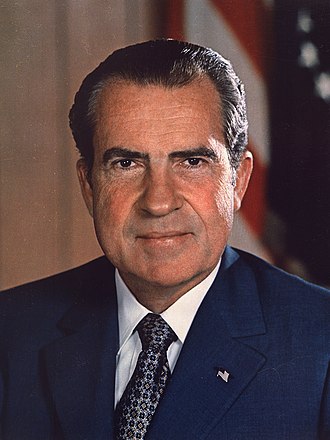
Richard M. Nixon served as the 37th President of the United States from January 1969 until his resignation in August 1974. In February 1971, he ordered the installation of a secret voice-activated taping system in the White House to preserve a historical record of his administration. Until the system's existence was revealed and dismantled in July 1973, the tapes captured Nixon directing major foreign policy initiatives, such as the opening to China, as well as his central role in the Watergate cover-up.
What Nixon talks about on the tapes
White House operations 4,718Presidential scheduling 2,225Public relations 1,784Presidential schedule 1,782Vietnam War 1,693Logistics 1,650Manolo Sanchez 1,626White House communications 1,400White House administration 1,399Presidential communication 1,243Henry Kissinger 1,191Foreign Policy 1,183
Conversations (21,010)
— Page 204 of 211President Nixon and Charles Colson discuss strategies to discredit former White House counsel John Dean amidst the Watergate investigations. The conversation focuses on portraying Dean as an unreliable witness who is seeking immunity to conceal his own involvement and further a political agenda against the President. Nixon emphasizes the importance of framing these attacks on the administration as harmful to the country and highlights the necessity of maintaining a unified front among White House staff.
President Nixon met with his personal aide, Manolo Sanchez, in the Old Executive Office Building to discuss personal meal arrangements. During the brief exchange, the President expressed a desire to deviate from his standard menu by selecting salmon for his lunch. Sanchez acknowledged the request to facilitate the food order.
President Nixon met with his valet, Manolo Sanchez, in the Old Executive Office Building to coordinate the delivery of food. The brief exchange focused exclusively on the logistics and arrival of a meal. No other policy matters or significant administrative decisions were recorded during this meeting.
President Nixon met with his longtime personal valet, Manolo Sanchez, in the Old Executive Office Building for a brief, informal interaction. The discussion was limited to the provision of refreshments, reflecting the routine personal assistance Sanchez provided to the President. No policy decisions or substantive political matters were addressed during this private exchange.
President Nixon met with Stephen B. Bull and David C. Hoopes to coordinate his upcoming schedule, including a trip to Florida for a commencement address and various cabinet and congressional meetings. The participants discussed speech preparation and the logistical management of his time. Additionally, Nixon addressed the security and custody of White House tapes, confirming that recordings were being placed under lock and key to restrict access.
President Nixon initiates a brief telephone request for the White House operator to place a call to Congressman Gerald R. Ford. This interaction serves as a logistical bridge to establish direct communication between the President and the future Vice President. No substantive policy discussions or decisions were recorded during this brief administrative exchange.
President Nixon consulted with a White House operator to facilitate an outgoing call. This interaction was strictly procedural, serving to connect the President with a third party. No substantive policy discussions or significant administrative decisions occurred during this brief exchange.
President Nixon met with his economic advisors and John Connally to evaluate potential policy responses to the national economy, specifically focusing on the impact of food prices and the potential implementation of an export freeze. The group debated the efficacy of a 60-day price freeze versus alternative measures to curb inflation and addressed the political risks associated with such interventions. Additionally, Nixon and Connally discussed Connally's ongoing advisory role, navigating the potential for public speculation regarding his conflict of interest and the administration's need to maintain a strong, proactive image amid the escalating Watergate scandal.
President Nixon met with his personal valet, Manolo Sanchez, to coordinate the delivery of an item to the Executive Office Building. Nixon instructed Sanchez to transport the materials to the designated office immediately. The brief exchange focused solely on the logistical transfer of these documents or items.
President Nixon met with an unidentified individual and Secret Service agents in the Oval Office to discuss the logistics of his movement to the Executive Office Building. The conversation primarily concerns the President's departure and reassignment within the complex. The exchange concludes abruptly following brief, ambiguous remarks regarding the President's personal conduct and public perception.
President Nixon and Congressman Gerald Ford discussed strategies to neutralize potential political disruption from Representative Pete McCloskey regarding Watergate-related initiatives by choosing to ignore his actions. The pair also reviewed ongoing personnel shifts, specifically the hiring of Melvin Laird and the sensitive, confidential return of Bryce Harlow to the White House staff. Additionally, Nixon agreed to contact William Timmons to clarify that recent leadership discussions were not intended as a criticism of his congressional relations efforts.
President Nixon and Gerald Ford discuss administration staffing and internal management strategies while emphasizing the need to focus on national governance despite the distractions of the Watergate scandal. Nixon outlines plans for personnel changes, specifically mentioning the upcoming return of an individual named Rice and addressing potential conflict of interest concerns. The President expresses his desire to maintain a strong, unified team to handle legislative and administrative legwork.
President Nixon initiates a brief communication with the White House operator to inquire about the frequency of personnel entering the Oval Office. This exchange serves as a casual administrative check regarding office traffic. No major policy decisions or significant developments occur during this short interaction.
President Nixon directs the White House operator to contact J. Fred Buzhardt, Jr., requesting his presence at the Oval Office. The brief communication serves as a scheduling directive to facilitate a formal meeting between the President and his White House counsel. This interaction reflects the administrative process Nixon utilized to coordinate legal consultations regarding ongoing White House matters.
President Nixon initiated a brief telephone request to connect with William E. Timmons, his Assistant for Congressional Relations. The exchange consisted solely of the President directing the White House operator to place the call. No substantive policy matters or further details were discussed during this brief administrative interaction.
President Nixon initiated a brief communication with a White House operator to facilitate an outgoing call. The interaction served as a routine administrative task to connect the President with another party. No further policy discussions or significant substantive developments were recorded during this brief exchange.
President Nixon consulted with William E. Timmons to discuss the effectiveness of a recent meeting with Republican Congressional leadership. Nixon explained that his earlier critical stance toward Timmons and his staff was a deliberate tactical move to address the concerns of Congressional members. The President expressed his full appreciation for the hard work of Timmons, Thomas C. Korologos, and the Congressional relations team, instructing Timmons to relay this gratitude to his staff.
President Nixon met with William E. Timmons to discuss legislative strategy and the President's ongoing outreach to Republican leadership, specifically referencing recent interactions with Gerald Ford. Nixon expressed appreciation for the efforts of Timmons and his staff in managing congressional relations despite political pressures. The conversation served primarily as an informal morale boost and a reaffirmation of the administration's coordinated efforts on Capitol Hill.
President Nixon met with J. Fred Buzhardt to discuss the White House's legal strategy regarding Watergate, specifically focusing on handling subpoenas for documents and managing executive privilege. They reviewed procedural approaches to resist blanket subpoenas by arguing for case-by-case determinations based on the national interest, as well as the potential implications of John Dean’s forthcoming testimony. Nixon and Buzhardt also assessed the risks of conflicting recollections among White House staff and evaluated the President's public position regarding the ongoing investigations.
President Nixon and Rose Mary Woods met to discuss ongoing concerns regarding the Watergate scandal, specifically focusing on the potential testimony of Thomas A. Pappas. Nixon expressed anxiety about his March 7 meeting with Pappas, emphasizing his desire to ensure there was no implication that he had thanked Pappas for raising funds to pay off Watergate defendants. The conversation also touched on the broader political climate, the impact of the Ervin Committee hearings, and the need to maintain staff morale while preparing for potential legal scrutiny.
President Nixon met with his personal aide Stephen B. Bull to coordinate the logistics for an upcoming appointment with Alexander M. Haig, Jr. The President instructed Bull to manage the scheduling and verify the status of the impending meeting. This discussion served as a brief administrative check-in to ensure the morning's agenda remained on track.
President Nixon facilitates a connection between Alexander M. Haig, Jr. and J. Fred Buzhardt, Jr. through the White House operator. This brief administrative exchange serves to initiate a direct line of communication between the two officials. The conversation concludes immediately upon the successful coordination of this requested call.
Alexander M. Haig, Jr. and J. Fred Buzhardt, Jr. discuss the administration's response to press reports regarding a potential subpoena from Samuel Dash, chief counsel for the Senate Watergate Committee. Buzhardt confirms he communicated with Dash to dispute the reports, noting that Dash denied ever stating an intention to issue a subpoena. The participants coordinate efforts to have the record publicly corrected to mitigate the political fallout.
President Nixon contacted the White House operator to facilitate an outgoing call to J. Fred Buzhardt, Jr. The brief exchange served as a routine administrative request to connect the President with his White House Counsel. No further substantive policy matters were addressed during this short bridge communication.
President Nixon met with Alexander Haig and J. Fred Buzhardt to strategize on managing ongoing Watergate disclosures and to discuss potential personnel changes within the White House staff. The conversation focused heavily on the administration's public relations response to subpoenas and media coverage, specifically regarding wiretap information and the handling of presidential papers. Additionally, the participants deliberated on potential economic policies, including a possible price freeze, and considered how to integrate John Connally into a special advisory role to strengthen leadership visibility.
President Nixon directs J. Fred Buzhardt, Jr. to coordinate with Leonard Garment regarding a confrontational response to Senate counsel Samuel Dash concerning leaked information about White House cooperation with the Watergate investigation. Nixon emphasizes that the administration must manage public perception and media narratives regarding the release of materials, rather than focusing on logistical logs. The President instructs Buzhardt to demand a public statement from Dash, threatening that the White House will initiate a critical media campaign if the administration's cooperation is not properly acknowledged.
President Nixon met briefly with an unidentified individual and aide Stephen B. Bull to discuss administrative matters regarding the presidential schedule. The conversation touched upon a past interaction between the President and Clarence M. Kelley, specifically referencing an incident involving an explosion in 1970. No major policy decisions were reached during this short logistical exchange.
President Richard Nixon met with Clarence M. Kelley to finalize his appointment as the new Director of the FBI and to outline the administration's expectations for his leadership. Nixon emphasized the need for Kelley to restore order, improve cooperation with other federal and local law enforcement agencies, and act as a fearless administrator to overcome the internal power struggles following J. Edgar Hoover’s tenure. The conversation also covered strategies for Kelley's upcoming confirmation hearings, particularly regarding Watergate, the handling of raw FBI files, and the administration's frustration with judicial restrictions on national security wiretapping.
President Nixon met with an unidentified individual in the Oval Office to discuss his official schedule. The brief consultation included a specific focus on upcoming engagements involving Counselor to the President Melvin R. Laird. No further details regarding policy decisions or additional agenda items were recorded during this brief administrative meeting.
President Nixon met with an unidentified individual to coordinate the immediate whereabouts of Melvin R. Laird. The discussion focused on locating Laird at Alexander M. Haig, Jr.’s office to facilitate his prompt return for a scheduled meeting in the Oval Office. Nixon directed that Haig also participate in this upcoming briefing.
President Nixon, Alexander Haig, and Melvin Laird met to coordinate the announcement of Laird's return to the administration as Counselor for Domestic Affairs. They discussed strategies for managing press inquiries, particularly regarding Watergate, and debated potential economic interventions like a wage-price freeze. The group also planned Laird's forthcoming schedule, which included meetings with key congressional figures and labor leader George Meany to ensure a smooth transition and maintain party unity.
President Nixon directs the White House operator to facilitate a telephone connection between AFL-CIO President George Meany and Presidential Advisor Melvin R. Laird. The President specifies that the call should be routed through his line, indicating his personal oversight of the request. This administrative action serves to bridge a communication channel between the White House and organized labor leadership.
President Nixon and Melvin R. Laird called AFL-CIO President George Meany to personally inform him of Laird's appointment as Counselor to the President for Domestic Affairs. During the conversation, Laird clarified that his new role would include overseeing the Cost of Living Council and wage-price policy. The participants agreed to meet once Meany recovered from a recent bout of tendinitis to discuss these economic issues in greater detail.
President Nixon met with Melvin Laird and Alexander Haig to discuss personnel shifts and the restructuring of responsibilities within the White House staff. The conversation focused on reassigning George Shultz’s duties, specifically moving him out of his energy portfolio to prioritize trade policy. The participants also touched upon the organizational roles of Roy Ash and other administrative adjustments to long-term policy management.
President Nixon met with an unidentified individual to coordinate the timing and communication of personnel changes involving Melvin Laird and Alexander M. Haig, Jr. The discussion centered on ensuring the public announcement of Haig’s retirement from the military was handled properly. The parties agreed to contact staff members John Irving and others to manage the dissemination of this information through wire services.
President Nixon met with his legal team and senior advisors, including Charles Wright, Alexander Haig, and J. Fred Buzhardt, to formulate a legal and public relations strategy regarding the intensifying Watergate investigation. The discussion focused on countering potential testimony from John Dean, particularly regarding his meetings with the President, and managing the risks posed by the Ervin Committee's upcoming hearings. The participants strategized on how to undermine Dean's credibility through targeted cross-examination by Fred Thompson and agreed on the necessity of maintaining a firm stance on executive privilege while preparing for further investigative challenges.
President Nixon consulted with an unidentified individual regarding the scheduling and readiness of an upcoming presidential address. The participants evaluated the risks of proceeding prematurely versus delaying the speech to ensure it was properly prepared. They ultimately determined that a short delay was preferable to appearing ill-prepared, leading to the postponement of the program.
President Nixon contacted the White House operator to place a telephone call to J. Fred Buzhardt, Jr., who was serving as Special Counsel to the President during the Watergate investigation. This brief interaction was strictly administrative, facilitating direct communication between the President and his legal advisor regarding ongoing confidential matters. No further policy discussions or substantive decisions were recorded during this brief exchange.
President Nixon initiated a brief contact with the White House operator to facilitate an outgoing call. This interaction serves as a functional bridge to connect the President with another party for communication purposes. No substantive policy matters or executive decisions were addressed during this short exchange.
President Nixon met with his valet, Manolo Sanchez, to discuss obtaining a recording of Charles Colson’s recent television interview with Howard K. Smith. Nixon sought to review the 30-minute program, which had been previously captured by White House staff. The conversation concluded with the decision to prepare the tape so that Nixon could view it for Tricia Nixon Cox.
President Nixon instructed his attorney, J. Fred Buzhardt, Jr., on the strategy for an upcoming meeting with Special Prosecutor Archibald Cox regarding the Watergate investigation. Nixon directed Buzhardt to project an image of full cooperation while maintaining a firm refusal to turn over sensitive presidential papers to avoid a constitutional crisis. Furthermore, Nixon urged Buzhardt to aggressively confront Cox about allegations that his staff was motivated by a desire to target the President, while simultaneously expressing absolute confidence that John Dean's testimony would ultimately prove Nixon's innocence.
President Nixon met with his legal counsel, J. Fred Buzhardt, Jr., to discuss the administration's ongoing cooperation with investigations and to coordinate a defensive strategy. Nixon commended Buzhardt’s recent legal work and emphasized that the White House would maintain a cooperative stance while remaining prepared for a political confrontation. The President firmly asserted his innocence regarding the matters under scrutiny and instructed Buzhardt to rebuff any attempts to obstruct their legal position.
President Nixon initiates a brief telephone exchange with the White House operator to request an outbound call to Charles W. Colson. The operator acknowledges the request to facilitate the connection. No further substantive policy matters are addressed in this short administrative communication.
President Nixon consulted with a White House operator to facilitate an outgoing telephone communication. This brief interaction served exclusively as a procedural step to connect the President with a third party. No substantive policy discussions or administrative decisions occurred during this brief exchange.
President Nixon consulted with a White House operator to facilitate a telephone call to Charles W. Colson. The discussion focused on coordinating the respective schedules of the President and Colson to ensure the connection could be completed. The conversation remained brief and procedural, centering on the logistics of reaching Colson.
President Nixon met with Stephen Bull to finalize scheduling arrangements for upcoming meetings with congressional and executive advisors, including Melvin Laird and John Connally. Following this, Nixon spoke with Charles Colson to discuss the public reception of Colson's recent television appearance with Howard K. Smith. Their conversation centered on the ongoing Watergate investigation, with Nixon expressing frustration over Colson’s claims regarding his knowledge of defense payments and potential testimony.
President Nixon and Charles Colson discuss strategies to combat negative press coverage and bolster public support amidst the unfolding Watergate scandal. Colson reports on the positive feedback from his recent television interview, suggesting that the administration should adopt a more aggressive, offensive posture to discredit John Dean and defend the President. Nixon agrees to coordinate with staff to disseminate these favorable public reactions to congressional allies, aiming to shift the narrative and stabilize the administration's position.
President Nixon and Alexander Haig discuss urgent diplomatic developments regarding the Paris peace talks, specifically tensions between Henry Kissinger and the South Vietnamese government. Following advice from Kissinger, Nixon agrees to meet with Ambassador Tran Kim Phuong to address these critical issues. Consequently, the President adjusts his upcoming schedule, including postponing a bipartisan Congressional meeting and coordinating a private dinner with John Connally, Bryce Harlow, and Haig.
President Nixon and Alexander Haig briefly discuss the possibility of scheduling an evening meeting to review certain reading materials. The conversation remains ambiguous regarding the specific documents in question and ultimately concludes without a firm commitment or definitive action. The exchange serves as a preliminary coordination effort to assess the President's availability for a follow-up briefing.
President Nixon met with an unidentified individual in the Old Executive Office Building to coordinate the scheduling of his upcoming engagements. The brief discussion served to finalize the timing for a 2:30 meeting, resulting in the individual’s departure shortly thereafter. No substantive policy matters were recorded during this brief administrative exchange.
President Nixon initiates a request through the White House operator to be connected with J. Fred Buzhardt, Jr. The brief exchange serves as a logistical coordination for the President to communicate with his legal counsel regarding the ongoing Watergate investigation. No substantive policy discussions occur during this brief administrative interaction.
President Nixon met with aide Stephen B. Bull to coordinate his upcoming schedule and administrative logistics. The discussion centered on arrangements for a meeting with John B. Connally, including a potential telephone call and a preparatory briefing involving Alexander M. Haig, Jr. Additionally, the pair addressed plans regarding the presidential yacht, the Sequoia.
President Nixon consulted with a White House operator to facilitate an outgoing telephone connection. This brief interaction served administrative purposes, as the President utilized the operator to reach a specific party. No substantive policy discussions or significant political developments occurred during this short communication.
President Nixon consults with J. Fred Buzhardt, Jr. regarding his upcoming meeting with Special Prosecutor Archibald Cox to gauge the potential for a hostile confrontation. The President expresses concern that Cox might intentionally provoke a conflict to justify a resignation, prompting the two to strategize on how to manage the interaction. They conclude by scheduling a follow-up briefing to occur after the President finishes a concurrent meeting with Congressional leadership.
President Nixon and White House counsel J. Fred Buzhardt, Jr. engaged in a brief exchange to confirm the scheduling of an upcoming afternoon meeting. The conversation served primarily as a logistical check to ensure the President was aware of the pending appointment with an unidentified individual. No substantive policy discussions or significant decisions were reached during this short interaction.
President Nixon requested that the White House operator connect him with Stephen B. Bull, a personal aide who frequently managed the President's scheduling and logistics. The brief exchange served purely administrative purposes to facilitate direct communication with a key staff member. No policy matters or substantive political discussions took place during this brief connection request.
President Nixon directs the White House operator to connect him to an individual identified as Mr. Steeple. The brief exchange serves as an administrative request to facilitate a phone call. No further substantive policy or political discussions occur during this recorded segment.
President Nixon directed Stephen B. Bull to facilitate a telephone call with Alexander M. Haig, Jr. immediately following Haig’s meeting with John B. Connally. The President clarified that he only required a phone conversation rather than an in-person meeting. Bull confirmed he would notify the staff to ensure the President was contacted as soon as the session with Connally concluded.
President Nixon instructed his aide, Stephen B. Bull, to facilitate a meeting with a person identified as Kate immediately following her current conversation. Nixon emphasized his desire to speak with her promptly while expressing caution about avoiding an interruption to her ongoing discussion. The brief exchange served to coordinate the President's personal schedule regarding this upcoming engagement.
President Nixon met with his personal valet, Manolo Sanchez, in the Old Executive Office Building. The primary purpose of this meeting was the delivery of items by Sanchez. No further details regarding the substance of the exchange are available beyond the recorded delivery.
President Nixon held a meeting in his Old Executive Office Building suite to conduct a return telephone call with an unidentified individual. Due to the lack of available transcripts or descriptive logs, the specific subject matter and any resulting decisions remain undocumented. This recording captures a routine administrative interaction within the President's daily schedule.
President Nixon and Alexander Haig discuss ongoing political damage control regarding the Watergate scandal, specifically focusing on efforts to implicate previous Democratic administrations in illegal wiretapping. Nixon and Haig strategize on maintaining pressure on figures like Joseph Califano and McGeorge Bundy by highlighting hypocrisy regarding past surveillance practices. Additionally, the pair reviews economic policy, including potential wage and price controls on gas and food, and confirms the scheduling of upcoming meetings, including one with John Connally.
President Nixon and Alexander Haig meet to discuss sensitive administrative and political intelligence matters, including the handling of specific files and potential leaks. The conversation touches on concerns regarding information security, the management of personnel or associates described as "valuable," and the strategic release of information. The discussion reflects the administration's preoccupation with controlling the narrative surrounding internal documents and external perceptions of their operations.
President Nixon initiates a brief telephone request to connect with his Deputy Press Secretary, Gerald L. Warren. The conversation is strictly logistical, serving solely as a directive for the White House operator to facilitate communication with Warren. No further substantive policy matters or decisions were discussed during this exchange.
President Nixon consulted with a White House operator to facilitate a phone connection to Gary Warren. The exchange served as a routine administrative request to place an outgoing call. No further substantive policy or political discussions occurred during this brief interaction.
President Nixon and Gerald L. Warren discuss media strategy, specifically the successful press reception of Melvin R. Laird’s recent briefings and the administration's efforts to project strength regarding economic policy and Congressional relations. The conversation also addresses ongoing Watergate pressures, with Nixon expressing confidence that public interest in impeachment and resignation has waned, while strategizing on how to use FBI wiretap disclosures to intimidate political opponents. Finally, they coordinate the optics for a forthcoming meeting on the Sequoia, intended to signal stability through discussions with John B. Connally and Bryce N. Harlow.
President Nixon and Deputy Press Secretary Gerald L. Warren discuss media strategy and public relations management regarding ongoing scandals. The conversation focuses on controlling the narrative surrounding key figures like Jeb Magruder and maintaining distance from student groups. They ultimately decide to limit public engagement and manage the flow of information through vetted, reliable channels.
President Nixon met with his aide Stephen B. Bull in the Old Executive Office Building for a brief two-minute session. Although no transcript is available to verify the specific content of their discussion, the meeting served as a routine administrative or logistical coordination between the President and his personal assistant. No further information exists regarding formal decisions or substantive developments stemming from this short encounter.
President Nixon consulted with the White House operator to facilitate a phone call to Alexander M. Haig, Jr. This brief interaction served as an administrative bridge to connect the President with his Chief of Staff. No further substantive policy matters were discussed during this brief exchange.
President Nixon met with Stephen B. Bull to coordinate administrative adjustments following the cancellation of a scheduled reception for Congressmen. The discussion focused on rescheduling the event and managing logistics for key advisors, including John B. Connally, Bryce N. Harlow, and Alexander M. Haig, Jr. Nixon explicitly directed Bull to summon Harlow immediately to address these logistical concerns and voting implications in the House of Representatives.
President Nixon and Alexander Haig coordinate logistics for a dinner meeting on the Sequoia with Bryce Harlow and John B. Connally, while discussing administrative efficiencies regarding the Cost of Living Council. Nixon directs Haig to consult with John T. Dunlop on strengthening the economic speech, specifically by incorporating trade tariff removals and aggressive measures to address rising food prices. Key policy considerations include the potential implementation of a price freeze on basic agricultural commodities like soybeans to signal resolve to the public.
President Nixon and Alexander Haig coordinate travel logistics regarding a planned trip to Carlisle, Pennsylvania. They discuss the movement of personnel, specifically considering how to transport an individual named Conway. The conversation focuses on balancing these transport arrangements with other ongoing White House obligations.
President Nixon initiates a brief telephone request to the White House operator to be connected with H. R. "Bob" Haldeman. The exchange serves as a routine administrative step to facilitate a direct line of communication between the President and his former Chief of Staff. No substantive policy discussions occur during this short connection.
President Nixon and Alexander Haig coordinate the logistics of a meeting with South Vietnamese Ambassador Tran Kim Phuong. Following a message from Henry Kissinger regarding the Ambassador’s status, the President instructs Haig to contact the Ambassador to ensure he remains in the country. They conclude the discussion by determining whether the President’s personal presence at the upcoming meeting is necessary.
President Nixon consulted with the White House operator to facilitate an outgoing call. The interaction was limited to procedural logistics for connecting the President to another party. No substantive policy matters or administrative decisions were documented during this brief exchange.
President Nixon consulted with the White House operator to determine the location and status of H.R. Haldeman, who was meeting with attorney John J. Wilson. Upon learning that Haldeman had been in the meeting for approximately thirty minutes, the President decided to initiate a return call to him. The brief exchange focused exclusively on coordinating this communication and verifying the current time.
President Nixon consults with a White House operator regarding a pending communication, expressing frustration over a specific individual's lack of cooperation. The President concludes that he must initiate a follow-up call himself to resolve the matter. The brief exchange highlights the administrative challenges Nixon faced in managing sensitive outreach and personal communications.
President Nixon contacted the White House operator to place a phone call to J. Fred Buzhardt, Jr., legal counsel for the White House. He instructed the operator to leave a message for Buzhardt to return his call upon returning to his office. The President explicitly requested that Buzhardt not be disturbed if he was currently unavailable.
President Nixon directed the White House operator to place a telephone call to Congressman Gerald R. Ford. The operator noted that Ford was likely on the House floor but suggested he could be retrieved for the call. This exchange served as a logistical attempt by the President to initiate direct communication with the House Minority Leader.
President Nixon held a brief administrative exchange with a White House operator. The dialogue consisted of routine logistical communication regarding telephone connectivity or call routing. No substantive policy discussions or significant political decisions were recorded during this brief interaction.
President Nixon consulted with the White House operator to facilitate an outgoing telephone connection. This brief interaction served administrative purposes to establish contact with another party. No substantive policy matters or significant decisions were addressed during this short logistical exchange.
President Nixon consulted with Gerald Ford and Hugh Scott regarding legislative strategy, specifically potential vetoes for the Minimum Wage Bill and the necessity of including a youth differential. The group coordinated scheduling changes for upcoming Cabinet and bipartisan Congressional meetings to better align with the President's upcoming Vietnam and Brezhnev summit briefings. Additionally, Nixon discussed economic policy concerns, expressing skepticism toward a prolonged wage and price freeze, and dismissed concerns regarding a speech by Representative Pete McCloskey about impeachment.
President Nixon held discussions with Gerald Ford and Hugh Scott to reschedule a meeting from Thursday to Tuesday. The President aimed to consolidate the schedule to address Vietnam policy and a freshman summit in a single session. Additionally, the participants touched upon bipartisan legislative strategy, labor-management relations, and concerns regarding the economic impact of labor policy.
President Nixon contacted the White House operator to place a personal telephone call to his daughter, Tricia Nixon Cox. The conversation was purely administrative, serving only to facilitate a private connection between the President and a family member. No policy matters or substantive political issues were addressed during the brief exchange.
President Nixon met with his valet, Manolo Sanchez, to discuss personal preparations and logistical arrangements. The conversation focused on the President's upcoming clothing requirements and his planned schedule for a trip aboard the presidential yacht, the Sequoia. The exchange served to coordinate the final details for his departure at 6:00 pm.
President Nixon spoke briefly with a White House operator to facilitate an outgoing call. The interaction served as a routine administrative request to connect the President to another party. No substantive policy discussions or significant political decisions occurred during this brief exchange.
President Nixon and his daughter, Tricia Nixon Cox, discuss Charles Colson's recent television interview with Howard K. Smith regarding the Watergate scandal. Tricia praises Colson’s performance and dignity, specifically highlighting his challenge to accusers to take lie detector tests. The call concludes with the President asking Tricia to inform First Lady Pat Nixon of his plans to have dinner on the Sequoia with John Connally and Alexander Haig.
President Nixon and his daughter, Tricia Nixon Cox, held a brief, informal check-in regarding a recent public appearance or event. The discussion centered on an unidentified individual's positive performance, which the President briefly acknowledged. No substantive policy decisions or political actions resulted from this short exchange.
President Richard Nixon met with his personal valet, Manolo Sanchez, to express personal appreciation for his service. The two discussed Sanchez's ongoing work schedule and professional responsibilities within the White House. The conversation served primarily as a brief interpersonal exchange regarding administrative arrangements and the President's recognition of his staff member.
President Nixon met with his personal valet, Manolo Sanchez, in the Old Executive Office Building to discuss routine personal service arrangements. Their interaction focused on the preparation of refreshments and the coordination of Sanchez's work schedule. The dialogue reflects the informal, day-to-day administrative management of the President's immediate environment.
President Nixon and Alexander Haig coordinate the public announcement of Clarence M. Kelley as the new FBI Director to ensure it receives optimal press coverage. They decide to schedule the announcement for 11:30 a.m. the following day, specifically timing it to follow a Cabinet meeting and fill a media gap created by ongoing Vietnam-related news. The pair also briefly discuss the delay in locating South Vietnamese Ambassador Tran Kim Phuong.
President Nixon and Alexander M. Haig, Jr. coordinated their schedules for a meeting occurring the following day. Due to the President's commitment to a cabinet meeting at 10:00 a.m., they agreed to shift their planned appointment to 11:30 a.m. This brief exchange served solely to finalize the logistics for their upcoming private session.
President Nixon initiates a brief telephone call to J. Fred Buzhardt, Jr. to coordinate an immediate meeting at the Executive Office Building. This conversation serves as a logistical bridge to facilitate an in-person discussion regarding Buzhardt's ongoing activities, specifically his interactions with special prosecutor Archibald Cox. The primary objective is to confirm Buzhardt's availability and expedite his arrival for a private briefing.
President Nixon initiated a brief contact with J. Fred Buzhardt, Jr. to coordinate a follow-up meeting. Nixon requested that Buzhardt come to his office in the Old Executive Office Building to discuss ongoing legal or administrative matters. The conversation served primarily as an administrative bridge to facilitate a more substantive, private discussion between the two men.
President Nixon met with J. Fred Buzhardt to review the status of the ongoing Watergate investigation and discuss the aggressive, broad-ranging document and testimony requests made by Special Prosecutor Archibald Cox. Buzhardt characterized Cox’s efforts as an attempt to overstep his mandate and challenge executive privilege, leading to a strategy of forcing Cox to formally request items in writing to maintain administrative control. Nixon and Buzhardt agreed to resist these demands firmly, preparing for an inevitable future confrontation or subpoena while emphasizing the necessity of protecting the constitutional integrity of the presidency.
President Richard Nixon met with his personal aide, Stephen B. Bull, in the Old Executive Office Building to handle routine administrative tasks. The primary focus of the brief interaction was the signing of a specific item, identified in records as a pen. Following the completion of this clerical action, Bull departed the office.
President Nixon met with South Vietnamese Ambassador Tran Kim Phuong, Alexander Haig, and Brent Scowcroft to discuss the critical need for continued U.S. aid to South Vietnam amidst growing Congressional opposition. Nixon emphasized that he remains committed to supporting President Nguyen Van Thieu but warned that legislative resistance makes securing future appropriations increasingly difficult. The discussion centered on the importance of survival for the South Vietnamese government and the necessity of managing expectations regarding American military and economic assistance.
President Nixon contacted the White House operator to facilitate a telephone connection to H.R. "Bob" Haldeman. This administrative call was necessary to initiate direct communication with the former Chief of Staff. No further substantive policy discussions were captured in this brief logistical exchange.
President Nixon contacted the White House operator to inquire about the whereabouts and schedule of H.R. Haldeman. The operator informed the President that Haldeman was attending church and was not expected to return until 9:30 p.m. Nixon acknowledged the information and decided to forgo further attempts to reach him at that time.
President Nixon contacted the White House operator to facilitate an outgoing call to former special counsel Charles W. Colson. The interaction served as a brief administrative step to connect the President with his former aide. No substantive policy matters or further developments were recorded during this short exchange.