Nixon, Richard M. (President)
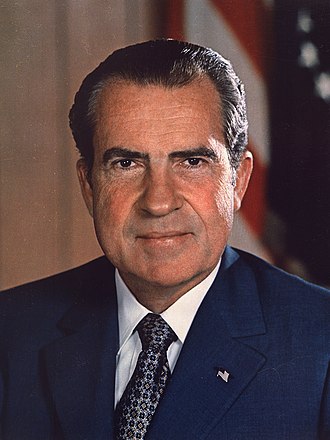
Richard M. Nixon served as the 37th President of the United States from January 1969 until his resignation in August 1974. In February 1971, he ordered the installation of a secret voice-activated taping system in the White House to preserve a historical record of his administration. Until the system's existence was revealed and dismantled in July 1973, the tapes captured Nixon directing major foreign policy initiatives, such as the opening to China, as well as his central role in the Watergate cover-up.
What Nixon talks about on the tapes
White House operations 4,718Presidential scheduling 2,225Public relations 1,784Presidential schedule 1,782Vietnam War 1,693Logistics 1,650Manolo Sanchez 1,626White House communications 1,400White House administration 1,399Presidential communication 1,243Henry Kissinger 1,191Foreign Policy 1,183
Conversations (21,010)
— Page 207 of 211President Nixon instructed the White House operator to place a telephone call to Secretary of the Treasury George P. Shultz. The President explicitly requested that the operator avoid interrupting Shultz if he was currently at lunch, reflecting a desire to minimize disruption to the Secretary's schedule. This routine administrative request served as a preparatory step for an impending discussion between the President and his Treasury Secretary.
President Nixon initiated a brief telephone communication through the White House operator to place an outgoing call. The primary purpose of the interaction was to facilitate a connection with Alexander M. Haig, Jr. No substantive policy discussions or complex developments occurred during this brief exchange.
President Nixon initiated a brief call through the White House operator to facilitate a connection to another party. The exchange served as a logistical step to bridge communication for a subsequent discussion. No substantive policy matters were addressed during this short administrative interaction.
President Nixon met with his valet, Manolo Sanchez, to coordinate personal refreshments and review his demanding daily schedule. They discussed upcoming logistics, including a cabinet meeting and an evening program in Manila, as well as the President’s need for rest. The conversation centered on managing the President's personal needs amidst a busy professional agenda.
President Nixon held a brief, informal interaction with a White House operator in his office. The exchange was strictly logistical in nature, serving as a routine communication check rather than a policy discussion. No substantive decisions or political matters were addressed during this short encounter.
President Nixon and Alexander Haig reviewed ongoing staffing efforts, specifically focusing on William Scranton's upcoming appointment to handle energy policy and John Connally's continued, flexible role with the administration. The conversation also touched on administrative coordination, including scheduling for Bryce Harlow and logistics regarding guest lists for a dinner with Leonid Brezhnev. Regarding the Watergate investigation, Nixon instructed that the White House must aggressively challenge emerging allegations and emphasized using the threat of perjury to deter John Dean, noting that the administration possesses records of all meetings Dean attended.
President Nixon and Alexander Haig discuss strategic messaging and public relations efforts intended to shift the administration’s focus away from ongoing investigations and toward a more proactive, self-directed agenda. They coordinate plans for an upcoming announcement or speech to build positive momentum, while touching upon the need to manage potential legal challenges or judicial obstacles. The conversation reflects an effort to maintain political control and confidence despite external pressures.
President Nixon initiates a brief telephone exchange with the White House operator to request a connection to Press Secretary Ronald L. Ziegler. The conversation serves solely as a logistical bridge to facilitate official communication between the President and his senior staff. No further substantive policy matters or decisions are discussed during this short interaction.
President Nixon initiates a brief request for the White House operator to connect a telephone call to an unnamed female recipient. This interaction reflects the administrative routine of managing the President's personal and official communications during the workday. No further substantive policy matters or critical political developments were recorded during this brief bridge to another party.
President Nixon and Press Secretary Ronald Ziegler discussed the positive media reception of Henry Kissinger’s recent Paris briefing and logistics regarding the President’s upcoming economic address. Nixon emphasized the importance of securing favorable press coverage and instructed Ziegler to coordinate photo opportunities with the Cabinet and Congressional leaders. To prevent premature media leaks, Nixon strictly ordered that the text of his economic speech be withheld from Cabinet members and legislators until 7:00 p.m., shortly before the address.
President Nixon and Press Secretary Ronald L. Ziegler coordinate the restricted release of sensitive documents to specific leaders. They decide that the text of the materials should not be provided early to these individuals, scheduling a formal delivery to their offices for 7:00 pm. This instruction serves to maintain strict control over the distribution of information during a politically sensitive period.
President Nixon consulted with an unidentified staff member regarding his upcoming scheduling needs and a draft speech prepared by Raymond K. Price. He explicitly instructed that he would not require assistance during the early morning hours, signaling a desire to adjust his current work timeline. This brief interaction served to refine the President's immediate agenda and administrative expectations.
President Nixon and Secretary of the Treasury George P. Shultz reviewed talking points for an upcoming press briefing regarding the administration's economic policy. Nixon instructed Shultz to emphasize that a broad freeze on wages, prices, and rents would trigger a recession, while specifically highlighting how rent control fosters slums and housing shortages. Shultz confirmed that recent data showed stable rent increases under Phase III, supporting the administration’s decision to reject mandatory controls except in isolated problem areas.
President Nixon and Treasury Secretary George Shultz discuss public messaging strategies regarding economic policy, specifically focusing on the administration's stance against rent control. They agree that market-based solutions remain effective because housing shortages are isolated rather than systemic. The President expresses approval of Shultz’s recent commentary and emphasizes the importance of framing these economic positions to maintain public confidence.
President Nixon and Alexander Haig discuss the recruitment of William W. Scranton for an energy-related appointment, noting that minor legal issues regarding Scranton's corporate involvement should not impact his candidacy. Nixon decides to meet with Scranton the following day at the White House rather than in Florida to finalize the plans. They agree to delay the public announcement until Saturday to avoid competing with other ongoing news stories.
Alexander M. Haig, Jr. and President Nixon discuss the timing of a forthcoming public announcement, ultimately deciding to schedule it for Saturday. The brief exchange confirms coordination regarding the release strategy for an unspecified story or policy initiative. Haig expresses readiness to manage the logistics and communications surrounding the project as instructed by the President.
President Nixon held a brief, informal conversation with an unidentified individual, during which they discussed the preparation and delivery of refreshments. Following this exchange, the President contacted the White House operator to place a follow-up call to Stephen B. Bull. No substantive policy or political matters were addressed during these brief administrative interactions.
President Nixon met with his valet, Manolo Sanchez, to coordinate the logistics of his late-afternoon schedule and evening plans. The discussion primarily focused on confirming the timing for a scheduled dinner and reviewing the President's personal agenda for the remainder of the day. No substantive policy decisions were made during this brief administrative exchange regarding the President's daily routine.
President Nixon met with his personal aide, Manolo Sanchez, in the Old Executive Office Building to discuss routine personal arrangements and scheduling. The conversation included coordinating a telephone call involving Raymond K. Price, Jr. and the service of refreshments. No significant policy decisions were recorded during this brief administrative interaction.
President Nixon instructed his aide, Stephen B. Bull, to strictly enforce a new policy prohibiting family members from accompanying guests during presidential meetings. Despite Nixon’s previous directive, Bull confirmed that families were included in an upcoming scheduled visit. Nixon emphasized that this practice must be discontinued permanently, ordering Bull to ensure no further exceptions are made for family attendance.
President Nixon instructed his aide, Stephen B. Bull, to strictly prohibit the inclusion of family members in future military interviews. Nixon emphasized that previous attempts to enforce this policy had failed, explicitly forbidding any recurrence of these combined meetings. The exchange served as a firm directive to ensure that all future interactions with the military remain restricted to official personnel only.
President Nixon and Raymond Price met to coordinate the final revisions and logistics for an upcoming address regarding the national economy. Nixon expressed dissatisfaction with the status quo advocated by his economic advisors, George P. Shultz and Herbert Stein, and emphasized the need for decisive action to address rising costs of living. Additionally, the pair discussed the impending announcement regarding William W. Scranton and Bryce N. Harlow, evaluating their roles and public perception as outsiders in the administration.
President Nixon instructs the White House operator to summon Press Secretary Ronald L. Ziegler to his office. The brief exchange serves as a direct directive to facilitate an immediate meeting between the President and his top spokesperson. No further policy or strategic details are discussed during this administrative call.
President Nixon requests that the White House operator locate and summon a man named Mr. Taylor to his office in the Old Executive Office Building. The brief interaction serves as a directive to facilitate an immediate in-person meeting. No further substantive policy or political discussions occur during this short exchange.
President Nixon and Ronald Ziegler met to coordinate administration strategy regarding ongoing Watergate investigations, public relations for upcoming economic policy speeches, and Vietnam-related diplomacy. Nixon directed Ziegler to encourage allies on the Ervin Committee, such as Edward Gurney and Howard Baker, to increase their pushback against Democratic-led inquiries. Additionally, they discussed methods for managing press narratives through third-party contacts and ensuring that recent successes in Vietnam negotiations, driven by Henry Kissinger, were presented in a positive light.
President Nixon met briefly with speechwriter Raymond K. Price, Jr. to address the omission of specific content regarding the nation's economy in a recent speech draft. The discussion focused on rectifying these gaps to ensure the administration's economic policy was properly articulated. Price departed immediately after the brief exchange, marking the conclusion of the meeting.
President Nixon held a brief discussion with an unidentified individual regarding the acquisition of public support from influential figures. The conversation focused on the potential value of securing strong statements of endorsement from John B. Connally, Albert E. Sindlinger, and Pierre Rinfret. No specific action items were finalized, but the dialogue suggests a strategic effort to bolster the administration's political standing through external allies.
President Nixon met with Marjorie P. Acker to review a reading copy of his upcoming speech regarding the nation's economy. The brief meeting focused on organizational details, specifically verifying the page count and ensuring the inclusion of necessary reminders within the text. No major policy shifts were recorded, as the session was limited to administrative preparation for the President's public address.
President Nixon communicated with a White House operator to facilitate an outgoing call. This routine interaction served as a administrative step to connect the President with a third party. No substantive policy matters or decisions were recorded during this brief technical exchange.
President Nixon requested that the White House operator connect him to specific individuals. This brief interaction served as a logistical step to facilitate direct communication with unidentified parties. The primary outcome was the initiation of an outgoing telephone call to fulfill the President's administrative requirements.
President Nixon met with his Vice President, Cabinet members, and senior staff to announce the implementation of a 60-day price freeze as part of a strategy to combat inflation. He explained that this measure, aimed at stabilizing food and gasoline prices, was a necessary pragmatic step to preempt more extreme, mandatory controls favored by Congress. Nixon emphasized his commitment to maintaining a free-market economy and tasked his Cabinet with actively promoting this policy to the public and opinion makers. He also highlighted the administration's broader accomplishments in foreign policy, including the end of the draft and the upcoming U.S.-Soviet summit.
President Nixon, accompanied by Ronald Ziegler and members of the press, prepared for a televised address from the Oval Office to outline his new economic strategy. During the session, technicians coordinated technical arrangements for the broadcast while the President reviewed his speech, which centered on implementing a price freeze and establishing "Phase 4" economic controls to combat inflation. Following the address, the President participated in a photo session with the press and discussed the logistics of the production.
President Nixon directed Stephen B. Bull to monitor the arrival of bipartisan Congressional leaders for an upcoming meeting. Nixon emphasized his desire to avoid waiting for the full group to assemble, instructing Bull to coordinate with William E. Timmons to ensure the President arrives only once a majority of attendees are present. This directive served to streamline the President's schedule and manage his appearance at the event.
President Nixon instructed Stephen B. Bull to monitor the status of a Congressional session and notify him immediately once it was ready for his attendance. The President expressed a strong desire to avoid any unnecessary waiting or idle time upon arrival. This brief exchange served as a coordination effort to ensure the President's schedule remained efficient regarding his planned appearance.
President Nixon consulted with his aide Stephen B. Bull regarding an upcoming meeting with bipartisan congressional leaders, including Speaker Carl Albert. Due to scheduling delays, Nixon instructed Bull to inform William E. Timmons that the President would deliver a brief statement and depart early rather than remaining for a lengthy Q&A session involving George P. Shultz. This decision effectively curtailed the President's planned engagement with the congressional leadership.
President Nixon and Stephen B. Bull briefly coordinate the President's schedule for an upcoming evening engagement. Nixon expresses his intent to deliver a prepared statement and depart quickly due to the late hour. This interaction serves as a logistical adjustment to ensure the President's attendance at the meeting remains concise.
President Nixon met with Nellie L. Yates and Manolo Sanchez to discuss administrative details regarding his upcoming schedule and an economic speech. The brief conversation focused on logistical preparations, specifically concerning signage for the event. No major policy decisions were reached during this informal planning session.
President Richard Nixon rehearsed his televised address titled 'The Nation's Economy,' in which he announced a 60-day price freeze to combat rising inflation, particularly regarding food and gasoline. The speech outlined the transition to a more comprehensive 'Phase 4' system of economic controls and requested legislative support from Congress to reduce government spending and address energy shortages. Nixon emphasized his commitment to returning to a free-market system while prioritizing the American consumer through potential export controls on food products.
President Nixon met with his personal valet, Manolo Sanchez, in the Old Executive Office Building to handle personal grooming preparations. The brief interaction centered on the President's appearance in anticipation of an upcoming speech. Sanchez confirmed he would deliver hair care products to the President to assist with these arrangements.
President Nixon met with Vice President Agnew, cabinet members, and a bipartisan group of Congressional leaders to announce an upcoming economic policy address and discuss the administration's new strategy to combat inflation. The President detailed a 60-day price freeze—excluding wages and raw agricultural products—and sought legislative assistance regarding export controls on food and gasoline supply allocations. Additionally, the President arranged for key Congressional leaders to receive ongoing briefings from administration officials during the upcoming summit with Soviet leader Leonid Brezhnev to ensure better oversight of the resulting agreements.
President Nixon initiated a brief administrative request to the White House operator to place a telephone call to his close friend and confidant, Charles G. “Bebe” Rebozo. The interaction was strictly procedural, serving only to facilitate the connection between the President and Rebozo. No further substantive policy or political discussions took place during this exchange.
President Nixon held a brief exchange with the White House operator to facilitate an outgoing call. The interaction functioned primarily as a routine administrative request to connect the President to another party. No substantive policy discussions or significant political developments occurred during this brief communication.
President Nixon and his close associate Bebe Rebozo discussed the President's upcoming economic speech and the recent success of the Paris peace negotiations regarding Vietnam. The two also coordinated logistics regarding a sensitive contribution involving a mutual friend associated with Howard Hughes, with Nixon advising Rebozo on the disposition of funds if Jesse Calhoun proved unwilling to accept them. Rebozo updated the President on the status of this intermediary contact, emphasizing the need to finalize the matter.
President Nixon met briefly with his close confidant Charles G. "Bebe" Rebozo to discuss an upcoming televised address and recent diplomatic developments regarding the Paris peace negotiations. During the informal check-in, the two men touched upon personal contacts and handled a brief logistical matter regarding an individual named Calhoun. The discussion concluded with Nixon reaffirming his schedule and preparing for his 8:30 pm speech.
President Nixon practiced his televised address to the nation, titled "The Nation’s Economy," in which he outlined a series of measures to combat rising inflation. The President announced a 60-day price freeze on consumer goods to stabilize the economy while signaling a transition toward more effective Phase 4 controls. He also called on Congress to support fiscal restraint, authorize export controls on agricultural products to prioritize domestic supply, and approve energy-related initiatives like the Alaska pipeline.
President Nixon met with his personal valet, Manolo Sanchez, in the Old Executive Office Building to address routine personal needs. The conversation focused on the organization and procurement of specific grooming supplies, including hair care products. No major policy or political matters were discussed during this brief exchange.
President Nixon met with his longtime valet, Manolo Sanchez, in the Old Executive Office Building to address an issue regarding the President's personal attire. The brief exchange focused exclusively on the delivery of a suit that Nixon identified as being incorrect. No other policy or political matters were discussed during this interaction.
President Nixon met with his aide Stephen B. Bull to coordinate his upcoming schedule and personal preparations. The discussion focused on logistical details involving Ray Voege, specifically regarding the application of makeup and a change of suit for the President. No major policy developments occurred, as the conversation was limited to these personal scheduling arrangements.
President Nixon met with Roy Voege, Manolo Sanchez, and an unidentified individual in his office to facilitate personal grooming and clothing arrangements. The discussion focused on the practical logistics of applying makeup and the delivery of a suit. These interactions served as brief, routine maintenance tasks regarding the President’s public appearance.
President Nixon rehearsed his national address titled “The Nation’s Economy” in the Old Executive Office Building. He practiced delivering arguments emphasizing the strength of the American economy, citing record employment and income growth while acknowledging the urgent problem of rising inflation and food prices. This recording served as a dress rehearsal to refine his messaging regarding the administration's new economic policies.
President Nixon met with his aide Stephen B. Bull in the Old Executive Office Building to review the President's upcoming schedule. The discussion focused on ensuring the President was adequately prepared and ready for his scheduled engagements. No specific policy decisions were recorded during this brief administrative session.
President Nixon held an undocumented meeting with unknown individuals in the Old Executive Office Building to discuss matters that remain unrecorded due to the lack of an available transcript. Given the timing and context of the Watergate scandal, the discussion likely centered on ongoing legal or political strategy, though no specific developments or action items can be confirmed. This session reflects the broader pattern of private consultations maintained by the President during a period of intense institutional crisis.
President Nixon initiated a brief telephone call with the White House operator to verify the exact time. The interaction served as a routine inquiry for temporal confirmation. No policy matters or further administrative actions were discussed during this short exchange.
President Nixon initiates a request through the White House operator to place a telephone call to Charles W. Colson. The brief exchange serves as a procedural step to facilitate direct communication between the President and his former special counsel. No further substantive policy matters or decisions were discussed during this brief connection.
President Nixon and Charles Colson discussed political strategy, focusing on the positive reception of the President's recent economic speech and his leadership regarding inflation. They addressed the ongoing Watergate investigation, specifically dismissing the credibility of John W. Dean and discussing the political implications of upcoming Ervin Committee testimony. Nixon also expressed significant frustration with Attorney General Elliott Richardson's recent conduct and asserted the need for administration loyalty regarding the handling of Justice Department appointments and public messaging.
Alexander Haig updates President Nixon on the highly positive public and political reception to the President’s recent televised speech on the economy. Haig emphasizes that the positive feedback reflects a widespread desire for presidential leadership and a clear shift of public attention away from the Watergate scandal. The two discuss the political importance of appearing in control, agreeing to disregard the ongoing testimony of John Dean while prioritizing aggressive communication on economic and foreign policy.
President Nixon instructed the White House operator to place a follow-up telephone call to Reverend Billy Graham. The President expressed a desire to reach Graham but explicitly requested that the operator avoid disturbing him if he were out to dinner. This brief exchange served as an administrative directive to re-establish contact after a previous unsuccessful attempt.
President Nixon contacted the White House operator to place an outgoing call to Press Secretary Ronald L. Ziegler. The brief interaction served as a logistical bridge to facilitate direct communication between the President and his top spokesperson. No further policy or substantive matters were discussed during this brief exchange.
President Nixon and Press Secretary Ronald Ziegler discussed the press reaction to the President’s recent economic speech and its potential to shift media focus away from the Watergate scandal. While Nixon expressed concern that journalists remained obsessed with Watergate, Ziegler noted that the press was generally impressed by the President's display of leadership and control. The two concluded that the positive reception of the address had successfully mitigated negative media scrutiny.
Charles W. Colson updates President Nixon on positive feedback from pollsters Albert E. Sindlinger and Louis P. Harris regarding the President’s recent speech on the economy. Nixon instructs Colson to gather additional details and report back after he finishes dinner. The brief exchange establishes a plan for Colson to provide a comprehensive briefing on these polling reports shortly thereafter.
President Nixon and Stephen B. Bull coordinate a series of follow-up telephone calls to gauge reactions to the President's recent speech on the economy. Bull updates the President on the status of various callers, including political allies and public opinion figures. Nixon decides to personally speak with Governor Ronald Reagan and pollster Louis Harris to conclude his outreach efforts for the evening.
President Nixon consulted with pollster Louis Harris to discuss public reaction to the President's recent economic speech, which introduced a price freeze to address rising inflation and food costs. The two discussed the importance of balancing international trade with domestic stability, specifically regarding soybean exports and agricultural prices. Additionally, they reviewed the upcoming state visit of Leonid Brezhnev, with Harris emphasizing strong public support for Nixon's foreign policy initiatives with the USSR and China despite ongoing domestic concerns regarding the Watergate scandal.
President Nixon initiates a request to the White House operator to place a telephone call to Governor Ronald Reagan. This interaction serves as a follow-up to a previous attempt by Reagan to reach the President. The operator acknowledges the request to facilitate the communication.
Charles Colson updated President Nixon on positive national sentiment regarding the President’s economic policies and recent diplomatic efforts, while discussing strategies to counter negative press coverage of the Watergate scandal. The two men coordinated on administrative staffing, specifically agreeing to provide polling contracts to allies Louis Harris and Albert Sindlinger, while expressing frustration with Attorney General Elliott Richardson’s perceived lack of defense of the White House. Nixon reaffirmed his commitment to maintaining a confident, proactive tone in public appearances rather than engaging in defensive press conferences.
President Nixon consulted with a White House operator regarding the status of a scheduled telephone call to Governor Ronald Reagan, who was attending a graduation rehearsal in Fremont, California. The President requested that the operator facilitate the call, specifying that he would remain available for another thirty minutes to speak with the Governor. This brief exchange served as a logistical coordination effort to ensure the two leaders could connect at their earliest mutual convenience.
President Nixon and Alexander Haig discuss the positive public response to the President's recent economic speech and strategize on handling Vice President Spiro Agnew’s upcoming meeting. They address the ongoing Watergate investigations, with Nixon expressing his intent to eventually attack the Ervin Committee once he has sufficient political leverage. Additionally, Nixon instructs Haig to ensure Henry Kissinger remains focused on foreign policy briefings—specifically regarding Vietnam, the "Year of Europe," and Leonid Brezhnev’s visit—while explicitly avoiding any comments on Watergate or wiretapping.
President Nixon initiates a brief request for the White House operator to connect him with his personal secretary, Rose Mary Woods. This administrative call serves as a logistical bridge to facilitate direct communication with a key staff member. No further policy or substantive matters are addressed during this brief exchange.
President Nixon attempted to reach his personal secretary, Rose Mary Woods, via the White House operator to discuss an administrative matter. After learning Woods was unavailable, Nixon requested the operator locate his personal secretary, Nellie L. Yates, provided she was currently in the office. He explicitly directed that she should not be contacted if she had already returned home for the evening.
President Nixon attempted to place a telephone call to Nellie L. Yates through the White House operator. After being informed that the recipient was unavailable at her office, the President directed the operator to terminate the effort. No further business was conducted or action items established during this brief exchange.
President Nixon initiates a request to speak with Senator Edward J. Gurney via the White House operator. The primary purpose of the brief communication is to facilitate a direct telephone connection between the President and the Senator. No further substantive discussion is captured on the recording beyond this administrative request.
President Nixon initiated a series of telephone calls late at night, initially requesting to speak with Senator Edward J. Gurney. After being informed that the Senator was unavailable at his home, the President directed the operator to place a call to speechwriter Raymond K. Price, Jr. instead. This exchange reflects the President's administrative efforts to reach key advisors during off-hours.
President Nixon called speechwriter Raymond K. Price, Jr. to commend him on the quality and tone of a recently televised address regarding the economy. The President emphasized that the primary objective was to project confidence and an upbeat perspective to the public during a time dominated by negative media coverage. Nixon credited Price's work for providing a necessary, positive contrast to the ongoing political climate surrounding Watergate.
President Nixon met briefly with David C. Hoopes in the Oval Office to address administrative matters regarding the presidential schedule. The discussion focused primarily on coordinating an upcoming meeting with Press Secretary Ronald L. Ziegler. Following this brief exchange, Hoopes departed the office.
President Nixon met with his senior advisors and Vice President Spiro Agnew to discuss foreign policy, the recent national price control address, and the growing political fallout from the Watergate and Baltimore County investigations. Nixon and his team strategized on how to manage the public perception of the Watergate hearings while considering ways to pivot toward an aggressive political defense. Additionally, they reviewed Vice President Agnew's role in the administration, including future travel and the need for him to maintain a visible and high-profile presence to support the President's agenda.
President Nixon met with David C. Hoopes to coordinate logistical details regarding the President's upcoming schedule and a photographic opportunity with George Putnam. The conversation focused on the precise timing of events and the specific arrangements for photography equipment and distribution. No broader policy decisions were reached, as the discussion remained strictly focused on the administrative management of the presidential calendar.
President Nixon and his secretary, Rose Mary Woods, met to discuss administrative arrangements for upcoming events and the President's public messaging. The conversation focused heavily on guest lists and logistics for the official visit of Soviet leader Leonid Brezhnev, as well as the strategy for the President's televised address regarding price control measures. Nixon provided guidance on maintaining a nonpartisan appearance for his events while tasking Woods with managing high-level invitations and coordinating schedules with various political figures.
President Nixon met with David C. Hoopes to coordinate the public announcement of Bryce N. Harlow’s return to the administration. The President emphasized the need for high-quality photography and media coverage to effectively highlight Harlow’s appointment. Nixon directed that Ronald Ziegler and his staff, including photographer Ollie Atkins and a Navy film crew, facilitate the necessary arrangements for the press opportunity.
President Richard M. Nixon and Press Secretary Ronald L. Ziegler coordinated the logistics for upcoming executive appointments and media opportunities. The discussion focused on managing the public announcement of William W. Scranton’s potential energy role, including the staging of a photograph at the President's desk. The pair also reviewed the President's broader schedule, specifically regarding meetings with George Putnam and other visitors.
President Nixon met with broadcaster George Putnam and Press Secretary Ronald L. Ziegler to coordinate a brief photo session in the Oval Office. The discussion touched upon the logistics of upcoming diplomatic events, including the presentation of credentials for ambassadors from Malawi, Oman, and the Khmer Republic. The participants also engaged in casual conversation regarding the President's schedule, personal hobbies such as horseback riding, and the history of the White House Rose Garden.
President Nixon met with broadcaster George Putnam, Press Secretary Ronald Ziegler, and the Simmonds family to discuss the administration's ongoing challenges. The conversation focused on the President's workload, the impact of the Watergate scandal, and the recent economic address regarding price controls and gasoline supply. The participants also touched upon public relations, the upcoming visit of Leonid Brezhnev, and various social greetings.
President Nixon and Alexander Haig held a brief, unscheduled meeting in the Oval Office to coordinate the President's upcoming daily itinerary. The discussion focused primarily on the logistics and management of the presidential schedule. No significant policy decisions or major developments were recorded during this two-minute interaction.
President Nixon, joined by Alexander Haig, met with William Scranton to recruit him for a high-level position as the administration's "energy czar." Nixon emphasized the need for a non-industry figure with political credibility to unify disparate agencies, manage complex foreign policy ties with oil-producing nations, and oversee long-term energy strategies. The discussion underscored the role's immense workload and political sensitivity, with Nixon urging Scranton to consider the offer after consulting with his wife. Throughout the meeting, the President also reflected on his broader foreign policy accomplishments, specifically regarding China, the Soviet Union, and the delicate diplomatic balance required in the Middle East.
President Nixon contacted the White House operator to facilitate a telephone connection with H. R. "Bob" Haldeman. This brief interaction served solely as a logistical request to initiate a conversation with his former Chief of Staff. No further substantive policy matters or decisions were recorded during this exchange.
President Nixon met with Stephen B. Bull to discuss logistical arrangements for the presentation of diplomatic credentials and the scheduling of his daily agenda. The President expressed frustration with the lack of substantive discussion caused by the presence of families during these ceremonies and sought to streamline the proceedings. Additionally, the conversation touched on communications involving H.R. Haldeman and Hobart D. Lewis regarding scheduling and administrative matters.
President Nixon met with Stephen Bull to coordinate administrative logistics and manage upcoming briefings for Press Secretary Ronald L. Ziegler. The discussion focused on scheduling and operational preparations, after which Nixon utilized the White House operator to facilitate a follow-up telephone call. These interactions served to organize the President’s immediate agenda and communication workflow.
President Nixon and a White House operator attempted to facilitate a return call to H.R. Haldeman. After the operator reported that Haldeman could not be reached, the President opted to wait and have the operator try the connection again later. The conversation functioned solely as a brief administrative coordination regarding personnel communication.
President Nixon held a brief, two-minute meeting in the Oval Office with an unidentified individual, followed by an engagement with Counselor to the President Anne L. Armstrong. While the audio content remains undefined, the scheduling of these encounters suggests a high-level briefing or administrative discussion. No specific policy decisions or significant developments were recorded during the available portion of this interaction.
President Nixon met with an unidentified individual in the Oval Office to briefly discuss the scheduling arrangements for Anne L. Armstrong. The brief encounter appears to have been focused on coordinating access or logistics regarding her current location. No significant policy decisions were recorded during this brief exchange.
President Nixon, Alexander Haig, and Anne Armstrong discuss the recruitment of William Scranton for a high-level position, emphasizing the importance of securing his agreement despite his wife's influence. They also finalize administrative announcements, including the appointment of Bryce Harlow and a change in title and salary for Rose Mary Woods. Haig confirms that Scranton is prepared to travel to Florida to finalize the arrangement, and the President requests a photograph with Harlow to coincide with the public announcement.
President Nixon met with Alexander Haig, Anne Armstrong, Bryce Harlow, and others to discuss public relations strategies following his June 13, 1973, address on economic price controls. The conversation focused heavily on managing the political influence and public roles of John Connally and George H. W. Bush within the administration and the Republican Party. Additionally, the group reviewed potential candidates for leadership roles, including positions within the Bicentennial Commission, while touching upon concerns regarding Watergate, upcoming elections, and personnel management.
President Nixon instructed the White House operator to place a telephone call to Hobart D. Lewis. The brief interaction served as a logistical request to facilitate direct communication with Lewis. No other substantive policy matters or further developments were discussed during this connection.
President Nixon held a brief, undocumented meeting with an unidentified individual in the Oval Office. Due to the lack of a transcript or descriptive record, the specific subject matter and objectives of this interaction remain unknown. No discernable policy decisions or significant administrative actions were captured during this interval.
President Nixon met with Secretary of the Treasury George Shultz to discuss the administration's economic policies, specifically the challenges surrounding wage and price controls and the need for greater congressional cooperation. Amidst the ongoing Watergate investigation and staff turnover, Shultz expressed personal frustration and a desire to depart his post, but Nixon strongly urged him to remain, emphasizing Shultz's indispensable expertise and credibility in managing the economy. The two agreed to delay any final decision regarding Shultz's tenure, scheduling a follow-up meeting in California to further evaluate the administration's future course.
President Nixon held a meeting in the Oval Office with an unidentified individual, during which a steward was summoned via buzzer. The conversation remains largely undocumented due to a lack of identifiable transcript content beyond the arrival and departure of the participant. No specific policy decisions or substantive topics were recorded in the available archival fragments.
President Nixon met with an unidentified individual in the Oval Office to discuss scheduling arrangements for an upcoming dinner engagement. The conversation remained brief and focused exclusively on logistical coordination. No major policy decisions or significant political developments were recorded during this encounter.
President Nixon met with Stephen B. Bull to discuss administrative logistics and coordinate communication with former Chief of Staff H.R. Haldeman. The President also addressed his upcoming schedule, specifically regarding a meeting with Alexander M. Haig, Jr. Additionally, the conversation included brief personal arrangements concerning a food order.
President Nixon and Alexander Haig met to discuss ongoing personnel conflicts within the White House, specifically the tensions between Roy Ash and other senior staffers, and George Shultz’s role and potential future in the administration. They evaluated the political and economic implications of the President’s domestic programs, with a focus on managing energy policy, labor relations, and Congressional relations. Additionally, the President and Haig touched on the unfolding Watergate investigations, including the credibility of key witnesses like Jeb Magruder and the potential political fallout for the administration.
President Nixon consulted with Alexander M. Haig, Jr. regarding schedules before speaking with Reader’s Digest editor Hobart D. Lewis. Lewis requested a private meeting with the President to discuss an undisclosed matter of concern that he had previously touched upon with H. R. Haldeman. Due to the President’s travel schedule to Illinois and Florida, coupled with the upcoming summit with Leonid Brezhnev, the parties agreed to defer the meeting until after the conclusion of the Brezhnev visit.
President Nixon contacted the White House operator to facilitate a telephone connection with former Chief of Staff H. R. Haldeman. This brief administrative exchange served solely to initiate the call between the two men. No substantive policy discussions or policy-related decisions occurred during this request.
President Nixon held a brief administrative interaction with the White House operator to facilitate a telephone connection. The conversation served a purely logistical purpose, functioning as a routine request for external communication. No substantive policy matters or political strategy discussions occurred during this exchange.