Nixon, Richard M. (President)
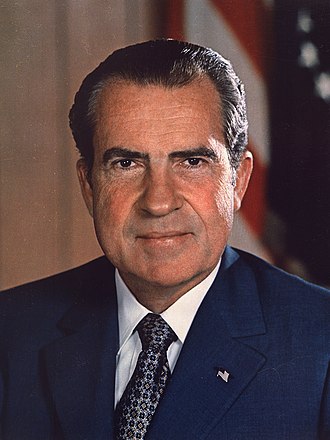
Richard M. Nixon served as the 37th President of the United States from January 1969 until his resignation in August 1974. In February 1971, he ordered the installation of a secret voice-activated taping system in the White House to preserve a historical record of his administration. Until the system's existence was revealed and dismantled in July 1973, the tapes captured Nixon directing major foreign policy initiatives, such as the opening to China, as well as his central role in the Watergate cover-up.
What Nixon talks about on the tapes
White House operations 4,718Presidential scheduling 2,225Public relations 1,784Presidential schedule 1,782Vietnam War 1,693Logistics 1,650Manolo Sanchez 1,626White House communications 1,400White House administration 1,399Presidential communication 1,243Henry Kissinger 1,191Foreign Policy 1,183
Conversations (21,010)
— Page 208 of 211President Nixon requested a telephone connection with H. R. Haldeman to discuss unspecified matters. Upon being informed that Haldeman's line was busy, the President instructed the operator to continue attempting the connection. The conversation concluded with Nixon noting there was no urgency to the request.
President Nixon held a brief, informal check-in with a White House operator regarding a pending or incoming call. The exchange served primarily to manage communication logistics rather than substantive policy matters. No major decisions were reached, as the President indicated there was no immediate urgency to the task at hand.
President Nixon and H. R. Haldeman discuss the management of the President's personal records and the potential publication of his first-term history, emphasizing their desire to exclude Watergate-related materials. They review the ongoing Ervin Committee hearings, focusing specifically on Jeb Stuart Magruder's testimony, his allegations against John Mitchell and John Dean, and the political implications for the White House. Additionally, the President assesses the favorable reception of his recent economic address and plans his upcoming schedule, including meetings with Leonid Brezhnev and Hobart Lewis.
President Nixon and H.R. Haldeman discuss the management of presidential records and materials, specifically focusing on the documentation of the administration's first four years. The two men also evaluate potential publishers for these materials and touch upon ongoing investigations, including the testimony of John Dean and others involved in the Watergate scandal. Nixon expresses concern regarding the motivations of those testifying and emphasizes the need for a strategic approach to documenting his presidency.
President Nixon initiates a request through the White House operator to place a telephone call to Press Secretary Ronald L. Ziegler. The conversation serves solely as a logistical bridge to facilitate this communication with his staff. No further substantive policy matters or decisions were discussed during this brief exchange.
President Nixon requested that the White House operator place a telephone call to an individual identified as Mr. Jacobs. The brief interaction focused solely on facilitating this connection. No other substantive political or administrative matters were discussed during this exchange.
President Nixon consulted with the White House operator to coordinate his upcoming schedule and staff interactions. He requested that press secretary Ronald Ziegler report to him following a briefing with Henry Kissinger. Additionally, Nixon directed that J. Fred Buzhardt, Jr. be brought in for a meeting.
President Nixon consulted with a White House operator regarding the logistics of handling a specific document or communication. The brief exchange focused on technical instructions for the delivery and management of sensitive materials. No major policy decisions were reached during this short administrative coordination.
President Nixon met with J. Fred Buzhardt, Jr., Ronald L. Ziegler, and Henry A. Kissinger to manage the intensifying political fallout from the Watergate scandal. The discussion focused on countering the testimony of key figures like John Dean and Jeb Magruder, specifically addressing their allegations regarding the White House's involvement in a cover-up and potential efforts to influence civil litigation. Nixon expressed frustration over the perceived lack of support from Republican legislators and strategized with his team on how to discredit Dean's testimony while maintaining the President's public narrative of non-involvement.
Ronald L. Ziegler and President Nixon coordinate a meeting regarding the timing and location of a scheduled press briefing. The President directs Ziegler to meet him at the Executive Office Building to discuss the matter further. This brief exchange serves to finalize the logistics for the upcoming press engagement.
President Nixon and Henry Kissinger coordinate logistics for the upcoming visit of Soviet leader Leonid Brezhnev, specifically regarding accommodations at the San Clemente compound for Brezhnev, his wife, and Andrei Gromyko. Nixon requests that Kissinger convey his gratitude for a warm personal note received from Brezhnev and confirm the residence arrangements. The two also briefly discuss Kissinger’s successful briefings to Congress and the press, as well as the optimal timing for the signing of a nuclear non-proliferation agreement.
President Nixon contacted the White House operator to initiate a telephone call to National Security Advisor Henry A. Kissinger. This brief interaction served as a formal request to connect the President with his top foreign policy aide for an urgent discussion. The primary objective of the communication was to facilitate immediate contact between the two officials.
President Nixon and Henry Kissinger coordinated the logistical details and public relations strategy for the upcoming visit of Soviet leader Leonid Brezhnev. The conversation covered the schedule for signing ceremonies, the arrangement of television tapings at Camp David, and the distribution of responsibilities for congressional briefings. Nixon also addressed the political climate, expressing satisfaction that positive engagement with congressional leaders was successfully distracting from the ongoing Watergate scandal.
President Nixon consulted with an unidentified staff member regarding the logistics and agenda for Soviet General Secretary Leonid Brezhnev’s upcoming state visit. The discussion focused on coordinating the schedule for events at Camp David, the timing of Brezhnev's televised address, and the status of several high-level bilateral agreements involving trade, nuclear arms, and maritime policy. Additionally, the President briefly touched on the progress of his domestic energy program and the general economic outlook.
President Nixon met with his Chief Petty Officer to coordinate logistics for a presidential excursion aboard the Sequoia. The President directed the officer to prepare the vessel for a departure at 6:30 p.m. for a small group of two guests. This meeting served to finalize the scheduling and passenger arrangements for the outing.
President Nixon contacted the White House operator to facilitate a telephone connection with First Lady Pat Nixon. The brief interaction served as a routine administrative request to reach the First Lady. No substantive policy discussions or significant political developments occurred during this exchange.
President Nixon calls First Lady Pat Nixon to invite her to a private dinner cruise on the presidential yacht, the Sequoia. They discuss the guest list, specifically mentioning the potential inclusion of Rose Mary Woods to celebrate her recent pay raise. The couple finalizes their departure plans, confirming they will leave within fifteen minutes.
President Nixon and First Lady Pat Nixon engage in a brief, informal exchange facilitated by a White House operator. The conversation centers on coordinating personal plans for the evening, specifically regarding the First Lady's availability or desire to attend an event. The brief dialogue concludes without any significant policy developments or substantive administrative action.
President Nixon consulted with an unidentified staff member regarding the current whereabouts and contact details of his personal secretary, Rose Mary Woods. The discussion focused on coordinating dinner plans and confirming whether Woods had returned to her residence. The President directed the staffer to verify her status and facilitate a forthcoming telephone call.
President Nixon met with an unidentified individual in the Executive Office Building to facilitate the delivery of a briefcase to the Lincoln Sitting Room. The brief exchange focused solely on the logistics of this transfer within the White House residence. Following the handoff, the unknown person departed the office, concluding the brief interaction.
President Nixon calls Rose Mary Woods to coordinate her arrival for a planned evening excursion on the presidential yacht, the Sequoia. The two discuss her ongoing beauty shop appointment and finalize travel logistics to ensure she meets the President and First Lady on the White House south grounds. Nixon instructs Woods to join their party directly rather than traveling separately, confirming a brief wait for her arrival.
President Nixon consulted with his personal secretary, Rose Mary Woods, to coordinate her attendance on a brief excursion aboard the presidential yacht, the Sequoia. After confirming Woods' current availability, Nixon instructed her to meet him at the South Grounds within twenty minutes to facilitate transportation together. The brief exchange focused primarily on scheduling logistics and travel arrangements for the outing.
President Nixon and his advisors met to finalize the logistics and agenda for Soviet General Secretary Leonid Brezhnev’s upcoming state visit. The discussion focused on balancing formal state proceedings with informal, spontaneous-looking events in San Clemente and at Camp David to foster positive imagery. Key decisions included finalizing the guest list for a reception—prioritizing a mix of political, business, and Hollywood figures—and arranging for a scenic coastal drive to provide Brezhnev with a more authentic view of America.
President Nixon contacted the White House operator to place a personal telephone call to Nellie Yates. He provided instructions to ensure the operator did not disturb Yates if she was at dinner or otherwise occupied. The conversation was purely administrative, serving as a brief request for telephonic assistance.
President Nixon instructed the White House operator regarding the screening of his incoming calls. He specifically requested that the operator avoid interrupting him for dinner-related inquiries or non-urgent matters. This brief interaction served to establish protocols for maintaining the President's workflow and privacy during his evening hours.
President Nixon calls his assistant, Nellie L. Yates, to coordinate administrative work following his evening excursion on the presidential yacht, Sequoia. The pair discusses personal matters, including the evening's weather and office aesthetics, before transitioning to a work-related task regarding upcoming remarks for the Everett M. Dirksen Center. Nixon requests that Yates assist him at the Executive Office Building to prepare these materials, leading to an agreement for her to return to the office to complete the project.
President Nixon and Nellie L. Yates engaged in a brief, informal exchange to coordinate their evening movements and logistical arrangements. The conversation focused on the President's work schedule at the Old Executive Office Building and plans for Yates's departure and return. No substantive policy matters were discussed, as the dialogue served primarily as a personal administrative check-in.
President Nixon met with a Chief Petty Officer to address the recovery of a misplaced briefcase. The President confirmed the location of the item in the Lincoln Sitting Room and issued instructions for its retrieval and delivery to the Executive Office Building. The brief interaction concluded once the retrieval process was initiated.
President Nixon held a brief, unscheduled meeting with an unidentified male visitor in the Executive Office Building. The primary focus of the discussion concerned the President's personal schedule and logistical arrangements managed by Nellie L. Yates. No major policy developments occurred, as the encounter concluded shortly after the brief administrative exchange.
President Nixon met with Nellie L. Yates in the Executive Office Building to coordinate the preparation and printing of an upcoming speech honoring Everett M. Dirksen. Beyond technical logistics regarding the speech’s formatting and delivery, the pair engaged in casual conversation about office decor, horticulture, and Yates’s dedicated work ethic. The meeting concluded with the President acknowledging Yates’s contributions to his administration.
President Nixon and Ronald Ziegler met to coordinate the administration's public relations strategy, focusing on shifting media attention away from the Watergate scandal toward upcoming economic initiatives and the impending Soviet summit. They analyzed the political damage caused by John Dean’s testimony and debated the merits of countering negative press coverage versus ignoring the ongoing Ervin Committee hearings. Ultimately, Nixon emphasized the necessity of projecting a poised, confident posture and maintaining a busy public schedule to steer the national narrative toward presidential business.
President Nixon met with his aide Stephen B. Bull to coordinate logistical preparations for an upcoming speech in Pekin, Illinois. The discussion centered on handling correspondence, managing interview requests, and ensuring the accuracy of the podium equipment and signage. Nixon directed Bull to streamline the processing of administrative tasks and confirmed that he would personally oversee the final preparations for his public appearance.
President Nixon met with his personal aide, Stephen B. Bull, to coordinate the logistics and security of sensitive documents and personal materials ahead of an upcoming trip to Peoria, Illinois. The two discussed the transfer of specific items, with Bull confirming that he would secure primary materials while restricting access to others during the travel. The meeting concluded with instructions to ensure the specified items were placed on the presidential aircraft.
President Nixon met with Nellie L. Yates to review and refine the text of his upcoming speech scheduled to be delivered in Pekin, Illinois. Beyond the legislative or policy-focused drafting of the address, the two engaged in casual conversation regarding Yates’s personal schedule. Their discussion touched upon recreational activities, specifically tennis and gardening advice involving Charles G. “Bebe” Rebozo.
President Nixon met with Nellie L. Yates to review and organize documents, including material regarding board policy, in preparation for an upcoming speech in Pekin, Illinois. The discussion focused on the clerical management of the president’s speaking notes and the physical organization of the draft text. No major policy decisions were made, as the interaction centered on administrative logistics and typing requirements.
President Nixon met with Alexander Haig, Henry Kissinger, and other staff members to review preparations for his upcoming speech in Pekin, Illinois, and the anticipated visit of Soviet leader Leonid Brezhnev. The participants discussed strategies for managing foreign relations, specifically addressing requests regarding potential diplomatic travel for Vice President Spiro Agnew and navigating the delicate balance of U.S. relations with China and the Soviet Union. Additionally, the President and his team assessed the administration's political standing amid Watergate-related pressures, the national economy, and media coverage, emphasizing the need to project presidential strength and focus on the administration's policy achievements.
President Nixon communicated with the White House operator to facilitate a scheduled meeting with National Security Advisor Henry A. Kissinger. The discussion served as an administrative coordination effort to ensure Kissinger was brought into the Oval Office for their private consultation. No substantive policy matters were discussed during this brief logistical exchange.
President Nixon held a brief, undocumented meeting with an unidentified individual in the Oval Office. The encounter involved the handling or exchange of a briefcase, though the specific nature of the interaction remains unclear due to the lack of a recorded transcript. The meeting concluded rapidly, with both parties departing the office within seven minutes.
President Richard M. Nixon met with Alexander M. Haig, Jr. in the Oval Office to discuss unspecified administrative or strategic matters. While the transcript remains unavailable, the brief meeting resulted in an agreement between the two participants. The discussion concluded within seven minutes, marking a quick interaction between the President and his Chief of Staff.
President Nixon contacted the White House operator to initiate an outgoing call. The communication served exclusively as a logistical request to be connected with Stephen B. Bull. No further substantive policy matters or broader political discussions were recorded during this brief exchange.
President Nixon met with Alexander Haig, Henry Kissinger, and Ronald Ziegler to finalize the logistics for Soviet General Secretary Leonid Brezhnev’s visit and to coordinate the administration’s strategy regarding the unfolding Watergate scandal. The participants discussed the summit schedule—including private sessions, signing ceremonies, and travel arrangements—and expressed frustration over negative media coverage, specifically regarding the potential impact of John Dean’s testimony. Nixon and his advisors resolved to maintain a tough, authoritative public image during the summit to ensure the success of the negotiations and to prevent domestic political turbulence from undermining the administration's foreign policy goals.
President Nixon, Ronald Ziegler, and Henry Kissinger met to strategize on managing the public relations fallout regarding John Dean's upcoming Ervin Committee testimony and recent damaging press reports. The group discussed methods to refute specific allegations—such as claims that the President authorized $1 million in hush money—while debating whether to address charges directly or maintain a strategy of calculated silence to avoid elevating Dean's profile. Additionally, Kissinger briefly consulted the President on messaging for the upcoming visit by Leonid Brezhnev to ensure the public perceived their diplomatic efforts as balanced rather than an attempt at global domination.
President Nixon met with an unidentified individual, likely a press aide or logistics coordinator, to finalize arrangements for the upcoming visit of Soviet General Secretary Leonid Brezhnev. The discussion focused on managing the media presence and optimizing television coverage for the President’s public remarks. They specifically addressed the strategic positioning of the press pool to ensure favorable visual documentation of the proceedings.
President Nixon consulted with an unidentified staff member regarding the logistics of Soviet General Secretary Leonid I. Brezhnev’s upcoming visit. The discussion centered on an unexpected delay caused by inclement weather affecting helicopter transportation. The President sought confirmation on the revised timeline and inquired about the presence of Major John V. Brennan to ensure the itinerary remained coordinated.
President Nixon and Alexander Haig discussed the White House's strategic response to the impending Ervin Committee testimony of John Dean and related Watergate allegations. They evaluated potential legal and political risks, including reports of financial irregularities involving Charles Colson and concerns regarding IRS audits of Lawrence O'Brien. The meeting also briefly touched upon logistical scheduling for the upcoming visit of Soviet leader Leonid Brezhnev.
President Nixon met briefly with two unidentified individuals in the Oval Office to coordinate details regarding his official schedule. The discussion centered on logistics and upcoming appointments, serving as a functional administrative update. No definitive policy decisions were recorded during this brief encounter.
President Nixon met with an unidentified individual in the Oval Office to coordinate preparations for the upcoming official visit of Soviet General Secretary Leonid I. Brezhnev. The discussion centered on logistical and strategic planning regarding the summit proceedings. Following the brief consultation, the visitor departed, leaving the President to finalize arrangements for the high-profile diplomatic engagement.
President Nixon met with an unidentified individual to finalize logistical details regarding the upcoming visit of Soviet General Secretary Leonid I. Brezhnev. The discussion centered on planning the specific arrangements for the formal arrival ceremony at the White House. The meeting concluded with no further recorded developments before the participants departed the Oval Office.
President Nixon met with Soviet General Secretary Leonid Brezhnev in the Oval Office to discuss the strengthening of U.S.-Soviet relations following their historic 1972 Moscow summit. The conversation centered on the necessity of building personal trust and confidence between the two leaders to facilitate long-term peace and cooperation, moving beyond historical Cold War tensions. Both leaders committed to a regular schedule of future summits and discussed the importance of expanding economic and cultural ties to solidify a new, stable era of superpower diplomacy.
President Nixon and General Secretary Leonid Brezhnev met in the Oval Office to conduct high-level diplomatic discussions during Brezhnev's state visit to the United States. The participants focused on strengthening bilateral relations, with extensive dialogue regarding the expansion of economic and trade ties, including potential large-scale energy cooperation and agricultural trade. They also addressed pressing international issues, such as the situation in the Middle East, the implementation of the Paris Accords regarding Vietnam, and preparations for a forthcoming nuclear agreement.
President Nixon met with Henry Kissinger, Alexander Haig, and Ronald Ziegler to coordinate the public messaging strategy regarding ongoing Soviet-American relations and bilateral summit agreements. Following the foreign policy segment, the group transitioned to a discussion of domestic political pressures, specifically focusing on the administration’s response to John Dean’s anticipated testimony before the Ervin Committee. Nixon emphasized the necessity of a disciplined, unified defense strategy to counter potential allegations of misconduct and manage the intense media scrutiny surrounding the Watergate investigation.
President Nixon met with Stephen B. Bull to coordinate final logistics for an upcoming state dinner honoring Leonid Brezhnev. The discussion focused on managing the guest list, the structure of the receiving line, and the timing of remarks to accommodate television network coverage. Nixon emphasized the necessity of precise preparation for the event's ceremonial elements.
President Nixon and Henry Kissinger met briefly to finalize the President's upcoming toast for the visit of Soviet General Secretary Leonid Brezhnev. The two reviewed the speech to ensure appropriate length and effective editing. They specifically focused on highlighting the diplomatic achievements reached between the United States and the Soviet Union over the preceding years.
President Nixon met with his personal valet, Manolo Sanchez, in the Old Executive Office Building. The brief discussion primarily focused on coordinating the President's upcoming schedule. No significant policy decisions were recorded during this brief administrative interaction.
President Nixon met with his aide, Stephen B. Bull, to review administrative details regarding his daily schedule. The discussion focused on coordinating upcoming appointments and managing the President’s time commitments. No major policy decisions were reached, as the meeting served primarily as a brief logistical check-in.
Alexander Haig briefed President Nixon on the postponement of the Ervin Committee hearings, attributing the delay to Senator Mike Mansfield and criticizing Senators Hugh Scott and Howard Baker for their political maneuvering. Additionally, Haig requested a meeting for Governor John A. Love, which the President tentatively scheduled for 5:30 p.m. to accommodate his ongoing work on a toast for Leonid Brezhnev. The President expressed significant frustration over Senator Baker’s recent public comments regarding their personal relationship.
President Nixon, assisted by Rose Mary Woods and Alexander M. Haig, Jr., worked to finalize the text of his upcoming toast for the visit of Soviet General Secretary Leonid Brezhnev. The participants focused on editing the speech for appropriate length and tone, specifically requesting the removal of extraneous references, such as a passage regarding John Adams. Nixon reviewed the revised wording to ensure the toast effectively conveyed a message of peace and mutual responsibility between the two global powers.
President Nixon consulted with the White House operator to facilitate a telephone connection with Alexander M. Haig, Jr. The primary purpose of the brief interaction was to manage executive communications and initiate a discussion with his Chief of Staff. No further substantive policy matters were recorded during this connection request.
President Nixon and Alexander Haig discuss strategies to counter negative press and potential political maneuvering by the Ervin Committee regarding the ongoing Watergate investigation. Nixon expresses concern that the committee and the media are timing leaks of John Dean’s testimony to undermine his upcoming Soviet summit. He directs Haig to coordinate with White House staff to aggressively push back against the committee’s narrative and specifically orders an investigation into allegations that Leonard Garment may be leaking information to the Washington Post.
President Nixon and Alexander Haig discuss political maneuvering regarding Senate Majority Leader Mike Mansfield and potential press exploitation of ongoing controversies. Nixon expresses concern that opponents intend to build up negative coverage over the summer to damage the administration. He directs Haig to thoroughly vet these developments and considers retaliatory measures, such as imposing tariffs, to counter the perceived political threat.
President Nixon held a brief, unscheduled interaction with the White House operator while located in the Old Executive Office Building. As no transcript exists for this encounter, the specific subject matter remains undocumented. The recording serves primarily as a procedural capture of administrative activity during the Nixon presidency.
President Nixon directed Stephen B. Bull to ensure that proper lighting arrangements were made for the podium to be used at that evening’s state dinner for Soviet leader Leonid Brezhnev. Emphasizing the importance of the setup, the President specifically requested that the lighting be sufficient for both himself and his guest. Bull committed to executing these instructions immediately.
President Nixon consults with Stephen B. Bull to verify travel arrangements for an upcoming trip to California. The President emphasizes the necessity of scheduling a makeup session, ensuring specific logistical requirements are met for his itinerary. This brief exchange serves to confirm the administrative planning of the President's personal and professional schedule.
President Nixon met with his personal aide, Manolo Sanchez, to discuss adjustments to his daily schedule. During the brief interaction, the President noted that a previously planned meeting involving J. Fred Buzhardt, Jr. had been concluded. The discussion served primarily to coordinate the President's immediate movements and administrative itinerary for the afternoon.
President Nixon met with an unidentified individual to coordinate scheduling and legal strategy regarding the ongoing Watergate investigation. The discussion specifically addressed the administration's defensive posture toward the Ervin Committee and concerns over damaging press leaks. Nixon also arranged a briefing with J. Fred Buzhardt, Jr. to further manage the White House's response to the scandal.
President Nixon met with an unknown individual in the Old Executive Office Building to facilitate the delivery of unspecified materials. During the brief interaction, the President also provided instructions for a message to be relayed to White House Chief of Staff Alexander M. Haig, Jr. The discussion concluded without further recorded elaboration on the nature of the documents or the specific content of the communication.
President Nixon met with J. Fred Buzhardt, Jr. and others to discuss strategies for discrediting John Dean in advance of his testimony before the Senate Watergate (Ervin) Committee. The participants focused on leaking evidence regarding Dean's alleged personal misuse of funds to portray him as a common thief rather than a whistleblower motivated by principle. Nixon and Buzhardt reviewed the status of witness preparation and emphasized the importance of using these financial revelations to gain leverage and undermine Dean's credibility with both the committee and the public.
President Nixon met with his aide Stephen B. Bull in the Oval Office to discuss administrative logistics. The conversation centered on the President's upcoming schedule, specifically involving the use of the presidential yacht, the Sequoia. No further significant actions or strategic developments were recorded during this brief administrative exchange.
President Nixon, joined by Alexander Haig and briefly by Henry Kissinger, met with John A. Love to formally recruit him to head a new, high-level White House office tasked with managing the nation's energy policy. The discussion addressed the intense bureaucratic rivalries regarding energy oversight and the critical need for an administrator with direct access to the President who could navigate complex environmental, foreign policy, and economic challenges. Nixon also briefly addressed concerns regarding the Watergate scandal, dismissing its relevance to Love's prospective role while emphasizing that the situation would need to run its course through the courts and the Ervin Committee.
President Nixon met with Alexander M. Haig, Jr. for a brief discussion regarding the White House's ongoing public relations strategy concerning the Watergate scandal. The two conferred on administrative messaging and the potential involvement of Ronald L. Ziegler in addressing queries from the Ervin Committee and television networks. The conversation resulted in a minor directive to refine a prepared statement by removing a concluding sentence.
President Nixon, Alexander Haig, and Ronald Ziegler met to discuss the White House's strategic response to the impending Ervin Committee testimony of John W. Dean III. The President and his aides analyzed how to manage the political fallout of the testimony during the upcoming summit with Leonid Brezhnev, weighing the pros and cons of potential delays. A significant focus of the discussion was the ongoing effort to discredit Dean by publicizing his alleged mishandling of campaign funds and payments to defendants.
President Nixon initiates a brief telephone exchange with the White House operator to request a meeting with his personal valet, Manolo Sanchez. The conversation serves as a direct administrative directive to facilitate this request. No further policy or strategic matters are addressed during this brief call.
President Nixon initiated a call through the White House operator to locate his daughter, Julie Nixon Eisenhower. The brief exchange focused on confirming her current whereabouts within the executive residence, specifically mentioning the West Hall or her guest room. No further policy or political discussions took place during this brief administrative request.
President Nixon consulted with the White House operator to facilitate a time-sensitive communication with Julie Nixon Eisenhower and her spouse before they departed the White House grounds. The President expressed urgency in reaching the couple prior to their return to their residence. This exchange served as a logistical coordination effort to ensure contact was made before their departure.
President Nixon contacted the White House operator to facilitate a personal phone call with his daughter, Julie Nixon Eisenhower. He inquired about the presence of a Secret Service agent at her residence and requested that the agent instruct her to return his call. The operator confirmed that the request had already been relayed, concluding the brief exchange regarding the President's attempt to reach his daughter.
President Nixon and Henry Kissinger met to coordinate the logistics and messaging for the ongoing visit of Soviet leader Leonid Brezhnev, including scheduling, guest lists for the Sequoia, and ensuring the summit's historic significance was properly emphasized. Kissinger advised on managing the press and briefing Allies, while the pair also discussed the political damage caused by the Watergate scandal. Nixon expressed frustration with the Ervin Committee hearings and Republican congressional behavior, deciding to postpone a public response until after John Dean’s testimony concluded.
President Nixon initiates a brief telephone exchange with the White House operator to inquire about the progress of a requested meeting. He specifically directs the operator to facilitate contact with Press Secretary Ronald L. Ziegler. The conversation serves as a routine administrative request to coordinate executive staff communication.
President Nixon consulted with a White House operator to assess the functionality of his telecommunications equipment. This brief exchange served as a technical check to ensure the President's phone lines were operating correctly. No policy discussions or significant political decisions were made during this routine inquiry.
President Nixon met with Alexander Haig, Ronald Ziegler, and J. Fred Buzhardt to discuss ongoing Watergate fallout and strategy, specifically focusing on the upcoming testimony of former White House counsel John Dean before the Ervin Committee. The participants expressed frustration with the lack of aggressive public defense by Republican allies and the perceived bias of special prosecutor Archibald Cox, prompting discussions on how to better leverage allies to challenge Dean's credibility and the scope of Cox's investigation. Additionally, the President reviewed his economic recovery program and the status of Leonid Brezhnev's state visit, stressing the importance of controlling the media narrative during these high-stakes events.
President Nixon initiates a brief telephone exchange with the White House operator to coordinate a meeting. The President requests the presence of J. Fred Buzhardt, Jr., his legal counsel, for an immediate consultation. This directive reflects the ongoing administrative efforts to manage legal affairs during the period of the Watergate investigations.
President Nixon and Henry Kissinger discuss logistics and planning for the upcoming visit of Soviet leader Leonid Brezhnev, specifically focusing on the itinerary for Camp David and the presidential yacht, the Sequoia. Kissinger updates the President on the Soviet Union's attempt to offer a non-aggression treaty to China, noting that the Chinese rejected the overture due to their ongoing relationship with the United States. The participants resolve to maintain flexibility regarding the Brezhnev schedule while ensuring the Soviet leader's security concerns are addressed.
President Nixon met with Rose Mary Woods to discuss logistics for Leonid Brezhnev’s state visit, specifically focusing on managing guest lists and timing for receiving lines and entertainment. Following Woods' departure, Alexander Haig joined the President to discuss the ongoing Watergate investigation, including the erratic public behavior of Martha Mitchell and efforts to ensure objectivity regarding Special Prosecutor Archibald Cox. The participants expressed concern over the perceived partisanship of the Ervin Committee and emphasized the need for strategic handling of political allies and legal representatives.
President Nixon met with his personal aide, Manolo Sanchez, in the Old Executive Office Building to briefly discuss the President's daily schedule. The conversation focused on upcoming engagements, specifically noting a scheduled meeting with National Security Advisor Henry Kissinger. No other substantive policy matters or major decisions were recorded during this brief administrative exchange.
President Nixon and Henry Kissinger met to coordinate the final arrangements and diplomatic strategy for Leonid Brezhnev’s upcoming visit to the United States. They discussed the scheduling of official events, the management of press and public relations regarding various bilateral agreements, and strategies to mitigate potential protests or political interference. Additionally, the pair touched upon ongoing domestic political pressures, specifically the impact of the Watergate hearings and their frustration with Congressional leadership.
President Nixon met with his personal valet Manolo Sanchez and Thomas Hart in the Old Executive Office Building to discuss administrative and personal logistical matters. The brief interaction focused primarily on the President’s lunch order, specifically requesting salmon and cottage cheese. No substantive policy or political developments were recorded during this brief encounter.
President Nixon met with his personal valet, Manolo Sanchez, in the Old Executive Office Building. The discussion focused on administrative matters and the President’s daily schedule. No major policy decisions or significant historical actions were recorded during this brief encounter.
President Nixon met with his personal valet, Manolo Sanchez, in the Old Executive Office Building to coordinate administrative tasks. The discussion focused primarily on the President’s daily schedule and logistical arrangements regarding an upcoming telephone call to his close friend, Charles G. “Bebe” Rebozo. The meeting concluded with instructions concerning the timing of this communication.
President Nixon initiates a brief telephone request for the White House operator to connect him with his close friend, Charles G. “Bebe” Rebozo. This interaction serves as a routine administrative step to facilitate a private communication between the President and Rebozo. No further discussion occurs during this segment beyond the initial request for the connection.
President Nixon consulted with the White House operator to determine the whereabouts of his friend Charles “Bebe” Rebozo. The operator informed the President that Rebozo had traveled to Philadelphia but would be at Robert Abplanalp’s residence in Yonkers that evening. Nixon indicated he would attempt to place a return call to Rebozo later that night if his schedule permitted.
President Nixon initiates a brief request for the White House operator to connect him with an individual named Mr. Rebosa. This conversation serves as a procedural exchange to facilitate a specific outgoing telephone call. No further substantive policy or political discussions occur during this brief interaction.
President Nixon consulted with the White House operator to facilitate an outgoing call. The brief exchange focused on coordinating communication logistics, resulting in the President's decision to personally contact an unnamed individual. This interaction served primarily as a logistical step for the President to initiate a private conversation.
President Nixon directs the White House operator to contact Press Secretary Ronald L. Ziegler. The President requests that Ziegler report to his office in the Executive Office Building for a meeting. No further substantive matters are addressed during this brief administrative call.
President Nixon consults with the White House operator regarding a piece of correspondence or documentation that requires immediate attention. The brief exchange confirms that Nixon has reviewed the material and acknowledges the necessity of addressing the issues raised by an individual identified as Rob. No specific policy decisions are finalized during this short communication.
President Nixon met with an unknown staff member to request the retrieval of a specific pipe located in the Lincoln Sitting Room. The President described the item’s appearance and color to ensure the aide could identify it correctly. The meeting concluded with the staff member acknowledging the request and departing to fulfill the errand.
President Nixon held a brief, informal meeting with one or more unidentified individuals in his Old Executive Office Building suite to discuss scheduling matters. The participants engaged in a short, vague exchange primarily concerned with the logistics of the President's upcoming availability. No substantive policy decisions or critical directives were recorded during this brief interaction.
President Nixon met with Ronald Ziegler, Alexander Haig, and Henry Kissinger to coordinate the upcoming state visit of Soviet leader Leonid Brezhnev and manage the ongoing Watergate crisis. The group planned the logistical details of the summit, including travel to Camp David, photograph opportunities, and public relations strategies for the Brezhnev visit. Simultaneously, they discussed political damage control, specifically preparing for John Dean's upcoming testimony before the Ervin Committee and determining the White House's public stance regarding the Watergate investigation and the role of special prosecutor Archibald Cox.
President Nixon and Henry Kissinger discussed logistical arrangements for an upcoming summit with Soviet leader Leonid Brezhnev at Camp David, including travel plans due to poor weather and the composition of the delegation. They coordinated the scheduling of an economic meeting and ensured that the timing of a formal agreement signing would follow substantive discussions to maximize its political impact. Additionally, they touched upon media management, specifically addressing speculative reports by Victor Louis and Kissinger's recent interactions with journalist Hugh Sidey regarding positive public relations efforts.
President Nixon instructed the White House operator to place a call to J. Fred Buzhardt, Jr. to discuss legal or administrative matters. He specifically directed that Buzhardt should not be contacted if he was currently at the Capitol, requesting that the operator verify his presence in his office first. This exchange highlights the logistical coordination required for Nixon to communicate with his legal team during the height of the Watergate investigations.
President Nixon speaks briefly with a White House operator to facilitate a telephone connection. The primary purpose of the call is to establish contact with Julie Nixon Eisenhower. No further substantive policy discussions occur during this brief administrative exchange.
President Nixon instructed the White House operator to notify him if a specific individual arrived or became available. This brief interaction served as a coordination effort to ensure the President was promptly alerted regarding the status of a pending contact. No other policy matters or substantive political issues were addressed during this short exchange.