Nixon, Richard M. (President)
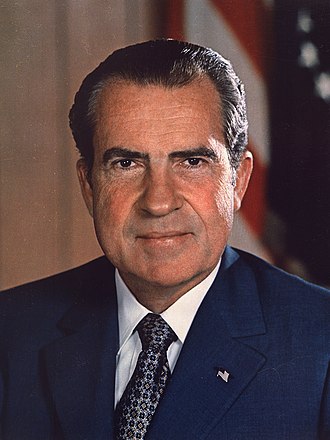
Richard M. Nixon served as the 37th President of the United States from January 1969 until his resignation in August 1974. In February 1971, he ordered the installation of a secret voice-activated taping system in the White House to preserve a historical record of his administration. Until the system's existence was revealed and dismantled in July 1973, the tapes captured Nixon directing major foreign policy initiatives, such as the opening to China, as well as his central role in the Watergate cover-up.
What Nixon talks about on the tapes
White House operations 4,718Presidential scheduling 2,225Public relations 1,784Presidential schedule 1,782Vietnam War 1,693Logistics 1,650Manolo Sanchez 1,626White House communications 1,400White House administration 1,399Presidential communication 1,243Henry Kissinger 1,191Foreign Policy 1,183
Conversations (21,010)
— Page 32 of 211President Nixon met with his personal valet, Manolo Sanchez, to attend to routine personal needs within the Old Executive Office Building. The brief exchange focused on the availability and maintenance of the President’s smoking supplies, specifically his pipe and tobacco. No policy matters were addressed, as the interaction was limited to confirming the status of these personal items.
President Nixon met with H.R. Haldeman and John Ehrlichman to discuss legislative strategy regarding Congressional appropriations and the distribution of discretionary funds, with a particular focus on prioritizing key states for political advantage. The group also evaluated the shifting foreign policy landscape, specifically addressing the public reaction to the upcoming China summit and the risks posed by potential congressional delegations visiting the PRC. A significant portion of the discussion centered on the political liability of Vice President Spiro Agnew, with the President and his staff contemplating the feasibility and timing of his potential resignation and replacement by John Connally to strengthen the 1972 ticket.
President Nixon contacted the White House operator to place a personal telephone call to his daughter, Julie Nixon Eisenhower. The operator successfully initiated the connection, facilitating a private conversation between the President and his daughter. No policy matters or official administrative decisions were discussed during this brief exchange.
President Nixon and First Lady Pat Nixon spoke briefly to coordinate their evening schedule. The discussion focused on finalizing the timing for their dinner and confirming plans to meet on the balcony. No major policy decisions were made, as the exchange served primarily to synchronize their personal arrangements.
President Nixon and First Lady Pat Nixon coordinate plans to meet on the balcony at 6:30 p.m. The brief exchange serves as a logistical check to confirm their upcoming social or professional engagement. No major policy decisions were discussed during this interaction.
President Nixon initiates a brief telephone call to Charles W. Colson through the White House operator. The conversation serves as a functional request to connect the President with a key staff member. No substantive policy discussions or decisions are recorded in this brief administrative exchange.
President Nixon contacted the White House operator to place a personal telephone call to his close friend and confidant, Charles G. “Bebe” Rebozo. The brief exchange served solely to facilitate this connection between the President and Rebozo. No substantive policy discussions or administrative actions occurred during this communication.
President Nixon and Charles Colson discuss the political fallout and public reception of the upcoming China initiative, agreeing that the move has successfully bolstered the President’s image while putting Democratic rivals like Senator Edward Kennedy on the defensive. They also address the lack of vocal enthusiasm from Republican legislative leaders regarding the initiative, with Nixon directing Colson to pressure these leaders to adopt a more aggressive and supportive stance. Furthermore, the two touch upon media strategy, noting that the administration's assertive tactics are yielding more favorable coverage from major networks.
President Nixon initiates a brief interaction with the White House operator to facilitate an outgoing call. The exchange serves as a functional administrative step to connect the President with another party. No substantive policy discussions or major decisions occurred during this brief communication.
President Nixon consulted with the White House operator to facilitate an outgoing call. The brief exchange served as a logistical step for the President to initiate official communications. No substantive policy discussions or complex decision-making occurred during this administrative interaction.
President Nixon and Charles Colson discuss strategies for managing public and political perceptions following the announcement of the President's upcoming trip to China. They express frustration with the lack of positive support from Republican legislators and the media, strategizing on how to pressure critics and ensure more favorable coverage. The conversation concludes with Nixon directing Colson to intensify efforts to demand support from party members and combat negative narratives regarding the administration's policies.
Manolo Sanchez, acting on behalf of President Nixon, coordinated a follow-up call with Charles G. "Bebe" Rebozo. The brief exchange served to reschedule Rebozo’s communication with the President to a specific time later that evening. The conversation concluded with the agreement that Rebozo would initiate the call at 7:45 pm.
President Nixon and his close associate Bebe Rebozo discuss the overwhelmingly positive public and media reception to the recent announcement of the President's initiative toward the People's Republic of China. The two men attribute the success of the announcement to the element of surprise and the administration's ability to maintain total secrecy until the revelation. Additionally, the conversation touches upon logistical planning for the President's upcoming California vacation and various personal matters, including Rebozo's personal schedule and a private bet between the two.
President Nixon contacted the White House operator to place a personal telephone call to his daughter, Tricia Nixon Cox. The conversation was administrative in nature, serving solely to facilitate the connection between the President and a family member. No policy matters or official government business were discussed during this brief exchange.
President Nixon and his daughter, Tricia Nixon Cox, discussed logistics regarding their respective personal schedules and social obligations. The President briefed Tricia on his upcoming trip to New York City, including a planned appearance by Ruby Keeler on Broadway. The conversation also touched upon Tricia’s coordination of social invitations for Edward R. F. Cox, Howard E. Cox, Jr., and Anne C. B. Cox.
President Nixon contacted the White House operator to place a personal telephone call to his daughter, Julie Nixon Eisenhower. The primary purpose of the exchange was to determine Julie’s current location so that the operator could successfully connect the President to her. No other substantive policy or political matters were discussed during this brief communication.
President Nixon contacted the White House operator to facilitate a telephone connection with Rex W. Scouten. The primary purpose of this brief communication was to initiate a direct line of contact with Scouten, who served as a member of the White House staff. No further substantive dialogue was recorded during this brief administrative exchange.
President Nixon contacted Stewart Stout via the White House operator to arrange for personal transportation. The President specifically requested a car to be prepared for his departure to attend a baseball game. The request served as a logistical instruction to facilitate the President's evening plans.
President Nixon contacted the White House operator to place a personal telephone call to Haakon Ingolf Romnes, the Chairman of the Board of the American Telephone and Telegraph Company (AT&T). This request served as a preliminary administrative step to facilitate a direct conversation between the President and the telecommunications executive. No further policy discussions or substantive developments occurred during this brief request.
President Nixon held an brief, unrecorded meeting in his Old Executive Office Building suite with unidentified individuals. Due to the lack of transcript content and the brevity of the exchange, the specific subject matter and any subsequent action items remain undocumented. The encounter serves primarily as a logistical entry in the President's daily schedule.
President Nixon met with his personal aide, Manolo Sanchez, to discuss the maintenance of a timepiece. The brief interaction focused on the fact that the President's watch had stopped functioning due to a dead battery. No significant policy or administrative decisions were made during this exchange.
President Nixon and Henry Kissinger met to strategize the upcoming presidential summit with the People's Republic of China (PRC), focusing on maintaining tight control over negotiations and logistics to preserve the President's diplomatic leverage. The two discussed their concerns regarding premature visits to China by other U.S. officials and politicians, agreeing that such unauthorized contact could complicate the administration's foreign policy goals and limit Nixon's freedom of action. Additionally, Nixon emphasized the importance of ensuring that the historical record correctly reflects that the PRC initiative was a product of his direct collaboration with Kissinger, rather than an achievement of the State Department.
President Nixon and H. R. Haldeman briefly conferred to coordinate an immediate in-person meeting. The President initiated the contact to request that Haldeman join him in his office in the Old Executive Office Building. No further substantive policy matters were discussed during this brief logistical exchange.
President Nixon met with H. R. Haldeman and Henry Kissinger to refine the President's upcoming schedule, focusing on high-profile diplomatic trips, including the pivotal mission to the People's Republic of China, and various domestic events. The participants discussed managing public relations for the China initiative, maintaining communication channels with the Soviet Union, and balancing presidential appearances to maximize political impact. Additionally, they addressed personnel matters, including ambassadorial appointments and strategies for handling congressional relations and party dissenters.
President Nixon met with an unknown individual in the Old Executive Office Building to conduct administrative business. The brief interaction primarily involved the President inquiring about a ringing telephone. No substantive policy discussions or significant political decisions were recorded during this brief segment.
President Nixon met with his personal valet, Manolo Sanchez, to discuss logistical arrangements regarding the President's upcoming daily schedule. The conversation focused on coordination for Nixon’s work arrival the following morning. No substantive policy decisions were made during this brief administrative exchange.
President Nixon met with his personal valet, Manolo Sanchez, in the Old Executive Office Building. The brief interaction focused on a specific request made by Sanchez to the President. Due to the lack of available transcript or additional documentation, no further substantive policy or administrative outcomes were recorded.
President Nixon consulted with the White House operator to facilitate a phone call, specifically requesting assistance in connecting with George Romney. The brief exchange focused on verifying the correct spelling of the name to ensure the operator could reach the intended party. No broader policy discussions or significant political decisions occurred during this interaction.
President Nixon met with his personal valet, Manolo Sanchez, in the Old Executive Office Building to handle routine administrative support. During the brief interaction, the President requested that Sanchez provide coffee. No policy matters or significant political developments were addressed during this short exchange.
Secretary of the Treasury John B. Connally briefed President Nixon on a routine $5 billion national debt refinancing plan that included the first-time issuance of 10-year bonds at a 7% interest rate. Connally acknowledged that the move would likely trigger political criticism from Representative Wright Patman and others due to the interest rates, but argued it was necessary to extend the debt's maturity profile. President Nixon expressed his support for the strategy, affirming that the Treasury should proceed as planned to manage the debt effectively.
President Richard Nixon and Treasury Secretary John Connally held a brief coordination meeting to discuss ongoing economic policy strategies. The participants touched upon the necessity of securing funding and evaluated the potential impact of pending economic developments. The conversation served as a preliminary check-in to ensure alignment on forthcoming financial maneuvers.
President Nixon contacted AT&T Chairman Haakon I. Romnes to commend the company for its management of a recent labor dispute and the dedication of employees who maintained telephone service during that period. Nixon highlighted the critical importance of reliable telecommunications, citing his recent use of the system to rapidly coordinate the announcement of his China initiative. The conversation transitioned into a broader discussion on the steel industry, where Nixon expressed concern over declining competitiveness and stressed the urgent need for labor-management cooperation regarding productivity and work rules.
President Nixon met with AT&T Chairman Haakon I. Romnes to express personal gratitude for the company's efforts in maintaining critical communication services during recent labor disputes. Nixon highlighted the essential role of telephone infrastructure during the recent high-stakes announcement regarding China. The conversation transitioned into an economic discussion, with Nixon voicing concerns regarding productivity and international competitiveness within the American steel industry as he sought a reasonable labor settlement.
President Nixon requested that the White House operator connect him with J. Curtis Counts, the director of the Federal Mediation and Conciliation Service. The purpose of the call was to initiate a conversation with the mediator regarding ongoing labor relations or industrial disputes. No further discussion occurred during this brief request for the operator's assistance.
President Nixon requested that the White House operator place a telephone call to Curt Combs of the Federal Mediation and Conciliation Service. This brief interaction served solely to facilitate official communication between the President and the mediator. No further substantive policy matters or decisions were discussed during this brief exchange.
President Nixon met with his personal valet, Manolo Sanchez, in the Old Executive Office Building for a brief administrative interaction. While specific details of the discussion remain undocumented due to the lack of a transcript, such meetings typically involved the coordination of the President's personal schedule and logistical arrangements. This exchange reflects the routine daily management of the President's staff and internal office operations.
In this meeting, President Nixon and his advisors, including John Connally and George Shultz, strategized on economic messaging and labor relations ahead of the 1972 election. They discussed the political risks of wage and price controls, analyzed the shifting attitudes of the American working class compared to the intellectual elite, and explored ways to appeal directly to the labor rank-and-file. The President emphasized the need to frame his economic and foreign policy initiatives in terms of national strength and job security to consolidate his base against political opponents.
President Nixon met with Miss Lund, the secretary to Federal Mediation and Conciliation Service Director J. Curtis Counts, for a brief introductory discussion. The conversation touched upon ongoing efforts to resolve a labor strike involving telephone workers, noting the involvement of George P. Shultz and James D. Hodgson. Additionally, the President engaged in casual rapport by discussing Counts' collegiate background as an All-American baseball player at UCLA.
President Nixon calls Willie J. Usery, Jr. to commend his successful mediation efforts in recent postal and railroad labor negotiations. The discussion shifts toward the upcoming steel labor disputes, with Nixon emphasizing the necessity of avoiding a strike while urging a non-inflationary settlement. Usery expresses optimism regarding the steel negotiations and affirms that the President's previous meetings with labor leaders have positively influenced the process.
President Nixon initiated a telephone call to Congressman George H. Mahon of Texas with the assistance of the White House operator and H.R. Haldeman. The primary purpose of the brief communication was to establish contact with the Congressman to discuss legislative or political matters. No specific policy details or substantive decisions were recorded in the available transcript excerpt beyond the administrative act of placing the call.
President Richard M. Nixon spoke with Congressman George H. Mahon to discuss the legislative strategy for passing a public employment bill before the upcoming August congressional recess. Nixon emphasized the urgency of the funding to combat unemployment during the summer months, arguing that delaying the appropriation would diminish the program's economic impact. Mahon agreed to coordinate with key congressional leadership and staff to expedite the necessary hearings, with Nixon committing to provide the relevant administration experts to testify.
President Nixon initiates a call to his assistant John D. Ehrlichman, intending to discuss matters involving George P. Shultz. After the operator begins the connection, the President abruptly cancels the request and instructs the operator not to proceed with the call. No substantive policy discussions or decisions occur during this brief administrative exchange.
President Nixon directs the White House operator to place an outgoing telephone call to John W. Rollins. The brief exchange serves as a logistical communication to facilitate contact with Rollins. No substantive policy discussions or complex developments occurred during this administrative request.
President Nixon and an unidentified interlocutor engage in a brief, informal consultation regarding potential personnel appointments or administrative candidates. The discussion centers on evaluating the suitability of individuals for a specific role, with a focus on a candidate referred to as 'Ffwrdd' and mentions of 'Judd.' The dialogue concludes without a finalized decision, though the participants affirm the perceived quality of the prospective appointees.
President Nixon held a brief exchange with the White House operator regarding potential professional opportunities in academia. The conversation involved personal reflections on the possibility of future university work and concluded without any formal policy decisions or administrative actions. The discussion remained focused on Nixon's personal contemplations rather than official White House business.
President Nixon met with his personal secretary Rose Mary Woods and aide Stephen B. Bull to address administrative and scheduling concerns. During the discussion, Nixon placed a call to John W. Rollins to verify his current location. The group also coordinated the departure of Stanley H. Bear from White House service and adjusted relevant scheduling matters.
President Nixon consulted with a White House operator to determine the whereabouts of John W. Rollins. The operator reported that Rollins was staying at the Denver Hilton but was currently unavailable, possibly due to a meeting. The conversation concluded with the operator promising to continue attempting to locate Rollins and to provide a follow-up call.
President Nixon and Henry Kissinger met to coordinate the President's schedule and finalize logistical arrangements for upcoming high-level meetings. Stephen B. Bull joined the discussion briefly to receive instructions regarding these scheduling requests. The brief exchange focused exclusively on managing the President's calendar and ensuring administrative preparedness.
President Nixon held a brief meeting with his personal valet, Manolo Sanchez, in the Oval Office. The discussion involved a personal matter categorized as restricted material, which was subsequently withdrawn from the public record. No significant policy decisions or state affairs were recorded during this brief interaction.
President Nixon, H. R. Haldeman, Charles Colson, and Henry Kissinger met to discuss the domestic and international implications of the administration's new initiative toward the People's Republic of China (PRC). The group evaluated the public’s fascination with the move, comparing its impact to the release of the Pentagon Papers, and strategized on how to leverage the policy to appeal to American youth ahead of the 1972 election. They also addressed political contingencies, including the potential for Vice President Spiro Agnew’s resignation, the political future of John Connally, and ongoing efforts to secure a resolution to the Vietnam War.
President Nixon and John W. Rollins discussed organizational efforts for an upcoming Republican fundraising dinner, specifically focusing on Rollins's role as chairman and his need for assistance with donors. The conversation also touched upon the positive reception of the President's recent television program regarding the People's Republic of China initiative. Additionally, the participants reviewed the strategic significance of the 18-21-year-old vote and other demographic sectors in a Delaware Republican poll, with Rollins noting he would coordinate with Harry S. Dent on the matter.
President Nixon instructed the White House operator to place a telephone call to Treasury Secretary John B. Connally. This brief administrative exchange served as the precursor to a substantive discussion between the two men. No policy decisions were finalized during this initial contact as the conversation was limited to the act of connecting the President to his Cabinet member.
President Nixon and H. R. Haldeman discussed political strategies to manage the impact of the Pentagon Papers, aiming to divide the Democratic Party on the Vietnam War issue while bolstering the President's image as a strong, decisive leader. The participants analyzed the positive public reception of the upcoming China initiative, which they planned to use to build momentum for the 1972 campaign. Furthermore, the meeting addressed domestic policy challenges, specifically examining how to navigate public dissatisfaction with court-ordered busing and the difficulties of advancing welfare reform.
President Nixon and Robert H. Finch discuss long-term political strategy, specifically focusing on positioning for the 1972 re-election campaign and Finch’s future career path. The two assess the political climate in California, the influence of Ronald Reagan, and the necessity of managing internal Republican dynamics and potential primary challengers. They also evaluate prospective roles for Finch, including a possible ambassadorship to Mexico or leadership of the Office of Emergency Preparedness (OEP), to ensure his visibility and continued contribution to the administration while preparing for a 1974 political campaign.
President Nixon met with Council of Economic Advisers Chairman Paul W. McCracken to discuss the administration's economic policy, including the challenges of high unemployment and inflation. The President expressed frustration with the sluggish economy and explored the potential for dramatic fiscal interventions, such as shifting tax structures or modifying the international value of the dollar to improve competitiveness. Following this, Nixon consulted with John B. Connally to coordinate a strategic response, emphasizing the need for decisive action and unity between the Council of Economic Advisers and the Treasury Department.
President Nixon directs Treasury Secretary John B. Connally to hold a private meeting with Paul McCracken to discuss sensitive international monetary issues and strategies for improving U.S. economic competitiveness. The President emphasizes the need to bypass other staff members, such as Paul Volcker and Arthur Burns, to obtain an objective assessment of potential revaluation options. Connally agrees to consult with McCracken independently and provide a candid evaluation of the explosive proposals.
President Nixon instructed the White House operator to place an outgoing call to his special counsel, Charles W. Colson. This brief communication served as the logistical initiation of a conversation between the two men. No substantive policy matters were discussed during this initial operator exchange.
President Nixon and Donald Rumsfeld met to discuss Rumsfeld's future career options within the administration, balancing his interest in Illinois politics with potential high-level federal appointments. They evaluated several possibilities, including a role as NATO ambassador, an Under Secretary position at the State Department, or a specialized roving envoy role focused on Latin America and other regions. The conversation also touched upon broader administration goals, the necessity of strengthening the State Department's internal administration, and political assessments of various Republican figures, including Iowa's Lieutenant Governor Roger Jepson.
President Nixon and Stephen B. Bull met to finalize the logistics for an upcoming visit by the Future Farmers of America. The discussion focused on coordinating a mini-receiving line and a White House tour, while also addressing the involvement of Bryce Harlow, H.R. Haldeman, and Representative Paul Findley. The participants confirmed the sequence of events in the Cabinet Room to ensure the orderly management of the group's visit.
President Nixon hosted Stanley H. Bear, a longtime doctor and associate, along with his wife and children for a brief Oval Office meeting. The visit served as a social courtesy to acknowledge the family, during which the President exchanged pleasantries, presented gifts, and arranged for a special White House tour. Nixon also expressed personal gratitude for Bear's years of loyal professional service as the family prepared to depart.
President Nixon met with his aide Stephen B. Bull to review logistical arrangements for an upcoming meeting with Robert J. Jamison. The brief discussion focused on scheduling and the preparation required for the President's engagement with Jamison. No further policy or strategic developments were recorded during this brief encounter.
President Nixon met with departing Secret Service agent Robert J. Jamison, his wife, and personal secretary Rose Mary Woods for a brief farewell visit. The discussion centered on Jamison's lengthy tenure with the Secret Service, including his experience during a Latin American trip, and his upcoming retirement plans to move to Florida. Nixon presented the couple with presidential gifts as a gesture of appreciation for Jamison's service and continued personal support.
President Nixon met with Rose Mary Woods and Dianne C. Tankoos to acknowledge Tankoos' commendable service to the administration. The President discussed her upcoming trip to Paris and expressed encouragement regarding her desire to travel and see the world. The brief exchange concluded with the President formally expressing his appreciation for her work.
President Nixon met with Stephen B. Bull to finalize logistical arrangements for an upcoming visit from the Future Farmers of America group. The discussion focused on coordinating the group's reception, including site selection between the Rose Garden and the Cabinet Room, and determining the extent of press coverage. Nixon instructed Bull to manage the group's arrival and provide updates regarding their status throughout the day.
President Nixon met with H.R. Haldeman and Stephen B. Bull to coordinate his daily schedule, address upcoming diplomatic meetings, and review recent public opinion polling regarding his initiative toward the People's Republic of China. Haldeman briefed the President on requests from William P. Rogers and Henry Kissinger concerning China representation, while also presenting survey data that showed strong public support for the President's diplomatic outreach. The discussion concluded with logistical arrangements for the President's afternoon appointments, including a meeting with the Future Farmers of America.
President Nixon and H. R. Haldeman reviewed current public opinion polling data, specifically focusing on the administration's approval ratings in relation to the developing initiative with the People's Republic of China and the ongoing Vietnam War. They analyzed how these policy moves affected the President's perceived capability compared to prominent political rivals like Edward Kennedy and Edmund Muskie. Additionally, they discussed personnel matters, including the potential reassignment of Robert Finch to a new post or ambassadorship to facilitate administrative changes.
President Nixon met with his valet, Manolo Sanchez, in the Old Executive Office Building for a brief informal interaction. The exchange consisted of a casual inquiry regarding daily developments and personal matters. No significant policy decisions or official actions were recorded during this brief encounter.
President Nixon consulted with the White House operator to inquire about any new developments or urgent communications. The conversation functioned as a brief administrative check-in to monitor the flow of information reaching the Oval Office. No major policy decisions were reached, as the exchange served primarily to maintain situational awareness regarding incoming calls and alerts.
President Nixon and Charles Colson discussed strategies to manage media coverage, specifically focusing on cultivating more favorable reporting from CBS regarding the administration's economic and policy successes. They reviewed the political benefits of the recent People's Republic of China initiative, which they agreed served as a valuable tool for boosting support among youth and improving the administration's overall image. Additionally, they touched on ongoing political operations, including the strategic use of Pentagon Papers-related information against Democratic candidates and the importance of John B. Connally’s role in managing labor relations.
President Nixon met with Charles W. Colson to discuss administrative strategies, including the management of sensitive internal communications and public messaging. The dialogue focused on the importance of maintaining strict control over classified or restricted information to prevent unauthorized dissemination. The participants also briefly evaluated the performance and coverage of major television networks during the preceding period.
President Richard M. Nixon met briefly with his longtime personal valet, Manolo Sanchez, in the Old Executive Office Building. The conversation primarily involved personal matters, as evidenced by a brief withdrawal segment classified as personal and returnable. No significant policy discussions or administrative actions occurred during this one-minute interaction.
President Nixon met with an unidentified individual in the Old Executive Office Building to coordinate scheduling and logistical arrangements. The discussion focused on the participant's current location and upcoming availability for future engagement. No substantive policy matters were recorded, as the dialogue served primarily to manage the President's administrative calendar.
President Nixon, William P. Rogers, and Henry Kissinger met to coordinate foreign policy strategy, focusing on the administration’s initiative toward the People’s Republic of China (PRC) and its impact on the United Nations and U.S.-Japan relations. The participants discussed managing the delicate diplomatic transition regarding Taiwan’s UN membership, the importance of maintaining strong ties with Japan, and the domestic political advantages of the evolving foreign policy, particularly concerning the Vietnam War and the Pentagon Papers. The President also reviewed legislative strategy for a bipartisan Vietnam ceasefire resolution with Senator Mike Mansfield and planned logistics for his upcoming visit to China.
President Nixon met with his aide Stephen B. Bull to coordinate upcoming administrative scheduling and logistics. The discussion centered on arrangements for a briefing in the Cabinet Room involving H.R. Haldeman and a group of senators. Nixon also addressed concerns regarding the diplomatic implications of his schedule and sought clarification on the timing of a planned meeting with Kevin Phillips.
President Nixon instructed the White House operator to place a telephone call to Congressman Charles E. Chamberlain of Michigan. This brief administrative interaction was intended to facilitate direct communication between the President and the Representative. No further discussion occurred during this recording segment as the operator proceeded to initiate the connection.
President Nixon consulted with the White House operator to facilitate a communication connection. The brief exchange focused on identifying and reaching a specific congressman from Michigan. The conversation served primarily as an administrative coordination effort to establish contact with the legislator.
President Richard M. Nixon met with White House aide Stephen B. Bull in the Oval Office to address administrative or scheduling matters. Although a transcript is unavailable, the interaction reflects the President's routine engagement with his personal staff. The meeting concluded immediately upon their departure at 5:16 pm.
President Nixon met with a bipartisan group of Senate leaders to frame the shifting geopolitical and economic landscape of the 1970s. Nixon highlighted the transition from a era of military confrontation to one of negotiation, emphasizing the necessity of integrating the People's Republic of China into the world community to prevent future instability. Following the President's overview, Peter G. Peterson delivered a briefing on the intensifying global economic challenge posed by the rapid industrial growth of nations like Japan and Germany. The meeting served as a strategic appeal for bipartisan support to ensure the United States remains competitive as military tensions subside and economic competition becomes the primary arena of international rivalry.
President Nixon met with Secretary of Defense Melvin Laird and National Security Advisor Henry Kissinger to review recent foreign policy developments, specifically Laird's trip to Japan and South Korea. The discussion focused on Japanese defense modernization, the status of U.S. military commitments in Korea, and the implementation of the Nixon Doctrine in light of the administration’s secret initiative to open relations with the People's Republic of China. Additionally, the participants addressed the Vietnam War, including the importance of maintaining robust supplies for South Vietnamese forces, and explored strategies for consolidating political support from moderate figures like Nelson Rockefeller.
President Nixon initiated a call to Senator William V. Roth to discuss a matter of business. Upon learning from the White House operator that the Senator was currently traveling to his Delaware residence, Nixon decided to postpone the outreach. No substantive policy discussions occurred as the President opted to attempt contact at a later time.
President Nixon met with Alexander P. Butterfield to finalize administrative tasks regarding his official schedule. The discussion centered on the review and signing of pending executive documents. The meeting concluded briefly with the President providing final instructions for the evening's workflow.
President Nixon, H. R. Haldeman, and Henry Kissinger discussed the positive political reception of the recent announcement regarding the opening of relations with the People's Republic of China, emphasizing its favorable impact among the nation's leadership class and broad public support. The group reviewed early poll data that suggested strong approval for the initiative, noting that this shift in sentiment potentially countered negative political fallout from the ongoing Pentagon Papers controversy. Additionally, the President and his staff discussed the potential appointment of David M. Kennedy as Ambassador to Japan and reviewed logistical arrangements for upcoming presidential schedule items.
President Nixon directed the White House operator to place a telephone call to his close friend and confidant, Charles G. "Bebe" Rebozo. The brief exchange served strictly as an administrative request to facilitate private communication between the two men. No substantive political or policy discussions took place during this recorded interaction.
President Nixon and Senator Robert Dole spoke to discuss the internal climate of the Republican National Committee following a recent meeting. They reviewed party sentiment regarding the President’s surprise initiative to engage the People’s Republic of China, alongside concerns over the national economy and regional political dynamics. The discussion also touched upon preparations for the upcoming Republican National Convention, including deliberations over potential host cities like Chicago, Miami, and San Diego.
President Nixon initiates a request for the White House operator to place a telephone call to Senator William V. Roth. The President briefly corrects his initial error regarding the Senator's home state, specifying Delaware rather than Maryland. This exchange serves as a routine administrative request to facilitate direct communication between the President and the Senator.
President Nixon contacted the White House operator to request a telephone connection with Special Counsel Charles W. Colson. This brief administrative interaction served as a routing request to facilitate direct communication between the President and a key advisor. No substantive policy matters or decisions were recorded during this brief bridge to the subsequent conversation.
President Nixon and his close associate Charles G. "Bebe" Rebozo spoke briefly to coordinate social arrangements and schedules for family members, including David and Julie Nixon Eisenhower, at Camp David. The discussion also touched upon general reactions to the President's recent diplomatic initiative regarding the People's Republic of China. This informal check-in served primarily to synchronize personal logistics and monitor public sentiment regarding administration policy.
President Nixon and Charles Colson discussed strategies for improving public perception of the administration’s handling of the national economy and unemployment rates. They analyzed current polling data and examined how positive economic indicators might be better communicated to the public. Nixon directed Colson to coordinate with pollster Louis Harris to ensure that recent positive trends and public sentiments were more accurately reflected in upcoming survey results.
President Nixon met with his personal aide, Manolo Sanchez, to briefly address logistical matters regarding the President's schedule. The conversation focused on the availability and status of Robert H. Finch. The meeting concluded immediately, with no significant policy decisions recorded.
President Nixon met with his Deputy Assistant Alexander P. Butterfield for a brief administrative check-in at the Oval Office. The discussion focused on routine logistical matters and the scheduling of White House operations. No major policy decisions or significant developments were recorded during this short encounter.
President Nixon and Henry Kissinger coordinated a telephone call to journalist Stewart Alsop, who was currently hospitalized at the National Institute of Health. The participants sought to locate Alsop's direct contact information through the White House operator to facilitate the outreach. This brief exchange focused entirely on the logistics of reaching the ailing columnist.
President Nixon held a brief, informal discussion with an unidentified participant in the Oval Office regarding upcoming scheduling matters. The conversation was limited to confirming logistical arrangements and calendar coordination. No substantive policy decisions or political directives were recorded during this exchange.
President Nixon coordinated with H. R. Haldeman to arrange a briefing with Henry Kissinger regarding his upcoming schedule and travel. The discussion served as a logistical preparation for a formal meeting between the President and Kissinger. The primary objective was to ensure the National Security Advisor was available for a direct consultation on pressing foreign policy matters.
President Nixon met with Henry Kissinger and H.R. Haldeman to discuss the domestic political impact of his opening to the People's Republic of China, specifically focusing on leveraging the initiative to bolster his support among youth and conservative factions. The group evaluated personnel moves, including appointing David M. Kennedy as Ambassador to Japan and assigning Robert H. Finch to the Office of Emergency Preparedness. Nixon directed his staff to prioritize an organized outreach effort on college campuses regarding foreign policy and mandated the expedited release of internal poll data to generate momentum and counter potentially unfavorable Gallup polling.
President Nixon called journalist Stewart J.O. Alsop to express personal support following news of Alsop's recent health diagnosis. The conversation included Nixon’s appreciation for Alsop’s objective reporting and support regarding the administration’s recent initiative to open relations with the People's Republic of China. Nixon also reaffirmed his commitment to significantly expanding federal funding for cancer research as a high priority.
President Nixon initiates a request to the White House operator to be connected with Charles W. Colson. The brief exchange serves as a logistical step to facilitate direct communication between the President and his special counsel. No substantive policy matters are discussed as the conversation is limited to the procedural task of establishing the phone connection.
President Nixon and H.R. Haldeman discuss the logistical arrangements for the upcoming presidential trip to the People's Republic of China, specifically focusing on the optics of the delegation. Nixon expresses concern that John D. Ehrlichman should not participate in his capacity as domestic policy advisor, citing potential conflicts and the need to manage public perceptions of the mission. The President ultimately decides to restrict Ehrlichman’s role to ensure he is not perceived as part of the primary diplomatic entourage.
President Nixon and Press Secretary Ronald L. Ziegler discuss the logistical arrangements and visual presentation for an upcoming budget meeting. They coordinate the use of charts and photography to effectively communicate administration economic policy to the public. The brief interaction concludes with the finalization of plans for these visual aids.
President Nixon met with his economic and national security advisors to address urgent concerns regarding the federal budget, economic growth, and the size of the government. Seeking to shift toward a balanced budget, Nixon directed his team to pursue aggressive spending cuts, including an across-the-board 10% reduction in federal personnel and significant decreases in defense and intelligence agency staffing. He emphasized that these efforts were essential for restoring confidence in the private sector and demanded a strategic overhaul of mission requirements, particularly within the Department of Defense and the CIA, to eliminate waste and redundant programs.
President Nixon met with Stephen B. Bull and Manolo Sanchez in the Oval Office to coordinate logistics and preparatory materials for his upcoming schedule. During the brief discussion, the President addressed lighting arrangements for the room and requested a copy of a forthcoming Milton Friedman article. This request was intended to facilitate a planned telephone call between the President and the economist.