Nixon, Richard M. (President)
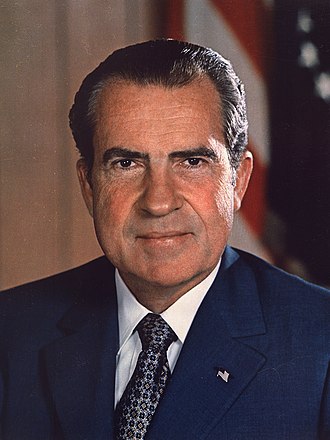
Richard M. Nixon served as the 37th President of the United States from January 1969 until his resignation in August 1974. In February 1971, he ordered the installation of a secret voice-activated taping system in the White House to preserve a historical record of his administration. Until the system's existence was revealed and dismantled in July 1973, the tapes captured Nixon directing major foreign policy initiatives, such as the opening to China, as well as his central role in the Watergate cover-up.
What Nixon talks about on the tapes
White House operations 4,718Presidential scheduling 2,225Public relations 1,784Presidential schedule 1,782Vietnam War 1,693Logistics 1,650Manolo Sanchez 1,626White House communications 1,400White House administration 1,399Presidential communication 1,243Henry Kissinger 1,191Foreign Policy 1,183
Conversations (21,010)
— Page 69 of 211President Nixon met with his daughter, Julie Nixon Eisenhower, to discuss her upcoming travel schedule, including a visit to a new Environmental Protection Agency research center near Duke University. They reviewed logistics for her appearances and discussed the challenges of public speaking, with the President offering advice on handling media interviews and avoiding the pitfalls of self-consciousness when appearing on television. Additionally, the President requested that Julie relay praise to the White House chef regarding a recent roast beef dinner.
President Nixon receives a status update from a White House operator regarding the travel plans of his daughter, Tricia Nixon Cox. The conversation confirms that Tricia is currently en route to Washington, D.C. This brief exchange serves primarily to inform the President of his daughter's arrival status.
President Nixon directed the White House operator to place a call to Lewis F. Powell, Jr. following the Senate's confirmation of Powell as an Associate Justice of the Supreme Court. The President intended to personally congratulate the new justice on his appointment. This conversation serves as a brief logistical step in the administration's outreach to key judicial appointees.
President Nixon met with an unknown individual, likely a representative of an NBC film crew, to facilitate the production of televised footage within the Oval Office. The discussion focused on logistical coordination and the specific positioning of equipment to ensure the desired visual coverage. Nixon authorized the crew to take a lunch break as they finalized their setup for the recording session.
President Nixon and Henry Kissinger discussed the escalating geopolitical crisis on the Indian subcontinent, specifically focusing on the roles of the Soviet Union and the People's Republic of China. Kissinger argued that Soviet aggression in the region threatened to embolden their stance in the Middle East and Vietnam, prompting the President to emphasize the importance of maintaining alignment with Chinese interests at the United Nations. They ultimately weighed the strategic risks and potential benefits of communicating a strong message to the Chinese to deter foreign intervention.
President Nixon and aide Stephen B. Bull coordinated logistics for upcoming Oval Office activities, specifically focusing on the setup for an NBC film crew. Nixon emphasized the need for strict time management during a scheduled drug policy meeting to ensure he remained on track for subsequent religious observances. The President directed Bull to enforce a fifteen-minute limit on the drug discussion to prevent delays in his schedule.
President Nixon met with senior military officials and personnel, including Brigadier Generals Jeanne M. Holm, Anna M. Hays, and Elizabeth P. Hoisington, to discuss the status and recruitment of women in the armed services. The discussion focused on the high quality of female college graduates entering officer training and the overall progress of integrating women into peacetime military roles. Following this, Stephen B. Bull briefed the President on the scheduling of the “Most Courageous Junior Olympian” award ceremony.
President Nixon met with Gary Washington, a recipient of the "Most Courageous Junior Olympian" award, alongside Senator Gordon L. Allott and various guests including an NBC film crew. The discussion centered on celebrating Washington's athletic achievements and personal resilience, with Nixon presenting commemorative gifts such as presidential cuff links. The conversation also touched upon broader topics including the role of private industry in youth programming, recent football games, and technical comparisons between offensive and defensive football line play.
President Nixon and Stephen B. Bull met briefly in the Oval Office to coordinate the President's daily schedule. The discussion centered on administrative arrangements, including a forthcoming statement, a signing ceremony, and preparations for a dinner event held that evening. The brief exchange focused primarily on the logistical management of the President's public appearances and calendar obligations.
President Nixon met with H. R. Haldeman and briefly spoke with Rose Mary Woods to coordinate scheduling and administrative details regarding upcoming diplomatic and social events. The discussion covered logistics for an upcoming Bermuda trip, a photo opportunity with Senator Strom Thurmond, and the reporting process for Maurice Stans following his visit to the USSR. Additionally, they addressed seating and invitation issues for a White House dinner involving George Shultz and the Brazilian delegation, emphasizing the need to manage professional optics and avoid unnecessary attendance at specific diplomatic meetings.
President Nixon met with Myles J. Ambrose, John D. Ehrlichman, George P. Shultz, and Egil Krogh, Jr. to discuss the administration's federal narcotics control strategy and the persistent issue of jurisdictional competition between the Justice and Treasury Departments. The group explored a new, aggressive approach that utilizes grand juries and special prosecution teams to target heroin street-level trafficking and reduce drug supply. Nixon emphasized the necessity of recruiting high-quality young lawyers into criminal law to support these efforts, noting that a unified, cross-agency strategy is essential for effective law enforcement.
President Nixon and Stephen B. Bull coordinated logistics for upcoming presidential meetings and public appearances. The discussion focused on scheduling Henry Kissinger and managing the presence of an NBC film crew and the press corps during these events. They also addressed the protocol for photo opportunities and whether observers could remain in the Oval Office for informal conversations.
President Nixon met with Canadian Prime Minister Pierre Trudeau to engage in a broad-ranging discussion on bilateral relations and major international crises. The leaders addressed economic tensions—specifically regarding U.S. trade measures, foreign capital investment in Canada, and the importance of maintaining a sound U.S. economy—while also consulting on the escalating India-Pakistan war. Nixon and Kissinger emphasized the necessity of a multilateral approach to monetary issues and expressed their desire to maintain a stable balance of power in South Asia despite the conflict.
President Richard Nixon met with Press Secretary Ronald L. Ziegler in the Oval Office for a brief, undocumented briefing. While the transcript remains unavailable, the discussion focused on political strategy regarding the Democratic Party. The meeting concluded abruptly after less than four minutes, with no specific administrative actions recorded.
President Nixon and Henry Kissinger met to strategize their response to the escalating India-Pakistan conflict and the potential collapse of West Pakistan. They discussed the necessity of maintaining a firm stance toward the Soviet Union and India, specifically considering a message to the People's Republic of China regarding military movements. Additionally, Nixon directed Kissinger to conduct background briefings with the press to deflect blame for the regional crisis and to manage public perception of the administration's foreign policy. The meeting also touched upon planning for Vietnam peace initiatives and the need for a tough diplomatic posture in upcoming international communications.
President Nixon met with his aide, Stephen B. Bull, to coordinate scheduling and manage upcoming meetings. The discussion centered on logistics for engagements involving Norman Vincent Peale, Julie Nixon Eisenhower, and legislative affairs staff, alongside specific administrative matters regarding pensions and tax deductions. Nixon emphasized the need for efficiency, instructing Bull to keep conversations brief and streamline the flow of visitors.
President Nixon met with his staff and nominee Lewis F. Powell, Jr. to discuss the status of pending legislation, congressional relations, and the upcoming Senate confirmation vote for Powell's Supreme Court appointment. The participants also reviewed a proposal for pension reform, specifically deliberating between two tax deduction options for individuals without employer-sponsored retirement plans. Nixon ultimately expressed support for the $1,500 deduction limit, emphasizing the administration's goal of encouraging private retirement savings for workers not covered by government or corporate pension programs.
President Nixon calls Lewis F. Powell, Jr. to congratulate him on his recent Senate confirmation to the Supreme Court. The two discuss the political opposition faced by Powell and fellow nominee William H. Rehnquist, drawing historical parallels to the controversial nomination of Louis D. Brandeis. Powell outlines his transition plan, noting that he intends to wrap up his private law practice and begin full-time service on the Court by January 1972 after coordinating with Chief Justice Warren E. Burger.
President Nixon contacted the White House operator to facilitate a personal call to First Lady Pat Nixon. The brief exchange served as a routine administrative request to establish a connection with the President's spouse. No further official policy or political matters were discussed during this brief communication.
President Nixon and Stephen B. Bull reviewed the logistics of the President’s upcoming schedule, specifically coordinating meetings involving Rose Mary Woods and Rex W. Scouten. The discussion focused on facilitating appointments with the Secretary of State and Canadian Prime Minister Pierre E. Trudeau. The brief exchange served to finalize administrative arrangements for these key diplomatic and internal engagements.
President Nixon met with his valet, Manolo Sanchez, to discuss the care and exercise of the President’s dog, King Timahoe. The discussion centered on the animal's dietary preferences and preparations for an upcoming walk. Additionally, the President requested that Sanchez retrieve a specific briefcase to accompany him.
President Nixon and First Lady Pat Nixon discussed logistical arrangements for the upcoming television special, 'A Day in the Life of the President.' The conversation focused on coordinating interview segments involving the President, the First Lady, and their daughter, Tricia Nixon Cox. Additionally, they briefly touched upon plans for a Christmas party to be held in the Lincoln Room.
President Nixon and Henry Kissinger discuss the ongoing India-Pakistan War, specifically evaluating a Soviet resolution at the United Nations that lacks a critical withdrawal provision. Nixon rejects the Soviet proposal and criticizes Secretary of State William P. Rogers for undermining the administration's official diplomatic position through inconsistent public statements. Kissinger is tasked with issuing a firm background statement to clarify the administration’s policy and emphasize Indian responsibility in the conflict.
President Nixon initiates a call through the White House operator to contact Henry A. Kissinger. The brief communication serves as a logistical bridge to facilitate direct consultation between the President and his National Security Advisor. No substantive policy matters are discussed, as the interaction is limited to the procedural request for connection.
President Nixon directed Henry Kissinger to contact Treasury Secretary John Connally to gauge his opinion regarding Secretary of State William Rogers’s performance. Nixon aimed to assess Connally's perspective on Rogers through this indirect communication channel. Additionally, Kissinger informed the President that he had received the full text of a recent Soviet diplomatic note, promising a follow-up report after further review.
President Nixon consulted with the White House operator to determine the current whereabouts of Henry Kissinger. The inquiry was prompted by an incoming call for Kissinger from Harold H. Saunders. The operator confirmed that Kissinger had briefly stepped out of his office, concluding the brief administrative exchange.
President Nixon initiates a call to Secretary of State William P. Rogers through the White House operator. While the specific substance of the ensuing discussion is not captured in this segment, the interaction serves as a logistical bridge to facilitate diplomatic consultations. The recording confirms the President's direct involvement in orchestrating high-level executive communication regarding foreign policy matters.
President Nixon and H.R. Haldeman discussed internal administrative friction, specifically the professional rivalry between Secretary of State William Rogers and National Security Advisor Henry Kissinger. They analyzed the impact of recent negative press coverage regarding the India-Pakistan war and the management of foreign policy, with Nixon expressing frustration over Rogers' perceived lack of vigor in confrontational matters. Ultimately, the two decided to refrain from immediate intervention in the Rogers-Kissinger conflict, opting to let the situation rest while monitoring the fallout from ongoing media narratives.
President Nixon and Press Secretary Ronald Ziegler discussed the administration's public messaging regarding the ongoing India-Pakistan conflict and the flow of refugees. They considered having Henry Kissinger provide a press briefing to explain the White House position and counter criticisms from figures like Senator Edward Kennedy. The goal was to establish a more effective diplomatic posture at the United Nations without directly engaging in a political confrontation with Kennedy.
President Nixon and H.R. Haldeman discussed the escalating tensions regarding the India-Pakistan conflict and Henry Kissinger's frustration with the State Department's perceived obstructionism. Kissinger specifically cited Secretary of State William P. Rogers's recent speech as a "disastrous" act that undermined ongoing diplomatic efforts and threatened his broader negotiation strategy regarding the Middle East and the Soviet Union. The participants evaluated the necessity of a Kissinger-led media backgrounder to clarify the administration's position, while also briefly coordinating the President's upcoming schedule with Maurice Stans.
Maurice Stans briefed President Nixon and Henry Kissinger on his recent 17-day trade exploration mission to the Soviet Union, Poland, and Sweden. Stans detailed positive, high-level discussions with Soviet Premier Alexei Kosygin regarding potential economic cooperation, including grain sales, industrial equipment credit, and the establishment of joint fact-finding groups. President Nixon directed Stans to maintain a low profile with the press to avoid prematurely committing to specific trade concessions while the administration maneuvers through ongoing geopolitical tensions in South Asia.
President Nixon met with Harold H. Saunders to ascertain the current location of National Security Advisor Henry Kissinger. The brief encounter served solely as a logistical check to locate Kissinger within the West Wing complex. No policy discussions occurred, and the exchange concluded immediately once Kissinger's whereabouts were confirmed in the outer office.
President Nixon met with his aide Stephen B. Bull to coordinate communication between Henry Kissinger and Harold H. Saunders. The brief discussion focused on facilitating a return call from Saunders to Kissinger regarding ongoing foreign policy matters. Bull confirmed Saunders' availability to ensure the contact could be established immediately.
President Nixon and H. R. Haldeman discuss a range of strategic concerns, focusing heavily on National Security Advisor Henry Kissinger’s volatile state of mind and his frustration regarding U.S. policy toward India, Pakistan, and the Soviet Union. The conversation explores Kissinger's suggestions of resigning and his desire to have taken a tougher stance on the Soviets weeks earlier, which Nixon and Haldeman analyze as a byproduct of personal disillusionment. Additionally, they review current polling data, the health of labor leader George Meany, and the scheduling of meetings with John Connally to address administrative and political strategy.
President Nixon met with Daniel P. Moynihan and John D. Ehrlichman to discuss the ongoing India-Pakistan war and domestic political strategy, specifically regarding school desegregation and busing. The participants evaluated international developments, including the search for a new UN Secretary General, before transitioning to a lengthy discussion on how the administration could frame education reform as a means to move past the divisive issue of busing. Nixon and his advisors explored rebranding these policies as a 'new era' of American education that emphasizes school choice and equality of opportunity while distancing the White House from the volatile desegregation debates of the past.
President Nixon and Alexander P. Butterfield met to coordinate logistics for an upcoming White House dinner and manage the President's schedule. The discussion focused on reviewing the guest list, which included prominent figures such as W. Averell Harriman and Nelson A. Rockefeller, and ensuring specific individuals like Ron Paul were accommodated. Nixon also requested an additional photograph session with Sergeant Davis to conclude his daily activities.
President Nixon met with Alexander P. Butterfield in the Oval Office to discuss administrative logistics and adjustments to the President's upcoming schedule. The brief conversation also involved coordination regarding Press Secretary Ronald L. Ziegler. No major policy decisions were reached during this administrative briefing.
President Nixon met with H. R. Haldeman to coordinate the administration's response to the ongoing India-Pakistan conflict and review the performance of his cabinet, particularly Secretary of State William P. Rogers. They discussed managing congressional and media reactions to the war, specifically highlighting the favorable perspectives of some senators versus the criticism from others like Edward Kennedy. Additionally, the President and Haldeman reviewed upcoming polling strategies for the 1972 election and addressed concerns regarding the composition of entertainers invited to White House social events.
President Nixon and Secretary of State William P. Rogers coordinate their upcoming schedules and discuss the positive reception Rogers received from Senate leadership regarding U.S. policy in East Pakistan. Rogers reports that lawmakers, including Mike Mansfield and J. William Fulbright, supported the administration's firm stance toward India. The two also touch upon diplomatic relations in South America, strategies for NATO burden sharing, and preparations for an upcoming meeting with foreign ministers.
President Nixon and Henry Kissinger discussed a significant diplomatic victory at the United Nations General Assembly, where a resolution calling for a ceasefire and withdrawal in the India-Pakistan War passed by a lopsided margin. They interpreted the vote as a validation of U.S. policy and a rebuke to India, the Soviet Union, and domestic critics like John Kenneth Galbraith and Senator Edward Kennedy. Kissinger and the President planned to leverage this momentum by mobilizing political allies to attack liberal dissenters and draw public attention to the hypocrisy of critics who had previously opposed U.S. actions in Cambodia.
President Nixon contacted the White House operator to request a telephone connection with his National Security Advisor, Henry Kissinger. This brief interaction served solely as an administrative coordination to facilitate direct communication between the President and Kissinger. No further substantive discussions occurred during this exchange.
President Nixon and Henry Kissinger spoke briefly to address the ongoing India-Pakistan War as it played out at the United Nations. Nixon inquired specifically about how Canada cast its vote during a UN General Assembly session regarding the conflict. Kissinger committed to verifying this information immediately and reporting back to the President.
President Nixon and Henry Kissinger discuss the positive impact of Nixon’s recent conversation with Canadian Prime Minister Pierre Trudeau, which resulted in Canada voting with the United States at the United Nations regarding the India-Pakistan War. The two strategize on building further momentum through Senate resolutions demanding an Indian withdrawal from Pakistan while criticizing Soviet involvement. Additionally, they briefly touch upon the effectiveness of a recent background press briefing and plan to arrange a meeting between the President and Nelson Rockefeller.
President Nixon met with his valet, Manolo Sanchez, in the Oval Office to coordinate logistics regarding his upcoming schedule at the Executive Office Building (EOB). The brief interaction focused on the management of the President's immediate movements and appointments. No major policy decisions were recorded during this logistical exchange.
President Nixon met with Alexander P. Butterfield to coordinate logistical arrangements for upcoming personal activities. The discussion focused on scheduling a visit for Julie Nixon Eisenhower to Camp David and finalizing timing for holiday plans. No significant policy decisions were made during this brief administrative briefing.
President Nixon and H.R. Haldeman met to discuss urgent legislative and foreign policy matters, including the ongoing India-Pakistan crisis and a pending continuing resolution for foreign aid. The President expressed frustration with the bureaucracy and Henry Kissinger's emotional state, while evaluating the political risks of US involvement in South Asia and the potential fallout from public and congressional opposition. They also reviewed internal administrative appointments and economic strategies, ultimately coordinating a schedule for further consultations with Kissinger and economic advisors.
President Nixon speaks briefly with a White House operator to facilitate the scheduling of an upcoming call. The President provides instructions regarding the necessary preparations for the connection. This exchange serves as an administrative coordination effort to manage the President's telephonic communications.
President Nixon met with Rose Mary Woods and later H. R. Haldeman to coordinate various administrative tasks, scheduling matters, and public relations efforts. Discussions included the career status of labor mediator J. Curtis Counts, the logistics for upcoming presidential holiday appearances, and the scheduling of a meeting between John B. Connally and the President regarding the Cost of Living Council. Additionally, the participants reviewed personal correspondence and debated the nature of the modern presidency compared to previous administrations.
President Nixon instructed the White House operator to place an outgoing call to former Speaker of the House John W. McCormack. This brief exchange served as a logistical request to initiate communication with the former legislative leader. No further substantive matters were discussed during this brief interaction.
President Nixon consulted with the White House operator to determine the current whereabouts and availability of former Speaker of the House John W. McCormack. Upon learning that McCormack would be unavailable until midday, the President instructed the operator to place a call to him at any time thereafter. This brief exchange served as a coordination effort to facilitate a future communication between the two men.
President Nixon initiates a brief administrative call to connect with Secretary of the Treasury John B. Connally. The President provides a direct request to the White House operator to facilitate this communication. No further policy or substantive discussion occurs during this short exchange.
President Nixon communicated with the White House operator to facilitate a transition in his travel arrangements. The brief interaction focused on the logistics of departing the Oval Office via automobile. No substantive policy matters were addressed during this short exchange.
President Nixon and Treasury Secretary John B. Connally spoke to coordinate their schedules for upcoming meetings, including a session with the French and a pre-meeting consultation between Connally and Henry Kissinger. Nixon informed Connally of his decision to veto the Office of Economic Opportunity legislation, citing ideological opposition to the bill's expansive child care provisions. The two also discussed the recent state visit of Brazilian President Emilio Garrastazu Medici, praising his leadership style and the economic stability of his administration compared to other Latin American nations.
President Nixon and John B. Connally discuss the philosophical opposition to broad federal child care legislation, specifically concerns regarding the impact on maternal roles and welfare reform. The conversation also shifts to an assessment of political and economic conditions in Brazil, with Connally praising the leadership style of its government. The two men agree to defer further discussion on these policy matters until their next meeting to better align their positions.
President Nixon contacted the White House operator to determine if his daughter, Julie Nixon Eisenhower, was still present at the White House. The President requested to speak with her directly if she could be located. This brief interaction served solely as a logistical inquiry to facilitate a private family conversation.
President Nixon contacted the White House operator to request a telephone connection with U.S. Ambassador to the United Nations George H.W. Bush. The communication was strictly administrative, serving as a directive to initiate a conversation with the Ambassador in New York. No further policy discussions or substantive developments occurred during this brief interaction.
President Nixon initiates a brief exchange with the White House operator to determine the whereabouts of his daughter, Julie Eisenhower. The President expresses an interest in locating her to place a telephone call. No significant policy discussions occur, as the interaction is purely personal and administrative in nature.
President Nixon instructed the White House operator to place an outgoing call to Ambassador George H.W. Bush in New York. The brief exchange served as a logistical step to facilitate direct communication between the President and his U.S. Representative to the United Nations. No further substantive policy matters were discussed during this brief request.
President Nixon and Julie Nixon Eisenhower coordinated their respective schedules and upcoming holiday plans during this brief telephone call. They discussed logistics for Julie’s public appearances, including an EPA research center dedication and a television segment on Christmas decorations for CBS. The conversation also touched upon family holiday arrangements, specifically Christmas Day dinner, a planned viewing of the film 'Nicholas and Alexandra,' and the President’s subsequent trip to Florida.
President Nixon and his daughter, Julie Nixon Eisenhower, held a brief informal meeting to coordinate upcoming family social plans and discuss their respective schedules. The discussion focused on potential travel to Camp David and the scheduling of an upcoming television appearance. No major policy decisions were made, as the conversation served primarily as a check-in regarding family arrangements and travel logistics.
President Nixon and Ambassador George H.W. Bush discuss the successful UN General Assembly vote regarding the India-Pakistan War, which favored the U.S. position for an immediate ceasefire and withdrawal. They analyze why India’s claims of moral superiority failed to sway the international community and criticize domestic media narratives that portray the administration's stance as anti-Indian. Nixon directs Bush to maintain the focus on the principle of anti-aggression, emphasizing that neither population size nor form of government justifies military invasion.
President Nixon and UN Ambassador George H.W. Bush discuss the ongoing Indo-Pakistani War and the diplomatic strategy regarding the United Nations. Nixon emphasizes that the U.S. position should be framed as opposition to international aggression rather than a choice between India and Pakistan. The two leaders coordinate a narrative focused on upholding international order, arguing that no domestic political or moral justification permits one nation to invade another.
President Nixon instructed the White House operator to place a telephone call to former Speaker of the House John W. McCormack. The exchange served as a brief administrative request to facilitate communication between the President and McCormack. The conversation concluded with the operator confirming she would initiate the call immediately.
President Nixon met with H. R. Haldeman, Ronald Ziegler, and Alexander Butterfield to discuss a wide range of administrative, political, and public relations matters. The conversation covered the administration's messaging on the India-Pakistan conflict and the UN vote, strategies for upcoming presidential media appearances, and logistical planning for international travel to the Azores and Bermuda. Additionally, they reviewed scheduling for the holiday season, including plans for White House social events, press interactions, and potential staff restructuring.
President Nixon and H. R. Haldeman convened in the Old Executive Office Building to discuss internal White House matters. Due to the unintelligible nature of the audio recording, no specific policy decisions or substantive topics could be identified from the transcript. The brief interaction concluded with Haldeman departing before 2:15 pm.
President Nixon met with his aide Stephen B. Bull to coordinate logistical arrangements for upcoming executive meetings. The discussion primarily focused on the President's calendar, specifically regarding scheduling meetings with Democratic leadership and evaluating recent polling data. No major policy decisions were made, as the conversation served as a brief administrative review of the President's internal schedule and meeting locations.
President Nixon met with his aide Stephen B. Bull to coordinate logistical arrangements for an upcoming meeting with Henry Kissinger. The discussion focused on selecting an appropriate venue, with the President expressing a specific preference to avoid meeting around a table. Bull confirmed that the necessary preparations were underway to facilitate the meeting based on the President's instructions.
President Nixon and Henry Kissinger strategized on the structure of an upcoming briefing regarding the current international situation. Seeking to balance high-level participation, Nixon determined that CIA Director Richard Helms would be excluded, while Secretary of State William Rogers would be included to maintain a specific optics strategy. The meeting concluded with plans to organize the sequence of presenters to ensure the desired political balance during the sessions.
President Nixon met with Press Secretary Ronald L. Ziegler to coordinate the upcoming presidential schedule and manage media engagement. The discussion focused primarily on the logistics of a planned backgrounder session and whether Ziegler should attend the event to represent the administration. No final decisions were recorded in the available transcript fragment, but the meeting served to align the President's public relations strategy.
President Nixon met with his aide Stephen B. Bull to review logistical and administrative matters concerning the President’s schedule. The discussion centered on specific appointments and staff-related coordination, specifically involving Pam Bull. No major policy decisions were recorded during this brief administrative check-in.
President Nixon met with an unidentified individual in his Old Executive Office Building office to discuss logistical matters concerning his schedule. The conversation touched upon a previous telephone call with Henry Kissinger and the itinerary of Vice President Spiro Agnew. No significant policy decisions or substantive action items were recorded during this brief administrative exchange.
President Nixon met with his personal valet, Manolo Sanchez, to coordinate logistics for upcoming travel. The discussion focused on scheduling the President’s travel itinerary, specifically regarding the timing of his impending trips to the Azores and Florida. No significant policy decisions were reached, as the conversation centered exclusively on planning these professional movements.
President Nixon met with his personal valet, Manolo Sanchez, in the Old Executive Office Building to coordinate the details of the President's upcoming schedule. The conversation focused on the logistics and timing of a specific meeting. The brief exchange concluded with the President wishing Sanchez well as he departed.
President Nixon met with his personal valet, Manolo Sanchez, in the Old Executive Office Building to coordinate his immediate agenda. During the brief interaction, the President addressed his upcoming schedule and prepared to initiate an unspecified telephone call. The exchange concluded with the President directing Sanchez to wait for further instructions regarding the next steps in his daily activities.
President Nixon consulted with a White House operator to facilitate an outgoing telephone communication. This brief interaction functioned as a standard administrative exchange to initiate a connection with another party. No substantive policy discussions or significant political decisions occurred during this brief request for operator assistance.
President Nixon and former Speaker of the House John W. McCormack spoke to exchange condolences and discuss geopolitical concerns. McCormack expressed his deep appreciation for First Lady Pat Nixon’s attendance at his wife's funeral, while the President briefed him on the ongoing India-Pakistan War, emphasizing the administration's commitment to humanitarian aid while avoiding direct military involvement. Additionally, McCormack suggested he could serve as a backchannel for potential diplomatic outreach to Nicaraguan President Anastasio Somoza, leveraging a personal connection through a mutual acquaintance.
President Nixon met with former Speaker of the House John W. McCormack to exchange social pleasantries and discuss the ongoing conflict between India and Pakistan. Nixon expressed a desire to avoid U.S. military involvement, characterizing the situation as a complex geopolitical power struggle involving the Soviet Union and China. The President emphasized a policy of providing only humanitarian aid while attempting to utilize the United Nations to de-escalate the regional violence.
President Nixon initiates a brief telephone call through the White House operator to connect with Special Counsel Charles W. Colson. The exchange serves solely as a logistical request to establish communication with a senior advisor. No substantive policy matters or tactical decisions are recorded during this brief connection process.
President Nixon instructed the White House operator to place a telephone call to Dr. Arthur S. Flemming. The brief exchange served as a logistical request to initiate contact with Flemming for an unspecified purpose. No further substantive discussion or decision-making occurred during this brief administrative interaction.
President Nixon and Alexander P. Butterfield discussed a draft letter intended for Representative Otto E. Passman that involved input from Clark MacGregor, William E. Timmons, and Henry A. Kissinger. After reviewing the document, the President determined that he should not sign the letter. The meeting concluded with the decision that the administration would instead proceed with a vote on the matter.
President Nixon held a brief, unscheduled meeting in the Old Executive Office Building with an unidentified individual. The interaction, lasting only three seconds, remains undocumented regarding its substance due to the lack of available transcripts or descriptive logs. Consequently, no specific policy decisions, political developments, or action items can be attributed to this exchange.
President Nixon utilized this session in the Old Executive Office Building to dictate a memorandum regarding a specific government matter. The brief recording captures the President expressing a clear directive for the removal or release of information, emphasizing the urgency of his decision. The substance of the directive remains obscured by the lack of clear transcript details and a subsequent period of withdrawn material.
President Nixon and John Ehrlichman coordinated their upcoming schedules to ensure availability for a meeting with George Shultz. They confirmed a meeting time of 4:30 PM to be held in the Executive Office Building. The brief exchange focused exclusively on logistics and confirming the participants' readiness for this administrative discussion.
President Nixon and H.R. Haldeman discuss administrative scheduling and coordination regarding key staff members and political figures, including John Ehrlichman, George Shultz, and Charles Colson. The discussion focuses on managing upcoming meetings and addressing recent developments concerning United Nations activities involving George H.W. Bush. Additionally, the President reviews logistical matters, including a potential conversation with John W. McCormack, to streamline executive operations.
President Nixon and Charles Colson discuss the political and strategic implications of securing an early release for Teamsters leader James R. Hoffa. They weigh the necessity of satisfying Teamsters President Frank Fitzsimmons against potential negative public perceptions of the administration being "soft on labor," while also considering whether a pardon could neutralize conservative editor William Loeb and prevent a primary challenge in New Hampshire. Nixon decides to consult with Attorney General John Mitchell to determine if a formal parole board process remains viable before considering a Christmas season pardon.
President Nixon and Charles Colson confer regarding pressure from Attorney General John Mitchell to expedite a decision on a sensitive political appointment or matter involving a potential senator. Nixon expresses hesitation about the proposed course of action, indicating he intends to consult with Mitchell personally to resolve the impasse. The discussion underscores internal administration friction and the uncertainty surrounding personnel strategy and its broader political implications.
President Nixon initiates a brief telephonic request to the White House operator to be connected with Attorney General John N. Mitchell. The conversation serves as an administrative bridge to facilitate direct communication with the Attorney General. No substantive policy matters are discussed, as the interaction is limited to placing the call.
President Nixon directs the White House operator to place an outgoing call to Attorney General John Mitchell. This brief interaction serves as a logistical bridge to facilitate an official communication between the President and the head of the Department of Justice. No further substantive policy matters were discussed during this brief exchange.
President Nixon calls Arthur S. Flemming to commend his successful management of the recent White House Conference on Aging and to discuss the administration’s legislative agenda. The conversation focuses on the newly submitted pension reform message, specifically addressing pension vesting and tax-deductible individual retirement plans. Nixon instructs Flemming to publicly emphasize their close communication and alignment on these domestic policy initiatives as he continues to advocate for the administration’s views in future meetings.
President Nixon praises Arthur S. Flemming for his skillful handling of a sensitive safety-related situation, expressing gratitude for his discretion. Nixon encourages Flemming to represent his administration's views publicly and cultivate the impression of having regular access to the President. Additionally, they briefly touch upon administrative budget matters and the potential for Flemming to advocate for specific priorities in upcoming budget messages.
President Nixon and Attorney General John Mitchell coordinate a meeting to discuss the impending decision regarding James R. Hoffa. The President requests that Mitchell travel to the Executive Office Building to review the matter further before a later appointment. Mitchell confirms his availability and agrees to meet with the President shortly.
President Nixon and Attorney General John Mitchell coordinate a brief, in-person meeting at the Old Executive Office Building. The conversation primarily serves as a logistical arrangement for Mitchell to travel to the White House following a discussion regarding a "compliment" and administrative status updates. Due to the brevity of the call and interruptions, no substantive policy decisions were finalized beyond the immediate scheduling of their encounter.
President Nixon contacted the White House operator to facilitate an urgent communication. The primary purpose of this brief exchange was to initiate a telephone call to Charles W. Colson. No substantive policy discussions occurred during this transition, as the interaction served solely as a logistical step to reach the requested staff member.
President Nixon held a brief, two-minute discussion with an unidentified individual regarding the current whereabouts of Attorney General John N. Mitchell. The conversation appears to be a quick inquiry into Mitchell's location, concluding abruptly without significant policy deliberation. No further actions or major decisions were recorded during this exchange.
President Nixon interacts with a White House operator to facilitate an outgoing call. The brief exchange serves as a procedural step for establishing telephonic communication. No substantive policy matters or significant decisions were addressed during this short administrative interaction.
President Nixon met with an unidentified individual in the Old Executive Office Building to dictate a memorandum. This brief session served to formally record specific administrative instructions or official notes. No further substantive policy discussions were documented during this short period.
President Nixon and Charles Colson discuss strategies to consolidate support among conservatives, specifically focusing on the political advantages of vetoing the OEO child care bill. The conversation addresses potential 1972 presidential primary challenges from the right, the administration's favorable position regarding the India-Pakistan War, and the impact of the recent UN vote. They also briefly discuss media strategy, including the promotion of Edith Efron's book and efforts to manage press coverage of the conflict.
President Nixon and Charles Colson discuss the administration's political strategy regarding the Office of Economic Opportunity (OEO) child care legislation. They emphasize the need to align with conservative constituents to maintain ideological support, weighing potential risks against political gains. Additionally, the pair briefly touches upon recent UN voting patterns, expressing satisfaction that the administration’s position remained consistent with international allies despite opposition from India and Russia.
President Nixon contacted the White House operator to place a follow-up call to Charles W. Colson. The brief exchange served as a routine administrative request to facilitate direct communication with his special counsel. No substantive policy matters were discussed during this brief connection.
President Nixon and his valet, Manolo Sanchez, briefly met in the Old Executive Office Building to discuss the status of a broken wall clock. The conversation was informal and focused on their personal observations regarding the item's condition. No significant administrative or policy decisions were reached during this short interaction.