Nixon, Richard M. (President)
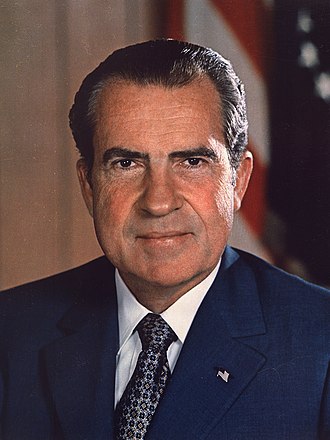
Richard M. Nixon served as the 37th President of the United States from January 1969 until his resignation in August 1974. In February 1971, he ordered the installation of a secret voice-activated taping system in the White House to preserve a historical record of his administration. Until the system's existence was revealed and dismantled in July 1973, the tapes captured Nixon directing major foreign policy initiatives, such as the opening to China, as well as his central role in the Watergate cover-up.
What Nixon talks about on the tapes
White House operations 4,718Presidential scheduling 2,225Public relations 1,784Presidential schedule 1,782Vietnam War 1,693Logistics 1,650Manolo Sanchez 1,626White House communications 1,400White House administration 1,399Presidential communication 1,243Henry Kissinger 1,191Foreign Policy 1,183
Conversations (21,010)
— Page 68 of 211President Nixon and Clark MacGregor discussed the legislative status of the Economic Stabilization Act and the prospects for concluding the current congressional session. They specifically addressed the potential need for an extended session due to ongoing negotiations, as well as reaction to recent administration statements regarding tax legislation. The participants evaluated the progress of these economic measures in the Senate and House to determine the timeline for adjournment.
President Nixon met with Alexander P. Butterfield, Rose Mary Woods, and Stephen B. Bull to discuss administrative logistics and personnel appointments. The conversation addressed the potential reassignment of Roger E. Johnson and evaluated various candidates for U.S. ambassadorial positions in Spain and Argentina. Additionally, the group touched upon the President’s upcoming schedule, including media appearances and his recognition as Time’s "Man of the Year."
President Nixon met with Charles Colson, Henry Kissinger, and H.R. Haldeman to discuss political strategy, economic reports, and foreign policy developments. The group reviewed Kissinger's recent press conference performance regarding upcoming summits, evaluated the political risks of the Indo-Pakistan conflict, and critiqued Secretary of State William P. Rogers's perceived lack of loyalty and effectiveness. Ultimately, the discussion focused on managing domestic political optics, including the manipulation of media narratives to discredit opponents and the careful coordination of foreign policy to protect the President’s initiatives.
President Nixon and H. R. Haldeman briefly conferred regarding the review process for a draft of an upcoming speech. The conversation specifically addressed John D. Ehrlichman's role in the drafting process and established that the President would conduct his own final review of the document the following day. This exchange served to coordinate administrative oversight of the speechwriting schedule.
President Nixon met with H. R. Haldeman and Alexander Butterfield to coordinate his upcoming schedule, specifically balancing personal travel to Florida and California with critical diplomatic and legislative demands. The discussion focused on managing the State of the Union timing in the face of potential Congressional conflicts and strictly curtailing foreign visitor meetings to prioritize administrative focus. Nixon also outlined a long-term strategic timeline for 1972, emphasizing the necessity of clearing his calendar for major diplomatic initiatives, including his upcoming trips to the People's Republic of China and the USSR.
President Nixon met with his personal valet, Manolo Sanchez, in the Oval Office to address administrative logistics. Their discussion centered on the President's upcoming daily schedule and the delivery of specific items. The meeting concluded with the coordination of personnel arrivals, reflecting the routine management of the President's workspace.
President Nixon met with H.R. Haldeman, Henry Kissinger, and other staff to coordinate his upcoming trip to Chicago, address legislative priorities, and discuss sensitive foreign policy matters. The group strategized on managing tax bill negotiations with Wilbur Mills, navigating the political implications of campaign finance legislation, and handling diplomatic tensions regarding the European Security Conference and an upcoming meeting with Golda Meir. Additionally, they reviewed personnel changes involving Arthur Fletcher and confirmed the cancellation of Billy Graham's planned trip to Taiwan.
President Nixon and the National Security Council met to coordinate U.S. strategy regarding European security, specifically focusing on the upcoming ministerial meetings in Brussels and the push for Mutual and Balanced Force Reduction (MBFR) talks. Participants discussed the complexities of navigating negotiations with Soviet counterparts, managing the varying interests of NATO allies, and addressing the political pressures surrounding troop levels and defense burden-sharing. The conversation concluded with a consensus on the need to maintain a unified diplomatic front while carefully managing the timing and scope of potential force reductions.
President Nixon initiates a call to Congressman James Harvey of Michigan through the White House operator. This brief exchange serves as a logistical bridge to facilitate direct communication between the President and the Representative. No further discussion occurs during this segment as the operator proceeds to place the requested call.
President Nixon, Henry Kissinger, and William Rogers met to coordinate strategy ahead of an upcoming visit from Israeli Prime Minister Golda Meir, specifically focusing on maintaining regional military balances and encouraging diplomatic negotiations. The participants agreed that the U.S. must provide security assurances and potential future arms deliveries to Israel without creating public, provocative announcements that could derail peace efforts. Additionally, the group discussed the timing of a future European Security Conference and potential summitry with the Soviet Union, as well as managing international monetary policy and high-level diplomatic scheduling regarding Italy, Canada, and China.
President Richard M. Nixon met with Alexander P. Butterfield to discuss adjustments to the President's daily schedule. The brief meeting, which also involved Stephen B. Bull, focused on logistical arrangements for upcoming appointments. No further substantive policy matters were recorded during this brief administrative exchange.
President Nixon met with aides Stephen B. Bull and Alexander P. Butterfield to coordinate scheduling for upcoming appointments. The discussion focused on managing the President's interactions with Congressional candidates and local political figures, including a representative from the Kentucky State Sheriff's office. The group reviewed these meeting logistics to ensure proper protocol for the visitors.
President Nixon met with Representative Richard W. Mallary, Raymond H. Nutter, Harry S. Dent, and Alexander P. Butterfield for a brief meeting in the Oval Office. A White House photographer was present at the commencement of the session to document the encounter. The entirety of the recorded discussion is classified as a personal returnable item, and no substantive details or policy decisions were preserved for the public record.
President Richard M. Nixon met with his aide Stephen B. Bull in the Oval Office to coordinate administrative matters regarding the President's daily schedule. The primary focus of the brief discussion was facilitating an upcoming meeting between the President and John D. Ehrlichman. The session concluded with Bull departing to carry out these scheduling arrangements.
President Nixon met with H. R. Haldeman and John Ehrlichman to discuss strategy for the upcoming White House Conference on Aging, emphasizing the administration's stance on fiscal responsibility and the benefits of H.R. 1 for older citizens. The participants evaluated speech drafts, reviewed potential political opposition from figures like Edmund Muskie regarding property taxes, and planned the President’s upcoming media appearances, including a television special. Additionally, they coordinated the President's interactions with Congressional leadership, ultimately deciding to prioritize smaller, more productive meetings with House leaders over broader, less effective sessions with Senate counterparts.
President Nixon and Representative James Harvey discussed the status of pending election reform legislation, focusing specifically on amendments and the implications of the Section 315 compromise. The conversation centered on coordinating congressional support and leveraging administration figures, including Vice President Spiro Agnew and various cabinet members, to advance the White House’s legislative agenda. Nixon sought to ensure the administration remained informed and strategic regarding emerging proposals, such as the network television time initiatives and check-off provisions promoted by John Anderson and others.
President Nixon initiates a call to Congressman Clarence J. Brown of Ohio through the White House operator. The conversation serves as a brief administrative coordination to facilitate direct communication between the President and the Representative. No substantive policy matters are discussed during this connection process.
President Nixon and Representative Clarence J. Brown discussed the status of election reform legislation and associated campaign finance provisions, specifically focusing on the upcoming conference committee. They emphasized the importance of maintaining a unified House position regarding Section 315 to prevent unfavorable Senate-driven changes. The President also expressed concerns regarding the 'campaign check-off' provision in the Tax Bill, highlighting potential risks related to political partisanship, the proliferation of minor parties, and the broader implications of using public funds for campaign financing.
President Nixon and Representative Clarence J. Brown discuss political campaign financing and the potential negative consequences of public funding systems. Nixon argues that moving away from individual campaign contributions—which he associates with responsible civic engagement—toward a system of government-funded or "painless" taxation could embolden candidates to act irresponsibly. The conversation highlights their shared concern that decoupling candidates from the traditional financial stakes of donors would diminish political accountability.
President Nixon held a brief, informal meeting in the Oval Office with unidentified individual(s). The dialogue is highly fragmentary, consisting primarily of casual pleasantries and ambiguous remarks regarding beverages. Due to the lack of substantive content, no specific policy decisions or significant administrative actions were recorded during this encounter.
President Nixon held an informal meeting in the Oval Office with his personal valet, Manolo Sanchez. The interaction was primarily personal in nature, as indicated by the withdrawal of sensitive material classified as a personal returnable. No significant policy discussions or official administrative decisions occurred during this brief encounter.
President Nixon and Alexander P. Butterfield held a brief meeting in the Oval Office to address administrative or scheduling logistics. The discussion remains largely unintelligible due to poor audio quality, providing no substantive record of policy decisions. Consequently, the meeting resulted in no documented outcomes or formal action items.
President Nixon met with Alexander P. Butterfield and Rose Mary Woods to coordinate logistical arrangements for an upcoming trip to Chicago. The participants reviewed scheduling details, specifically focusing on the preparation of materials and the selection of academics and former ambassadors for meetings. They also discussed administrative matters regarding potential media appearances and ongoing negotiations involving financial interests.
President Nixon consulted with his close friend Bebe Rebozo regarding potential travel plans to Florida and his upcoming meeting with Israeli Prime Minister Golda Meir to discuss the provision of Phantom jets. The two men also discussed congressional developments surrounding a tax bill and the potential for a presidential veto regarding a campaign check-off provision. Additionally, they reviewed recent media coverage concerning a shopping event attended by Pat Nixon and Julie Nixon Eisenhower.
President Nixon instructed the White House operator to place an outgoing call to his Chief of Staff, H. R. Haldeman. This brief interaction served solely to facilitate official communication between the President and his top aide. No further substantive policy matters or decisions were discussed during this brief connection.
President Nixon initiates a brief telephonic administrative exchange with the White House operator to verify the availability of key staff members. After confirming that H.R. Haldeman has not yet returned to his residence, the President redirects the request to speak with Charles W. Colson. This communication serves as a logistical coordination effort to facilitate a high-priority contact.
President Nixon and H. R. Haldeman coordinated the President's upcoming travel schedule, specifically weighing potential trips to Florida and Camp David while considering press logistics and weather reports from Charles "Bebe" Rebozo. The conversation also addressed the status of a speech on economic policy and Phase II wage-price controls, including the involvement of John D. Ehrlichman in drafting. Furthermore, the two discussed legislative coordination with Clark MacGregor regarding the status of pending tax legislation.
President Nixon and Charles Colson reviewed current economic conditions, focusing on the volatile stock market and the administration's efforts to influence public and business sentiment regarding the New Economic Policy. They discussed legislative strategy for an upcoming tax bill, including potential veto options and the need to secure support from key congressional leaders and business figures. Additionally, they touched upon labor relations, specifically managing invitations to a State Dinner to maintain political leverage with labor unions.
President Nixon contacted the White House operator to facilitate an outgoing call to his close friend and confidant, Charles G. “Bebe” Rebozo. The brief exchange served strictly as a logistical request for the operator to connect the President to Rebozo. No further substantive policy matters or decisions were discussed during this brief administrative interaction.
President Nixon consulted with his close friend Bebe Rebozo to secure a Florida weather forecast for the following day. The brief exchange served to facilitate logistical planning for the President's upcoming travel arrangements. Following the update, Nixon requested that the information be relayed to his personal aide, Manolo Sanchez.
President Nixon instructed the White House operator to place a telephone call to John D. Ehrlichman. The brief exchange served solely to facilitate communication between the President and his Assistant for Domestic Affairs. No further policy discussions or substantive developments occurred during this brief interaction.
President Nixon and John Ehrlichman consulted regarding the President's upcoming address to the Second Decennial White House Conference on Aging. Their discussion focused on refining specific policy positions, particularly those involving Medicare, prescription drug provisions, and property tax reforms. The two finalized language for the speech, addressing concerns regarding budget constraints and the role of the Domestic Council in managing conference proposals.
President Nixon consulted with his close confidant Bebe Rebozo regarding the logistics of an upcoming trip to Florida. The discussion focused on coordinating the President's travel schedule with local weather conditions, specifically monitoring wind, temperature, and rain forecasts for December 4. No major policy decisions were made during this brief planning call.
President Nixon consulted with John D. Ehrlichman to prepare for his upcoming address to the Second Decennial White House Conference on Aging. The discussion focused on managing policy expectations regarding Medicare prescription drug coverage and income floor acceleration under H.R. 1, given the significant budget constraints facing the administration. They specifically addressed the role of Arthur S. Flemming and the Domestic Council in navigating these complex fiscal challenges and conference resolutions.
President Nixon initiated a brief telephone request for the White House operator to connect him with his Chief of Staff, H.R. Haldeman. This exchange served as a routine administrative step to facilitate a direct conversation between the President and his key advisor. No substantive policy matters were discussed during this brief connection process.
President Nixon consulted with H. R. Haldeman regarding the status of pending tax legislation and its impact on his scheduled trip to Florida. The discussion focused on complex congressional negotiations, specifically the campaign check-off provision and the potential for the tax bill to face defeat in the House of Representatives. Haldeman provided updates on legislative progress involving figures such as Wilbur D. Mills and Clark MacGregor, while also addressing broader concerns regarding the India-Pakistan conflict and other active congressional conferences.
President Nixon and H. R. Haldeman discuss administrative updates regarding upcoming budget meetings and travel to Florida, as well as the status of tax legislation and campaign reform. A significant portion of the conversation is dedicated to Nixon’s dissatisfaction with the performance of his speechwriting staff, specifically Raymond Price and others. The President expresses a desire to refine his communication style and directs Haldeman to restructure staff responsibilities to ensure that speech drafts better capture his personal voice rather than the generic, bureaucratic style he associates with the Eisenhower era.
President Nixon requested that the White House operator facilitate a call to Senator Wallace F. Bennett. The operator informed the President that Senator Bennett was currently hospitalized and provided the necessary contact information for his room. This brief administrative interaction concluded with the President confirming the phone number to reach the Senator.
President Nixon met with Stephen B. Bull and Manolo Sanchez to coordinate his daily agenda and prepare for an upcoming meeting with Henry Kissinger. The participants briefly discussed administrative scheduling and logistical details regarding the President's personal affairs, including the behavior of his dogs during a potential trip to Florida. The exchange focused primarily on managing the President's time and ensuring that his upcoming engagement with Kissinger proceeded as requested.
President Nixon met with Henry Kissinger and H. R. Haldeman to coordinate foreign and domestic policy priorities. Key discussions included managing Middle East negotiations ahead of the upcoming U.S.-USSR summit, finalizing the appointment of David M. Kennedy as Ambassador to NATO, and addressing administrative failures regarding trade licenses for India. Nixon also emphasized his desire to bypass the establishment in his diplomatic efforts, specifically regarding the opening of relations with the People's Republic of China, while coordinating appearances to maintain support for his economic policies.
President Nixon consulted with the White House operator to facilitate a phone call to an individual who was reportedly ill and potentially hospitalized. The operator provided the President with a specific contact number and room location for the party. This brief interaction served solely to coordinate the placement of a private or official call.
President Nixon initiated a brief telephone call with Frances Bennett to inquire about the medical status of her husband, Senator Wallace F. Bennett. The conversation focused on the Senator’s recent surgery and his ongoing recovery progress. No significant policy decisions were made, as the exchange served primarily as a gesture of personal concern regarding the Senator's health.
President Nixon met briefly with Frances Bennett to inquire about the health of her husband, Senator Wallace F. Bennett, who was hospitalized due to an ulcer. Expressing a personal and political need for the Senator's return to work, Nixon offered words of encouragement regarding his recovery. The discussion served as a gesture of support during the Senator's medical absence.
President Nixon, Rose Mary Woods, and Stephen B. Bull met to coordinate the President's upcoming travel schedule and discuss various administrative logistics. The conversation included planning for a dinner with Canadian Prime Minister Pierre Trudeau, reviewing Rose Mary Woods' personal schedule, and evaluating potential staff roles for Robert L. King. Additionally, the President briefly addressed a tax-related inquiry from Clark MacGregor during the session.
President Nixon and Clark MacGregor met to discuss the legislative strategy for the tax bill currently stalled in conference, specifically focusing on the controversial political campaign "check-off" provision. Nixon maintained a firm stance against the check-off on principle, ultimately deciding that he would oppose any version of it, request its repeal in the next legislative session, and veto any associated appropriation bills. Additionally, the pair briefly discussed administrative actions to support corn prices and noted the declining health of George Meany.
President Nixon met with his aide Stephen B. Bull to address a telephone communication from his daughter, Tricia Nixon Cox. During the brief exchange, the two discussed a matter involving Clark MacGregor, a senior administration official. The meeting served as a quick briefing to ensure the President was kept informed regarding these personal and political inquiries.
President Nixon met with H.R. Haldeman, Clark MacGregor, and others to discuss key administrative and political matters, including the successful confirmation of Earl Butz as Secretary of Agriculture despite opposition, and the management of legislative issues such as the tax bill. The group also coordinated the President’s upcoming diplomatic schedule, the logistical handling of his planned trip to the People's Republic of China, and strategies for improving the quality and impact of presidential speeches. Finally, Rose Mary Woods joined the President to review his personal schedule, correspondence, and various staffing concerns.
President Nixon contacted the White House operator to facilitate a personal phone call to his daughter, Tricia Nixon Cox. The brief exchange served as a directive for the operator to initiate the connection. No policy matters or substantive political business were discussed during this brief administrative interaction.
President Nixon consulted with the White House operator to facilitate communication with his daughter, Tricia Nixon Cox. Upon learning that she was unavailable until late afternoon, the President confirmed that he had left a message for her with her security detail. The brief exchange served solely as an administrative coordination of a personal call.
President Nixon contacted the White House operator to request a telephone connection with Special Counsel Charles W. Colson. This brief administrative interaction served as the necessary logistical step to facilitate a private discussion between the President and his advisor. No substantive policy matters were discussed during this brief request for assistance.
President Nixon consulted with a White House operator to facilitate an outgoing call. The brief exchange focused on establishing a connection with a specific, yet unnamed, individual. No substantive policy discussions occurred during this brief administrative interaction.
President Nixon and Press Secretary Ronald Ziegler coordinated public relations strategies regarding upcoming administration events, including a Business Council meeting and an appearance by Assistant Secretary of Labor Arthur Fletcher. They finalized plans for press coverage and photo opportunities, weighing the necessity of multiple media appearances against the risk of overexposure. Nixon ultimately approved the proposed schedule, trusting that the distinct nature of each event would prevent negative overlap in media coverage.
President Nixon and Charles Colson discussed the administration's strategic response to rising unemployment statistics, specifically planning how to address potential political criticism from figures like Lawrence F. O'Brien. They reviewed current labor data, including coordination with Secretary of Labor James D. Hodgson, and evaluated the potential for personnel reassignments within the Bureau of Labor Statistics and the Council of Economic Advisers. The conversation also touched on various logistical matters, including scheduling and legislative issues such as the campaign check-off veto.
President Nixon and Charles Colson discuss legislative strategy regarding tax policy and potential Senate opposition. Nixon outlines a plan to maintain a firm public stance against unfavorable tax legislation, suggesting that if it passes, he will signal his disapproval and commit to seeking its repeal in the upcoming legislative session. The conversation reflects the administration's focus on managing political optics and controlling the economic agenda heading into the 1972 election year.
President Nixon met with his aide Stephen B. Bull in the Oval Office to conduct a brief review of the President's daily schedule. The primary focus of the discussion was the President's upcoming meeting with Gordon M. Metcalf. Bull concluded the meeting by departing immediately following this coordination.
President Nixon met with retail executives Gordon Metcalf and William Batten, along with George Shultz and other staff, to review economic performance, retail sales trends, and the potential impact of wage-price controls. The discussion shifted toward the American political system, specifically addressing the President’s staunch opposition to tax-funded political campaign check-offs. Nixon expressed his intent to leverage his veto power if necessary to prevent the inclusion of these campaign financing provisions in pending tax legislation.
In this meeting, President Nixon first met with Arthur A. Fletcher and Kenneth R. Cole, Jr. to discuss the promotion of an economic development initiative aimed at supporting schools and securing campaign funding for the 1972 election. Following a brief photo opportunity, Henry A. Kissinger joined the President to address diplomatic frustrations regarding the State Department's resistance to executive directives concerning the conflict between India and Pakistan. The two concluded that the President would reassert his authority to ensure that his administration's policy, which favored a less pro-Indian stance, was implemented without further bureaucratic obstruction.
President Nixon met briefly with his aide, Stephen B. Bull, to coordinate logistics or preparations for an upcoming meeting with Israeli Prime Minister Golda Meir. The conversation was limited in scope, serving primarily to facilitate executive scheduling and engagement with the Israeli leadership. No further substantive policy decisions were recorded during this one-minute encounter.
President Nixon met with Israeli Prime Minister Golda Meir, Henry Kissinger, and Yitzhak Rabin to discuss the status of U.S.-Israel relations and the ongoing Middle East peace process. The discussion focused on military support, specifically the delivery of Phantom aircraft, while balancing Israel's security needs against the diplomatic necessity of exploring political negotiations. Nixon reassured Meir of the U.S. commitment to maintaining a military balance in the region and outlined a strategy to pursue both military preparedness and diplomatic outreach simultaneously.
President Nixon met briefly with an unidentified individual in the Oval Office to discuss scheduling matters. The interaction was brief, lasting less than two minutes, and primarily consisted of logistical exchanges regarding the President's calendar. Due to poor audio quality and limited recorded dialogue, no substantive policy decisions or political developments were captured.
President Nixon and Henry Kissinger discussed complex diplomatic strategies regarding the Middle East, focusing on the implications of recent negotiations with Israeli Prime Minister Golda Meir and the necessity of managing US-USSR-PRC relations. They strategized on how to stall formal settlement processes until at least 1973 to avoid political fallout and potential conflicts while maintaining the balance of power. Additionally, the conversation touched upon personnel matters, including the potential appointment of David M. Kennedy and the handling of the ongoing India-Pakistan crisis.
President Nixon hosted a large gathering in the Oval Office, including Secretary of Agriculture Earl Butz, several members of Congress, and various agricultural officials, to discuss the state of the American agricultural sector. The President highlighted the efficiency of American farmers and the affordability of food for domestic consumers as a significant national achievement. The meeting served as a public relations event to underscore the importance of agriculture to the nation's overall well-being and to reinforce support for administration policies.
President Nixon contacted the White House operator to facilitate a telephone connection. The primary purpose of this brief exchange was to place a call to his personal secretary, Rose Mary Woods. The conversation served solely as a logistical request for administrative assistance.
President Nixon and Rose Mary Woods discussed the arrangements for First Lady Pat Nixon’s attendance at an upcoming funeral and planned for the President’s scheduled NBC filming the following day. The majority of the conversation focused on finalizing the guest list and seating capacity for a White House dinner featuring international monetary discussions, specifically resolving conflicts regarding the inclusion of George Shultz and the removal of Peter Flanigan or Dr. Edward David. Nixon directed Woods to prioritize Shultz due to his role in economic negotiations and instructed her to handle the diplomatic adjustment of the guest list.
President Nixon instructed the White House operator to place an outgoing telephone call to Senator Strom Thurmond. This brief interaction served as a logistical step to facilitate direct communication between the President and the Senator. No further substantive policy matters were discussed during this specific exchange.
President Nixon called Senator Strom Thurmond to extend birthday greetings and invite the Senator and his wife, Nancy, to visit the Oval Office. During the call, they arranged a photo opportunity to include the First Lady, Pat Nixon, at the White House. The participants agreed to schedule the visit and the photograph for the following Tuesday at noon.
President Nixon initiates a request for the White House operator to place a telephone call to Secretary of State William P. Rogers. This brief administrative interaction serves as a logistical bridge to facilitate an upcoming direct consultation between the President and the Secretary. No substantive policy discussions occur during this specific segment of the communication.
President Nixon and Secretary of State William P. Rogers discussed the ongoing India-Pakistan War, focusing on the deadlock at the UN Security Council and the deteriorating military situation in East Pakistan. The President reaffirmed the U.S. demand for a mutual withdrawal of forces as a condition for any resolution. They also coordinated the logistics for an upcoming high-level meeting at the Executive Office Building and scheduled follow-up communications with Ambassador George H.W. Bush.
President Nixon contacted the White House operator to place a direct call to National Security Advisor Henry A. Kissinger. This brief interaction served solely as an administrative bridge to initiate a private consultation between the two men. No substantive policy matters were discussed during this request.
President Nixon initiates a brief telephone request for the White House operator to connect him with Charles W. Colson. The interaction serves exclusively as an administrative instruction to facilitate communication with a key staff member. No substantive political or policy discussions occur during this short exchange.
President Nixon consulted with the White House operator to facilitate communications with his staff. After failing to reach Henry Kissinger at his residence, the President instructed the operator to abandon the attempt. The conversation concluded with the operator confirming that Charles W. Colson was available on the line for the President.
President Nixon and Charles Colson reviewed the administration's recent successes, including favorable press coverage for Vice President Agnew and progress on economic and legislative goals. They discussed strategy regarding the ongoing India-Pakistan War, the political vulnerability of Democrats, and optimistic economic indicators provided by Albert Sindlinger. Finally, they assessed upcoming challenges in Congress, specifically focusing on the confirmation of Supreme Court nominees and the battle to pass foreign aid legislation.
President Nixon initiates a request to the White House operator to place a telephone call to Secretary of State William P. Rogers. This brief exchange serves as a logistical coordination to facilitate direct communication between the President and his chief diplomat. No substantive policy matters were discussed during this connection beyond the placement of the call.
President Nixon met with an unidentified individual in the Oval Office to briefly review his daily schedule. The discussion remained focused on logistical planning and the management of the President's upcoming appointments. No significant policy decisions or substantive actions were recorded during this short encounter.
President Nixon held a brief communication with the White House operator to facilitate an outgoing call. This interaction served a purely administrative purpose to connect the President with another party. No substantive policy discussions or decision-making processes were recorded during this brief exchange.
President Nixon met with his aide Stephen B. Bull to review and finalize his upcoming daily schedule. The primary focus of the brief discussion was confirming an appointment with National Security Advisor Henry A. Kissinger. No other substantive policy matters were recorded during this brief administrative check-in.
President Nixon met with his valet, Manolo Sanchez, to receive a personal item Sanchez had retrieved following a previous engagement. The brief exchange confirms the fulfillment of a prior promise made by the President regarding the recovery of this object. No substantive policy matters or major political decisions were addressed during this short interaction.
President Nixon and Secretary of State William P. Rogers discussed the feedback from a legislative breakfast regarding the ongoing conflict between India and Pakistan. Rogers reported that Senate leaders Mike Mansfield and Hugh Scott advocated for a neutral U.S. position and noted that Congress would likely oppose further foreign aid to nations ignoring UN resolutions. The President instructed Rogers to follow up with these leaders later that day to provide a briefing on the situation and also discussed the upcoming favorable Senate confirmation votes for Supreme Court nominees Lewis F. Powell, Jr. and William H. Rehnquist.
President Nixon and Secretary of State William P. Rogers discuss the administration's legislative strategy following a breakfast meeting with congressional leaders. The conversation focuses on congressional support for the U.S. position at the United Nations regarding the Indo-Pakistani conflict. Nixon directs Rogers to follow up with House leaders after 4:00 pm to coordinate efforts on an upcoming vote.
President Nixon directs the White House operator to place a telephone call to Secretary of State William P. Rogers. This brief exchange functions as a logistical instruction to facilitate direct communication between the President and his chief diplomat. No policy matters are discussed, as the conversation is limited to the operator's administrative task of connecting the two parties.
President Nixon, Henry Kissinger, and various senior advisors met to discuss the escalating India-Pakistan conflict, focusing on the potential for a U.N. ceasefire, the status of American civilians, and the management of regional military actions. Concurrently, the President consulted with George H.W. Bush regarding U.N. strategy and coordinated with John Ehrlichman and Vice President Agnew on domestic legislative priorities, specifically tax bills and revenue sharing. The President also spoke with Wilbur Mills to foster a spirit of cooperation between the Administration and Congress regarding economic and tax legislation, emphasizing the need for a unified approach to ensure key bills advance.
President Nixon and Secretary of State William P. Rogers discuss the administration's strategy for managing congressional and public perceptions regarding the escalating India-Pakistan War. Nixon emphasizes the importance of highlighting the administration’s humanitarian record and maintaining strict neutrality to avoid domestic political fallout. They agree that Rogers will hold a limited briefing for key senators to keep them informed without escalating the situation into a perceived crisis, and Nixon encourages Rogers to attend the upcoming NATO meeting despite the regional conflict.
President Nixon attempted to initiate an outgoing telephone call that failed to reach the intended party. The recording captures brief administrative interaction with an unknown individual, likely a White House operator, regarding the unsuccessful connection attempt. No substantive policy discussions or decisions occurred during this brief exchange.
President Nixon, Henry Kissinger, and UN Ambassador George H.W. Bush discuss U.S. strategy regarding the ongoing India-Pakistan War at the United Nations. The President directs Bush to aggressively pursue a UN Security Council resolution demanding an immediate ceasefire and withdrawal, insisting that a political settlement must be secondary to stopping the fighting. Nixon also authorizes Bush to take the issue to the General Assembly to build public pressure and instructs him to forcefully counter any domestic political misrepresentations of the administration's position.
President Nixon initiates a request for the White House operator to place a telephone call to Congressman Wilbur D. Mills. While the specific nature of the discussion is not preserved in this brief segment, the communication indicates an attempt to establish direct contact with the influential Chairman of the House Ways and Means Committee. This interaction highlights the President's ongoing efforts to engage with congressional leadership on legislative matters.
President Nixon initiated this call to Chairman Wilbur Mills to reassure him of the administration's support following negative press coverage regarding recent tax bill compromises. The two leaders discussed strategies to foster cooperation between the White House and the Ways and Means Committee, specifically focusing on the financial relief provided to cities and counties through H.R. 1 and proposed health programs. They also coordinated legislative strategy for revenue sharing and potential Senate opposition, with Nixon emphasizing his commitment to working closely with Mills to avoid unnecessary confrontations.
President Nixon initiates a call through the White House operator to reach Romana A. Banuelos, the Treasurer of the United States. The exchange focuses on administrative coordination to establish communication with Banuelos. No substantive policy matters are addressed in this brief logistical recording.
President Nixon met with an unidentified individual in the Oval Office to discuss the status of an ongoing task and coordinate the President's upcoming schedule. The participants briefly addressed time management constraints regarding the completion of the assignment and a potential diplomatic engagement. The meeting concluded when the unidentified man departed to accommodate these scheduling requirements.
President Nixon and Stephen B. Bull met to coordinate scheduling matters, specifically focusing on the logistics for an upcoming appointment with Romana A. Banuelos. The President reviewed his calendar, which included arrangements for meetings with John B. Connally and Henry Kissinger, as well as the potential presence of Julie Nixon Eisenhower at the Executive Office Building. Additionally, Nixon acknowledged the 50th career anniversary of journalist Willard Edwards and coordinated the details for Rose Mary Woods to host him for lunch.
President Nixon and Henry Kissinger discussed strategies to support West Pakistan during the Indo-Pakistani War, including authorizing a back-channel request for the Shah of Iran to provide military aid in exchange for future U.S. compensation. They finalized plans to announce an $86.8 million aid cutoff to India while ensuring humanitarian assistance to Pakistan remained unaffected. Additionally, the President reviewed scheduling logistics for an upcoming meeting with John B. Connally and addressed concerns regarding potential Soviet interference in the conflict.
President Nixon met with John B. Connally and Henry A. Kissinger to coordinate strategy regarding the Group of Ten international monetary negotiations and the escalating India-Pakistan crisis. Connally briefed the President on the difficulty of securing trade and currency realignment concessions from foreign nations, specifically noting Canada's resistance to multilateral solutions. Simultaneously, Nixon and his advisors discussed cutting off U.S. aid to India in response to its aggression toward Pakistan, ultimately deciding to formalize this shift in foreign policy.
President Nixon telephoned Romana A. Banuelos to congratulate her on her unanimous Senate confirmation as Treasurer of the United States. During the brief call, Nixon expressed his confidence in her leadership and pride in her California background. Secretary of the Treasury John B. Connally also participated in the exchange to personally convey his congratulations and welcome her to the department.
President Nixon directed the White House operator to place an outgoing call to Senator Milton R. Young of North Dakota. This administrative request initiated the process of establishing contact between the President and the Senator for legislative or political consultation. The exchange served as a routine logistical step in the President's daily communication efforts.
President Nixon communicated with the White House operator to facilitate contact with Senator Milton R. Young. The operator informed the President that the Senator was currently at lunch and committed to delivering the message through his office staff. This brief exchange reflects standard administrative procedures for managing presidential communications with members of Congress.
President Nixon met with his personal valet, Manolo Sanchez, to discuss upcoming scheduling arrangements. During this brief encounter, the President signaled his intention to step away from his duties to focus on personal rest and recuperation. The conversation primarily served to coordinate these private plans and ensure the President would be undisturbed for a period.
President Nixon met with Stephen B. Bull in the Oval Office to coordinate his immediate daily schedule, specifically regarding an upcoming bill signing and a telephone call to Alexander P. Butterfield. The brief discussion touched on administrative logistics and the involvement of Rose Mary Woods. The interaction concluded with preparations for a secondary conversation involving an unknown participant.
President Nixon and Alexander Butterfield met to coordinate administrative logistics regarding upcoming visitor protocols, ambassadorial nominations, and executive scheduling. Nixon issued specific directives to curb unnecessary gift exchanges and redundant photograph distributions for White House guests. The discussion also addressed the status of specific diplomatic nominations and confirmed the protocol for providing gifts to Portuguese representatives.
President Nixon met with Senator Milton R. Young and journalist Willard Edwards to discuss various administrative tasks, including sending congratulatory notes and certificates of recognition to citizens for heroic acts. The participants reviewed personal correspondence and discussed arrangements for upcoming holiday observances. Additionally, the President took time to recognize Willard Edwards for his long-standing career in journalism, marking his professional longevity with a birthday acknowledgment.
President Nixon placed a brief telephone call to Senator Milton R. Young to extend personal birthday greetings. During the exchange, the President acknowledged the Senator’s significant legislative contributions, specifically highlighting his dedicated work on the Senate Appropriations Committee. The conversation served primarily as a gesture of political rapport and goodwill between the two men.
President Nixon initiates a request through the White House operator to be connected with his daughter, Tricia Nixon Cox. This brief administrative interaction serves solely to facilitate a personal phone call. No other political, governmental, or policy-related matters were discussed during this exchange.