Nixon, Richard M. (President)
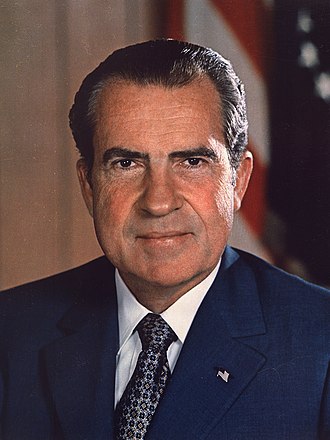
Richard M. Nixon served as the 37th President of the United States from January 1969 until his resignation in August 1974. In February 1971, he ordered the installation of a secret voice-activated taping system in the White House to preserve a historical record of his administration. Until the system's existence was revealed and dismantled in July 1973, the tapes captured Nixon directing major foreign policy initiatives, such as the opening to China, as well as his central role in the Watergate cover-up.
What Nixon talks about on the tapes
White House operations 4,718Presidential scheduling 2,225Public relations 1,784Presidential schedule 1,782Vietnam War 1,693Logistics 1,650Manolo Sanchez 1,626White House communications 1,400White House administration 1,399Presidential communication 1,243Henry Kissinger 1,191Foreign Policy 1,183
Conversations (21,010)
— Page 70 of 211President Nixon met with John Mitchell and Henry Kissinger to discuss two distinct issues: the potential commutation of Jimmy Hoffa's prison sentence and the escalating India-Pakistan war. Regarding Hoffa, the President sought a strategy to secure his release while minimizing political fallout, focusing on coordination with union leadership and managing public perception. The conversation shifted to the South Asian crisis, where Nixon and Kissinger expressed deep frustration with the State Department's perceived bureaucratic delays in enforcing sanctions against India. Consequently, Nixon directed his advisors to prepare aggressive diplomatic and military options to deter Indian aggression and mitigate the influence of Soviet-aligned forces in the region.
President Nixon met with an unidentified individual in the Old Executive Office Building to briefly coordinate scheduling logistics. The discussion centered on confirming travel timelines and adjusting the President's upcoming availability. The participants reached a consensus to allow a brief period for the President to return before reconvening.
President Nixon communicated briefly with the White House operator to facilitate an outgoing call. The exchange served as a logistical step to connect the President with an additional party. No substantive policy matters or administrative decisions were documented during this short interaction.
President Nixon met with an unknown individual, likely a staff member or aide, to briefly address a specific logistical request regarding the President's schedule. The primary focus of the discussion was the procurement of a chair for an upcoming meeting with John D. Ehrlichman. The interaction concluded quickly after the President issued this instruction.
President Nixon directs Charles Colson to coordinate the release of Jimmy Hoffa through a commutation of sentence handled by Attorney General John Mitchell, rather than the parole board. Nixon instructs Colson to manage the expectations of labor leader Frank Fitzsimmons by channeling all future communications through Mitchell. Additionally, the pair discusses the health of George Meany and an attempt by Meany's associates to mend relations following recent public criticisms of the administration.
President Nixon and Charles Colson discuss the management of sensitive political assignments and the coordination of communications with Attorney General John Mitchell. They focus on ensuring that Petro acts as the primary point of contact for specific objectives while maintaining discretion regarding the President's personal involvement. Additionally, the conversation touches upon the health of an individual named Keene and the importance of professional handling of these administrative matters.
President Nixon contacted the White House operator to request a telephone connection with First Lady Pat Nixon. The brief interaction served solely as a functional bridge to facilitate a private conversation between the President and his wife. No policy matters or significant administrative decisions were discussed during this exchange.
President Nixon and his personal secretary Rose Mary Woods briefly coordinated his schedule regarding upcoming appointments and personal commitments. The discussion centered on an upcoming dinner with First Lady Pat Nixon and a scheduled meeting with Dr. W. Kenneth Riland. No major policy decisions were made during this short administrative exchange.
President Nixon initiates a brief interaction with the White House operator from his office in the Old Executive Office Building. The conversation is largely non-substantive, consisting of a single exclamation from the President. No policy decisions, political strategy, or administrative actions are discussed during this short exchange.
President Nixon and First Lady Pat Nixon discussed adjustments to the President's evening schedule, specifically regarding dinner arrangements involving Rose Mary Woods and Dr. W. Kenneth Riland. The brief exchange focused on coordinating the logistics and timing of the President's upcoming social or personal commitments. No major policy decisions were reached, as the conversation was limited to private itinerary planning.
President Nixon and First Lady Pat Nixon coordinate their evening schedule to ensure a meeting takes place with Rose Mary Woods and a guest named Ben. The brief exchange confirms a 6:15 pm start time for this appointment. No other policy or political matters were addressed during this logistical check-in.
President Nixon instructed the White House operator to place an outgoing call to National Security Advisor Henry A. Kissinger. This brief interaction served as a logistical administrative step to facilitate a direct communication line between the President and his advisor. No substantive policy matters were discussed during this request.
President Nixon met with John D. Ehrlichman and George P. Shultz to coordinate administration strategy across a range of domestic and international issues. The discussion covered the upcoming veto of Office of Economic Opportunity legislation, fiscal planning and budgetary maneuvering to manage the national debt, and ongoing international monetary and trade negotiations. Additionally, the participants reviewed the President's upcoming travel schedule, personnel assignments, and positive media outreach, including strategic efforts to frame recent judicial appointments and economic policies in a favorable light.
President Nixon and Henry Kissinger discussed the escalating India-Pakistan War and its potential impact on U.S.-Soviet relations and the upcoming 1972 presidential election. The President expressed concern about the crisis jeopardizing the Moscow Summit and the Strategic Arms Limitation Talks, while Kissinger emphasized the need to prevent an Indian attack on West Pakistan. They further explored the possibility of leveraging military actions in North Vietnam to send a strategic message to both the Soviet Union and China regarding U.S. resolve.
President Nixon instructed the White House operator to place an outgoing telephone call to Mrs. Ralph Bunche in New York. The exchange served as a procedural request to facilitate communication between the President and the spouse of the recently deceased diplomat and United Nations official. No further policy discussions or significant political developments occurred during this brief administrative interaction.
President Nixon and his personal secretary, Rose Mary Woods, discuss the administrative details regarding the death of diplomat Ralph J. Bunche, including coordinating a presidential statement and a personal call to Ruth H. Bunche. Additionally, the pair reviews correspondence from Elmer H. Bobst and plans for the placement and display of a bust of Winston Churchill in the Oval Office. The meeting concludes with a brief logistical exchange involving a White House operator.
President Nixon telephoned Ruth A. Bunche to offer his condolences following the death of her husband, the renowned diplomat Ralph J. Bunche. During the call, the President reflected on Bunche’s character and their shared connection to California. Nixon concluded by assuring Mrs. Bunche that the White House would issue an appropriate formal statement to honor the late diplomat's contributions to global peace.
President Nixon met with Ruth Bunche to express his personal condolences and profound respect following the recent passing of her husband, the distinguished diplomat Ralph Bunche. The President recalled their shared connection through UCLA and lauded Ralph Bunche’s character and global contributions to peace. Nixon concluded the brief meeting by assuring Ruth Bunche that the administration would appropriately honor her husband’s legacy in official statements.
President Nixon contacted the White House operator to place an outgoing call to Congressman Charles R. Jonas of North Carolina. The conversation served primarily as a brief administrative request to facilitate communication with the Representative. No substantive policy discussions occurred during this brief exchange.
President Nixon met with his personal secretary, Rose Mary Woods, and personal aide, Manolo Sanchez, to discuss the decor and arrangement of the Oval Office. The group specifically focused on the placement and aesthetic style of an Abraham Lincoln bust within the room. No significant policy decisions were recorded during this informal administrative discussion.
President Nixon met with H.R. Haldeman, Ronald Ziegler, and Henry Kissinger to address administrative personnel matters, media relations, and pressing foreign policy crises. Ziegler and the President discussed managing network media expectations regarding interviews and the promotion of Christmas-themed specials featuring Julie Nixon Eisenhower. Concurrently, Kissinger briefed the President on the escalating India-Pakistan conflict, urging a hard-line stance against Indian aggression and recommending a diplomatic meeting with the Soviet Minister of Agriculture to signal U.S. dissatisfaction with Soviet conduct.
President Nixon consulted with the White House operator to facilitate a telephone connection with an unidentified individual. The brief interaction served as a logistical step to initiate an outgoing call from the Oval Office. No further details regarding the substance of the intended conversation were recorded.
President Nixon met with Brazilian President Emilio Garrastuzu Medici and Lt. Gen. Vernon A. Walters to discuss regional stability and intelligence cooperation in Latin America. The discussion focused on coordinating US-Brazil policies regarding the Organization of American States, managing potential threats from Cuba and Chile, and reviewing infrastructure projects like the Pan American Highway. The participants also established private communication channels and addressed the transition of Vernon Walters to the Central Intelligence Agency.
President Nixon met with Press Secretary Ronald Ziegler and Deputy Director of the CIA Vernon Walters to discuss sensitive intelligence matters. The conversation, which was almost entirely redacted for national security, focused on confidential briefing details and operational secrecy. Walters departed the Oval Office shortly after the discussion concluded.
President Nixon and Alexander P. Butterfield met to discuss the staffing transition of Christine Wilde, the secretary to Jon M. Huntsman. The conversation focused on her departure and the assessment of her professional qualifications for future placement. The President evaluated the timing for a potential meeting with Wilde as part of these personnel considerations.
President Nixon met with Christine Wilde, Jon M. Huntsman, and Alexander P. Butterfield for a brief logistical discussion regarding Wilde’s departure from the administration. The group addressed the timing of her exit and her transition to a new professional role. The meeting concluded with the President presenting Wilde with a parting gift, for which she expressed her gratitude.
President Nixon interacts briefly with the White House operator to facilitate communication. The exchange consists of the President abruptly refusing to speak to an unidentified individual. No substantive policy discussions or administrative actions occur during this brief interaction.
President Nixon met with his senior advisors, including H. R. Haldeman and Henry Kissinger, to address the escalating conflict between India and Pakistan and the internal friction regarding his administration's foreign policy bureaucracy. Concerned that Indian success could destabilize the region and undermine U.S. credibility, Nixon decided to take a firm stance by demanding that the State Department warn the Indian government against attacking West Pakistan. As a show of force, he directed the deployment of a naval task force to the Bay of Bengal under the guise of an evacuation mission. The President expressed deep frustration with the hesitation of his bureaucracy and explicitly ordered his team to carry out these directives with purpose and urgency.
President Nixon telephoned Representative Charles R. Jonas to extend birthday greetings and maintain political rapport. The conversation pivoted to the recent death of Willis Smith, Jr., a prominent supporter of the President, in a plane crash. Nixon committed to contacting the Smith family, including the grieving mother and widow, to offer his condolences for their loss.
President Nixon directed the White House operator to place a condolence call to Anna Lee Smith, the widow of former North Carolina Senator Willis Smith. The President sought to reach Mrs. Smith at her home following the recent death of her son in an automobile accident. He advised the operator to contact the office of Representative Charles R. Jonas to obtain the necessary telephone information for connecting the call.
President Nixon placed a telephone call to Anna Lee Smith to offer his and the First Lady's condolences following the tragic death of her son, Willis Smith, Jr., in a private airplane accident. During the brief conversation, Nixon reminisced about the younger Smith’s contributions to his 1968 presidential campaign and his character. The President concluded the call by offering encouragement to Mrs. Smith as she navigated the sudden loss.
President Nixon initiated a brief telephone request to the White House operator to be connected with Congressman Wilbur D. Mills. The conversation served as a logistical step to facilitate direct communication between the President and the influential Chairman of the House Ways and Means Committee. No further policy discussion occurred during this brief administrative exchange.
President Nixon and Alexander Butterfield met to coordinate the President's upcoming schedule, specifically focusing on the legislative progress of a pending tax bill. Nixon discussed the necessity of contacting Representative Wilbur D. Mills to secure the bill's passage. Butterfield was tasked with facilitating the communication and managing the timing of this engagement.
President Nixon consulted with the White House operator to discuss the placement of obstacles or physical barriers. The brief exchange focused on the logistics of clearing or positioning items in the middle of a street. No major policy decisions were made beyond these logistical arrangements.
President Nixon calls Congressman Wilbur Mills to commend him for securing the House passage of recent tax legislation despite opposition from George Meany and Edward B. Miller regarding the "check off" provision. Mills reports that key Senate figures, including Russell B. Long, Herman E. Talmadge, and Carl T. Curtis, have expressed confidence in the bill's prospects in the upper chamber. Nixon offers to intervene by calling senators if necessary, though both agree to monitor the situation for any signs of obstruction.
President Nixon met with Congressman Wilbur D. Mills to exchange congratulations regarding the successful passage of pending legislation, likely related to economic or tax policy. The brief discussion served to affirm their ongoing collaboration, with Mills expressing his readiness to intervene or provide further support if the legislative process requires additional executive pressure. Nixon acknowledged the congressman's contributions, solidifying the coordination strategy for the remainder of the session.
President Nixon initiates a brief request to the White House operator to place a telephone call to Congressman John W. Byrnes of Wisconsin. The conversation serves solely as a logistical administrative step to facilitate direct communication with the legislator. No further substantive policy matters are discussed during this exchange.
President Nixon initiates a brief communication through the White House operator to place an outgoing call. The interaction serves as a functional request to connect with an individual in Burns, Wisconsin. No substantive policy discussions or political developments occur during this brief administrative exchange.
President Nixon and H. R. Haldeman coordinated the President's upcoming schedule, specifically discussing travel logistics to Florida and the management of high-level meetings. The President expressed frustration with staff, particularly over unauthorized scheduling of a meeting with an ambassador to receive a letter, and raised concerns regarding the physical and mental exhaustion of Henry Kissinger. They also touched upon legislative updates regarding tax bills and broader economic indicators such as inflation and unemployment.
President Nixon calls Representative John W. Byrnes to express his gratitude for the successful House passage of tax legislation, specifically noting the victory in keeping opposition votes below 100. Byrnes expresses confidence that the Senate will follow suit and pass the conference report, citing the pressure on senators to adjourn for the session. Both men agree that the momentum makes it highly unlikely the Senate will seek to restart the legislative process.
President Nixon contacted the White House operator to facilitate an outgoing call to Charles W. Colson. The brief exchange served as a logistical step to initiate communication with a key staff member. No substantive political or policy discussions occurred during this brief interaction.
President Nixon and Stephen B. Bull briefly met to discuss administrative arrangements for an upcoming meeting with Hubert Maga. The President specifically inquired about the logistics of obtaining photographs for the event. Nixon directed Bull to coordinate with Ronald L. Ziegler regarding these visual materials.
President Nixon met with Hubert Maga of Dahomey, accompanied by Sophia K. Porson and Alexander M. Haig, Jr., to discuss international relations, foreign aid, and bilateral cooperation. The conversation focused on Dahomey’s alignment with U.S. positions at the United Nations, the importance of sovereign principles over national size in global affairs, and agricultural and urban development challenges in Dahomey exacerbated by drought and supply issues. The leaders addressed Congressional opposition to foreign aid and discussed Dahomey’s request for U.S. support regarding international labor appointments and peace efforts in the Middle East as recommended by the Organization of African Unity.
President Nixon met with his personal aide Manolo Sanchez and staffer Stephen B. Bull to discuss a scheduled engagement with Ambassador Jaime Arguelles. The brief exchange focused on coordinating the logistics of the meeting, with mention of General Alexander M. Haig, Jr.'s involvement in the arrangements. No major policy decisions were reached, as the conversation served primarily as a brief administrative coordination regarding the President's daily schedule.
President Nixon met with Jaime Arguelles and Alexander M. Haig, Jr. to discuss a letter from Spanish leader Francisco Franco regarding Spain's position on Law of the Sea negotiations. Beyond the diplomatic correspondence, the conversation largely consisted of pleasantries and an exchange of personal regards. The President fondly recalled his previous visit to Spain and extended an open invitation for Franco’s grandchildren to contact the White House if they visit the United States.
President Nixon met with Alexander P. Butterfield and Manolo Sanchez to coordinate the timing and protocol for an upcoming federal judgeship announcement. The President confirmed his intention to proceed with the announcement and attended to administrative tasks, including the signing of a letter or bill. The brief session concluded with the departure of Butterfield and Sanchez after these procedural matters were addressed.
President Nixon and Henry Kissinger met to refine the administration's response to the escalating India-Pakistan conflict, specifically regarding a letter to be sent to Soviet leader Leonid Brezhnev. The discussion focused on discouraging Indian military aggression against West Pakistan and leveraging potential trade consequences to exert pressure. Nixon directed Kissinger to keep the communication firm and direct, explicitly avoiding a prolonged debate over the technical details of ongoing negotiations.
President Nixon met with Soviet officials Vladimir Matskevich and Yuli Vorontsov, alongside Henry Kissinger, to discuss the deteriorating India-Pakistan conflict and its potential to derail broader US-Soviet relations. Nixon emphasized that while the Soviet Union might gain influence through India's military success, such a result risked jeopardizing key diplomatic initiatives, including upcoming summits, trade agreements, and arms control talks. Following the Soviet delegates' departure, Nixon and Kissinger strategized on using a naval task force to signal American resolve while pressuring India for assurances against further territorial expansion in West Pakistan.
President Nixon met with senior administration officials, including Henry Kissinger, Richard Helms, and Admiral Thomas Moorer, to discuss urgent foreign policy concerns regarding the escalating India-Pakistan conflict and the geopolitical maneuvering of the Soviet Union. The participants evaluated the risks posed by Soviet involvement in the region and the potential for broader international instability. The meeting served to align the administration's strategic stance on these pressing global security challenges.
President Nixon met with Stephen B. Bull to coordinate his upcoming daily schedule and arrange briefings with key advisors. They specifically discussed the logistics for an impending meeting with Treasury Secretary John B. Connally and a phone call with Henry A. Kissinger. Additionally, Nixon initiated plans for a follow-up conversation with John D. Ehrlichman regarding the veto message for the Economic Opportunity Amendments of 1971.
President Nixon and John Ehrlichman met to finalize the veto message regarding the Economic Opportunity Amendments of 1971. The brief discussion focused on reviewing the contents of the drafted message to ensure it met the President's requirements. Following this review, the participants reached a consensus to proceed with the planned veto.
President Nixon and Henry Kissinger met to discuss the escalating India-Pakistan conflict and the potential necessity of U.S. intervention with the Soviet Union. Nixon affirmed his commitment to supporting Pakistan despite contrary diplomatic advice and concerns regarding the upcoming Moscow Summit. The two strategized on how to pressure the USSR to restrain India from invading West Pakistan, establishing a fallback position should their initial efforts fail.
President Nixon and Secretary of the Treasury John Connally met to strategize on impending international monetary negotiations and domestic tax legislation. Connally advised the President on the necessity of securing trade concessions and achieving currency realignment before agreeing to remove the import surcharge or modifying the gold standard. They specifically discussed the political strategy for upcoming bilateral meetings with foreign leaders, including French President Georges Pompidou, aiming to leverage US economic standing to reach a favorable multilateral agreement.
President Nixon held a brief meeting with an unidentified individual in the Oval Office to discuss his upcoming schedule. The primary focus of the discussion was a request for a future meeting with a specific person. No other details were recorded regarding the identity of the interlocutor or the nature of the requested engagement.
President Nixon met with Alexander P. Butterfield in the Oval Office to coordinate administrative details regarding the President's schedule. Their discussion focused specifically on the processing and handling of a pending veto message. The brief exchange served as a logistical update to ensure staff were prepared to execute the required documentation.
President Nixon and Henry Kissinger discussed strategies to manage the India-Pakistan conflict, focusing on orchestrating a ceasefire and a potential joint U.S.-USSR appeal to preserve West Pakistan. They assessed the geopolitical risks to the upcoming Moscow Summit and agreed to maintain a hardline stance against Indian aggression, including providing financial aid to Indonesia to counterbalance India's regional influence. Additionally, the President issued instructions regarding an upcoming meeting with conservative members of Congress about the defense budget and authorized Kissinger to explore a potential international monetary deal with French President Georges Pompidou.
President Nixon and Charles Colson reviewed several domestic and political issues, including the successful progress of tax legislation and the positive reception of the administration's new pension plan. They discussed political strategy for the 1972 campaign, specifically focusing on leveraging internal Democratic divisions and using media messaging to target rivals like Edmund Muskie and Edward Kennedy. Additionally, they assessed the effectiveness of recent public relations efforts, such as Pat Nixon's retail visits and the administration's response to the India-Pakistan War, concluding that current public interest in the latter was minimal.
President Nixon and his personal secretary, Rose Mary Woods, discuss the logistical and public relations challenges surrounding the scheduling of television appearances for Julie Nixon Eisenhower. The President expresses frustration with the inadequate planning currently being handled by staff and directs Woods to coordinate with Bob Haldeman to ensure the proposed Christmas-themed program moves forward effectively. They agree that positive media exposure featuring Julie is essential for the administration's public image and conclude that stronger oversight is required to regain control over the scheduling process.
President Nixon initiates a brief telephone exchange to request that the White House operator connect him with Stephen B. Bull. The conversation serves strictly as a logistical directive to facilitate communication with a key aide. No further policy or administrative matters are addressed during this brief call.
President Nixon met with his aide Stephen B. Bull to coordinate his daily schedule and manage upcoming appointments. The President adjusted the timing for an interview with Jerrold L. Schecter to 5:00 p.m. at Camp David, specifying that he wanted to conduct the session and provide a tour of the grounds privately. Additionally, Nixon reviewed logistics for a forthcoming meeting with Henry Kissinger to ensure his agenda remained clear of overlapping commitments.
President Nixon and an unnamed aide (likely Henry Kissinger) discuss high-stakes foreign policy maneuvers, specifically the Indo-Pakistani War and internal administration management. They coordinate efforts to pressure the Soviet Union for a ceasefire in West Pakistan and review the status of defense budget negotiations, with Nixon emphasizing the need for tough public posturing and decisive action. The President also addresses domestic political optics, including the need for a coordinated public relations approach to ensure the administration receives credit for its policy initiatives.
President Nixon held a brief, six-minute meeting in the Oval Office with an unidentified male visitor. Aside from a short segment of the recording that has been withdrawn for personal reasons, no transcript or specific details regarding the agenda were preserved. Consequently, the substance of this interaction and any potential directives remain historically unrecorded.
President Nixon and his personal secretary, Rose Mary Woods, coordinated logistical details for the President's upcoming schedule and personal social arrangements. They discussed the handling of correspondence and an appointment regarding Cornelius V. “Sonny” Whitney, as well as the timing for a visit to Camp David. Additionally, the pair planned logistics for a theater outing involving Julie Nixon Eisenhower, specifically debating the timing of dinner and pre-theater preparations to ensure a smooth schedule.
President Nixon interacts with a White House operator to facilitate an incoming communication. The brief exchange focuses on managing telephone logistics and identifying an expected guest. No substantive policy discussions or major administrative decisions occur during this short administrative interaction.
President Nixon and Henry Kissinger discussed the escalating India-Pakistan conflict, focusing on the need for a cease-fire and the strategic risks of Pakistan suffering a military collapse. Concerned that India's continued military action—supported by the Soviet Union—represented naked aggression, they planned to return to the UN Security Council to challenge the Indian position and pressure the Soviets. The discussion also addressed the need to shape American public opinion and coordinate with the British, as well as the implications of these developments for the administration's upcoming diplomatic overtures to the People’s Republic of China.
President Nixon and Alexander Butterfield met to coordinate the President's upcoming daily schedule and manage several high-level appointments. They specifically discussed the need to reschedule a meeting with Senator Barry Goldwater due to the Senator's travel, ensuring the postponement was framed in a way that distanced the President from any scheduling conflicts. The conversation concluded with instructions to handle the logistics of these meetings—including engagements involving John Ehrlichman, George Shultz, and Clark MacGregor—while maintaining appropriate administrative buffers.
President Nixon and Stephen B. Bull discussed logistical adjustments to the President's daily schedule regarding an upcoming meeting with Henry Kissinger. The President directed Bull to reschedule their appointment, requesting a twenty-minute briefing session immediately preceding a separate 10:00 a.m. engagement. This brief interaction served to refine the timing of high-level foreign policy coordination.
President Nixon and Henry Kissinger discussed the ongoing India-Pakistan crisis, focusing on the tactical necessity of maintaining pressure through the United Nations Security Council despite receiving a late-arriving diplomatic message from the Soviet Union. Nixon emphasized his determination to act decisively against bureaucratic resistance, which he contrasted with the indecisiveness he attributed to other potential leaders. Kissinger updated the President on their strategy to leverage communications with both the USSR and the People's Republic of China to secure a ceasefire and protect West Pakistan. Ultimately, they decided to proceed with the planned White House statement and UN actions to ensure their diplomatic objectives remained irreversible.
President Nixon held a brief, informal meeting in the Oval Office with unidentified individuals. The transcript is fragmented and provides no specific information regarding substantive policy discussions, political developments, or actionable items. Consequently, the primary significance of this exchange is limited to documenting the President's immediate presence and accessibility to visitors within his workspace.
President Nixon dictates a memorandum regarding the filming of a CBS Christmas special featuring his daughter, Julie Nixon Eisenhower. The President notes technical challenges and humorous incidents involving the family dogs during the production process. He expresses his appreciation for the production crew's assistance in managing these disruptions and navigating the filming requirements.
President Nixon dictates a memorandum for the file regarding a recent set of interactions or production-related logistics. The brief remarks touch upon the preference for floor-level positioning over lounge settings and express a personal desire for colleagues to relocate to his city. No major policy decisions or significant governmental actions were documented in this fragmented recording.
President Nixon met with his personal valet, Manolo Sanchez, to coordinate the retrieval and display of a Silver Star medal previously provided by Walter H. Annenberg. Nixon instructed Sanchez to bring the medal to the Oval Office so it could be placed on a display board. The brief exchange focused exclusively on the logistics of locating and positioning this specific personal item within the workspace.
President Nixon and Press Secretary Ronald Ziegler met to coordinate media strategy regarding upcoming television appearances, specifically focusing on an NBC documentary titled 'A Day in the Life of the President.' They discussed the program's historical significance and potential for future rebroadcasting, with Nixon instructing Ziegler to organize a campaign encouraging public feedback to NBC to cement its status as a historical document. The conversation also touched upon scheduling logistics for other media engagements, including an upcoming interview with Dan Rather and a Christmas special featuring Julie Nixon Eisenhower.
President Nixon consulted with the White House operator to facilitate a phone connection to a Senator located in the White House residence. The brief exchange focused on identifying the Senator's specific whereabouts to ensure the call could be successfully placed. The conversation served strictly as a logistical coordination to establish communication between the President and the legislator.
President Nixon and Henry Kissinger met to discuss urgent diplomatic and military strategies regarding the ongoing Indo-Pakistani War. Fearing the total collapse of West Pakistan, they strategized on forcing a ceasefire by leveraging international pressure through the Soviet Union, the People’s Republic of China, and third-party arms transfers from nations like France. Nixon emphasized the need for a aggressive public relations campaign to blame India for the conflict's atrocities and directed that the U.S. maintain its commitment to West Pakistan's survival despite congressional constraints.
President Nixon and Henry Kissinger met to discuss the escalating India-Pakistan military conflict and formulate a diplomatic response to the Soviet Union. They focused on drafting a high-priority hotline message to Leonid Brezhnev that emphasized the urgent need to prevent the situation from spiraling beyond their control. Kissinger was directed to convey this strategy through established channels, ensuring that U.S. efforts to shape international opinion and manage the crisis remained firm despite bureaucratic resistance.
President Nixon met with W. Allen Wallis, Frederick Mosteller, and George P. Shultz to receive a report from the Commission on Federal Statistics regarding the state and efficacy of the U.S. federal statistical system. The discussion focused on improving the credibility and accuracy of government data, the need to strengthen the Statistical Policy Division within the Office of Management and Budget, and the necessity of maintaining high standards for economic indicators like the GNP. Additionally, the participants addressed concerns regarding data confidentiality, the potential for a quinquennial census, and the importance of ensuring that policymakers base decisions on accurate, non-politicized information.
President Nixon held an informal meeting in the Oval Office with his personal valet, Manolo Sanchez. The interaction was brief and largely personal in nature, concluding shortly after a short segment of the recording was withdrawn for privacy reasons. No major policy decisions or significant administrative actions resulted from this discussion.
President Richard Nixon met with his personal valet, Manolo Sanchez, in the Oval Office. The brief interaction consisted primarily of ambient room noise and muffled background conversation, precluding any substantive policy discussion or administrative decision-making. No official actions or strategic developments were recorded during this encounter.
President Nixon and Stephen B. Bull met briefly to review the President's immediate schedule and manage logistical arrangements for upcoming appointments. They discussed the time allocation for a meeting with journalist Nicholas P. Thimmesch and the protocol for a Distinguished Service Medal presentation involving General Leonard F. Chapman, Jr. and Major General James D. Hughes. Nixon instructed Bull to strictly limit the duration of the Thimmesch interview to five minutes.
President Nixon met with Stephen B. Bull and Major General James D. Hughes to facilitate an award presentation. The brief discussion focused on administrative coordination for the ceremony, specifically involving General Leonard F. Chapman, Jr. and potentially Ronald L. Ziegler. The meeting served as a logistical arrangement to organize the schedule and attendees for the upcoming event.
President Nixon hosted a ceremony in the Oval Office to honor General Leonard F. Chapman, Jr., upon the conclusion of his tenure as Commandant of the Marine Corps. The President formally presented General Chapman with the Distinguished Service Medal in recognition of his leadership during the Vietnam War and his service on the Joint Chiefs of Staff. The meeting included remarks from both the President and the General reflecting on the dedication of Marine Corps personnel, the importance of military families, and Chapman's 36-year career.
President Nixon met with Alexander P. Butterfield to coordinate logistical arrangements for an upcoming meeting with National Security Advisor Henry A. Kissinger. This brief encounter served to finalize the President's daily agenda and ensure the scheduling of his national security briefing. No substantive policy discussions were recorded during this exchange, which focused exclusively on administrative calendar management.
President Nixon met with Alexander P. Butterfield to coordinate and finalize the logistics of the President's upcoming daily schedule. The discussion focused on time management and ensuring the brief window of available time was utilized efficiently. No major policy decisions were reached, as the primary objective was administrative synchronization of the President's immediate agenda.
President Nixon met with Alexander P. Butterfield to coordinate the management of an unspecified individual's schedule. During the brief discussion, Nixon instructed Butterfield to ensure that the individual does not rush their assigned tasks. The exchange confirms the President's personal oversight of logistical arrangements and meeting pacing.
President Nixon directed his aide, Stephen B. Bull, to provide presidential gifts, specifically cufflinks and pens, to unidentified guests. This brief administrative instruction ensured that appropriate tokens of appreciation were distributed from the existing White House inventory. Bull acknowledged the request and confirmed that the staff would handle the arrangements.
President Nixon and Alexander P. Butterfield met to coordinate the President's immediate daily schedule and upcoming appointments. They discussed the logistics regarding a meeting with Henry Kissinger, as well as engagements with Alexander M. Haig, Jr. and David Packard. The conversation centered on managing the timing and professional flow of these cabinet-level interactions, including the status of Packard's resignation.
President Nixon met with Stephen B. Bull and Rose Mary Woods to coordinate his daily schedule and manage upcoming meetings. The discussion focused on logistical priorities regarding scheduled appointments with David Packard and Nicholas P. Thimmesch, alongside the handling of reports provided by Franklin Haydn Williams. The session concluded with instructions to prioritize the meeting with Packard and the management of sensitive administrative documentation.
President Nixon met with departing Deputy Secretary of Defense David Packard and Alexander Haig to discuss the transition of Packard's office and the administration’s upcoming defense budget priorities. Nixon expressed strong appreciation for Packard’s service during various international crises and sought his advice on managing relationships with the business elite upon his return to private life. The group also evaluated specific defense spending adjustments, including potential investments in F-111 aircraft and airborne command posts, to signal military strength while managing domestic economic impacts.
President Nixon met with his personal aide Manolo Sanchez and deputy assistant Alexander P. Butterfield to coordinate logistics regarding the President’s travel schedule. The discussion centered on the timing and readiness of flight arrangements for upcoming trips. The group briefly reviewed these travel plans before Butterfield and Sanchez departed the Oval Office.
President Nixon met with journalist Nicholas P. Thimmesch and Press Secretary Ronald L. Ziegler to discuss the administration's naval defense strategy and to influence Thimmesch's journalistic focus. The President emphasized the necessity of modernizing the U.S. fleet to maintain global parity with the Soviet Union, framing naval strength as vital for international presence. Additionally, Nixon offered career advice to Thimmesch, encouraging him to transition from print journalism to more influential roles in television, specifically in public broadcasting.
President Nixon and Henry Kissinger met to coordinate U.S. strategy regarding the ongoing India-Pakistan conflict, focusing on facilitating a ceasefire and managing relations with the Soviet Union and China. Kissinger briefed the President on his back-channel communications with Soviet and Pakistani officials, emphasizing the need to keep Secretary of State William Rogers and the State Department at a distance to maintain tight control over the negotiations. Additionally, the two discussed the defense budget, with Nixon agreeing to raise the expenditure figure to $77.5 billion based on recommendations from David Packard to satisfy domestic political concerns and ensure support from conservatives.
President Nixon met with his personal valet, Manolo Sanchez, in the Old Executive Office Building. The brief interaction, which contains minimal intelligible content beyond an interjection, serves as a record of a routine staff meeting. No substantive policy discussions or significant administrative decisions were captured during this exchange.
President Nixon consulted with his personal secretary, Rose Mary Woods, to verify whether his daughter, Tricia Nixon Cox, had appeared on the "Today" show as scheduled. Nixon expressed concern over her absence during the live broadcast and instructed Woods to investigate whether the segment had been pre-recorded. Woods was tasked with confirming the status of the taping and reporting back to the President.
President Nixon met with his aide Stephen B. Bull to review his upcoming schedule, specifically focusing on a meeting with Clark MacGregor. The discussion centered on managing pending congressional legislation and the implications of a recent amendment introduced by Chairman O'Connor. The participants affirmed their satisfaction with the progress made on these legislative strategies prior to their scheduled engagement.
President Nixon met with his personal valet, Manolo Sanchez, to coordinate upcoming logistics regarding his daily schedule. The two men discussed the timing of an impending appointment, with the President instructing Sanchez to provide notification as soon as his visitor arrived. The brief exchange served to facilitate the President's immediate movements and ensure the efficient transition between scheduled engagements.
President Nixon met with an unknown individual to discuss logistical arrangements for the upcoming Christmas holiday. The conversation centered on the President's potential visit to Camp David and the status of his son-in-law David Eisenhower's travel plans. Nixon also briefly coordinated a call to Clark MacGregor regarding official business.
President Nixon met with his valet, Manolo Sanchez, and an unidentified individual to discuss routine personal matters. During the meeting, the participants addressed the delivery of coffee and a brief exchange regarding a phone call to Senator Birch E. Bayh, Jr. The interaction primarily focused on personal service and administrative logistics within the Executive Office Building.
President Nixon met with his valet, Manolo Sanchez, to discuss personal administrative matters and the President's upcoming daily schedule. The brief conversation centered on specific logistical arrangements and the status of an individual identified as Riffle. No significant policy decisions were made during this routine interaction.
President Nixon consulted with an unidentified staff member regarding legislative priorities and administrative scheduling. The discussion centered on the status of a pending tax bill and the coordination of a future meeting with Clark MacGregor. Nixon provided specific directives regarding his upcoming calendar and general instructions for staff management.