Nixon, Richard M. (President)
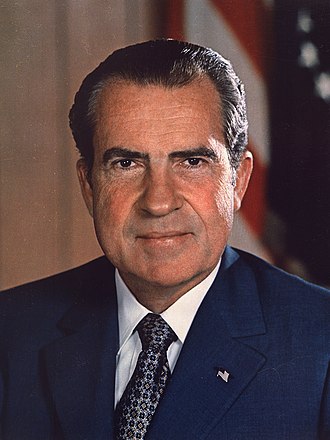
Richard M. Nixon served as the 37th President of the United States from January 1969 until his resignation in August 1974. In February 1971, he ordered the installation of a secret voice-activated taping system in the White House to preserve a historical record of his administration. Until the system's existence was revealed and dismantled in July 1973, the tapes captured Nixon directing major foreign policy initiatives, such as the opening to China, as well as his central role in the Watergate cover-up.
What Nixon talks about on the tapes
White House operations 4,718Presidential scheduling 2,225Public relations 1,784Presidential schedule 1,782Vietnam War 1,693Logistics 1,650Manolo Sanchez 1,626White House communications 1,400White House administration 1,399Presidential communication 1,243Henry Kissinger 1,191Foreign Policy 1,183
Conversations (21,010)
— Page 103 of 211President Nixon met with an unidentified individual in the Old Executive Office Building to record and deliver dictation intended for his personal secretary, Rose Mary Woods. The conversation served as a logistical session for the processing of administrative or presidential materials. No further details regarding the substance of the dictated content are available.
President Nixon met with his personal secretary, Rose Mary Woods, in the Old Executive Office Building to facilitate administrative tasks. The discussion focused on the delivery of official dictation and the coordination of the President's upcoming meeting schedule. This interaction reflects the routine logistical management required to maintain the President’s workflow and time management during a busy period in the White House.
President Nixon dictates a memorandum for the file regarding the necessity of restructuring the Central Intelligence Agency. The discussion centers on the need for a new bureaucratic approach within the intelligence community. The recording concludes with brief administrative instructions regarding the memo's transcription and physical handling.
President Nixon and Rose Mary Woods discussed administrative logistics, including the distribution of commemorative gifts from recent events, and reflected on his recent Duke Law School reunion. The conversation transitioned into a review of domestic and international reaction to Nixon's speech regarding the blockade and mining of North Vietnam, noting high public approval ratings. The two also exchanged views on the erosion of American social institutions, the mistreatment of Vietnam veterans, and the perceived influence of left-wing ideology in American schools.
President Nixon initiates a brief telephone request to the White House operator to be connected with Charles W. Colson. The interaction serves as a functional administrative step to facilitate a direct line of communication between the President and his special counsel. No further substantive discussions occur during this short exchange.
President Nixon dictates a memorandum concerning various administrative and political matters, including a legal plea involving an individual named Jackson in North Carolina and correspondence regarding Marilyn Phillips. The discussion also touches upon concerns regarding FBI appropriations and broader sociocultural critiques of religious institutions and their perceived lack of patriotism. The brief session focuses on capturing specific directives and recollections for future follow-up.
President Nixon consults with the White House operator to discuss political developments regarding Senator Hollis and the Democratic caucus. The conversation focuses on the Senator's surprise decision to publicly oppose the Democratic caucus vote, which Nixon views as a significant and positive political development. The exchange reflects Nixon's interest in tracking legislative dissent and internal party dynamics.
President Nixon and Charles Colson discuss the positive performance of Secretary of Defense Melvin Laird during a recent televised press conference regarding the Vietnam War. Impressed by Laird’s intensity and effectiveness, the President directs Colson to coordinate a follow-up meeting with H. R. Haldeman. The brief call serves to facilitate immediate staff consultation on how to leverage the momentum from the press conference.
President Nixon and Charles Colson discuss an unidentified public statement or legal case that they both believe has been handled effectively. The conversation focuses on the strategic merits of this development and brief commentary on the political implications of recent diplomatic maneuvers involving China. No specific policy decisions were reached, as the brief exchange primarily centers on evaluating the public relations value of current events.
President Nixon met with his senior advisors and staff to strategize on managing public opinion and political messaging following his recent decision to blockade and mine North Vietnamese ports. The discussion centered on utilizing favorable polling data, countering media criticism, and coordinating consistent rhetoric among administration officials and Republican allies. Nixon also made key decisions to restrict access to government facilities like the Sequoia and Camp David, while rejecting a proposal to meet with liberal Republican senators to avoid being put in a politically compromising position.
President Nixon and H. R. Haldeman met to review the public reception of the administration's recent decision to blockade North Vietnam and to discuss the political implications for the upcoming election. They examined a large volume of telegrams and correspondence from diverse supporters, including veterans, religious groups, and business organizations, as evidence of strong public approval. Additionally, the pair engaged in personal reflections on the President's disciplined lifestyle compared to his predecessors and reviewed potential candidates for Supreme Court appointments.
President Nixon met with an unknown individual to discuss the aftermath of the attempted assassination of George Wallace. The participants exchanged commentary on Wallace’s controversial rhetoric, debating the extent to which his political style incited hostility. Additionally, the conversation briefly touched upon Senator Jacob Javits and the political skill of John Connally.
President Nixon and Henry Kissinger met briefly to coordinate logistical arrangements for an upcoming visit from a Soviet trade delegation. They specifically discussed the seating protocol and the intended duration for the President's meeting with the representatives. This discussion ensured that official interactions with the Soviet officials were properly structured before the delegation's arrival.
President Nixon met with his aide Stephen B. Bull to coordinate administrative logistics regarding a scheduled telephone call with Alexander M. Haig Jr. The brief discussion centered on the timing and specific purpose of the upcoming conversation with Haig. No further policy developments or major decisions were recorded during this short briefing.
President Nixon and Press Secretary Ronald L. Ziegler met briefly to coordinate logistics regarding an upcoming meeting with a Soviet trade delegation. The discussion focused on managing the public perception of the event, specifically addressing the size of the delegation and the arrangements for official press photography. The brief exchange served to finalize Ziegler's role and presence during the delegation's visit to the White House.
President Nixon met with his aide Stephen B. Bull to coordinate the presentation of gifts to Soviet representatives. The discussion focused on the selection of cuff links and the logistical scheduling for the gift-giving ceremony. This brief consultation ensured that the appropriate items were prepared for upcoming diplomatic interactions.
President Nixon met with Soviet Minister of Foreign Trade Nikolai Patolichev, Ambassador Anatoliy Dobrynin, and senior U.S. officials to discuss the expansion of U.S.-Soviet economic and trade relations ahead of the upcoming Moscow summit. Patolichev outlined Soviet interest in obtaining credit for large-scale projects and Most Favored Nation (MFN) status, while Nixon emphasized his desire to transcend specific technical hurdles to establish a historic, long-term economic partnership between the two superpowers. The meeting served to reaffirm high-level commitments to future cooperation, with Nixon signaling his willingness to use his executive authority to reach significant agreements with General Secretary Leonid Brezhnev.
President Nixon met with Alexander P. Butterfield to debrief on a recent meeting, specifically inquiring whether any significant issues were addressed. Butterfield characterized the interaction as a routine business courtesy call rather than a high-stakes negotiation. Despite the informal nature of the exchange, he confirmed that they discussed substantive matters involving trade relations, including agricultural and industrial products.
President Nixon, Henry Kissinger, and Ronald Ziegler met to discuss the political fallout and public messaging strategy following Nixon's decision to mine North Vietnamese harbors. The group analyzed the unexpectedly mild reactions from the Soviet Union and China, concluding that a Soviet summit remains highly likely despite the escalating conflict. Nixon and Kissinger also reviewed military operations in South Vietnam, with the President proposing the strategic use of tank deployments based on his study of World War I tactics.
President Nixon met briefly with an unidentified individual to coordinate logistical arrangements regarding his schedule at the Executive Office Building. The discussion focused on the necessity of managing time for transition between locations. This brief interaction concluded quickly as the President departed the Oval Office.
President Nixon contacted the White House operator to initiate a telephone call to his special counsel, Charles W. Colson. The brief exchange served solely as a request to connect with Colson. No further policy discussions or substantive developments occurred during this interaction.
President Nixon instructed the White House operator to place calls to both Charles W. Colson and his daughter, Tricia Nixon Cox. Upon learning that Colson was currently meeting with John D. Ehrlichman, the President requested that Colson return the call at his convenience rather than interrupting his meeting. These logistical requests highlight the President's administrative coordination during the workday.
President Nixon consulted with the White House operator to facilitate an outgoing call. The brief exchange focused on establishing a telephonic connection with another party. No substantive policy discussions or major administrative decisions were recorded during this brief administrative interaction.
President Nixon contacted Charles W. Colson to coordinate a follow-up meeting after Colson concluded a strategy session involving John N. Mitchell, H. R. Haldeman, and John D. Ehrlichman. The participants briefly discussed the status of their ongoing political deliberations at the Executive Office Building. Nixon instructed Colson and Haldeman to meet with him at the White House immediately after their current proceedings wrapped up to review specific action items.
President Richard Nixon met with Special Counsel Charles Colson in the Old Executive Office Building for a brief discussion. Due to the lack of a transcript for this minute-long engagement, the specific substance of their exchange remains unrecorded. Consequently, no definitive policy decisions or developments can be attributed to this particular meeting.
President Nixon held a brief, informal telephone conversation with his daughter, Tricia Nixon Cox. The exchange served as a personal check-in between the President and his family member. No official policy matters or significant administrative decisions were recorded during this brief interaction.
President Nixon and his daughter, Tricia Nixon Cox, engage in a brief, informal exchange regarding their schedules and upcoming plans. The President encourages Tricia to remain at her current engagement rather than rushing, before suggesting a meeting later at a school with her husband, Edward Cox. No significant policy or political matters are addressed during this short personal interaction.
President Nixon and H. R. Haldeman met to review the President’s daily schedule, specifically discussing an upcoming breakfast meeting with Wilbur D. Mills and a session with Soviet Minister of Foreign Trade Nikolai S. Patolichev. The conversation included a reference to former President Harry S. Truman in the context of the meeting with Mills. No further substantive policy decisions or developments were recorded during this brief administrative exchange.
President Nixon contacted the White House operator to facilitate an urgent telephone connection with Senator Hugh Scott. The brief exchange served as a logistical request to initiate a high-level communication between the President and the Senate Minority Leader. No further substantive policy matters were discussed during this specific interaction.
President Nixon met with H.R. Haldeman and Charles Colson to discuss strategies for bolstering public and congressional support for the recent escalation of the Vietnam War, specifically the blockade. The participants reviewed favorable polling data and analyzed the effectiveness of media messaging and public relations efforts led by allies like Senators Hugh Scott and Robert Griffin. The discussion focused on framing the blockade as a necessary, rational move and discrediting Democratic critics and anti-war protesters as being out of step with the American public.
President Nixon and Senate Minority Leader Hugh Scott discuss recent public support for the administration's Vietnam policy, specifically focusing on the favorable response to Nixon’s blockade decision as evidenced by Erie County poll results. Scott praises the President's recent rhetoric and language, leading Nixon to request that Scott share his colorful phrasing directly with Chuck Colson for use in future White House communications. Both parties agree on the strategic importance of using favorable polling data to bolster their public position.
President Nixon initiates a brief telephone call to the White House operator to request a connection to Senator Robert P. Griffin. This administrative interaction serves to facilitate a legislative communication between the President and the Senator. No further substantive policy matters were discussed during this brief exchange.
President Nixon called Senator Robert P. Griffin to commend him for his public support of the administration's Vietnam blockade policy. The two discussed Griffin’s recent confrontational exchange with Senator Frank Church on the Senate floor regarding shifting Democratic positions on cease-fire proposals. Nixon reaffirmed his confidence that the blockade strategy would succeed and encouraged Griffin to maintain pressure on political opponents.
President Nixon, Henry Kissinger, and H.R. Haldeman met to coordinate strategy regarding the escalation of the Vietnam War and the upcoming Soviet Summit. The discussion focused on the effectiveness of recent U.S. air strikes against North Vietnamese infrastructure, the ongoing blockade of Haiphong Harbor, and the potential impact of these actions on relations with the Soviet Union. The participants decided to restrict public statements from Secretary of State William P. Rogers to avoid undermining the President's peace offer or creating diplomatic confusion as the administration prepared for the Moscow summit.
President Nixon met with an unknown individual to briefly discuss his upcoming schedule and logistical arrangements regarding a visit with his longtime valet, Manolo Sanchez. The conversation centered on the President's personal movements and the coordination of his car transport. No significant policy decisions were recorded during this brief administrative exchange.
President Nixon met with an unknown individual to discuss adjustments to his official schedule, specifically regarding a planned visit with his valet, Manolo Sanchez. The brief exchange reflects the President’s intent to manage his time and personal interactions while coordinating daily logistical arrangements. No major policy decisions were reached during this short administrative consultation.
President Nixon met with an unidentified individual to discuss a diplomatic communication received from the West German government. The conversation focuses on an analysis of a response from Egon Bahr, described as mild in tone and notably silent regarding the upcoming summit. The participants assess the implications of the German feedback, which appears to express subtle dissatisfaction with recent decisions without escalating tensions.
President Nixon and Henry Kissinger met to evaluate the Soviet Union's moderate response to the U.S. naval blockade and mining of North Vietnamese ports. They discussed managing diplomatic communications regarding the upcoming Moscow summit, specifically ensuring that Soviet interests and the German Treaty were handled without jeopardizing the President's scheduled visit. Kissinger provided updates on his recent interactions with Soviet Ambassador Anatoliy Dobrynin, and the two agreed to keep the State Department and Secretary of State William P. Rogers largely uninformed of these sensitive negotiations to maintain control over the administration's Vietnam policy.
President Nixon met with his aide Stephen B. Bull to coordinate the scheduling of his upcoming appointments. The discussion focused on finalizing the timing for meetings with Secretary of State William P. Rogers and National Security Advisor Henry A. Kissinger. They also addressed the logistics for the President's departure via helicopter to Camp David, where he was scheduled to be joined by Charles G. "Bebe" Rebozo.
President Nixon and H. R. Haldeman met to discuss legislative strategy regarding Vietnam, specifically addressing potential Congressional resolutions on funding cutoffs. They debated the merits of adopting a "sense of Congress" resolution to preempt more restrictive amendments and explored ways to manage public and Congressional support for the administration's policies. Additionally, the President decided to postpone a meeting with POW wives to ensure it served as an effective public relations event, while also dismissing concerns about current anti-war demonstrations as largely confined to radical students rather than the broader public.
President Nixon contacted the White House operator to facilitate a personal telephone call to First Lady Pat Nixon. This brief interaction served as a routine administrative request to connect the President with his wife. No policy matters or significant administrative decisions were addressed during the communication.
President Richard Nixon and First Lady Pat Nixon engaged in a brief telephone conversation. The exchange consisted of personal matters that were subsequently identified as returnable and withdrawn from the public record. No substantive policy discussions or administrative actions occurred during this brief interaction.
President Richard Nixon and First Lady Pat Nixon held a brief meeting in the Oval Office to discuss personal matters. The conversation appears to be a casual check-in regarding the activities and events of the preceding month. No significant policy decisions or official government actions were recorded during this short exchange.
President Nixon initiates a brief administrative interaction with the White House operator to place an outgoing telephone call. The conversation serves a purely functional purpose to facilitate official communication. No substantive policy matters or strategic developments are discussed during this brief exchange.
President Nixon met with Alexander P. Butterfield to coordinate logistics for an upcoming trip to Camp David. The discussion centered on arranging secretarial services and establishing standby procedures for the visit. Butterfield confirmed that the necessary personnel would be prepared for the trip.
President Nixon met with Rose Mary Woods and Stephen B. Bull to discuss administrative arrangements for his upcoming schedule and receive updates on staff matters, including the recovery of Manolo Sanchez. The discussion included a review of positive public and personal feedback regarding the President's recent television address concerning the Vietnam blockade. Additionally, the President addressed potential implications for the Soviet Summit and coordinated logistics for an upcoming meeting with Secretary of State William P. Rogers.
President Nixon met with William Rogers, Henry Kissinger, and H. R. Haldeman to discuss the administration's strategic posture regarding the Vietnam War, the upcoming Soviet Summit, and managing congressional relations. Amidst concerns over potential leaks and the risk of the Soviets canceling the summit, the President emphasized the importance of maintaining a firm, low-key public stance to maximize pressure on North Vietnam. The group also evaluated the political risks associated with congressional attempts to limit presidential war powers and reviewed the ongoing naval and military operations, including B-52 strikes.
President Nixon met with Stephen B. Bull and Alexander P. Butterfield to finalize logistics for several upcoming events, including a meeting with John Cardinal Krol and a large reception in the Blue Room. Discussions focused on scheduling the Cardinal’s visit aboard the Sequoia and coordinating protocol for the reception, specifically the introductions of guests and the flow of the receiving line. Nixon emphasized the need for efficient crowd management and clear identification of attendees to streamline the social proceedings.
President Nixon met with John B. Connally and Stephen B. Bull to discuss the transition of the Treasury Secretary position from Connally to George P. Shultz, including plans for an upcoming cabinet announcement. The conversation also covered international affairs, specifically the blockade of North Vietnam and negotiations with the Soviet Union, as well as the President’s desire for tighter controls on the political and professional appointments of Jewish individuals within his administration. Additionally, Nixon and Connally explored future post-resignation roles for Connally, including diplomatic missions to Latin America and an appointment to the President's Foreign Intelligence Advisory Board (PFIAB).
President Nixon met with George Shultz and later John Connally to finalize Shultz's appointment as the new Secretary of the Treasury, replacing the outgoing Connally. The discussion covered the upcoming formal announcement and cabinet meeting, the transition of responsibilities, and the need for a firm economic strategy regarding the budget and international monetary policy. Additionally, they reviewed potential leadership changes, specifically the appointment of Caspar Weinberger to head the Office of Management and Budget, while briefly noting the continued domestic support for the President’s Vietnam War policies.
President Nixon instructed the White House operator to place an urgent call to Cornelia Wallace following the attempted assassination of her husband, Governor George C. Wallace. The President sought to contact the First Lady of Alabama personally to offer his support during the unfolding crisis. This interaction highlights the immediate political and personal response by the White House to the violent attack on the presidential candidate.
President Nixon met with Donald Kendall and Peter Flanigan to coordinate strategy for upcoming trade negotiations with the Soviet Union, specifically regarding the Pepsi-Vodka agreement and Most Favored Nation (MFN) status. The participants emphasized the importance of maintaining high-level control over economic diplomacy to prevent lower-level bureaucratic gridlock and discussed leveraging credit offers to secure long-term grain commitments. Additionally, Nixon and Kendall exchanged frustrations regarding the lack of political support from the business establishment, contrasting it with the perceived necessity of building a new, more reliable coalition.
President Nixon met with George Shultz, Caspar Weinberger, and H.R. Haldeman to discuss the immediate aftermath of the attempted assassination of George Wallace and to formalize upcoming cabinet shifts. The group reviewed the details of the shooting and coordinated the administration's public response and schedule. Additionally, Nixon confirmed the appointment of George Shultz as Secretary of the Treasury and Caspar Weinberger as Director of the Office of Management and Budget, emphasizing the necessity of a stringent fiscal policy and budget control.
President Nixon contacted the White House operator to facilitate a telephone call to First Lady Pat Nixon. The brief interaction served as a logistical request to establish a line with her. No further policy or administrative matters were discussed during this exchange.
President Nixon met with Alexander P. Butterfield to receive an urgent update regarding the assassination attempt on Governor George Wallace, including details about the assailant, the victims, and the severity of Wallace’s injuries. Following this, the President consulted with H. R. Haldeman and First Lady Pat Nixon to assess how to handle a scheduled Blue Room reception in light of the national tragedy. They ultimately decided to restrict press access to the event to avoid optics that would appear inappropriate given the gravity of the shooting.
President Nixon spoke with the White House operator to facilitate an outgoing call. This interaction served a purely administrative purpose to connect the President with another party. No substantive policy discussions or decisions occurred during this brief communication exchange.
President Nixon and First Lady Pat Nixon discussed the appropriateness of holding a scheduled Blue Room reception following the attempted assassination of George Wallace. Concerned that appearing in a festive public setting while the nation was in crisis would be insensitive, the couple weighed options including cancellation or excluding the press. They ultimately reached a tentative plan for the First Lady to host the event alongside curator Clement Conger while excluding media coverage to maintain decorum.
President Nixon met with his aide, Stephen B. Bull, in the Oval Office to address administrative matters regarding the executive schedule. The primary focus of the discussion concerned the President's upcoming meeting with Chief of Staff H.R. Haldeman. No substantive policy decisions were recorded during this brief administrative briefing.
President Nixon consulted with H. R. Haldeman regarding his potential participation in an upcoming scheduled event. Ultimately, the President decided to proceed with the event while opting not to attend in person. Consequently, he instructed the White House operator to place a call to First Lady Pat Nixon to coordinate the situation.
Following the assassination attempt on Governor George Wallace, President Nixon and John Connally discussed the political fallout and the immediate need to provide enhanced Secret Service protection to other presidential candidates, specifically Senator Edward M. Kennedy and Representative Shirley Chisholm. The participants deliberated on how to frame these security measures publicly while bypassing legal obstacles that previously barred the Secret Service from covering non-candidates. During the discussion, Connally recounted his personal experience surviving the John F. Kennedy assassination, providing a grim context for the ongoing concern over the safety of political figures.
President Nixon and First Lady Pat Nixon consult on whether the President should attend a scheduled Blue Room reception following the shooting of presidential candidate George C. Wallace. Concerned that a jovial appearance would be inappropriate given the somber political climate and historical parallels to the Kennedy assassinations, the couple discusses alternative options, including having a surrogate read remarks or making a brief, solemn appearance. The President concludes the call without a final decision, opting to confer with H. R. Haldeman before committing to a course of action.
President Nixon, H.R. Haldeman, John Connally, and Eugene Rossides discussed the immediate expansion of Secret Service protection for presidential candidates following the assassination attempt on George Wallace. The group specifically evaluated the security needs of Edward M. Kennedy and Shirley Chisholm, while dismissing candidates deemed inactive. Nixon ordered that protection details be prepared for both Kennedy and Chisholm, pending further investigation into the status of other potential candidates.
President Nixon called Cornelia Wallace to express his concern and offer prayers following the assassination attempt on her husband, George Wallace. Mrs. Wallace provided an update on the Governor's condition, noting the presence of a bullet near his spine and ongoing medical complications involving his liver. The President offered encouragement by comparing the resilience of politicians to Theodore Roosevelt's experience after being shot, emphasizing George Wallace's reputation as a fighter.
Following the assassination attempt on Governor George Wallace, President Nixon and John Connally directed Treasury official Eugene Rossides to immediately assign Secret Service protection to various presidential candidates. Connally coordinated the dispatch of agents to Edward Kennedy and Shirley Chisholm, while also instructing Rossides to provide a reduced security detail for other candidates like Wilbur Mills and Patsy Mink. The participants further discussed the status of other candidates' travel plans and the logistics for releasing official statements regarding these expanded protective measures.
President Nixon, H. R. Haldeman, Charles Colson, and other staff members met to discuss the immediate aftermath and implications of the assassination attempt on Governor George Wallace. The President expressed intense frustration with the lack of information and the perceived incompetence of the Secret Service, repeatedly ordering his staff to bypass them and mobilize the FBI to take control of the investigation. Nixon specifically emphasized the need to determine the assailant's identity and political motivations—particularly any potential ties to anti-Vietnam War sentiments—to prevent media speculation or a repeat of the perceived failures following the John F. Kennedy assassination.
In the aftermath of the attempted assassination of Governor George C. Wallace, President Nixon, H. R. Haldeman, and Charles Colson utilized White House telephone lines to coordinate an information pipeline with Secret Service Director James J. Rowley. The discussion focuses on gathering immediate intelligence regarding the assailant, Arthur H. Bremer, and ensuring the White House receives critical details—such as the purchase of the weapon and the suspect's background—ahead of media reports. Parallel to these operational efforts, the participants also discussed the political impact of the administration's recent Vietnam policies and the President's upcoming summit in Moscow.
President Nixon, H.R. Haldeman, and Charles Colson discuss the investigation into the shooting of George Wallace, focusing on jurisdictional authority to involve the FBI. Nixon expresses a deep distrust of the Secret Service and directs that the FBI be ordered to take the lead in the investigation based on the federal nature of the victims. The participants explore legal justifications for this federal oversight, specifically citing the status of the officials targeted in the attack.
H. R. Haldeman coordinated with the White House operator to ensure that any incoming call from Secret Service Director James J. Rowley would be routed directly to his current telephone line. Simultaneously, President Nixon conferred with Charles Colson regarding unspecified administrative matters. This exchange serves as a logistical bridge, prioritizing urgent communication between the White House and federal security leadership.
President Nixon instructed the White House operator to place an outgoing call to his close friend and confidant, Charles G. “Bebe” Rebozo. The brief exchange served as a logistical request to initiate a private communication between the two men. No substantive policy matters were discussed during this brief administrative interaction.
Secret Service official Thomas J. Kelley briefs H. R. Haldeman and President Nixon on the identification of Arthur Herman Bremer as the suspect in the assassination attempt on Governor George Wallace. Kelley details Bremer’s background, including his purchase of the weapon and prior arrest record, while confirming that no other conspirators are currently suspected. The participants discuss security measures to ensure the suspect’s safety while in custody at the hospital to prevent a situation similar to the murder of Lee Harvey Oswald by Jack Ruby.
President Nixon, H.R. Haldeman, and Charles Colson consulted with Attorney General Richard Kleindienst to receive updates on the investigation into the attempted assassination of George Wallace. The participants reviewed the status of the assailant, Arthur Bremer, and discussed FBI assignments regarding his custody, interrogation, and isolation. Officials expressed significant concern over potential public perception, specifically aiming to avoid any resemblance to the controversy surrounding the John F. and Robert F. Kennedy investigations.
President Nixon, H.R. Haldeman, and John Ehrlichman discussed the immediate aftermath of the assassination attempt on Governor George Wallace. The conversation centered on the status of the investigation into the assailant, Arthur H. Bremer, and the coordination of federal law enforcement efforts led by L. Patrick Gray and W. Mark Felt. Ehrlichman received instructions to maintain tight control over the information flow to the President, specifically drawing comparisons to the handling of the John F. Kennedy assassination to ensure effective management and reporting.
Charles W. Colson contacted the White House operator to facilitate communication between key administration officials. The primary purpose of the exchange was to arrange a telephone call for John D. Ehrlichman. The discussion focused on coordinating this outreach in conjunction with a separate call involving H. R. Haldeman.
President Nixon, H. R. Haldeman, Charles Colson, and FBI Associate Director W. Mark Felt discussed the aftermath of the assassination attempt on George C. Wallace. The participants focused on the background of the assailant, Arthur H. Bremer, specifically exploring potential political motivations, his anti-war connections, and rumored ties to Edward M. Kennedy. The group coordinated on the FBI's investigation and the necessity of verifying these rumors to ensure accurate reporting to the President.
Charles W. Colson initiated a series of telephone calls to coordinate a conversation between President Nixon and Kenneth W. Clawson. The purpose of these communications was to facilitate direct contact between the President and Clawson regarding undisclosed administrative matters. While the specific substance of their discussion remains undocumented due to the lack of a transcript, the administrative efforts reflect an urgent need to connect the President with his staff.
Following the assassination attempt on Governor George Wallace, President Nixon and his aides, including H. R. Haldeman and Charles Colson, discussed strategies to manipulate public perception of the assailant's political affiliations. They explicitly directed staff to leak a story portraying the gunman as a supporter of Democratic candidates George McGovern and Edward Kennedy to associate the act with the political left. Additionally, the President reviewed the security implications for his own public appearances and coordinated with John Connally regarding future travel assignments.
President Nixon contacted the White House operator to facilitate an outgoing call to John B. Connally. The brief exchange served as a logistical step to establish communication between the President and the former Treasury Secretary. No further policy discussions or substantive actions were recorded during this connection.
President Nixon consulted with John and Nellie Connally regarding the political fallout from the assassination attempt on George Wallace and the timing of pending public announcements. The discussion also addressed the logistical planning and security concerns surrounding the Connallys' upcoming diplomatic tour of Latin America. Additionally, the parties reviewed recent administrative matters, including the President's attendance at a Blue Room reception and an evaluation of Eugene Rossides' performance.
President Nixon met with Nellie L. Yates and briefly conferred with FBI Associate Director W. Mark Felt following the attempted assassination of Governor George Wallace. The conversation centered on the implications of the shooting, with Nixon drawing historical parallels to the assassinations of Robert F. Kennedy and the wounding of John B. Connally. Nixon emphasized the need for a thorough FBI investigation to avoid the controversies associated with previous high-profile political shootings.
President Nixon and FBI Associate Director W. Mark Felt discussed the status of the investigation into the attempted assassination of Governor George Wallace by Arthur H. Bremer. They reviewed evidence recovered from Bremer's apartment, including his writings, and examined the suspect's background, including prior arrests. The President emphasized the need for a thorough investigation, specifically drawing parallels to the assassination of John F. Kennedy, and sought updates on the identification and containment of potential accomplices.
President Nixon contacted the White House operator to facilitate an urgent communication with his domestic affairs advisor, John D. Ehrlichman. The brief exchange served as a logistical bridge to connect the President with his key staff member. No further policy discussions or substantive developments were recorded during this brief administrative interaction.
President Nixon contacted the White House operator to facilitate a telephone connection with special counsel Charles W. Colson. This administrative interaction served as a logistical step to initiate a direct communication with a key member of the President's inner circle. No further details regarding the substance of the intended conversation are available.
President Nixon contacted the White House operator to request an urgent telephone connection to National Security Advisor Henry A. Kissinger. This brief administrative exchange served as the necessary step to facilitate a direct line of communication between the President and his advisor. No further substantive policy matters were discussed during this brief request.
President Nixon contacted the White House operator to facilitate a telephone call to First Lady Pat Nixon. The brief interaction served strictly as a request for the operator to connect the President to his wife. No policy matters or administrative business were discussed during this communication.
President Nixon initiates a brief interaction with the White House operator to facilitate a telephonic communication. This contact serves as a logistical administrative step to connect the President with another party for further discussion. No substantive policy matters or major decisions were recorded during this brief exchange.
President Nixon held a brief, unsuccessful attempt to place a telephone call through the White House operator. The interaction ended quickly without the President successfully reaching the intended party. No substantive policy matters or administrative decisions were documented during this short exchange.
President Nixon held a brief, procedural exchange with the White House operator to facilitate an outgoing communication. The interaction focused on the logistics of placing a telephone call through the White House switchboard. No substantive policy discussions or significant political developments occurred during this brief administrative contact.
President Nixon held a brief, unscheduled interaction with a White House operator while working in the Old Executive Office Building. Although the specific substance of the exchange remains unrecorded, the interaction reflects the routine administrative communication required to manage telephonic operations during the President's evening hours. No substantive policy decisions or historical actions are documented as a result of this connection.
President Nixon and First Lady Pat Nixon discussed the aftermath of the attempted assassination of George Wallace, specifically reviewing his medical condition and the political ramifications regarding public sentiment. They also coordinated their respective roles and attendance for an upcoming Blue Room reception, including the specific inclusion of Janet Neff. The conversation highlights the personal stress of the political climate and the logistical challenges of maintaining official appearances following the shooting.
President Nixon and First Lady Pat Nixon briefly discussed their immediate schedule and logistical arrangements during a short late-evening meeting. The President inquired about the First Lady's recent activities and potential media engagements, while coordinating plans related to a planned visit to a grave site. The exchange focused primarily on organizing their respective movements for the remainder of the evening.
President Nixon contacted the White House operator to facilitate a telephone connection with his close friend and confidant, Charles G. "Bebe" Rebozo. This brief administrative interaction served as a logistical step to initiate a personal communication between the two men. No further substantive discussions were recorded during this brief exchange.
President Nixon contacted the White House operator to facilitate a telephone call to Ann Duggan. The primary purpose of the brief interaction was to secure the connection and locate the intended recipient. No further substantive policy matters or executive actions were addressed during this exchange.
President Nixon consulted with a White House operator to confirm the successful completion and mutual understanding of a previous communication. The brief exchange served as a follow-up to ensure that the intended message had been clearly conveyed to the recipient. No further actions were required, as both parties expressed satisfaction that the matter had been handled effectively.
President Nixon held a brief, unscheduled meeting with a White House operator in his Old Executive Office Building workspace. The interaction appears to be a routine administrative exchange, as no substantive policy or political discussions were recorded. The meeting serves primarily as a record of the President's immediate access to telecommunications support staff during late-evening hours.
President Nixon and Charles Colson discuss the ongoing investigation into the assassination attempt on George Wallace following the shooting earlier that day. They address concerns regarding the FBI's handling of the probe and potential conflicts with the Secret Service's investigative efforts. The President emphasizes the need for careful management of the situation while monitoring reports on the shooter, Arthur Bremer, and Wallace's medical status.
President Nixon and Charles Colson briefly discussed the aftermath of the attempted assassination of Governor George Wallace, which had occurred earlier that same day. They exchanged remarks regarding the governor's medical condition and physical injuries, as well as the initial response to the incident. No major policy decisions were made during this short, informal check-in regarding the shooting.
President Nixon and John Ehrlichman discuss the aftermath of the assassination attempt on Governor George C. Wallace by Arthur Bremer. Nixon expresses intense concern regarding the FBI's handling of the investigation, drawing explicit parallels to the perceived failures of the John F. Kennedy assassination inquiry. The two coordinate efforts to maintain White House oversight of the federal investigation and the subsequent psychiatric and legal proceedings involving Bremer.
President Nixon and John Ehrlichman briefly discuss concerns regarding the absence of a formal list and the political activities of Hubert Humphrey and a figure identified as McGarrett. The exchange highlights the President's unease regarding these developments and his subsequent decision to refrain from contacting an unspecified individual. The brief meeting serves to monitor ongoing political monitoring efforts and potential outreach strategies.
President Nixon and Henry Kissinger discussed the political and security implications of the attempted assassination of George C. Wallace, including the status of suspect Arthur H. Bremer and the intensification of candidate protection measures. They reviewed the impact of the shooting on upcoming diplomatic relations with the Soviet Union, specifically addressing progress on SALT negotiations and preparations for the impending Moscow summit. Additionally, the conversation touched upon the ongoing North Vietnamese offensive and the status of U.S. bombing operations in Vietnam.
President Nixon and Henry Kissinger discuss the security assessment and handling of the individual responsible for the attempted assassination of Governor George Wallace, who had occurred earlier that day. Nixon expresses concern regarding the potential for leaks and mismanagement, explicitly instructing Kissinger to withhold related information from Secretary of State William Rogers. The conversation focuses on ensuring the matter is handled securely and that the assailant’s radical background is contained without triggering the public scrutiny experienced during previous political assassinations.