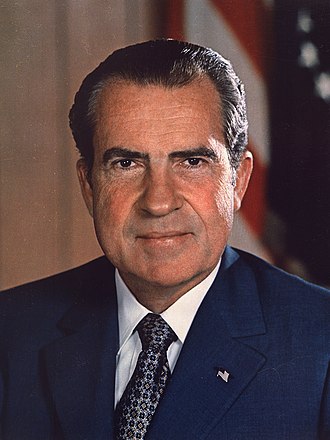
Nixon, Richard M. (President)
Richard M. Nixon served as the 37th President of the United States from January 1969 until his resignation in August 1974. In February 1971, he ordered the installation of a secret voice-activated taping system in the White House to preserve a historical record of his administration. Until the system's existence was revealed and dismantled in July 1973, the tapes captured Nixon directing major foreign policy initiatives, such as the opening to China, as well as his central role in the Watergate cover-up.
What Nixon talks about on the tapes
White House operations 4,718Presidential scheduling 2,225Public relations 1,784Presidential schedule 1,782Vietnam War 1,693Logistics 1,650Manolo Sanchez 1,626White House communications 1,400White House administration 1,399Presidential communication 1,243Henry Kissinger 1,191Foreign Policy 1,183
Conversations (21,010)
— Page 133 of 211President Nixon and Charles W. Colson discussed political strategy for the 1972 election, focusing heavily on countering George McGovern's recent foreign policy speech regarding the Vietnam War. Nixon instructed Colson to mobilize labor leaders and other allies to attack McGovern's proposals as a "sellout" to communists, specifically criticizing his stance on amnesty for draft evaders and the potential deployment of Sargent Shriver to Hanoi. Additionally, the pair celebrated a recent victory in the House of Representatives regarding a federal spending ceiling, with Nixon emphasizing the importance of framing the issue as a fight against high taxes to gain leverage over the Senate.
President Nixon and Charles Colson discuss legislative strategy regarding tax and spending bills, focusing on framing the issue as a fight against high taxes to secure necessary votes. The conversation shifts significantly to a political attack on Sargent Shriver, whom Nixon criticizes for his stance on Vietnam, POWs, and amnesty. Nixon instructs Colson to aggressively challenge Shriver's credibility, aiming to frame his positions as a betrayal of American service members and a surrender to communist interests.
President Nixon received a brief update from the Camp David operator regarding the status of Congressman Wilbur D. Mills. The operator informed the President that Mills was currently traveling and would initiate a return phone call upon his arrival home. Nixon acknowledged the message and confirmed his availability to receive the call at any time.
President Nixon held a brief, informal communication with the Camp David operator to confirm the readiness and connectivity of the facility's telephone system. The interaction served as a routine check of the communications infrastructure while the President was in residence at Aspen Lodge. No substantive policy matters or major political decisions were addressed during this brief exchange.
President Nixon and Congressman Wilbur Mills coordinated legislative strategy to secure support in the Senate Finance Committee for a pending bill involving debt limits, Medicare, and welfare. Mills encouraged Nixon to convene a private, Republican-led meeting with key Senators, specifically mentioning Len Jordan and Harry F. Byrd, Jr., to build momentum while avoiding obstruction from Russell Long. The two agreed on a strategy to compromise on specific bill provisions, such as disability and widow's benefits, to ensure passage while keeping the administration's legislative team, including William Timmons and John Veneman, fully informed.
President Nixon consulted with Congressman Wilbur D. Mills to solicit praise and strategic advice regarding a recent legislative speech delivered on the House floor. Following a brief exchange of pleasantries, the two discussed coordinating a high-stakes meeting with Senate leadership scheduled for the following Thursday morning. Nixon sought to align legislative strategy while navigating the sensitive, partisan nature of the upcoming discussions with key senators.
President Nixon requested that the Camp David operator connect him with former Wisconsin Congressman John W. Byrnes. The brief interaction served solely to facilitate this outgoing call. No further substantive policy discussions were recorded during this exchange.
President Nixon held a brief communication with the Camp David operator from the Aspen Lodge study. The interaction served as a routine administrative or logistical exchange regarding the operation of the facility's communications. No significant policy decisions or substantive political developments occurred during this short contact.
President Nixon calls Congressman John W. Byrnes to congratulate him on a successful House vote regarding the debt limit expenditure ceiling. Seeking to maintain legislative momentum, Nixon outlines his plan to pressure Republican senators during an upcoming Thursday morning meeting to ensure a unified front. Byrnes and the President agree that securing a substantial vote is critical to strengthening their position in the subsequent House-Senate conference committee.
President Nixon met with Representative John W. Byrnes to express appreciation for a successful legislative vote and to coordinate strategy for an upcoming meeting with Republican senators. The President directed Byrnes to pressure holdouts to ensure party unity ahead of a critical conference, emphasizing the need for lawmakers to stand firm. They agreed to hold a session on Thursday morning to formalize this legislative push and secure necessary support.
President Nixon contacted the Camp David operator to facilitate a personal telephone call to his daughter, Tricia Nixon Cox. The brief exchange served purely administrative purposes to connect the President with his family. No policy matters or substantive political topics were discussed during this request.
President Nixon spoke briefly with a Camp David operator from the Aspen Lodge to handle routine telecommunications logistics. The interaction consisted of standard administrative procedure rather than a substantive policy discussion. No significant decisions or political developments occurred during this brief exchange.
President Richard Nixon spoke with his daughter, Tricia Nixon Cox, during an evening telephone call from Camp David. The conversation, which has been almost entirely withdrawn from public access for privacy reasons, served as a personal exchange between the President and his daughter. No policy matters or significant administrative decisions were recorded or disclosed in the available documentation.
President Richard Nixon met with his daughter, Tricia Nixon Cox, during a private session at Camp David. As no transcript of the discussion is currently available, the specific substance of their conversation remains undocumented. The meeting serves as a record of personal engagement between the President and his daughter during his tenure.
President Nixon contacted the Camp David operator to facilitate a telephone connection. The primary purpose of this brief exchange was to initiate a call to Charles W. Colson. No substantive policy matters were addressed during this administrative interaction.
President Nixon communicated with the Camp David operator from the Aspen Lodge study to address logistical needs or telecommunications support during his stay. Given the lack of a transcript and the brevity of the recording, the exchange likely involved routine operational requests rather than substantive policy discussions. This interaction serves as a record of the President's logistical management while in residence at the retreat.
President Nixon and Charles Colson discuss a strategic counter-offensive against George McGovern following his recent foreign policy speech. They plan to challenge McGovern's platform by highlighting his inaccuracies regarding North Vietnamese forces and his perceived naivety on national security issues like POWs and amnesty. The two agree to mobilize administration officials, including Melvin Laird and William Rogers, to discredit McGovern's qualifications and frame his rhetoric as a dangerous proposal for surrender.
President Nixon and Charles Colson discuss strategies to publicly discredit a political opponent, specifically by framing his positions on Vietnam as naive, fraudulent, and indicative of an unfitness for the presidency. The two strategize on using John Connally to counter the opponent's messaging and discuss the necessity of securing prime-time television coverage regardless of cost. Nixon emphasizes the importance of highlighting the opponent’s perceived support for the enemy and his failure to condemn communist aggression during sensitive negotiations.
President Nixon met with his personal valet, Manolo Sanchez, at the Aspen Lodge study at Camp David. The interaction, which lasted approximately 40 seconds, consisted of a brief, informal exchange between the President and his staff member. No policy decisions or substantive political discussions were recorded during this session.
President Richard Nixon and First Lady Pat Nixon met privately at the Aspen Lodge in Camp David. The discussion consisted entirely of a brief personal exchange that was subsequently withdrawn from public record for privacy reasons. No substantive policy or political matters were addressed during this short interaction.
President Richard Nixon convened a brief meeting with an unidentified individual at the Aspen Lodge study in Camp David. Due to the presence of withdrawn material and a lack of available transcript, the specific nature of the discussion remains undocumented. No significant policy developments or actionable outcomes can be determined from the available records.
President Richard Nixon and H.R. Haldeman met at Camp David to coordinate the President's upcoming travel schedule to the South and finalize logistics for the accompanying press pool. They also discussed strategies to leverage negative campaign themes against George McGovern, specifically targeting his positions on amnesty, the Vietnam War, and prisoners of war to sharpen the distinction between the candidates. Additionally, the pair reviewed recent civil unrest, including a hostage incident in Washington, D.C., and evaluated the effectiveness of the local police force.
President Richard Nixon met with his valet, Manolo Sanchez, at the Aspen Lodge study at Camp David. The discussion primarily involved personal matters rather than substantive policy or administrative business. The interaction concluded with no recorded policy developments or executive action items.
President Nixon initiates a brief telephone call through the Camp David operator to connect with his Chief of Staff, H.R. Haldeman. This exchange serves as a routine administrative request to facilitate communication with a key advisor. No substantive policy discussions occur, as the dialogue is restricted to the logistical task of placing the call.
President Nixon met with his personal valet, Manolo Sanchez, at the Aspen Lodge during a retreat at Camp David. The brief interaction served as a check-in regarding the President's schedule and the handling of an incoming telephone call from Chief of Staff H.R. Haldeman. No substantive policy discussions occurred during this brief exchange before Sanchez departed.
President Nixon initiated a brief communication with the Camp David operator to address logistical or operational matters at the retreat. Given the lack of a transcript, the specific substance of the exchange remains unrecorded. The interaction reflects the President’s direct engagement with support staff to facilitate his activities during his stay at Aspen Lodge.
President Nixon and H. R. Haldeman coordinate the arrival schedule and briefing protocol for Henry Kissinger following his Vietnam peace negotiations in Paris. They confirm that Kissinger should report to Secretary of State William P. Rogers immediately upon his return before meeting with the President. Nixon expresses confidence in the negotiations despite the lack of a clear breakthrough, opting to wait until Kissinger is refreshed to receive a full debriefing.
President Nixon and H.R. Haldeman coordinate the scheduling and briefing process for an incoming official to meet with Secretary of State William Rogers. The President emphasizes the necessity of the individual reporting to Rogers immediately to align their positions before a subsequent meeting with the President. This orchestration aims to ensure a unified strategy before any potential public engagement.
President Nixon contacted the Camp David operator to facilitate a telephone connection with his Chief of Staff, H.R. Haldeman. This brief interaction served solely as an administrative request to reach a key advisor while the President was stationed at Camp David. No other policy matters or substantive discussions were addressed during this exchange.
President Nixon initiated a brief communication with the Camp David operator from the Aspen Lodge study. The interaction served as a routine administrative or logistical check regarding telecommunications services at the retreat. No substantive policy matters or political discussions were recorded during this one-minute exchange.
President Nixon and H.R. Haldeman coordinated the schedule for Henry Kissinger’s return to Washington to ensure their meetings were not disrupted by the President's travel to Atlanta. Nixon directed Haldeman to instruct Kissinger to delay his arrival until 5:00 p.m. so that they could meet privately with Secretary of State William P. Rogers. The plan further included a private dinner at the White House with Nixon, Kissinger, and Alexander Haig to discuss ongoing diplomatic matters.
President Nixon and H.R. Haldeman coordinated the logistics for an upcoming meeting with a high-level official, likely Henry Kissinger, to ensure his arrival did not coincide with the President's public appearance in Atlanta. Nixon emphasized the political importance of avoiding a conflicting schedule and decided to host a private, unannounced dinner with the official and Alexander Haig. The conversation focused on managing optics and securing a quiet opportunity for a substantive debriefing.
President Nixon contacted the Camp David operator to facilitate a telephone connection with domestic affairs advisor John D. Ehrlichman. This brief administrative interaction served as the necessary step to initiate a formal policy discussion. The President successfully placed the request to reach his advisor, moving the conversation to a private line.
President Nixon consulted with the Camp David operator regarding the current whereabouts of advisor John D. Ehrlichman. Upon learning that Ehrlichman had just departed in a vehicle, the President decided against attempting to reach him at that moment. Nixon concluded the brief exchange by opting to defer the communication to a later time.
President Nixon initiates a brief administrative communication with the Camp David operator from the Aspen Lodge study. This interaction primarily concerns standard logistical coordination regarding the use of the site's hard wire telecommunications system. No substantive policy matters or major political decisions were addressed during this short exchange.
President Nixon consulted with the Camp David operator to facilitate a telephone connection. The brief exchange served purely administrative purposes, focusing on the mechanical logistics of establishing a call. No substantive policy matters or political discussions were recorded during this interaction.
President Nixon met with an unidentified individual in the Oval Office for a brief, two-minute encounter. Due to the limited duration of the recording and the withdrawal of segment content, the specific agenda and substance of the dialogue remain unknown. No substantive policy developments or administrative decisions are discernable from the available record.
President Nixon and John Ehrlichman met to strategize on legislative tactics regarding the federal debt limit and spending legislation as the congressional session drew to a close. They discussed the administration's firm stance against spending amendments, as well as the political complications surrounding a potential busing filibuster led by Senator Hugh Scott and James B. Allen. Ultimately, Nixon directed the administration to resist compromise on these issues, favoring a strategy that would allow Congress to conclude its session without enacting unfavorable legislation.
President Nixon met with his economic advisors and Republican Senate leadership to coordinate a strategy for securing congressional support for a federal spending ceiling. The discussion focused on the necessity of controlling runaway federal expenditures and the potential use of the presidential veto to enforce a $250 billion spending limit. Nixon and his team evaluated the legislative outlook for the debt limit bill, including strategies for handling amendments and managing potential political fallout regarding domestic programs.
President Nixon and Alexander Butterfield met to coordinate the President's upcoming schedule, specifically focusing on balancing campaign obligations with official administrative duties. They discussed arrangements for Drug Abuse Prevention Week events and logistical preparations for a meeting with Japanese Foreign Minister Masayoshi Ohira to support bilateral relations. Nixon instructed Butterfield to minimize his calendar commitments during the week to prioritize political activities while delegating the coordination of these conflicting priorities.
President Nixon and H.R. Haldeman discussed strategies for the 1972 reelection campaign, specifically focusing on how to manage campaign expenses and counter negative media coverage. They debated whether to launch an aggressive counterattack against the Democratic party and the press regarding perceived bias and alleged double standards in reporting, while acknowledging the need to maintain public order. Additionally, the President reviewed updates on Vietnam negotiations with Henry Kissinger and coordinated the upcoming schedule for Kissinger's return and subsequent meetings with Secretary of State William Rogers.
President Nixon instructed the White House operator to facilitate a meeting with Charles W. Colson. He specifically directed that Colson be routed to the Executive Office Building (EOB) rather than the main White House office. This brief communication served as an administrative directive to coordinate a private consultation with his special counsel.
President Nixon contacted the White House operator to clarify the logistics of a previously requested meeting with Charles W. Colson. He instructed the operator to summon Colson to the Oval Office only if he was currently at the White House. The President explicitly directed that Colson should not be disturbed if he had already departed for home.
President Nixon initiates a brief communication through the White House operator to facilitate an external telephone connection. This interaction serves as a functional step in the President's administrative workflow during his time in the Executive Office Building. No substantive policy discussions or decision-making processes occur during this brief exchange.
President Nixon contacted the White House operator to place an outgoing telephone call. The brief exchange served as a routine administrative request to connect the President to another party. No substantive policy discussions or significant political decisions occurred during this brief interaction.
In this extensive meeting, President Nixon consulted with staff and advisors—including Charles Colson, H. R. Haldeman, Henry Kissinger, and Alexander Haig—to discuss political strategy for the 1972 campaign and the status of Vietnam peace negotiations. The President reviewed public reaction to his recent Atlanta trip and explored campaign themes centering on morality, social issues, and the perceived permissiveness of his opponent, George McGovern. Concurrently, Kissinger briefed the President on the intricacies of ongoing peace talks, specifically addressing the difficult diplomatic challenge of managing South Vietnamese President Nguyen Van Thieu's resistance to a potential ceasefire agreement. The conversation reflects the administration's dual focus on securing a reelection victory while attempting to finalize a 'peace with honor' in Vietnam.
President Nixon contacted the White House operator to initiate a telephone call to speechwriter Raymond K. Price, Jr. This brief interaction served solely as a logistical request to establish communication with a key member of the President's staff. No substantive policy discussions or decisions occurred during this brief administrative exchange.
President Nixon consulted with a White House operator to facilitate an outgoing call. This routine interaction served as a technical precursor to the President’s subsequent telephonic communications. No policy decisions or substantive political deliberations occurred during this brief exchange.
President Nixon and speechwriter Raymond K. Price, Jr. discuss the drafting and refinement of various upcoming presidential speeches. The pair decides to remove references to marijuana and dangerous drugs from a crime policy draft to avoid unnecessary controversy. They also review the status of drafts concerning paternalism, veterans, agriculture, health, and education, while agreeing to defer a foreign affairs speech until the outcome of Vietnam peace negotiations becomes clearer.
President Nixon met with Alexander P. Butterfield to coordinate the logistics and timing of an upcoming meeting with H.R. Haldeman. This discussion focused on managing the President's daily schedule to ensure efficient communication with his Chief of Staff. The brief interaction resulted in the immediate synchronization of the President’s agenda for the morning.
President Nixon met with Raymond K. Price, Jr. and H.R. Haldeman to coordinate campaign strategy, public relations, and responses to various political scandals. The discussion touched on upcoming speeches, the effectiveness of political commercials, and the management of negative media coverage regarding Democratic challenger George McGovern. Additionally, the participants reviewed the unfolding legal risks associated with Watergate, including Grand Jury testimony and the potential exposure of White House staffers involved in campaign sabotage operations.
President Nixon met with the Pay Board to express his appreciation for their efforts in curbing inflation and managing wage-price controls established by his August 1971 economic initiatives. The conversation focused on the effectiveness of these controls, the importance of maintaining cooperation between labor and business, and the broader context of economic stability in the United States compared to Great Britain. Nixon emphasized that while the Pay Board's regulatory work was essential, long-term economic health would ultimately depend on market forces and the discipline of the American public.
President Nixon and Alexander P. Butterfield met to review a draft of the President’s upcoming radio address focused on crime and drug abuse. During this brief consultation, the two discussed the content and messaging of the speech scheduled for October 15, 1972. They also touched upon the President’s administrative schedule to ensure coordination with his public remarks.
President Nixon, John Ehrlichman, and Ronald Ziegler met to discuss legislative strategy regarding a controversial water bill and H.R. 1, weighing the political risks of a pocket veto against the necessity of limiting federal spending. The group examined concerns about congressional session timelines and the potential for a spending ceiling, ultimately agreeing to delay a final decision while maintaining a low-key public posture. Beyond legislative mechanics, the President and Ehrlichman analyzed the 1972 campaign landscape, noting that their focus on fiscal conservatism, social values, and national defense was resonating with voters disillusioned by the perceived permissiveness of the opposition.
President Nixon met with Representative Joe D. Waggonner, Jr., Richard K. Cook, and Helmut Sonnenfeldt to discuss Waggonner's upcoming diplomatic trip to Romania to attend the Bucharest Trade Fair. The President briefed Waggonner on how to advocate for Most Favored Nation (MFN) trade status with Romania, emphasizing that the U.S. should frame such trade normalization as standard treatment for nations with positive relations rather than as special favoritism. Additionally, the participants discussed political strategy for the 1972 campaign, congressional cooperation, and personal security concerns regarding the President.
President Nixon met with his aide Stephen B. Bull in the Oval Office to briefly coordinate the daily schedule of Chief of Staff H.R. Haldeman. The exchange was administrative in nature, focusing on the logistical arrangement of Haldeman's upcoming appointments. The meeting concluded quickly after the brief procedural review.
President Nixon met with his aide Stephen B. Bull to conduct a brief review of administrative scheduling. The discussion focused on coordinating the upcoming engagements and briefings for key staff members, including H.R. Haldeman, Charles Colson, and Press Secretary Ronald Ziegler. No major policy decisions were made during this short administrative check-in.
President Nixon met with Stephen B. Bull to coordinate administrative logistics regarding staff schedules. The discussion focused on the upcoming briefing schedule for Press Secretary Ronald L. Ziegler and the personal calendar of special counsel Charles W. Colson. No major policy decisions were made, as the brief interaction served primarily to align the President's daily agenda.
President Nixon and Alexander P. Butterfield met briefly to coordinate administrative logistics regarding the President’s upcoming radio address on crime and drug abuse. The discussion focused on the distribution of document copies to Egil Krogh and the scheduling of a meeting with James S. Copley. The pair confirmed the status of final revisions being made to the address before the President’s scheduled signing.
President Nixon met with Ronald Ziegler and Charles Colson to discuss press relations, the 1972 campaign, and strategies for neutralizing political attacks regarding the Watergate scandal. The participants expressed frustration with perceived media double standards and reviewed plans to prepare a 'white paper' documenting Democratic campaign improprieties to mirror those alleged against the Republicans. Additionally, they analyzed George McGovern's recent political comments on troop commitments and discussed the effectiveness of internal polling data in mitigating the impact of Watergate coverage.
President Nixon met with the executive board of the Utility Workers Union of America (UWUA) to accept their formal endorsement for the 1972 presidential campaign. During the session, the President and union representatives discussed labor issues, the necessity of nuclear energy development despite environmental opposition, and the complexities of regulating executive salaries. The meeting concluded with the exchange of presidential memorabilia, reinforcing the administration's attempt to build rapport with labor leadership.
President Nixon met with Stephen B. Bull to coordinate logistics for a scheduled appearance with former baseball players Bobby Thomson, Ralph Branca, and Claire Ruth. The discussion focused on the agenda for this meeting, which included a photo session and the presentation of commemorative golf balls. This interaction served to finalize the President's public relations schedule and ensure the smooth execution of the planned gift exchange.
President Nixon hosted a meeting with baseball figures including Claire Ruth, Bobby Thomson, and Ralph Branca to discuss the history and cultural significance of baseball. The conversation focused on iconic moments like Thomson's 1951 home run and Babe Ruth's legendary "called shot" during the 1932 World Series. Nixon used the occasion to reflect on the role of sports in promoting patriotism and unity, and he presented his guests with gifts bearing the presidential seal.
President Richard Nixon met with his valet, Manolo Sanchez, in the Old Executive Office Building for a brief, five-minute encounter. The conversation consisted of a short, personal exchange that was ultimately withheld from the public record. No significant policy discussions or administrative actions resulted from this meeting.
President Nixon and Stephen B. Bull engaged in a casual discussion regarding baseball history, specifically reflecting on the physical stature and aging of players like Ralph Branca and Bobby Thompson. The conversation transitioned into a brief review of the President's upcoming schedule. Manolo Sanchez joined the meeting briefly toward its conclusion, though the discussion remained informal throughout.
President Nixon and Charles Colson met to discuss campaign strategy, media relations, and their ongoing antagonism toward the press and political opponents. The conversation focused on discrediting Democratic tactics and the perceived bias of major news outlets like The Washington Post and The New York Times, which Nixon deemed hostile to his administration. They also evaluated the political impact of George McGovern's campaign, the Vietnam War, and potential economic issues, while strategizing on how to manipulate media coverage and public perception ahead of the upcoming election.
President Richard Nixon met with his longtime personal valet, Manolo Sanchez, in the Old Executive Office Building. The brief interaction, lasting little more than a minute, was categorized as personal and remained private. No official policy matters or administrative decisions were documented in this session.
President Richard M. Nixon met with his personal valet, Manolo Sanchez, in the Old Executive Office Building to attend to private, personal matters. The conversation was brief and did not involve substantive policy discussions or administrative action items. Due to the personal nature of the interaction and the lack of a transcript, no official records of the specific dialogue were preserved for the historical record.
President Richard Nixon met with his longtime valet, Manolo Sanchez, in the Old Executive Office Building. The brief discussion primarily concerned personal matters, as indicated by the withdrawal of the recorded content under personal privacy exemptions. No significant policy decisions or administrative actions were documented during this private interaction.
President Nixon held a brief meeting with his longtime valet, Manolo Sanchez, in the Old Executive Office Building. The interaction was primarily personal in nature, as indicated by the official record of a withdrawn segment classified as a personal returnable item. Due to the limited duration of the engagement and the absence of a transcript, no substantive policy discussions or administrative actions were recorded.
President Nixon met with an unknown individual to briefly coordinate professional schedules and workflow requirements. The discussion focused on the necessity of completing pending tasks before the participants moved on to other obligations. No substantive policy decisions were documented during this short exchange.
President Nixon, H.R. Haldeman, and Henry Kissinger met to discuss political strategy regarding the upcoming 1972 presidential election, focusing on countering George McGovern's attacks on the administration's Vietnam policy. The group analyzed the status of peace negotiations with North Vietnam and the potential for a breakthrough, while also addressing the delicate diplomatic management of South Vietnamese President Nguyen Van Thieu. Nixon directed Kissinger to maintain a firm stance with Thieu to ensure cooperation while preparing for an imminent trip to Saigon to solidify the path toward a potential cease-fire.
President Nixon met with his aide Stephen B. Bull to review upcoming adjustments to the presidential schedule. The discussion centered on appointments involving Deputy Press Secretary Gerald L. Warren and newspaper publisher James S. Copley. The brief exchange served as a logistical update to ensure these meetings were properly integrated into the President's calendar.
President Nixon and his personal secretary, Rose Mary Woods, held a brief administrative meeting in the Oval Office. The primary focus of the discussion concerned the President's schedule and the logistical arrangements for upcoming appointments. No significant policy decisions were made during this short exchange, which served primarily to coordinate the President's calendar.
President Nixon met with Deputy Press Secretary Gerald L. Warren to briefly review the logistics and personnel involved in a recent visit from James S. Copley. The discussion touched upon the duration of the meeting, the physical appearance of the attendees, and the roles of associated individuals including Helen Copley and Victor H. Krulak. The exchange served as a debriefing regarding the administrative and personal aspects of the encounter.
President Nixon met with his aide Stephen B. Bull to coordinate upcoming logistical details for the President's schedule. The discussion focused on the timing and planning of meetings involving James S. Copley, Henry A. Kissinger, Victor H. Krulak, and Gerald L. Warren. Bull also received instructions regarding the handling of specific nicknames during these engagements.
President Nixon met with newspaper publisher James S. Copley and his wife, Helen, along with Victor Krulak and Gerald Warren to discuss media relations and the President's perspective on the press. During the conversation, Nixon critiqued the editorial leanings of major national newspapers like the Washington Post and the New York Times, contrasting them with the more balanced coverage he perceived in the Washington Star. The meeting concluded with a presentation of gifts, including presidential mementos and a discussion of various diplomatic artifacts displayed in the Oval Office.
President Nixon and H. R. Haldeman met briefly in the Oval Office to coordinate their respective schedules. The discussion was limited to logistical arrangements and the synchronization of their daily agendas. No significant policy decisions or strategic actions were recorded during this short exchange.
President Nixon held a brief meeting with his personal valet, Manolo Sanchez, in the Oval Office. The discussion remained private, as evidenced by a brief withdrawal of personal material from the record. No substantive policy matters or official administrative actions were documented during this short encounter.
President Nixon met with his aide, Stephen B. Bull, to review the scheduling of an upcoming appointment with Charles W. Colson. The discussion centered on arrangements for a television taping session involving Colson. Bull exited the Oval Office shortly after the brief logistical consultation.
President Nixon met with his aide Stephen B. Bull in the Oval Office to conduct a brief administrative review of Charles W. Colson's upcoming schedule. The discussion focused on coordinating Colson's movements and engagements for the period. No major policy shifts were recorded, as the meeting served primarily for logistical oversight of White House staff activities.
President Nixon and Alexander P. Butterfield met to review preparations for the President’s upcoming October 15 radio address regarding crime and drug abuse. The discussion focused on the inclusion of a specific anecdote concerning the death of Frank Tummillo, which Nixon intended to highlight to emphasize the severity of the issue. Egil “Bud” Krogh, Jr. was identified as a key contributor to the drafting process for these remarks.
President Nixon met with his senior advisors to discuss 1972 campaign strategies, including countering Democratic attacks on corruption and addressing negative press coverage. The participants evaluated legislative priorities, specifically the potential vetoes of the welfare reform bill (H.R. 1) and the water pollution control bill, while navigating the timing of Congressional adjournment. Finally, Nixon discussed the recent Washington, D.C. jail takeover, requesting an assessment of potential prison reforms and the feasibility of incorporating D.C. facilities into the federal prison system.
President Nixon met with H.R. Haldeman and Ronald Ziegler to discuss administrative matters, including Oval Office furnishings, and casual commentary on the 1972 World Series. The conversation shifted to critical foreign policy updates regarding Henry Kissinger's ongoing Vietnam peace negotiations and the strategic timing of a potential ceasefire announcement before the 1972 election. Additionally, the group touched upon political campaign activities, specifically addressing allegations of "dirty tricks" linked to Charles Colson and the Committee to Re-elect the President regarding rival candidates Edmund Muskie and Henry Jackson.
President Nixon met with Rose Mary Woods and Manolo Sanchez to discuss various administrative, diplomatic, and personal matters, including the handling of official gifts and correspondence. They reviewed potential diplomatic outreach to King Faisal of Saudi Arabia regarding oil interests and addressed political concerns from American Jewish leaders concerning Soviet emigration. Additionally, the President authorized the procurement of commemorative plates for use as future state gifts and reviewed protocols for presidential seals on commemorative items.
President Nixon met with Alexander P. Butterfield to coordinate logistical details regarding upcoming White House communications. They discussed a potential health-related telephone call between First Lady Pat Nixon and Eleanor McGovern. Additionally, the pair addressed the administrative preparation for the President's scheduled radio address on crime and drug abuse, specifically assigning transcription responsibilities to Rose Mary Woods and Marjorie P. Acker.
President Nixon and H.R. Haldeman discuss the 1972 presidential campaign, focusing on Nixon's intense personal animosity toward George McGovern and his firm refusal to grant the Democratic nominee any post-election courtesies. The conversation touches upon perceived double standards in press coverage, grievances regarding the Democratic Party’s campaign tactics, and the ongoing complexities of Vietnam peace negotiations. Nixon expresses deep contempt for the opposition, dismissing the idea of diplomatic post-election gestures while emphasizing the strategic importance of securing a settlement in Vietnam before the election.
President Nixon initiates a call to his personal secretary, Rose Mary Woods, through the White House operator. The conversation serves as a brief logistical exchange to connect the President with Woods. No substantive policy or political discussions are recorded during this brief administrative interaction.
President Nixon instructed his personal secretary, Rose Mary Woods, to coordinate a weekend trip to Camp David with his close associates Bebe Rebozo, Robert Abplanalp, and Hobart Lewis. The group was scheduled to depart the White House on Saturday afternoon to spend the remainder of the weekend and Monday at the retreat. This call served as an administrative request to finalize logistical arrangements and invitations for the President's guests.
President Nixon contacted the White House operator to initiate a call to his National Security Advisor, Henry Kissinger. The brief communication served solely to facilitate this connection between the President and his advisor. No substantive policy matters or further decisions were discussed during this exchange.
President Nixon and Henry Kissinger discuss concerns over a news leak regarding sensitive Vietnam peace negotiations, specifically a report by Marvin Kalb that accurately detailed a potential standstill ceasefire and the necessity of President Nguyen Van Thieu's approval. Both men suspect Secretary of State William P. Rogers or his aide William H. Sullivan of leaking the information to ensure their involvement in the process. The conversation concludes with Kissinger updating the President on his work with Robert McNamara and confirming his readiness to execute upcoming diplomatic communications.
President Nixon contacted the White House operator to place an urgent call to his Special Counsel, Charles W. Colson. The brief exchange served solely as a functional request to initiate this communication channel. No substantive policy matters or tactical discussions occurred during this short interaction.
President Nixon and Charles W. Colson discussed a strategy to counter media narratives by highlighting the violence directed against the Nixon campaign. They reviewed a list of documented attacks on campaign headquarters and acts of intimidation by anti-war protesters to contrast these events with allegations of campaign pranks. Nixon directed Colson to have Bob Dole and Clark MacGregor confront the press regarding their perceived double standard in reporting these incidents.
President Nixon and Stephen B. Bull met briefly to review the President's upcoming daily schedule and internal communications. The discussion focused on coordinating a planned meeting with H.R. Haldeman and reviewing the morning's news summary. No major policy decisions were reached during this administrative briefing.
President Nixon met with his personal aide, Stephen B. Bull, to request a specific receipt. During the brief exchange, the President focused on administrative tasks related to document retrieval. The meeting concluded with Bull carrying out the President's request for the document.
President Nixon met with H.R. Haldeman and John Ehrlichman to coordinate the end-of-session legislative strategy, including maneuvering around the debt ceiling and potential vetoes of the water bill. The group discussed the 1972 campaign, specifically criticizing Senator Charles Percy for his public antagonism toward the White House and strategizing on how to support primary opponents like Roman Pucinski. Additionally, they reviewed sensitive foreign policy developments regarding Vietnam negotiations and leaks, while also managing the President’s logistical schedule, including upcoming radio addresses and security protocols for telephone access.
President Nixon met with a delegation of medical professionals from the People's Republic of China to discuss ongoing scientific and medical exchanges, a topic previously addressed during his trip to Beijing. Following the delegation's departure, Nixon and Henry Kissinger transitioned to a private discussion regarding sensitive geopolitical negotiations. They reviewed the status of U.S.-Soviet trade and maritime agreements and engaged in a detailed, strategic planning session concerning the impending Vietnam War settlement. Kissinger outlined a high-stakes itinerary involving visits to Saigon and Hanoi, aimed at finalizing a ceasefire agreement before the 1972 election while maintaining operational secrecy and managing the potential political fallout.
President Nixon met with Stephen B. Bull to coordinate his daily schedule and manage upcoming briefings. They discussed the logistics surrounding Henry Kissinger's return and scheduled meetings with John D. Ehrlichman and William E. Timmons. Additionally, the President requested that Alexander Butterfield deliver a revised speech draft to the Oval Office for his review.
President Nixon met with Alexander P. Butterfield to coordinate logistical arrangements regarding the President's upcoming travel plans. The primary focus was the President's tentative departure for Camp David and potential schedule adjustments contingent upon the status of Congressional adjournment. Ultimately, they concluded that the President would remain in Washington for dinner if the Congressional situation remained unresolved.
President Nixon contacted the White House operator to place a telephone call to speechwriter Raymond K. Price, Jr. This brief administrative interaction served as the initiation of a direct communication line between the President and a key member of his staff. No further policy discussion or substantive deliberation occurred during this brief request.