Nixon, Richard M. (President)
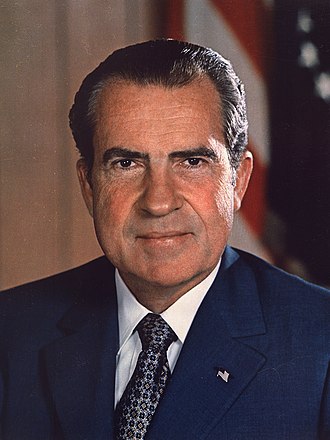
Richard M. Nixon served as the 37th President of the United States from January 1969 until his resignation in August 1974. In February 1971, he ordered the installation of a secret voice-activated taping system in the White House to preserve a historical record of his administration. Until the system's existence was revealed and dismantled in July 1973, the tapes captured Nixon directing major foreign policy initiatives, such as the opening to China, as well as his central role in the Watergate cover-up.
What Nixon talks about on the tapes
White House operations 4,718Presidential scheduling 2,225Public relations 1,784Presidential schedule 1,782Vietnam War 1,693Logistics 1,650Manolo Sanchez 1,626White House communications 1,400White House administration 1,399Presidential communication 1,243Henry Kissinger 1,191Foreign Policy 1,183
Conversations (21,010)
— Page 36 of 211President Nixon, George Shultz, and Alexander Butterfield met briefly in the Oval Office to coordinate logistics regarding the President's schedule. The conversation focused on the arrival of a bicycle and the necessity of follow-up communication. The participants concluded the meeting quickly to attend to these immediate administrative tasks.
President Nixon and H. R. Haldeman met to coordinate preparations for an upcoming press conference, specifically focusing on messaging regarding domestic economic policy. The pair reviewed the logistics and attendee list for a scheduled excursion on the presidential yacht Sequoia, which included key administration figures like John Mitchell, Henry Kissinger, and Donald Rumsfeld. Additionally, they discussed the development of briefing materials for the press event, with Patrick Buchanan tasked to assist in preparing potential questions.
President Nixon met with his valet, Manolo Sanchez, in the Old Executive Office Building to discuss logistics regarding his upcoming public schedule. The brief interaction centered on the President's preparation for photography sessions. No major policy decisions were made during this exchange, which focused primarily on routine administrative planning.
President Nixon coordinated the logistics and attendance for a high-level meeting scheduled for August 10, 1971. The discussion centered on finalizing the timing for this session and confirming the participation of key individuals regarding the ongoing international monetary situation. The parties reached an agreement to hold the meeting at 4:30 pm to address these pressing economic matters.
President Nixon initiates a brief administrative request to the White House operator to place a telephone call to George P. Shultz. The conversation consists solely of the President's instructions to connect him with Shultz, then serving as the Director of the Office of Management and Budget. No further policy discussions or significant decisions occur during this brief exchange.
President Nixon and George P. Shultz met to discuss preparations for a forthcoming meeting, focusing on the current international monetary situation and the potential for a perceived economic crisis. The participants also addressed pending HEW legislation, specifically evaluating the political feasibility of sustaining a potential presidential veto in Congress. Additionally, the President requested a review of retail sales figures to better gauge the national economic outlook before their next high-level consultation.
President Nixon and H. R. Haldeman briefly conferred regarding the logistics and attendance for an upcoming meeting involving John B. Connally. The discussion focused on finalizing the participant list and coordinating the schedule for this session. No major policy decisions were made during this brief administrative exchange.
President Nixon met briefly with Alexander P. Butterfield in the Old Executive Office Building to review the President's schedule. This short interaction served as a logistical check-in regarding upcoming appointments and administrative planning. No substantive policy matters or major decisions were recorded during this brief encounter.
President Nixon met briefly with his personal valet, Manolo Sanchez, in the Old Executive Office Building. The primary purpose of this brief interaction was for the President to request assistance with his glasses. No substantive policy matters or political discussions were recorded during this short exchange.
President Nixon met with his personal secretary, Rose Mary Woods, to discuss personal administrative matters and the logistics of recent presidential travel. The conversation touched upon the President’s recent trip to New Hampshire and Maine, including details regarding his stay on Minot Island and associated correspondence with Jack J. Dreyfus. Additionally, the participants reviewed the schedules of Tricia Nixon Cox and Julie Nixon Eisenhower, and Woods prepared for an upcoming meeting with H.R. Haldeman regarding personnel nominations and recommendations involving Herbert G. Klein.
President Nixon met with John Connally and H.R. Haldeman to finalize a comprehensive economic program intended to stabilize the dollar and address international monetary instability. The discussion focused on the risks of premature leaks, specifically regarding media reports that could trigger global financial panic, and the strategic timing of announcing major policy shifts such as a potential wage-price freeze and changes to gold conversion. Connally and the President emphasized the need for absolute confidentiality among staff and Treasury officials to ensure the administration could implement its economic reforms as a single, cohesive package.
President Nixon met with his staff and political advisors to discuss his upcoming schedule, including preparations for a press conference and strategies regarding upcoming Republican National Committee meetings. The discussion focused heavily on political optics, specifically planning disruptive tactics to target Democratic rivals Edmund Muskie, Hubert Humphrey, and Edward Kennedy at an AFL-CIO convention in Dallas. Nixon and his team strategized using public protests, such as anti-busing demonstrations, to manipulate press coverage and create political friction for his opponents.
President Nixon met with Alexander P. Butterfield to coordinate administrative logistics regarding his daily schedule. The discussion centered on the location and arrangements for a meeting with Attorney General John N. Mitchell in the Situation Room. Additionally, the two addressed matters pertaining to the President's personal secretary, Rose Mary Woods.
President Nixon met with John Mitchell, H.R. Haldeman, and Henry Kissinger to address serious unauthorized leaks of sensitive government documents, specifically a Kissinger memorandum regarding talks with Chou En-lai and a proposed "gold window" economic policy. The President expressed intense frustration over the disclosures in Paul Scott’s column and directed his staff to identify the sources, suspecting potential leaks from the Treasury Department or the Council of Economic Advisers. Additionally, the group discussed political strategies for managing the Kent State grand jury announcement, handling the Teamsters' request for Jimmy Hoffa's pardon, and balancing the President's public appearances before veterans' organizations.
President Nixon and Alexander P. Butterfield met briefly in the Oval Office to coordinate logistics for an upcoming photograph session in the mess. The discussion focused on scheduling preparations and the necessity of planning the event effectively. The conversation concluded with the President confirming his availability to accommodate these arrangements.
President Nixon met with a group of newly appointed assistant secretaries and administrators from various federal agencies to formally welcome them into his administration. During the brief gathering, the President emphasized the importance of their public service roles, distinguishing those who serve to 'do something' from those who merely seek status. The meeting concluded with Nixon presenting the appointees with presidential gifts, including golf balls and cufflinks, as a gesture of appreciation for their upcoming work on key domestic and foreign policy issues.
President Nixon met with Deputy Assistant Alexander P. Butterfield to review and coordinate the President's upcoming schedule. The discussion centered on finalizing arrangements for meetings with key figures, including Chairman of the Council of Economic Advisers Paul W. McCracken and Ambassador Ellsworth F. Bunker. This session served to ensure the President's administrative agenda remained aligned with his strategic priorities.
President Nixon met with economic advisor Paul W. McCracken to discuss the precarious state of the national economy and the impending crisis in international monetary affairs. McCracken provided a memorandum outlining potential responses to the weakening dollar, including the possibility of closing the gold window and allowing the currency to float. Nixon emphasized the need for extreme secrecy regarding these plans to prevent leaks and indicated his desire for a deliberate, rather than reactive, approach to handling the potential economic instability.
President Nixon met with an unknown individual in the Oval Office to briefly discuss the scheduling arrangements for George P. Shultz. The meeting lasted no more than two minutes and focused exclusively on coordinating the Director of the Office of Management and Budget's availability. No further policy discussions or significant strategic decisions were recorded during this brief encounter.
President Nixon met with George P. Shultz to orchestrate a comprehensive and dramatic economic package, including a wage-price freeze, the closing of the gold window, and potential import taxes. The President emphasized the need for strict message control to prevent leaks from officials like McCracken, Peterson, and Connally, which could trigger a run on the dollar. Shultz was tasked with preparing materials for Congressional testimony and coordinating with Arthur Burns regarding the implementation of the Wage and Price Board, with the President stressing that the effort must appear decisive to restore public confidence.
President Nixon met with Ellsworth Bunker and Henry Kissinger to discuss the volatile political and military situation in South Vietnam, specifically focusing on the upcoming elections and the strained relationship between President Nguyen Van Thieu and Duong Van Minh. The participants reviewed the effectiveness of U.S. military aid, the status of ongoing negotiations with North Vietnam, and the broader geopolitical implications of Nixon's planned trip to China. Nixon emphasized the necessity of maintaining robust military support for South Vietnam, including the provision of M-48 tanks, despite expected domestic political opposition.
President Nixon consulted with George Shultz regarding the political strategy for two pending bills, relaying concerns raised by John Connally about the timing of potential vetoes. Connally advised against immediate action, arguing that the administration had not yet established the necessary political predicate to justify a veto to Congress. Consequently, the President decided to delay his final decision pending further analysis of the administration's leverage and the likelihood of successfully challenging Congress.
President Nixon contacted the White House operator to facilitate a telephone connection with special counsel Charles W. Colson. The brief exchange served as an administrative request to reach a key member of the White House staff. No other substantive policy or political matters were discussed during this brief logistical communication.
President Nixon met with his personal aide, Manolo Sanchez, for a brief, informal discussion regarding his schedule and personal matters. The conversation shifted between lighthearted observations about diplomatic appointments and a brief, cryptic reflection on maintaining resolve in the face of ongoing challenges. The meeting concluded with Nixon extending a social invitation for lunch to Sanchez's wife.
President Nixon and Stephen B. Bull met briefly in the Oval Office to coordinate administrative logistics regarding the President's upcoming schedule. The discussion focused on arrangements for a bill signing ceremony and the procurement of a specific chair for the event. This meeting served as a routine planning session to ensure protocol was maintained for the President's public engagements.
President Nixon met with his personal secretary, Rose Mary Woods, and aide Stephen B. Bull to review his upcoming schedule and manage personal administrative tasks. The discussion included brief coordination regarding upcoming meetings with key staff members, including Alexander Butterfield, Ronald Ziegler, H. R. Haldeman, and Charles Colson. A significant portion of the session involved personal matters, which were subsequently withdrawn from public record.
President Nixon and Charles Colson discuss strategies for challenging the credibility of television news networks, specifically citing favorable reports of support for the President in New Hampshire. They highlight the positive reactions from Senator Norris Cotton regarding ABC's coverage and express a desire to continue pressuring media outlets to counter perceived liberal bias. The conversation concludes with a focus on leveraging public opinion and media analysis, such as the work of Edith Efron, to undermine the networks' influence.
President Nixon contacted the White House operator to facilitate an outgoing call to his special counsel, Charles W. Colson. This brief communication served solely as a logistical request to initiate a conversation with a key member of the administration. No further policy or administrative matters were discussed during this exchange.
President Richard M. Nixon met with Alexander P. Butterfield in the Oval Office to facilitate an urgent administrative request. The primary purpose of this brief interaction was for the President to summon Henry A. Kissinger for a consultation. Following the exchange, Butterfield departed to carry out the President's instructions.
President Nixon and Alexander P. Butterfield met in the Oval Office to coordinate administrative logistics regarding Henry Kissinger's schedule. The brief discussion served to align the President's priorities with the National Security Advisor's upcoming appointments. No major policy decisions were recorded during this exchange.
President Nixon met with H.R. Haldeman and Henry Kissinger to discuss personnel changes, press relations, and upcoming strategic initiatives. The group reviewed the President's public image, specifically criticizing the media's use of negative adjectives and tone, while coordinating a strategy to promote a media study by Edith Efron. They also reviewed foreign policy issues, including arms control and upcoming diplomatic efforts with China, and addressed the need for strict internal secrecy regarding pending economic policy decisions.
President Nixon met with the Joint Chiefs of Staff, Vice President Agnew, and key defense officials to review the military’s fiscal year 1973 budget and strategic posture. The Joint Chiefs presented briefings on the shifting global military balance, particularly the expansion of Soviet strategic and conventional forces, and argued that current fiscal constraints threatened the effectiveness of the Nixon Doctrine. The President emphasized the need to build a compelling public and congressional case for defense requirements to counter an anti-military climate, while acknowledging the severe domestic fiscal pressures he faced.
President Nixon and Charles W. Colson discuss the media's failure to provide significant coverage of positive retail sales statistics, noting that only NBC reported on the data to provide balance to their broader economic criticism. Colson explains that the administration relied on Harold Passer to disseminate the figures and clarifies that the data reflected a revision of existing weekly reports rather than a major new development. Nixon expresses frustration over the lack of press attention, highlighting the importance of the 15% sales increase as an encouraging economic indicator.
President Nixon contacted the White House operator to facilitate an urgent communication with Secretary of the Treasury John B. Connally. The interaction served as a logistical step to initiate a broader discussion between the two officials. No further substantive policy matters were addressed during this brief exchange.
This recording captures informal, pre-meeting exchanges in the Cabinet Room between White House staff, including Oliver Atkins, and members of a visiting Cambodian delegation led by Sisowath Sirik Matak. The discussion primarily centers on logistical arrangements for the delegation's upcoming schedule, the management of press access, and general pleasantries regarding White House protocol and history. No substantive policy negotiations between President Nixon and the delegation occurred during this specific segment of the recording.
President Nixon and Alexander Butterfield met to review the exchange of diplomatic gifts between the President and Prime Minister Lon Nol of Cambodia. The discussion centered on the specific items presented, including a clock and flowers given by the White House, and a silver urn and gold ruby necklace received in return. This meeting served as a procedural wrap-up of the gift-giving protocols associated with the Prime Minister's visit.
President Nixon met with Cambodian Prime Minister Sisowath Sirik Matak to discuss the military and political situation in Cambodia amidst the ongoing Vietnam War. The discussion focused on Cambodia's defense strategy, the resilience of the Cambodian people against North Vietnamese aggression, and concerns regarding the regional impact of U.S. troop withdrawals from South Vietnam. Nixon reaffirmed the U.S. commitment to Asian independence and maintaining a military presence in the Pacific to prevent communist domination, while emphasizing that regional nations must ultimately bear the primary responsibility for their own defense.
President Nixon met with Aldo F. DiChiara, Crensenzi W. Castaldo, and George T. Bell for a brief ceremonial visit that included a photo opportunity and the presentation of gifts, such as cufflinks and presidential seals. The participants engaged in light conversation regarding the 1964 presidential campaign and Barry Goldwater before discussing Nixon's upcoming speaking engagements, including an address to the Veterans of Foreign Wars. The group also briefly touched upon federal assistance for parochial schools and expressed their organizational support for the President.
President Nixon met with Alexander P. Butterfield to coordinate the logistics of an upcoming meeting with Jon M. Huntsman. The brief discussion served to finalize the President's schedule regarding this visit. No other policy matters were addressed during this exchange.
President Nixon met with A. Blaine Huntsman and Jon M. Huntsman in the Oval Office for a brief, ceremonial encounter. A White House photographer was present to document the session, which centered on the formal exchange of gifts, specifically golf balls. The meeting concluded after approximately one minute with no substantive policy matters discussed.
President Nixon and H. R. Haldeman met to coordinate staffing and public relations strategies, including the management of First Lady Pat Nixon's upcoming trips and regional political outreach efforts. They also discussed the professional development and salary adjustments for staff members within the First Lady's office, specifically addressing the compensation of Julie Robinson relative to her colleagues. Additionally, the President reviewed administrative concerns regarding Senator Edward Gurney's relationship with the White House and potential public outreach opportunities at Glacier National Park.
President Nixon met with Alexander P. Butterfield and Stephen B. Bull to coordinate his daily schedule and manage pending administrative tasks. Key discussions centered on the timeline for an urgent appropriations bill and the logistics of a White House tour for broadcaster Paul Harvey. Nixon sought to streamline these appointments to accommodate upcoming meetings with the Council of Economic Advisers and other staff members.
President Nixon summoned the White House operator to his office to assist with initiating a telephone call. The exchange serves as a brief administrative interaction to facilitate communication. No substantive policy matters or political developments were addressed during this short encounter.
President Nixon and Treasury Secretary John Connally discussed the status of ongoing economic pressures and Connally's travel plans. Nixon emphasized the importance of consulting with the Joint Chiefs of Staff regarding military budget allocations before finalizing the administration's fiscal planning. Both parties agreed that Connally should proceed with his scheduled trip, as he remained easily reachable by telephone to manage economic developments.
President Nixon and Secretary of the Treasury John Connally discussed the implementation schedule for a major economic policy plan, confirming the intent to proceed with their original timeline rather than accelerating it. The participants touched upon administrative logistics and the necessity of coordinating with the Joint Chiefs regarding budget preparations. They concluded the brief exchange by finalizing travel plans and affirming their commitment to the established strategic agenda.
President Nixon and Alexander Butterfield coordinate the logistics and movement of a visitor through the White House residence. The brief exchange focuses on ensuring the individual’s arrival and departure are managed discreetly, including confirming the visitor's awareness of their schedule. The discussion concludes with procedural instructions regarding the guest's path through the executive complex.
President Nixon met with Kenneth R. Cole, Jr. and George P. Shultz to discuss budget overages in the Agriculture and Labor-HEW appropriations bills. The participants evaluated the political feasibility of a veto, concluding that the Labor-HEW bill lacked the necessary support to sustain a veto while the Agriculture bill presented a difficult political optics challenge due to attached HUD water and sewer grants. Ultimately, the President decided to sign the bills rather than pursue a veto, opting instead to direct agencies like the OMB to manage budget outlays through administrative strategies such as impounding funds or delaying grants.
President Nixon dictates a letter to his personal secretary, Rose Mary Woods, addressed to Senator Norris Cotton regarding a recent trip to New Hampshire. The conversation shifts to a discussion about a recent White House church service and the President's explicit refusal to cooperate with the New York Times. Nixon expresses clear resentment toward the newspaper, emphasizing that his staff was instructed to avoid assisting them with their reporting.
President Nixon met with his personal aide, Stephen B. Bull, to conduct an administrative review of his daily schedule. This brief session served to manage the President's upcoming commitments and logistical arrangements within the Oval Office. No major policy initiatives were recorded, as the discussion remained focused on routine executive time management.
President Nixon met with broadcaster Paul Harvey and aide Harry S. Dent to discuss the cultural divide in America, specifically contrasting the "liberal elite" with the values of the nation's "heartland" and working class. The conversation focused on the influence of media, academia, and religion on public opinion regarding the Vietnam War, law enforcement, and traditional patriotism. Nixon articulated his belief that political success depended on appealing to the middle and working classes who remained committed to traditional values despite the influence of the intellectual establishment.
President Nixon met with Alexander P. Butterfield to address administrative matters concerning the President's daily schedule. Specifically, the discussion centered on coordinating a meeting with Thomas R. Shepard, Jr. The brief exchange served to finalize these scheduling arrangements for the President's calendar.
President Nixon met with Thomas R. Shepard, Jr. and H.R. Haldeman to discuss strategies for addressing the perceived moral crisis and lack of leadership within the American intellectual and opinion-making classes. Nixon expressed deep frustration with the media, academia, and business elites, characterizing them as self-destructive and lacking the conviction of the 'silent majority.' The conversation focused on the need to cultivate a more patriotic, constructive narrative to counteract the negative influence of these groups, with Nixon encouraging Shepard to continue using his public platform to advocate for these values.
President Nixon met with his Council of Economic Advisers, including Paul McCracken, Herbert Stein, and George Shultz, to assess the current state of the national economy and evaluate potential administration interventions. The discussion focused on economic indicators, inflation, and the political and psychological impact of potential wage and price controls. Nixon emphasized the need for confidentiality regarding major policy shifts, such as closing the gold window, while the group weighed various stimulus options, including tax relief and investment tax credits, to spur business confidence and consumer spending.
President Nixon met with his aide Stephen B. Bull to coordinate logistical details and discuss the agenda for an upcoming meeting with Billy Graham. The discussion focused on finalizing scheduling arrangements and defining the scope of the conversation intended for the evangelist. No formal policy decisions were recorded during this brief administrative planning session.
President Nixon met with Billy Graham and a large delegation of religious and civic leaders, including representatives from the First Baptist Church of Dallas and various educational and charitable organizations, to engage in general conversation and group introductions. The discussion touched upon the President’s recent travels, potential future visits, and coordination for a White House church service. Additionally, the President and Graham briefly discussed the importance of foreign policy briefings and the influence of religious figures in public life.
President Nixon met with Peter M. Flanigan to address pending policy decisions regarding petrochemicals and international textile trade. The discussion focused on evaluating options for oil import policies and the political implications of utilizing the national security clause to manage textile negotiations with Japan. Flanigan reported on consultations with various Cabinet members and congressional figures, emphasizing the need for timely decisions to navigate complex industry pressures and diplomatic relations.
President Nixon and George Shultz met to evaluate the current state of the national economy and assess the feasibility of implementing a wage and price freeze to combat inflation. They discussed various economic indicators, including retail sales and GNP, while considering the necessity of a dramatic policy shift to stabilize the business environment. Additionally, the pair coordinated on administrative matters, specifically the postponement of federal pay increases and staffing levels for the Jobs for Veterans program.
President Nixon held a brief meeting in the Oval Office with an unidentified individual to review his daily schedule. The discussion focused on coordinating the President's upcoming appointments and logistical arrangements for the day. No substantive policy decisions were documented during this short exchange before the participant departed.
President Nixon contacted the White House operator to initiate a call to professional baseball player Harmon Killebrew of the Minnesota Twins. The President requested that the operator locate Killebrew, who was believed to be in Bloomington, Minnesota, at the time. This brief interaction served solely to facilitate personal communication between the President and the athlete.
President Nixon consulted with the White House operator to facilitate a communication with Carmen Kildrew, who was affiliated with the Minnesota Twins baseball team. The discussion centered on confirming the recipient's interest in receiving a message from the President. The exchange concluded with an affirmative expectation that Kildrew would be receptive to the outreach.
President Nixon and Henry Kissinger discuss coordinating a meeting involving H.R. Haldeman to clarify specific administrative or strategic objectives. The President emphasizes his desire to establish clear expectations and ensure that all parties are aligned regarding the intended focus of the discussion. This brief interaction serves as a preparatory step to streamline communication and firm up the agenda for the subsequent meeting.
President Nixon met with H. R. Haldeman and Henry Kissinger to discuss sensitive foreign policy initiatives, including the upcoming secret negotiations with the Soviet Union and planning for his potential visits to China and Moscow. The President emphasized a strict information blackout regarding these trips, directing that the New York Times be excluded from access, and expressed his frustration with media coverage, specifically an interview involving James Reston and Zhou Enlai. Additionally, they reviewed domestic political concerns, including responding to urban issues and the President's stance on busing, while finalizing public relations strategies for his upcoming diplomatic agenda.
President Richard Nixon called Major League Baseball player Harmon Killebrew to congratulate him on reaching the milestone of 500 career home runs. The two discussed Killebrew’s recent recovery from a foot injury, the legacy of former Washington Senators players, and the player's enduring popularity with the Nixon family. During the conversation, the President offered words of encouragement and promised to send Killebrew a presidential golf ball as a token of his support.
President Nixon met with his personal valet, Manolo Sanchez, in the Oval Office to address administrative and service-related needs. The brief exchange focused primarily on the President's request for refreshment, specifically coffee. No significant policy discussions occurred during this interaction.
President Nixon met with aide Stephen B. Bull to coordinate administrative logistics and manage his daily schedule. The discussion centered on finalizing the location for an upcoming meeting with John D. Ehrlichman, selecting between the Oval Office and the Executive Office Building, and managing the queue for pending bill signings. Additionally, the President issued a brief instruction to Manolo Sanchez regarding a delay on a specific, unspecified action.
President Nixon met with Stephen B. Bull and Manolo Sanchez to coordinate his daily schedule and logistical arrangements for upcoming appointments. The discussion focused on the venue for a meeting with John D. Ehrlichman, specifically debating the preference between the Oval Office and the Executive Office Building, as well as the processing of various bill signings. Additionally, the participants touched upon the First Lady’s schedule at Wolf Trap and the coordination of presidential appearances.
President Nixon held a brief meeting in the Oval Office with an unidentified individual, which concluded shortly after initial greetings were exchanged. Due to the limited duration and the lack of a recorded transcript, the substance of the discussion remains unavailable for analysis. No significant policy decisions or administrative actions were documented during this short interaction.
President Nixon, John Ehrlichman, and Ronald Ziegler met to coordinate administration strategy regarding news leaks, classification policies, and the public handling of the Pentagon Papers. The President emphasized his commitment to a new, stricter classification system while justifying past actions as necessary for protecting sensitive foreign negotiations, such as those with China and the Soviet Union. The group also discussed the management of busing policy, the possible retirement of J. Edgar Hoover, and upcoming domestic policy initiatives, including welfare reform and revenue sharing.
President Nixon and H. R. Haldeman met to coordinate upcoming schedule adjustments and strategy sessions regarding speechwriting. The discussion focused on organizing individual meetings with speechwriter Raymond K. Price, Jr. and advisor George P. Shultz to refine the President's public messaging. Nixon directed Haldeman to structure these appointments to ensure direct, separated consultations for each project.
President Nixon held a brief meeting with an unidentified individual to facilitate a scheduled appointment with Charles W. Colson. The discussion served as a logistical arrangement to ensure a future consultation between the President and his special counsel. No substantive policy matters were addressed during this short exchange.
President Nixon and H. R. Haldeman coordinate the scheduling of afternoon appointments, specifically finalizing the timing for a meeting with Henry Kissinger's review group. They agree to relocate the three o'clock session to the Executive Office Building to accommodate the President's work schedule. The discussion concludes with the scheduling of an additional meeting with an unnamed individual at four o'clock.
President Nixon and H. R. Haldeman met briefly to finalize details regarding the President's upcoming schedule. The primary focus of the discussion was confirming a meeting or event involving the Executive Office Building (EOB). The conversation concluded with the pair agreeing to a three o'clock appointment.
President Nixon contacted the White House operator to facilitate a telephone connection with his Chief of Staff, H.R. Haldeman. This administrative interaction served as a logistical step to initiate a direct conversation between the President and his senior aide. No further substantive policy matters were discussed during this brief exchange.
President Nixon met with staff members, including Ronald Ziegler, Charles Colson, and H.R. Haldeman, to discuss a range of domestic and political issues, including school desegregation policy and public relations strategies. The conversation focused on exploiting political divisions among Democrats regarding the Pentagon Papers and the Vietnam War, and preparing for future economic messaging during the autumn. Additionally, Nixon addressed concerns over a potential security breach involving lost personal notes from a trip to Indiana and coordinated upcoming administrative schedules and briefings.
President Nixon met with his personal valet, Manolo Sanchez, in the Old Executive Office Building to discuss personal administrative matters. The brief interaction focused on the President's immediate schedule and the handling of various items within the office. No significant policy decisions were made during this informal exchange.
President Nixon met with his personal valet, Manolo Sanchez, in the Old Executive Office Building to review the President's upcoming professional schedule. This informal consultation served to coordinate administrative logistics and manage the President's daily agenda. No further significant policy developments or strategic decisions were recorded during this brief administrative interaction.
President Nixon and Henry Kissinger coordinate their schedules for an upcoming discussion, deliberating on whether to meet immediately at the Executive Office Building or communicate via telephone later. The brief exchange focuses on logistical arrangements to facilitate a follow-up consultation involving key staff members. Ultimately, they agree to delay the substantive discussion, with the President initiating the next point of contact.
President Nixon met with Henry Kissinger, Adm. Thomas Moorer, and other administration officials to strategize on the escalating India-Pakistan crisis, specifically aiming to prevent an outbreak of war. The discussion emphasized a policy of U.S. neutrality and the importance of avoiding public pressure on Pakistan while encouraging quiet, behind-the-scenes diplomatic efforts to reach a political accommodation. Nixon decided to send representatives to explore humanitarian relief options as a pragmatic vehicle to facilitate these sensitive political conversations with Pakistani leader Yahya Khan.
President Nixon met with George P. Shultz to coordinate upcoming meetings with staff members Raymond K. Price, Jr. and Peter G. Peterson regarding economic policy and scheduling. The President expressed frustration with ongoing administrative challenges and tasked Shultz with reviewing data related to Peterson's portfolio. Additionally, the discussion touched on the controversial application of national security powers concerning textile trade negotiations involving Peter M. Flanigan.
President Nixon met with his valet, Manolo Sanchez, to coordinate the retrieval of personal items from the Lincoln Room. The conversation focused on locating and bringing the President's pipes to his office in the Executive Office Building. This brief interaction highlights the routine administrative and personal assistance provided by the domestic staff to the President.
President Nixon met with H.R. Haldeman and Raymond Price to discuss administrative strategy regarding internal economic policy disputes and the development of his upcoming radio addresses. The President expressed frustration with ongoing infighting among his advisors—specifically involving John Mitchell, Peter Flanigan, and David Kennedy—concerning textile import quotas and Japan-related trade issues, ordering Haldeman to unify these factions. Additionally, Nixon provided editorial guidance for his future radio broadcasts, emphasizing a patriotic, upbeat tone focused on the dignity of work, the American spirit, and religious heritage to counter negative public sentiment.
President Nixon and George Shultz met to deliberate on the implementation of a major new economic program, specifically focusing on the necessity of a wage-price freeze and a potential import tax to combat inflation and restore public confidence. They discussed the legal and political complexities of these actions, weighing the risks of such measures against the need for U.S. economic leadership and stability. Henry Kissinger joined the meeting briefly to coordinate on international affairs, including the Accidental War Agreement and diplomatic relations with China and the Soviet Union, before the conversation returned to the logistical challenges of the domestic economic agenda, including federal budget cuts and public communication strategies.
President Nixon and H. R. Haldeman discuss the overwhelming influence of television news on public perception and the modern political landscape. The conversation reflects a mutual desire for a reprieve from the intense, constant media cycle surrounding domestic and international affairs. Beyond these observations, they briefly touch upon political developments regarding key figures like John V. Lindsay and shifting party affiliations.
President Nixon instructed the White House operator to initiate a telephone connection with National Security Advisor Henry Kissinger. This brief administrative exchange served to facilitate high-level communication between the President and his advisor. No substantive policy discussions occurred during this specific call segment.
President Nixon and Henry Kissinger discuss coordinating a diplomatic signing ceremony with Soviet Foreign Minister Andrei Gromyko, slated for September 30th, and the necessity of managing State Department involvement through William Rogers. The conversation also addresses the administration's fiscal strategy, specifically balancing the push for increased national security and defense spending against the political liability of raising taxes. Nixon directs Kissinger to coordinate with George Shultz and David Packard to develop a budget approach that maintains military strength without necessitating immediate tax hikes.
President Nixon utilized the White House operator to facilitate a bridge connection between himself, his personal secretary Rose Mary Woods, and OMB Director George P. Shultz. The brief interaction served primarily as a logistical coordination to initiate a private consultation with Shultz. No substantive policy matters were discussed during this initial operator-assisted connection.
President Nixon directed George P. Shultz to coordinate with Henry Kissinger and David Packard to finalize a defense budget that maintains national security interests. Additionally, Nixon instructed Shultz to consult exclusively with John Ehrlichman regarding a sensitive, separate initiative while specifically excluding other staff members like Peter Peterson and H.R. Haldeman to ensure strict confidentiality. Nixon emphasized the need for compartmentalization, advising Shultz to keep John Connally uninformed of the broader strategy so he could maintain honest deniability with the press.
President Nixon consulted with his secretary, Rose Mary Woods, regarding an individual claiming to possess the President's personal notes. Nixon expressed relief after Woods confirmed the man—a government employee—had no such documentation and had fabricated his claims. The President subsequently detailed his meticulous security procedures for handling sensitive scheduling materials while traveling to prevent potential leaks or security breaches.
President Nixon instructed the White House operator to place an outgoing call to California Governor Ronald Reagan. This brief administrative interaction served as the necessary logistical step to facilitate a direct conversation between the President and the Governor. No further policy discussions or substantive developments occurred during this brief exchange.
President Richard Nixon and California Governor Ronald Reagan spoke to coordinate their respective schedules for upcoming travel and to arrange a meeting during the President's planned trip to California. The two discussed the political implications of New York City Mayor John Lindsay's recent party affiliation change and touched upon upcoming diplomatic developments. Nixon emphasized the importance of these confidential foreign policy matters and instructed Reagan to receive a formal briefing from Henry Kissinger regarding these hopeful, non-public affairs.
President Nixon initiated a call through the White House operator to contact Hobart D. Lewis, the president and editor-in-chief of Reader's Digest. The primary purpose of this brief interaction was to facilitate a direct line of communication between the President and the publishing executive. No substantive discussion occurred between the President and the operator, as the exchange served solely as an administrative step to connect the two parties.
President Nixon consulted with Reader's Digest editor Hobart D. Lewis regarding political optics, the status of the economy, and the administration’s foreign policy initiatives. Nixon previewed his upcoming national travel schedule, emphasizing that his team was actively working to address public concerns about economic conditions. The discussion also touched upon engaging conservative opinion leaders and coordinating a forthcoming meeting between Henry Kissinger and William F. Buckley, Jr. to build broader support for the President's agenda.
President Nixon contacted the White House operator to facilitate private communications with two key associates. He explicitly requested to be connected with his close friend Charles G. "Bebe" Rebozo and subsequently asked to reach speechwriter and advisor Patrick J. Buchanan. This exchange served as an administrative bridge to initiate these two specific telephone conversations.
President Nixon contacted the White House operator to facilitate a telephone connection with Patrick J. Buchanan. The brief exchange served as an administrative request to reach the presidential advisor. No substantive policy matters were discussed during this short communication.
President Nixon consulted with the White House operator regarding the location of his friend Bebe Rebozo. After learning that Rebozo was traveling to Walter Caves, the President decided to cancel the call rather than leave a message. The conversation concluded with the operator receiving instructions to place a new call to Patrick J. Buchanan instead.
President Nixon and Patrick J. Buchanan engaged in a broad strategic discussion regarding the shifting political landscape and the prospective field of Democratic presidential candidates. The conversation examined the recent statements and political maneuverings of figures like Henry “Scoop” Jackson, John V. Lindsay, and George McGovern, while analyzing party dynamics related to the Vietnam War and social issues. This dialogue served to refine the administration’s understanding of opposition vulnerabilities and the evolving challenges posed by various Democratic factions ahead of the upcoming election cycle.
President Nixon contacted the White House operator to facilitate an outgoing call to Senator Barry M. Goldwater. This brief exchange served as a logistical step to initiate a direct line of communication between the President and the Senator. No further substantive policy discussions were recorded during this connection.
President Nixon consulted with the White House operator to facilitate a telephone call to Senator Barry Goldwater. The operator confirmed that the Senator was currently located in Arizona and proposed using a specific contact number to reach him. Nixon authorized the operator to proceed with the attempt to establish the connection.
President Nixon contacted the White House operator to facilitate a telephone connection with Chicago Mayor Richard J. Daley. The brief exchange served as an administrative request to reach the Mayor for a direct conversation. No other substantive political or policy discussions were addressed during this brief bridge to the call.
President Nixon and Senator Barry Goldwater discuss the political implications of New York City Mayor John V. Lindsay’s shift in party affiliation and the associated frustrations within the Republican Party. They touch upon the views of Ronald Reagan and the historical context of supporting Nelson Rockefeller, reflecting a shared antipathy toward Lindsay’s political trajectory. The conversation concludes with brief personal pleasantries regarding the President’s upcoming travel to California.