Nixon, Richard M. (President)
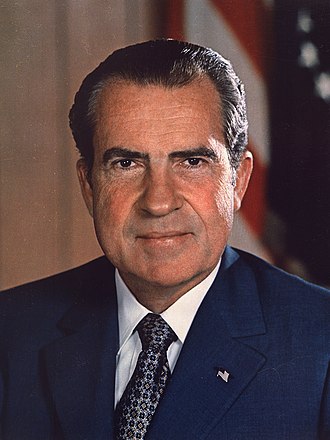
Richard M. Nixon served as the 37th President of the United States from January 1969 until his resignation in August 1974. In February 1971, he ordered the installation of a secret voice-activated taping system in the White House to preserve a historical record of his administration. Until the system's existence was revealed and dismantled in July 1973, the tapes captured Nixon directing major foreign policy initiatives, such as the opening to China, as well as his central role in the Watergate cover-up.
What Nixon talks about on the tapes
White House operations 4,718Presidential scheduling 2,225Public relations 1,784Presidential schedule 1,782Vietnam War 1,693Logistics 1,650Manolo Sanchez 1,626White House communications 1,400White House administration 1,399Presidential communication 1,243Henry Kissinger 1,191Foreign Policy 1,183
Conversations (21,010)
— Page 83 of 211President Nixon and John Ehrlichman discuss political strategy, focusing on the need to moderate public rhetoric regarding tax reform to avoid it becoming a political liability. The President instructs Ehrlichman to coordinate with a political associate to ensure alignment on administration objectives and to maintain a strong, proactive stance in upcoming policy deliberations. Additionally, the conversation touches upon the status of legal services reform and internal administration morale regarding regional political outreach.
President Nixon initiates a brief telephone call through the White House operator to contact his aide, Stephen B. Bull. The exchange serves solely as a logistical request to establish a direct line of communication with Bull. No further administrative details or substantive policy matters are addressed in this short operator-assisted connection.
President Nixon met with Reader's Digest editor Hobart D. Lewis to advocate for a follow-up article highlighting the administrative successes of New Jersey Governor William T. Cahill. Nixon emphasized Cahill’s accomplishments in environmental policy, education reform, and his efforts to combat corruption, contrasting these achievements with past negative portrayals of the state. The discussion served as an editorial pitch to improve the public perception of the Cahill administration through the magazine's national platform.
President Nixon initiated a brief, informal communication with the White House operator from his office in the Old Executive Office Building. The exchange consisted of a singular, colloquial greeting rather than a discussion of policy or official business. No substantive developments, decisions, or administrative actions occurred during this brief interaction.
President Nixon contacted his aide, Stephen B. Bull, to coordinate his personal schedule. The President requested that Bull arrange a haircut appointment for 5:30 that afternoon. Nixon further instructed that if the barber was unavailable at that time, the appointment should be rescheduled for the following day.
President Nixon met with his aide, Stephen B. Bull, to briefly discuss administrative staffing or scheduling matters. The President inquired about the possibility of arranging daily five-minute appointments for Bull, emphasizing the necessity of their regular communication. The brief exchange served as a directive for Bull to coordinate his availability to meet with the President on a consistent, daily basis.
President Nixon met with Governors Nelson Rockefeller, Ronald Reagan, William Milliken, and Linwood Holton to formally dictate letters of appreciation following a recent governors' dinner. The conversation highlights the administration's effort to maintain political cohesion and express gratitude for the participants' supportive remarks regarding his peace initiatives and policy agenda. These letters served to acknowledge the governors' contributions and reinforce existing alliances heading into a challenging political period.
President Nixon met with his personal aide, Manolo Sanchez, and an unidentified individual in the Old Executive Office Building. The discussion focused on administrative logistics, specifically regarding the handling of eyeglasses and a speech draft intended for Rose Mary Woods, potentially authored by Patrick J. Buchanan. The participants managed desk items and coordinated the transfer of documents during the brief interaction.
President Nixon and H.R. Haldeman met to coordinate the President's upcoming schedule and strategic planning. Their discussion focused on organizing logistics for Nixon’s impending trip to the People's Republic of China, as well as managing his appointments for March and April 1972. The two also reviewed polling materials to assess the political landscape during this critical period.
President Nixon, along with H.R. Haldeman, Ronald Ziegler, and Peter Flanigan, discussed strategies for responding to Senator Muskie's criticisms of the President's Vietnam peace proposal. They debated the best approach for public rebuttal, considering television appearances, press statements, and the potential impact of various responses on public perception and political maneuvering. The conversation also touched upon the upcoming press conference of Secretary Rogers and the President's recent Vietnam speech, including its television ratings and public reaction.
President Nixon and Peter M. Flanigan discuss the management of upcoming trade negotiations and the coordination of White House staff testimony. Nixon mandates that John B. Connally lead these presentations while strictly prohibiting White House aides like Peter G. Peterson and William D. Eberle from testifying. The two also address concerns regarding David M. Kennedy's role in textile negotiations, with Nixon agreeing to proceed with the CIEP subcommittee arrangement only after Flanigan confirms it will keep industry stakeholders satisfied.
President Nixon initiates a request through the White House operator to place a telephone call to National Security Advisor Henry A. Kissinger. This brief administrative exchange serves as the logistical bridge to facilitate a high-level consultation between the President and his advisor. No substantive policy matters were discussed during this brief connection.
President Nixon and Henry Kissinger discussed a coordinated public relations strategy to counter recent criticism from Senator Edmund Muskie regarding the administration's Vietnam policy. The two agreed to maintain a firm, unified stance through rebuttals from White House staff and congressional allies while dismissing the civil conflict in Northern Ireland as an internal matter. Furthermore, they reviewed military contingency plans for Vietnam, with Nixon directing the immediate deployment of air and naval assets to South Vietnam to prepare for a potential North Vietnamese offensive.
President Nixon and Secretary of State William P. Rogers discuss how to balance US diplomatic relations with Great Britain and Ireland amidst rising domestic political pressure and violence in Northern Ireland. They agree to avoid formal mediation or public condemnation of the British, while signaling a willingness to offer 'good offices' to help resolve the conflict and managing requests for meetings from Irish officials. Additionally, the President confirms his strategy to bolster military forces in South Vietnam while deferring aggressive action against North Vietnam until after his upcoming trip to the People's Republic of China.
President Nixon instructed the White House operator to connect him with special counsel Charles W. Colson. This brief administrative exchange served as the direct precursor to a substantive discussion between the President and one of his key political advisors. No further topics were addressed during this connection process.
President Nixon consulted with the White House operator to determine the current status and availability of Charles W. Colson. The President decided against immediate contact and directed the operator to postpone the attempt to reach Colson until the following day. No substantive policy matters were addressed during this brief administrative exchange.
President Nixon contacted the White House operator to facilitate a telephone connection with his personal secretary, Rose Mary Woods. The brief exchange served as a routine administrative request to place an outgoing call. No substantive policy matters or further developments were discussed during this short interaction.
President Nixon contacts the White House operator to initiate an outgoing call to Secretary of State William P. Rogers. The brief exchange serves as a functional request to connect the President with the Secretary for official government business. No further substantive discussion occurs during this short administrative interaction.
President Nixon met with Henry Kissinger, H. R. Haldeman, William Rogers, and Kenneth Keating to coordinate Administration responses to political challenges, specifically regarding Senator Edmund Muskie’s recent speeches and media criticism. The group discussed strategies to manage the fallout from the President's upcoming trip to China, focusing on framing the diplomatic effort as a necessary opening rather than a final conclusion. Additionally, they addressed the strained relationship between Treasury Secretary John Connally and David Kennedy, and prepared Ambassador Keating for upcoming Senate Foreign Relations Committee testimony regarding U.S. policy toward India, Pakistan, and Bangladesh.
President Nixon and Secretary of State William P. Rogers discuss the appropriate U.S. response to the escalating civil unrest in Ireland, emphasizing a statesmanlike, non-interventionist approach to avoid exacerbating tensions. Nixon advises Rogers to avoid making political capital out of the situation, noting the need to maintain diplomatic decorum with Great Britain. Additionally, Nixon cautions Rogers regarding a scheduled meeting with Russian poet Yevgeny Yevtushenko, warning him to be wary of the poet's intentions and to strictly limit photo opportunities.
President Nixon met with his aide, Stephen B. Bull, to coordinate administrative logistics regarding an upcoming meeting with Ambassador Ellsworth F. Bunker. The discussion focused on scheduling and preparations for this diplomatic consultation. Following the brief briefing, Bull departed the Oval Office.
President Nixon met with Ellsworth Bunker and Henry Kissinger to discuss the deteriorating situation in Vietnam and the upcoming diplomatic visit to the People's Republic of China. The conversation focused on bolstering military strength through increased bombing operations, the necessity of protective reaction strikes against North Vietnamese surface-to-air missile (SAM) sites, and the management of U.S. troop withdrawal announcements. Nixon emphasized the importance of Bunker remaining in his post to provide continuity during the expected communist spring offensive and forthcoming negotiations. Additionally, the group reviewed the status of U.S.-India relations and the potential for a residual military force in South Vietnam.
President Nixon met with his personal valet, Manolo Sanchez, in the Oval Office to discuss logistical details regarding the President's upcoming schedule. The conversation focused on managing the daily itinerary and coordinating professional obligations. No significant policy decisions were recorded during this brief administrative interaction.
President Nixon dictates a confidential memorandum to Secretary of State William P. Rogers to guide his upcoming discussions with Soviet Ambassador Anatoliy Dobrynin ahead of the Moscow summit. The President emphasizes a cautious approach toward the summit agenda, specifically regarding the Middle East, Vietnam, and SALT negotiations, while urging Rogers to avoid premature commitments or explicit references to linkage. Nixon further instructs that US trade and credit concessions should be utilized as strategic bargaining chips rather than early giveaways. Finally, the President mandates that these sensitive guidelines remain restricted to Rogers and Henry Kissinger to maintain tactical control over the diplomatic process.
President Nixon met with H. R. Haldeman and Henry Kissinger to discuss preparations for his upcoming trip to the People's Republic of China, including logistical arrangements and media strategy. The conversation centered on managing the professional friction between Secretary of State William Rogers and Kissinger, with Nixon emphasizing the need for a unified administration front to ensure the success and perception of his China initiative. Additionally, they reviewed domestic issues such as stock market performance, unemployment figures, and the President's upcoming schedule, which included a visit to Florida to provide a quiet environment for policy study.
Julie Nixon Eisenhower consulted the President regarding how to articulate the administration's stance on busing during her public appearances. President Nixon affirmed her critique of the policy's disadvantages and provided talking points emphasizing that, while legal segregation must be abolished to ensure educational equality, forced busing beyond neighborhood limits creates social chaos and results in inferior education. The conversation concluded with a brief coordination of the President's upcoming travel schedule to Florida.
President Nixon met with his personal aide, Stephen B. Bull, to clarify scheduling logistics. The discussion focused on confirming the timing for an upcoming appointment that had caused confusion. The meeting concluded with Nixon reassuring Bull to avoid unnecessary pressure regarding the schedule.
President Nixon met with H.R. Haldeman, Ronald Ziegler, and Henry Kissinger to strategize the administration's public relations response to Senator Edmund Muskie’s Vietnam speech and to analyze the latest North Vietnamese negotiation proposals. Following these internal policy discussions, the President met with Soviet poet Yevgeny Yevtushenko and interpreter Demitir Zarechnak to discuss U.S.-Soviet cultural relations and the geopolitical significance of Nixon's upcoming diplomatic trips to the People's Republic of China and the USSR. The conversation emphasized the President's goal of leveraging personal diplomacy to improve international stability and establish a framework for long-term peaceful cooperation between world powers.
President Nixon met with Stephen B. Bull to discuss the Soviet poet Yevgeny Yevtushenko. During the brief exchange, Nixon drew a comparison between the poet and a German professor. No further significant policy decisions or administrative actions were recorded during this brief encounter.
President Nixon met with his aide Stephen B. Bull to coordinate the scheduling of Charles W. Colson. The discussion focused on establishing a protocol for when Colson should be notified of upcoming plans. They ultimately decided that Bull should inform Colson of these arrangements approximately ten minutes in advance.
President Nixon, Charles Colson, and Ron Ziegler met to discuss domestic political strategy, focusing on exploiting the recent peace negotiation failures of Democratic candidate Edmund Muskie. Nixon directed his team to aggressively attack Muskie's public statements regarding the Vietnam War, arguing that they undermined the administration's ongoing diplomatic efforts. Additionally, the group reviewed positive economic indicators—specifically improvements in unemployment rates for married men—and strategized on how to promote these figures to the public to improve the President's image ahead of the 1972 campaign.
President Nixon, Admiral Thomas Moorer, and Henry Kissinger met to discuss the necessity of maintaining direct communication channels between the President and the Joint Chiefs of Staff, notwithstanding bureaucratic concerns from the Department of Defense. Nixon emphasized his constitutional duty as Commander-in-Chief and expressed frustration with constraints following the Charles Radford security leak incident involving columnist Jack Anderson. The President instructed Kissinger and General Alexander Haig to manage potential friction with the Secretary of Defense to ensure the military leadership could continue to report directly to him.
President Nixon and General Alejandro A. Lanusse of Argentina held a telephone conversation to discuss international relations and bilateral economic cooperation. The leaders addressed Nixon’s upcoming trip to the People's Republic of China, with Lanusse expressing support for the initiative and confirming Argentina's own move to normalize relations with Beijing. They also reviewed the progress of an Argentine financial mission in Washington, with Nixon pledging U.S. support for Argentina's economic stability and emphasizing the importance of their continued diplomatic and trade partnership.
President Nixon held an Oval Office meeting with an unidentified individual, the substance of which remains inaccessible due to the lack of an available transcript or audio clarity. As the recording consists entirely of unintelligible dialogue, no specific policy decisions, political strategies, or administrative actions can be attributed to the participants. Consequently, the historical significance of this encounter remains undetermined.
President Nixon met with various staff members and advisors to manage his schedule and coordinate messaging regarding his upcoming trip to the People's Republic of China. The participants discussed handling press inquiries, the timing of the announcement of the press list, and how to address potential questions about administration policy. Additionally, Nixon held a telephone conversation with Argentine General Alejandro A. Lanusse to discuss bilateral economic cooperation and regional diplomatic relations.
President Nixon instructed the White House operator to place a telephone call to speechwriter and aide Raymond K. Price, Jr. This brief administrative interaction served as the initiation of a direct communication line between the President and a key member of his writing staff. No substantive policy discussions occurred during this exchange, as its sole purpose was to facilitate the connection.
President Nixon met with United States Attorneys and Justice and Treasury Department officials to emphasize that drug enforcement was the administration's top priority. He urged the attorneys to prioritize the aggressive prosecution of drug peddlers and pushers while improving their public relations efforts to demonstrate the federal government's commitment to the cause. The President encouraged these officials to coordinate more effectively with local law enforcement and to reassure their respective constituencies that the administration was actively tackling the national drug problem.
President Nixon met with his aide, Stephen B. Bull, to review and finalize details regarding upcoming diplomatic engagements. The discussion centered on scheduling a meeting with ambassadors Moulaye el-Hassan Ould Moktar and Witold Trampczynski. The two coordinated administrative arrangements necessary for these official diplomatic proceedings.
President Nixon and Rose Mary Woods engaged in a wide-ranging discussion regarding the personal dynamics and professional tensions among his Cabinet members and close associates. The President expressed frustration over the interpersonal conflict between Secretary of State William P. Rogers and National Security Advisor Henry A. Kissinger, as well as his irritation regarding Martha Mitchell. Ultimately, the conversation highlighted Nixon's sense of professional isolation and his struggle to identify close confidants who could provide companionship without bringing political or personal drama into his inner circle.
President Nixon and Press Secretary Ronald Ziegler met to discuss the fallout from a televised interview given by H. R. Haldeman, which drew significant criticism for his rhetoric regarding Vietnam War dissenters. The two strategized on how to manage the ensuing press inquiries, focusing on the need to emphasize the President's support for 'honest criticism' while distancing the administration from the more incendiary aspects of Haldeman's personal views. They also reviewed preparations for the President’s upcoming trip to the People's Republic of China, including logistical issues related to the press pool and upcoming media briefings.
President Nixon directed H. R. Haldeman to instruct speechwriter William Safire to expand a foreign policy document by 250 words to reach a total length of 1,500 words. Nixon expressed a desire to avoid further administrative friction regarding the draft, noting that the length should remain strictly at the 1,500-word limit to align closer to Henry Kissinger’s original submission. The President stipulated that once this adjustment was made, he would finalize the document without further revisions.
President Richard Nixon met with his personal valet, Manolo Sanchez, in the Old Executive Office Building to address a specific, though unidentified, personal request. The discussion remained brief and private, serving primarily to facilitate an administrative or logistical matter between the President and his staff member. No further policy-related developments were recorded during this brief encounter.
President Nixon and H. R. Haldeman met to review briefing materials in preparation for the President's scheduled appearance at the White House Conference on the Industrial World Ahead later that evening. The discussion focused on finalizing the details and logistics for the upcoming presentation. The President tasked Haldeman with confirming specific elements of the material to ensure the address was properly prepared.
President Richard Nixon met with his personal valet, Manolo Sanchez, in the Old Executive Office Building. While the specific transcript is unavailable, the meeting focused on a personal request initiated by Sanchez. No further administrative or political decisions were documented during this brief interaction.
President Nixon met with his personal valet, Manolo Sanchez, in the Oval Office to coordinate logistics for the upcoming day. The discussion focused on finalizing the President’s immediate schedule and movements. Following the brief consultation, the two departed the office together to carry out the planned itinerary.
President Nixon and Alexander P. Butterfield met to finalize the scheduling and agendas for an upcoming Cabinet meeting and a session with Congressional leaders. The discussion focused on coordinating topics for the Cabinet, including the ongoing dock strike, welfare reform, and the proposed value-added tax. They also addressed protocol for the final meeting of Secretary of Commerce Maurice Stans.
President Nixon and speechwriter Raymond K. Price, Jr. discussed preparations for an upcoming address to the White House Conference on the Industrial World Ahead. The pair debated the strategic value of the President delivering a formal, prepared speech versus a more spontaneous presentation style, while considering the time commitment required. Additionally, they briefly touched on incorporating John B. Connally’s views on the Productivity Commission and confirmed the President’s intent to meet with volunteers.
President Nixon instructed the White House operator to terminate an ongoing call. This brief exchange served as a directive to cease communication with the party currently on the line. No further substantive policy or administrative matters were discussed.
President Nixon and Stephen B. Bull reviewed the President’s daily schedule, specifically coordinating the timing of an upcoming meeting with John D. Ehrlichman. The discussion centered on managing the President's obligations before a scheduled 4:30 pm commitment at a hotel. They addressed logistics regarding pending discussions on busing policies and meetings with members of Congress.
President Nixon consulted with speechwriter Raymond Price and H. R. Haldeman regarding revisions to his upcoming address for the White House Conference on the Industrial World Ahead. Nixon instructed Price to reorganize the speech by splicing the existing introductory draft with a set of substantive talking points to create a roughly 2,000-word text. He authorized Price to finalize the draft by cutting and pasting sections, while noting the need to manage potential overlaps regarding the wage and price freeze.
President Nixon met with speechwriter Raymond K. Price, Jr. to coordinate the structure of an upcoming address or initiative. The pair discussed splicing together two separate documents to ensure a cohesive narrative flow, specifically focusing on integrating page six of the initiative with existing talking points. They concluded that the combination would be effective and would require minimal additional synthesis.
President Nixon contacted the White House operator to facilitate a telephone connection with his Press Secretary, Ronald L. Ziegler. The brief exchange served purely administrative purposes to initiate official communication between the President and a key member of his staff. No further substantive policy discussions were recorded during this brief request.
President Richard Nixon met briefly with his personal valet, Manolo Sanchez, in the Old Executive Office Building. During this short interaction, the President requested a cup of coffee. No other substantive political or administrative matters were discussed.
President Nixon and John Ehrlichman met to discuss the administration's political strategy regarding court-ordered busing and to manage the fallout from a potentially damaging news exposé involving the President's brother, Donald Nixon. Ehrlichman advised that the President should meet with key Republican sponsors of anti-busing legislation to signal interest without formally committing to a constitutional amendment before his trip to China. Simultaneously, they addressed the imminent release of a Jack Anderson column detailing Donald Nixon's questionable business dealings and ties to controversial figures, ultimately deciding that the President must distance himself from his brother's activities and work with John Mitchell to secure Donald's exit from his current business commitments.
President Nixon and Alexander P. Butterfield coordinate the seating arrangements and attendee list for an upcoming Cabinet meeting involving congressional leaders and White House staff. The President emphasizes prioritizing key leadership positions while expressing a desire to limit the overall number of staff attendees to maintain focus. The discussion also touches upon the status of a foreign assistance bill statement.
President Nixon initiates a brief, informal check-in with the White House operator to inquire about her well-being. This interaction serves as a routine interpersonal exchange rather than a policy-driven discussion. No substantive political decisions or administrative actions occur during this brief communication.
President Nixon and Ronald Ziegler discussed upcoming press briefings, specifically addressing Henry Kissinger’s presentation of a foreign policy report and recent media coverage concerning H. R. Haldeman’s controversial remarks about critics of Vietnam War negotiations. They agreed that Ziegler should respond to George McGovern’s recent policy proposals by refusing to comment on the positions of presidential candidates while maintaining the right to correct factual errors. Additionally, Nixon categorically denied a rumor reported by Helen Thomas regarding his direct involvement in selecting journalists for the upcoming trip to the People's Republic of China, authorizing Ziegler to clarify that the selection process followed established criteria rather than personal influence.
President Nixon met with Press Secretary Ronald Ziegler to establish a media strategy regarding the 1972 presidential campaign. Nixon instructed Ziegler to adopt a policy of refusing to comment on statements made by other political candidates to avoid entanglement in campaign rhetoric. Additionally, the pair briefly discussed personnel and personal associations to ensure the administration maintained a clear public record regarding outside influences.
President Nixon requested that the White House operator connect him to First Lady Pat Nixon. This brief communication served as a logistical bridge to facilitate a private conversation between the President and his wife. No substantive political or policy matters were discussed during this brief exchange.
President Nixon met with his personal aide, Manolo Sanchez, to coordinate his evening attire and logistical arrangements. The President directed Sanchez to bring a suit and specific ties to the Old Executive Office Building, where he intended to dress for an upcoming engagement. This brief interaction served primarily to manage the President's personal schedule and wardrobe requirements.
President Nixon initiates a brief administrative request to the White House operator to place an outgoing call. The conversation serves solely as a logistical bridge to connect the President to an external party. No substantive policy discussions or decisions are recorded during this brief exchange.
President Nixon and Rose Mary Woods reviewed the final agenda and logistics for an upcoming White House cabinet meeting and a speech to business leaders. The conversation focused on refining the President's public messaging regarding economic policy, including his defense of wage and price controls, and managing the political fallout surrounding a controversial article about Donald Nixon. Nixon directed Woods to finalize speech materials, emphasizing the need for brevity and a clear, even-handed tone while avoiding specific endorsements of pending legislative proposals during his upcoming diplomatic travel.
President Nixon and First Lady Pat Nixon briefly discussed their respective evening schedules and recent personal activities. The conversation touched upon the President’s concern regarding a lingering cold before his upcoming speaking engagement and the First Lady’s positive impressions of a recent visit with their daughter, Julie. No formal policy matters were addressed during this short exchange.
President Nixon and First Lady Pat Nixon discussed the logistics of an upcoming business dinner speech, specifically confirming the attendance of guests Helene and Jack Drown. They also briefly reviewed the details of a recent Florida visit with Julie and David Eisenhower, including a dinner outing. No major policy decisions were made during this brief exchange regarding social and family scheduling.
President Nixon contacted the White House operator to facilitate a telephone connection with Press Secretary Ronald L. Ziegler. This brief administrative interaction served as a logistical bridge to initiate a direct conversation between the President and his top spokesperson. No substantive policy matters were discussed during this request.
President Nixon initiated a phone call to request a conversation with Press Secretary Ronald L. Ziegler. Upon learning that Ziegler was currently occupied with a briefing, Nixon instructed the operator to have him return the call once he concluded his duties. This brief exchange serves primarily as an administrative coordination for the President's upcoming communication with his press secretary.
President Nixon met with key advisors and staff, including H. R. Haldeman and Henry Kissinger, to prepare for his upcoming historic trip to the People's Republic of China and discuss the 1972 campaign strategy. The participants reviewed sensitive internal polling data, evaluated the political risks posed by news stories from columnist Jack Anderson involving F. Donald Nixon, and analyzed public reaction to Vietnam policy and recent busing controversies. Additionally, the President provided guidance on managing press relations for the China trip and discussed the importance of maintaining a unified administration stance on foreign and domestic policy matters.
President Richard Nixon met to rehearse and refine his speech, 'Industrial World Ahead: A Look at Business in 1990,' which he delivered to industrial leaders later that day. The address focused on the necessity of increasing American productivity and maintaining a competitive global economic stance to avoid isolationism and trade protectionism. Nixon defended his administration’s use of temporary wage and price controls as a necessary measure to curb inflation while emphasizing the broader goal of fostering long-term economic growth and job creation.
President Nixon practiced his speech entitled 'Industrial World Ahead: A Look at Business in 1990' to prepare for a public address to American business leaders. The speech emphasizes the necessity of increasing American productivity and innovation to remain competitive in a changing global economy. Nixon defends his administration’s use of temporary wage and price controls to combat inflation and calls upon industry leaders to avoid protectionism while focusing on economic growth.
President Nixon met with Stephen B. Bull to coordinate the logistics and timing of his upcoming travel schedule. They specifically discussed the departure arrangements for an impending trip. The President instructed Bull to initiate the departure whenever the necessary parties were prepared to proceed.
President Nixon met with his valet, Manolo Sanchez, in his Old Executive Office Building workspace. The interaction was brief and limited to a request by the President for tea. No other policy or administrative matters were discussed during this exchange.
President Nixon requested the accurate time from the White House operator during a brief communication in the Executive Office Building. This routine exchange served merely as a check for the President's personal reference. No substantive policy discussions or administrative decisions resulted from the interaction.
President Richard M. Nixon practiced a public address titled "Industrial World Ahead: A Look at Business in 1990," focusing on America's economic competitiveness and global role. He analyzed the nation's declining productivity relative to international rivals and the impact of the first U.S. trade deficit since the 1830s. The speech aimed to frame the necessity of temporary wage and price controls within a broader commitment to free-market principles and the revitalization of the American spirit.
President Nixon contacted the White House operator to verify the current time. This brief exchange served exclusively to confirm the time for administrative or personal record-keeping purposes. No further policy matters or official business were discussed during the call.
President Nixon met with his aide, Stephen B. Bull, to review and finalize the President's upcoming daily schedule. The two men discussed logistical arrangements and the prioritization of specific appointments during this period. The meeting concluded with Bull receiving instructions to coordinate the necessary details for the President's documented agenda.
President Nixon contacted the White House operator to arrange a birthday call for H. Walter Riland, the father of Dr. W. Kenneth Riland. The President provided the recipient's specific contact information in Scarsdale, New York, to facilitate the connection. This brief administrative interaction served as a personal outreach effort by the President.
President Nixon, H. R. Haldeman, and various staff members met to discuss administrative scheduling, the quality and strategy of presidential speechwriting, and broader media relations. The conversation focused on the President's upcoming schedule, including interactions with congressional leaders and diplomatic representatives, while expressing significant frustration over the lack of emotional impact in current speech drafts. The participants further analyzed political messaging regarding the Vietnam War, strategizing on how to maintain public support by framing Nixon’s actions as fulfilling his executive responsibilities against political undercutting by critics.
President Nixon met with his aide Stephen B. Bull and personal valet Manolo Sanchez to discuss the logistics and placement of a microphone within the Oval Office. The conversation focused on identifying a concealed location for the recording device to ensure it remained hidden during future proceedings. No major policy decisions were made, as the dialogue was limited to technical coordination regarding the physical installation of the equipment.
President Nixon met with his personal valet, Manolo Sanchez, to facilitate a brief logistical request. Nixon directed Sanchez to retrieve an unidentified woman, referred to as "her," for an immediate meeting. This interaction reflects the routine coordination of the President's personal and official schedule.
President Nixon requested that the White House operator place a call to Walter Ryland, the father of Dr. Ryland. The President provided the operator with Ryland’s specific address in Scarsdale, New York, to ensure the correct individual was reached. No further substantive policy matters or political discussions occurred during this brief administrative interaction.
President Nixon initiated this call to extend birthday greetings to H. Walter Riland, the father of the President's physician, Dr. W. Kenneth Riland, in recognition of his 90th birthday. The two men exchanged brief pleasantries regarding the President's upcoming trip to the People's Republic of China and the President’s appreciation for the Riland family. The conversation served primarily as a personal gesture of goodwill and gratitude.
President Nixon initiated a brief call to Dr. W. Kenneth Riland to extend birthday greetings on his 90th birthday. During the exchange, the President complimented the work of Riland's son, who was a member of the White House staff. The conversation remained cordial and strictly social, serving as a gesture of personal goodwill between the President and the Riland family.
President Nixon met with an unidentified individual to discuss adjustments to his official daily schedule. The brief exchange focused specifically on setting an appointment for 1:30 pm. No further details regarding the nature or participants of the meeting were preserved in the recording.
President Nixon met with an unidentified individual to discuss his upcoming daily schedule. The conversation focused on managing the President's time, specifically concerning a request to extend an existing appointment by 45 minutes. This brief interaction highlights the administrative oversight and logistical coordination required to maintain the President's calendar during this period.
President Nixon and his personal secretary, Rose Mary Woods, discussed administrative details regarding a speech draft prepared by William L. Safire, emphasizing the necessity of obtaining Henry Kissinger’s approval for the document. The two also reviewed Nixon's upcoming schedule, specifically coordinating a meeting with Jack Brown. Furthermore, the conversation touched upon the logistics of Manolo Sanchez's speech drafting and acknowledged the steady stream of visitors to Woods’ office.
President Nixon met with his valet, Manolo Sanchez, to facilitate the drafting of a speech for his personal secretary, Rose Mary Woods. The discussion focused on coordinating the logistics and preparation of this address. The session concluded with Sanchez departing the office shortly thereafter.
President Nixon directed the White House operator to place a telephone call to Robert H. Finch. This brief interaction served solely to initiate communication with the former Secretary of Health, Education, and Welfare. The President's primary action was the immediate request for this connection.
President Nixon coordinated with the White House operator to facilitate a phone conversation with Robert H. Finch. The operator informed the President that Finch was currently at lunch with John C. Veneman at the Madison Hotel but expected to return shortly. Nixon requested that Finch call him back before 3:00 p.m., or otherwise be reached later that afternoon.
President Nixon instructed the White House operator to place an outgoing call to Senate Minority Leader Hugh Scott. This brief communication served solely as a logistical request to establish a connection with the Senator. No further substantive policy matters or tactical decisions were discussed during this interaction.
President Nixon contacted the White House operator to facilitate a direct communication with Press Secretary Ronald L. Ziegler. This brief administrative interaction was initiated solely to place a call to Ziegler for undisclosed purposes. No further discussion or substantive policy matters were recorded during this brief exchange.
President Nixon consulted with the White House operator to facilitate an outgoing call. The discussion served as a logistical bridge to connect the President with another party. No substantive policy or political developments occurred during this brief administrative interaction.
President Nixon consulted with the White House operator to verify the current time and determine if a deadline had passed. The brief exchange focused on coordinating the timing of an upcoming task or phone call. No major policy decisions were made during this logistical check.
President Nixon and H. R. Haldeman discussed logistics for upcoming travel, including scheduling meetings with John B. Connally and managing various international trip invitations to Japan, Europe, and the USSR. The conversation focused on arranging a meeting with Connally during an upcoming Florida trip and coordinating the President's personal schedule to account for his health and upcoming press engagements. Additionally, they reviewed public relations strategies, specifically regarding the staging of photography for the President's economic and budget messages.
President Nixon directs the White House operator to place a telephone call to Senator Hugh Scott. This brief administrative interaction serves as a routine logistical request to facilitate communication between the President and the Senate Minority Leader. No further substantive policy matters are addressed in this exchange.
President Nixon and Ronald Ziegler discussed the media fallout and criticism surrounding the selection process for reporters invited to cover upcoming administration events. Ziegler defended the administration's criteria for media selection against claims of regional bias, specifically addressing concerns from Texas figures like John Connally. They also reviewed public relations strategy, including how Ziegler successfully rebutted accusations that the selection process prioritized television coverage for spectacle.
President Nixon and Press Secretary Ronald Ziegler briefly reviewed the status of a recent press briefing and staffing challenges. The discussion focused on personnel recruitment difficulties, with Ziegler confirming that no suitable candidates meeting the administration's criteria were currently available for specific positions. Nixon expressed frustration regarding the quality of external associations while acknowledging the perceived fairness of the administration's public messaging strategy.
President Nixon calls Senate Minority Leader Hugh Scott to commend him on the positive press coverage received following a recent leadership conference statement. The two discuss political strategies for criticizing Democratic presidential candidates Edmund Muskie and George McGovern, characterizing their policy positions as impediments to peace negotiations in Vietnam. Nixon encourages Scott to emphasize that these Democrats are effectively sabotaging potential peace settlements ahead of the 1972 election.
Senate Minority Leader Hugh Scott met with President Nixon to relay positive public feedback regarding the President's recent statement following a leadership meeting. The discussion focused on political strategy, specifically characterizing those advocating for alternative peace terms as undermining the administration's chances for a diplomatic settlement before the upcoming election. Nixon reaffirmed the importance of maintaining a unified stance, acknowledging Scott's critical role in steering party support for his foreign policy initiatives.
President Nixon contacted the White House operator to initiate a telephone call to Congressman Earl B. Ruth of North Carolina. The brief exchange served solely to facilitate this communication, with the President providing the necessary contact information to the operator. No further policy or political discussions occurred during this brief request.
President Nixon attempted to place a telephone call to Congressman Earl B. Ruth through the White House operator. The connection failed, resulting in the accidental disconnection of the Congressman. The operator requested permission to reestablish the call, which the President authorized.