Dole, Robert J.
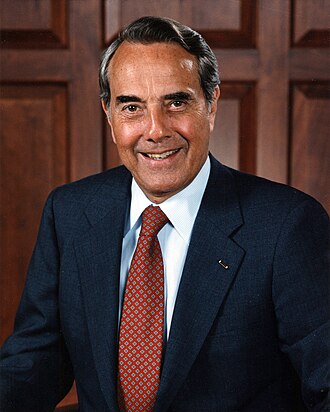
During the Nixon administration, Robert J. Dole served as a Republican U.S. Senator from Kansas, a position he assumed in January 1969 and held throughout Nixon's presidency. Concurrently, from January 1971 to January 1973, Dole served as Chairman of the Republican National Committee (RNC), acting as a staunch partisan defender of the President's policies during the majority of the White House taping period. Following Nixon's landslide 1972 reelection, Dole was replaced as RNC Chairman by George H.W. Bush in January 1973, returning his full focus to the Senate as the Watergate scandal began to escalate.
President Nixon hosted a group of officials, family members, and congressional guests in the Oval Office for the ceremonial swearing-in of Thomas S. Kleppe as the new Administrator of the Small Business Administration (SBA). Following the oath of office, the group discussed the agency's primary objectives, specifically emphasizing the need for active engagement with the business community and the provision of low-interest loans for victims of the recent California earthquake. The meeting concluded with the President presenting gifts to the attendees and formal expressions of mutual support and cooperation.
President Nixon met in the Oval Office with the Heltemes family—the 1971 Easter Seal poster family—accompanied by Senator Robert Dole and other guests. The meeting served as a ceremonial event to honor the poster child and distribute presidential gifts, including Apollo-themed viewers and cufflinks. Following the departure of the Heltemes group, Nixon held a broader discussion with his remaining visitors regarding the state of the film industry, expressing his preference for family-oriented entertainment and criticizing the prevalence of explicit content in modern movies.
President Nixon met with Republican congressional leaders and cabinet members to discuss rural development initiatives and solicit support for the administration's policy agenda. Secretary of Agriculture Clifford Hardin and staff provided an extensive briefing on the status of rural America, highlighting demographic shifts and explaining the mechanics of proposed federal revenue-sharing programs designed to foster economic growth. Participants also reviewed legislative priorities, including the upcoming vote on the supersonic transport (SST) appropriation and other pending congressional business.
President Nixon met with his Cabinet and key staff to discuss the status of the administration's revenue sharing legislative agenda and receive briefings on various international developments. Administration officials reported on their outreach efforts to build public and Congressional support for revenue sharing while addressing opposition from labor and minority groups. Additionally, Cabinet members provided updates on their recent foreign travels, emphasizing the geopolitical successes of the Nixon Doctrine in Southeast Asia and the strengthening of international cooperation on transportation and environmental safety.
President Nixon met with John Mitchell, Robert Dole, and H. R. Haldeman to discuss political strategies, media relations, and the administration's public image regarding the Vietnam War. The participants reviewed the political fallout from recent events, including a physical altercation at the Gridiron dinner and the news of Thomas E. Dewey's sudden death. The conversation focused on framing the President’s Vietnam policy as a major administration achievement while navigating legislative challenges, such as campaign spending reform and opposition from congressional "doves."
President Nixon met with Vice President Agnew and Republican Congressional leaders to secure support for two of his primary initiatives: the Supersonic Transport (SST) program and a major government reorganization plan. Secretary of Transportation John Volpe advocated for the SST by addressing environmental, economic, and technological concerns, arguing that the project was essential for U.S. aviation preeminence and long-term economic growth. Subsequently, John Connally detailed the work of the Ash Council, urging the legislators to embrace a fundamental restructuring of the executive branch to improve government efficiency, accountability, and public trust. Nixon emphasized that these measures were critical for ensuring that his administration could effectively manage federal programs and maintain the nation's competitive edge.
President Nixon and his Cabinet met to discuss the ongoing challenge of inflation and rising construction costs, focusing on the administration's strategic options for economic stabilization. Dr. Paul McCracken reviewed current inflationary trends and labor market data, outlining a spectrum of potential responses ranging from maintaining current fiscal policies and targeted interventions to implementing more aggressive measures like wage and price controls. The meeting served as a forum to evaluate the efficacy of various regulatory mechanisms, such as the National Commission on Productivity and the suspension of the Davis-Bacon Act, while weighing the political and practical risks of further government intervention in the economy.
President Nixon, Senator Robert Dole, and H. R. Haldeman met to coordinate political messaging regarding the Vietnam War and the administration's withdrawal strategy. The participants discussed strategies to deflect criticism from Democrats by emphasizing that the previous administration was responsible for initiating the conflict and that Nixon's plan ensures a responsible exit without a communist takeover. They decided to highlight the administration's commitment to achieving a 'generation of peace' and to pivot toward publicizing positive economic indicators as a counter-narrative to war-related concerns.
President Nixon met with Vice President Agnew and Republican Congressional leaders to discuss the administration's legislative and economic agenda. The participants analyzed current economic indicators, including inflation and productivity, and evaluated the implementation of the Task Force for International Development's recommendations regarding foreign and military aid. Additionally, the group addressed the future of the military draft, focusing on pay increases and the transition toward an all-volunteer force while assessing potential legislative hurdles in Congress.
President Nixon met with a group of Republican senators and key advisors, including Henry Kissinger, to discuss the political landscape surrounding the Vietnam War and national defense policy. The conversation focused on the erosion of public support for the war, the impact of various congressional anti-war resolutions, and the importance of maintaining American preeminence despite shifting domestic and international pressures. The participants strategized on how to manage the political fallout of the Vietnamization policy and addressed concerns regarding defense preparedness and the administration's foreign policy initiatives in the Soviet Union and China.
President Nixon met with Henry Kissinger, H. R. Haldeman, and other staff members to discuss administration messaging regarding the China initiative and the ongoing anti-war protests in Washington, D.C. The President expressed frustration over not receiving proper credit for his foreign policy initiatives and directed his team to ensure the public understands these efforts are directed by him rather than the State Department. Regarding the protests, Nixon instructed his team to maintain a posture of 'cool respect,' avoid direct confrontation, and leverage public sentiment against the demonstrators to reinforce his broader philosophy of personal responsibility and national character.
President Nixon met with his Cabinet and key staff to coordinate legislative strategies and manage domestic policy agendas. The discussion focused on securing passage for welfare reform and other administration priorities by engaging directly with congressional leadership and balancing competing interests within the labor market. Participants assessed the challenges of mobilizing support among both Democrats and Republicans and emphasized the necessity of persistent lobbying and effective communication with legislative committees.
President Nixon hosted a bipartisan group of congressional members and administration officials in the Cabinet Room for the ceremonial signing of the Telephone Bank Bill (S. 70). The meeting featured general discussion regarding rural telecommunications policy, the recognition of Agriculture Day, and the presentation of commemorative gifts. Attendees also engaged in casual conversation concerning the President's upcoming schedule and domestic matters.
President Nixon met with his Cabinet and Republican Congressional leaders to coordinate the administration's legislative agenda, specifically addressing the ongoing national railroad strike and the upcoming Congressional vote on the military draft. The discussion also focused on foreign policy, with Secretary of Defense Melvin Laird and Henry Kissinger providing briefings on the status of NATO, the credibility of U.S. military commitments in Europe, and the implications of recent Soviet statements regarding mutual force reductions. The President urged the Congressional leaders to maintain a firm stance against unilateral U.S. force withdrawals while emphasizing the need to handle these matters through stable, negotiated frameworks rather than disruptive legislative amendments.
President Nixon met with his Cabinet and key advisors to announce a major breakthrough in Strategic Arms Limitation Talks (SALT) with the Soviet Union, culminating in a joint statement to be released simultaneously in both nations. The agreement establishes a framework to prioritize limiting anti-ballistic missile (ABM) systems while pursuing parallel measures for offensive weapons. Nixon emphasized that the breakthrough was achieved by maintaining a strong U.S. defense posture, and he urged his administration to avoid public speculation or detailed commentary that could complicate sensitive ongoing negotiations.
President Nixon met with H. R. Haldeman, Robert Dole, and John Mitchell to discuss the administration's political strategy, including the management of the 1972 Republican National Convention site selection and efforts to increase youth voter registration. The group evaluated the political risks of pending legislation, specifically gun control, health care, and public works bills, while coordinating messaging to contrast Nixon's policies with Democratic alternatives. Additionally, the President and his advisors reviewed strategies for handling press relations—including a potential public moratorium for Vice President Agnew—and addressed concerns regarding the Vietnam War, POW repatriation, and the impact of economic issues on his reelection prospects.
President Nixon met with Republican Congressional leaders to discuss the administration’s new, multi-pronged national strategy for combating drug abuse, emphasizing a shift toward treatment, rehabilitation, and the creation of a centralized Special Action Office. During the discussion, Nixon and his team outlined plans for increased interdiction, expanded military detoxification programs, and a firm, non-permissive stance against the legalization of marijuana. Furthermore, the participants addressed the political climate surrounding the Vietnam War, with Nixon urging support against anti-war amendments and arguing that congressional deadlines for withdrawal would undermine sensitive ongoing negotiations.
President Nixon met with his Cabinet members to discuss the delicate political landscape surrounding the administration's efforts to open communications with the People's Republic of China. The conversation centered on the necessity of maintaining strict discretion to avoid premature public speculation, which could jeopardize sensitive diplomatic negotiations and create political vulnerabilities. Nixon emphasized the importance of a unified front among Cabinet members to manage domestic and international expectations as the policy shift progressed.
President Nixon and his administration met with Republican Congressional leaders to discuss the 1971-1972 economic outlook, focusing on key indicators such as GNP, unemployment rates, and inflation. The discussion centered on evaluating recent economic growth, managing ongoing labor disputes in the steel and transportation sectors, and addressing political concerns regarding the administration's fiscal and wage-price policies. The President and his economic advisors emphasized their commitment to achieving peacetime economic stability and requested support from leadership to convey a positive but measured economic narrative to the public.
President Nixon met with H. R. Haldeman, Robert Dole, and William Timmons to coordinate Republican strategy regarding the 1972 National Convention site selection, specifically leaning toward San Diego. The group discussed the political necessity of framing the President’s recent initiative toward the People's Republic of China as a masterstroke of leadership to build momentum for the 1972 election. Furthermore, Nixon directed his staff to organize economic briefings for Republican members of Congress to bolster party morale and counter Democratic attacks concerning the economy and the Vietnam War.
President Nixon and Senator Robert Dole spoke to discuss the internal climate of the Republican National Committee following a recent meeting. They reviewed party sentiment regarding the President’s surprise initiative to engage the People’s Republic of China, alongside concerns over the national economy and regional political dynamics. The discussion also touched upon preparations for the upcoming Republican National Convention, including deliberations over potential host cities like Chicago, Miami, and San Diego.
President Nixon met with Vice President Agnew and his Cabinet to discuss the administration's foreign policy objectives and the state of the national economy. Agnew briefed the attendees on his recent international tour, highlighting the global reception of the Nixon Doctrine and the challenges posed by the Arab-Israeli conflict, East Pakistan, and the increasing Soviet and Chinese presence in various regions. Nixon and his advisers subsequently addressed the economic outlook, emphasizing the need for an aggressive, unified defense of administration policies regarding inflation and unemployment, while dismissing the viability of permanent wage and price controls. Finally, the President mandated a strict reduction in government personnel and grade-level escalation to improve budget management across executive departments.
President Nixon, Pat Nixon, and the Cabinet met with their spouses to discuss the implementation and public perception of the administration’s New Economic Policy. Secretary of the Treasury John Connally led a comprehensive briefing on the wage-price freeze, tax reforms, and international monetary adjustments aimed at curbing inflation. The discussion emphasized the necessity of these economic measures for restoring national growth, managing federal expenditures, and building public and congressional support for the administration's program.
President Nixon met with Robert Dole, Alexander Haig, and H. R. Haldeman to discuss political strategy, the administration's wage and price freeze, and foreign affairs. A significant portion of the conversation centered on the Attica state prison riots, where Nixon expressed support for Governor Nelson Rockefeller's refusal to grant amnesty to the rioters. Additionally, the participants reviewed Dole's recent trip to the Far East and evaluated potential Democratic opponents and general campaign messaging for the 1972 election.
President Nixon met with his Cabinet and key staff members to review the administration’s domestic and foreign policy priorities, primarily focusing on the economic transition to 'Phase II' and the announcement of a 1972 Soviet summit. Officials discussed the successful implementation of the wage-price freeze and the strategy for securing organized labor's cooperation on the newly formed Pay Board and Price Commission to curb inflation. Additionally, the President addressed the importance of linking economic policy to job growth through his pending tax proposals, while Secretary of State Rogers and the President emphasized that international diplomatic overtures toward the Soviet Union and China were part of a cohesive, long-term strategy for global peace.
President Nixon, John Connally, Donald Rumsfeld, and a delegation of Republican Congressional leaders met to coordinate legislative strategy regarding the administration's domestic economic program and various foreign policy concerns. The discussion focused on the implementation of wage and price controls, pending tax legislation, and the management of international trade negotiations, particularly regarding Japan and the import surcharge. Participants also addressed the confirmation of Supreme Court nominees Lewis F. Powell and William Rehnquist, as well as ongoing legislative battles concerning the Vietnam War and Defense Department appropriations.
President Nixon hosted a large gathering in the Oval Office, including Secretary of Agriculture Earl Butz, several members of Congress, and various agricultural officials, to discuss the state of the American agricultural sector. The President highlighted the efficiency of American farmers and the affordability of food for domestic consumers as a significant national achievement. The meeting served as a public relations event to underscore the importance of agriculture to the nation's overall well-being and to reinforce support for administration policies.
President Nixon and Senator Robert Dole discuss administrative updates and upcoming political strategy during an informal telephone call. Nixon highlights his focus on drafting the State of the Union address and notes plans for a cabinet dinner, which will serve as the farewell event for Maurice Stans. Additionally, the President encourages Dole to meet with Charles 'Bebe' Rebozo while in Miami to discuss Florida's political climate.
President Nixon and Senator Robert Dole discuss political strategy and administrative planning in anticipation of the upcoming election year. The President stresses the importance of unifying the party and coordinating with colleagues to ensure effective messaging. They also touch upon personnel matters and the need for a cohesive outreach strategy to appeal to broader segments of the electorate.
President Nixon met with Vice President Agnew and Republican congressional leaders to discuss strategy regarding his recent speech on Vietnam and the administration's upcoming FY 1973 budget. The President and Henry Kissinger briefed the attendees on the Vietnam peace negotiations, emphasizing that the U.S. had made comprehensive offers while denouncing North Vietnamese intransigence and political maneuvering. Economic advisors, including George Shultz and Herbert Stein, presented the administration's fiscal plans, highlighting the importance of balancing the budget while supporting a transition to a peacetime economy through controlled spending and wage-price stabilization. Participants agreed on the necessity of maintaining a firm stance on defense and economic policy to solidify public support and improve the administration's negotiating leverage.
President Nixon met with Vice President Agnew and Republican Congressional leaders to coordinate legislative strategy on key domestic priorities, specifically revenue sharing, welfare reform, and Social Security legislation. The discussion focused on overcoming legislative stalemates in the Ways and Means Committee and the Senate, particularly regarding the influence of Chairman Wilbur Mills and the need for a unified Republican stance. The President urged the leadership to maintain pressure for compromise bills that align with administration goals while avoiding fiscally irresponsible mandates during an election year.
President Nixon met with Republican congressional leaders and cabinet officials to strategize on the administration's legislative agenda, specifically focusing on revenue sharing, welfare reform, and the Equal Educational Opportunities Act. The discussion addressed the political and procedural challenges of implementing a busing moratorium and the importance of countering Democratic criticism regarding the economy. Nixon emphasized the need for a unified party strategy to leverage economic accomplishments and maintain pressure on Democratic opponents leading into the 1972 election cycle.
President Nixon met with Republican congressional leadership to coordinate administration talking points on sensitive domestic and foreign policy issues. The discussion focused primarily on the ongoing military situation in Vietnam, emphasizing the success of Vietnamization, the importance of maintaining public support, and the necessity of keeping political opposition from undermining the war effort. Additionally, the President and his advisors briefed members on key legislative priorities, specifically the administration's stance against forced busing and efforts to address rising food prices and drug-related crime. The participants discussed strategies for distributing these fact sheets and maintaining a unified front to influence public perception and legislative outcomes.
President Nixon met with Vice President Agnew and key Republican Congressional leaders to coordinate legislative strategy on critical administration priorities, specifically revenue sharing, the defense procurement bill, and Vietnam-related war powers resolutions. The discussion focused on overcoming Democratic resistance to the President’s revenue-sharing program and maintaining a firm legislative stance on maintaining military strength. Nixon emphasized that American foreign policy, including negotiations with the Soviet Union, remains contingent upon the credibility of U.S. defenses and a unified national commitment.
President Nixon met with Vice President Agnew and Republican Congressional leaders to analyze the current political landscape and formulate electoral strategies heading into the 1972 campaign. A significant portion of the discussion focused on the perceived bias of the media in their treatment of Democratic candidate George McGovern compared to historical GOP figures like Barry Goldwater. Nixon encouraged leadership to coordinate closely on legislative and campaign messaging, noting that the Republican party must remain disciplined to capitalize on the internal divisions within the Democratic party.
President Nixon met with his Cabinet and senior staff to discuss strategies for achieving a balanced federal budget by 1975, emphasizing the necessity of immediate spending cuts and potential vetoes of congressional legislation to curb inflation. Budget Director George Shultz outlined the administration’s plan to issue "ceiling letters" to agency heads to enforce strict fiscal guidelines and reduce government deficits. The participants also reviewed recent positive economic indicators, including growth in the Gross National Product and declining unemployment, while noting that the public generally views government spending as a primary driver of inflation.
President Nixon met with H. R. Haldeman, Clark MacGregor, and Robert J. Dole to strategize regarding the upcoming 1972 presidential campaign. The discussion focused on political maneuvering and the coordination of campaign efforts in the lead-up to the election. While a significant portion of the meeting was withdrawn from public record, the session served as a tactical planning assembly for the administration's political team.
H. R. Haldeman and Senator Robert Dole coordinated the administration's public response to the recent disclosure of Thomas F. Eagleton’s health issues. Haldeman relayed President Nixon’s explicit directive that all campaign staff and party officials maintain a policy of no comment regarding Eagleton’s personal situation. The participants agreed that silence was the optimal strategy, anticipating that the controversy would naturally resolve itself without Republican intervention.
President Nixon met with a large group of Republican Congressional leaders to coordinate legislative strategy and discuss the administration's economic record ahead of the upcoming election. The conversation focused on countering Senator George McGovern's economic proposals, with the President and his advisors emphasizing that the administration's policies had fostered recovery, reduced inflation, and increased civilian employment. Key action items included distributing briefing materials to counter Democratic attacks, pushing for a government spending ceiling to avoid future tax increases, and planning strategy for upcoming votes on controversial appropriation bills and foreign aid legislation.
President Nixon met with Vice President Agnew and Republican Congressional leaders to coordinate legislative strategy ahead of the upcoming election, specifically focusing on the status of pending bills and the management of the Congressional schedule. Key priorities included securing a federal spending ceiling, advancing revenue sharing, and emphasizing anti-busing legislation as a must-pass measure to counter Democratic-led policies. The President urged the leadership to maintain a unified front on fiscal restraint, framing opposition to Republican economic proposals as reckless and warning that Democrats should bear the political cost for failing to curb government spending.
President Nixon met with his senior staff and campaign advisors to assess his 1972 reelection strategy, focusing on framing the debate against George McGovern around key issues like Vietnam, welfare, busing, and national defense. The group discussed the necessity of moving from a defensive posture to an aggressive offense by highlighting the radical nature of McGovern's positions to the general public. Additionally, the President met with James Hodgson and other officials to review progress on veterans' benefits and education programs, confirming plans to maintain support among Vietnam-era veterans as part of the broader campaign effort.
President Nixon met with his economic advisors and Republican Senate leadership to coordinate a strategy for securing congressional support for a federal spending ceiling. The discussion focused on the necessity of controlling runaway federal expenditures and the potential use of the presidential veto to enforce a $250 billion spending limit. Nixon and his team evaluated the legislative outlook for the debt limit bill, including strategies for handling amendments and managing potential political fallout regarding domestic programs.
President Nixon met with Senator Robert J. Dole and Charles W. Colson to devise campaign strategies for the final stretch of the 1972 presidential election. The discussion focused on countering George McGovern's campaign, managing the fallout from anti-war protests and hecklers, and framing the Vietnam peace negotiations as a victory for peace with honor rather than surrender. Additionally, the participants addressed public perception regarding the Watergate break-in, attempting to minimize its political impact by characterizing it as a misguided security operation.
President Nixon met with a delegation of Spanish-speaking campaign surrogates and administration officials to discuss Hispanic representation in the federal government and political outreach efforts for the 1972 election. Emphasizing his commitment to merit-based recruitment, Nixon urged the attendees to inspire Hispanic youth by demonstrating that progress is achievable through participation in the existing system. The participants shared their experiences regarding the administration's impact on their communities, specifically highlighting successes in urban mass transportation and economic advancement, while reinforcing their support for the President’s reelection.
President Nixon held a series of phone conversations with political allies including Robert Dole, William Mills, Gordon Allott, and James McKevitt on November 4, 1972. The calls served to build momentum and express appreciation for campaign support from key constituencies and regional leaders as the general election approached. Nixon discussed localized campaign strategies, the importance of maintaining unity within the party, and securing support from diverse groups, including the black community. The discussions also touched on logistical concerns regarding campaign messaging and the management of sensitive political relationships.
President Nixon called Senator Robert Dole while the latter was in Kansas to offer campaign support and well wishes to Republican candidates Morris Kay and Chuck McAtee. The discussion focused on bolstering the GOP ticket in Kansas, specifically emphasizing the importance of securing a win for the gubernatorial race. Nixon expressed his appreciation for Dole's national campaigning efforts and agreed to reach out to former Governor Alf Landon as a gesture of party unity.
President Nixon met with H. R. Haldeman, Robert Dole, and various staff members to discuss political appointments, including the selection of George H. W. Bush as the new Republican National Committee Chairman and the departure of Robert Dole. The group also evaluated strategies for a second-term administration reorganization, emphasizing the need for loyal, creative personnel and improved administrative control over the bureaucracy. A significant portion of the discussion focused on managing the public relations fallout of the Watergate scandal and Segretti's campaign sabotage operations, with the President weighing whether to issue a statement to distance the White House from these controversies.
President Nixon met with Robert Dole, George H. W. Bush, and William Timmons to coordinate a unified Republican defense regarding the Watergate scandal and its impact on the administration. The participants discussed strategies to shift the public narrative by emphasizing national security concerns and separating the President from the actions of subordinates like John Dean. Additionally, the group addressed the Alaska Pipeline Bill, upcoming foreign state visits, and potential future political roles for Dole.