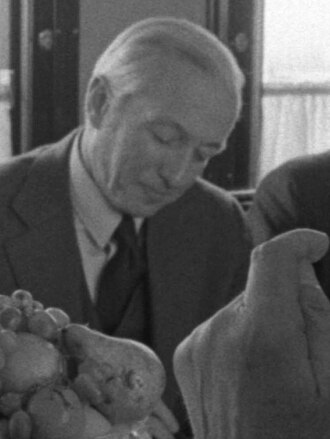
Sonnenfeldt, Helmut ("Hal")
Helmut "Hal" Sonnenfeldt was a senior staff member of the National Security Council from January 1969 until late 1973, serving as a close advisor to Henry Kissinger on Soviet and European affairs. Known as "Kissinger's Kissinger," he was a key architect of the Nixon administration's policy of détente with the Soviet Union during the entire White House taping period. His work focused on critical issues such as arms control negotiations and relations with Eastern European nations.
President Nixon met with Henry Kissinger and a large group of National Security Council staff members in the Cabinet Room to formally sign the annual Foreign Policy Message. The President used the occasion to express his profound appreciation for the high quality and volume of work produced by the staff, emphasizing his personal confidence in the materials they provided. The event served as a ceremony to recognize the collective efforts of those involved in drafting the document, accompanied by the distribution of souvenir pens.
President Nixon met with West German politician Gerhardt Schroeder, Henry Kissinger, and Helmut Sonnenfeldt to discuss international security and the shifting global balance of power. The participants engaged in a wide-ranging dialogue regarding the ongoing Berlin negotiations, East-West relations, the importance of British entry into the European Economic Community, and the potential impact of Chinese diplomacy on the Vietnam War. Nixon emphasized the necessity of a multipolar world order where strong, independent power centers—including a unified Europe, Japan, and the United States—serve to maintain global stability.
President Nixon met with staff and diplomats in two distinct sessions to coordinate logistics for Tricia Nixon’s upcoming wedding and to discuss foreign policy strategy regarding the Soviet Union and China. During the first segment, Nixon and his aides finalized guest lists, entertainment plans, and security arrangements for wedding-related social events, specifically managing the inclusion of personal friends and family members. In the second portion, the President pivoted to a strategic review of trade and foreign policy with Jacob Beam and Helmut Sonnenfeldt, focusing on the potential for utilizing trade incentives, such as grain deals and commercial credits, to improve U.S. relations with Communist powers and expand American diplomatic leverage. Nixon emphasized a desire for a more assertive, hard-line administrative image while exploring the practical utility of trade restrictions as a tool for Cold War maneuvering.
President Nixon met with his National Security Council to discuss strategy for Mutual and Balanced Force Reduction (MBFR) negotiations with the Soviet Union, emphasizing the importance of verification and maintaining allied unity. The President and his advisors examined how to use these potential force reductions to counter domestic congressional pressure for unilateral troop withdrawals. Additionally, the group addressed the ongoing crisis surrounding the publication of the Pentagon Papers, with Nixon expressing a need to strengthen penalties for leaking classified information and to defend the executive branch's ability to maintain secure communications.
President Nixon met with King Olav V of Norway and members of his delegation to discuss diplomatic relations and international affairs. The conversation covered the special relationship between the United States and Norway, as well as broader geopolitical shifts, including the rise of Japan and Nixon’s strategic outreach to China. Nixon emphasized the necessity of maintaining strong economic and political ties with European allies while navigating the changing global power structure.
President Nixon met with H. R. Haldeman and Henry Kissinger to strategize for an upcoming televised announcement, weighing the benefits of holding it in the Oval Office versus the press room to maximize public impact while limiting media access. The conversation also shifted to staffing concerns, specifically the President's frustration with Peter Peterson's performance and the need for a more loyal, strategic replacement in the commerce role. Finally, the group discussed foreign policy and domestic political risks, including the timing of further troop withdrawals in Vietnam and the complications of a potential European diplomatic trip.
Henry Kissinger directs Helmut Sonnenfeldt to draft talking points for Arthur K. Watson regarding an upcoming meeting with French President Georges Pompidou. The objective is to secure a preliminary, informal meeting between the Nixon administration and Pompidou before engaging with other international counterparts, despite potential protocol constraints. Kissinger requests to review the draft personally before it is transmitted via back-channel communications.
President Nixon and members of the National Security Council met to coordinate the United States' strategy regarding ongoing arms control negotiations with the Soviet Union. The discussion centered on the complexities of Anti-Ballistic Missile (ABM) systems, the status of Safeguard and hard site defenses, and the comparative capabilities of Soviet and American submarine-launched ballistic missiles (SLBMs) and ICBMs. Participants evaluated potential congressional reactions and internal administration messaging while addressing the strategic implications of Soviet negotiating positions.
President Nixon and the National Security Council met to coordinate U.S. strategy regarding European security, specifically focusing on the upcoming ministerial meetings in Brussels and the push for Mutual and Balanced Force Reduction (MBFR) talks. Participants discussed the complexities of navigating negotiations with Soviet counterparts, managing the varying interests of NATO allies, and addressing the political pressures surrounding troop levels and defense burden-sharing. The conversation concluded with a consensus on the need to maintain a unified diplomatic front while carefully managing the timing and scope of potential force reductions.
President Nixon and members of the National Security Council met to evaluate strategic options for the ongoing Strategic Arms Limitation Talks (SALT), focusing on ABM site deployments and the potential inclusion of submarine-launched ballistic missiles (SLBMs). Nixon emphasized the political necessity of securing an agreement that prevents Soviet strategic superiority, while participants debated the relative merits of "hard-site" defense versus current safeguard proposals and the impact of these negotiations on Congressional support. The discussion underscored a shared concern regarding the erosion of U.S. bargaining leverage and established a firm directive to pursue an agreement based on the principle of strategic equivalency.
President Nixon met with the General Advisory Committee on Arms Control and Disarmament to deliberate on the ongoing negotiations with the Soviet Union regarding strategic arms limitations. The discussion focused on the complexities of ABM systems, the technical challenges of verification, and the political implications of potential agreements for domestic support and international relations. Participants also analyzed the strategic balance between the U.S. and the USSR, weighing the risks and opportunities of reaching a formal accord.
President Nixon met with Yugoslavian representative Toma Granfil and advisor Helmut Sonnenfeldt to discuss diplomatic relations and upcoming geopolitical objectives. The discussion centered on fostering strong bilateral ties with Yugoslavia, including the exchange of birthday greetings for President Josip Broz Tito, and clarifying the objectives of Nixon’s impending trip to Moscow. Nixon emphasized his commitment to maintaining independent state sovereignty and pledged to provide Tito with a personal, frank report on the outcomes of his Soviet negotiations.
President Nixon met with bipartisan Congressional leaders to discuss the upcoming Soviet summit and the administration's strategic approach to international relations. The discussion focused on complex issues including trade, Most Favored Nation (MFN) status for the Soviet Union, and the potential for bilateral cooperation despite ideological differences. Nixon emphasized the importance of maintaining a unified stance to ensure the success of the negotiations while managing domestic political expectations.
President Nixon met with Soviet Foreign Minister Andrei Gromyko and other high-ranking officials to review the state of U.S.-Soviet relations following the May 1972 Moscow summit. The discussion focused on progress in arms control, including the scheduling of upcoming SALT II talks, and the complexities of achieving peace in the Middle East and Vietnam. Nixon emphasized the constraints imposed by the ongoing U.S. election cycle, while both sides reaffirmed their commitment to maintaining the strategic course established during the Moscow summit despite lingering regional tensions.
President Nixon met with Polish diplomat Witold Trampczynski and advisor Helmut Sonnenfeldt to review the President’s recent trip to Poland and discuss ongoing bilateral economic relations. The discussion touched on personal reflections regarding Edward Gierek, the importance of fostering trade—specifically regarding Polish ham exports—and the necessity of resolving technical negotiations involving bondholders and debt rescheduling. Nixon emphasized his commitment to fulfilling previous agreements while acknowledging that outstanding business and economic disputes required continued negotiation.
President Nixon met with Representative Joe D. Waggonner, Jr., Richard K. Cook, and Helmut Sonnenfeldt to discuss Waggonner's upcoming diplomatic trip to Romania to attend the Bucharest Trade Fair. The President briefed Waggonner on how to advocate for Most Favored Nation (MFN) trade status with Romania, emphasizing that the U.S. should frame such trade normalization as standard treatment for nations with positive relations rather than as special favoritism. Additionally, the participants discussed political strategy for the 1972 campaign, congressional cooperation, and personal security concerns regarding the President.
President Nixon met with Soviet Minister of Foreign Trade Nikolai Patolichev, Ambassador Anatoliy Dobrynin, and senior U.S. officials to finalize and sign a major bilateral trade agreement. The discussion emphasized the importance of strengthening U.S.-Soviet economic ties, including the role of the Export-Import Bank and Most Favored Nation status, as a foundational element of long-term diplomatic relations. Following the departure of the Soviet delegation, the President consulted with his staff regarding the sensitive, ongoing negotiations to end the Vietnam War and secure a cease-fire.
President Nixon met with Sir Christopher Soames and administration officials to address the growing trend of isolationism in both the United States and Europe and its potential impact on trans-Atlantic relations. The discussion focused on complex trade negotiations, the role of an enlarged European Economic Community, and the necessity of maintaining unified Western political and economic strength in the face of competition from Japan and shifting global powers. Nixon emphasized the political difficulty of passing trade legislation in a protectionist-leaning U.S. Senate and urged European leaders to cooperate on a balanced approach to trade and energy security to prevent an ugly confrontation.
President Nixon met with Congressman Paul Findley and advisors Richard Cook and Helmut Sonnenfeldt to discuss a resolution on Atlantic Union. Nixon expressed his support for the principle of Atlantic Union but was hesitant to publicly endorse the specific resolution due to potential complications with ongoing European security conferences and trade negotiations. He agreed to provide a letter for Findley to use, expressing his support for the goal without becoming an active advocate, similar to his stance on the Equal Rights Amendment. The conversation also touched upon legislative challenges, including veto overrides and congressional relations.
President Nixon met with members of the National Security Council and other senior officials to discuss the strategic balance of power between the U.S. and the USSR, specifically in anticipation of the SALT II negotiations. The discussion focused on the impact of qualitative and quantitative disparities in throw-weight, bombers, and MIRV technology on U.S. and Soviet first- and second-strike capabilities. Nixon emphasized the importance of maintaining an appearance of strategic equivalence to preserve the confidence of U.S. allies and domestic support, directing his team to refine their negotiating strategy without rushing into a premature moratorium on weapons testing.
President Nixon met with George Shultz, Helmut Sonnenfeldt, and John Ehrlichman to coordinate economic and national security policy, specifically focusing on the intersection of trade legislation and East-West diplomacy. Nixon emphasized the need to bridge the gap between Shultz’s economic initiatives and Henry Kissinger’s national security priorities to present a unified administration stance on European and Soviet relations. The participants also reviewed domestic labor and economic policy, including pension reform and minimum wage legislation, with Nixon instructing his team to manage Labor Secretary Peter Brennan’s expectations while maintaining a conservative budgetary position.
President Nixon and members of the National Security Council met to discuss the strategic importance of Mutual Balanced Force Reductions (MBFR) amidst growing congressional pressure for unilateral U.S. troop cuts. The discussion focused on maintaining a credible conventional defense posture in Europe to avoid a reliance on "tripwire" nuclear escalation, which Nixon and his advisors agreed would be untenable given the current parity in nuclear capabilities between the U.S. and the Soviet Union. Participants ultimately reached a consensus to pursue negotiations that link force improvements with potential reductions while resisting domestic isolationist trends and preserving NATO's operational cohesion.
President Nixon and his advisors met to finalize the logistics and agenda for Soviet General Secretary Leonid Brezhnev’s upcoming state visit. The discussion focused on balancing formal state proceedings with informal, spontaneous-looking events in San Clemente and at Camp David to foster positive imagery. Key decisions included finalizing the guest list for a reception—prioritizing a mix of political, business, and Hollywood figures—and arranging for a scenic coastal drive to provide Brezhnev with a more authentic view of America.
President Nixon met with Soviet General Secretary Leonid Brezhnev in the Oval Office to discuss the strengthening of U.S.-Soviet relations following their historic 1972 Moscow summit. The conversation centered on the necessity of building personal trust and confidence between the two leaders to facilitate long-term peace and cooperation, moving beyond historical Cold War tensions. Both leaders committed to a regular schedule of future summits and discussed the importance of expanding economic and cultural ties to solidify a new, stable era of superpower diplomacy.
President Nixon and General Secretary Leonid Brezhnev met in the Oval Office to conduct high-level diplomatic discussions during Brezhnev's state visit to the United States. The participants focused on strengthening bilateral relations, with extensive dialogue regarding the expansion of economic and trade ties, including potential large-scale energy cooperation and agricultural trade. They also addressed pressing international issues, such as the situation in the Middle East, the implementation of the Paris Accords regarding Vietnam, and preparations for a forthcoming nuclear agreement.
President Nixon, Soviet General Secretary Leonid Brezhnev, and key members of their diplomatic and economic teams met to discuss the expansion of U.S.-Soviet trade and the challenges of integrating two distinct economic systems. The conversation focused on large-scale, long-term projects in the energy sector—specifically oil and gas—and the necessity of institutionalizing economic cooperation through trade missions and working groups. Participants acknowledged that while political will is high, practical implementation requires navigating complex issues of financing, pricing, and administrative differences between American private enterprise and the Soviet state-controlled economy.
President Nixon met with Vice President Agnew, Secretary of State William Rogers, Henry Kissinger, and bipartisan congressional leaders to discuss recent foreign policy breakthroughs and the administration's ongoing diplomatic strategy. The discussion focused on the significance of newly negotiated agreements with the Soviet Union, specifically regarding the prevention of nuclear war and the management of bilateral relations. Nixon emphasized that these diplomatic efforts represent a move toward global stability and stressed the necessity of maintaining bipartisan support as his administration continues these critical negotiations with Soviet leadership.