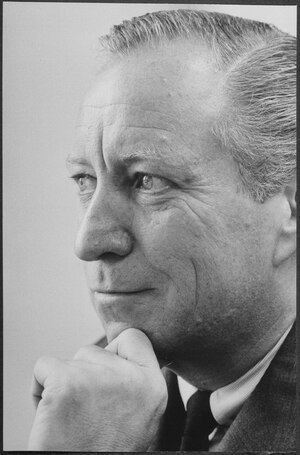
Garment, Leonard
Leonard Garment served as Special Consultant to the President from May 1969 to January 1974, advising Richard Nixon on civil rights, the arts, and minority issues. During the White House taping period, his responsibilities shifted dramatically when he was appointed Acting Counsel to the President in April 1973, replacing John Dean amidst the escalating Watergate scandal. He held this legal role until January 1974, when he transitioned to Assistant to the President, a position he maintained through the end of the Nixon administration in August 1974.
President Nixon met with members of the Advisory Council on Minority Business Enterprise to review the group's recent report and discuss strategies for fostering minority-owned businesses. The participants emphasized a "self-help" philosophy, advocating for increased private sector involvement and federal administrative support rather than relying solely on legislative handouts. Nixon expressed his support for the recommendations, directing the council to act as a watchdog to ensure his administration effectively implements these economic initiatives for minority communities.
President Nixon met with his senior staff and advisors to discuss communication strategies for the administration's policy achievements and historical outreach. The group explored ways to better leverage the President's personal historical expertise, such as his recent presentation on John Quincy Adams, to improve public perception through televised forums rather than relying on the mainstream press. Nixon emphasized the need to bypass the press corps by speaking directly to key demographics, including the elderly and youth, while instructing his staff to maintain stricter control over who is permitted to discuss substantive policy on television.
President Nixon and Leonard Garment reviewed the President's recent press conference, focusing on his confrontational strategy toward the media. Nixon defended his direct communication style, suggesting that bypassing the press to speak to the public was a necessary tactic despite the resulting friction. The discussion also covered the ongoing situation in Laos, which Nixon compared to World War I tactical attrition, and his commitment to Israel that the U.S. would not impose a peace settlement.
President Nixon met with members of the Congressional Black Caucus to receive a comprehensive position paper detailing grievances and policy recommendations regarding employment, housing, civil rights, and foreign policy. The Caucus representatives urged the administration to prioritize federal job creation, release frozen urban development funds, and address systemic issues within the criminal justice and military systems. Nixon acknowledged the significance of the meeting as a constructive starting point, promising that his staff would facilitate ongoing communication and proper consideration of the Caucus’s specific proposals.
President Nixon met with Rogers C. B. Morton, Ted Stevens, and several staff members to discuss the status and legislative strategy for the Alaska Native Claims Settlement Act. The participants reviewed the challenges of moving the bill through the House and Senate, specifically noting the roles of key legislators like John P. Saylor and James A. Haley. During the meeting, which included a photo session, the President emphasized the historical significance of the legislation and encouraged the team to continue their efforts to secure its passage.
President Nixon met with H.R. Haldeman, Leonard Garment, Robert Finch, and Nancy Hanks to discuss arts policy, including appointments to the Hirshhorn Museum Board of Trustees and the President's upcoming speech at an Associated Councils of the Arts conference. The participants also explored strategies to support the struggling American film industry through tax incentives and antitrust relief while emphasizing the need for higher-quality, story-driven domestic productions. Additionally, the President reviewed positive public opinion polling data following his recent speech on Southeast Asia and decided against a televised question-and-answer session with the American Society of Newspaper Editors to avoid overexposure and continued debate on the Vietnam War.
President Nixon met with Arthur S. Flemming, John B. Martin, Elliot L. Richardson, and Leonard Garment to discuss preparations for the upcoming White House Conference on Aging. The President emphasized his desire to foster greater intergenerational connection and respect for the elderly, suggesting that the administration's volunteer initiatives should prioritize mobilizing retired citizens while also encouraging youth to engage with and assist older populations. Participants addressed political sensitivities regarding recent administrative transfers of programs for the elderly and agreed to coordinate closely on the conference agenda to ensure it effectively reflects the administration's commitment to the quality of life for aging Americans.
President Richard M. Nixon met with representatives from several prominent senior citizens' organizations to discuss federal policy and the specific needs of the elderly population. The participants, including administration officials such as George Shultz and Dr. Arthur S. Flemming, addressed critical issues including Social Security cost-of-living adjustments, Medicare and health care accessibility, housing, and transportation. The President emphasized his commitment to addressing these challenges through government programs and invited the organizations to continue providing input to his staff to assist in developing effective legislative solutions.
President Nixon and Leonard Garment discuss the positive reception of the President's recent speech on the arts, which Nancy Hanks reported was well-received by leaders in the field. Beyond cultural policy, Garment informs the President of a significant fundraising development involving Taft Schreiber, Sam Rothberg, and other California Democrats targeting $5 million for the 1972 campaign. Nixon emphasizes the importance of framing arts and culture as essential to the human experience, transcending basic material needs like food stamps or Social Security.
President Nixon and Leonard Garment discussed the administration's outreach efforts to the arts community and the political value of engaging with cultural figures. Nixon emphasized his belief that the government should look beyond material concerns like social security or food stamps to convey more profound, inspirational messages to the public. He specifically instructed Garment to encourage Nancy Hanks, the chair of the National Endowment for the Arts, to maintain flexibility and effectively navigate the countercultural climate of the era.
President Nixon, Vice President Agnew, and a large group of Cabinet members and senior staff met to establish a strategic framework for domestic policy, budget planning for the 1973 fiscal year, and the development of the 1972 Republican legislative and election platform. Participants reviewed polling data regarding national, community, and family concerns, noting that the economy, inflation, and unemployment are primary public priorities while other issues like pollution and consumerism are often driven by media visibility. The President and attendees emphasized the need for better communication to receive credit for administration accomplishments, focusing on a limited number of 'gut issues' rather than overextending on too many programs. Ultimately, the group discussed the necessity of coordinating policy initiatives and messaging to ensure visible progress on key economic and social concerns ahead of the 1972 election.
President Nixon met with the newly appointed National Urban League Executive Director Vernon E. Jordan, Jr., and administration officials to discuss establishing a productive working relationship. The conversation focused on the administration's support for Urban League initiatives, specifically exploring the feasibility of incorporating the organization into federal drug abuse education and rehabilitation programs. Nixon also emphasized the urgency of passing his welfare reform and revenue-sharing proposals, urging Jordan to support these efforts to aid the poor and improve social conditions.
President Nixon met with Henry Kissinger and Attorney General John Mitchell to discuss the legal and political fallout following the Supreme Court's ruling on the Pentagon Papers. The President directed his team to aggressively pursue the criminal case against Daniel Ellsberg, emphasizing that they should utilize leaks to the press to discredit him and his supporters. They also strategized on reforming the executive classification system to prevent future unauthorized disclosures of presidential memoranda and sensitive national security information.
President Nixon updates Leonard Garment on a recent outreach call to Congressman Charles B. Rangel regarding the administration's civil rights efforts and the Black Caucus. The two discuss the political utility of maintaining open lines of communication with minority leaders, including Vernon E. Jordan, Jr., despite ideological differences. Nixon suggests strategically planting the positive story of his rapport with Rangel to help shape favorable media coverage on the administration's civil rights progress.
President Nixon met with Arthur S. Flemming, his family, and various administration officials in the Oval Office to mark Flemming's appointment to a federal position focused on the needs of older citizens. The ceremony included formal introductions, the presentation of gifts, and a brief photograph session with the White House press corps. Flemming expressed his gratitude for the opportunity and affirmed his commitment to championing the dignity and welfare of the nation’s elderly population.
President Nixon met with Robert O. Anderson, J. Erik Jonsson, and other advisors to discuss the creation of an "Institute for National Goals," a project designed to help cities and the nation engage in long-term, consensus-based planning. The group explored using computer modeling and systems analysis to identify societal priorities, contrasting this pragmatic, goal-oriented approach with the perceived indecisiveness of traditional foundations and academic idealists. Nixon expressed support for the concept and directed his team to coordinate with George P. Shultz and David J. Mahoney to evaluate the initiative's feasibility, potential funding, and government role.
President Nixon met with his Cabinet Committee on Education and a group of prominent private attorneys to develop a legislative and constitutional strategy for addressing federal court-ordered school busing. The participants debated the merits of proposing a temporary moratorium on new busing orders while Congress pursued longer-term, systemic solutions focused on improving educational quality. The meeting resulted in a consensus to refine these legislative proposals and maintain strict confidentiality regarding the involvement of the private counsel to protect the administration's political and legal standing.
President Nixon met with Ronald Berman, Chairman of the National Endowment for the Humanities (NEH), and Leonard Garment to discuss strategies for using the arts and humanities to counter the ideological influence of radical intellectuals on college campuses. They evaluated the potential for government-sponsored film and literature programs to appeal to a moderate, middle-class constituency that respects traditional education and values. Nixon emphasized his desire for content that highlights historical and biographical themes rather than current ideological trends, while Berman reported on efforts to bring more moderate academics into the administration's orbit to combat the influence of university radicals.
President Nixon met with bipartisan Congressional leaders, administration officials, and cabinet members to advocate for a legislative moratorium on court-ordered busing to achieve racial balance in schools. Nixon argued that current judicial mandates were causing societal turmoil and urged Congress to act immediately to stop new busing orders while advancing his broader 'Equal Educational Opportunities Act.' The administration proposed a two-pronged strategy involving an immediate legislative moratorium followed by a long-term commitment to compensatory education funding to improve school quality, specifically for low-income and minority students.
President Nixon met with David J. Mahoney, Jr., Kenneth R. Cole, Jr., and Leonard Garment to address the strategic direction and administrative challenges facing the Bicentennial Commission. Mahoney emphasized the need for higher-level cabinet participation and stronger White House support to combat congressional criticism and bureaucratic inertia. Nixon directed the participants to improve coordination across departments, committing to issue a formal memorandum requiring cabinet members to appoint assistant secretaries to attend commission meetings to ensure institutional accountability.
President Nixon met with George Shultz, Arthur Burns, and John Ehrlichman to discuss economic strategy, focusing on tax reform and property tax relief. The group evaluated the political risks of pursuing tax changes before the election, debating how to frame their proposals without being perceived as increasing taxes. Additionally, the President and H. R. Haldeman discussed administrative logistics, including the potential for a cruise on the Sequoia to discuss strategy and the implementation of Secret Service protection for Senator Edward Kennedy.
President Nixon calls Leonard Garment to coordinate a meeting at Camp David regarding the reorganization of his second-term cabinet. Nixon emphasizes his intent to break free from bureaucratic constraints by installing new personnel, specifically noting plans to move Caspar Weinberger into a major cabinet position and reassign Elliot Richardson. The conversation also transitions into a discussion on political conduct, with Nixon criticizing George McGovern’s 1972 concession statement while reflecting on his own history of gracious election losses.
President Nixon met with W. Clement Stone, Douglas K. Kinsey, and Leonard Garment to evaluate the progress and future leadership of the National Center for Voluntary Action (NCVA). The discussion focused on revitalizing the organization through the potential involvement of George Romney, improving private sector financial support, and shifting the focus toward specific, actionable community goals. Additionally, Nixon and Stone addressed public speculation regarding a potential ambassadorship for Stone, with Nixon confirming his intent to retain the current ambassador and advising Stone to focus on his non-political volunteer initiatives.
In this meeting, President Nixon met with his Vice President, Cabinet, and senior staff to provide a briefing on the impending Vietnam cease-fire agreement, scheduled for signing on January 27, 1973. National Security Advisor Henry Kissinger detailed the arduous negotiation process, emphasizing that the agreement achieved key U.S. objectives including the return of POWs, the withdrawal of American forces, and the right of South Vietnamese self-determination. Following the Vietnam discussion, the President transitioned to a briefing on the fiscal year 1974 budget, where Director Caspar Weinberger presented plans for spending cuts and program terminations designed to maintain a full-employment balance and avoid tax increases.
President Nixon and his Cabinet met to launch a strategic public relations campaign, titled the Presidential Spokesmen program, aimed at pressuring Congress to support his budget priorities and oppose spending-heavy legislation. Nixon urged his officials to frame the budget debate not as a constitutional conflict, but as a direct choice between the economic interests of the 'New American Majority' and the fiscal irresponsibility of the opposition. The session included briefings on foreign policy, defense spending, and law enforcement, emphasizing the need for administration spokesmen to maintain a positive, disciplined narrative while avoiding defensive posturing on 'false issues.'
President Nixon met with Max M. Fisher and Leonard Garment to discuss foreign policy strategy, specifically regarding the American Jewish community's opposition to granting Most Favored Nation (MFN) status to the Soviet Union. Nixon argued that linking trade concessions to Soviet Jewish emigration would be counterproductive, potentially damaging U.S.-Soviet relations and hindering the ongoing, quiet progress being made on emigration. He tasked Fisher and Garment with privately engaging Jewish community leaders to discourage congressional efforts to attach restrictive riders to MFN legislation, emphasizing that effective diplomacy requires secrecy and avoiding public posturing.
President Nixon met with H.R. Haldeman, John Ehrlichman, and Leonard Garment to discuss administrative strategies regarding the Watergate investigation and the management of economic policy. The group focused heavily on establishing a "hard-line" stance on executive privilege to navigate upcoming Senate hearings and protect the President's position amidst the unfolding scandal. Additionally, they reviewed economic concerns, including inflation and the challenges of transitioning away from government price controls.
President Nixon and Leonard Garment met to strategize on managing the escalating Watergate scandal and its impact on the administration's credibility. Garment advised the President to act preemptively by issuing a brief, clear public statement that would distance him from the unfolding crisis and the individuals involved, including H.R. Haldeman, John Ehrlichman, and John Dean. They also discussed the necessity of potentially suspending key staffers involved in the investigation to mitigate political damage and restore public confidence.
President Nixon and his national security advisor, Henry Kissinger, met with a delegation of American Jewish leaders to discuss the status of Soviet Jewry and the persistent obstacles regarding emigration from the USSR. The President urged the group to avoid public confrontation and support for the Jackson-Vanik Amendment, arguing that legislative mandates would jeopardize his delicate, high-level diplomatic channels with Soviet leadership that had already yielded progress on exit visas. Nixon maintained that his quiet, personal, and direct pressure on the Soviets remained the most effective tool for protecting human rights without triggering a broader geopolitical crisis.
President Nixon met with Leonard Garment to strategize on managing Watergate-related legal threats, specifically focusing on the protection of presidential files and the invocation of executive privilege. They discussed the legal defense of White House staff members like H.R. Haldeman, John Ehrlichman, Egil Krogh, and David Young during upcoming grand jury appearances and FBI interrogations. Nixon emphasized that sensitive documents remained under his direct control, while the two agreed on a measured, narrow approach to asserting executive privilege to avoid perceptions of a cover-up.
President Richard Nixon and Leonard Garment met to discuss legal strategies and concerns regarding the ongoing Watergate investigation. The conversation centers on navigating potential grand jury testimony, the application of executive privilege to shield the President, and the management of sensitive information being provided to the Senate committee. The discussion reflects the mounting pressure of the legal challenges facing the administration at that time.
Alexander Haig and Leonard Garment coordinated on the status of legal filings regarding Watergate-related documents and communications with the Justice Department. Garment confirmed that a motion had been filed and agreed to press for updates from the court via Justice Department channels. Additionally, the pair briefly discussed the competence of an unnamed individual, with Garment expressing confidence in the person's performance relative to previous alternatives.
President Nixon met with Ronald Ziegler, Alexander Haig, and Leonard Garment to manage the administration's defensive response to ongoing Watergate investigations and emerging media scrutiny regarding the President's personal finances. The group discussed the legal and political implications of recent testimony from Lt. Gen. Vernon Walters, concerns regarding potential indictments of senior staff, and the management of sensitive documents related to the Huston Plan. Nixon emphasized maintaining a strategy of resilience, rejecting the idea of constant public rebuttals, while coordinating efforts to handle inquiries from the Ervin Committee and prosecutors without further damaging the presidency.
President Nixon and Leonard Garment, coordinated by Ronald Ziegler, discuss the administration's frustration with the Senate Watergate Committee's delay in addressing false allegations that the President stole $1 million in campaign funds. Garment reports on his unsuccessful efforts to reach Senators Sam Ervin and Howard Baker, while Nixon aggressively instructs him to pressure Fred Thompson for swifter action. They conclude that the committee's inability to promptly deny these claims provides the White House with a strategic political advantage.
Ronald L. Ziegler and Leonard Garment coordinate a strategy to manage negative press coverage concerning the Watergate investigation. They discuss an individual's attempt to contact Senator Sam Ervin and contemplate demanding a public apology if the critical reports persist. The participants establish a secure communication channel via a specific White House telephone line to finalize their response after further information is gathered.
Leonard Garment and Ronald Ziegler discuss coordinating a response to an unfounded news story circulating via United Press International regarding the Ervin Committee. Garment reports that Senator Howard Baker denied the story's validity and clarifies that investigator Carmine Bellino is in Washington rather than California. The two agree that the committee must expedite their public rebuttal of the claims to align with the White House briefing schedule, with Ziegler emphasizing the need for a more urgent administrative response.
President Nixon, Ron Ziegler, and Leonard Garment coordinate a confrontational strategy to force the Ervin Committee to issue a public retraction regarding unsubstantiated allegations against the President. Nixon expresses significant frustration with the perceived lack of aggression from his legal team, specifically criticizing Howard Baker's response to the committee's reporting. The President directs Garment to demand an immediate apology and threaten the committee's overall credibility to ensure they do not successfully propagate false charges.
President Nixon met with Ronald Ziegler, Leonard Garment, and Lawrence Higby to strategize the White House response to recent press allegations regarding the funding of the President's San Clemente property. The group discussed mounting a public counter-offensive, including demanding a retraction and formal apology from the Ervin Committee and considering a libel lawsuit against the Associated Press. Nixon emphasized the necessity of fighting these charges vigorously to protect his credibility and shift the focus away from the ongoing Watergate scandal.
President Nixon and Leonard Garment discussed the upcoming Federal Election Reform speech, specifically focusing on how to frame campaign finance proposals and secure bipartisan support. They debated the merits of including specific policy suggestions, such as limits on cash contributions, versus delegating those tasks to a reform commission. Additionally, Nixon directed Garment to ensure Press Secretary Ron Ziegler took a aggressive public stance against the Ervin Committee regarding ongoing financial allegations, aiming to discredit the committee's credibility.
President Nixon met with his Vice President, Cabinet members, and senior staff to receive departmental updates and reinforce the administration's policy goals. The discussion spanned a wide array of topics, including minority recruitment, the status of the Watergate special prosecutor search, energy policy, and the administration's foreign policy record. Nixon emphasized the importance of maintaining a strong national defense and a unified front against political challenges while encouraging his team to continue their work with confidence.
President Nixon and Vice President Agnew met with the Cabinet and senior staff to discuss major foreign and domestic policy priorities and internal administration management. The discussion centered on upcoming diplomatic summits with Leonid Brezhnev and Georges Pompidou, negotiations with North Vietnam regarding the ceasefire, and economic challenges including inflation and energy policy. Additionally, General Alexander Haig briefed the Cabinet on the administration's efforts to stabilize internal governance, improve relations with Congress, and manage the ongoing political fallout from the Watergate scandal.