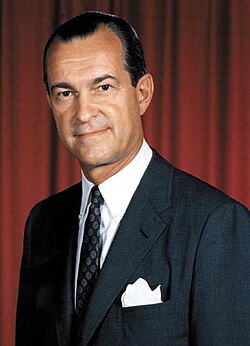
Helms, Richard M.
Richard M. Helms served as the Director of Central Intelligence from June 1966 until February 1973, making him a central figure during the majority of the White House taping period. As DCI, he frequently briefed President Nixon on foreign intelligence and covert operations, but their relationship soured after Helms resisted White House efforts to involve the CIA in the Watergate cover-up. Following his dismissal as DCI, Nixon appointed Helms as the United States Ambassador to Iran, a diplomatic post he held from April 1973 until December 1976.
President Nixon met with his senior national security and military advisors, including Henry Kissinger, Melvin Laird, and Admiral Thomas Moorer, to receive an update on the ongoing Lam Son 719 operation in Laos. The discussion focused on the military situation on the ground, the effectiveness of South Vietnamese forces, and strategies to manage press coverage regarding the conflict. Nixon emphasized the importance of maintaining a unified administration message and advised his team to treat the press as an adversarial force rather than providing direct, vulnerable answers to speculative inquiries.
President Nixon met with his national security team, including Vice President Agnew, Henry Kissinger, and William Rogers, to review the status of ongoing military operations in Southeast Asia and the complex diplomatic situation in the Middle East. Military leadership provided a detailed briefing on Operation Lam Son 719 and related efforts to interdict the Ho Chi Minh Trail, emphasizing that while the fighting is intense, the operations are effectively disrupting enemy logistics and protecting American withdrawal interests. The discussion subsequently shifted to the Middle East, where the President expressed frustration over Israel's reluctance to offer a concrete negotiating position despite Egypt's concessions. Nixon concluded by stressing the importance of maintaining a firm stance, noting that while the U.S. remains a reliable ally, it will not offer unconditional support without a reciprocal commitment to a serious peace process.
President Nixon met with Henry Kissinger, Alexander Haig, William Rogers, Melvin Laird, Admiral Thomas Moorer, and Richard Helms to coordinate strategy following the President's March 4, 1971, press conference. The discussion focused on maintaining public and political momentum for the ongoing Vietnamization effort and the military operations in Laos (Lam Son), specifically addressing potential responses to North Vietnamese missile fire and troop movements. Nixon emphasized the necessity of success in Southeast Asia to maintain American global credibility, while the participants reviewed intelligence on enemy capabilities and planned upcoming Congressional testimony and media appearances to manage the narrative surrounding the war.
President Nixon met with his National Security Council and key cabinet officials to receive a high-level briefing on developments in Soviet strategic capabilities, particularly concerning new ICBM silo construction and ballistic missile test programs. The participants evaluated the implications of these technological advancements for U.S. defense posture, including the necessity of maintaining a robust anti-ballistic missile (ABM) system. Discussions emphasized the need for a coordinated approach to strategic negotiations and the potential impact of Soviet military growth on current arms limitation efforts.
President Nixon met with his cabinet, diplomatic staff, and intelligence officials to declare drug abuse 'public enemy number one' and to coordinate a comprehensive strategy for eradicating the international supply of narcotics. The participants evaluated the effectiveness of current interdiction programs in Southeast Asia, the Middle East, and Europe, ultimately concluding that despite increased law enforcement efforts, the drug problem was expanding. The President directed his team to prioritize the escalation of foreign pressure, including potential subsidies for poppy crop eradication in Turkey, and announced the centralization of domestic drug policy under a new White House office.
President Nixon met with his National Security Council to discuss strategy for Mutual and Balanced Force Reduction (MBFR) negotiations with the Soviet Union, emphasizing the importance of verification and maintaining allied unity. The President and his advisors examined how to use these potential force reductions to counter domestic congressional pressure for unilateral troop withdrawals. Additionally, the group addressed the ongoing crisis surrounding the publication of the Pentagon Papers, with Nixon expressing a need to strengthen penalties for leaking classified information and to defend the executive branch's ability to maintain secure communications.
President Nixon and members of the National Security Council met to review the Fiscal Year 1973 defense budget and evaluate U.S. strategic capabilities relative to the USSR. The discussion centered on balancing budgetary constraints with the requirements of the Nixon Doctrine, specifically regarding troop deployments in Europe, East Asia, and the need for flexible "swing forces." The participants assessed the modernization of strategic forces, naval requirements, and the political implications of U.S. military presence abroad in the context of ongoing diplomatic negotiations with China and the Soviet Union.
President Nixon met with the National Security Council and senior advisors to conduct an extensive assessment of the deteriorating political and military situation in South Vietnam, focusing on the stability of the Nguyen Van Thieu administration and the threat posed by opposition factions and communist forces. The discussion covered strategic military planning for the upcoming dry season in Cambodia and Laos, the progress of Vietnamization, and the implications of U.S. troop withdrawal timelines on both the battlefield and domestic public opinion. Participants also evaluated the potential impact of diplomatic initiatives, including the President's announcement regarding Henry Kissinger’s trip to Peking, on North Vietnam's strategic calculations and internal morale.
President Nixon met with John Ehrlichman and CIA Director Richard Helms to discuss the President's access to sensitive, classified intelligence documents, specifically concerning past operations like the Bay of Pigs and the assassination of Ngo Dinh Diem. Nixon emphasized his need for full information regarding historical foreign policy and intelligence "dirty tricks" to prepare for upcoming diplomatic negotiations and to manage political exposure. Following this, Nixon met with David Kennedy, Henry Kissinger, and Peter Peterson to strategize on high-stakes textile trade negotiations with Japan, where they aimed to secure an agreement by applying pressure while maintaining the credibility of the U.S. position.
President Nixon and members of the National Security Council met to coordinate the United States' strategy regarding ongoing arms control negotiations with the Soviet Union. The discussion centered on the complexities of Anti-Ballistic Missile (ABM) systems, the status of Safeguard and hard site defenses, and the comparative capabilities of Soviet and American submarine-launched ballistic missiles (SLBMs) and ICBMs. Participants evaluated potential congressional reactions and internal administration messaging while addressing the strategic implications of Soviet negotiating positions.
President Nixon and the National Security Council met to coordinate U.S. strategy regarding European security, specifically focusing on the upcoming ministerial meetings in Brussels and the push for Mutual and Balanced Force Reduction (MBFR) talks. Participants discussed the complexities of navigating negotiations with Soviet counterparts, managing the varying interests of NATO allies, and addressing the political pressures surrounding troop levels and defense burden-sharing. The conversation concluded with a consensus on the need to maintain a unified diplomatic front while carefully managing the timing and scope of potential force reductions.
President Nixon met with senior administration officials, including Henry Kissinger, Richard Helms, and Admiral Thomas Moorer, to discuss urgent foreign policy concerns regarding the escalating India-Pakistan conflict and the geopolitical maneuvering of the Soviet Union. The participants evaluated the risks posed by Soviet involvement in the region and the potential for broader international instability. The meeting served to align the administration's strategic stance on these pressing global security challenges.
President Nixon convened this meeting of the National Security Council to assess the potential for a major North Vietnamese military offensive and to coordinate U.S. support for South Vietnam. The participants, including Henry Kissinger, Melvin Laird, and Admiral Thomas Moorer, discussed enemy troop movements, the effectiveness of Vietnamization, and the need for enhanced military authorities for field commanders. Nixon directed the council to provide robust support while ensuring that South Vietnamese forces receive the primary public credit, emphasizing that the U.S. must remain committed to a successful outcome despite domestic political pressures.
President Nixon met with his Cabinet and senior staff to debrief them on the results and implications of his recent diplomatic trip to the People's Republic of China. The President emphasized that the primary success of the visit was the establishment of a new communication channel between the two nations, which he argued was essential for managing long-term stability and reducing the potential for future conflict. Nixon shared his impressions of Chinese leadership, particularly his discussions with Chou En-lai, noting the stark ideological differences while highlighting common strategic interests, such as peace in the Pacific and balancing influence against the Soviet Union. The discussion concluded with a focus on how this opening could be leveraged to reshape international relations and manage regional tensions across Asia.
President Nixon and members of the National Security Council met to evaluate strategic options for the ongoing Strategic Arms Limitation Talks (SALT), focusing on ABM site deployments and the potential inclusion of submarine-launched ballistic missiles (SLBMs). Nixon emphasized the political necessity of securing an agreement that prevents Soviet strategic superiority, while participants debated the relative merits of "hard-site" defense versus current safeguard proposals and the impact of these negotiations on Congressional support. The discussion underscored a shared concern regarding the erosion of U.S. bargaining leverage and established a firm directive to pursue an agreement based on the principle of strategic equivalency.
President Nixon met with the Cabinet Committee on International Narcotics Control to evaluate the administration's progress and strategies in combating the global drug trade. The participants discussed international trafficking routes, the effectiveness of law enforcement efforts in countries like Turkey and Southeast Asia, and the need for improved coordination between federal agencies. The meeting served to reinforce the priority of drug interdiction and treatment programs while addressing inter-agency conflicts that hindered unified action.
President Nixon and John B. Connally held a wide-ranging discussion to coordinate political messaging and strategy regarding the upcoming presidential election. They focused on managing negative press, particularly concerning the ITT scandal and rising food prices, while solidifying their stance on domestic policy issues such as Social Security and environmental regulations. Nixon emphasized the necessity of standing firm on these policies rather than reacting to every fluctuation in public sentiment or media criticism.
President Nixon and CIA Director Richard Helms discussed the North Vietnamese government's silence regarding recent American B-52 strikes. Nixon directed Helms to amplify US psychological warfare efforts by using broadcasts to publicize the effectiveness and scale of these strikes. The President explicitly ordered the inclusion of details regarding incoming naval units, additional carriers, and further B-52 deployments to maximize the psychological impact on the North Vietnamese.
President Nixon met with CIA Director Richard Helms to emphasize the urgency of executing pending personnel and organizational changes within the intelligence agency. Nixon pressed Helms to implement these adjustments as thoroughly as possible. The brief exchange focused on accelerating the pace of internal restructuring efforts.
President Nixon met with his national security team, including Henry Kissinger, Admiral Thomas Moorer, and Secretary of Defense Melvin Laird, to receive a comprehensive military briefing on the ongoing North Vietnamese Easter Offensive. Admiral Moorer provided a detailed regional analysis of the conflict, noting that while South Vietnamese forces were facing intense pressure and heavy casualties, they were holding key positions with the crucial assistance of U.S. air power and naval support. The President emphasized that the conflict would remain difficult but reaffirmed his commitment to maintaining air support and striking military targets in North Vietnam until the offensive subsided.
President Nixon hosted a ceremony in the Oval Office for Vernon A. Walters to mark his promotion and official swearing-in as Deputy Director of the Central Intelligence Agency. Joined by Walters's family, Judge Edward Tamm, and CIA Director Richard Helms, the President administered the oath of office and acknowledged Walters's 31 years of military service. The meeting concluded with a photography session and the distribution of presidential gifts to the attendees.
President Nixon convened his National Security Council to weigh critical military options regarding the ongoing North Vietnamese offensive and the potential collapse of South Vietnamese forces. Key participants, including Henry Kissinger, Melvin Laird, and John Connally, debated the strategic risks of maintaining the status quo versus implementing a naval blockade and intensified air strikes on North Vietnam. While acknowledging the potential for a diplomatic crisis and the likely cancellation of the upcoming Moscow summit, the President and his advisors emphasized the necessity of demonstrating resolve to protect U.S. credibility and avoid a catastrophic military defeat. Ultimately, the discussion centered on whether a more aggressive military posture could provide the leverage required to salvage the situation in South Vietnam and secure the release of American prisoners of war.
President Nixon briefed CIA Director Richard M. Helms on his recent meeting with Mexican President Luis Echeverría Álvarez ahead of the two men's scheduled appointment. Nixon instructed Helms to leverage the President's personal endorsement during their upcoming discussion and shared his recent intelligence assessment regarding Soviet and Chinese subversion. Furthermore, Nixon emphasized to Helms his commitment to concluding the Vietnam War correctly and maintaining a strong anti-aggression posture throughout the Western Hemisphere.
President Nixon met with H.R. Haldeman and John Ehrlichman to discuss personnel staffing, legislative strategy, and the administration’s approach to managing congressional relations following his reelection. A significant portion of the discussion centered on Vice President Spiro Agnew’s recent attempts to assert independent policy initiatives, with Nixon and his aides expressing concern about Agnew's lack of coordination with the White House and his pursuit of public attention. The group also evaluated strategies for promoting the administration's budget and legislative agenda, specifically focusing on how to handle executive privilege claims and the confirmation of presidential assistants by Congress.
President Nixon consulted CIA Director Richard Helms regarding his upcoming appointment as Ambassador to Iran and his role in addressing the unstable situation surrounding Iranian oil. Nixon emphasized the need for Helms to exert broader influence over regional stability in the Persian Gulf, suggesting an early trip to the region despite Helms’s initial plans for a mid-March departure. Helms was instructed to consult with John Ehrlichman, Peter Flanigan, and John Connally to prepare for this mission, which aimed to consolidate U.S. interests and intelligence prior to an anticipated crisis.
President Nixon met with outgoing CIA Director Richard Helms to discuss Helms's upcoming ambassadorial appointment to Iran and to provide strategic guidance on global foreign policy. Nixon emphasized the importance of Helms applying his intelligence background to the critical issue of energy and oil production while maintaining a balanced, pragmatic approach to international relations. The two also addressed the challenges of managing global criticism of the U.S., regional security dynamics in the Persian Gulf, and the complex geopolitical task of negotiating a Middle East settlement between Israel and the Arab states.
President Nixon met with CIA Director Richard Helms and National Security Advisor Henry Kissinger to discuss several critical foreign policy issues. Key topics included the Shah of Iran's potential visit to the US, the ongoing situation in Oman, and Israel's weapon requests, with particular attention to air power. The conversation also touched upon the complexities of the Vietnam settlement, including ceasefire violations and POW releases, and the strategic importance of oil and US relations with Saudi Arabia and Iran.
President Nixon and H. R. Haldeman met to overhaul the administration’s schedule, focusing on establishing a regular rhythm of meetings with Cabinet members, Congressional leaders, and White House staff to improve coordination and morale. They discussed administrative shifts, including the reorganization of the CIA and the abolition of the Land panel, while also analyzing the President’s historical poll performance compared to previous administrations. Nixon emphasized the necessity of 'thinking time' and decided to implement a more structured, frequent engagement strategy with key political stakeholders to bolster support for his agenda.
President Nixon expressed his appreciation to Richard Helms for providing thorough and incisive reports, specifically regarding intelligence matters and oil policy. Nixon commended the quality of the work and noted that it provided necessary guidance for his upcoming policy decisions. The two agreed to share the less sensitive documents with White House staff, including Charles DiBona and Henry Kissinger, while keeping the more controversial material restricted to the President's private files.