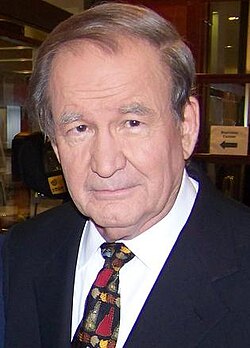
Buchanan, Patrick J.
Patrick J. Buchanan served as a key advisor and speechwriter throughout the Nixon administration, specializing in political strategy and media analysis. During the taping period, he prepared the President's daily News Summary and drafted influential rhetoric, including the 'Silent Majority' concept, while transitioning from Special Assistant to Special Consultant in 1972. He was a frequent participant in strategy sessions captured on the White House tapes, often advocating for a more aggressive conservative political stance.
President Nixon met with Republican congressional leaders and cabinet members to discuss rural development initiatives and solicit support for the administration's policy agenda. Secretary of Agriculture Clifford Hardin and staff provided an extensive briefing on the status of rural America, highlighting demographic shifts and explaining the mechanics of proposed federal revenue-sharing programs designed to foster economic growth. Participants also reviewed legislative priorities, including the upcoming vote on the supersonic transport (SST) appropriation and other pending congressional business.
President Nixon met with Vice President Agnew and Republican Congressional leaders to secure support for two of his primary initiatives: the Supersonic Transport (SST) program and a major government reorganization plan. Secretary of Transportation John Volpe advocated for the SST by addressing environmental, economic, and technological concerns, arguing that the project was essential for U.S. aviation preeminence and long-term economic growth. Subsequently, John Connally detailed the work of the Ash Council, urging the legislators to embrace a fundamental restructuring of the executive branch to improve government efficiency, accountability, and public trust. Nixon emphasized that these measures were critical for ensuring that his administration could effectively manage federal programs and maintain the nation's competitive edge.
President Nixon directed Patrick Buchanan to compile specific, compelling data points to bolster the administration's messaging on key domestic issues. The President requested dramatic statistics regarding the growth of minority-owned enterprises and the competitive standing of the American steel industry. Furthermore, he tasked Buchanan with consulting George Shultz and Paul McCracken to identify strong economic indicators, such as retail and automobile sales, housing starts, and record-breaking stock market performance, to project a narrative of upward economic momentum.
President Nixon directed Patrick Buchanan to compile dramatic, high-impact data points to bolster the administration's messaging on minority enterprise, steel industry competitiveness, and economic recovery. Nixon requested specific, positive statistics on housing starts, retail and automobile sales, and stock market performance to illustrate public confidence. The President tasked Buchanan with coordinating with advisors George Shultz and Paul McCracken to finalize these talking points for upcoming public use.
President Nixon and Patrick J. Buchanan coordinate the collection of favorable economic data to highlight a positive turnaround in the economy during March 1971. The President emphasizes the need to isolate March statistics—such as retail sales, housing starts, and automobile production—from the broader, more moderate first-quarter figures to demonstrate upward momentum. Buchanan is tasked with delivering these reports to the President, along with a newspaper column by James J. Kilpatrick, Jr., which Nixon’s daughter, Julie, had recommended.
President Nixon met with Patrick Buchanan to strategize on how to frame recent economic indicators to emphasize a positive turnaround in the economy during the month of March. Nixon specifically directed Buchanan to isolate March data to demonstrate growth in retail sales and demand, countering negative media narratives focused on sluggish industrial production. Additionally, the two briefly touched upon a recent positive column by James J. Kilpatrick that had been recommended to the President by his daughter, Julie.
President Nixon and Patrick Buchanan met to discuss media strategy for an upcoming interview with the American Society of Newspaper Editors and to address recent negative press regarding White House surveillance. The two reviewed reports from The Washington Post concerning security cameras at San Clemente and Camp David, framing the surveillance as a necessary security measure rather than an invasive practice. Additionally, they touched upon the political impact of the administration's recent People's Republic of China initiative and the role of the FBI in managing civil unrest.
President Nixon and Patrick J. Buchanan review the President’s recent hour-long interview with newspaper editors, focusing on the prevalence of foreign policy questions over domestic issues. Nixon reflects on his public defense of FBI Director J. Edgar Hoover and discusses the effectiveness of the radio format for his interactions with the press. The pair concludes that the event was a success, with Buchanan noting that the audience’s reactions and the President's deliberate pacing played well for radio listeners.
President Nixon and aide Patrick J. Buchanan discuss the political fallout of the administration's new initiative toward the People's Republic of China. They observe that the move has successfully disrupted the liberal press, drawing attention away from the Vietnam War and causing confusion among political 'doves.' Nixon emphasizes his cautious approach regarding formal UN recognition and his ongoing commitment to maintaining relations with Taiwan.
President Nixon met with Vice President Agnew and Republican Congressional leaders to discuss the administration's legislative and economic agenda. The participants analyzed current economic indicators, including inflation and productivity, and evaluated the implementation of the Task Force for International Development's recommendations regarding foreign and military aid. Additionally, the group addressed the future of the military draft, focusing on pay increases and the transition toward an all-volunteer force while assessing potential legislative hurdles in Congress.
President Nixon and Patrick J. Buchanan reviewed the President’s recent news conference, focusing on the effectiveness of his messaging regarding anti-war demonstrations and foreign policy. Nixon emphasized his goal of projecting confidence and signaling that the administration would not be deterred by protesters, while specifically highlighting his remarks on “peace in their time” and the recent opening of relations with China. The conversation concluded with Nixon praising Buchanan and the White House staff for their preparation for the event.
President Nixon met with Vice President Agnew, Treasury Secretary John Connally, and Republican Congressional leaders to address critical economic and legislative challenges. The primary focus was the potential bankruptcy of the Lockheed Corporation and the necessary legislative strategy to secure government loan guarantees to prevent a ripple effect of industrial failures and job losses. Additionally, the group reviewed the administration's legislative priorities, including welfare reform, general and special revenue sharing, and the status of various appropriations bills.
President Nixon met with Republican Congressional leaders to discuss the administration’s new, multi-pronged national strategy for combating drug abuse, emphasizing a shift toward treatment, rehabilitation, and the creation of a centralized Special Action Office. During the discussion, Nixon and his team outlined plans for increased interdiction, expanded military detoxification programs, and a firm, non-permissive stance against the legalization of marijuana. Furthermore, the participants addressed the political climate surrounding the Vietnam War, with Nixon urging support against anti-war amendments and arguing that congressional deadlines for withdrawal would undermine sensitive ongoing negotiations.
Alexander P. Butterfield consulted Patrick J. Buchanan for a quick assessment of Terry McGinnity prior to McGinnity’s brief meeting with President Nixon. Buchanan characterized McGinnity as an "okay guy" but expressed a tepid level of enthusiasm, noting that he was not overly impressed. Butterfield sought this input to provide the President with a brief evaluation following the scheduled handshake in the receiving line.
President Nixon held a series of meetings with top advisors, including H.R. Haldeman, John Connally, and George Shultz, to discuss political messaging, economic strategy, and staff management. Key developments included a directive to stop administration officials from providing background briefings to the press and a decision to maintain a firm, non-conciliatory stance regarding the prosecution of Daniel Ellsberg. Additionally, the President and Connally strategized on the public communication of economic policy, with the President emphasizing the need for a strong, unified message that highlights economic growth while rejecting wage and price controls.
President Nixon directs Patrick J. Buchanan to provide Representative Jack F. Kemp with strategic talking points and opposition research ahead of Kemp’s upcoming appearance on the David Frost show. Because Kemp is scheduled to debate anti-war critic Paul N. McCloskey Jr., the President emphasizes the need for Kemp to be well-prepared to counter McCloskey’s arguments regarding the administration's Southeast Asia policy. Buchanan is tasked with coordinating this effort, including potential collaboration with Charles W. Colson, to ensure Kemp is equipped to effectively challenge McCloskey.
President Nixon directed Patrick J. Buchanan to prepare a concise talking paper for Congressman Jack F. Kemp regarding his political opponent, Paul N. McCloskey, Jr. Rather than providing exhaustive research, Nixon requested a strategic document that outlines specific, impactful points for Kemp to utilize in his messaging. The primary objective of this guidance was to provide Kemp with an effective framework to aggressively challenge McCloskey.
President Nixon and his administration met with Republican Congressional leaders to discuss the 1971-1972 economic outlook, focusing on key indicators such as GNP, unemployment rates, and inflation. The discussion centered on evaluating recent economic growth, managing ongoing labor disputes in the steel and transportation sectors, and addressing political concerns regarding the administration's fiscal and wage-price policies. The President and his economic advisors emphasized their commitment to achieving peacetime economic stability and requested support from leadership to convey a positive but measured economic narrative to the public.
President Nixon and Patrick J. Buchanan met to prepare for an upcoming press conference by strategizing responses to anticipated inquiries. They discussed a range of sensitive issues, including the national economy, steel industry policies, and complex foreign policy challenges regarding Pakistan and the People's Republic of China's potential UN seat. The pair also addressed internal political concerns, specifically correcting inaccuracies regarding Vice President Spiro Agnew’s recent trip to Africa and managing controversies surrounding Rev. John J. McLaughlin.
President Nixon and Patrick J. Buchanan met to discuss administration strategies regarding contentious issues, specifically school busing and the national economy. Nixon expressed firm opposition to forced busing, suggesting the administration should clarify that Supreme Court rulings on the matter are not mandates. Additionally, they reviewed media coverage of the economy, with Nixon instructing Buchanan to proactively highlight positive economic indicators—such as housing, construction, and retail sales—to counter negative press narratives regarding unemployment statistics.
President Nixon and Patrick J. Buchanan engaged in a broad strategic discussion regarding the shifting political landscape and the prospective field of Democratic presidential candidates. The conversation examined the recent statements and political maneuverings of figures like Henry “Scoop” Jackson, John V. Lindsay, and George McGovern, while analyzing party dynamics related to the Vietnam War and social issues. This dialogue served to refine the administration’s understanding of opposition vulnerabilities and the evolving challenges posed by various Democratic factions ahead of the upcoming election cycle.
President Nixon and Patrick Buchanan discuss the positive public and congressional reception to the President’s recent address to Congress. They specifically note the effectiveness of the speech’s economic nationalism themes and the benefits of its faster, more assertive delivery style. Nixon expresses satisfaction with shifting the legislative burden onto Congress, acknowledging that the sheer volume of his proposals places significant pressure on the opposition.
President Nixon and Patrick J. Buchanan briefly discussed the shifting political climate, characterized by a rise in 'America First' sentiment among the public. They touched upon the political implications of current economic policies and expressed satisfaction regarding the administration's progress in securing legislative funding. No specific policy decisions were reached during this short exchange beyond assessing the favorable reception of their economic agenda.
President Nixon met with a large group of Republican Congressional leaders to solicit support for his administration's economic initiatives, specifically the New Economic Policy and tax reform measures. Key topics included the Job Development Tax Credit, depreciation reform, and strategies to secure bipartisan support for the Economic Stabilization Act as the program entered its second phase. The participants also discussed the necessity of public and business cooperation, as well as the international trade context of the President's economic agenda.
President Nixon met with H. R. Haldeman, Ronald Ziegler, and Patrick Buchanan to discuss strategies for managing press relations, refining speech delivery, and addressing public perception of administration policies. The group debated the frequency and format of presidential press conferences, weighing the benefits of television appearances versus more controlled communication methods. They also reviewed political developments regarding potential Democratic challengers and discussed personnel issues, specifically the political standing and future tenure of J. Edgar Hoover.
President Nixon consulted with his personal aide Manolo Sanchez to receive an update on the health of his personal secretary, Rose Mary Woods. Sanchez confirmed that he had recently spoken with California regarding her hospital stay and reported that she was recovering well and resting comfortably. The brief discussion served to reassure the President of Woods' positive health status following her recent procedure.
President Nixon met with his staff and members of the press to review his recent, highly effective performance during a press conference. They discussed the tactical success of his responses regarding key administration initiatives, including the military draft extension, Phase II of his economic policy, and his upcoming summit in the People's Republic of China. The conversation underscored the administration's determination to maintain the draft to safeguard U.S. peace initiatives and focused on framing the South Vietnamese elections within a realistic, historical context of global democratic development. Finally, the group considered future media strategies and the need for supporting data regarding U.S. foreign aid distribution to bolster the President's public narrative.
President Nixon and Patrick Buchanan discuss media strategy for an upcoming press conference, specifically focusing on handling questions regarding Edmund Muskie, the Attica prison riots, and foreign aid statistics. The President expresses his support for Nelson Rockefeller's management of the Attica crisis and notes his consideration of Senator Edward Brooke for a Supreme Court appointment. Additionally, Nixon instructs Buchanan to mobilize conservative allies to pressure the Senate regarding the draft and national defense appropriations, framing opposition to these measures as a vote against American security.
President Nixon and Patrick Buchanan coordinated messaging strategy ahead of a speaking engagement in Detroit, focusing on economic policy, busing, and a potential Supreme Court nomination. Nixon directed Buchanan to work with Herbert Stein on clarifying Phase II economic plans and suggested leveraging the contrast between his position on busing and that of Edmund Muskie to create political friction. Additionally, they discussed the strategy for securing the nomination of Richard H. Poff to the Supreme Court, specifically emphasizing how Poff’s background might appeal to Southern conservatives and provoke divisions within the Democratic Party.
President Nixon and Patrick Buchanan coordinated messaging strategy regarding upcoming public appearances and economic policy, specifically the impact of recent import surcharges and Phase II of the administration's economic control plan. Nixon directed Buchanan to consult with Herbert Stein to refine talking points on economic trends and policy justifications. Additionally, the pair discussed messaging on controversial social issues, including court-ordered busing, ensuring that the President’s stance was framed within the requirements of legal compliance while maintaining a clear ideological position.
President Nixon instructed Patrick J. Buchanan to prepare a concise, half-page summary of the administration's anti-drug initiatives for public dissemination. The President emphasized the need to frame these efforts as a coordinated, three-front "worldwide offensive" while highlighting the role of the administration's drug policy advisor. This directive aimed to simplify the messaging regarding government drug policy to effectively garner public support and emphasize the administration's active oversight.
President Nixon and Patrick J. Buchanan discussed the need for a concise summary of the administration's anti-drug initiatives to be prepared for public communication. Nixon emphasized the importance of framing the federal response as a urgent, comprehensive effort involving international cooperation and specialized medical support. Buchanan was tasked with distilling these complex policy actions into a brief, high-impact document.
President Nixon and Patrick J. Buchanan briefly discussed securing a positive response from Henry Kissinger regarding East-West trade initiatives and the Comer River project. The President directed Buchanan to ensure that Kissinger’s forthcoming paper highlights the administration’s previous accomplishments in these areas. This exchange functioned as a follow-up to coordinate communication strategy on foreign policy developments.
President Nixon and Patrick Buchanan discuss the public relations strategy for the announcement of a new Environmental Protection Agency (EPA) engine initiative. Nixon advises against a formal White House rollout, suggesting instead that the information be released casually in response to a press inquiry. Buchanan is tasked with consulting William Ruckelshaus and John Whitaker to evaluate the viability and potential risks of this low-profile approach.
President Nixon and Patrick J. Buchanan briefly discussed a public relations matter involving the announcement of a property referred to as "Rocco's house." The President directed Buchanan to verify if there were any strategic concerns or potential issues that would prevent the administration from moving forward with the announcement. No definitive decision was reached, as the conversation concluded with instructions for further internal review.
President Nixon and Patrick J. Buchanan coordinate a media strategy to emphasize optimistic economic indicators to the public rather than focusing on complex policy details like Phase II or the Japanese yen. Nixon instructs Buchanan to collaborate with George Shultz and William Safire to generate a concise list of positive trends in retail, housing, and automobile sales. The primary goal is to bolster public confidence by highlighting tangible economic growth that resonates with ordinary citizens.
President Nixon and Patrick J. Buchanan discuss media strategy for promoting the administration's economic agenda to the public. Nixon directs Buchanan to emphasize optimistic economic indicators and domestic quality-of-life improvements rather than focusing on complex trade negotiations or bureaucratic personnel appointments. The objective is to craft a simplified, positive narrative that resonates with the general public rather than the press corps.
President Nixon and Patrick J. Buchanan discussed the need for a brief official response regarding the Ways and Means Committee's recent tax actions. Nixon instructed Buchanan to draft the statement by cross-referencing public remarks made by Treasury official Charls E. Walker with George P. Shultz. The objective was to ensure administrative messaging remained consistent and aligned between the two officials.
President Nixon and Patrick J. Buchanan briefly coordinate the administrative response regarding upcoming tax cuts and sanctions. The discussion focuses on ensuring consistency between the White House and E.P. Walker concerning these economic policy initiatives. The pair concludes the meeting by confirming the necessity of keeping these efforts aligned.
President Nixon and Patrick J. Buchanan discussed the status of labor-related negotiations involving George Shultz and James Hodgson. Nixon informed Buchanan that he was currently meeting with the two officials to address the issue and consequently requested a delay in preparing further materials. The President ultimately decided to refrain from immediate public comment on the subject and invited Buchanan to his office for a follow-up discussion.
President Nixon and Patrick J. Buchanan briefly discussed an ongoing meeting involving Secretary of Labor James Hodgson and an unidentified individual. Nixon indicated that a pending decision or response would be delayed until the conclusion of these talks. The brief exchange served to coordinate strategy and manage expectations regarding the outcome of those discussions.
President Nixon consulted with aides Patrick J. Buchanan and Henry A. Kissinger regarding economic policies, the impending announcement of a U.S.-Soviet Union summit, and potential Supreme Court appointments. The participants discussed strategies for the Pay Board, the timing of foreign policy announcements, and the political implications of prospective judicial candidates. Significant actions included coordinating briefings for labor leader George Meany and finalizing preparations for the President’s public announcement regarding upcoming diplomatic negotiations.
President Nixon and Republican Congressional leaders met to coordinate strategy on key foreign and domestic policy initiatives, emphasizing the administration's progress in achieving global peace and economic stabilization. Secretary of State William Rogers provided an assessment of U.S. leadership, focusing on the upcoming United Nations vote regarding Taiwan, the ongoing India-Pakistan crisis, and preparations for Nixon's summits in Moscow and Beijing. The group also discussed legislative tactics for securing Republican priorities, specifically the Economic Stabilization Act and the ongoing challenge of the Mansfield Amendment to Vietnam policy. Nixon urged the leaders to maintain a firm, unified front to avoid projecting vulnerability to foreign adversaries and domestic political opponents.
President Nixon met with Patrick J. Buchanan to prepare for the announcement of his upcoming Supreme Court nominations. The discussion focused on the desired judicial philosophy of potential appointees, specifically emphasizing the balance between the rights of society and the rights of the accused. The pair also reviewed a broader news summary covering international affairs and economic indicators, including the Nobel Peace Prize and stock market trends.
President Nixon and Patrick J. Buchanan conferred briefly regarding the search for a specific quotation attributed to journalist Walter Lippmann. The discussion touched upon material appearing in Newsweek and the potential for a direct telephone inquiry to Lippmann to clarify the statement. The meeting concluded with an agreement to proceed with efforts to verify the citation.
President Nixon and Patrick Buchanan discuss the positive reception among conservatives following the President's recent Supreme Court nominations. The two men mock the mainstream media's prediction of a constitutional crisis, noting how analysts like Eric Sevareid and Dan Rather were forced to walk back their commentary after the announcement. Nixon emphasizes the importance of maintaining conservative support and expresses confidence that the nominees, specifically William H. Rehnquist, will easily overcome political opposition in the Senate confirmation process.
President Nixon and Patrick J. Buchanan discuss the political implications of recent Supreme Court developments and their reception by the press. Nixon emphasizes that despite media distractions and criticism, the administration's conservative base should be satisfied with the current judicial trajectory. The brief exchange highlights the President's frustration with media coverage and his strategic focus on maintaining conservative support.
President Nixon, John Connally, Donald Rumsfeld, and a delegation of Republican Congressional leaders met to coordinate legislative strategy regarding the administration's domestic economic program and various foreign policy concerns. The discussion focused on the implementation of wage and price controls, pending tax legislation, and the management of international trade negotiations, particularly regarding Japan and the import surcharge. Participants also addressed the confirmation of Supreme Court nominees Lewis F. Powell and William Rehnquist, as well as ongoing legislative battles concerning the Vietnam War and Defense Department appropriations.
President Nixon met with Patrick J. Buchanan, Kenneth M. Smith, and Lyndon K. Allin for a brief Oval Office session that included a photo opportunity and gift presentation. The discussion focused on the ongoing Senate confirmation hearings for Supreme Court nominees William H. Rehnquist and Lewis F. Powell, Jr. Nixon and his advisors particularly addressed liberal opposition to these appointments, specifically criticizing the double standards of critics like Joseph L. Rauh, Jr. regarding past judicial selections.
President Nixon tasked Patrick J. Buchanan with conducting historical research into Abraham Lincoln’s post-Civil War amnesty policies. The President specifically requested clarification on whether these amnesty provisions excluded deserters. Buchanan was directed to verify the historical details and report his findings back to Nixon.
President Nixon and Patrick J. Buchanan conferred on various research requests, including data on UN voting regarding the India-Pakistan conflict, salaries of public broadcasters, and historical casualties from the 1948 partition. The President also discussed the upcoming television interview with Dan Rather, concluding that the format would likely focus on long-range issues rather than breaking news. Additionally, the pair analyzed the political landscape of the 1972 Democratic presidential primary, specifically assessing the prospects of candidates like George Wallace, John Lindsay, and Edmund Muskie.
President Nixon and Patrick J. Buchanan conferred on strategies for addressing media coverage of the Indo-Pakistani War and the recent United Nations vote on a ceasefire. The President requested specific data regarding casualties and public sector salaries to help shape the administration's public narrative. They ultimately agreed to focus on long-range political messaging rather than reacting to minor news cycle developments.
H. R. Haldeman and Patrick Buchanan review the President’s recent press conference, assessing its effectiveness and impact on public perception. They discuss the substance of Nixon’s delivery, particularly his handling of Vietnam questions and his strong stance on busing. The conversation highlights the administration's strategic timing regarding busing legislation in light of the President’s upcoming trip to the People's Republic of China.
President Nixon met with bipartisan Congressional leaders, administration officials, and cabinet members to advocate for a legislative moratorium on court-ordered busing to achieve racial balance in schools. Nixon argued that current judicial mandates were causing societal turmoil and urged Congress to act immediately to stop new busing orders while advancing his broader 'Equal Educational Opportunities Act.' The administration proposed a two-pronged strategy involving an immediate legislative moratorium followed by a long-term commitment to compensatory education funding to improve school quality, specifically for low-income and minority students.
President Nixon met with Republican congressional leaders and cabinet officials to strategize on the administration's legislative agenda, specifically focusing on revenue sharing, welfare reform, and the Equal Educational Opportunities Act. The discussion addressed the political and procedural challenges of implementing a busing moratorium and the importance of countering Democratic criticism regarding the economy. Nixon emphasized the need for a unified party strategy to leverage economic accomplishments and maintain pressure on Democratic opponents leading into the 1972 election cycle.
President Nixon met with Republican congressional leadership to coordinate administration talking points on sensitive domestic and foreign policy issues. The discussion focused primarily on the ongoing military situation in Vietnam, emphasizing the success of Vietnamization, the importance of maintaining public support, and the necessity of keeping political opposition from undermining the war effort. Additionally, the President and his advisors briefed members on key legislative priorities, specifically the administration's stance against forced busing and efforts to address rising food prices and drug-related crime. The participants discussed strategies for distributing these fact sheets and maintaining a unified front to influence public perception and legislative outcomes.
President Nixon, Henry Kissinger, and Patrick Buchanan coordinated on the development of a speech for Vice President Spiro Agnew regarding the Vietnam War. The discussion focused on drafting rhetoric to sharply criticize Ivy League university presidents who opposed the administration's bombing campaigns against North Vietnamese military targets. Nixon directed his staff to emphasize themes of North Vietnamese aggression and to explicitly attack the perceived lack of patriotism and moral courage among academic leaders.
President Nixon and Henry Kissinger met in the Oval Office to coordinate strategy ahead of Kissinger's secret mission to Moscow to negotiate with Soviet leaders regarding the Vietnam War and a potential summit. They discussed maintaining a tough military posture, including continued bombing of North Vietnamese targets to leverage negotiations, while framing the Moscow trip as a broader diplomatic effort. The participants also finalized plans to conceal Kissinger’s location by claiming he was attending staff meetings at Camp David, effectively keeping the press and public in the dark until a planned announcement following the talks.
President Nixon and Patrick J. Buchanan met to coordinate the official administration response to the death of FBI Director J. Edgar Hoover. They discussed the drafting and release of a formal statement to honor Hoover's 48-year tenure and legacy of service. The conversation focused on ensuring the public tribute appropriately reflected the President's appreciation for Hoover's loyalty.
President Nixon and H. R. Haldeman coordinate the public announcement of FBI Director J. Edgar Hoover's death. Nixon rejects an initial recommendation for Attorney General Richard G. Kleindienst to break the news, insisting that he personally make the announcement to reflect the national significance of the position. They discuss the circumstances of Hoover's passing, including the timing and natural causes, while finalizing logistics for the President's upcoming television statement.
President Nixon met with Patrick J. Buchanan to discuss the handling of a statement regarding the recently deceased FBI Director, J. Edgar Hoover. The conversation focused on the timing and strategic release of this official statement. No further actions were recorded before the brief meeting concluded.
President Nixon, H. R. Haldeman, and Patrick Buchanan coordinated the timing of the President’s public announcement regarding the death of J. Edgar Hoover. Nixon insisted that the announcement of Hoover's death and his own subsequent television statement occur in immediate succession to avoid speculation or media delays. The participants finalized a strategy to ensure Nixon’s remarks served as the definitive lead story of the evening news cycle.
President Nixon met with Republican congressional leadership to coordinate strategy on key domestic and foreign policy issues during an election year. The discussion focused on distributing fact sheets regarding economic improvements, crime reduction, and unemployment to bolster support, while also strategizing to defeat restrictive anti-war amendments in Congress. Additionally, the President announced his decision to appoint an acting FBI director to ensure institutional stability following the death of J. Edgar Hoover, aiming to shield the bureau from partisan political controversy.
President Nixon consulted with John Mitchell and Patrick Buchanan regarding domestic political reactions to the recent naval blockade of North Vietnam. The discussion focused on securing public support from influential figures, including Supreme Court Justice Lewis F. Powell Jr., Secretary of State William P. Rogers, and Kenneth Rush. Nixon also coordinated logistics for an upcoming Duke Law School reunion dinner, emphasizing a controlled press photo opportunity to maintain an appropriate public image during the military escalation.
President Nixon and Patrick Buchanan discuss the importance of maintaining public and political support for the newly announced blockade of North Vietnam. Nixon expresses concern about appearing weak and stresses the necessity of mobilizing pro-war "hawks" to sustain momentum during the projected months-long operation. Buchanan confirms that key allies remain fully supportive of the administration's strategic posture.
President Nixon dictated a memorandum to Patrick J. Buchanan outlining a strategy to discredit the perceived liberal bias of the national media during the 1972 election cycle. The discussion focused on characterizing George McGovern's policy positions on issues like amnesty, defense spending, and abortion as extreme to influence public perception. Nixon directed that this assessment be distributed to his operating staff to counter coverage from major news outlets and strengthen the administration’s reelection campaign.
President Nixon met with Vice President Agnew and key Republican Congressional leaders to coordinate legislative strategy on critical administration priorities, specifically revenue sharing, the defense procurement bill, and Vietnam-related war powers resolutions. The discussion focused on overcoming Democratic resistance to the President’s revenue-sharing program and maintaining a firm legislative stance on maintaining military strength. Nixon emphasized that American foreign policy, including negotiations with the Soviet Union, remains contingent upon the credibility of U.S. defenses and a unified national commitment.
President Nixon met with Vice President Agnew and Republican Congressional leaders to analyze the current political landscape and formulate electoral strategies heading into the 1972 campaign. A significant portion of the discussion focused on the perceived bias of the media in their treatment of Democratic candidate George McGovern compared to historical GOP figures like Barry Goldwater. Nixon encouraged leadership to coordinate closely on legislative and campaign messaging, noting that the Republican party must remain disciplined to capitalize on the internal divisions within the Democratic party.
President Nixon and Patrick J. Buchanan engaged in a brief telephone consultation regarding the preparation of a memorandum. The discussion focused on establishing the document's structure, including its significance, analytical framework, and specific talking points. This conversation served as a preparatory step to determine the framing and strategic wording for an upcoming communication or briefing document.
President Nixon and Patrick Buchanan discuss media strategy and legislative maneuvering regarding a specific congressional vote, likely related to fiscal policy or tax legislation. The President seeks to refine messaging for upcoming speeches and media appearances, specifically referencing an op-ed piece by Robert Novak. Additionally, Nixon instructs Buchanan to consult with George Shultz to clarify his position on a pending tax bill and ensure administration unity.
President Richard Nixon and aide Patrick J. Buchanan consult regarding Buchanan's upcoming professional schedule and commitments. The brief discussion focuses on administrative coordination and the logistical management of Buchanan's time. No major policy developments are recorded, as the dialogue remains centered on internal staff planning.
President Nixon met briefly with his personal aide, Manolo Sanchez, to discuss the scheduling of his upcoming presidential commitments. Following Sanchez's departure, the President spoke with speechwriter Patrick J. Buchanan to coordinate the drafting of a formal statement regarding capital punishment. This discussion served to finalize the administration's public stance on the death penalty as part of the broader political agenda.
President Nixon met with Patrick J. Buchanan to discuss the political and legal implications of capital punishment in light of recent Supreme Court opinions. The brief consultation focused on the administration's stance and reaction to judicial developments regarding the death penalty. No specific policy shift was finalized during the session, which served primarily as a briefing on the evolving constitutional landscape.
President Nixon met with members of his White House News Summary staff to discuss the importance of monitoring media coverage of the 1972 presidential campaign. He directed the staff to provide confidential, quantitative analyses of how television networks, wire services, and newspapers covered the campaign to better understand media bias and its potential impact on voters. Nixon emphasized the need for a balanced approach to information and instructed his team to keep these sensitive evaluations internal as they prepared to counter negative press narratives regarding Senator George McGovern and the administration.
President Nixon met with various staff members and officials to discuss a wide array of administrative, foreign policy, and political matters. The President reviewed his upcoming schedule and foreign affairs, including a review of the House Foreign Affairs Committee's narrow vote to mandate a U.S. military withdrawal from Vietnam. Additionally, H. R. Haldeman coordinated with the President and Vice President Agnew to enforce a strict no-comment policy regarding the personal affairs of Thomas Eagleton, while discussions also touched on campaign strategy and potential coordination with George Wallace's associates.
President Nixon and Patrick J. Buchanan engaged in a brief telephone conversation to discuss immediate political messaging or strategic administrative matters. Although the specific dialogue remains unintelligible and unrecorded, the interaction serves as a point of reference for subsequent deliberations documented in related files. This call reflects the frequent, high-level consultation maintained between the President and his advisor during the 1972 campaign cycle.
President Nixon consulted with Patrick J. Buchanan to request research regarding a recent congressional speech by Senator Mike Mansfield concerning Greece. The primary objective was to obtain historical context or records related to the Senator's remarks for use in administration policy or messaging. No further substantive developments were recorded during this brief administrative exchange.
President Nixon consulted with H. R. Haldeman regarding Clark MacGregor’s performance and the fallout from a recent press conference involving Nelson Rockefeller. The discussion focused on managing political messaging, including the potential for future briefings directed at Cabinet members and the spouses of administration officials. They further addressed Rockefeller’s assessment of MacGregor as they strategized on internal political coordination.
President Nixon met with his staff and advisors to review his recent press conference, assessing its effectiveness in countering criticism of his Vietnam policy and the perceived "double standard" of his critics. Nixon and his team discussed strategies to further neutralize opposition, including coordinating public relations efforts against negative media coverage and managing congressional resistance to his war policy. The President also reviewed his upcoming schedule, including golf outings and social engagements, while coordinating sensitive communication channels with key political allies like John Connally.
President Richard M. Nixon and aide Patrick J. Buchanan held a brief telephone call that was immediately followed by a period of withdrawn, personal conversation. Due to the minimal duration and the withdrawal of the substantive portion of the call, no specific policy decisions or agenda items were recorded in the available transcript. The interaction primarily serves to document the direct lines of communication between the President and his advisor during this period.
President Richard M. Nixon met with White House aide Patrick J. Buchanan for a brief, one-minute consultation in the Oval Office. While no transcript exists for this session, the meeting reflects the ongoing administrative coordination between the President and his advisor during the 1972 campaign season. The interaction serves as a record of high-level access and informal communication patterns within the Nixon White House.
President Nixon consulted with Patrick J. Buchanan to solicit his assessment of a briefing recently provided by H. R. Haldeman. Buchanan expressed his alignment with the strategy or information outlined in the rundown. The exchange functioned as a brief confirmation of internal consensus regarding the reported subject matter.
President Nixon and Patrick J. Buchanan engaged in a brief discussion regarding a specific, though currently redacted, strategic idea. The conversation centered on the potential implementation of this initiative, which was associated with the reference of Captain Holden. No further substantive details regarding the outcome or further actions are available due to the withdrawal of the specific item discussed.
President Nixon and Patrick J. Buchanan engaged in a brief telephone exchange. The conversation served as a preliminary check-in between the President and his advisor. No significant policy decisions or substantive political matters were addressed during this short interaction.
President Nixon held a brief meeting with White House aide Patrick J. Buchanan shortly before his scheduled departure. The interaction served as a final consultation or farewell before the President left his office. No specific policy decisions were recorded during this abbreviated exchange.
Patrick J. Buchanan contacted the White House operator to facilitate an outgoing call to the office of Lyndon K. “Mort” Allin. The brief exchange served as a routine administrative request to connect Buchanan with an outside party. No substantive policy discussions or political developments occurred during this brief communication.
Patrick J. Buchanan engaged in a telephone conversation with an unidentified woman to review and process current wire service reports. The discussion focused on summarizing these news briefings to assist the White House in monitoring the day's media landscape. No specific policy actions or formal decisions resulted from this administrative exchange.
President Nixon met with Charles W. Colson and Patrick J. Buchanan to discuss political strategy and administrative coordination during the 1972 reelection campaign. The participants reviewed Colson’s recent interactions with political analyst Richard M. Scammon and analyzed the President’s earlier meeting with youth representatives from the Committee for the Reelection of the President. The dialogue focused on campaign outreach efforts and assessments of the current political landscape.
President Nixon met with a large group of Republican Congressional leaders to coordinate legislative strategy and discuss the administration's economic record ahead of the upcoming election. The conversation focused on countering Senator George McGovern's economic proposals, with the President and his advisors emphasizing that the administration's policies had fostered recovery, reduced inflation, and increased civilian employment. Key action items included distributing briefing materials to counter Democratic attacks, pushing for a government spending ceiling to avoid future tax increases, and planning strategy for upcoming votes on controversial appropriation bills and foreign aid legislation.
President Nixon and Patrick J. Buchanan met to coordinate public relations and campaign strategies ahead of the 1972 election. They discussed managing media bias—specifically regarding crowd size reporting and the administration's record on hiring women for policy positions—and planned aggressive political attacks against George McGovern and Ramsey Clark. The discussion emphasized the need for consistent messaging from administration speakers regarding Clark's potential FBI appointment and the development of a forthcoming speech on amnesty by Vice President Spiro T. Agnew.
President Nixon met with Patrick J. Buchanan and Stephen B. Bull to dictate a memorandum outlining economic talking points for a new fact sheet. Nixon emphasized the need for a more dramatic and effective presentation of the administration's economic successes, specifically comparing U.S. growth rates, inflation reduction, and consumer food costs favorably against international benchmarks. He directed Buchanan to refine these statistics to better illustrate how the American worker has gained ground against inflation compared to the 1966–1969 period.
President Nixon met with Vice President Agnew and Republican Congressional leaders to coordinate legislative strategy ahead of the upcoming election, specifically focusing on the status of pending bills and the management of the Congressional schedule. Key priorities included securing a federal spending ceiling, advancing revenue sharing, and emphasizing anti-busing legislation as a must-pass measure to counter Democratic-led policies. The President urged the leadership to maintain a unified front on fiscal restraint, framing opposition to Republican economic proposals as reckless and warning that Democrats should bear the political cost for failing to curb government spending.
President Nixon met with George Shultz, Arthur Burns, and John Ehrlichman to discuss economic strategy, focusing on tax reform and property tax relief. The group evaluated the political risks of pursuing tax changes before the election, debating how to frame their proposals without being perceived as increasing taxes. Additionally, the President and H. R. Haldeman discussed administrative logistics, including the potential for a cruise on the Sequoia to discuss strategy and the implementation of Secret Service protection for Senator Edward Kennedy.
In this meeting, President Nixon and H.R. Haldeman, later joined by Peter Dailey and Ronald Ziegler, discussed campaign strategy for the 1972 election, focusing heavily on media advertising and the effectiveness of surrogates like John Connally and Spiro Agnew. The participants assessed the political impact of the Watergate scandal, with Nixon instructing staff to maintain a public stance of non-involvement while letting the Justice Department handle inquiries. Additionally, they reviewed scheduling for upcoming campaign appearances and evaluated the President's responses to domestic controversies, including the U.S. Olympic team's performance and various public relations opportunities.
President Nixon met with Charles Colson and Patrick Buchanan to discuss electoral strategy and campaign messaging for the 1972 election. They focused on building a coalition among working-class voters by emphasizing shared values and the importance of work, while simultaneously crafting efforts to distance Democratic opponent George McGovern from radical anti-war demonstrators. Additionally, the participants touched on upcoming judicial appointments and the political management of the Watergate scandal as a campaign issue.
President Nixon met with a large group of reporters and staff in the Oval Office to conduct a press conference, followed by a private debriefing with his senior aides, including H.R. Haldeman, John Ehrlichman, and Charles Colson. During the public session, Nixon addressed current events such as the 1972 campaign, the status of the Vietnam peace negotiations, allegations regarding the U.S.-Soviet grain deal, and his stance against a 1973 tax increase. Following the departure of the press, the President and his advisors discussed the effectiveness of his performance, particularly the benefit of using his responses as recorded campaign material, and strategized on future scheduling and media messaging.
President Nixon, Patrick Buchanan, and Henry Kissinger met to strategize an aggressive public relations campaign in the final days before the 1972 election. Nixon instructed his team to produce a 'White Paper' that would contrast his administration's 'peace with honor' approach to Vietnam against the 'peace with surrender' policies of George McGovern, while also countering media narratives regarding Watergate and administration campaign practices. The participants emphasized the need to frame the recent Vietnam peace negotiations as a successful, hard-won achievement driven by the President's firm May 1972 policies, rather than as a rushed election-year political maneuver.
President Nixon and his Cabinet met to launch a strategic public relations campaign, titled the Presidential Spokesmen program, aimed at pressuring Congress to support his budget priorities and oppose spending-heavy legislation. Nixon urged his officials to frame the budget debate not as a constitutional conflict, but as a direct choice between the economic interests of the 'New American Majority' and the fiscal irresponsibility of the opposition. The session included briefings on foreign policy, defense spending, and law enforcement, emphasizing the need for administration spokesmen to maintain a positive, disciplined narrative while avoiding defensive posturing on 'false issues.'
In this meeting, President Nixon addressed his Cabinet and senior staff regarding the recent departures of top aides H.R. Haldeman and John Ehrlichman, framing the transition as a necessary move to restore stability amidst the escalating Watergate investigation. Nixon emphasized the importance of maintaining public trust, directed the staff to cooperate fully with investigators, and insisted that the White House avoid any appearance of a cover-up. Cabinet members and staff discussed the administration’s focus on governance, foreign policy, and economic management, reaffirming their collective commitment to the President's agenda despite the political crisis.