Nixon, Richard M. (President)
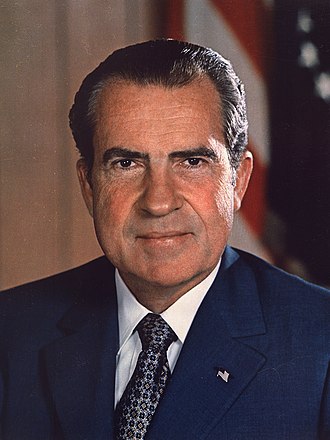
Richard M. Nixon served as the 37th President of the United States from January 1969 until his resignation in August 1974. In February 1971, he ordered the installation of a secret voice-activated taping system in the White House to preserve a historical record of his administration. Until the system's existence was revealed and dismantled in July 1973, the tapes captured Nixon directing major foreign policy initiatives, such as the opening to China, as well as his central role in the Watergate cover-up.
What Nixon talks about on the tapes
White House operations 4,718Presidential scheduling 2,225Public relations 1,784Presidential schedule 1,782Vietnam War 1,693Logistics 1,650Manolo Sanchez 1,626White House communications 1,400White House administration 1,399Presidential communication 1,243Henry Kissinger 1,191Foreign Policy 1,183
Conversations (21,010)
— Page 95 of 211President Nixon met with his aide Stephen B. Bull in the Old Executive Office Building to facilitate the delivery of specific materials. The brief interaction focused on the physical handover of documents or items requested by the President. No further information regarding the nature of the materials was recorded before Bull concluded the meeting.
President Nixon held a brief meeting with an unidentified individual in his Old Executive Office Building suite. The dialogue consists solely of initial greetings before the recording concludes, yielding no substantive political or administrative discussion. No policy decisions or developments occurred during this brief interaction.
President Nixon and Henry Kissinger met to discuss the military situation in Vietnam and the strategic necessity of upcoming air strikes despite potential opposition from Defense Secretary Melvin Laird and Admiral Thomas Moorer. Nixon expressed resolve to proceed with the strikes, dismissing concerns about field commander reactions and skepticism regarding Laird's intentions. Kissinger agreed to receive a military briefing first to better inform the President's final decision on whether to attend the briefing himself.
President Nixon initiated a brief administrative contact with the White House operator to facilitate an outgoing call. The interaction served primarily as a functional request to connect the President with another party. No substantive policy matters or significant executive decisions were addressed during this short exchange.
President Nixon and First Lady Pat Nixon coordinate personal social arrangements and family matters. They discuss the death of Zelda Arbuthnot and the need to send condolences to her family, as well as logistical plans for hosting the Marshburns at the White House. The conversation concludes with a brief mention of including Edward C. Nixon in a dinner engagement.
President Nixon and First Lady Pat Nixon discussed scheduling and social arrangements for the upcoming weekend. The conversation centered on the potential attendance of guests, specifically identified as Oliver and Oscar, and the logistics of hosting a dinner or attending a boxing match on Sunday night. The President agreed to review the guests' departure plans before finalizing the arrangements for the visit.
President Nixon and Rose Mary Woods coordinate logistics for upcoming social arrangements involving family members. The discussion focuses on scheduling dinners with Oscar and Olive Marshburn, as well as Edward Nixon, while ensuring the President’s Sunday and Monday calendars remain organized. Nixon directs Woods to manage these invitations and establish a reliable system for him to receive urgent calls via the White House operator.
President Nixon held a brief telephone conversation with Raymond J. Arbuthnot to extend condolences following the death of Arbuthnot’s wife, Zelda. Beyond personal matters and family greetings, the two discussed the President's upcoming trip to Canada and the ongoing war in Vietnam. Arbuthnot expressed his support for the President’s recent military actions against North Vietnam.
President Nixon contacted Raymond J. Arbuthnot to offer personal condolences regarding the recent death of Arbuthnot's wife, Zelda. The conversation also touched on casual updates regarding Arbuthnot's ranch, family members, and the President's firm stance on the ongoing conflict with North Vietnam. The brief exchange concluded with a friendly invitation for Arbuthnot to visit the White House in the future.
President Nixon hosted social guests, including Raymond J. Arbuthnot and an unidentified woman, at the White House for dinner and a tour. The brief interaction focused on casual conversation regarding the guests' experience at the executive residence. Nixon shared his impressions of the unidentified woman, specifically complimenting her intelligence and physical appearance.
President Nixon met with an unidentified individual in the Old Executive Office Building for a brief, informal encounter. The primary purpose of the brief interaction involved the President placing an order for consommé. No significant political or policy matters were addressed during this short exchange.
President Nixon and Henry Kissinger met to coordinate strategy regarding the Vietnam War, specifically addressing the North Vietnamese proposal for a public plenary session on April 27. They determined that the U.S. should condition its attendance at the public meeting on the North Vietnamese agreeing to a prior private meeting on April 24, aimed at breaking the diplomatic deadlock. Furthermore, they discussed the possibility of a naval blockade of Haiphong and emphasized that Nixon’s upcoming trip to Moscow must be contingent upon substantive progress regarding Vietnam, with the President prepared to cancel the summit if necessary to protect his administration's political standing.
President Nixon contacted the White House operator to facilitate an urgent communication with his Chief of Staff, H.R. Haldeman. This brief administrative exchange served as the necessary step to bridge the connection between the President and his top aide. No further policy or strategic matters were discussed during this request.
President Nixon held a brief, informal communication with the White House operator to discuss an unspecified matter. During the exchange, the President expressed frustration regarding the value or necessity of the task at hand, ultimately determining that the effort was not worthwhile. No further administrative actions or policy decisions were recorded during this brief interaction.
President Nixon and H.R. Haldeman discuss the urgent need to shift the administration's public relations focus toward supporting increased military action in Vietnam, including the authorization of air strikes in North Vietnam. Nixon instructs Haldeman to direct Charles Colson and his staff to move away from internal controversies like the ITT case and instead mobilize a public campaign to support the war effort. Additionally, Nixon expresses significant frustration with Secretary of State William P. Rogers's perceived weakness on foreign policy, insisting that the administration must present a unified, tough stance against North Vietnamese aggression.
President Nixon and H.R. Haldeman discuss the need to project strength and publicize a more assertive stance regarding ongoing negotiations and foreign policy. Nixon expresses frustration with the perceived passivity of his administration's supporters in Congress and directs Haldeman to mobilize key allies and spokespeople to counter the political opposition. The conversation concludes with an action item for Haldeman to coordinate a more aggressive public relations strategy.
President Nixon and Henry Kissinger discuss the tactical delay of a meeting or communication involving Soviet Ambassador Anatoliy Dobrynin. Expressing concern over potential manipulation by the Soviets, the President emphasizes the need for an FBI background check to ensure security. The two agree to postpone their next move until they have verified the reliability of the situation.
President Nixon consulted with an associate regarding communication strategies for ongoing Vietnam negotiations. The discussion centered on the necessity of maintaining a formal distance from direct legal-style negotiations and expressing appreciation for Secretary of Defense Melvin Laird’s consistent support. Nixon acknowledged Laird's toughness and political reliability despite his occasionally critical demeanor.
President Nixon met with his personal valet, Manolo Sanchez, to discuss the President's personal dining preferences for the afternoon. Nixon requested cheese and crackers to be brought to his office and consulted with Sanchez regarding the scheduling of his evening meal. The brief interaction focused solely on these routine administrative and dietary arrangements.
President Nixon consulted with an unidentified individual regarding logistics for White House access. The discussion focused on coordinating with Rex W. Scouten to ensure that guests or personnel utilize the front door for entry instead of the middle entrance. This administrative request reflects the President's attention to security and protocol arrangements for upcoming visitors.
President Nixon met with his personal valet, Manolo Sanchez, in the Old Executive Office Building to discuss an unspecified request. The nature of the interaction remains obscured due to the lack of a transcript, leaving the specific objective of the meeting unknown. Sanchez departed shortly after the exchange, which serves as a record of a routine administrative or personal consultation between the President and his staff.
President Nixon met with his personal aide, Manolo Sanchez, in the Old Executive Office Building to discuss personal services. The brief exchange focused on a request for consommé to be served to the President. No major policy matters or official administrative decisions were addressed during this interaction.
President Nixon met with his valet, Manolo Sanchez, at the Old Executive Office Building to address administrative matters. The primary focus of the discussion concerned a request from National Security Advisor Henry Kissinger for a formal meeting with the President. This brief interaction served as a logistical coordination point to facilitate communication between Nixon and his top foreign policy advisor.
President Nixon and Henry Kissinger discussed intensified military operations in North Vietnam, specifically focusing on naval bombardment and air strikes against Haiphong's shore batteries and oil storage facilities. The conversation centered on the potential cancellation of Kissinger’s upcoming Moscow trip and the subsequent implementation of a blockade as a retaliatory measure. Additionally, they reviewed diplomatic strategy regarding future peace negotiations, with Nixon instructing Kissinger to ensure the administration takes a firm public stance against repeating the failed 1968 bombing halt.
President Nixon initiated a brief telephone communication with the White House operator to request an outgoing call to National Security Advisor Henry Kissinger. This administrative interaction served as the necessary logistical step to connect the President with his primary foreign policy advisor late in the evening. No substantive policy discussions were recorded during this brief exchange.
President Nixon and Henry Kissinger discussed the ongoing Vietnam War and the administration's strategic response to North Vietnamese aggression. They reviewed recent intelligence regarding a North Vietnamese message relayed through Soviet intermediary Anatoliy Dobrynin, concluding that the North's recent overtures for peace talks resulted from the pressure of intensified U.S. air strikes. Nixon reaffirmed his commitment to maintaining a hard-line military strategy, including targeted bombing in the North, while Kissinger prepared for his upcoming diplomatic trip to Moscow to discuss a potential summit and the Vietnam settlement.
President Nixon instructed the White House operator to place a call to H.R. "Bob" Haldeman. The exchange served strictly as a logistical request to facilitate communication with his Chief of Staff. No further substantive policy discussions occurred during this brief interaction.
President Nixon met with an unidentified individual in the Old Executive Office Building to acknowledge and express gratitude for an unspecified action. Due to the lack of available documentation or transcript, the specific nature of the business or the identity of the participant remains unknown. The meeting concluded briefly, with the visitor departing the office shortly after the initial exchange.
President Nixon held a brief meeting in his Old Executive Office Building suite with unidentified individuals to coordinate logistics. The discussion focused on scheduling and confirming the arrival of the participants for a subsequent meeting. The primary outcome was the successful establishment of the meeting's attendance and location.
President Nixon and Henry Kissinger discuss the successful outcome of recent U.S. air strikes against North Vietnamese targets, specifically noting the extensive damage inflicted on petroleum, oil, and lubricant (POL) storage areas near Hanoi and Haiphong. They assess the status of the North Vietnamese offensive at An Loc, emphasizing the importance of continued military pressure to erode the enemy's fighting capability while maintaining strategic flexibility. Kissinger provides updates on his preparations for a high-stakes trip to Moscow, where he intends to leverage the administration's firm military stance to manage relations with the Soviet Union and pressure North Vietnam toward negotiations.
President Nixon attempted to reach Chief of Staff H. R. Haldeman by telephone to discuss unspecified matters. After the White House operator informed him that Haldeman was likely attending church services, the President decided to postpone the call. No substantive policy discussions or decisions occurred during this brief administrative exchange.
President Nixon contacted the First Lady, Pat Nixon, to coordinate logistics for their stay at Camp David. The discussion focused on confirming the duration of their visit and establishing the specific departure and arrival times. The conversation served primarily as a brief administrative exchange to finalize their weekend travel schedule.
President Nixon requested that the White House operator connect him to First Lady Pat Nixon. After the initial connection attempt, the operator placed the call on hold to facilitate the transfer. This brief interaction served solely as a logistical bridge to enable a private conversation between the President and his wife.
President Nixon contacted the White House operator to request a direct connection to the Military Aide’s office. This brief administrative interaction served as a logistical bridge to facilitate official communication between the President and his military staff. No further substantive policy discussions were recorded during this brief exchange.
President Nixon coordinates logistics with Major John V. Brennan for an afternoon helicopter departure to Camp David, accompanied by the First Lady and Manolo Sanchez. Amidst these travel arrangements, the President expresses strong approval regarding recent U.S. air strikes in Vietnam. He specifically notes positive feedback from Henry Kissinger concerning the Pentagon’s enthusiastic reaction to the success of the military operation.
President Nixon contacted the White House operator to coordinate logistics for a trip to Camp David. He directed the operator to notify First Lady Pat Nixon of a schedule change, delaying their departure time to 1:00 p.m. Additionally, the President requested that the operator connect him with his personal secretary, Rose Mary Woods.
President Nixon contacted the White House operator in an attempt to reach his personal secretary, Rose Mary Woods. Upon learning from Marjorie P. Acker that Woods was unavailable, likely due to church attendance, the President declined alternative assistance. He concluded the call by requesting that Woods return his message once she became available.
President Nixon contacted the White House operator to place a call to his Chief of Staff, H.R. Haldeman. The President inquired about Haldeman's location and instructed the operator not to disturb him if he was still attending church services. No further administrative or political business was conducted during this brief exchange.
President Nixon contacted the White House operator to place an urgent follow-up call to Major John V. "Jack" Brennan. This brief communication served solely as a logistical request to connect the President with Brennan. No further policy or strategic matters were discussed during this specific exchange.
President Nixon and H. R. Haldeman discussed strategies to manage ongoing political pressures, specifically regarding the ITT hearings and the potential nomination withdrawal of Richard Kleindienst. They agreed to offer Peter Flanigan’s testimony under specific conditions to derail the scheduled testimony of Jack Gleason, which they feared could lead to damaging disclosures. Additionally, they reviewed recent effective air strikes in Vietnam and planned to task Charles Colson and Clark MacGregor with mobilizing public support and attacking critics of the administration’s war policy.
President Nixon instructed Major John V. Brennan to offer the presidential yacht, the Sequoia, for Secretary of State William P. Rogers's use, provided it was not currently scheduled by Alexander P. Butterfield. The President also discussed the poor weather conditions at Camp David, noting that heavy rain and potential travel limitations necessitated a follow-up call to First Lady Pat Nixon. Brennan was tasked with coordinating these logistics and reporting back on the availability of the vessel.
President Nixon contacted the White House operator to place an outgoing call to First Lady Pat Nixon. The primary purpose of this brief interaction was to facilitate communication between the President and his wife. No policy matters or significant executive decisions were discussed during this connection.
President Nixon and First Lady Pat Nixon discussed logistical arrangements for their upcoming visit to Camp David, focusing on current weather and landing conditions. The conversation also touched upon their respective personal schedules and the television coverage of the Apollo 16 launch. No major policy decisions were made, as the exchange served primarily to coordinate their travel and shared interests.
President Nixon requested that the White House operator place a telephone call to Major John V. (“Jack”) Brennan. This brief communication served solely as an administrative directive to establish contact with Brennan. No further policy discussions or significant developments occurred during this brief interaction.
President Nixon consulted with Major John V. Brennan regarding logistics for his potential travel to Camp David and the availability of the presidential yacht, the Sequoia. Due to uncertain weather forecasts involving predicted thunderstorms, Nixon instructed Brennan to delay offering the yacht to Secretary of State William P. Rogers. The President requested an updated weather report by 3:30 p.m. to finalize his plans for the day.
President Nixon contacted the White House operator to facilitate a telephone connection with his Chief of Staff, H.R. Haldeman. This brief interaction served solely as a logistical request to initiate a high-level administrative communication. No substantive policy discussions occurred during this exchange.
President Nixon and H.R. Haldeman discussed strategies to secure the confirmation of Richard G. Kleindienst as Attorney General amidst ongoing legislative obstacles. They specifically reviewed a plan for Senator Paul J. Fannin to initiate negotiations with Senator Sam Ervin regarding the testimony of Peter M. Flanigan in an effort to resolve concerns over executive privilege and prevent a filibuster. Nixon emphasized the need for urgency, instructing Haldeman to have Mitchell facilitate an immediate approach to Ervin while ensuring the administration receives public credit for the proposed compromise.
President Nixon and his personal secretary, Rose Mary Woods, discuss the cancellation of a planned trip to Camp David due to inclement weather and coordinate Woods's availability for the remainder of the day. During the call, Woods relays supportive sentiments from Arthur Burns regarding the President’s recent decision to escalate Vietnam air strikes despite potential political fallout. Nixon emphasizes his resolve to avoid losing the war, citing the significant deployment of naval and air assets as evidence of his commitment.
President Nixon contacted the White House operator to place a follow-up call to his Chief of Staff, H. R. Haldeman. After initially requesting Haldeman, the President corrected himself and specifically asked to be connected to Mr. Holloman. This brief communication served solely as an administrative request to facilitate a telephone connection between the President and a staff member.
President Nixon initiated a brief, informal communication with the White House operator to discuss personal matters, specifically referencing his church and an individual named Paul. The exchange concludes abruptly with the President apologizing for a technical error regarding a call transmission. No substantive policy discussions or executive actions occurred during this brief interaction.
President Nixon consulted with the White House operator and First Lady Pat Nixon regarding scheduling and logistical arrangements for upcoming events. The discussion focused on coordinating attendance and preferences for specific activities or engagements. No major policy decisions were reached, as the brief exchange was limited to personal and administrative coordination.
President Nixon held a brief, informal check-in with First Lady Pat Nixon via a White House operator. Their exchange was personal in nature rather than focused on official policy matters, centered on upcoming schedule adjustments and the First Lady's travel plans. No substantive administrative decisions or political actions resulted from this interaction.
President Nixon initiates a brief administrative call from his office in the Old Executive Office Building. He requests that the White House operator connect him to the military aide's office. This recording serves as a functional request to facilitate communication with military staff.
President Nixon met with John V. Brennan to arrange transportation to Camp David, specifically requesting assistance for a departure around 1:00 p.m. During the exchange, they briefly discussed the recent aerial strikes conducted by the Pentagon, noting the intensity of the reaction to the military operation. The meeting focused on both logistical travel arrangements and a situational update regarding ongoing military activities.
President Nixon met with his valet, Manolo Sanchez, to coordinate logistics for an upcoming trip to Camp David and preparations for a visit from Tricia Nixon Cox. The discussion focused on scheduling the departure, organizing a meal, and managing the transport of the presidential pets. Nixon ultimately instructed Sanchez to bring the three dogs aboard the helicopter for their 1:00 p.m. departure.
President Nixon consulted with the White House operator to facilitate an outgoing communication request. The brief exchange focused on establishing a connection for an unidentified call. No substantive policy decisions or political developments occurred during this brief administrative interaction.
President Nixon initiates a brief communication through the White House operator to reach Andrew. The exchange serves as a functional request to connect with a specific individual for further discourse. No substantive policy matters or major decisions are recorded in this brief administrative interaction.
President Nixon initiates a brief, informal communication with the White House operator to facilitate an outgoing call. The conversation is fragmentary and does not contain substantive policy discussions or significant administrative decisions. It serves primarily as a routine logistical interaction between the President and the switchboard staff.
President Nixon consulted with the White House operator to facilitate an outgoing call. The brief interaction served as a logistical step to connect the President with another party. No substantive policy discussions or major developments occurred during this brief exchange.
President Nixon and H. R. Haldeman met to coordinate White House messaging and administrative operations during a period of high-stakes national security concerns. The discussion focused on organizing briefings for Cabinet members and Congressional leaders regarding the ongoing military situation, as well as delegating internal communications tasks to staff members like Charles Colson. Nixon emphasized the importance of maintaining a unified front, instructing Haldeman to ensure staff and allies were prepared to support the administration’s position confidently.
President Nixon and H. R. Haldeman discuss the precarious status of Richard G. Kleindienst’s nomination for Attorney General amidst ongoing ITT-related hearings. They deliberate on whether to force an early withdrawal of the nomination to avoid potentially damaging testimony from Jack Gleason and to mitigate further political fallout. The President directs Haldeman to coordinate with John Mitchell regarding the urgency of these maneuvers and the feasibility of securing confirmation through political negotiations with Senator Samuel Ervin.
President Nixon and Henry Kissinger spoke briefly to coordinate a follow-up briefing regarding recent reports from Alexander Haig. Kissinger, who was attending a personal engagement, provided a preliminary update on the situation in Vietnam. The President deferred a detailed discussion until Kissinger returned home, prioritizing a formal report over an immediate phone conversation.
President Nixon contacted the White House operator to facilitate an urgent connection with his Chief of Staff, H. R. Haldeman. This brief interaction served solely as a logistical request to initiate a follow-up conversation with Haldeman. No substantive policy matters or additional decisions were recorded during this brief administrative exchange.
President Nixon and H.R. Haldeman discuss the status of Richard G. Kleindienst's Attorney General nomination and the political risks associated with potential testimony from Jack Gleason. The conversation focuses on concerns regarding campaign contributions, specifically the ITT controversy, and the administration's strategy for managing the confirmation process. Nixon directs Haldeman to ensure that contingency speeches and planning are prepared in case the situation necessitates a sudden change in strategy.
President Nixon contacted the White House operator to facilitate a telephone connection with Major John V. (“Jack”) Brennan. This brief administrative exchange served solely to initiate communication with the Major. No further substantive policy matters or tactical decisions were captured during this brief operational request.
President Nixon consulted with Major John V. Brennan to arrange the cancellation of his planned trip to Camp David. Brennan acknowledged the directive and confirmed he would immediately execute the change in schedule. The brief discussion served solely to finalize the logistics regarding the President’s travel plans.
President Nixon initiates a request through the White House operator to place a telephone call to evangelist William F. “Billy” Graham. The brief exchange serves as a logistical bridge to establish direct contact with Graham for undisclosed purposes. No further discussion occurs beyond the request for the operator to connect the President.
President Nixon and Henry Kissinger discuss the tactical situation in Vietnam, specifically the successful use of B-52 strikes and air power to stabilize the defense around Route 13 and An Loc. The two review reports from General Alexander Haig and General James Hollingsworth, expressing confidence that South Vietnamese forces can withstand current enemy pressure. Additionally, the pair coordinates arrangements for Kissinger's upcoming trip to Moscow, including a strategy to manage Secretary of State William P. Rogers's involvement and the planning of a private, secure meeting at Camp David to finalize preparations.
President Nixon and Reverend Billy Graham discussed the health of John Connally and shared personal reflections on the current treatment of former President Lyndon B. Johnson by the Democratic Party. Nixon expressed sympathy for Johnson, noting that he had been abandoned by his own party’s presidential candidates, while Graham shared insights from a recent conversation with the former president. The call also touched upon the success of recent U.S. military strikes in the Haiphong area of Vietnam.
President Nixon reviews genealogical background information regarding the Michener family, noting their Quaker roots and connections to his own maternal ancestry. The discussion also touches upon a recent interaction between Gordon Robertson and Canadian Prime Minister Pierre Trudeau concerning the merits of a permanent civil service. Nixon and his interlocutor contemplate the tension between maintaining institutional continuity and the need for administrative changes to mitigate entrenched bureaucracy.
President Nixon met with Stephen B. Bull to coordinate administration messaging and political maneuvering, specifically regarding ongoing negotiations with North Vietnam and domestic legislative concerns. The discussion centered on clarifying the administration's stance on negotiations to avoid undermining press secretary Ron Ziegler and managing potential political fallout from staff appointments and campaign-related controversies. Nixon also instructed his team to prepare contingency plans for troop withdrawals and to adopt a more aggressive posture on both international and domestic communications.
President Nixon and Henry Kissinger discussed strategies for managing the North Vietnamese Easter Offensive while maintaining the possibility of the upcoming Moscow summit. They agreed to adopt a "tough as nails" negotiating stance on Vietnam, rejecting North Vietnamese proposals that were contingent on halting U.S. bombing, while keeping the diplomatic channel to the Soviet Union open. Nixon emphasized his determination to protect the U.S. position, signaling his willingness to authorize a naval blockade if diplomatic pressure and military action failed to curb Hanoi's aggression. The President also directed his staff to maintain a calm, public-facing posture while intensifying criticism of political opponents who appeared to align with the enemy's interests.
President Nixon dictates a memorandum for the file reflecting on recent communications and his personal schedule. He notes a report from Billy Graham regarding minimal student unrest at the University of North Carolina concerning Vietnam bombing campaigns, as well as a supportive phone call from Nelson Rockefeller. Nixon also records personal reflections on recent calls with his daughters and his intent to take a brief period of rest after a working dinner.
President Nixon dictated his dissatisfaction with the quality and delivery method of a recent toast prepared for an Organization of American States event. He expressed a preference for an ad-libitum style in future remarks, noting that it better reflects his personal rapport with others. Nixon acknowledged, however, that prepared texts remain necessary for events in countries like China, where translation requirements and formal protocols necessitate closer adherence to a script.
President Nixon met with his aide Stephen B. Bull to coordinate his daily agenda and upcoming appointments. The discussion focused on finalizing the schedule for a meeting with National Security Advisor Henry Kissinger and a luncheon with Representative William M. Colmer. No significant policy decisions were recorded during this brief administrative check-in.
President Richard M. Nixon met with his personal valet, Manolo Sanchez, in the Oval Office to dictate a series of memoranda for the executive record. This brief encounter served as a routine administrative session for the President to formalize notes or instructions for his files. The meeting concluded when Sanchez departed the office shortly before 9:00 am.
President Nixon and Henry Kissinger discussed the ongoing North Vietnamese offensive and the necessity of maintaining a firm, composed posture to ensure U.S. foreign policy credibility. They reviewed plans for a potential troop withdrawal, the administration's strategic response to Soviet and Chinese protests, and the military effectiveness of intensified bombing campaigns in North Vietnam. Nixon emphasized that he must act decisively regardless of domestic political consequences, viewing his leadership as essential to preventing future administrative weakness in foreign affairs.
President Nixon and H. R. Haldeman met to coordinate administration messaging during the North Vietnamese Easter Offensive, specifically emphasizing a tough public stance against the invasion and a refusal to apologize for increased military pressure. They discussed strategies for managing press relations, including a directive to ignore specific inquiries about the President’s decision-making process and to boycott certain journalists. Additionally, the President and his staff coordinated upcoming scheduling, including the President's trip to Camp David and efforts to manage the public relations fallout regarding the nomination of Richard Kleindienst.
President Nixon met with Witold Trampczynski to discuss the logistics and diplomatic significance of his forthcoming visit to Poland, emphasizing the importance of strong US-Poland relations due to the large Polish-American population. Prior to the meeting, Nixon and Henry Kissinger coordinated on sensitive Cold War geopolitical strategy, specifically regarding the precarious nature of the upcoming Soviet summit and the need to maintain a firm stance against the USSR. Following Trampczynski's departure, Nixon directed Kissinger to adopt a combative public messaging strategy, instructing his team to attack Democrats for their perceived lack of support for the South Vietnamese effort against the recent Northern invasion.
President Nixon and Henry Kissinger met to strategize on the Vietnam War, focusing on managing domestic political fallout from North Vietnam's offensive and the potential for a negotiated settlement involving the Soviet Union. Nixon emphasized the need for a firm public stance against Democratic critics and discussed the potential for linking the upcoming Moscow summit to progress in Paris peace negotiations. Following Kissinger's departure, Ronald Ziegler joined the President to discuss press reporting on the Moscow trip itinerary and to coordinate scheduling adjustments for First Lady Pat Nixon's upcoming events, including a table tennis exhibition.
President Nixon met with Rose Mary Woods to discuss the planning and logistical execution of upcoming White House social functions, including events for retired members of Congress and Navy comrades. The President provided specific instructions regarding the integration of musical entertainment to ensure a more dynamic experience for guests, while expressing personal disapproval of modern dance performances. Additionally, the pair addressed staffing concerns, including tensions involving Constance Stuart, and the need for better public relations regarding the quality of cultural programming hosted by the administration.
President Nixon consulted with an unidentified individual regarding the scheduling of a telephone call. Following this briefing, the President contacted the White House operator to initiate a request to speak with Secretary of State William P. Rogers. The exchange served as a preparatory step for official diplomatic coordination.
President Nixon consulted with the White House operator to check the status of a scheduled call to Secretary of State William P. Rogers. Upon learning that Rogers was unavailable because he was still testifying before Congress, Nixon instructed the operator to hold the call. No further substantive matters were discussed during this brief administrative exchange.
President Nixon and H.R. Haldeman reviewed the ongoing Senate confirmation hearings for Richard G. Kleindienst and Secretary of State William P. Rogers's testimony regarding the Vietnam War. They expressed satisfaction with Rogers’s firm performance before the Senate Foreign Relations Committee, particularly his defense of the administration's bombing policies and his rejection of North Vietnamese negotiation demands tied to halting military actions. Additionally, the President and Haldeman discussed strategies for managing White House staff departures, logistics for upcoming travel, and potential responses to diplomatic and political pressure, including the possibility of a naval blockade in Vietnam.
President Nixon met with Donald B. Rice, Caspar Weinberger, and George Shultz to discuss Rice's transition to a new position at the Rand Corporation. Following the personnel discussion, Nixon turned to the ongoing North Vietnamese invasion of South Vietnam, expressing resolve despite the potential impact on his upcoming Soviet summit. He emphasized a firm stance regarding potential retaliatory actions, including a blockade of Hanoi and Haiphong, while criticizing press coverage of the conflict.
President Nixon consulted with unidentified staff regarding the current locations and status of Henry Kissinger, Admiral Thomas H. Moorer, and Kenneth Rush. The dialogue focused on confirming logistical details and departures related to high-level diplomatic or military coordination. The discussion served as a brief administrative check-in to verify the whereabouts of key officials involved in sensitive governmental operations.
President Nixon consults with an unidentified staff member regarding scheduling logistics and the duration of an upcoming meeting. The discussion centers on ensuring a briefing with Henry Kissinger is completed before the President’s scheduled departure at 12:30 p.m. The exchange serves primarily as an administrative coordination effort to manage the President's tight midday itinerary.
President Nixon and Henry Kissinger met to discuss strategy regarding the ongoing North Vietnamese offensive and the potential for a diplomatic interim agreement. Kissinger argued that while a blockade could be effective, an interim solution—bolstered by Soviet guarantees and a cessation of enemy offensives—could protect Nixon's political standing and ensure the success of the upcoming Moscow summit. Nixon emphasized his commitment to military toughness, including the possibility of a blockade, and expressed strong approval of recent South Vietnamese military performance as reported by General Alexander Haig. They concluded that maintaining a firm posture while keeping the Moscow summit intact remained their primary objective.
President Nixon instructed the White House operator to place a call to Secretary of State William P. Rogers. The President specified that the call should be connected only after Rogers concluded his ongoing congressional testimony. This action was intended to facilitate direct communication regarding the Secretary's legislative appearances.
President Nixon consulted with the White House operator to determine the location and availability of Secretary of State William P. Rogers. Upon learning that Rogers was still attending a hearing and remained unreachable, the President requested that a message be left for his secretary. Nixon subsequently directed the operator to reschedule his follow-up call for 3:00 p.m. due to his own impending departure for the Capitol.
President Nixon met with Stephen B. Bull to coordinate logistical details regarding his upcoming schedule and travel arrangements. The conversation focused on the President's planned meeting with Representative William M. Colmer and the management of travel to and from Capitol Hill. Nixon also instructed Bull to facilitate a phone call with Secretary of State William P. Rogers to discuss ongoing administrative matters.
President Nixon held a brief, three-minute meeting with an unidentified individual in the Oval Office. The discussion centered on matters related to the President's schedule. Due to the lack of a transcript or documentation regarding the participant, the specific nature of the scheduling adjustments remains unknown.
President Nixon held a brief, informal meeting with his personal valet, Manolo Sanchez, in the Old Executive Office Building. While no transcript exists to detail the specifics of their dialogue, the session served as a routine interaction between the President and his longtime staff member. The meeting concluded quickly without any documented policy developments or formal agenda items.
President Nixon met with Ronald Ziegler and Henry Kissinger to coordinate the administration's public posture regarding military actions in Indochina, specifically the recent bombing of Haiphong and the presence of Soviet ships. Kissinger briefed the President on his communications with Soviet Ambassador Anatoliy Dobrynin and journalist Stewart Alsop, emphasizing the administration's determination to maintain a firm stance despite concerns over the upcoming Moscow summit. The group finalized plans for the President to meet with Secretary of Defense Melvin Laird and Admiral Thomas Moorer to ensure consistent testimony before the Senate Foreign Relations Committee.
President Nixon contacted the White House operator to initiate a telephone call to Secretary of State William P. Rogers. This brief exchange served as a logistical request to establish direct communication with the Secretary. No further policy discussions or significant developments occurred during this brief administrative interaction.
President Nixon initiated a brief call through the White House operator to be connected with Secretary of State William P. Rogers. The purpose of the interaction was to facilitate direct communication with the Secretary for undisclosed official business. No further dialogue was recorded during this brief administrative exchange.
President Nixon held a brief, informal meeting with an unidentified individual in the Old Executive Office Building. The conversation, which lasted only eight minutes, appears to contain a singular, reactionary remark regarding an unspecified negative development. No substantive policy discussions, political strategy, or actionable directives were captured on the recording.
President Nixon and H. R. Haldeman discussed Secretary of State William P. Rogers's successful congressional testimony and the administration's plan to capitalize on it. Nixon directed Haldeman to have Patrick Buchanan extract key talking points from the testimony for immediate distribution to cabinet members and administration spokesmen. They also reviewed Rogers's assertive confrontation with Senator J. William Fulbright and coordinated the upcoming appearance of Secretary of Defense Melvin Laird to maintain a unified public narrative.
President Nixon and H. R. Haldeman meet to discuss administrative reports and the operational status of an unspecified project. During the exchange, they review performance feedback regarding the project's launch and overall execution. Nixon ultimately confirms his intent to move forward with the initiative.
President Nixon and Secretary of State William P. Rogers discuss the success of Rogers's recent appearance before the Senate Foreign Relations Committee regarding the Vietnam War. Nixon praises Rogers's performance and instructs Patrick Buchanan to prepare a summary of the testimony for broad distribution to bolster the administration's messaging. The two also coordinate the official response to questions concerning Soviet ships and plan for upcoming military testimony from Melvin Laird and Admiral Thomas Moorer. Finally, Nixon outlines his strategy to announce a significant troop withdrawal in June to demonstrate confidence in South Vietnam’s defense and shift the domestic narrative.