Nixon, Richard M. (President)
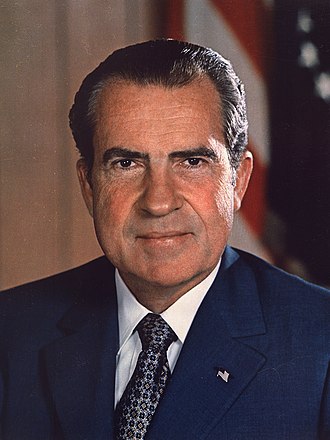
Richard M. Nixon served as the 37th President of the United States from January 1969 until his resignation in August 1974. In February 1971, he ordered the installation of a secret voice-activated taping system in the White House to preserve a historical record of his administration. Until the system's existence was revealed and dismantled in July 1973, the tapes captured Nixon directing major foreign policy initiatives, such as the opening to China, as well as his central role in the Watergate cover-up.
What Nixon talks about on the tapes
White House operations 4,718Presidential scheduling 2,225Public relations 1,784Presidential schedule 1,782Vietnam War 1,693Logistics 1,650Manolo Sanchez 1,626White House communications 1,400White House administration 1,399Presidential communication 1,243Henry Kissinger 1,191Foreign Policy 1,183
Conversations (21,010)
— Page 96 of 211President Nixon and Secretary of State William P. Rogers discuss the administration's strategy for responding to North Vietnamese aggression amidst ongoing troop withdrawal plans. Nixon outlines his intent to announce a reduction in the U.S. troop ceiling to 50,000 within two months to manage domestic political pressure. The two men also discuss the importance of effectively communicating the administration's Vietnam policy to Congress and foreign missions through concise summaries of official transcripts.
President Nixon consults with an associate regarding political strategies to counter Democratic opposition to his Vietnam policies. The discussion centers on drafting a public critique of those who fail to condemn the North Vietnamese invasion, specifically highlighting Secretary of State William P. Rogers's recent Senate testimony. Nixon instructs the participant to coordinate with Clark MacGregor to ensure this messaging is effectively disseminated to influence congressional and public opinion.
President Nixon met with his personal valet, Manolo Sanchez, to coordinate the President's afternoon schedule. During the brief exchange, Nixon announced his intent to take a nap, prompting Sanchez to confirm the timing of his next scheduled engagement at four o'clock. This interaction served to finalize arrangements for the President's rest period within his busy daily itinerary.
President Nixon and H.R. Haldeman discussed strategies to manage the ongoing ITT-related congressional hearings, specifically focusing on limiting the testimony of Peter M. Flanigan and avoiding the appearance of Jack Gleason. The administration secured an agreement with Chairman Sam Ervin to restrict White House witnesses and conclude hearings by Thursday, contingent upon Flanigan providing a written statement. To bolster this position, Nixon and Haldeman planned for Republican senators to stall during executive sessions and raise objections regarding the relevance of testimony to delay or prevent further questioning.
President Nixon and H. R. Haldeman discuss legislative strategy, specifically focusing on managing a filibuster and addressing the role of the committee chairman regarding subpoenas. The conversation explores the political optics of delaying tactics in Congress while briefly touching upon Vietnam policy. The two agree to defer deeper discussion of these sensitive topics until a later, more private meeting.
President Nixon met with H. R. Haldeman and Ronald Ziegler to coordinate the administration's public relations strategy regarding the Vietnam War and the ongoing North Vietnamese invasion. The discussion focused on framing the conflict by challenging anti-war Democrats and emphasizing the necessity of U.S. military actions against North Vietnamese targets. Additionally, they evaluated potential congressional resolutions to condemn North Vietnamese aggression and briefly touched upon the potential resignation of Secretary of the Treasury John Connally in relation to the upcoming Soviet summit.
President Nixon contacted the White House operator to facilitate a personal telephone call to his daughter, Tricia Nixon Cox. The conversation served as a brief administrative request to connect the President with a family member. No policy matters or official government business were discussed during this interaction.
President Nixon met with his aide Stephen B. Bull in the Oval Office to coordinate his official schedule. The discussion focused primarily on arranging a meeting with National Security Advisor Henry A. Kissinger. This brief administrative interaction served to confirm the timing for the President's upcoming diplomatic consultations.
President Nixon met with Alexander P. Butterfield to coordinate administrative logistics and manage the arrivals of unidentified individuals, including Henry Kissinger. The discussion primarily focused on scheduling details and the sequence of meetings in the Oval Office. Butterfield confirmed the arrangement of these appointments before departing the office.
President Nixon consults with his daughter, Tricia Nixon Cox, regarding her upcoming attendance at a table tennis match. The President provides guidance on how to manage potential press inquiries, specifically advising her to defer to Secretary of State William P. Rogers regarding Vietnam and to express a polite, forward-looking interest in the People's Republic of China. Nixon emphasizes the importance of remaining calm in the face of potential hecklers and keeping any public remarks brief and diplomatic.
President Nixon advises his daughter, Tricia Nixon Cox, on how to navigate a potentially contentious public appearance involving political protesters. He counsels her to remain composed and avoid making official statements if questioned about administration policy or recent announcements by the Secretary of State. The exchange concludes with a brief, supportive discussion regarding her future interest in traveling to the People's Republic of China.
President Nixon met with Henry Kissinger, H. R. Haldeman, Melvin Laird, and Admiral Thomas Moorer to coordinate the administration's public and military response to the North Vietnamese Easter Offensive. The group discussed the importance of maintaining a firm stance to protect U.S. credibility and ensure the success of the President's upcoming Moscow trip, while emphasizing that the ongoing conflict was a Soviet-backed "massive communist invasion." Significant decisions included Laird’s plan to publicly highlight the effectiveness of South Vietnamese forces and U.S. air support, while maintaining strategic ambiguity regarding potential naval blockades or mining operations.
President Nixon contacted the White House operator to request a telephone connection to Manolo Sanchez. The interaction was brief, serving solely to facilitate communication between the President and his personal valet. No other policy matters or administrative business were conducted during this call.
President Richard M. Nixon held a brief telephone conversation with his longtime personal valet, Manolo Sanchez. Given the very short duration of the call and the lack of a formal transcript, the exchange was purely personal or administrative in nature rather than a discussion of policy or state affairs. No substantive executive decisions or historical developments were recorded during this brief interaction.
President Nixon initiates a brief request for the White House operator to connect him with Secretary of State William P. Rogers. The purpose of the call is to establish a direct line of communication with the Secretary for an unstated objective. The interaction concludes immediately after the operator acknowledges the request to place the call.
President Nixon and Alexander P. Butterfield held a brief administrative meeting in the Oval Office to coordinate logistics. The discussion focused on the current location and availability of Secretary of State William P. Rogers. No specific policy decisions were finalized, as the meeting functioned primarily to facilitate executive scheduling and internal communications.
President Nixon consulted with a White House operator to facilitate a telephonic connection. This brief interaction served an administrative purpose to initiate communication with an unspecified party. No substantive policy discussions or major decisions were recorded during this brief exchange.
President Nixon and Secretary of State William P. Rogers discuss the positive reception of Rogers's recent Senate Foreign Relations Committee testimony regarding Vietnam, noting commendations from Julie Nixon Eisenhower and Lady Bird Johnson. Rogers also recounts his attendance at a well-attended table tennis match accompanied by Tricia Nixon Cox, noting the presence of various protest groups among the crowd. The conversation concludes with a brief update on the improving military situation in Vietnam following a briefing from Admiral Thomas H. Moorer.
President Nixon, Henry Kissinger, and Secretary of Defense Melvin Laird met to evaluate the ongoing military situation in Vietnam and coordinate strategy ahead of Kissinger's upcoming summit preparations in Moscow. The participants expressed frustration over unauthorized press reports suggesting internal administration discord regarding air strikes, emphasizing the need for a unified front to project strength and pressure North Vietnam. Nixon sought to maintain leverage for his potential Moscow visit, specifically discussing the tactical efficacy of air campaigns, the strategic value of a potential naval blockade, and the importance of maintaining a firm stance against North Vietnamese aggression to ensure favorable negotiation outcomes.
President Nixon directs the White House operator to place a call to Secretary of Defense Melvin R. Laird. This request follows a private consultation between the President and National Security Advisor Henry A. Kissinger regarding national security or defense-related matters. The conversation functions primarily as an administrative step to facilitate immediate communication between the President and the Secretary of Defense.
President Nixon and the White House operator coordinated an effort to contact Secretary of Defense Melvin Laird, who was attending a Senate Armed Services Committee meeting at the Capitol. Upon learning that Laird's availability was uncertain, the President instructed the operator to attempt to reach him at his location. This administrative exchange reflects the ongoing communication requirements between the White House and the Department of Defense regarding urgent business.
President Nixon and Secretary of Defense Melvin Laird coordinated their public response to a New York Times report falsely claiming that U.S. bombing in Vietnam had been reduced for diplomatic purposes. Nixon directed Laird to aggressively deny these reports to maintain strategic ambiguity, stressing the importance of this stance for ongoing diplomatic efforts. Laird confirmed that he had already refuted the story during recent testimony before the Senate Armed Services Committee and had prepared a media clip to ensure the denial reached a wider audience.
President Nixon met with H.R. Haldeman and Henry Kissinger to review administration messaging, political strategy, and foreign policy developments. Key discussions included orchestrating a media push against Prime Minister Pierre Trudeau following anti-U.S. demonstrations in Canada, managing the ITT controversy, and framing the administration's hardline stance on the Vietnam War. Nixon also prioritized controlling the narrative regarding D.C. crime statistics and discussed future protocols for staff reporting on international travel.
President Nixon and Henry Kissinger met to evaluate the status of the Vietnam War and the strategic implications of increased U.S. bombing operations ahead of Kissinger’s upcoming trip to Moscow. They discussed the effectiveness of recent air and naval strikes, specifically noting the pressure being placed on North Vietnam and the diplomatic necessity of demonstrating strength to the Soviets. Nixon emphasized the importance of maintaining military momentum to ensure a strong bargaining position, while both men weighed the risks and potential fallout of a naval blockade on the upcoming Moscow summit.
President Nixon met with unidentified individuals in the Oval Office to briefly discuss an unspecified visual event or item presented to the group. The interaction lasted only eighteen seconds before the recording was terminated. No substantive policy discussions or significant presidential decisions were captured during this brief exchange.
President Nixon directed the White House operator to place a telephone call to his daughter, Tricia Nixon Cox. This interaction was strictly personal in nature, serving as a request to initiate a private conversation. No political, administrative, or policy-related matters were discussed during this brief administrative exchange.
President Nixon and H. R. Haldeman met to review the President’s upcoming schedule, specifically focusing on preparations for a meeting with the People's Republic of China table tennis team. Nixon requested that briefing materials for the event be condensed to a single page due to his limited time, while emphasizing a non-political approach. The discussion also addressed Agriculture Secretary Earl Butz’s upcoming trip to the USSR and the need to manage his press announcements in light of Henry Kissinger’s concurrent diplomatic efforts in Moscow.
President Nixon met with an unknown woman to discuss the scheduling of the American table tennis team's upcoming visit to the People's Republic of China. This engagement served as a high-profile element of the administration's ongoing diplomatic efforts to improve relations with the PRC. The brief meeting concluded with the departure of the participant following the logistical review of the team's itinerary.
Tricia Nixon Cox recounts her experience attending a table tennis match at the University of Maryland, where she and Secretary of State William P. Rogers were subjected to intense boos and hostile demonstrations from students. President Nixon expresses frustration with his staff for scheduling the event at a known "radical" campus, ultimately blaming Henry Kissinger’s team for the poor planning. The pair concludes the call by briefly discussing the logistics of Tricia’s potential role in leading a tour for the visiting Chinese table tennis team.
President Nixon and his daughter, Tricia Nixon Cox, discuss recent public appearances at universities and the negative receptions faced by administration officials, specifically Secretary of State William Rogers. The President expresses his disapproval of officials attending campus events, characterizing his own staff's handling of these situations as inadequate. The exchange concludes with the President offering reassurance regarding Tricia's upcoming public engagements.
President Nixon held a brief, unscheduled meeting in the Oval Office with an unidentified woman. Following her departure, Stephen B. Bull joined the President to facilitate the transition between appointments. Due to the lack of an available transcript, the specific nature of the discussion remains undocumented.
President Nixon and Stephen B. Bull met to coordinate the logistics for an upcoming White House visit by the People's Republic of China table tennis team. They discussed the specific protocol for the meeting, including plans for handshakes, translation requirements, and photo opportunities. Nixon emphasized his desire to limit interaction with the American table tennis delegation to maintain the focus on the Chinese guests.
President Nixon met with his aide Stephen B. Bull to coordinate logistical details and preparations for an upcoming White House visit by the People's Republic of China table tennis team. The discussion centered on managing the President's engagement with the visiting athletes as part of the broader diplomatic efforts to improve U.S.-China relations. Following the brief consultation, the participants departed the Oval Office to proceed with the scheduled activities.
President Nixon, H. R. Haldeman, Henry Kissinger, and Charles Colson met to discuss domestic and foreign policy strategies amidst escalating public protests over the Vietnam War. They focused on leveraging public support for the administration's aggressive stance against the North Vietnamese offensive, while coordinating counterattacks against Democratic critics and media outlets perceived as hostile. A key decision was to maintain a firm, hawkish rhetoric regarding the war and to pressure congressional allies, such as Barry Goldwater, to introduce resolutions condemning North Vietnam to force Democrats into an indefensible political position. Additionally, the group analyzed the shifting Democratic primary landscape, concluding that the party's internal divisions and the rise of George McGovern's campaign played to the President's electoral advantage.
President Nixon contacted the White House operator to place a personal telephone call to his daughter, Tricia Nixon Cox. The brief interaction served exclusively as a request for the operator to connect the President to his daughter. No further policy or administrative matters were discussed during this exchange.
President Nixon met with Alexander P. Butterfield for a brief discussion regarding the configuration and management of the President's daily schedule. This consultation focused on administrative logistics and upcoming appointments within the Oval Office. No major policy decisions were recorded during this brief administrative briefing.
President Nixon consulted with the White House operator to facilitate an outgoing call. The interaction primarily focused on the mechanics of connecting the President to a specific party, serving as a brief administrative bridge to an external conversation. No substantive policy discussions or major decisions occurred during this exchange.
President Nixon met with his personal valet, Manolo Sanchez, in the Oval Office. The brief interaction focused on the President's personal request for consommé. No significant political or administrative developments were recorded during this brief service-related exchange.
President Nixon and his daughter, Tricia Nixon Cox, discuss their respective schedules and recent public events, including a meeting with the PRC table tennis delegation. The President advises Tricia on her upcoming trip to Chicago, specifically instructing her to maintain positive relations with Mayor Richard J. Daley by placing a courtesy call to his office. They also touch upon photographic arrangements for Julie Nixon Eisenhower and the President’s potential plans to visit Camp David.
President Nixon and his daughter, Tricia Nixon Cox, discussed social logistics and protocol regarding upcoming public appearances and sports events. The President specifically requested that Tricia convey his personal best wishes and gratitude for a positive reception to an individual associated with David Eisenhower. This informal meeting focused on managing public relations and maintaining favorable personal connections.
President Nixon and Julie Nixon Eisenhower coordinated the logistics and timing for an upcoming photo session involving the First Family. The conversation centered on reconciling the President's immediate schedule, including a meeting with Secretary of Agriculture Earl L. Butz, with the arrangements for the photography session on the White House lawn. Ultimately, the discussion served to ensure the photo event could proceed without disrupting the President’s pending official appointments.
President Nixon met with his aide Stephen B. Bull to reorganize the scheduling of upcoming appointments. The discussion focused primarily on adjusting the timing and duration of a meeting with Secretary of Agriculture Earl L. Butz. Nixon also addressed the coordination of Butz's visit in relation to the schedule of National Security Advisor Henry A. Kissinger.
President Nixon, Henry Kissinger, and Secretary of Agriculture Earl Butz met to debrief on Butz's recent trip to the Soviet Union and coordinate messaging ahead of the President's upcoming Moscow summit. The discussion focused on the potential for U.S.-Soviet agricultural trade and grain deals, which Nixon insisted must be linked to broader geopolitical progress, specifically regarding the conflict in Vietnam. They agreed that while Butz should highlight positive, preliminary discussions, he must publicly emphasize that significant hurdles regarding credit terms and international political tensions remained unresolved to avoid appearing desperate for an agreement.
President Nixon and John Ehrlichman met to coordinate political messaging and administration strategies regarding several contentious domestic issues, specifically busing, crime, and the economy. They discussed leveraging public opposition to school busing to challenge congressional inaction, while also planning a public relations campaign to highlight the administration’s successes in crime reduction and drug enforcement. Furthermore, they reviewed political tactics for managing upcoming tax debates, including using Treasury statements to frame the administration as populist against congressional special interest loopholes.
President Nixon contacted the White House operator to initiate a telephone call to Clark MacGregor. The brief exchange served as a routine administrative request to establish a connection with the counselor to the President. No substantive policy discussions took place during this short administrative interaction.
President Nixon met with Manolo Sanchez and Alexander P. Butterfield in the Oval Office to discuss administrative logistics and presidential scheduling. The brief interaction included a discussion regarding John B. Connally and the location of H.R. Haldeman. The session concluded with the President signing an official document related to a housing issue.
President Nixon uses this brief interaction with the White House operator to place an outgoing telephone call. He provides specific instructions to connect him with Mark Greger. No substantive policy matters or further developments are discussed during this brief administrative exchange.
President Nixon coordinated with staff members Stephen Bull, Clark MacGregor, and Alexander Butterfield to arrange a private trip aboard the presidential yacht, the Sequoia. The participants finalized the logistics for a late afternoon departure and dinner, while also briefly discussing the timing of an urgent telephone call to be placed by the President. These arrangements were intended to facilitate an informal meeting away from the office.
President Nixon initiated a brief telephone call to Clark MacGregor to coordinate an immediate, informal meeting at the White House. The two discussed MacGregor’s current location and availability to convene at the Oval Office. This conversation served primarily as a logistical exchange to facilitate an urgent face-to-face consultation between the President and his advisor.
President Nixon met with an unknown individual in the Oval Office to discuss administrative logistics. The primary subject of the conversation was the cancellation of a specific buzzer request signal within the White House communications system. This brief interaction resulted in the immediate adjustment of these internal signaling procedures.
President Nixon met with Clark MacGregor to coordinate the administration's legal and political defense regarding the Senate investigation into the ITT antitrust settlement. They strategized on managing witness testimony and committee dynamics, specifically aiming to mitigate aggressive questioning from Democratic senators Edward Kennedy and John Tunney by utilizing Republican committee allies. Furthermore, Nixon urged MacGregor to maintain an offensive political posture, particularly by contrasting the administration's actions with previous Democratic inaction on conglomerates and by framing the administration's stance on the Vietnam War as a necessary defense against communist aggression.
President Nixon initiates a brief telephone call to his daughter, Julie Nixon Eisenhower. The President directs the White House operator to place the call, serving as a routine personal communication between family members. No further policy or administrative matters are addressed during this brief exchange.
President Nixon consulted with a White House operator to facilitate an outgoing telephone connection. This brief interaction served administrative purposes to establish a line for the President's immediate communication needs. No substantive policy matters or further developments were recorded during this brief exchange.
President Nixon and his daughter, Julie Nixon Eisenhower, coordinated logistical details regarding upcoming family plans and the President's schedule. The discussion addressed the cancellation of a planned Camp David visit in favor of a trip on the Sequoia, as well as a recent photo session involving Otto Stupakoff and Ollie Atkins. Additionally, the President arranged for helicopter transportation for Julie and Tricia Nixon Cox from Andrews Air Force Base to facilitate a future visit.
President Nixon held a brief meeting with his daughter, Julie Nixon Eisenhower, in the Oval Office. The discussion served as a personal engagement between the two, though the specific substance remains restricted due to the withdrawal of material from the official record. No substantive policy decisions or political developments were documented during this short interaction.
President Nixon contacted the White House operator to initiate a telephone call to National Security Advisor Henry A. Kissinger. This brief interaction served solely as a logistical request to establish a line of communication with his primary foreign policy advisor. No substantive policy discussions occurred during this exchange.
The President requested to speak with National Security Advisor Henry Kissinger, who was dining in New York at the time. The White House operator facilitated the contact by coordinating with Kissinger’s agent to arrange for him to be called at the restaurant. Nixon confirmed this arrangement, moving forward with the plan to establish immediate communication with his advisor.
President Nixon met with his personal valet, Manolo Sanchez, in the Old Executive Office Building. While no transcript is available to verify the specific subjects of the conversation, the brief interaction suggests a routine administrative or personal check-in between the President and his staff member. The session concluded after a brief duration without any recorded substantive policy developments or action items.
President Nixon met with his personal valet, Manolo Sanchez, in the Old Executive Office Building for a brief, informal encounter. The conversation consisted of a short, private exchange that was subsequently withdrawn from the public record for being personal in nature. No substantive policy or political decisions resulted from this interaction.
President Nixon consulted with the White House operator during an evening session in the Old Executive Office Building. The brief interaction focused on facilitating telephonic communications, though the specific parties intended for contact remain undocumented. No policy decisions or substantive political developments were recorded during this brief administrative exchange.
President Nixon consulted with a White House operator to facilitate an outgoing communication. The brief interaction served as a logistical step to connect the President with another party for undisclosed administrative or personal business. No substantive policy matters or major developments were recorded during this brief exchange.
Henry Kissinger updates President Nixon on a highly successful and warm meeting with Chinese officials, confirming Beijing's strategic interest in maintaining a U.S. presence in Asia as a counterweight to the Soviet Union. The discussion then shifts to the vulnerability of U.S. officials during diplomatic visits to Moscow, with both men expressing frustration over the perceived weakness of Ambassador Jacob Beam and other Cabinet members in rebutting Soviet propaganda. Nixon concludes by emphasizing the need for stricter oversight of U.S. personnel traveling to the Soviet Union to prevent them from being manipulated or misled.
President Nixon and Henry Kissinger met to coordinate strategy following the President's recent discussions regarding sensitive foreign policy matters. The brief consultation served as a follow-up to earlier deliberations, likely centering on ongoing diplomatic efforts in Vietnam or preparations for international summits. No formal transcript is available to detail specific directives, but the meeting functioned as a high-level synchronization of executive decision-making.
President Nixon initiates a brief telephone request to the White House operator to be connected with Charles W. Colson. The interaction serves as a functional step to facilitate communication between the President and his special counsel. No further substantive discussion occurs during this short exchange.
President Nixon communicated briefly with the White House operator to facilitate an outgoing call. This short interaction served as a logistical step to connect the President with another party for official business. No substantive policy discussions occurred during this brief exchange.
President Nixon held a brief, informal meeting with his personal valet, Manolo Sanchez, in the Old Executive Office Building. The conversation primarily involved personal matters rather than substantive policy or administrative business. The interaction concluded quickly, with no recorded decisions or official actions taken.
President Nixon and Charles Colson discussed the administration's political strategy regarding the ongoing Senate hearings on the International Telephone and Telegraph (ITT) case and the Vietnam War. They celebrated a favorable 12-1 vote regarding Peter M. Flanigan’s testimony, viewing it as a tactical victory that effectively neutralized opposition and paved the way for an eventual acquittal of Richard G. Kleindienst. Furthermore, they coordinated efforts to pressure Democrats over their opposition to the U.S. war effort in Vietnam, utilizing surrogates like Vice President Agnew, John B. Connally, and labor leaders to maintain a tough, patriotic public stance.
President Nixon and Charles Colson discuss political strategy regarding Senate hearings on ITT and the broader Vietnam War discourse. Nixon expresses a desire to frame the opposition's stance on the war as supporting the enemy, aiming to pressure political rivals. They also review economic messaging, including the Consumer Price Index (CPI) and the effectiveness of the President's economic council.
President Nixon held a brief, private meeting with his valet, Manolo Sanchez, in the Old Executive Office Building. Due to the lack of a transcript and the existence of a withdrawn personal segment, the specific substance of the exchange remains unavailable for public analysis. The interaction lasted less than six minutes and appears to have been limited to personal matters rather than substantive policy discussions.
President Nixon and Henry Kissinger met briefly in the Old Executive Office Building to discuss ongoing foreign policy matters. The exchange lacks a substantive transcript, suggesting it served as a short procedural check-in or a lead-in to further deliberations. No specific policy decisions or action items are documented in this brief recorded segment.
President Nixon met with his aide, Stephen B. Bull, in the Old Executive Office Building to review and coordinate the President's upcoming daily schedule. The brief discussion focused on administrative planning and logistics for the morning's agenda. No substantive policy decisions were recorded during this short exchange.
President Nixon and Henry Kissinger met to discuss the escalating military situation in Vietnam, specifically the progress of air strikes and the status of North Vietnamese ground attacks at locations such as An Loc and Long Tieng. They analyzed the domestic political climate, expressing frustration with hostile media coverage and campus anti-war protests, while noting support for the President from figures like George Wallace. Furthermore, they coordinated strategy for Kissinger’s upcoming trip to Moscow and the potential public announcement of a presidential summit with Soviet leadership to maximize political impact.
President Nixon consulted with a White House operator to facilitate an outgoing call. The brief exchange focused on coordinating the connection for a specific individual. No substantive policy discussions or significant political developments occurred during this administrative interaction.
President Nixon recorded a brief, informal memorandum for the file, reflecting on recent social interactions and miscellaneous administrative observations. The President commented on various personal subjects, including individuals he encountered, a recent excursion on the Sequoia, and his daughter Tricia Nixon Cox. The dictation serves as a personal record of these fleeting reflections rather than a discussion of formal policy or government decisions.
President Nixon met with H. R. Haldeman to discuss the impending resignation of Treasury Secretary John Connally, focusing on the political timing and the need to frame his departure as a supportive transition rather than a sign of administration instability. They strategized on potential replacements, specifically identifying George Shultz as the ideal successor due to his expertise and free-market philosophy. Additionally, the President and his staff coordinated a cover story for Henry Kissinger’s secret diplomatic mission to Moscow, deciding to utilize a fake 'periodic staff planning session' at Camp David to distract the press.
President Nixon initiates a request for the White House operator to connect him with special counsel Charles W. Colson. This brief communication serves purely as an administrative directive to facilitate a subsequent private discussion between the President and his advisor. No substantive policy matters are addressed in this exchange.
President Nixon met with his personal valet, Manolo Sanchez, in the Old Executive Office Building to discuss personal arrangements. The conversation focused on the President's lunch requirements, specifically a request for consommé. No significant political or policy matters were addressed during this brief exchange.
President Nixon met with an unidentified individual to review administrative logistics regarding his daily schedule. The brief discussion centered on managing the President's upcoming appointments and ensuring his availability for key commitments. No major policy decisions were recorded during this interaction.
President Nixon directs Press Secretary Ronald Ziegler to conduct a survey of the White House press corps regarding whether their children attend Washington, D.C. public schools. Nixon aims to use the resulting data—whether presented as raw numbers or percentages—to challenge reporters who are critical of the local school system. He instructs Ziegler to assign staff to personally call members of the press to gather this information, establishing a deadline for the report by the following Wednesday.
President Richard Nixon met with his personal valet, Manolo Sanchez, in the Old Executive Office Building. The brief interaction consisted of a short inquiry, though the specific subject matter remains undocumented due to the lack of a transcript. No further significant developments or policy decisions are recorded for this exchange.
President Nixon met with his personal valet, Manolo Sanchez, in his Old Executive Office Building workspace. The brief interaction, lasting only seven seconds, focused on Sanchez's request for access to the President. No substantive policy matters were discussed beyond this administrative encounter.
President Nixon met with his personal aide, Manolo Sanchez, at the Old Executive Office Building to review the President's upcoming schedule. The conversation centered on logistical arrangements for Nixon's official engagements. No major policy decisions were recorded during this brief administrative check-in.
President Nixon instructed the White House operator to secure his current location by closing the office. This brief directive served to ensure the President's privacy during his work in the Old Executive Office Building. No further substantive matters were recorded during this brief administrative exchange.
President Nixon and Charles Colson discuss administration strategy regarding the ongoing ITT hearings and the political fallout of the North Vietnamese offensive. They focus on tactical maneuvers to delay or stall the ITT testimony to protect administration interests while coordinating a message of firm leadership against communist aggression. Nixon expresses satisfaction with bipartisan support and the public's perceived shift in favor of his administration's Vietnam policies.
President Nixon and Charles Colson discuss political strategy regarding ongoing congressional hearings and the public narrative surrounding the Vietnam War. They analyze the Democratic Party's internal divisions over an 'end to war' amendment, with Nixon emphasizing the need to frame his opponents as siding with communists. Ultimately, the President encourages an aggressive stance, framing the ongoing crisis as an opportunity to project strength and firm leadership to the public.
President Nixon and H. R. Haldeman coordinate a public appearance in the Rose Garden to honor D.C. Police Chief Jerry V. Wilson for his success in reducing crime in the nation's capital. The President outlines his intended remarks, which emphasize the administration's progress on crime and highlight Wilson’s leadership as a national model. During the meeting, the two also briefly touch upon Edwin Reinecke’s testimony regarding the ITT hearings and a scheduled appointment with John B. Connally.
President Nixon and H. R. Haldeman discussed the potential funding sources for translators used by Henry Kissinger, specifically questioning whether these individuals were paid through government funds or private foundations. Expressing concern over the optics and propriety of the arrangement, Nixon directed Haldeman to investigate any ties to the administration. The President emphasized that the White House should avoid any involvement that could be perceived as improper or vulnerable to criticism.
President Nixon and H. R. Haldeman briefly discuss the source of funding for campaign-related 'transletters' to ensure they are being handled appropriately. The President directs Haldeman to ensure these materials are financed through private, rather than government, funds. They also briefly touch upon campaign activities related to the Indiana primary.
President Nixon initiates a brief telephone exchange through the White House operator to request a direct connection with Press Secretary Ronald L. Ziegler. The call serves as a logistical bridge to facilitate communication between the President and his senior staff. No further substantive policy matters are addressed in this short administrative segment.
President Richard Nixon met with his valet, Manolo Sanchez, in the Old Executive Office Building to discuss personal refreshments. During the brief interaction, the President requested that Sanchez provide him with coffee. No other substantive policy or administrative matters were addressed during this short exchange.
President Nixon and Stephen B. Bull met to finalize logistical arrangements and talking points for an upcoming appointment with D.C. Police Chief Jerry V. Wilson. The discussion addressed the scheduling of a photo opportunity with the U.S. table tennis team and specifically covered the President's intended comments regarding Egil "Bud" Krogh, Jr. The primary objective was to coordinate the sequence and location of these meetings to ensure operational efficiency.
President Nixon consulted with a White House operator to facilitate an outgoing telephone connection. This brief interaction served administrative purposes to establish a line for the President's official communication. No further substantive policy or strategic discussions occurred during this brief exchange.
President Nixon and Press Secretary Ronald Ziegler consulted on how the administration should respond to an upcoming statement from Ivy League university presidents condemning the U.S. bombing of North Vietnam. Nixon decided to maintain a low-key approach, opting for a "no comment" strategy to avoid granting unnecessary relevance to the protesters. They also discussed coordinating with Vice President Agnew and staffer Charles Colson for potential counter-messaging, while agreeing that maintaining a posture of confidence was the administration's best strategy.
President Nixon and Press Secretary Ronald Ziegler strategize on managing public perception regarding the North Vietnamese invasion of South Vietnam. Nixon emphasizes the need to project strength, instructing Ziegler to avoid giving the impression that the administration is retreating from the conflict. Additionally, they discuss dismissing critical voices in the press, with Nixon directing Ziegler to portray these critics as irrelevant and out of touch with the reality of the situation.
President Nixon contacted the White House operator to facilitate a telephone connection with Press Secretary Ronald L. Ziegler. This brief exchange served solely as an administrative bridge to initiate communication with a key staff member. No policy matters or substantive political issues were addressed during this brief request.
President Nixon instructed the White House operator to place a telephone call to an individual identified as Mr. Zaker. This brief exchange served as a procedural request to initiate a specific communication. No further substantive discussion occurred during this interaction.
President Nixon and Press Secretary Ronald Ziegler strategize on how to counter criticism from Ivy League university presidents regarding the recent U.S. bombing campaign in Vietnam. Nixon suggests a biting public retort emphasizing that university leadership should condemn the enemy rather than the United States. They ultimately decide against a direct White House statement, opting instead to have a political ally like Senator Barry Goldwater deliver the line to deflect attention and maintain a strategic distance.
President Nixon and Press Secretary Ronald Ziegler discuss strategies to address media coverage of anti-war protests on university campuses. Nixon proposes a rhetorical counter-attack that highlights the perceived hypocrisy of demonstrators for criticizing the United States rather than the enemy. The pair decides to have a political surrogate, such as Barry Goldwater, deliver this critique to the public to effectively challenge the protestors' stance.
President Nixon directs the White House operator to connect Patrick J. Buchanan with Henry Kissinger. This administrative request facilitates direct communication between the National Security Advisor and the speechwriter to coordinate specific policy or messaging efforts. No further discussion occurs during this brief exchange.
President Nixon, Henry Kissinger, and Patrick Buchanan coordinated on the development of a speech for Vice President Spiro Agnew regarding the Vietnam War. The discussion focused on drafting rhetoric to sharply criticize Ivy League university presidents who opposed the administration's bombing campaigns against North Vietnamese military targets. Nixon directed his staff to emphasize themes of North Vietnamese aggression and to explicitly attack the perceived lack of patriotism and moral courage among academic leaders.