Nixon, Richard M. (President)
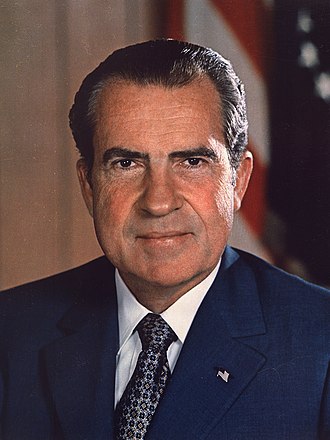
Richard M. Nixon served as the 37th President of the United States from January 1969 until his resignation in August 1974. In February 1971, he ordered the installation of a secret voice-activated taping system in the White House to preserve a historical record of his administration. Until the system's existence was revealed and dismantled in July 1973, the tapes captured Nixon directing major foreign policy initiatives, such as the opening to China, as well as his central role in the Watergate cover-up.
What Nixon talks about on the tapes
White House operations 4,718Presidential scheduling 2,225Public relations 1,784Presidential schedule 1,782Vietnam War 1,693Logistics 1,650Manolo Sanchez 1,626White House communications 1,400White House administration 1,399Presidential communication 1,243Henry Kissinger 1,191Foreign Policy 1,183
Conversations (21,010)
— Page 97 of 211President Nixon and Henry Kissinger met in the Oval Office to coordinate strategy ahead of Kissinger's secret mission to Moscow to negotiate with Soviet leaders regarding the Vietnam War and a potential summit. They discussed maintaining a tough military posture, including continued bombing of North Vietnamese targets to leverage negotiations, while framing the Moscow trip as a broader diplomatic effort. The participants also finalized plans to conceal Kissinger’s location by claiming he was attending staff meetings at Camp David, effectively keeping the press and public in the dark until a planned announcement following the talks.
President Nixon contacted the White House operator to facilitate a personal phone call to his daughter, Tricia Nixon Cox. This brief communication served strictly as an administrative request to connect the President with his family. No policy matters or substantive political issues were addressed during the brief interaction.
President Nixon contacted the White House operator to determine the current location of his daughter, Tricia Nixon Cox. He specifically clarified that he was not attempting to reach her but merely seeking confirmation of her whereabouts within the executive complex. The operator agreed to investigate her status and provide the requested information.
President Nixon and his daughter, Tricia Nixon Cox, discussed their respective schedules and upcoming plans for a family visit to Camp David. The President coordinated the timing of his arrival with Tricia and First Lady Pat Nixon, noting the First Lady's prior commitments to an International Choral Festival. The call also briefly addressed the President's ongoing meeting with Alexander Haig following Haig's recent return from Vietnam.
President Nixon and his daughter, Tricia Nixon Cox, discussed logistics regarding upcoming travel plans and family engagements. The conversation touched upon the President's scheduled meetings, specifically mentioning General Alexander Haig's recent return from Vietnam, and addressed scheduling conflicts involving First Lady Pat Nixon. The exchange served primarily as a coordination check for family events, including a proposed trip to Kansas and potential travel to Chicago.
President Nixon and his personal secretary, Rose Mary Woods, discussed administrative arrangements regarding the First Lady’s return travel from New Bern, North Carolina, and the coordination of a telephone call to Tricia Nixon Cox. The brief meeting centered on logistical scheduling, including confirming the timing of Pat Nixon’s arrival and integrating additional itinerary items. The President directed Woods to facilitate further communication with the family to finalize these travel and scheduling details.
President Nixon and Henry Kissinger discussed the diplomatic risks and strategic conditions surrounding Kissinger’s upcoming trip to Moscow ahead of the Soviet summit. They reached a consensus that any public announcement regarding a return to plenary peace talks on Vietnam must be backed by ironclad Soviet guarantees to prevent the U.S. from being forced to halt bombing and blockade operations prematurely. Following this, Nixon consulted with Charles Colson regarding political pushback from university administrators over the administration’s Vietnam policies, emphasizing a need for a firm, adversarial response to critics.
President Nixon and Henry Kissinger coordinated on an urgent communication strategy, focusing on the need to relay specific arguments to Charles W. Colson. The President directed the White House operator to connect him with Colson to discuss these points immediately. This exchange underscores the high level of coordination between Nixon and his top advisor regarding the handling of sensitive political tasks.
President Nixon and Charles Colson discussed strategies to manage the ongoing ITT confirmation hearings, focusing on limiting hostile questioning of witness Jack Gleason and stalling Democratic probes. Nixon directed Colson to leverage information regarding past Democratic contributions from ITT to deflect political pressure and, if necessary, expose financial ties between the company and members of the Senate. The conversation also touched on the administration's aggressive communication strategy, specifically praising John Connally’s public defense of Vietnam policy and planning for Vice President Spiro Agnew to confront dissenting Ivy League university presidents.
President Nixon contacted the White House operator to facilitate an outgoing call to Charles W. Colson. The brief exchange served as an administrative request to connect the President with his special counsel. No further substantive discussion was recorded during this interaction.
President Nixon and Charles Colson discuss political strategy, focusing on upcoming testimony by Peter M. Flanigan regarding the ITT case and the administration's plan to frame Democratic candidates as being disloyal and supportive of the enemy regarding the Vietnam War. They review the morale-boosting effects of recent bombing campaigns in Vietnam and critique the effectiveness of various economic spokespeople. The conversation emphasizes the need for the administration to aggressively push these narratives to shift public opinion and gain support from labor groups.
President Nixon met with his valet, Manolo Sanchez, to discuss the scheduling of an upcoming event or appointment. The brief exchange focused on confirming a specific plan that remained pending official approval. No definitive action was taken, as the participants awaited further confirmation before finalizing arrangements.
President Nixon met with H.R. Haldeman to discuss high-level administration strategy, including preparations for Henry Kissinger’s upcoming trip to Moscow and the management of sensitive Vietnam negotiations. The President expressed frustration with Kissinger’s tendency to engage in philosophical digressions during diplomatic talks and instructed that specific, direct messages be relayed regarding the necessity of prioritizing a Vietnam settlement over broader summit discussions. Additionally, they reviewed domestic political issues, including the ITT case, upcoming press strategy, and staff transitions, while Nixon emphasized his desire to reduce his own preoccupation with negative media coverage.
President Nixon and H. R. Haldeman discuss the status of the upcoming Soviet summit, specifically addressing the possibility of cancellation. They coordinate a message for Henry Kissinger regarding ongoing negotiations over anti-ballistic missiles and the National Command Authority. The discussion emphasizes the need for clear communication and strategic messaging to ensure Kissinger remains aligned with the administration's position.
President Nixon and John Connally met to discuss the administration's aggressive response to the North Vietnamese invasion, including the strategic use of bombing and the potential for a naval blockade. Amidst this foreign policy crisis, they reviewed Connally’s planned departure from his position as Secretary of the Treasury and discussed his successor, with George Shultz emerging as the preferred choice. The conversation further explored domestic economic policy, including plans for austerity budgets and welfare reform, as well as the political necessity of maintaining a strong, decisive image for the upcoming 1972 election.
President Nixon met with his personal secretary, Rose Mary Woods, to coordinate logistics for an upcoming social dinner and review his immediate schedule. The discussion focused on managing the guest list, including the attendance of Charles "Bebe" Rebozo, and planning a potential trip to Camp David with Tricia Nixon Cox and the First Lady. Nixon emphasized the need for careful communication with staff and associates regarding these arrangements to avoid administrative complications.
President Nixon met with the President's Panel on Nonpublic Education to discuss strategies for supporting private and parochial schools through tax credits and welfare legislation. The discussion focused on the necessity of private-sector self-help, the constitutional hurdles posed by the courts, and the political challenges of passing school-aid legislation during an election year. Nixon encouraged the panel to continue lobbying efforts on a bipartisan basis to build momentum for future success, while also emphasizing his administration's commitment to the role of parents in the educational marketplace.
President Nixon met with Clifford D. Carlson, Carol A. Carlson, and Max L. Friedersdorf for a brief, informal social visit in the Oval Office. The conversation included expressions of presidential condolences regarding the recent death of Carlson's wife and lighthearted exchanges about family and personal appearances. The meeting concluded with a formal photograph session and the distribution of presidential gifts, including cuff links and golf balls.
President Nixon contacted the White House operator to facilitate a personal telephone call to First Lady Thelma C. ("Pat") Nixon. The interaction served as a brief administrative request to connect the President with his wife. No substantive political or policy matters were discussed during this brief exchange.
President Nixon held a brief follow-up call with an unidentified individual to address an outstanding matter. The dialogue focused exclusively on the President returning a previous message from the participant. No further substantive details regarding the conversation are available due to the lack of a transcript.
President Nixon met with his aide Stephen B. Bull to coordinate his upcoming schedule and logistics. The discussion focused on arranging a meeting with John D. Ehrlichman, specifically concerning a matter involving the Massachusetts Institute of Technology (MIT). The conversation concluded after finalizing these brief administrative arrangements.
President Nixon met with Stephen B. Bull to discuss personal logistics and the aesthetic upkeep of the White House grounds. The President emphasized the seasonal beauty of the Rose Garden, specifically instructing Bull to ensure guests see the crab apples and tulips during their brief bloom. Additionally, the pair touched upon housing matters, with Nixon offering advice on real estate as an investment.
President Nixon, First Lady Pat Nixon, and John Ehrlichman discussed the successful public reception of the giant pandas recently gifted to the United States. Mrs. Nixon provided details regarding the pandas' popular behavior and the extensive media coverage of the event. The conversation also touched upon logistical scheduling for the Nixon family's upcoming visits to Camp David.
President Nixon met with John Ehrlichman to direct a significant reduction in federal spending, specifically targeting grants and contracts for higher education and scientific research. Motivated by a desire to curb support for academic institutions perceived as ideologically unfriendly, Nixon instructed Ehrlichman to work with Caspar Weinberger to systematically eliminate these subsidies, focusing on the non-renewal of grants rather than early cancellation to avoid legal complications. Additionally, the two discussed strategies for controlling media coverage and ensuring consistent, positive administration-friendly reporting on weekend news cycles.
President Nixon met with Alexander P. Butterfield to coordinate administrative logistics regarding his upcoming schedule and staff communications. The discussion touched upon briefings for Press Secretary Ronald Ziegler and the President's review of war powers legislation. The meeting concluded with preparations for Nixon’s departure to Camp David later that afternoon.
President Nixon met with Ronald Ziegler and Alexander Haig to coordinate the administration's messaging on the Vietnam War, specifically directing staff to label North Vietnamese forces as "the enemy" rather than the "other side." The group discussed the political implications of a recent House Democratic resolution regarding Vietnam and planned the President's upcoming press conference. Additionally, Nixon instructed Ziegler on how to handle press inquiries regarding Henry Kissinger's whereabouts over the weekend and confirmed his decision to stop attending various press association dinners.
President Nixon initiated this brief call to coordinate with Alexander M. Haig, Jr. regarding an ongoing discussion with Press Secretary Ronald L. Ziegler. Nixon instructed Haig to remain in his office, signaling that he intended to follow up shortly to address specific administrative matters. The conversation served primarily as a logistical check-in to prepare for a subsequent, more detailed briefing.
President Nixon and Alexander M. Haig, Jr. met to discuss the status of the ongoing North Vietnamese offensive and coordinate communication with Henry Kissinger, who was currently in Moscow. The conversation focused on the tactical efficacy of B-52 bombing strikes, the performance of South Vietnamese forces in areas like An Loc, and the psychological impact of these actions on North Vietnamese morale. Nixon and Haig also strategized on how to frame these military efforts to the American press and Congress, aiming to counter domestic opposition while maintaining pressure on the North through sustained air operations.
President Nixon and his valet, Manolo Sanchez, coordinate logistical arrangements for the President's upcoming travel, including helicopter scheduling and potential plans at the Executive Office Building. Nixon also consults Sanchez on the social propriety of calling First Lady Pat Nixon to inform her of his arrival plans, ultimately deciding against it. This brief exchange serves to finalize the President's personal agenda for the evening.
President Nixon met with his personal valet, Manolo Sanchez, to coordinate logistics for the President's upcoming departure for Camp David. The discussion focused on finalizing the travel schedule, including the timing of Sanchez's own departure. Additionally, they reviewed arrangements for the President's scheduled appearance at the American Society of Newspaper Editors (ASNE) reception.
President Nixon contacted the White House operator to facilitate a telephone connection with his Press Secretary, Ronald L. Ziegler. The brief exchange served solely as an administrative request to initiate communication with a key member of the administration's communications staff. No further substantive policy matters or tactical decisions were discussed during this short interaction.
President Richard Nixon met with his personal valet, Manolo Sanchez, in the Old Executive Office Building. The brief interaction, lasting only five seconds before a portion of the recording was withdrawn for personal privacy reasons, appears to be a routine administrative or service-related exchange. No substantive policy discussions or historical decisions were recorded during this segment of the meeting.
President Nixon met with his personal valet, Manolo Sanchez, in the Old Executive Office Building. The brief interaction focused on the practical limitations of the taping system as the President noted he had run out of recording tape. No significant policy discussions occurred during this exchange.
President Richard M. Nixon met with his valet, Manolo Sanchez, in his Old Executive Office Building workspace. The primary purpose of the session involved the President utilizing dictating equipment to record information or correspondence. No specific policy discussions or major political developments were recorded during this brief administrative interaction.
President Nixon held a brief, private meeting with his personal valet, Manolo Sanchez, in the Old Executive Office Building. Due to the lack of a transcript and the existence of a withdrawn segment, the substance of the discussion remains classified or restricted. No significant policy decisions or official developments were recorded as having resulted from this brief interaction.
President Nixon held a meeting with his valet, Manolo Sanchez, in the Old Executive Office Building. The conversation, which lasted for sixteen seconds of recorded audio before being withdrawn, involved personal matters. No significant policy decisions or governmental actions were documented in this brief interaction.
President Nixon utilized this session in the Old Executive Office Building to record a formal memorandum for the official record. The meeting served as a brief administrative exercise intended to document specific information for the White House files. Due to the unavailability of a transcript and the presence of withdrawn material, the exact subject matter of this dictation remains classified or restricted.
President Nixon met with Alexander Butterfield and Stephen Bull to discuss administrative arrangements for White House gifts and the President's upcoming schedule. The participants coordinated the distribution of customized putters intended for political contributors and reviewed logistical details for an upcoming meeting with Bob Hope. The discussion also included a brief review of photographs involving astronauts and preparations for the President’s scheduled appearances.
President Nixon and Press Secretary Ronald Ziegler coordinate logistics for an upcoming meeting with Bob Hope, ensuring photographer Ollie Atkins captures images in both the Oval Office and the Rose Garden for a commemorative album. They also review the political fallout from a recent Democratic caucus vote on Vietnam, with Nixon emphasizing the importance of highlighting low attendance and partisan dynamics. To counter the narrative, they discuss leveraging Republican allies and staffer Charles Colson to amplify support for the position from loyal Democrats.
President Nixon and Press Secretary Ronald L. Ziegler discuss plans for an upcoming photo opportunity, specifically requesting that photographer Polly Peterson capture images from multiple vantage points for a personal album. They also touch upon political matters, including the status of local party membership and the reaction of Republicans to local Democratic activities. The conversation concludes with a brief status update on these administrative and political concerns.
President Nixon initiates a brief telephone exchange to request that the White House operator connect him with Charles W. Colson. The call serves as a logistical coordination to facilitate direct communication between the President and his special counsel. No further substantive discussion occurs during this interaction.
President Richard M. Nixon utilized the recording session in his Old Executive Office Building suite to dictate a memorandum for the official record. The substance of this dictation remains restricted as a personal returnable item, meaning no information regarding specific policy decisions or internal communications is publicly available. This brief recorded period served primarily as a procedural tool for the President to formalize administrative documentation.
President Nixon initiates a brief inquiry with the White House operator to determine his current location. The interaction serves as a routine administrative check, confirming the President’s presence within the Old Executive Office Building. No further policy matters or significant executive actions were discussed during this brief exchange.
President Nixon initiates a brief telephone call to summon Charles W. Colson to his office. The two discuss the logistics of their upcoming in-person meeting, confirming that Colson is nearby and available to head over immediately. The brief exchange serves primarily as a coordination step for a private consultation between the President and his advisor.
President Richard Nixon met with special counsel Charles W. Colson for a brief, one-minute discussion in the Old Executive Office Building. While no transcript exists for this encounter, the interaction reflects the ongoing advisory relationship between the President and Colson regarding White House administrative or political matters. The meeting served as a brief consultation within the broader context of their regular coordination on executive affairs.
President Nixon met with his personal valet, Manolo Sanchez, to coordinate the secure handling and internal transfer of sensitive private files and personal items. The President directed Sanchez to move specific documents and an unknown article between the Old Executive Office Building and the Oval Office. This brief interaction served to manage the President's personal administrative logistics and workspace organization.
President Nixon instructed the White House operator to place an outgoing call to Caspar Weinberger. The brief exchange served as a logistical request to facilitate direct communication between the President and the then-Deputy Director of the Office of Management and Budget. No further policy discussions or substantive developments occurred during this short administrative interaction.
President Nixon met with Charles Colson, William P. Rogers, and Caspar Weinberger to discuss strategies for managing the Vietnam War, congressional opposition, and the ITT investigation. A key focus was rallying public and congressional support for the President's military response to the North Vietnamese invasion by framing it as a necessary defense of U.S. troops and national integrity. The group also addressed the need to cut federal subsidies for higher education institutions as a budget austerity measure and considered tactics to discredit Democratic opponents who were viewed as defeatist. Additionally, the President received updates on economic figures and discussed the administration's defensive stance regarding ongoing congressional hearings.
President Nixon directs Office of Management and Budget Director Caspar Weinberger to pursue aggressive budget cuts for higher education subsidies, specifically targeting research funding at institutions like MIT. Nixon argues that these institutions are oversubsidized and advocates for a 'ruthless examination' of federal contracts, proposing that the administration simply refuse to renew them during the upcoming budget cycle. He expresses frustration with resistance from the Department of Health, Education and Welfare and White House staff, insisting that these austerity measures are necessary to control government spending.
President Nixon initiates a request to the White House operator to be connected with Secretary of State William P. Rogers. This brief administrative interaction serves as the preliminary step for a subsequent high-level diplomatic discussion. The primary action item is the establishment of this telephonic communication channel between the President and the State Department leadership.
President Nixon and Secretary of State William P. Rogers discuss arranging a Vietnam briefing for State Department staff by Alexander Haig, intended to bolster confidence in administration policy and demonstrate inter-agency cooperation. The two also address recent congressional developments regarding Vietnam, with Nixon emphasizing the political risks faced by anti-war critics. Additionally, they coordinate strategy for an upcoming American Society of Newspaper Editors (ASNE) event, specifically targeting key regional media figures and planning Cabinet attendance.
President Nixon met with his aide Stephen B. Bull to facilitate the scheduling of an upcoming visit by entertainer Bob Hope. The primary objective of the meeting was to coordinate Hope's arrival and manage his interactions with Alexander M. Haig, Jr. and Ronald L. Ziegler. Nixon emphasized the urgency of the logistics, specifically tasking Bull with capturing photographs of the guest before anticipated weather complications.
President Nixon met with Rose Mary Woods and Stephen B. Bull to coordinate administrative logistics and personal scheduling matters. The discussion centered on the arrangements for Bob Hope’s upcoming meeting, including the necessity of capturing photographs before expected inclement weather. Additionally, the group reviewed the President’s travel itinerary to Camp David and confirmed plans regarding Bebe Rebozo’s arrival.
President Nixon met with entertainer Bob Hope, Press Secretary Ronald Ziegler, and photographer Ollie Atkins to discuss logistics for an upcoming photo session in the Rose Garden. The group coordinated the use of flags and specific lighting for the shots, while also briefly reflecting on Hope’s golf game and past encounters. Additionally, they touched upon potential comedic material regarding the President’s attendance at an American Society of Newspaper Editors reception, specifically mentioning pandas and columnist Jack Anderson.
President Nixon met with Bob Hope, Ronald Ziegler, and others to discuss the current military situation in Vietnam, specifically the North Vietnamese offensive and the American response. Nixon emphasized that the U.S. was committed to using overwhelming air and sea power to prevent a South Vietnamese collapse and to maintain international credibility, framing the conflict as a high-stakes geopolitical poker game with implications for the Middle East. The President expressed deep frustration with the American press, accusing journalists of defeatism and actively undermining the war effort by inciting troops and supporting the enemy.
President Nixon met briefly with an unknown woman who delivered a briefcase to the Oval Office. During the brief exchange, the unidentified visitor recounted a past experience involving an anti-war heckler at a public event. The conversation concluded shortly thereafter without any formal policy decisions or further administrative action.
President Nixon met with Henry Kissinger, Alexander Haig, and other staff members to finalize the strategy for an upcoming televised address regarding the worsening military situation in Vietnam. The President emphasized his desire for a simple, direct speech that would frame the North Vietnamese invasion as a clear act of aggression while preparing the public for potential military losses. A significant portion of the conversation focused on the necessity of matching tough rhetoric with decisive air and naval strikes, as well as the importance of maintaining diplomatic credibility ahead of the upcoming Soviet summit. Nixon also instructed his team to improve their public relations efforts, expressing deep frustration with the lack of aggressive messaging from the State Department and the Pentagon regarding the conflict.
President Nixon consulted with staff to dictate a memorandum regarding the ongoing North Vietnamese invasion and the necessary rhetorical framing for his upcoming address. The discussion focused on maintaining a firm stance against North Vietnamese aggression and the strategic necessity of avoiding national humiliation during negotiations. Nixon finalized revisions to his speech with John K. Andrews, Jr. to ensure the administration's resolve in the face of persistent military conflict.
President Nixon met with unidentified individual(s) in the Old Executive Office Building to discuss administrative or political matters. Due to the lack of an available transcript or specific descriptive logs, the precise subject matter and policy outcomes of this interaction remain unrecorded. This meeting reflects the routine but obscured nature of the President’s daily schedule during the spring of 1972.
President Nixon dictated specific notes and revisions for a speech draft addressing the North Vietnamese invasion. He emphasized characterizing the conflict as a case of naked aggression while outlining the necessity of the U.S. response and the defense of South Vietnam. The President directed an aide to consolidate these dictations into a formal document to finalize the speech's messaging regarding the frustrations and strategic stakes of the war.
President Nixon consulted with an aide regarding his upcoming address on the situation in Vietnam. The discussion focused on incorporating specific revisions proposed by John K. Andrews into the speech draft. The President sought to refine the messaging and content of the remarks to ensure they effectively addressed the administration's strategic position on the war.
President Nixon consulted with an unidentified individual regarding revisions to the text of an upcoming speech. The dialogue focused on refining the specific language and messaging strategy for this address. No definitive final text was recorded, leaving the nature of the edits and the specific subject matter of the speech ambiguous.
President Nixon dictated notes and drafted portions of a speech aimed at justifying continued American involvement in the Vietnam War amidst the North Vietnamese spring invasion. He focused on framing the conflict as a critical test for global peace, arguing that a withdrawal would embolden future communist aggression while undermining the credibility of U.S. power. The President sought to contrast his administration's generous peace offers and troop withdrawals against North Vietnam's reliance on Soviet-supplied weaponry and battlefield escalation.
President Nixon met with Alexander P. Butterfield to coordinate logistics for an upcoming dinner with congressmen. The discussion focused on finalizing the guest list, specifically addressing invitations for Secretary of Defense Melvin Laird, Donald Rumsfeld, and former representative Clark MacGregor. The participants also reviewed drafting edits for a speech regarding Vietnam policy, emphasizing the administration's stance against communist aggression and the necessity of preventing future conflicts.
President Nixon dictates notes for a speech draft focusing on the geopolitical ramifications of the Vietnam War in the context of his 1972 reelection campaign. He analyzes the potential impact of a perceived U.S. defeat on presidential credibility, global peace, and foreign policy. The dictation emphasizes the necessity of maintaining international respect following his recent diplomatic initiatives with China and the Soviet Union.
President Nixon held a brief, unscheduled meeting in the Old Executive Office Building with Alexander M. Haig, Jr. While the specific transcript is unavailable, the discussion occurred during a period of high-level national security deliberations regarding the Vietnam War. This interaction reflects the ongoing, direct consultative relationship between the President and Haig concerning military and diplomatic strategy.
President Nixon and his personal secretary Rose Mary Woods coordinate the logistics of delivering a speech. The brief discussion focuses specifically on the handling of recording tapes and arrangements for Manolo Sanchez to facilitate the delivery. No broader policy issues are addressed, as the conversation remains strictly confined to administrative tasks.
President Richard Nixon met with his personal valet, Manolo Sanchez, in the Old Executive Office Building to handle a private administrative matter. The primary purpose of the brief interaction was to arrange for the delivery of an unspecified item to the President's personal secretary, Rose Mary Woods. No further policy or political discussions were recorded during this brief exchange.
President Nixon and an unidentified associate review draft remarks for a speech concerning the Vietnam War. The discussion focuses on refining the rhetoric surrounding the necessity of avoiding a humiliating American withdrawal to maintain the global standing and prestige of the presidency. Nixon emphasizes the strategic importance of his upcoming diplomatic travel to Moscow and the necessity of preventing actions that would irreparably weaken the nation's influence in global peace negotiations.
President Nixon met with H.R. Haldeman, Ronald Ziegler, and Henry Kissinger to strategize for an upcoming televised address regarding the Vietnam War and secret diplomatic breakthroughs. They discussed the administration's plan to maintain a hard-line stance on the continued bombing of North Vietnam while emphasizing a commitment to peace through secret channels with the Soviet Union. A primary goal of the meeting was to coordinate the messaging to keep administration supporters mobilized, confuse political opponents, and discredit media critics who were skeptical of the administration's foreign policy maneuvers.
President Nixon, H. R. Haldeman, and Press Secretary Ronald Ziegler discuss the aftermath of a press briefing conducted by Ziegler and Henry Kissinger regarding the President's recent activities. Nixon probes the media's reaction and specific questioning concerning his recent stay at Camp David and his overall credibility. To debrief on the session's tone and effectiveness, the President instructs Ziegler to bring Kissinger to the Oval Office for a meeting.
President Nixon contacted the White House operator to facilitate a telephone connection with John K. Andrews, Jr., a member of the White House research office. The brief interaction served as a formal request to initiate this specific line of communication. No further policy or substantive matters were discussed during this brief exchange.
President Nixon engages in a brief discussion with a White House operator regarding the effectiveness of his administration's high-stakes diplomatic and strategic maneuvers. The conversation highlights the administration’s strategy of leveraging credible threats to force adversaries back to the negotiating table. The President specifically references the necessity and success of recent secret meetings in advancing his foreign policy objectives.
President Nixon and John K. Andrews, Jr. held a brief telephone call to coordinate an immediate in-person meeting. Nixon requested that Andrews accelerate his arrival at the White House to discuss unspecified ongoing work. The pair agreed to convene promptly to review these matters.
President Nixon met with John K. Andrews, Jr. to discuss the urgent necessity of securing a ceasefire in Vietnam as a means of extricating the United States from the conflict. Nixon emphasized the difficulty of maintaining current military commitments and suggested that achieving an immediate cessation of hostilities was the priority, with secondary terms left for future negotiation. The brief exchange highlights the administration’s shifting focus toward prioritizing an exit strategy amid mounting pressure.
President Nixon and Henry Kissinger met to coordinate the final drafting and scheduling of an upcoming presidential speech concerning the ongoing conflict in Vietnam. They discussed the tactical nuances of troop withdrawals and the necessity of establishing a firm negotiating position regarding territorial occupation. The primary focus centered on refining the administration's public message while ensuring that military considerations remained central to their diplomatic strategy.
President Nixon met with aides Winston Lord and John K. Andrews, Jr. to rehearse and refine a forthcoming speech regarding the Vietnam War. During the session, the President read a draft that emphasized his refusal to compromise U.S. national interests for election-year political gains, while framing the conflict as a test of American resolve against communist aggression. The discussion focused on adjusting the speech’s length and wording to underscore the necessity of achieving "peace with honor" and maintaining the integrity of the presidency.
President Nixon contacted the White House operator to request a telephone connection with his Press Secretary, Ronald L. Ziegler. The brief exchange served solely as an administrative bridge to facilitate direct communication with a key member of his staff. No further substantive policy discussions occurred during this specific transition period.
President Nixon consulted with an aide regarding the final drafting and tone of an upcoming presidential speech. The discussion focused on refining rhetorical conclusions and ensuring the address avoided negative political risks associated with past Cambodian policy rhetoric. Furthermore, they deliberated on the implications of Nixon’s status as a declared re-election candidate on the speech's overall messaging.
President Nixon consulted with a White House operator regarding the logistics and physical arrangement of an upcoming event or display, specifically discussing the structural configuration of a "tree" or "box." The exchange focused on operational ease and aesthetic presentation, with the President seeking a more compact or "tight" setup. The conversation concluded with a brief mention of including medical input in the project's planning.
President Nixon and Press Secretary Ronald Ziegler consulted on media coverage regarding Vietnam, confirming that wire stories and press reports were trending favorably. They discussed the impact of Nixon’s recent public statements on the White House press corps, noting that the administration had successfully unsettled critics. Ziegler confirmed that the President’s upcoming speech would be prominently featured in the 3:00 p.m. news cycle.
President Nixon and Press Secretary Ronald Ziegler discuss the drafting of a brief statement regarding the progress of a long-standing political or military struggle. Nixon instructs Ziegler to emphasize that the administration is nearing the conclusion of this effort and should remain committed to seeing it through to success. This brief coordination session serves to ensure that public messaging reflects the President's perspective on the administration's momentum.
President Nixon contacted the White House operator to place an outgoing call to Charles W. Colson. The brief exchange served as an administrative request to facilitate direct communication with his special counsel. No further substantive policy matters were discussed during this connection.
President Nixon consults with his valet, Manolo Sanchez, regarding the development of a specific communication strategy intended for the Soviet Union. Nixon emphasizes his indifference toward domestic election-year optics, focusing instead on demonstrating to the Soviets that they lack political leverage over his administration. The conversation centers on framing a tough diplomatic stance as a necessary countermeasure to recent international friction.
President Nixon initiates a brief administrative interaction with the White House operator to facilitate a telephonic connection. This recording serves as a logistical bridge to a subsequent conversation, underscoring the President's reliance on operators for managing official communication lines. No substantive policy matters or major strategic decisions are discussed during this brief bridge.
President Nixon met with his personal valet, Manolo Sanchez, in the Old Executive Office Building. The brief interaction, lasting less than six minutes, consisted of a personal segment that has been withdrawn from the public record. No official policy matters or significant administrative decisions were recorded during this brief encounter.
President Nixon initiated this brief telephone call to determine Charles Colson's current location and availability. Upon confirming Colson’s proximity, the President requested that he come to the White House for a short meeting. The primary purpose of the contact was to facilitate this immediate, informal consultation between the two men.
President Richard M. Nixon and Charles W. Colson held a brief, one-minute meeting in the Old Executive Office Building to coordinate administrative or political objectives. While a transcript is not available for this specific exchange, the discussion served as a follow-up to a related conversation held earlier that day. No specific policy decisions were recorded during this brief interaction.
President Nixon initiates a request for the White House operator to place a telephone call to Clark MacGregor. The brief exchange serves as a logistical coordination to facilitate direct communication between the President and his advisor. No further substantive policy matters are addressed during this brief call.
President Nixon initiates a brief administrative communication with the White House operator from his office in the Old Executive Office Building. The recording functions as a technical bridge or coordination effort, facilitating a subsequent conversation recorded under a separate identifier. No substantial policy matters or executive decisions are documented within this short interaction.
President Nixon and Charles Colson coordinated a communication plan involving Clark MacGregor. The participants arranged for MacGregor to return a call to the President immediately upon his arrival at the Capitol. This brief exchange served to facilitate direct contact between Nixon and MacGregor regarding pending political business.
President Nixon met with Charles Colson and other staff members to strategize regarding the public perception of his Vietnam policy and the administration's upcoming diplomatic efforts. They discussed the positive impact of increased bombing in North Vietnam, the success of recent press backgrounders in shaping the President's image as a courageous leader, and the importance of using supportive polling data to counter political opposition. Nixon emphasized his determination to maintain military pressure regardless of political risks to his reelection or the upcoming Soviet summit, while also coordinating the public handling of Henry Kissinger's secret trip to Moscow.
President Nixon and Clark MacGregor discussed ongoing military operations in Vietnam, specifically focusing on continued B-52 bombing raids and the administration's firm stance against North Vietnam. MacGregor provided positive feedback regarding public reception to recent statements made by the Vice President and the appointment of John Mooty as the CRP chairman in Minnesota. Additionally, they reviewed the status of Richard G. Kleindienst’s confirmation proceedings, anticipating a favorable committee vote on his nomination the following morning.
President Nixon contacted the White House operator to facilitate a telephone connection with his National Security Advisor, Henry Kissinger. The brief exchange served as a logistical request to initiate this high-level communication. No substantive policy matters were discussed during this initial routing call.
President Nixon and Henry Kissinger discussed upcoming public relations strategy regarding the Vietnam War, specifically noting Governor Ronald Reagan's strong support for the administration's bombing campaign. Kissinger reported that he shared speech materials with Soviet diplomat Yuli Vorontsov to clarify the U.S. position amidst intense press speculation. The two agreed to maintain a unified message and avoid further media contact ahead of a scheduled afternoon meeting to finalize the President's speech.
President Nixon contacted the White House operator to place an outgoing call to Stephen B. Bull. This brief administrative exchange served as a request to connect the President with a member of his staff. No further discussion or policy matters were addressed during this short communication.
President Nixon met with his personal valet, Manolo Sanchez, in the Old Executive Office Building. While the specific details of their discussion remain unrecorded due to the lack of a transcript, the meeting served as a brief interlude between the President's scheduled engagements, including a session with National Security Advisor Henry Kissinger. This interaction reflects the routine personal exchanges between Nixon and his long-time staff member during the workday.
President Richard Nixon met with his longtime personal valet, Manolo Sanchez, in the Old Executive Office Building. The discussion focused on administrative matters and the handling of professional papers involving John D. Ehrlichman. This interaction highlights the routine management of the President's personal staff and document organization within the Executive Office.
President Nixon met with Henry Kissinger, Ronald Ziegler, and other staff to finalize a major televised speech regarding troop levels and the ongoing conflict in Vietnam. The discussion focused on refining the speech's tone to appeal to hawkish supporters while managing political fallout from critics and maintaining strict secrecy surrounding Kissinger’s recent diplomatic mission to Moscow. Nixon also provided instructions on how to handle Secretary of State William Rogers and SALT negotiations, emphasizing the need to consolidate executive control over diplomatic messaging and strategy.
President Nixon consulted with his aide Stephen B. Bull to confirm the logistics for an upcoming meeting with Dr. W. Kenneth Riland. The two agreed that the appointment would take place at 6:00 p.m. within the White House residence. This brief interaction served to finalize the venue and timing for the President’s evening schedule.