Nixon, Richard M. (President)
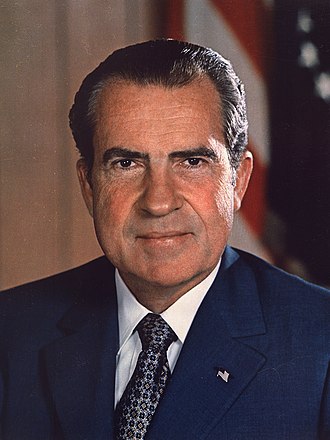
Richard M. Nixon served as the 37th President of the United States from January 1969 until his resignation in August 1974. In February 1971, he ordered the installation of a secret voice-activated taping system in the White House to preserve a historical record of his administration. Until the system's existence was revealed and dismantled in July 1973, the tapes captured Nixon directing major foreign policy initiatives, such as the opening to China, as well as his central role in the Watergate cover-up.
What Nixon talks about on the tapes
White House operations 4,718Presidential scheduling 2,225Public relations 1,784Presidential schedule 1,782Vietnam War 1,693Logistics 1,650Manolo Sanchez 1,626White House communications 1,400White House administration 1,399Presidential communication 1,243Henry Kissinger 1,191Foreign Policy 1,183
Conversations (21,010)
— Page 151 of 211President Nixon and Julie Nixon Eisenhower discuss coordinating a meeting between Press Secretary Ronald L. Ziegler and First Lady Pat Nixon regarding Julie’s career plans. Following consultation with H.R. Haldeman, the President decides to facilitate the outreach himself to ensure a direct discussion. The President tasks Ziegler with calling the First Lady to schedule a meeting for that afternoon.
President Nixon and Alexander Haig discuss the status of Vietnam peace negotiations following Haig's recent communication with Henry Kissinger. They address Kissinger’s exhausted state and sensitive mood upon his return, agreeing to postpone a meeting until he has rested. Haig commits to sending Kissinger a message that conveys the President's strategic input regarding future planning and Vice President Agnew's upcoming trip in a manner that avoids unnecessary friction.
President Nixon met with Alexander M. Haig, Jr. to facilitate the transfer of briefing materials and prepare for an upcoming appointment. The brief exchange focused on the delivery of specific documents for the President's review. The meeting concluded with Haig leaving the necessary paperwork for Nixon's attention.
President Nixon met with Alexander Haig to assess the stalled Vietnam peace negotiations and the deteriorating mental state of National Security Advisor Henry Kissinger. Nixon expressed frustration over recent setbacks, including failed diplomatic maneuvers and Kissinger’s emotional volatility, while emphasizing the need to isolate Kissinger from the influence of Secretary of State William Rogers and Secretary of Defense Melvin Laird. The two discussed potential military contingencies—specifically renewed bombing of North Vietnam and the reseeding of mines—as tools to pressure Hanoi and support South Vietnamese President Nguyen Van Thieu, ultimately deciding to move forward with a firm, objective strategy.
President Nixon consulted with a White House operator to facilitate an outgoing telephone call to an unidentified individual. The brief exchange primarily functioned to coordinate the connection for the President's upcoming communication. No substantive policy matters or further actions were recorded in this fragment.
President Nixon met with his personal valet, Manolo Sanchez, in the Old Executive Office Building. The discussion focused on coordinating the President's upcoming schedule and daily logistical requirements. No significant policy decisions were recorded during this brief administrative encounter.
President Nixon met with his valet, Manolo Sanchez, to coordinate upcoming logistical details regarding his official schedule. The conversation focused on the President's interactions with John D. Ehrlichman and the management of his time in the Executive Office Building. No significant policy decisions were recorded during this brief administrative exchange.
President Nixon met with his valet, Manolo Sanchez, in the Old Executive Office Building to discuss personal matters and the President’s daily schedule. The brief interaction included a remark concerning the prospects for education following the conclusion of the war. No major policy decisions were reached during this informal exchange.
President Nixon met with his personal valet, Manolo Sanchez, to discuss the President's upcoming schedule and personal arrangements. During the brief interaction, Sanchez inquired about the President's physical well-being, to which Nixon declined any need for assistance or intervention. The meeting served as a routine check-in regarding the President's personal needs and daily itinerary.
President Nixon met with an unidentified individual in his Old Executive Office Building office to discuss confidential administrative or political matters. Due to the absence of an available transcript, the specific agenda, policy decisions, and outcomes of the engagement remain unknown. The meeting lasted for a duration of less than 96 minutes before the participant departed.
President Nixon met with his personal valet, Manolo Sanchez, in the Old Executive Office Building to discuss personal arrangements. During the brief interaction, the President requested that Sanchez provide him with refreshments. The meeting concluded shortly thereafter when Sanchez departed to fulfill the request.
President Nixon met with his personal valet, Manolo Sanchez, to discuss and reconcile his upcoming presidential schedule. The two reviewed a discrepancy regarding the President's availability, ultimately confirming his agenda for the first three days of the week. No further policy or administrative actions were recorded during this brief administrative check-in.
President Nixon met with unidentified individual(s) in the Oval Office to discuss his upcoming schedule. While the specific details of the conversation were not recorded in a transcript, the brief meeting focused exclusively on administrative planning and logistical arrangements for the President's calendar. No further policy decisions or significant developments were noted during this short interval.
President Nixon met with Stephen B. Bull to review upcoming scheduling logistics, specifically focusing on an appointment with Dwight L. Chapin and Ronald H. Walker. The discussion centered on providing a gift for Chapin and reviewing the organizational structure of the National Park Service in relation to the White House. They also discussed the role and utilization of the U.S. Park Police during the 1972 presidential campaign.
President Nixon met with Ronald H. Walker and Dwight L. Chapin to discuss reforming the National Park Service by eliminating special privileges and private facilities previously reserved for members of Congress. Nixon expressed disapproval of the exclusive use of government-maintained properties, such as Coco Lobo, and directed his staff to repurpose these assets for public use as an economy measure. Additionally, the President criticized the agency's lack of promotional support for his administration and emphasized the need for better public relations and the promotion of loyal personnel within the organization.
President Nixon, Anne Armstrong, and H.R. Haldeman met to discuss staffing for the administration's second term, specifically focusing on a new, high-level role for Armstrong within the White House. The participants considered placing Armstrong in a senior advisory position—rather than the Chief of Protocol—to better leverage her political skills, manage the Bicentennial Commission, and address criticism regarding the representation of women. Nixon emphasized the need for a specific, authoritative title and an office within the White House complex to ensure Armstrong had the necessary proximity and influence to manage key policy and political initiatives.
President Nixon directed Stephen B. Bull to rearrange his daily schedule by delaying a meeting with Senator Henry M. Jackson. To facilitate this shift, Nixon instructed Bull to coordinate with the Secretary of Defense to ensure a preceding meeting with George P. Shultz concluded promptly. The primary goal of these adjustments was to restrict access to Jackson and manage the timing of high-level briefings regarding international travel and oil policy.
President Nixon met with George Shultz, Edwin Cohen, and Lewis Engman to discuss tax policy strategy and congressional relations following the 1972 election. The group deliberated on how to approach key legislative figures, such as Wilbur Mills, regarding property taxes, private school aid, and potential tax code reform. The President emphasized a pragmatic approach to working with Congress to advance administration priorities while maintaining flexibility on controversial issues like the value-added tax.
President Nixon instructed the White House operator to initiate a telephone call to economist Milton Friedman. The purpose of the request was to connect with Friedman at the Mayo Clinic for a consultation. No further discussion or substantive policy matters occurred during this brief administrative exchange.
President Nixon initiated a brief exchange with the White House operator to inquire about the staff's status. The interaction serves as a routine check-in between the President and support personnel. No formal policy decisions or substantive political matters were addressed during this short communication.
President Nixon and Stephen B. Bull met briefly in the Oval Office to coordinate the timing and logistics of a scheduled meeting with Senator Henry M. "Scoop" Jackson. The conversation centered on the potential negative impact that interrupting or delaying the senator might have on their professional relationship and mutual trust. No further policy decisions were recorded during this short exchange.
President Nixon consulted with the White House operator to clarify the identity and location of economist Milton Friedman, whom Treasury Secretary George Shultz had recommended for contact. The President initially expressed confusion due to conflicting information suggesting the contact might be a physician requiring heart surgery at the Mayo Clinic. After verifying that the individual was indeed the prominent academic professor rather than an ear, nose, and throat doctor, the President confirmed the correct contact information.
President Nixon met with Senator Henry "Scoop" Jackson to discuss a range of foreign policy issues, including Jackson's recent travels to the Middle East and Eastern Europe, energy policy, and personnel appointments for the second term. They shared concerns about Soviet influence in the Persian Gulf and the need for a unified U.S. energy strategy, with Nixon tasking Jackson to coordinate with John Connally on regional developments. Additionally, the two discussed strategies for dealing with an uncooperative Senate, the importance of personnel loyalty in defense and arms control appointments, and potential roles for figures like John Sherman Cooper.
President Nixon telephoned economist Milton Friedman to offer his personal best wishes ahead of Friedman’s upcoming heart surgery at the Mayo Clinic. Informed of the procedure by George Shultz, Nixon expressed his high regard for Friedman’s intellect and importance to the nation. The brief exchange focused on morale and well-wishes, with Nixon encouraging a swift recovery.
President Nixon initiates a routine administrative request through the White House operator to be connected with Press Secretary Ronald L. Ziegler. The brief interaction serves solely as a bridge to facilitate communication between the President and his senior staff member. No policy matters or substantive discussions occur during this exchange.
President Nixon met with H.R. Haldeman and John Ehrlichman to discuss personnel and organizational strategy for his second term. The participants focused on the importance of appointing a high-profile woman to the White House staff to handle political and PR tasks, with Anne Armstrong identified as a prime candidate due to her toughness and political savvy. They also addressed concerns regarding cabinet performance, the management of congressional relations, and the necessity of re-instituting regular staff meetings to prevent unauthorized end-runs by officials like George Shultz.
President Nixon consulted with Press Secretary Ronald Ziegler regarding a strategy to secure increased television coverage for the White House Christmas decorations. Nixon directed Ziegler to arrange a tour of the festive displays, led by either First Lady Pat Nixon or Julie Nixon Eisenhower, specifically requesting that the broadcast feature the decor rather than include a presidential interview. Ziegler agreed to coordinate with NBC and Barbara Walters to facilitate the filming, aiming for a segment that would capture the aesthetic of the decorations while excluding the President from any on-camera dialogue.
President Nixon contacted the White House operator to facilitate an urgent communication with General Alexander M. Haig, Jr. The brief exchange served solely as a logistical request to establish a telephone connection with the General. No further policy or strategic matters were discussed during this short administrative interaction.
President Nixon and Alexander Haig discuss the deteriorating status of Vietnam peace negotiations and the necessity of resuming military action to break the current diplomatic impasse. They determine that Henry Kissinger’s suggestion to continue talks in Paris into January is unacceptable, as it would expose the administration to charges of deceit. Instead, they decide to move forward with aggressive military measures, including mining and bombing, while framing the escalation as a necessary response to North Vietnam’s failure to return American prisoners of war. To ensure internal unity, they plan a small, private National Security Council meeting to align key advisors like Secretary of State William Rogers and Secretary of Defense Melvin Laird on this strategy.
President Nixon met with his key advisors, including Henry Kissinger, Alexander Haig, and H.R. Haldeman, to discuss the deteriorating state of Vietnam peace negotiations following North Vietnamese intransigence and bad faith. Kissinger detailed the tactics used by the North Vietnamese, including reneging on previously agreed-upon points and introducing new, unacceptable demands, which led to an impasse. The group resolved to maintain a firm posture, agreeing to intensify military pressure through bombing campaigns while carefully managing public relations to ensure the responsibility for the stalled peace process remained with the North Vietnamese. Nixon decided against a televised address at that moment, opting for a low-key briefing to frame the situation as a failure of communist cooperation rather than a total breakdown of talks.
President Nixon contacted the White House operator to place a personal telephone call to his daughter, Julie Nixon Eisenhower. The brief exchange served solely to facilitate this communication. No further policy or administrative matters were discussed during this connection.
President Nixon and a White House operator coordinated a phone call for the President to speak with his daughter, Julie Nixon Eisenhower. The operator informed Nixon that Julie was currently on the line with her husband, David Eisenhower. Consequently, the President instructed the operator to call him back once Julie’s line became available.
President Nixon held a brief administrative interaction with the White House operator to facilitate official communication. The discussion served as a logistical bridge to connect the President with other parties via the White House telephone system. No substantive policy matters were addressed during this brief exchange.
President Nixon held a brief, informal check-in with the White House operator to facilitate immediate communication needs. The discussion functioned as a logistical coordination point to bridge the President with other individuals or offices. No specific policy decisions were recorded during this brief administrative interaction.
President Nixon initiated a call to the White House operator to be connected with his daughter, Tricia Nixon Cox, who was in London. This brief communication served solely as a logistical request to establish contact with his family member. No policy matters or official developments were discussed during this exchange.
President Nixon initiated a brief telephone call to his daughter, Tricia Nixon Cox, through a White House operator. Upon learning that she was unavailable for the next hour or more, the President opted to leave a message. The interaction served as a logistical attempt to coordinate communication regarding Tricia’s current schedule.
President Nixon held a brief communication with the White House operator from the Oval Office. The interaction focused on facilitating telephonic connections for the President. No further substantive policy or administrative matters were recorded during this brief exchange.
President Nixon held a brief, one-minute meeting in the Oval Office with an unidentified individual. Given the extremely short duration and lack of available documentation, no specific topics, policy decisions, or action items could be determined from the recording. This interaction remains an inconclusive entry in the White House taping system.
President Nixon met with H.R. Haldeman and other staff to review administrative reorganizations, personnel appointments for his second term, and preparations for his upcoming meeting with Senator John Stennis. The discussion focused on shifting away from internal promotions, with specific deliberations on staffing the CIA, identifying potential female candidates for government roles, and reevaluating the use of military aides in social settings. Nixon emphasized a desire for a more "hard-nosed" approach to congressional relations and requested that his team focus on political strategy rather than traditional gift-giving or ceremonial scheduling.
President Nixon and his daughter, Julie Nixon Eisenhower, coordinate social scheduling and personal arrangements during this call. The President tasks Julie with extending a dinner invitation to Rose Mary Woods and facilitates plans for a dinner with Alice Roosevelt Longworth by asking Julie to consult with First Lady Pat Nixon. Additionally, they briefly discuss David Eisenhower's new employment and coordinate logistics regarding the First Lady's upcoming travel plans to California.
President Nixon met with Senator Hugh Scott and William Timmons to discuss legislative strategy, Republican leadership roles, and the status of ongoing Vietnam peace negotiations as the administration prepared for the 93rd Congress. The President emphasized his desire to unify Republican political operations under George H.W. Bush and Bill Brock, while addressing concerns about party performance in the 1972 elections. Nixon also signaled his intent to maintain military pressure on North Vietnam to secure a favorable peace settlement and underscored the importance of bipartisan communication to manage Congress on spending and key policy initiatives.
President Nixon held a brief telephone conversation with his daughter, Tricia Nixon Cox, to discuss her ongoing trip to the United Kingdom. Nixon provided her with specific messages of support to convey to British Prime Minister Edward Heath and noted his intention to reach out to J. Paul Getty for his 80th birthday. The President also briefly touched upon the status of Vietnam peace negotiations, emphasizing his commitment to maintaining pressure until a resolution is reached.
President Nixon speaks with his daughter, Tricia Nixon Cox, to check in on her recent travel experiences and social engagements in Britain. During the conversation, Nixon discusses international political resilience and offers encouragement for a message to be relayed to a British political contact regarding political perseverance. They also touch upon diplomatic relations and the President's personal fondness for J. Paul Getty.
President Nixon instructed the White House operator to initiate a call to J. Paul Getty in London. The purpose of this communication was for the President to extend birthday wishes to Getty in honor of his 80th birthday. The operator confirmed the request and proceeded to facilitate the international connection.
President Nixon instructed the White House operator to place a telephone call to his daughter, Julie Nixon Eisenhower. This brief administrative interaction was initiated solely to facilitate personal communication between the President and his family. No policy matters or substantive governmental issues were addressed during the brief exchange.
President Nixon instructed the White House operator to place a long-distance call to London. The purpose of this communication was to reach Paul A. in recognition of his 80th birthday. The operator acknowledged the request, initiating the logistical task of connecting the President to his party abroad.
President Nixon met with his personal aide, Manolo Sanchez, to discuss upcoming administrative arrangements and scheduling. The discussion briefly touched upon the President's scheduled meeting with H.R. Haldeman and concluded with instructions regarding personal items, specifically the retrieval of the President’s cuffs. This brief interaction served as a coordination of immediate logistical and personal needs during the workday.
President Nixon initiates a brief request for the White House operator to connect him with a contact identified as Joy. This brief interaction serves as a routine administrative communication to facilitate a follow-up phone call. No substantive policy discussions or major decisions occurred during this brief exchange.
President Nixon and H. R. Haldeman met to coordinate the administrative reorganization for the second term, which included staff reductions and reassigning personnel to cabinet departments to improve efficiency. They discussed managing the East Wing and the role of Julie Nixon Eisenhower in assisting with transitions, as well as preparations for the 1973 Inauguration, including speechwriting and inaugural events. Additionally, the President reviewed his strategy for Vietnam negotiations, focusing on a proposal to link the cessation of bombing and troop withdrawal to the return of American prisoners of war.
President Nixon and his daughter, Julie Nixon Eisenhower, coordinate holiday social engagements and confirm the inclusion of key guests like Rose Mary Woods and Alice Roosevelt Longworth. The discussion focuses on ensuring proper dinner invitations to prevent potential interpersonal friction and finalizing informal meal plans. Additionally, the pair briefly touches upon the logistical status of a refrigerator repair being managed by Rex Scouten.
President Nixon instructed the White House operator to connect him with William E. Timmons, then serving as the Assistant to the President for Congressional Relations. The brief exchange served as a logistical request to initiate a telephone communication with Timmons. No further policy discussions or substantive developments were recorded in this initial contact.
President Nixon and Henry Kissinger coordinated their schedules to arrange a follow-up meeting later that afternoon with Alexander Haig. The discussion focused on confirming the timing for this tripartite session, ultimately settling on 2:30 p.m. Kissinger was tasked with notifying Haig of the scheduling adjustment.
President Nixon met with his personal valet, Manolo Sanchez, to discuss adjustments to his daily schedule and administrative tasks. The President explicitly stated his decision to forgo his scheduled nap, opting instead to attend to other pressing matters. Following this instruction, the two briefly addressed the coordination of personal affairs and the reorganization of office priorities.
President Nixon met with his valet, Manolo Sanchez, to provide specific instructions regarding Christmas decorations for his residence in Florida. The conversation focused on utilizing a pre-decorated tree that had been sent to the property rather than arranging for a new, elaborate display. Additionally, an unknown individual briefly joined the meeting to request a session with Charles W. Colson.
President Nixon consulted with the White House operator to place an outgoing telephone call. The exchange was brief and strictly functional, serving only to facilitate telephonic communication for the President. No substantive policy discussions or political developments occurred during this brief interaction.
President Nixon directs William E. Timmons to compile and deliver documentation regarding a specific legislative amendment sponsored by Senator Michael J. Mansfield. The request focuses on obtaining the exact language of the amendment, which concerned a four-month prison provision, alongside relevant voting records. Timmons commits to delivering this information to the Executive Office Building immediately to support the administration's tracking of congressional activities.
President Nixon and William E. Timmons held a brief meeting to discuss the administrative handling and potential sentencing delays involving a specific individual. The conversation focused on the timeline of the legal process and the reasons behind recent bureaucratic hold-ups. No major policy shifts were recorded during this brief exchange.
President Nixon contacted the White House operator to initiate an outgoing call to industrialist Jean Paul Getty. The brief exchange served as a logistical request to connect the President with Getty for undisclosed purposes. No further policy discussions or significant developments occurred during this brief administrative interaction.
President Nixon met with his personal valet, Manolo Sanchez, in the Old Executive Office Building to facilitate a brief administrative task. The primary purpose of the meeting was for the President to place a telephone call to Charles W. Colson. Following the initiation of this call, Sanchez concluded his duties and departed the office.
President Nixon consulted with his personal valet, Manolo Sanchez, regarding the scheduling of an upcoming meeting with Charles W. Colson. The brief discussion focused specifically on the timing of this appointment. The interaction concluded with the President confirming his availability before Sanchez departed the office.
President Nixon met with Henry Kissinger and Alexander Haig to discuss the current stalemate in Vietnam negotiations, specifically addressing North Vietnamese intransigence and bad-faith tactics regarding a potential cease-fire and the status of U.S. prisoners of war. Facing a breakdown in talks and an imminent congressional session that threatened to cut off war funding, Nixon decided to resume U.S. bombing and mining of North Vietnamese infrastructure. The President and his advisors concluded that this military pressure was necessary to force a settlement, maintain U.S. credibility, and ensure that South Vietnamese President Nguyen Van Thieu understood the necessity of a finalized agreement.
President Nixon met with Henry Kissinger and Alexander Haig to assess the stalled Vietnam peace negotiations and contemplate the strategic use of increased bombing campaigns, specifically targeting Hanoi and Haiphong, to compel North Vietnamese concessions. The discussion focused on maintaining U.S. leverage while navigating concerns regarding South Vietnamese President Nguyen Van Thieu's cooperation, domestic political pressures, and the potential impact on relations with the Soviet Union ahead of a planned 1973 summit with Leonid Brezhnev. Amidst these diplomatic maneuvers, Nixon also briefly paused the meeting to place a personal birthday call to J. Paul Getty.
President Nixon telephoned Jean Paul Getty to extend warm personal wishes on the occasion of Getty’s 80th birthday. The conversation served to reaffirm their ongoing friendship and included a brief mention of Tricia Nixon Cox’s travel plans to 10 Downing Street. Getty expressed his strong personal support for the President’s administration before the call concluded with mutual well-wishes.
President Nixon and H. R. Haldeman met briefly to coordinate administrative logistics and executive appointments. The discussion centered on the timing of the announcement regarding John A. Scali’s nomination as Ambassador to the United Nations. Additionally, the participants reviewed the President’s schedule, including a planned telephone call to Arthur Krock.
President Nixon initiates a request to the White House operator to facilitate an immediate meeting with special counsel Charles W. Colson. This brief interaction serves as a directive to bring a key staff member into the Oval Office for consultation. The primary objective is to establish direct communication with Colson to address ongoing administrative or political business.
President Nixon directed the White House operator to place a telephone call to Arthur Krock, a prominent former New York Times columnist. Despite reports that Krock was currently in poor health, Nixon expressed a desire to reach him directly. The President advised the operator to consult his personal secretary, Rose Mary Woods, to secure the necessary contact information to complete the call.
President Nixon held a brief interaction with the White House operator to facilitate an official communication. This administrative encounter served as a logistical step to connect the President with another party for further discussion. No substantive policy matters or major decisions were recorded during this brief logistical exchange.
President Nixon met with his aide Stephen B. Bull to provide specific instructions regarding executive branch outreach to Congress. The discussion focused on coordinating legislative strategy and refining the role of William E. Timmons in managing these congressional relations. This brief interaction served to delegate administrative follow-ups necessary to maintain effective communication with Capitol Hill.
President Nixon held a brief, unscheduled communication with the White House operator from his office in the Old Executive Office Building. The interaction served as a routine administrative exchange to facilitate telephone connectivity. No policy discussions or significant political developments occurred during this brief contact.
In this wide-ranging discussion, President Nixon met with top aides and political associates to strategize for his second term, with a primary focus on navigating the difficult final stages of the Vietnam peace negotiations. Nixon emphasized his resolve to continue bombing campaigns until a satisfactory agreement was reached while managing public perception and Congressional relations. The conversation also covered extensive planning for second-term personnel appointments—including naming John Scali as UN Ambassador—and organizational restructuring to ensure a loyal, efficient administration. Throughout, Nixon stressed the need for his appointees to avoid being captured by existing bureaucracies and to cultivate new political constituencies rather than deferring to the traditional East Coast establishment.
President Nixon called veteran journalist Arthur Krock to express his well-wishes regarding Krock's declining health. The conversation focused on their long-standing professional relationship and mutual admiration, with Nixon reflecting on his political career and the significance of his 1972 electoral victory. Nixon also took the opportunity to critique contemporary journalism, noting his appreciation for Krock's past objectivity compared to the current state of the New York Times.
President Nixon met with his personal valet, Manolo Sanchez, to discuss miscellaneous logistical matters and scheduling. The brief exchange included a logistical reminder regarding a check and coordination of the President’s upcoming calendar. The conversation also touched upon arrangements for Dr. William M. Lukash and the President's daughters, Julie Nixon Eisenhower and Tricia Nixon Cox.
In this extensive Oval Office meeting, President Nixon, H.R. Haldeman, Henry Kissinger, and other key advisors discussed the administration's second-term reorganization, personnel appointments (including John Scali as UN Ambassador), and public relations strategies. A significant portion of the conversation focused on the status of Vietnam peace negotiations, with Nixon emphasizing a hardline approach, including the escalation of bombing and mining operations to pressure North Vietnam. The President also provided specific directives for handling the press and managing the White House social schedule, including the exclusion of certain media outlets and the coordination of internal White House renovations.
President Nixon initiates a call to Senate Majority Leader Michael J. Mansfield through the White House operator. The primary purpose of this brief communication is to facilitate a direct conversation between the President and the Senator. No further policy discussions or substantive developments occur during this logistical interaction.
President Nixon and Senate Majority Leader Mike Mansfield discuss establishing a more collaborative, bipartisan approach to legislative affairs for the upcoming congressional term. Nixon expresses a desire to move beyond strictly partisan leadership meetings, proposing instead a regular, small-group format with top congressional leaders to address complex issues such as the energy crisis. The two agree to meet after the first of the year to further develop this framework, maintaining confidentiality to avoid political friction within their respective parties.
President Nixon instructed the White House operator to facilitate a meeting at the White House with his daughter, Julie Nixon Eisenhower, and his close confidant, Charles G. "Bebe" Rebozo. The brief exchange served primarily to initiate the scheduling of these individuals for a personal visit. No substantive policy matters were addressed during this administrative request.
President Nixon contacted the White House operator to facilitate a telephone connection. The primary purpose of this brief communication was to initiate a call to Charles W. Colson. No further policy or substantive matters were discussed during this exchange.
President Nixon met with John Ehrlichman to discuss the second-term administration reorganization, emphasizing the need to assert control over the federal government and prioritize loyalists for key appointments. The two men also strategized on managing Congressional relations, specifically favoring bipartisan cooperation with Democrats like Mike Mansfield to bypass obstructionist Republicans. Additionally, they reviewed domestic policy messaging, with Nixon stressing the importance of brevity in inaugural speeches and direct, disciplined communications to frame his administration’s accomplishments.
President Nixon met with his personal valet, Manolo Sanchez, in the Oval Office. The discussion was centered on the arrangements and delivery of the President’s lunch. This brief interaction served as a routine logistical exchange regarding the President's daily personal schedule.
President Nixon met with his valet, Manolo Sanchez, in the Oval Office to coordinate logistics for an upcoming reception for his 1972 election supporters. During the brief interaction, the two discussed arrangements for the event and managed the delivery of an unidentified item to the White House residence. The conversation primarily focused on scheduling details and personal administrative tasks.
President Nixon met with an unidentified male visitor in the Oval Office to briefly review the President's upcoming schedule. The conversation was extremely brief, lasting ten minutes or less, and concluded with the departure of the visitor. No substantive policy matters or major political decisions were recorded during this session.
President Nixon and Charles Colson discuss strategy for upcoming administrative appointments, media relations, and the political fallout of potential military action in Vietnam. Nixon affirms his support for George D. Webster’s IRS nomination despite tax audit concerns and directs Colson to place David E. Bradshaw at the FCC to counter network influence. Furthermore, they discuss mobilizing administration supporters, including labor leaders, to defend the anticipated resumption of U.S. bombing in North Vietnam while maintaining public approval for the administration's 'new majority' strategy.
President Nixon and Alexander Butterfield coordinated final preparations and logistics for a White House dinner scheduled for December 16, 1972. Following the resignation of John B. Connally, who was slated to be the respondent, Nixon decided that Secretary of State William P. Rogers should serve in that role. Additionally, the President confirmed that Vice President Spiro Agnew and Mrs. Agnew would join him and the First Lady in receiving guests.
President Nixon met with Zosimo T. Monzon in the Oval Office to inquire about the availability of Rose Mary Woods and Marjorie P. Acker. The primary purpose of the brief interaction was to locate these staff members for the President. No further policy or administrative decisions were documented during this short exchange.
President Nixon met with Zosimo T. Monzon and Stephen B. Bull to coordinate administrative tasks and the handling of personal correspondence. The discussion focused on scheduling matters for Rose Mary Woods and Marjorie P. Acker, alongside specific instructions for the delivery and secure filing of a letter regarding the Elmer H. Bobst Library dedication. Nixon emphasized strict control over the reproduction of these documents, mandating that only one copy be produced for his personal files.
President Nixon and Stephen B. Bull coordinated the President's schedule regarding a meeting with Vice President Spiro T. Agnew. They discussed the timing of Agnew's visit in relation to briefings involving Henry Kissinger and Anatoliy Dobrynin. Nixon instructed Bull to convey that he would be available around 10:00 a.m. following a breakfast meeting.
President Nixon and Alexander Haig met to discuss the status of Vietnam peace negotiations and to review the messaging for an upcoming briefing on the stalemate. The President expressed frustration with the stalled talks, emphasizing the need for a swift conclusion to secure the release of POWs and prevent a North Vietnamese military buildup. They agreed that the administration must maintain a balanced approach that holds both North and South Vietnam accountable while remaining firm against potential Congressional efforts to cut off war funding.
President Nixon met with his aide Stephen B. Bull to coordinate his daily schedule and manage administrative details. They discussed upcoming meetings with Vice President Spiro T. Agnew and reviewed the scheduling for Henry Kissinger. During the discussion, Nixon focused on revising specific language within a memorandum directed at Kissinger.
President Nixon, Henry Kissinger, and Vice President Spiro Agnew met to coordinate their strategy regarding stalled Vietnam peace negotiations and the accompanying Congressional pressure to cut off war funding. The participants discussed the intransigence of South Vietnamese President Nguyen Van Thieu and the tactical duplicity of North Vietnam, which had hindered a finalized settlement agreement. Nixon and Kissinger decided that Kissinger would publicly brief the press on the status of the talks, aiming to shift blame for the delays onto North Vietnam while maintaining a firm stance on continued military support for the South.
President Nixon met with Stephen B. Bull to coordinate various administrative and scheduling matters. The discussion focused on managing the personal schedules of H.R. Haldeman and Rose Mary Woods, as well as coordinating meetings involving Julie Nixon Eisenhower. Additionally, the President addressed correspondence intended for Elmer H. Bobst and finalized arrangements for an upcoming meeting with Haldeman.
President Nixon met with his valet, Manolo Sanchez, in the Oval Office to coordinate logistics for the President's upcoming schedule. The primary focus of the brief discussion centered on arrangements involving the Executive Office Building. No major policy developments occurred, as the meeting was limited to administrative and personal scheduling tasks.
President Nixon met with his aide Stephen B. Bull to review his daily schedule and coordinate upcoming administrative tasks. The discussion covered appointments with Mamie Eisenhower, H. R. Haldeman, and Ronald Ziegler, while also touching upon personnel matters and the management of Rose Mary Woods's office. The meeting served as a brief logistical check-in to organize the President’s priorities for the remainder of the day.
President Nixon directed the White House operator to place a telephone call to Thomas G. Dunn, the Mayor of Elizabeth, New Jersey. The brief exchange served as a logistical request for the operator to facilitate the connection. No further discussion or substantive policy deliberations occurred during this short communication.
President Nixon met with Alexander P. Butterfield and later Ronald L. Ziegler to coordinate media strategy regarding the administration's second-term reorganization. Nixon expressed concern that the press failed to adequately highlight the scale of personnel changes in his cabinet and sub-cabinet compared to previous administrations, particularly regarding religious and regional diversity. He directed Ziegler to emphasize that this restructuring was necessary to assert control over the executive branch bureaucracy, drawing a lesson from the mistakes of the Lyndon B. Johnson administration.
President Nixon called Thomas G. Dunn to offer personal encouragement ahead of the mayor's scheduled open-heart surgery. Building on a conversation Nixon had with Dunn’s son the previous night, the President expressed confidence in the mayor's recovery and reaffirmed his appreciation for Dunn's political support. The exchange served as a gesture of goodwill and moral support during a critical health challenge.
President Nixon met briefly with Thomas G. Dunn to offer personal encouragement and well-wishes prior to Dunn’s upcoming open-heart surgery. Nixon expressed confidence in Dunn’s recovery, referencing his strong character and shared connections with Dunn's son. The conversation served as a private gesture of support during a difficult health challenge.
President Nixon met with his personal aide Manolo Sanchez and appointments secretary Stephen B. Bull to coordinate his upcoming schedule and staff interactions. The discussion focused on logistics regarding his movement to the Executive Office Building and a planned meeting with Alexander M. Haig, Jr. They also addressed the necessity of Haig consulting with Henry Kissinger to align on policy directives before the President’s departure.
President Nixon met with his aide Stephen B. Bull to coordinate his daily schedule and manage internal communications. The discussion centered on an upcoming meeting between Alexander M. Haig, Jr. and Henry A. Kissinger. Nixon provided clear instructions to Bull regarding the logistics of this high-level briefing.
President Nixon met with Alexander P. Butterfield to coordinate logistics for an upcoming Cabinet dinner. The discussion focused on finalizing the guest list and reviewing the seating diagram for the event. Nixon requested specific documentation to ensure he could personally select the guests for his table.
President Nixon and Alexander P. Butterfield met to coordinate the logistics and guest list for an upcoming Cabinet dinner. They discussed the specific number of White House assistants and other officials to include while ensuring the venue remained comfortable for the attendees. Nixon requested a final head count and instructed Butterfield to consult with H.R. Haldeman to finalize the seating arrangements and potential additions.