Nixon, Richard M. (President)
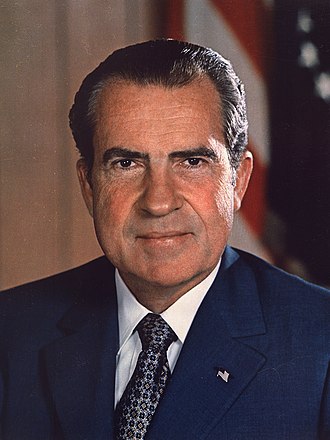
Richard M. Nixon served as the 37th President of the United States from January 1969 until his resignation in August 1974. In February 1971, he ordered the installation of a secret voice-activated taping system in the White House to preserve a historical record of his administration. Until the system's existence was revealed and dismantled in July 1973, the tapes captured Nixon directing major foreign policy initiatives, such as the opening to China, as well as his central role in the Watergate cover-up.
What Nixon talks about on the tapes
White House operations 4,718Presidential scheduling 2,225Public relations 1,784Presidential schedule 1,782Vietnam War 1,693Logistics 1,650Manolo Sanchez 1,626White House communications 1,400White House administration 1,399Presidential communication 1,243Henry Kissinger 1,191Foreign Policy 1,183
Conversations (21,010)
— Page 186 of 211President Nixon met with his personal valet Manolo Sanchez and an unidentified individual to coordinate his immediate professional and personal schedule. The brief discussion primarily concerned the President's upcoming evening bowling plans and arrangements for a meeting with Secretary of State William P. Rogers scheduled for the following afternoon. No significant policy decisions were recorded during this logistics-focused interaction.
President Nixon met with Stephen B. Bull to review a taped statement regarding energy policy. The discussion focused on the brevity of the recording and the President’s intent to utilize the footage for broader messaging purposes. Nixon expressed dissatisfaction with the current draft while planning for its finalization and distribution.
President Nixon met with William P. Rogers, H.R. Haldeman, and John Ehrlichman to discuss the deepening Watergate scandal and potential legal strategies for the administration. The conversation focused on managing the fallout from emerging testimony, the necessity of forcing the resignation of compromised staff members, and the strategic importance of legal representation and public image. The President expressed significant concern regarding the loyalty of his staff and the risk of being implicated in obstruction of justice, ultimately leaning toward a policy of full disclosure and cooperation with investigators to mitigate further political damage.
President Nixon and Press Secretary Ronald Ziegler discussed the strategy and messaging used during Ziegler's recent press briefing regarding the ongoing Watergate investigation. Ziegler confirmed he had contacted John Dean to outline the administration's new position and briefed the press on the President’s recent intensive investigation. They reviewed how Ziegler deflected difficult questions about the timing of the President’s inquiry and his previous, now-contradicted statements defending Dean. Nixon expressed satisfaction with Ziegler's refusal to disclose private discussions with individuals like John Mitchell or specific details of the White House staff investigation.
President Nixon contacted the White House operator to request an immediate telephone connection to National Security Advisor Henry A. Kissinger. This brief interaction served solely as a procedural step to facilitate a high-level consultation between the President and his advisor. No substantive policy matters or further details were discussed during this specific segment of the communication.
President Nixon and Henry Kissinger discuss the escalating political crisis surrounding the Watergate scandal, specifically debating the potential resignation or termination of top aides H.R. Haldeman, John Ehrlichman, and John Dean. Nixon expresses frustration over the situation while emphasizing the need for hard evidence before taking any personnel actions, rejecting advice from Leonard Garment to act prematurely. Additionally, they coordinate strategy for managing bipartisan congressional leaders regarding Soviet Jewish emigration and the importance of maintaining foreign policy initiatives despite the domestic political turmoil.
President Nixon initiates a brief telephone request through the White House operator to be connected with Chief of Staff H. R. Haldeman. This call serves as an administrative bridge to facilitate direct communication between the President and his top aide during the ongoing investigations into the Watergate scandal. The exchange establishes an immediate line of communication for the President's urgent briefing requirements.
President Nixon initiated a brief exchange with the White House operator to facilitate a transition to a different telephone line. The conversation served primarily as a logistical coordination to reconnect the President with H. R. Haldeman. No substantive policy matters were discussed during this brief administrative bridge.
President Nixon and H.R. Haldeman discuss the escalating legal risks surrounding the Watergate investigation, specifically focusing on the potential testimony of John Dean and the vulnerability of White House staff. They strategize on how to manage the fallout regarding payments made to defendants, the necessity of mapping out personal and professional liabilities, and the potential pressure on John Mitchell to accept responsibility. The conversation emphasizes a need for the President and his team to prepare for future revelations while attempting to protect the institution of the presidency from further damage.
President Nixon and Press Secretary Ronald Ziegler strategized on the public narrative regarding the Watergate scandal, focusing on the President’s recent discovery of new facts and his subsequent collaboration with Assistant Attorney General Henry Petersen. They discussed drafting a formal statement to address the potential involvement of H.R. Haldeman and John Ehrlichman while emphasizing the need for full disclosure. The meeting also included logistical planning for upcoming consultations with staff members and legal counsel regarding the President's handling of the ongoing investigation.
President Nixon and H. R. Haldeman convened in the Oval Office to coordinate the President's daily schedule. The primary focus of the discussion was the upcoming meeting with John D. Ehrlichman. No significant policy decisions were recorded during this brief administrative exchange.
President Nixon met briefly with an unidentified woman in the Oval Office to discuss scheduling matters. The interaction was limited in scope, involving instructions regarding the President's calendar. The conversation concluded quickly as the individual departed shortly after their arrival.
President Nixon, H. R. Haldeman, and Ronald Ziegler met to discuss the escalating legal and political fallout from the Watergate investigation, specifically focusing on John Dean's role, his demand for immunity, and his threats to implicate the White House. The participants strategized on how to manage media narratives, maintain the President's credibility, and address the potential for damaging testimony from Dean regarding cover-up activities and blackmail demands from E. Howard Hunt. Nixon also directed Haldeman to handle his collection of White House tapes, suggesting that most should be destroyed while preserving only material deemed worth keeping for the library.
President Nixon and an unidentified individual briefly coordinated logistics for an upcoming meeting scheduled in the Roosevelt Room. The discussion focused on confirming that the participants were prepared and ready to convene. Following this short administrative exchange, the President departed the Oval Office to proceed with his scheduled activities.
President Nixon met with his aide Stephen B. Bull to review his upcoming daily schedule and manage logistical arrangements for pending appointments. The discussion focused on coordinating the President's interactions with key figures, including H.R. Haldeman, Giulio Andreotti, and John A. Volpe. Nixon provided specific instructions regarding the scheduling of these meetings and clarified his availability for the remainder of the week.
President Nixon and Stephen B. Bull reviewed the President's daily schedule, focusing on upcoming appointments with James T. Lynn, Giulio Andreotti, and a meeting in the Cabinet Room. The discussion also addressed a scheduled finance-related meeting involving David K. Wilson and George H. Bush. The primary objective was to coordinate logistics and preparations for these administrative and diplomatic engagements.
President Nixon and Italian Prime Minister Giulio Andreotti, joined by Henry Kissinger, held a wide-ranging discussion on international trade, security policy, and geopolitical strategy. The conversation focused on managing trade relations with Japan, mitigating Soviet-led propaganda efforts against Western multinational corporations, and navigating the complexities of European defense burden-sharing and the Mutual and Balanced Force Reductions (MBFR). The participants also discussed the political situation in Argentina and the importance of maintaining strong NATO cohesion in the face of perceived radicalism and global instability.
President Nixon met briefly with an unidentified visitor in the Oval Office to coordinate logistics regarding his upcoming meeting with Dr. Rainer Barzel. The discussion focused specifically on the scheduling and timing of the appointment with the West German political leader. No further substantive matters were recorded during this one-minute encounter.
President Nixon met with Ambassador John A. Volpe to discuss Volpe's diplomatic activities in Italy, specifically regarding the political strength of Prime Minister Giulio Andreotti. The conversation also covered the selection process for a new ambassador to Poland, with Volpe providing recommendations and status updates on potential candidates who had been vetted by the FBI and Catholic leadership. The two also addressed the logistical complexities of appointing a military officer to a civilian diplomatic post.
President Nixon initiates a phone call to Vice President Spiro T. Agnew through the White House operator. The conversation is strictly procedural, serving as an administrative request to connect the President with his Vice President for a private discussion. No policy matters or substantive political topics are addressed during this brief exchange.
President Nixon and Vice President Agnew discussed a contentious meeting with congressional leaders regarding Soviet Jewry and its impact on U.S.-Soviet relations. Agnew expressed shock at the confrontational stance taken by Senators Jackson, Ribicoff, and Javits, arguing that linking Jewish emigration to arms control policy was an unreasonable burden. They collectively agreed that such tactics threatened foreign policy, and Agnew offered to publicly champion the administration’s position should the President choose to take the issue to the American people.
President Nixon and Vice President Agnew discussed the growing domestic political pressure to link U.S. foreign policy toward the Soviet Union with the emigration of Soviet Jews. Agnew expressed frustration over the confrontational attitudes of specific individuals, while the President asserted that the public would not permit a minority to undermine broader national security objectives. The conversation emphasized the administration's determination to resist congressional efforts to use trade and war policy as leverage for Soviet emigration demands.
President Nixon and Henry Kissinger met to coordinate their strategy regarding Jewish emigration and relations with the Soviet Union, specifically aiming to address political pressure from figures like Senator Henry Jackson. Concerned about potential confrontations with activists, the President decided to cancel a scheduled meeting with Jewish leaders to avoid hostile criticism. They also discussed managing the schedule of Rainer Barzel to prioritize meetings with Congressional leaders over ceremonial press opportunities.
President Nixon, H.R. Haldeman, and Press Secretary Ronald Ziegler met to discuss public relations strategy regarding the ongoing Watergate scandal, specifically addressing John Dean's recent communications. They debated whether the President should meet with Dean and finalized a plan for how Ziegler should respond to press inquiries about his own prior knowledge of the matter. Ultimately, they decided that Ziegler would adopt a firm stance, refusing to answer detailed questions in order to protect the rights of potential defendants and maintain a neutral posture.
President Nixon directs the White House operator to place a telephone call to Secretary of the Treasury George P. Shultz. The conversation consists solely of the President initiating this administrative request to connect with his Cabinet official. This brief exchange serves as a logistical precursor to a subsequent substantive discussion between the two men.
President Nixon met with German politician Rainer Barzel and Erich Feldweg to discuss the importance of Western unity and the maintenance of NATO forces. The participants emphasized the need for strong spiritual leadership to counter disillusionment among Western youth and the intellectual elite, whom they characterized as being overly soft toward adversaries. Nixon outlined his upcoming working trip to Europe, expressing his intent to move beyond ceremonial gestures and establish a new, robust structure for Western international relations.
President Richard Nixon met with Nellie L. Yates in the Oval Office to discuss matters regarding the President’s daily schedule. The brief meeting concluded without any official public record of substantive policy deliberations or major administrative decisions. The interaction appears to have been limited to logistical or personal calendar coordination.
President Nixon and Stephen B. Bull coordinate scheduling priorities for Treasury Secretary George Shultz to discuss the Economic Stabilization Act and an upcoming energy message. Nixon emphasizes the importance of managing the flow of visitors to the Oval Office while authorizing Shultz to proceed with a film clip appearance. The exchange serves as a brief logistical planning session to prepare the President for briefings on legislative and energy policy.
President Nixon met with his aide Stephen B. Bull to coordinate his daily schedule and manage administrative priorities. The discussion centered on adjusting the meeting time for Representative William G. Bray and facilitating communication between the President and Treasury Secretary George P. Shultz regarding congressional matters. These logistical adjustments were part of the administration's ongoing efforts to maintain legislative momentum during the heightened political pressure of the Watergate era.
President Nixon consulted with the White House operator to facilitate an outgoing communication. This brief interaction served as a logistical bridge to connect the President with another party, as noted by its association with a subsequent recording. No substantial policy or political discussions took place during this brief administrative exchange.
President Nixon and George Shultz discuss the political risks associated with the pending Economic Stabilization Act conference report. While they express frustration over unfavorable provisions like mandatory disclosure of business profits and wage exemptions, they ultimately conclude that the risk of losing the legislation entirely outweighs these concerns. Nixon decides against supporting Gerald Ford’s attempt to defeat the report in the House, directing his team to manage the bill's implementation instead. The conversation also touches on political tensions regarding the emigration of Soviet Jews and the potential impact on upcoming summits.
President Nixon and George Shultz discuss a legislative setback regarding trade and immigration policy, specifically focusing on the political maneuvers of Senator Henry Jackson. The two evaluate the risks of enforcing certain provisions versus finding ways to circumvent them, ultimately deciding to accept the legislative situation as it stands. Nixon expresses deep frustration over the impact of these political obstacles on diplomatic summits and plans to shift the burden of blame for any potential failures onto congressional opponents.
President Nixon initiates a call to the White House operator to be connected with Assistant Attorney General Henry E. Petersen. The interaction serves as a brief logistical request to establish direct communication with Petersen amid ongoing investigations. No further substantive discussion occurs during this short exchange beyond the request for the connection.
President Nixon met with an unidentified individual in the Oval Office to facilitate an immediate transition or movement within the workspace. The brief discussion centered on logistical arrangements for the President's schedule, specifically regarding a commitment to Kiwanis International. No significant policy decisions were recorded during this short exchange.
President Nixon met with his valet, Manolo Sanchez, to coordinate the logistics of his midday schedule. The brief discussion focused on arranging the President’s lunch location within the Executive Office Building and facilitating his time for rest. No substantive policy matters were addressed, as the conversation was limited to these personal administrative requirements.
President Nixon met with Congressman William G. Bray and members of Kiwanis International to discuss the organization's community service initiatives and recent global activities. The group briefed the President on their "Share Your Life" program, which focuses on elderly care and volunteerism, and introduced the upcoming "Camelot" program designed to support youth career education. Nixon expressed strong support for service clubs, noting their importance in fostering community spirit and local leadership.
President Nixon met briefly with his personal valet, Manolo Sanchez, in the Oval Office. The discussion was limited to the President's attire. No further policy or administrative actions were recorded during this brief encounter.
President Nixon met with a film crew in the Oval Office to record his public remarks regarding a new energy policy message being transmitted to Congress. The session involved extensive technical coordination, including adjustments to lighting, audio equipment, and camera positioning to ensure the production met broadcast standards. After encountering technical issues and performance miscues during the initial recording, the President successfully re-filmed the statement in its entirety before concluding the session.
President Nixon and Assistant Attorney General Henry E. Petersen confer to discuss the ongoing status of the Watergate investigation, specifically focusing on grand jury leaks, the legal status of key figures like Jeb Stuart Magruder and John W. Dean, III, and concerns regarding the Ervin Committee's access to FBI interview files. The conversation highlights the administration's efforts to manage public comments via Ron Ziegler while maintaining judicial neutrality, as well as the urgency of securing a commitment from Magruder to prevent premature committee interference. Petersen emphasizes the need to tie down testimony before negotiating with Senator Ervin, while Nixon reaffirms his intent to handle high-profile individuals consistently while avoiding accusations of a cover-up.
President Nixon contacted the White House operator to place a personal telephone call to his daughter, Julie Nixon Eisenhower. The brief exchange served solely to facilitate this communication. No policy matters or administrative actions were discussed during the connection.
President Nixon, Julie Nixon Eisenhower, and Stephen B. Bull met briefly in the Oval Office to coordinate the President's upcoming schedule, specifically regarding a planned trip to Camp David. They discussed the necessity of finalizing an economic message before departing on Friday afternoon. Nixon instructed his daughter to continue with her personal plans while he managed the logistical requirements of his Cabinet and testimony commitments.
President Nixon and his daughter, Julie Nixon Eisenhower, coordinate travel plans and discuss their upcoming personal schedules. Nixon outlines his intent to travel to Key Biscayne on Friday afternoon and mentions a potential trip to Camp David to focus on drafting an economic message. He also encourages Julie to spend time with her mother, Pat Nixon, despite the First Lady's busy agenda.
President Nixon and Stephen B. Bull reviewed the presidential schedule, focusing specifically on a proposed meeting with Jewish leaders regarding the status of Soviet Jews. Nixon expressed significant reservations about participating in the meeting personally, fearing it might be unproductive or poorly received. He instructed Bull to consult Henry Kissinger for advice on whether the meeting should proceed without his attendance.
President Nixon and John Ehrlichman met to discuss the growing legal and political risks surrounding the Watergate scandal, specifically focusing on the recent actions and potential testimony of John Dean. They reviewed their past interactions with Dean, debated his motivations and potential conflict of interest regarding John Mitchell, and examined the vulnerabilities posed by previous meetings. The discussion included strategies for managing the White House response to subpoenas and legal inquiries, as well as the potential application of executive privilege to protect sensitive information.
President Nixon held a brief, unscheduled meeting with an unidentified individual in the Oval Office. The participants engaged in a short, fragmented discussion regarding an unspecified request. No significant policy decisions or substantive developments were captured during this exchange.
President Nixon met with his economic advisors and cabinet members to discuss how to manage persistent inflation and public frustration with the economy following the recent passage of the Economic Stabilization Act. Arthur Burns and others proposed various policy adjustments, including a potential return to some Phase 2-style controls like pre-notification, while Roy Ash and Herbert Stein argued for staying the course with Phase 3 to avoid further distorting the market. Ultimately, the administration emphasized the importance of fiscal restraint and maintaining a consistent long-term strategy rather than implementing impulsive or overly restrictive controls that could trigger a recession.
President Nixon met with his economic advisors, including George Shultz, Arthur Burns, and Roy Ash, to discuss the administration's ongoing struggle with inflation and the potential implementation of Phase III economic stabilization measures. The participants analyzed the political and psychological impact of price controls, the efficacy of pre-notification requirements for major corporations, and the necessity of maintaining public confidence amid rising prices. Nixon emphasized the importance of fiscal discipline, particularly regarding the federal budget, while rejecting broad, disruptive price freezes in favor of targeted economic management.
An unidentified caller consults President Nixon regarding the origin of invitations for an upcoming energy briefing scheduled for the following morning. The President discusses the scheduling of this event, which was coordinated by aide Stephen B. Bull. The exchange serves to clarify logistical oversight concerning high-level administration briefings during this period.
President Nixon and Henry Kissinger discussed the mounting political pressure from the Watergate scandal and the potential necessity of forcing the resignations of top aides H.R. Haldeman and John Ehrlichman. Kissinger advised that the President must proactively and "brutally" distance himself from his staff to preserve the integrity of the presidency and ensure the continued conduct of foreign policy. The two explored potential personnel replacements, such as Kenneth Rush or James T. Lynn, and considered a strategy of suspending lower-level staff to create a framework for the eventual departure of senior officials.
President Nixon and his national security advisor, Henry Kissinger, met with a delegation of American Jewish leaders to discuss the status of Soviet Jewry and the persistent obstacles regarding emigration from the USSR. The President urged the group to avoid public confrontation and support for the Jackson-Vanik Amendment, arguing that legislative mandates would jeopardize his delicate, high-level diplomatic channels with Soviet leadership that had already yielded progress on exit visas. Nixon maintained that his quiet, personal, and direct pressure on the Soviets remained the most effective tool for protecting human rights without triggering a broader geopolitical crisis.
President Nixon met with H. R. Haldeman and John Ehrlichman to discuss White House staff appointments, the ongoing Watergate investigation, and the public relations strategy for addressing the scandal. The participants debated whether to maintain the President's public detachment from the investigation or to proactively frame the administration as victims of subordinates who misled them. Nixon emphasized his desire to insulate the presidency from the unfolding legal crises, while Haldeman and Ehrlichman urged him to project confidence and consider taking a short break from the office to regain his perspective.
President Nixon and John D. Ehrlichman engaged in a brief telephone communication facilitated by a White House operator. The interaction primarily consisted of an apology regarding the handling of the call connection. No substantive policy matters or strategic developments were recorded during this brief exchange.
President Nixon held a brief morning meeting with an unidentified individual in the Oval Office. The interaction concluded immediately following the President’s brief remark regarding an unnamed person being "divine." No substantive policy discussions or administrative actions were recorded during this segment of the meeting.
President Nixon met with Assistant Attorney General Henry E. Petersen to discuss the ongoing Watergate investigation and the challenge of managing leaks from the U.S. Attorney's office. The conversation focused on the credibility of key figures like John Dean, Jeb Stuart Magruder, and Gordon C. Strachan, as well as the legal difficulties of pursuing conspiracy charges against H.R. Haldeman and John Ehrlichman. Nixon emphasized that any potential immunity deals or further investigative steps must be grounded in corroborated testimony rather than conflicting accounts, while reinforcing his assertion that the White House had cooperated fully with the investigation.
President Nixon and Henry Kissinger held a brief meeting to discuss a recent conversation Kissinger had with Dennis Bassett. Kissinger expressed his high regard for Bassett, describing him as a gentleman. The discussion served as a short briefing regarding these personal interactions rather than a substantive policy matter.
Ronald L. Ziegler requested that the White House operator connect him to John W. Dean, III, to facilitate a direct communication between the two men. President Nixon was present in the background during the initiation of this call. The primary action taken was the administrative coordination required to reach Dean via telephone.
President Nixon and Press Secretary Ronald Ziegler met to coordinate the White House's public response to a defiant statement released by White House Counsel John Dean, who vowed not to serve as a scapegoat in the burgeoning Watergate scandal. The discussion focused on insulating the presidency from the unfolding investigation, with Nixon and Ziegler agreeing that the administration’s official stance should prioritize finding the truth rather than identifying scapegoats. Ziegler was instructed to avoid commenting on Dean’s individual credibility while emphasizing the administration's cooperation with the grand jury to maintain a posture of ignorance regarding prior wrongdoing.
President Nixon met with his valet, Manolo Sanchez, in the Oval Office to discuss personal matters and ensure his well-being. The brief exchange primarily functioned as a check-in between the President and his staff member. No substantive policy decisions or political developments were recorded during this interaction.
President Nixon met with Stephen B. Bull to secure a copy of John Dean’s recent public statement regarding the Watergate scandal. The President requested that the document be retrieved for review and subsequent use by Jonathan in upcoming meetings. This exchange highlights the administration's urgent efforts to analyze Dean’s evolving testimony and its potential impact on the unfolding investigation.
President Nixon met with his aide Stephen B. Bull to address the unfolding legal and political crisis involving White House Counsel John W. Dean III. The discussion focused on the implications of Dean’s recent statement as the Watergate scandal intensified. This brief meeting reflects the President's urgent efforts to monitor the evolving testimonies and internal fallout surrounding his administration's key figures.
President Nixon and John Ehrlichman met to discuss legal strategies for defending White House staff members implicated in the developing Watergate scandal. They analyzed the potential for immunity for John Dean, the legal risks regarding campaign funds, and the possibility of separating the legal defense of presidential aides from that of other political figures. The discussion highlighted their concern over how these proceedings might impact the administration's public image and the necessity of managing internal information to protect the President.
President Nixon met with his valet, Manolo Sanchez, to coordinate logistics for an upcoming trip to Florida and the delivery of materials to the Executive Office Building. Nixon instructed Sanchez to notify Tricia Nixon Cox and Julie Nixon Eisenhower regarding the travel plans. The discussion primarily focused on managing the President's personal schedule and communication with his family.
President Nixon initiates a brief telephone call to White House Press Secretary Ronald L. Ziegler. The President requests that the operator connect him directly to Ziegler to facilitate a private communication. No substantive policy matters or further developments are discussed during this short administrative interaction.
President Nixon and Press Secretary Ronald Ziegler coordinate the administration's public response regarding the President’s ongoing meetings with Assistant Attorney General Henry Petersen. They specifically discuss how to address media inquiries concerning Watergate investigations and clarify that the President does not receive reports from the grand jury. Nixon instructs Ziegler to emphasize that while he receives updates on general investigative progress from Petersen, he is not privy to the contents or internal proceedings of the grand jury.
President Nixon and Press Secretary Ronald Ziegler coordinate the administration's public messaging regarding the Watergate investigation. Nixon instructs Ziegler to emphasize that the President does not receive reports from the Grand Jury to combat rumors of scapegoating and leaks. He directs Ziegler to contact Assistant Attorney General Henry Petersen to confirm this official stance.
President Nixon directs the White House operator to place an outgoing telephone call to Press Secretary Ronald L. Ziegler. The conversation serves solely as a brief administrative exchange to facilitate communication between the President and his press office. No substantive policy discussions or political developments occur during this brief operator-assisted connection.
President Nixon instructs Press Secretary Ronald Ziegler to publicly emphasize that he has explicitly directed Assistant Attorney General Henry Petersen to withhold all grand jury proceedings from him. Nixon expresses concern that leaks, particularly those involving columnist Jack Anderson, could taint the investigation and wants to distance himself from the inner workings of the grand jury. The President clarifies that while he continues to receive general investigatory reports, he is consciously avoiding specific grand jury information to maintain procedural integrity.
President Nixon and Press Secretary Ronald Ziegler discuss the need to maintain a clear firewall between the White House and ongoing Grand Jury proceedings to avoid potential legal contamination. Nixon emphasizes that he explicitly instructed officials not to disclose any Grand Jury findings to him to preserve the integrity of both the official investigation and his own internal review. The discussion underscores the administration's strategic effort to distance the President from sensitive information during the escalating Watergate investigation.
President Nixon initiated a request for the White House operator to connect him with domestic policy advisor John D. Ehrlichman. The call served as a brief administrative coordination to facilitate a direct conversation between the President and Ehrlichman. No substantive policy matters were discussed during this short operator interaction.
President Nixon initiated a brief exchange with the White House operator to facilitate an outgoing telephone call. The interaction served as a logistical step to connect the President with an unidentified individual. No substantive policy discussions or significant political developments occurred during this short communication.
President Nixon and John Ehrlichman discuss the status of internal White House investigations into the Watergate scandal. The conversation focuses on whether members of the staff had provided sworn statements regarding their lack of involvement, specifically noting that John Dean had not signed such a statement. They conclude that the effort to secure these affidavits was ultimately abandoned, leaving the administration without formal documentation from all staff members.
President Nixon briefly advises John Ehrlichman to maintain a composed and disciplined demeanor when interacting with White House staff. This exchange serves as a strategic suggestion regarding personnel management and public perception during a period of heightened internal pressure. No formal decisions or specific policy actions were recorded during this brief interaction.
President Nixon met with his personal valet, Manolo Sanchez, in the Old Executive Office Building to discuss routine personal arrangements. The brief interaction primarily concerned the President's meal preferences and specific food service requests. No significant policy matters or political developments were addressed during this exchange.
President Nixon held a brief, informal session in his Old Executive Office Building suite involving an unknown party and Manolo Sanchez. The discussion primarily facilitated the coordination of a follow-up telephone communication. The exchange concluded with the President finalizing arrangements for a callback, reflecting the routine logistical management of his daily schedule.
President Nixon met with his valet, Manolo Sanchez, to coordinate logistics for a planned evening outing on the presidential yacht, the Sequoia. They briefly discussed the guest list and the necessary arrangements for the excursion. Nixon provided instructions regarding the expected number of attendees for the trip.
President Nixon met with his aide Stephen B. Bull to finalize logistical details regarding Senator John C. Stennis. The President confirmed plans for Stennis and his wife to accompany the Nixons aboard Air Force One and instructed Bull to keep his upcoming schedule clear of all obligations except for a Cabinet meeting. This brief interaction served to manage the President's immediate calendar and facilitate direct engagement with the Senator.
President Nixon met with his personal valet, Manolo Sanchez, to coordinate logistics for an upcoming trip to Florida. The discussion focused on travel arrangements involving the First Lady, family pets, and Fina Sanchez. Additionally, the President relayed instructions regarding a message for his daughter, Tricia Nixon Cox, to be included in his afternoon schedule.
President Nixon and Henry Kissinger discuss the political fallout regarding Jewish leaders' pressure on U.S.-Soviet relations, specifically concerning the potential cancellation of an upcoming summit. Nixon expresses extreme frustration with the influence of Jewish groups and the Jackson-Vanik Amendment, vowing to publicly blame American Jewish leaders if their advocacy causes the summit to collapse. Both participants agree that the administration must prioritize American national interests over these specific lobbying efforts, even at the risk of inciting antisemitic sentiment.
President Nixon and Henry Kissinger met briefly in the Old Executive Office Building to discuss concerns regarding the security and integrity of their private communications. The President expressed immediate apprehension about potential surveillance or interference with his ability to hold confidential conversations. No substantive policy decisions were reached during this short interaction, which focused primarily on the vulnerability of the taping environment.
President Nixon met with his personal valet, Manolo Sanchez, in the Old Executive Office Building to discuss personal logistics. The conversation focused specifically on the menu for the President's upcoming dinner. No broader policy or administrative developments were recorded during this brief interaction.
President Nixon held a brief, three-minute meeting in the Old Executive Office Building with an unidentified individual. While no transcript or recording content is available to confirm the substance of the discussion, the meeting was centered on the President's official schedule. No specific policy decisions or significant developments can be determined from the available records.
President Nixon directs the White House operator to facilitate a meeting with Richard A. Moore. The request specifies that the encounter should take place at the Executive Office Building. This conversation serves as a logistical directive to coordinate internal communications involving a key aide.
President Nixon initiates a request through the White House operator to place a telephone call to John D. Ehrlichman. The brief exchange serves as the administrative bridge to connect the President with his Assistant for Domestic Affairs during the height of the Watergate investigation. No substantive policy discussions occur, as the interaction is limited to the mechanics of facilitating the communication.
President Nixon consulted with the White House operator to facilitate a phone call with Richard Martin. The brief interaction served as a logistical step to connect the President with this specific individual for undisclosed purposes. No further policy discussions or significant executive decisions were recorded during this brief exchange.
President Nixon and Richard A. Moore met to discuss the escalating Watergate investigation, specifically focusing on the roles of John Dean and John Mitchell. They examined the potential legal liabilities arising from the cover-up, the solicitation of hush money for E. Howard Hunt, and the risk that Dean might turn against the administration to secure immunity. Nixon expressed frustration over the perceived ineptitude of his subordinates and the potential for a damaging narrative regarding obstruction of justice, ultimately emphasizing the need to keep the administration's involvement shielded from the ongoing investigations.
President Nixon, John Ehrlichman, and Stephen Bull meet briefly in the Old Executive Office Building to coordinate a private session. The participants discuss the need for a short break and reference symbolic or metaphorical language regarding seeking energy from a church setting. The meeting serves primarily as a logistical pause in their broader discussions during the height of the Watergate-era legal pressures.
President Nixon initiates a request through the White House operator to place an outgoing telephone call. The exchange is purely administrative, focused on facilitating communication with an unidentified party. No policy decisions or substantive discussions occur during this brief interaction.
President Nixon and John Ehrlichman coordinate a brief, informal meeting while at the White House. The conversation focuses on logistics, with Nixon suggesting a ten-minute break and Ehrlichman confirming he is located in the gym and can meet the President shortly. No substantive policy matters are discussed, as the exchange is limited to scheduling their immediate encounter.
President Nixon initiates a brief telephone call to the White House operator to be connected with his daughter, Julie Nixon Eisenhower. The exchange serves as a routine administrative request to facilitate private communication between the President and a family member. No policy matters or substantive political issues are discussed during this brief connection.
A White House operator informs President Nixon that his daughter, Julie Nixon Eisenhower, is currently en route back to the White House. The brief exchange serves as a logistical update regarding the President's family. No further policy or administrative developments are discussed during this communication.
President Nixon met with John Ehrlichman to discuss the ongoing fallout from the Watergate investigation, specifically focusing on the legal exposure of White House staff members and potential strategies for handling prosecutors. They evaluated the political implications of keeping or removing H.R. Haldeman from his post and analyzed the testimony of John Dean. The discussion also addressed reports regarding the secret removal of political files from the White House, with Ehrlichman advising the President to maintain distance from the daily influx of rumors to avoid distraction.
President Nixon and his daughter, Julie Nixon Eisenhower, exchanged brief pleasantries regarding their upcoming personal schedules. The conversation primarily served as a check-in between family members, with Julie expressing her support for her father. The discussion concluded with a brief mention of the President’s impending trip to Florida.
President Nixon requested that the White House operator place a telephone call to his domestic affairs advisor, John D. Ehrlichman. The brief exchange served as a routine administrative bridge to initiate communication with a key staff member during the Watergate crisis. No further substance was recorded beyond the initiation of this connection.
President Nixon and John Ehrlichman touch base regarding an imminent meeting with Charles Colson. The brief call serves to coordinate schedules as the President prepares to depart the office shortly. Ehrlichman indicates he needs to consult with Colson before reporting back to the President with a status update.
President Nixon met briefly with John Ehrlichman to initiate an inquiry regarding a vague, unspecified matter referred to as a "mystery." The dialogue reflects the intense atmosphere of the escalating Watergate scandal, as the participants exchange minimal information during this short encounter. No specific policy decisions were recorded during this brief exchange.
President Nixon met with his aide Stephen B. Bull to verify the status of a specific memorandum requiring his signature. The brief discussion confirmed that the President had successfully applied a notation regarding a requested change to the document. This interaction served to finalize administrative processing for the paperwork on the President’s desk.
John Ehrlichman updates President Nixon regarding an ongoing investigation into a mysterious removal of eight boxes of materials from a committee office the day after the Watergate break-in. Ehrlichman reports that Charles Colson, H.R. Haldeman, and others lack knowledge of the event, though they suspect it involved someone with high-level access like Robert C. Odle or Frederick C. LaRue. The President expresses concern over the potential link to Watergate and emphasizes the urgent need to identify the individual who reportedly moved the materials to a private apartment.
President Nixon met with attorneys John J. Wilson and Frank H. Strickler to discuss the evolving Watergate scandal and its potential legal impact on H.R. Haldeman and John D. Ehrlichman. The participants reviewed the status of federal investigations, the handling of secret funds, and the potential for upcoming indictments against White House staff. They also deliberated on the political implications of keeping or removing Haldeman and Ehrlichman from their positions, comparing the situation to historical precedents regarding presidential staff resignations.
President Nixon met with his attorneys, John J. Wilson and Frank H. Strickler, to receive a legal briefing on the ongoing Watergate investigations involving H.R. Haldeman and John Ehrlichman. The attorneys detailed their recent discussions with prosecutors Seymour Glanzer and Earl J. Silbert, expressing concern over the prosecutors' aggressive tactics and the potential for indictments despite a perceived lack of clear criminal evidence. The President and his counsel discussed the potential political fallout of suspending or forcing the resignations of his top aides, ultimately deciding to stand firm and await further developments before taking drastic action.
President Nixon instructed the White House operator to place a telephone call to John D. Ehrlichman. The brief exchange served primarily to facilitate direct communication between the President and his domestic policy advisor during the height of the Watergate investigations. No further substantive discussion occurred on this specific line.