Nixon, Richard M. (President)
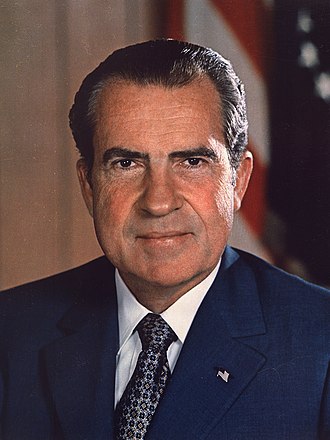
Richard M. Nixon served as the 37th President of the United States from January 1969 until his resignation in August 1974. In February 1971, he ordered the installation of a secret voice-activated taping system in the White House to preserve a historical record of his administration. Until the system's existence was revealed and dismantled in July 1973, the tapes captured Nixon directing major foreign policy initiatives, such as the opening to China, as well as his central role in the Watergate cover-up.
What Nixon talks about on the tapes
White House operations 4,718Presidential scheduling 2,225Public relations 1,784Presidential schedule 1,782Vietnam War 1,693Logistics 1,650Manolo Sanchez 1,626White House communications 1,400White House administration 1,399Presidential communication 1,243Henry Kissinger 1,191Foreign Policy 1,183
Conversations (21,010)
— Page 199 of 211President Nixon contacted the Camp David operator to request a telephone connection with his Chief of Staff, Alexander M. Haig, Jr. The call served as a brief administrative bridge to facilitate direct communication between the President and his top aide. No further substantive discussion occurred during this interaction.
President Nixon communicated with the Camp David operator to determine the whereabouts of General Alexander M. Haig, Jr. The President requested that Haig be informed of his availability to receive a return call upon the General's arrival at his residence. This brief administrative exchange functioned to facilitate direct coordination between the President and his Chief of Staff during a period of high-level White House activity.
President Nixon initiated a brief telephone request to connect with his Press Secretary, Ronald L. Ziegler. The conversation served strictly as a logistical bridge to facilitate communication between the President and a key member of his inner circle. No substantive policy discussions or political developments occurred during this brief interaction.
President Nixon and Ronald Ziegler discussed the progress of a White House strategy team, led by Alexander Haig and others, which was drafting a comprehensive White Paper to counter Watergate-related allegations. Nixon emphasized the necessity of preparing damaging counter-information regarding John Dean, specifically citing Dean's alleged subornation of perjury and his potential involvement with John Mitchell in the Robert Vesco case. The participants affirmed that they have sufficient information to discredit Dean if he continues to implicate the President or his top staff.
President Nixon initiates a brief telephonic request to be connected with Press Secretary Ronald L. Ziegler. The call serves as a logistical bridge to facilitate direct communication with his primary spokesperson. No substantive policy matters or further developments occur during this brief administrative interaction.
President Nixon and Press Secretary Ronald Ziegler consulted at Camp David to coordinate the administration's public relations strategy regarding the Watergate scandal and upcoming press engagements. They discussed the timing for releasing a White House 'White Paper' and potential meetings with congressional leaders, specifically noting the need to reassure members of the Armed Services Committee. Nixon emphasized his desire to travel more frequently to shift public perception away from the 'embattled' narrative of the White House, while the two agreed that despite the unprecedented, sustained media attacks, the administration remained resilient.
President Nixon and Alexander Haig met to discuss managing the ongoing Watergate crisis, focusing on the need for a non-defensive, proactive White House response through a forthcoming White Paper. They reviewed the political and economic implications of potential new wage and price controls, with Nixon stressing the need for decisive action to restore public confidence despite resistance from his economic advisors. Additionally, the two discussed the status of a potential Vietnam ceasefire communiqué and coordinated the release timing to align with POW developments.
President Nixon contacted the Camp David operator to place a telephone call to H.R. Haldeman. Upon learning that Haldeman was likely attending church services, the President requested to be notified upon his return so that he could reconnect. This brief exchange served as a logistical coordination for the President to reach his former Chief of Staff.
President Nixon consulted with the Camp David operator regarding the expected arrival time of H.R. Haldeman. The brief exchange served to coordinate logistics for a scheduled meeting or arrival at the retreat. No substantive policy matters were discussed during this operational communication.
President Nixon and H. R. Haldeman coordinated the development of a White House 'White Paper' intended to publicly clarify the administration's role in the Watergate scandal. The discussion focused on establishing a firm, unified defense by emphasizing that the 'Plumbers' unit and related activities were strictly motivated by legitimate national security concerns regarding government leaks, rather than a criminal cover-up. Nixon directed Haldeman to verify specific recollections with John Ehrlichman, particularly regarding the timing of knowledge surrounding the Daniel Ellsberg break-in and discussions of executive clemency. The President underscored his resolve to remain on the offensive, citing recent positive public support and insisting that the administration's actions regarding the CIA and FBI were necessary security measures.
President Nixon placed a call through the Camp David operator to request a telephone connection with H. R. Haldeman. This brief interaction served as a logistical step to facilitate direct communication between the President and his former chief of staff. No substantive policy matters were discussed during this request.
President Nixon instructed the Camp David operator to attempt a telephone connection with H. R. Haldeman after an initial call to his residence went unanswered. The President requested that the operator persist in reaching Haldeman and check back in approximately thirty minutes. This brief exchange highlights the President's ongoing communication efforts with his former Chief of Staff during the period following Haldeman's resignation.
President Nixon utilized the Camp David operator to facilitate a personal telephone call to his daughter, Tricia Nixon Cox. This brief communication served a private, familial purpose rather than addressing matters of state or official policy. No significant political developments or administrative decisions were documented during this brief exchange.
President Nixon and his daughter, Tricia Nixon Cox, engage in a brief personal check-in while the President is staying at Camp David. The conversation touches upon the President's recent positive reception in Norfolk, Virginia, and the upcoming Prisoners of War reception. Additionally, Nixon dismisses the ongoing Watergate Ervin Committee hearings as a "sham," characterizing the participating senators as ridiculous figures seeking attention.
President Nixon instructed the Camp David operator to place a telephone call to White House Chief of Staff Alexander M. Haig, Jr. The brief exchange focused on establishing a specific communication line, identified as Channel 8, for the President's use. This interaction was a procedural step to facilitate a private discussion between the President and his top aide.
President Nixon and Alexander Haig discussed the preparation of a White House 'White Paper' intended to frame the administration's past actions—including wiretaps and security measures—around the necessity of national security rather than Watergate-related controversies. The two assessed the political landscape, emphasizing the need to maintain support among key Congressional leaders like John Stennis and Barry Goldwater to resist pressures for resignation or impeachment. They also touched on economic policy strategy, including potential wage and price controls, and agreed to position John Connally to lead on energy policy to avoid political risks associated with other potential appointees.
President Nixon utilized the Camp David switchboard to place a personal telephone call to his daughter, Julie Nixon Eisenhower. This brief interaction served solely to facilitate communication between the President and his family member. No official policy matters or administrative decisions were addressed during this connection.
President Nixon and his daughter, Julie Nixon Eisenhower, held a brief telephone conversation to discuss his recent, well-received public appearance in Norfolk, Virginia. Their dialogue quickly shifted to the political climate, where they addressed the ongoing Watergate crisis and the erratic public behavior of Martha Mitchell. Julie encouraged her father to remain resolute in his political survival, and the President affirmed his determination to overcome the scandal for the sake of the country and the world.
President Nixon requested that the Camp David operator connect him via telephone to his former Chief of Staff, H.R. Haldeman. This brief administrative interaction served as a logistical bridge for the President to initiate a private communication with a key aide during his stay at Camp David. The call highlights the ongoing, off-the-record access Nixon maintained with Haldeman despite the latter's recent resignation amidst the burgeoning Watergate scandal.
President Nixon attempted to reach H. R. Haldeman by telephone from Camp David, but the operator was unable to locate him. The call was intended to establish direct contact with the former Chief of Staff. After receiving confirmation that Haldeman was unavailable, the President instructed the operator to attempt the call again in one hour.
President Nixon contacted the Camp David operator to facilitate an outgoing telephone call to Hobart D. Lewis. The interaction served strictly as a logistical request for the operator to connect the President to Mr. Lewis. No substantive policy discussions or political developments occurred during this brief exchange.
President Nixon initiated this brief call to check on the morale of Hobart D. Lewis amidst the intensifying Watergate scandal. The discussion centered on the President's public image and the strategic difficulty of defending himself against various allegations, including cover-up and clemency claims. They expressed mutual admiration for a recent supportive letter written by John S. D. Eisenhower to the New York Times, contemplating potential future use of the text to shift public focus toward broader international interests like the upcoming Soviet summit.
President Nixon contacted the Camp David operator to facilitate a telephone connection with his close friend and confidant, Charles G. “Bebe” Rebozo. This brief administrative interaction served as a logistical step to initiate a private conversation between the two men. No substantive policy matters or decisions were discussed during this brief request for assistance.
President Nixon and his close associate Bebe Rebozo spoke briefly via telephone to coordinate adjustments to their upcoming meeting schedule. The two men agreed to move their planned appointment forward by approximately fifteen minutes. Rebozo confirmed his availability, and the call concluded with the finalized logistical arrangement.
President Nixon and H. R. Haldeman discussed the administration's strategy for managing the growing Watergate scandal and upcoming congressional hearings. They focused on maintaining a firm stance regarding executive privilege over White House staff notes and coordinating a unified defense centered on national security concerns. The two also assessed the perceived lack of momentum in the Ervin Committee hearings and reviewed the status of key administration figures, including John Ehrlichman and Henry Kissinger, in relation to ongoing investigations.
President Nixon initiated a brief administrative request to the Camp David operator to connect him with his former Chief of Staff, H.R. Haldeman. The call serves as a routine communication attempt to reach a key advisor during the President's stay at the retreat. No substantive policy matters were discussed, as the interaction was limited to the placement of the telephone connection.
H.R. Haldeman briefs President Nixon on his recent discussions with John Ehrlichman regarding the Watergate scandal, specifically focusing on the Ellsberg break-in and the administration's legal defense strategies. They coordinate a narrative emphasizing that the "Plumbers" operation and associated activities were motivated by national security concerns, rather than criminal intent. Nixon also discusses his April 18th conversation with Henry Petersen to ensure his own conduct appears consistent with proper executive oversight, ultimately deciding to draft a "White Paper" to solidify their national security justification.
President Nixon initiates a request for an operator to connect him via telephone to White House Chief of Staff Alexander M. Haig, Jr. The brief interaction serves solely as a logistical bridge to facilitate direct communication with his top aide. No substantive policy discussions or decisions occur during this brief exchange.
President Nixon and Alexander Haig discuss the ongoing development of a White House White Paper intended to address the Watergate scandal and associated controversies. Nixon emphasizes that the document must move away from a defensive tone, focusing instead on national security justifications and a more aggressive political posture. They agree to involve Patrick Buchanan in refining the draft's specifics while setting a firm strategy to reject talk of impeachment and confront political critics directly.
President Nixon placed a brief telephone call from the Camp David study to the facility's operator to request a connection to his former Chief of Staff, H.R. Haldeman. This exchange served solely as a logistical communication to facilitate further private discussion between the President and Haldeman. No substantive policy or political matters were addressed during this brief request for a telephone patch.
President Nixon attempted to reach H. R. Haldeman via the Camp David operator to discuss urgent matters. Upon learning that Haldeman was dining at a nearby residence, the President instructed the operator to have him return the call later. This exchange highlights the logistical coordination required for Nixon to maintain direct communication with his key advisors during his retreat.
President Nixon initiates a brief telephone call through the White House operator to contact Press Secretary Ronald L. Ziegler. The conversation is strictly logistical in nature, serving only to facilitate direct communication with his spokesperson. No policy matters or substantive political issues are discussed during this exchange.
President Nixon and Press Secretary Ronald Ziegler discuss the development of a formal White House statement intended to provide a defense against ongoing Watergate allegations. The President emphasizes a strategy of aggressive public response, including challenging the credibility of committee witnesses and declassifying sensitive information from prior administrations to pressure political opponents. Throughout the call, Nixon reaffirms his commitment to fight the scandal rather than resign, citing national security concerns and the need to maintain public confidence in his leadership.
President Nixon met with an unknown individual to discuss his daily schedule and administrative matters involving Press Secretary Ronald L. Ziegler. The brief encounter took place in the Oval Office to coordinate the President's upcoming activities. Due to the lack of a transcript and the absence of recorded dialogue, no substantive policy decisions or developments were captured.
President Nixon met with Ronald Ziegler and Alexander Haig to strategize the White House response to the escalating Watergate scandal and manage public perception of his embattled administration. They discussed the tactical release of a forthcoming White Paper, the management of congressional and press relations, and the necessity of distancing the President from staff members implicated in the investigation, such as H. R. Haldeman and John Ehrlichman. Nixon and his advisors resolved to maintain a posture of command by focusing on national policy, specifically upcoming economic initiatives and the summit with Leonid Brezhnev, to project stability while weathering the ongoing controversy.
President Nixon and Alexander Haig met in the Old Executive Office Building to review upcoming scheduling priorities and administrative coordination. The discussion focused on managing the President's calendar and addressing immediate logistical concerns for the White House staff. No major policy shifts were recorded, as the dialogue primarily centered on routine executive branch management and time allocation.
President Nixon and Alexander Haig met to strategize the drafting of a White House White Paper intended to shape public perception of the Watergate scandal and address mounting allegations. The discussion focused on carefully framing the President's past communications with figures like L. Patrick Gray and Henry Petersen to emphasize that his actions were rooted in protecting national security rather than facilitating a cover-up. Nixon directed Haig to ensure the document explicitly addressed unauthorized activities involving the CIA and the Plumbers, while maintaining that the President had no prior knowledge of specific illegal acts like the break-in at the office of Daniel Ellsberg’s psychiatrist.
President Nixon directs the White House operator to place a telephone call to Alexander M. Haig, Jr. The exchange serves as a brief administrative interaction to facilitate direct communication between the President and his Chief of Staff. No further substantive policy matters are discussed during this short connection.
President Nixon and Alexander Haig coordinate the framing of the President’s involvement in the Watergate scandal and its intersection with national security matters for a forthcoming speech. They discuss specific linguistic choices, such as using the term "illegal" rather than "criminal," and outline how to explain Nixon's interactions with L. Patrick Gray and Henry Petersen. The conversation emphasizes justifying the President’s actions regarding the Ellsberg case and the Plumbers by presenting these activities as legitimate national security protections.
President Nixon initiated a brief communication with a White House operator to request a connection to an individual identified as Johnny. The exchange served primarily as a functional administrative request to facilitate a subsequent phone call. No substantive policy discussions or major decisions occurred during this brief interaction.
President Nixon and Alexander Haig discuss the management of information and materials related to ongoing investigations, specifically focusing on what should be disclosed to prosecutors versus what falls under security protections. Nixon expresses concern over the handling of CIA-related information and the legal implications of providing specific directives to the agency. The conversation underscores the administration's efforts to navigate the tension between cooperative transparency and the protection of sensitive executive branch records.
President Nixon contacted the White House operator to place an outgoing call. Although the specific recipient is not confirmed, the context suggests the President was initiating a conversation with Alexander M. Haig, Jr. The interaction was limited to standard administrative coordination required to connect the President to his intended party.
President Nixon consulted with a White House operator to facilitate an outgoing call. This brief interaction served as a technical step in managing presidential communications. No substantive policy matters or major political decisions were recorded during this connection.
President Nixon and Alexander Haig coordinate the preparation of a statement regarding the Watergate scandal, specifically focusing on the inclusion of details concerning the President's interactions with Louis Patrick Gray and Vernon A. Walters. The participants discuss whether J. Fred Buzhardt, Jr. has sufficient information to draft these specific points and determine how to integrate them into the upcoming document. They agree to finalize their strategy during a planned 2:00 pm meeting, while remaining available for further consultation if new questions arise.
President Nixon and Alexander Haig coordinate the strategic presentation of specific information to an unnamed individual, emphasizing the need to provide factual support for a desired narrative. The pair discusses the timing and methodology for releasing this material, balancing the preference for a structured timeline versus a continuous flow of communication. Nixon underscores his desire to guide the approach without appearing to rigidly dictate the final execution.
President Nixon initiated a brief telephone request with the White House operator to be connected with Alexander M. Haig, Jr. The primary purpose of the exchange was to facilitate communication with his Chief of Staff. No further substantive policy discussions occurred during this brief request to place the call.
President Nixon directs the White House operator to cancel an ongoing call and place a new one to Alexander M. Haig, Jr. He specifies that the operator should reach Haig even if he is currently in a meeting. This administrative instruction serves as a brief coordination effort to facilitate direct communication with his Chief of Staff.
President Nixon consulted with the White House operator to facilitate an outgoing call. This brief interaction served administrative purposes, allowing the President to connect with another party to discuss official business. No substantive policy or political matters were recorded during this connection request.
President Nixon consulted with a White House operator regarding the potential cancellation of a specific case or call. The brief exchange focused on procedural inquiries, though the limited transcript remains inconclusive regarding the underlying legal or administrative matter. No definitive action or resolution is recorded within this specific segment of the conversation.
President Nixon and Alexander M. Haig, Jr. coordinated a brief, unscheduled meeting to discuss internal matters. Haig confirmed that preparations were in order, prompting the President to move immediately to his office. The discussion functioned as a logistical bridge to facilitate an upcoming face-to-face consultation.
President Nixon and Alexander M. Haig, Jr. briefly coordinated their schedules to transition to a follow-up meeting. This exchange served as a logistical precursor to a more substantive discussion, as evidenced by the President's prompt to proceed to the next location. The conversation was limited to moving the executive agenda forward.
President Nixon consulted with his personal valet, Manolo Sanchez, regarding the aesthetic upkeep of his Old Executive Office Building workspace. The two discussed the logistics of applying dust covers to the office chairs to maintain the furniture. The brief meeting concluded with Sanchez acknowledging the President's instructions for these protective measures.
President Nixon and Alexander Haig met to refine the strategic framing and content of an upcoming White House "White Paper" intended to address the burgeoning Watergate scandal. They focused on drafting language that would insulate the President from culpability regarding the break-in, the payment of funds to defendants, and "dirty tricks," while emphasizing national security concerns to justify his actions and administration policies. The discussion centered on balancing public transparency with the assertion of executive privilege to protect presidential papers and staff testimony from congressional investigators.
President Nixon met with his personal valet, Manolo Sanchez, to facilitate logistical arrangements regarding the President’s daily schedule. During the brief interaction, Nixon provided instructions to contact the secretary of Alexander M. Haig, Jr. to coordinate the delivery of a draft statement concerning the Watergate scandal. The primary objective of the meeting was to ensure that the document was prepared and ready for the President's review by his three o'clock appointment.
President Richard Nixon met with his personal valet, Manolo Sanchez, in the Old Executive Office Building to discuss the President's upcoming schedule. The conversation served as a brief administrative coordination regarding Nixon's daily activities. No major policy developments or significant political decisions were recorded during this session.
President Nixon met with his personal valet, Manolo Sanchez, in the Old Executive Office Building for a brief, informal interaction involving refreshments. During this exchange, the President abruptly directed Sanchez to remain silent. The meeting concluded shortly thereafter with Sanchez’s departure.
President Nixon held a private meeting in the Old Executive Office Building with an unidentified individual. The transcript for this recording is currently undefined, leaving the specific agenda and any resulting decisions or actions unpreserved for historical analysis. Consequently, the nature of the interaction remains unknown to researchers.
President Nixon met with Stephen B. Bull in the Old Executive Office Building to coordinate the President's upcoming schedule. The primary focus of the brief discussion was arranging meetings with Alexander M. Haig, Jr. and Ronald L. Ziegler. Bull subsequently departed the office after these administrative details were addressed.
President Nixon met with an unidentified individual in the Old Executive Office Building to briefly discuss the scheduling of Alexander M. Haig, Jr. The discussion was fragmented and inconclusive, providing little substantive detail regarding administrative operations or strategic decision-making. The meeting concluded quickly without any clear record of action items or formal agreements.
President Nixon met with Alexander Haig and Ronald Ziegler to coordinate the White House's public relations and legal strategy regarding the upcoming release of a Watergate "White Paper." The participants discussed the drafting of the document, the importance of controlling the narrative, and how to brief Congressional leaders on its contents to clear the air. A significant portion of the conversation focused on crafting the President’s official account of his knowledge—specifically regarding the Daniel Ellsberg break-in and the roles of H.R. Haldeman, John Ehrlichman, and John Dean—to ensure the documentation presented him in a favorable light.
President Nixon met briefly with an unidentified visitor in his Old Executive Office Building office to discuss personal matters, as referenced by the mention of a family connection. The meeting lasted only one minute and served primarily as a brief scheduling interruption. Following the departure of the unknown individual, the President proceeded to meet with Ronald L. Ziegler and J. Fred Buzhardt, Jr.
President Nixon and J. Fred Buzhardt, Jr. met to meticulously craft the language for a forthcoming White House "White Paper" regarding the Watergate scandal. The discussion focused on defining the President’s timeline of knowledge concerning the Daniel Ellsberg break-in and his interactions with Henry Petersen and other Justice Department officials. By emphasizing the "national security" nature of these events, they sought to clarify the President's position and minimize his direct involvement or culpability in the burgeoning cover-up investigation.
President Nixon, Ronald Ziegler, and Alexander Haig met to refine the language of a forthcoming White House "White Paper" intended to address the ongoing Watergate investigation. The President focused on carefully phrasing his lack of prior knowledge regarding illegal activities or hush-money payments, while simultaneously attempting to frame his actions within the context of protecting national security operations. They discussed the necessity of maintaining a firm public stance against the congressional inquiries, with Nixon emphasizing the importance of "fighting" back to avoid the political and international consequences of appearing weak.
President Nixon initiated a brief telephone call through the White House operator to place an outgoing call. Due to the unintelligible nature of the request, the intended recipient, believed to be First Lady Pat Nixon, remains unconfirmed. No substantive policy discussions or administrative decisions occurred during this connection.
President Nixon calls First Lady Pat Nixon to inform her of a change in his evening plans. He explains that he must work on a new strategy with Alexander Haig, Jr., necessitating the cancellation of their scheduled dinner. The President notes that he intends to take Haig out to eat instead.
President Nixon contacted the White House operator to place an outgoing call to Press Secretary Ronald L. Ziegler. The brief interaction served as a logistical bridge to facilitate direct communication with his spokesperson. No substantive policy matters were discussed during this specific exchange.
President Nixon initiates a brief administrative communication with a White House operator. The primary purpose of the contact is to facilitate an outgoing call to another party. No substantive policy matters or political developments are recorded in this interaction.
President Nixon informs First Lady Pat Nixon of a change in his schedule, necessitating that he return to the Old Executive Office Building the following day to work on an alternative plan. The First Lady acknowledges the adjustment and confirms she will manage her own affairs accordingly. This brief exchange reflects the President's ongoing logistical adjustments during a period of high political pressure.
President Nixon contacted the White House operator to facilitate an outgoing call. The brief exchange served as a logistical step to connect the President with another party. No substantive policy matters or major decisions were recorded during this brief administrative interaction.
President Nixon and Press Secretary Ronald Ziegler coordinate the precise wording of an upcoming White House statement regarding the Watergate scandal. Nixon emphasizes the need to avoid phrasing that could be exploited by the press, specifically instructing Ziegler and Patrick Buchanan to ensure the language does not imply that Watergate is damaging his foreign policy initiatives. This directive follows concerns over recent negative media coverage sparked by remarks made by Henry Kissinger.
President Nixon and Press Secretary Ronald Ziegler discuss the management of public perceptions and media narratives regarding ongoing investigations. The President emphasizes the importance of controlling the framing of allegations to avoid political vulnerability. This brief exchange reflects the administration's strategic focus on shaping the press response to minimize further scrutiny.
President Nixon instructed the White House operator to place a telephone call to J. Fred Buzhardt, Jr., then serving as Special Counsel to the President. This exchange served as the administrative bridge to initiate direct communication with Buzhardt regarding ongoing legal matters. No further substantive discussion occurred during this brief request to connect.
President Nixon initiates a brief administrative interaction with the White House operator to facilitate an outgoing call. The conversation serves primarily as a logistical step to establish communication for a subsequent discussion. No substantive policy matters are addressed in this short exchange.
President Nixon directs White House Counsel J. Fred Buzhardt, Jr. to relocate from his office to the President's location for a private briefing. The meeting serves to coordinate their ongoing efforts regarding an unspecified administrative problem that the President is currently addressing. This brief exchange functions as a logistical prompt to facilitate an immediate, in-person consultation on sensitive legal or political matters.
President Nixon and J. Fred Buzhardt, Jr. held a brief exchange to coordinate an immediate meeting. The conversation served primarily as a logistical check to confirm Buzhardt's location following his scheduled session. The two agreed to convene shortly thereafter to review ongoing materials and case developments.
President Nixon and J. Fred Buzhardt, Jr. met to coordinate the preparation of a White House 'White Paper' intended to manage public and legal fallout from the ongoing Watergate investigation. The discussion focused on refining the document’s narrative regarding the Daniel Ellsberg break-in and defining the limits of executive privilege concerning staff memoranda and sensitive presidential communications. Nixon emphasized the necessity of a proactive, non-defensive public stance, directing Buzhardt to ensure that key internal documents and notes remain protected from congressional committee scrutiny.
President Nixon and Alexander Haig coordinate the release of a forthcoming White House statement intended to leverage recent leaks from the Ervin Committee regarding national security concerns. The pair decides to delay the statement until the following morning to ensure the draft emphasizes the committee’s unanimous recommendations and to allow for further legislative consultations. Haig confirms that key personnel, including Bryce Harlow, J. Fred Buzhardt, and himself, will manage outreach to congressional leaders like Hugh Scott, John Stennis, and Henry Jackson to bolster their political position. Additionally, they agree that Press Secretary Ronald Ziegler should avoid a morning briefing to build anticipation for the President's scheduled afternoon statement.
President Nixon and Alexander Haig held a brief, late-evening meeting to coordinate scheduling and discuss internal administrative preferences. The participants reviewed potential recommendations or materials, with Nixon expressing skepticism regarding the effectiveness of a specific graph or presentation. The discussion concluded with a decision to reconvene at 9:00 am the following day.
President Nixon held an brief, late-evening meeting with an unidentified associate, potentially Alexander M. Haig, Jr., to discuss matters involving George H. W. Bush. The conversation centered specifically on the associate's recent interactions or communications with Bush. No further details regarding the nature of these contacts or resulting administrative directives are audible in the provided transcript.
Alexander M. Haig, Jr. briefed President Nixon on his recent discussions with Republican congressional leaders, including Gerald Ford, Hugh Scott, and Robert Griffin. The leadership group expressed strong support for the President and sought to refute an Evans and Novak report that suggested a lack of professional party backing regarding the Watergate crisis. To address these concerns and maintain morale, they arranged a meeting with the President to reaffirm their commitment and requested more frequent consultations during the unfolding scandal.
President Nixon held a brief morning meeting in the Oval Office with an unidentified individual, during which Press Secretary Ronald L. Ziegler was also discussed. The discussion primarily focused on the President’s daily schedule and logistical arrangements for the upcoming period. No significant policy decisions were recorded during this brief administrative encounter.
President Nixon and Stephen B. Bull met to discuss the preparation status of pending administrative paperwork. Additionally, the President reviewed his upcoming schedule, specifically focusing on his movements regarding the Executive Office Building. The meeting concluded shortly thereafter with Bull exiting the Oval Office.
President Nixon held a brief morning meeting with his personal secretary, Rose Mary Woods, and Nellie L. Yates in the Oval Office. The interaction primarily consisted of informal greetings and general movement within the office space. No substantive policy discussions or executive decisions were recorded during this brief encounter before the participants departed.
President Nixon and Ronald Ziegler met to strategize the White House's public relations response to the escalating Watergate scandal and the formation of the Ervin Committee. They discussed the necessity of releasing a substantive 'White Paper' to challenge negative press narratives and counter ongoing allegations against the administration. The President emphasized a need to pivot from a defensive stance toward an aggressive, unified platform to maintain public support and protect the integrity of the presidency.
President Nixon initiates a call to the White House operator to be connected with Chief Justice Warren E. Burger. The primary purpose of this brief administrative interaction is to facilitate direct communication between the President and the head of the Supreme Court. No substantive policy discussions occur, as the exchange is limited to the operator's coordination of the requested connection.
President Nixon and Stephen B. Bull reviewed the President’s upcoming schedule, focusing on logistics for congressional meetings, receptions, and foreign leader visits. The discussion covered the simplification of arrival ceremonies for international dignitaries and the management of direct access protocols for telephone communications. They also finalized details for an upcoming presidential award ceremony and discussed Nixon’s preferences regarding his travel arrangements to Iceland, California, and various domestic retreats.
Chief Justice Warren E. Burger initiated this call to offer personal support to President Nixon, acknowledging the political pressure surrounding the Watergate scandal. The two discussed the difficulty of ensuring fair trials for figures like H.R. Haldeman, John Ehrlichman, and John Mitchell amidst intense public scrutiny and media coverage. Nixon expressed frustration over his inability to oversee his subordinates more closely due to the demands of his foreign policy agenda, including relations with China, the Soviet Union, and the Vietnam War.
President Nixon met with Chief Justice Warren E. Burger for a brief exchange regarding the ongoing Watergate-related legal proceedings. Nixon expressed his concerns about the fairness of public trials, specifically referencing the impact of hearsay and the treatment of individuals like John Mitchell. The President also reflected on his administrative oversight, noting that he would have acted more decisively against overzealous subordinates had he been less focused on his presidential duties.
President Nixon and aide Stephen B. Bull reviewed the President's upcoming schedule, focusing on key legislative and political engagements including meetings with Republican leadership and discussions regarding the Alaska pipeline and agricultural legislation. The conversation addressed the coordination of appointments involving figures such as Alexander Haig, Elliot Richardson, and various congressional members. Nixon provided specific directives regarding his preferences for these meetings, emphasizing the management of his time and personnel interactions.
President Nixon met with his personal aide, Stephen B. Bull, to coordinate the logistics and scheduling of various upcoming official events and meetings. The discussion encompassed planning for a trip to California, a meeting with Republican leadership, and preparations for Memorial Day observances, including potential surrogate participation. They also addressed the scheduling of meetings with congressional leadership and the President’s anticipated travel to Iceland.
President Nixon and Alexander Haig met to discuss the administration's strategic response to the Watergate scandal, specifically focusing on the composition and release of a forthcoming White Paper intended to address public and congressional concerns. They reviewed the status of internal staff morale and the necessity of maintaining stable government operations amidst the political turmoil. Additionally, the pair coordinated an upcoming economic meeting with key advisors to address the need for decisive action regarding national economic policy.
President Nixon met briefly with an unidentified male visitor in the Old Executive Office Building. The recording consists entirely of a segment designated as refreshment, with no substantive policy or political discussions documented. The encounter concluded without any reported developments or specific action items.
President Nixon met with Alexander Haig and J. Fred Buzhardt to strategize the drafting of a White House 'White Paper' intended to manage public and legal fallout from the Watergate investigation. The discussion focused heavily on refining the document's phraseology regarding the President's knowledge of the Huston Plan, the break-in at Daniel Ellsberg's psychiatrist's office, and other controversial intelligence activities. Nixon sought to craft a narrative that assumed generalized responsibility for the actions of 'overzealous' staff members to protect the administration while distancing himself from specific authorization of illegal acts.
President Nixon initiates a brief request to be connected to his aide, Stephen B. Bull. The conversation is strictly logistical, serving only as a directive to the White House operator to facilitate communication with a staff member. No substantive political or policy matters are addressed during this exchange.
President Nixon initiated a brief communication through the White House operator to place an outgoing call. The interaction functioned solely as an administrative bridge to facilitate contact with another party. No substantive policy matters or political discussions were recorded during this short exchange.
President Nixon and Stephen B. Bull discussed the President's immediate scheduling needs during a brief telephone exchange. Nixon decided to cancel a meeting involving Mary T. Brooks due to concerns about being overcommitted. Bull was instructed to postpone the engagement until the following day.
President Nixon met with his aide Stephen B. Bull to discuss the functional status of the White House taping system. The brief exchange focused on the necessity of verifying that recording equipment was operating correctly. This interaction underscores the administration's active oversight of internal surveillance procedures during the intensifying Watergate scandal.
President Nixon initiates a brief telephone call through the White House operator to contact his Chief of Staff, Alexander M. Haig, Jr. The interaction serves as a functional step to facilitate internal communication within the administration. No further substantive discussion occurs during this specific recording.
President Nixon contacted the White House operator to facilitate a telephonic connection. This brief interaction served as a functional administrative request to initiate a follow-up conversation. No substantive policy matters or decisions were discussed during this brief exchange.
President Nixon consulted Alexander Haig regarding the specific language of a forthcoming White House statement concerning the Watergate scandal. The President reviewed a draft containing replacements for a sentence involving his authorization of "any means" and requested that the revised text be brought to him for final approval. This exchange ensured that the administration's official position on the matter was carefully vetted prior to public release.