Nixon, Richard M. (President)
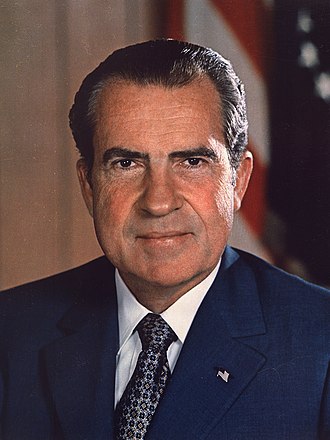
Richard M. Nixon served as the 37th President of the United States from January 1969 until his resignation in August 1974. In February 1971, he ordered the installation of a secret voice-activated taping system in the White House to preserve a historical record of his administration. Until the system's existence was revealed and dismantled in July 1973, the tapes captured Nixon directing major foreign policy initiatives, such as the opening to China, as well as his central role in the Watergate cover-up.
President Nixon and Press Secretary Ronald L. Ziegler discuss strategies for managing press coverage regarding the Vietnam War and recent media reporting. Nixon directs Ziegler to emphasize that South Vietnamese military operations are facilitating American troop withdrawals and ultimately saving U.S. lives. The two align on a messaging approach to counter critical Washington Post coverage by consistently referring reporters back to the administration’s established position on the war effort.
President Nixon and Alexander P. Butterfield discussed the handling of marked-up news summaries, specifically regarding the President's personal annotations and feedback. The conversation focused on integrating these presidential comments into forthcoming economic briefings involving John B. Connally, Paul W. McCracken, and George P. Shultz. Nixon emphasized the importance of ensuring these insights were conveyed during relevant meetings, including an afternoon session concerning the trucking industry.
President Nixon and Alexander P. Butterfield discussed the scheduling of upcoming meetings during the President's designated "open hour." Nixon reviewed a list of potential visitors, including John R. Williams, Jr. and John B. Waters, Jr., and instructed Butterfield to vet the appointments to ensure they added value. The President ultimately decided to limit the number of attendees to keep the meetings productive and focused.
President Nixon and H. R. Haldeman convened with senior advisors and staff to coordinate administrative messaging on foreign trade and economic policy, with a focus on enforcing stricter discipline among cabinet officers. The President also consulted Henry Kissinger on national security matters, specifically seeking to navigate the ongoing friction between Kissinger and Secretary of State William P. Rogers while managing the sensitive public relations aspects of the Vietnam War and the Laotian operation. Additionally, the President issued directives regarding internal staff management and requested an investigation into a recent security leak concerning the Strategic Arms Limitation Talks (SALT).
President Nixon and Alexander P. Butterfield discussed the logistical arrangements for upcoming White House entertainment featuring the group Up With People and comedian Bob Hope. The President outlined his preferences for the program flow, specifically regarding the timing of his own stage appearances and the formal introductions of the performers. The conversation served to clarify the President's public engagement expectations to ensure the event proceeded according to his desired schedule.
President Nixon met with Senator Milton R. Young, Representative Mark Andrews, and a delegation of twenty-five members of the North Dakota Legislature to discuss his Administration's revenue sharing proposals. The President emphasized the specific benefits of general and special revenue sharing for North Dakota, highlighting a new $1 billion initiative dedicated to rural development. The meeting concluded with the President presenting gifts to the attendees and engaging in informal conversation regarding North Dakota and the legislative delegation's influence in Congress.
President Nixon met with his aide Stephen B. Bull in the Oval Office to facilitate a formal photograph with Arizona Governor John R. "Jack" Williams, Jr. The meeting served as a brief administrative coordination to ensure the session with the Governor proceeded as scheduled. Following this logistical arrangement, Bull departed the office immediately.
President Nixon met with Arizona Governor Jack Williams to discuss the state's economic conditions and urgent concerns regarding water resource management and infrastructure funding. Following Williams' departure, Nixon consulted with John Ehrlichman and Ronald Ziegler regarding strategy for an upcoming meeting with state governors, specifically aiming to avoid hostile media coverage by favoring private discussions over open forums. The President ultimately decided to conduct his pitch to the governors in a closed setting to ensure candid communication without the interference of grandstanding attendees.
President Nixon hosted John B. Waters, Jr. and his family for a brief social visit and photo opportunity in the Oval Office, during which he presented them with gifts and discussed the office's surroundings. The meeting served primarily as a gesture of goodwill toward the Waters family, including informal conversation regarding Tennessee politics and previous speaking engagements. Outside of the family visit, the recording includes brief, fragmented discussion regarding strategy for a separate event, emphasizing the President's desire to control media access and minimize public exposure during specific political sessions.
President Nixon met with his aide Stephen B. Bull to issue an immediate directive regarding the White House press corps. The President ordered Bull to bring the press into the Oval Office without delay. This brief, one-minute interaction served as a logistical instruction to facilitate an unscheduled or urgent media engagement.
President Nixon met with the President's Science Advisory Committee to discuss a range of national priorities, most notably the administration's proposed initiative to combat cancer. The committee advised against creating a separate, standalone agency for cancer research, instead recommending a centralized leadership structure within the National Institutes of Health to maintain scientific integration. The discussion also covered the ethical and public policy challenges of future technologies like hurricane cloud seeding, as well as strategies to address economic challenges, including the unemployment of scientists and engineers and the need for improved national productivity.
President Nixon met with his senior aides and advisors to strategize the temporary suspension of the Davis-Bacon Act, framing the move as an emergency measure to combat inflation in the construction industry rather than an attack on labor unions. The group, including H.R. Haldeman, John Ehrlichman, Charles Colson, and George Shultz, worked to refine a public statement that would justify the suspension by drawing parallels to the administration's previous interventions in the steel and oil sectors. Nixon emphasized the need to maintain credibility with his political allies while ensuring the message clearly articulated that the suspension was a necessary response to rising costs rather than a permanent repeal of labor protections.
President Nixon met with Manolo Sanchez and Stephen B. Bull in the Oval Office to discuss logistical arrangements or personal scheduling matters. The brief recording consists primarily of room noise and muffled background dialogue, preventing a clear understanding of substantive policy decisions. The exchange concludes with a general acknowledgment regarding the need to proceed with current plans.
President Nixon met with Alexander P. Butterfield and Stephen B. Bull in the Oval Office to coordinate administrative logistics regarding presidential scheduling and document handling. The discussion focused on managing the President's immediate workflow and the disposal of specific materials. The participants reached an informal consensus on these logistical arrangements before concluding the brief meeting.
President Nixon consulted with the White House operator to facilitate a telephone call to speechwriter William L. Safire. The exchange served as a routine administrative request to establish a line of communication with a key staff member. No policy matters or substantive discussions were recorded during this brief interaction.
President Nixon met with Alexander P. Butterfield to confirm the logistics for an evening engagement. The pair briefly coordinated the scheduling for a briefing, identified as a 'CD,' set for 6:00 p.m. The meeting concluded once the timeline for this appointment was established.
President Nixon met with speechwriter William Safire to discuss the drafting and refinement of the upcoming 'State of the World' message. The conversation focused on the presentation of national security, defense, and arms control policies, particularly in relation to the perspectives of Secretary of Defense Melvin Laird and Secretary of State William Rogers. Nixon tasked Safire with integrating editorial changes to ensure the message effectively articulated his vision for a strong America.
President Nixon met with Alexander P. Butterfield to discuss the management of the President's daily schedule. The conversation focused on logistics and arrangements for upcoming appointments and administrative affairs. No specific policy decisions were finalized during this brief exchange regarding White House operations.
President Nixon held a brief, informal discussion with an unidentified participant regarding personal sentiments on physical appearance. The dialogue centered on the expression of subjective preferences toward body image. No formal policy decisions or administrative actions were recorded during this brief exchange.
President Nixon and Press Secretary Ronald Ziegler coordinate the media strategy for the President’s upcoming appearance at the Governors’ conference. They discuss the logistics of radio and television coverage, specifically deciding against requesting formal radio time in favor of providing clips. Nixon also touches upon potential messaging regarding the political implications of a conviction to ensure the administration's stance is clearly communicated.
President Nixon and H.R. Haldeman met with several aides and officials, including Harry Dent and Robert Finch, to strategize on public relations, political outreach, and the upcoming 1972 campaign. The discussion covered the President's scheduled travel and appearances, the necessity of carefully managing his time and public messaging, and the ongoing administrative handling of internal personnel issues, specifically the dissenting foreign service officers. They also touched upon foreign policy communications, the importance of maintaining control over official messaging, and the logistical organization of White House workspaces and executive meetings.
President Nixon, Henry Kissinger, and H.R. Haldeman met to coordinate upcoming National Security Council (NSC) meetings, refine public relations strategies regarding Vietnam, and discuss ongoing tensions in the Middle East. The President expressed frustration with internal leaks and administrative friction between Henry Kissinger and Secretary of State William Rogers. Decisions were made to streamline briefing procedures for the NSC and to manage diplomatic messaging to the press and Congress regarding the Vietnam conflict.
President Nixon met with his personal valet, Manolo Sanchez, in the Oval Office to discuss personal arrangements. The conversation focused on a logistical request regarding the President's coat. The brief interaction concluded with the two men departing the office immediately afterward.
President Nixon met with his senior staff to address several pressing administrative and political matters, primarily focusing on the South Vietnamese military operation in Laos and strategies for managing press criticism of the war. Nixon and his advisors discussed the need to report progress on the operation without overpromising, while also weighing whether to send General Alexander Haig to Vietnam to provide an independent assessment of the ground situation. Additionally, the President reviewed his recent engagement with Republican governors and considered whether to make a brief appearance at a White House meeting with Black leaders to maintain goodwill without becoming entangled in policy debates.
President Nixon and H. R. Haldeman coordinated the logistics and talking points for an upcoming meeting with a group of Black leaders. They discussed emphasizing the administration's commitment to government responsiveness and reorganization, while strategizing on how to best engage the attendees. The President also tasked his staff with inquiring about the status of Negro History Month programming and exploring the possibility of providing the visitors with a special tour of the White House.
President Nixon, H. R. Haldeman, and Alexander Butterfield coordinate logistics regarding an exhibit of Black art from Tuskegee currently on display at the White House. The participants discuss potential tours for school children and the presentation of specific presidential gifts, such as bowls and cup lids, to visitors. Nixon directs the staff to ensure the presentation is handled effectively during his brief appearance with the group.
President Nixon and H. R. Haldeman met to coordinate the President's upcoming schedule, focusing on agriculture-related appearances and the management of high-level meetings with business and community leaders. The President expressed frustration with White House staffing processes, specifically regarding the frequency of his meetings with advocacy groups and his desire to delegate these engagements to senior staff members like George Shultz or George Romney. Additionally, the conversation included a candid assessment of Henry Kissinger’s personality, his ongoing conflicts with Secretary of State William Rogers, and the need for a more disciplined administration strategy when dealing with political opponents and the press.
President Nixon met with his personal valet, Manolo Sanchez, in the Oval Office for a brief informal interaction. The primary focus of the meeting was the serving of refreshments. No significant policy decisions or administrative actions were documented during this short exchange.
President Nixon met with H.R. Haldeman and Henry Kissinger to discuss the administration's political strategy regarding the Vietnam War, specifically focusing on how to respond to Democratic caucus proposals for troop withdrawal deadlines. The President emphasized his preference for maintaining direct control over sensitive foreign policy communications, expressing frustration with Kissinger’s tendency to monopolize briefings and obstruct direct contact between the President and other key advisors like Melvin Laird or William Rogers. Consequently, Nixon directed his staff to develop a more effective, unified political posture to challenge Democratic opposition, while he personally prepared to draft a speech addressing these issues.
President Nixon met with an unidentified individual in the Oval Office for a brief consultation. While the majority of the discussion was withdrawn for personal or sensitive reasons, the brief nature of the meeting suggests a high-level private exchange. No specific policy actions or substantive decisions are publicly documented due to the limited duration and the restricted status of the conversation.
President Nixon met briefly with his personal valet, Manolo Sanchez, in the Oval Office. The two discussed lunch arrangements before departing together. This brief interaction reflects the routine personal logistical coordination between the President and his staff.
President Nixon and H. R. Haldeman discuss the social dynamics and political hostilities encountered during recent White House functions. Haldeman analyzes the personal animosity displayed by Ronald and Nancy Reagan toward the President, comparing it to the visible disdain previously observed in Eunice Shriver during a diplomatic dinner. The conversation emphasizes the perceived emotional reactions of various political figures toward Nixon's presence in office.
President Richard M. Nixon met with radio technicians in the Oval Office to record his radio address concerning the Second Annual Foreign Policy Report to Congress. The discussion primarily focused on technical logistics, the arrangement of recording equipment, and the President's delivery of specific segments of the speech. During the session, the President successfully recorded the address, including a re-recorded segment to ensure the clarity and effectiveness of his message on foreign policy.
President Nixon met with Henry Kissinger and a large group of National Security Council staff members in the Cabinet Room to formally sign the annual Foreign Policy Message. The President used the occasion to express his profound appreciation for the high quality and volume of work produced by the staff, emphasizing his personal confidence in the materials they provided. The event served as a ceremony to recognize the collective efforts of those involved in drafting the document, accompanied by the distribution of souvenir pens.
President Nixon and Alexander Butterfield met to coordinate the logistics for an upcoming series of photo opportunities with visitors, including Thomas and Glenda Kleppe and Judge George Renercomb. The President provided specific instructions on the positioning of guests within the Oval Office to ensure the process remained efficient and brief. Nixon emphasized the need for a rapid turnover to minimize the duration of the sessions.
President Nixon hosted a group of officials, family members, and congressional guests in the Oval Office for the ceremonial swearing-in of Thomas S. Kleppe as the new Administrator of the Small Business Administration (SBA). Following the oath of office, the group discussed the agency's primary objectives, specifically emphasizing the need for active engagement with the business community and the provision of low-interest loans for victims of the recent California earthquake. The meeting concluded with the President presenting gifts to the attendees and formal expressions of mutual support and cooperation.
President Nixon met with outgoing Inter-American Development Bank (IADB) official Felipe Herrera, along with Charls Walker and other staff, to discuss U.S.-Latin American relations and the bank's role in the region. The conversation focused on the necessity of soft-loan windows for developing nations, the importance of private capital, and the President's vision for a partnership based on "peaceful change," stability, and mutual dignity. Following the policy discussion, the President and Herrera exchanged gifts and tokens of appreciation, with the meeting concluding after further remarks from Walker regarding the administration's commitment to these diplomatic principles.
President Nixon met with Alexander P. Butterfield to finalize arrangements for an upcoming meeting with Representative Joe D. Waggonner, Jr. and J. M. Menefee. The President instructed Butterfield to proceed with the scheduling of these individuals. This brief discussion focused exclusively on coordinating the logistics of the President’s official calendar.
President Nixon met with Joe D. Waggonner, Jr., Juanita Morris Moody, John C. Whitaker, and Richard K. Cook to discuss oil production concerns in Louisiana and potential impacts on national energy policy. Waggonner introduced an official from the Louisiana Department of Conservation, who presented data suggesting that claims of artificially suppressed oil production were unfounded and explained the industry's struggle with declining drilling rates and rising costs. The President acknowledged the technical complexity of the issue and directed his staff, particularly John Whitaker, to coordinate a follow-up meeting with relevant administration officials to ensure a more informed approach to oil regulation.
President Nixon and Dwight L. Chapin discussed logistical arrangements for upcoming White House events, specifically a reception involving John Quincy Adams' portrait and a dinner honoring astronauts. They reviewed seating plans, the program structure, and potential guest list additions, including the possibility of inviting prominent golfers. Nixon also addressed the travel arrangements for John B. Connally to Camp David and decided against inviting an MIT scientist who had contributed to the Apollo 14 mission due to concerns over his appearance.
President Nixon met with his former law partner Milton C. Rose to discuss private legal and personal matters, specifically the wills of Elmer and Momdouha Bobst. They reviewed executor arrangements for the Bobsts' estates and the future activation of the Elmer and Momdouha Bobst Foundation, ensuring that Nixon's role as a potential director would not create conflicts or adverse publicity. Additionally, the pair discussed the status of their former law firm, Mudge, Rose, Guthrie & Alexander, potential advisory roles for Elmer Bobst regarding national cancer research initiatives, and scheduling for upcoming White House events.
President Nixon met with David M. Kennedy and General Alexander Haig to discuss the strategic objectives and logistical planning for Kennedy’s upcoming diplomatic tour of Vietnam, Indonesia, Micronesia, Hong Kong, and Thailand. The President emphasized the critical need for an expert evaluation of South Vietnam’s post-withdrawal economic viability and urged Kennedy to consult directly with local leaders and business figures to bypass the perceived limitations of State Department bureaucracy. Additionally, Nixon provided specific instructions for managing regional alliances, including reassuring Thai leadership of U.S. commitment and addressing the political complexities of Micronesian governance.
President Nixon and H. R. Haldeman discuss strategies for managing the President's public image, presidential schedule, and press relations. Key topics include handling potential conflicts regarding Vice President Agnew's attendance at the Gridiron Club, coordinating future public events like an agricultural fair at the White House, and streamlining the President's public speaking engagements to improve impact. Nixon emphasizes the importance of repeating key rhetorical themes, such as his 'generation of peace' messaging, and expresses a preference for utilizing radio addresses to reach the public efficiently without the logistical burdens of televised appearances.
President Nixon and Henry Kissinger discuss managing media strategy regarding a potential interview or article with a journalist named Brandon. The President distinguishes between the candor expected for a book project versus a breaking news story, expressing concern over how the material might be framed. They coordinate logistical arrangements for the upcoming meeting, noting that Secretary of State William Rogers will facilitate the journalist's arrival.
President Nixon held a brief, one-minute meeting with his Deputy Assistant, Alexander P. Butterfield, in the Oval Office. While the recording does not contain substantive dialogue or actionable directives, it documents a routine administrative interaction between the President and his aide. The meeting concluded immediately, leaving no significant policy decisions or developments on the record.
President Nixon met with Ronald Ziegler and Stephen Bull to discuss media management strategies and political messaging regarding federal welfare reform. The participants reviewed the network television coverage of the President's recent film clips, specifically analyzing how to better leverage media exposure to shape public perception. Additionally, they coordinated efforts to influence John Burns's public stance on federal control of welfare and managed the President’s upcoming meeting schedule.
President Nixon met with Stephen B. Bull to coordinate scheduling adjustments regarding Henry Kissinger and a pending National Security Council meeting. Bull confirmed that he successfully communicated the cancellation of a meeting between Kissinger and the President, streamlining the executive agenda. The discussion focused on managing these logistical shifts and ensuring staff were prepared for upcoming security briefings involving George H. W. Bush.
President Nixon met with Secretary of Defense Melvin Laird, Admiral Thomas Moorer, Henry Kissinger, and Chairman of the NATO Military Committee Admiral Sir Nigel Henderson to discuss the strategic importance of NATO and global defense priorities. The participants analyzed the role of conventional versus nuclear deterrents and evaluated international security concerns in regions including Vietnam, the Middle East, and South Africa. Nixon emphasized the necessity of maintaining alliance cohesion and credible defense capabilities while monitoring Soviet geopolitical ambitions and SALT negotiations.
President Nixon met with Patricia R. Hitt and a group of federal officials and associates for a brief, ceremonial visit in the Oval Office. The encounter, which included members of the press, focused on casual conversation regarding the office's furnishings, historical decor, and artwork. Nixon used the opportunity to express his appreciation for the group's ongoing service and contributions to the federal government.
President Nixon met with his aide, Stephen B. Bull, to review the President’s upcoming schedule and address concerns regarding interactions with the press corps. The brief discussion served to coordinate logistics for managing media access during this period. No major policy decisions were reached, as the conversation focused primarily on administrative scheduling.
President Nixon met with a group of visitors, including Francis E. White, Frederick C. Wieting, and several others, for a brief ceremonial event in the Oval Office. The participants expressed their appreciation for the President’s support of legislation related to the National Association of Presidents and discussed their ongoing work in their respective fields. The President acknowledged their efforts as a significant service and concluded the meeting with farewells following a short photo opportunity.
President Nixon and Stephen B. Bull met to finalize logistical details regarding the President’s daily schedule and upcoming appointments. The discussion centered on managing the timing and coordination of meetings with Thomas L. Lias, Guilford Dudley, Jr., and Harry S. Dent. They specifically decided to utilize the receiving room to facilitate these scheduled engagements efficiently.
President Nixon met with a delegation of Princeton University students, accompanied by White House aide Jeb Stuart Magruder, to discuss their political support for his administration. The conversation focused on the rationale behind Nixon's Southeast Asia policies, specifically regarding the ongoing operations in Laos and Cambodia and the necessity of maintaining public perspective. Nixon encouraged the students to remain politically active on campus and emphasized the importance of effectively communicating his foreign policy goals to the public through television and media.
President Nixon and Stephen B. Bull briefly met in the Oval Office to coordinate logistics for an upcoming presidential outing. The discussion focused on specific navigation instructions and positioning for a location the President intended to visit. No substantive policy matters were addressed during this short administrative exchange.
President Nixon met with representatives Cecil W. Stevenson, Frank G. Wood, and George T. Bell, along with a White House photographer, for a ceremonial visit in the Oval Office. The participants discussed the administration's policy regarding prisoners of war, with Nixon reaffirming his commitment to the issue as previously stated in a public address. The meeting concluded with the presentation of a formal resolution to the President and the exchange of autographs and tokens of appreciation.
President Nixon met with Thomas L. Lias and Harry S. Dent for a brief, informal session following a photo opportunity. The President offered career advice and encouragement to Lias regarding an upcoming diplomatic assignment, specifically highlighting the challenges of the social obligations associated with such a role. The participants concluded by affirming their ongoing commitment to future political campaign efforts.
President Nixon met with U.S. Ambassador to Denmark Guilford Dudley, Jr. and advisor Harry S. Dent to discuss Dudley’s desire to step down from his diplomatic post. Dudley requested a sabbatical for 1972, citing his intention to focus on Nixon’s reelection campaign and to settle personal business affairs. The President expressed appreciation for Dudley’s service and agreed to coordinate the transition to ensure a suitable successor for the ambassadorship.
President Nixon met with his aide Stephen B. Bull to coordinate upcoming appointments and manage the flow of visitors into the Oval Office. They specifically discussed scheduling arrangements regarding Frederic V. Malek and Henry A. Kissinger. The discussion concluded with instructions to facilitate these meetings and manage the arrival of the scheduled guests.
President Nixon met with Press Secretary Ronald Ziegler and Stephen Bull to coordinate administration messaging and manage public perception. The discussion focused on Ziegler's handling of press inquiries regarding the National Security Council, welfare reform, and media coverage by columnists like Holmes Alexander. Additionally, they reviewed strategies for communicating foreign policy, specifically emphasizing the administration's non-negotiable stance on securing the release of prisoners of war (POWs) during U.S. force withdrawals.
President Nixon, H.R. Haldeman, and several staff members met to discuss administrative scheduling, public relations strategies, and domestic political polling. The President emphasized a preference for radio over television for addressing the public, citing its effectiveness for targeted messaging and avoiding excessive media scrutiny. Additionally, they reviewed recent polling data regarding Congress and discussed personnel arrangements, including the roles of Bryce Harlow and Donald Rumsfeld in managing intergovernmental relations.
President Nixon met with his aide Stephen B. Bull in the Oval Office to facilitate the delivery of documentation. The brief interaction focused on the exchange of written materials, with Henry Kissinger also noted as being present for a portion of the proceedings. No significant policy decisions were recorded during this brief administrative encounter.
President Nixon, Henry Kissinger, and Alexander Haig met to discuss the volatile diplomatic landscape of the Middle East, focusing specifically on Israeli concerns regarding potential border adjustments and U.S. policy. The participants examined the implications of a return to 1967 borders, the role of the Soviet Union in the region, and the necessity of maintaining military support for Israel. The discussion concluded with a consensus on the need to consult Joseph Sisco to better align future U.S. policy options ahead of a scheduled meeting with Secretary of State William Rogers.
President Nixon and Stephen B. Bull met briefly to discuss the President's upcoming schedule and appointments. The conversation, which was already in progress when the recording began, concluded quickly as Bull departed the Oval Office. No major policy decisions or significant developments occurred during this short administrative check-in.
President Nixon and H. R. Haldeman met to coordinate strategy for an upcoming meeting with Secretary of State William P. Rogers regarding Middle East policy. Nixon requested concise talking points to probe the views of Henry Kissinger, Joseph Sisco, and Israeli Ambassador Yitzhak Rabin on sensitive issues like the 1967 borders and arms shipments. Additionally, the pair briefly discussed arrangements for acquiring portraits of John Quincy and Louisa Catherine Adams for First Lady Pat Nixon.
President Nixon met with journalist Henry Brandon to discuss the complexities of the modern presidency and the evolution of American foreign policy. The conversation covered the transition from the post-war era's clear geopolitical boundaries to the current need for pragmatic, sophisticated, and mature leadership in a world defined by nuclear parity and internal domestic challenges. Nixon reflected on his decision-making processes regarding Vietnam, Cambodia, and Laos, emphasizing his approach of maintaining perspective while navigating the constraints of a "new isolationism" and intense public scrutiny.
President Nixon met with his aide, Stephen B. Bull, to coordinate his late afternoon schedule and review upcoming appointments. The discussion centered on finalizing meetings with Secretary of State William P. Rogers and National Security Advisor Henry A. Kissinger. The President confirmed a 6:00 p.m. meeting time and directed Bull to prepare for the arrival of pending administrative documents.
President Nixon and Secretary of State William P. Rogers met to discuss delicate foreign policy issues, including the situation in Laos involving UN Secretary-General U Thant and broader strategic considerations regarding China and the Soviet Union. The two also discussed the administration's public relations strategy, with Nixon emphasizing the need to control the release of information to the press to avoid appearing reactive. Additionally, the President expressed strong opposition to placing public housing projects in suburban neighborhoods, framing the issue as an economic concern rather than a racial one.
President Nixon met with his aide Stephen B. Bull to coordinate the scheduling of Henry Kissinger's upcoming activities. The discussion focused on managing the timing of Kissinger’s departure and his subsequent meeting at 6:00 p.m. Bull was directed to facilitate these logistical arrangements to ensure the President's schedule remained on track.
President Nixon and Henry Kissinger met to coordinate foreign policy strategy, specifically discussing the delay of a USS Enterprise visit to Chile and the ongoing management of U.S. bombing authorizations in Vietnam. They reviewed press criticism of the administration’s handling of the conflict in Laos and debated the potential effectiveness of public statements regarding Strategic Arms Limitation Talks (SALT). Ultimately, the President decided to maintain a firm stance on administration messaging despite negative media coverage and legislative inquiries.
President Nixon and H.R. Haldeman reviewed the President's upcoming schedule, discussed potential ambassadorial appointments for J. Willard Marriott, Jr. and Charles D. Thornton, and evaluated strategies for public and media relations. Nixon expressed strong reservations about White House staff members, particularly Henry Kissinger, appearing on television to discuss substantive policy matters. They also analyzed recent Gallup poll data regarding the Vietnam War and the invasion of Laos, deciding to implement more frequent polling to better track public opinion trends.
President Nixon met with his senior national security and military advisors, including Henry Kissinger, Melvin Laird, and Admiral Thomas Moorer, to receive an update on the ongoing Lam Son 719 operation in Laos. The discussion focused on the military situation on the ground, the effectiveness of South Vietnamese forces, and strategies to manage press coverage regarding the conflict. Nixon emphasized the importance of maintaining a unified administration message and advised his team to treat the press as an adversarial force rather than providing direct, vulnerable answers to speculative inquiries.
President Nixon met with his aide Stephen B. Bull to briefly discuss administrative details regarding the President’s daily schedule. The conversation focused on the presence of a security guard on the premises and the scheduling of an upcoming appointment with Leonard Garment. Bull received instructions to coordinate these logistics before exiting the Oval Office.
President Nixon met with his senior staff and advisors to discuss communication strategies for the administration's policy achievements and historical outreach. The group explored ways to better leverage the President's personal historical expertise, such as his recent presentation on John Quincy Adams, to improve public perception through televised forums rather than relying on the mainstream press. Nixon emphasized the need to bypass the press corps by speaking directly to key demographics, including the elderly and youth, while instructing his staff to maintain stricter control over who is permitted to discuss substantive policy on television.
President Nixon met with his national security team, including Vice President Agnew, Henry Kissinger, and William Rogers, to review the status of ongoing military operations in Southeast Asia and the complex diplomatic situation in the Middle East. Military leadership provided a detailed briefing on Operation Lam Son 719 and related efforts to interdict the Ho Chi Minh Trail, emphasizing that while the fighting is intense, the operations are effectively disrupting enemy logistics and protecting American withdrawal interests. The discussion subsequently shifted to the Middle East, where the President expressed frustration over Israel's reluctance to offer a concrete negotiating position despite Egypt's concessions. Nixon concluded by stressing the importance of maintaining a firm stance, noting that while the U.S. remains a reliable ally, it will not offer unconditional support without a reciprocal commitment to a serious peace process.
President Nixon and Alexander P. Butterfield held a brief administrative meeting to coordinate the President's upcoming schedule and review recent events. They touched upon Secretary of State William P. Rogers' previous phone call regarding a March 1 dinner and discussed Attorney General John N. Mitchell’s recent press conference. Press Secretary Ronald L. Ziegler was also noted in the context of managing these logistical and media-related items.
President Nixon, H.R. Haldeman, and Ronald Ziegler met to discuss the President's upcoming schedule, including a potential press conference and public relations strategies regarding recent media coverage of his trip to Des Moines. Later, John Mitchell joined the meeting to coordinate his own upcoming press conference, specifically focusing on Revenue Sharing and the Law Enforcement Assistance Administration (LEAA). The group prioritized proposing a reorganization of U.S. Capitol Police security, using the President’s successful implementation of the Executive Protective Service as a model, which Nixon subsequently discussed with Speaker Carl Albert.
President Nixon met with his task force leaders and advisors to discuss the legislative strategy for the Task Force on International Development proposals and the challenges of securing Congressional support. Key participants included Rudolph Peterson, Peter Peterson, Clark MacGregor, and Henry Kissinger, who debated the jurisdictional split of foreign assistance programs between the State and Defense Departments. The group emphasized the need to integrate foreign aid with broader U.S. economic and trade policies, and Nixon tasked MacGregor with coordinating closely with Congressional leadership to ensure the proposals moved forward without significant delays.
President Nixon held a brief, informal meeting in the Oval Office with his personal valet, Manolo Sanchez. The interaction served as a routine check-in between the President and a member of his domestic staff. No substantive policy matters or administrative decisions were recorded during this brief encounter.
President Nixon consulted with the White House operator to facilitate an outgoing call to Secretary of State William P. Rogers. The brief exchange focused solely on establishing the connection and identifying the specific participants required for the conversation. No substantive policy discussions occurred during this interaction.
President Nixon coordinated with the White House operator to facilitate a return call to Secretary of State William P. Rogers. During this brief interaction, the President specified that the connection should be established after 3:00 p.m. to suit his schedule. No further policy matters or substantive discussions were addressed during this exchange.
President Nixon and H. R. Haldeman reviewed the administration's public relations strategy, focusing on countering negative media coverage regarding the President's recent trip to Iowa and managing optics for upcoming travel. The discussion emphasized the need for more effective messaging, including the coordination of special letters to governors like Ronald Reagan and Nelson Rockefeller to support revenue sharing initiatives. Additionally, the pair evaluated the logistical success of recent social events, such as the astronaut dinner, comparing them to state functions to better plan future appearances.
President Nixon held two distinct meetings in the Oval Office: the first with Turkish diplomat Targut Menemencioglu and his team to discuss geopolitical concerns in Pakistan, India, and Turkey, including the future of the Central Treaty Organization (CENTO); the second with Chief Justice Warren Burger, John Mitchell, and John Dean regarding judicial reform and the President's potential appearance at an American Bar Association event in London. During the first session, Nixon reaffirmed the importance of maintaining U.S. support for Pakistan and stability in the region despite domestic Congressional opposition. The subsequent meeting focused on the need to expedite the criminal justice system in the U.S. and coordinated scheduling for Law Day and judicial conferences.
President Nixon held a social meeting in the Oval Office with the Ulmer family and their associates to reminisce about past personal connections and exchange presidential memorabilia. Following an informal tour of the office and family pleasantries, the conversation shifted toward potential professional coordination between Ralph E. Ulmer and administration officials George Shultz and Caspar Weinberger regarding the National Association of County Administrators (NACA). The meeting concluded with the President facilitating arrangements for further discussions between these parties to address administrative and organizational matters.
President Nixon met in the Oval Office with the Heltemes family—the 1971 Easter Seal poster family—accompanied by Senator Robert Dole and other guests. The meeting served as a ceremonial event to honor the poster child and distribute presidential gifts, including Apollo-themed viewers and cufflinks. Following the departure of the Heltemes group, Nixon held a broader discussion with his remaining visitors regarding the state of the film industry, expressing his preference for family-oriented entertainment and criticizing the prevalence of explicit content in modern movies.
President Nixon met with Kenneth R. Lyons, leader of the National Association of Government Employees, and aide Charles W. Colson to discuss labor relations within the federal government. The President emphasized his desire for responsible union leadership, his opposition to strikes in essential services, and his support for addressing pay disparities between federal blue-collar workers and the private sector. The discussion also covered broader political topics, including the recent bombing of the U.S. Capitol and the importance of public support for law enforcement.
President Nixon and Alexander P. Butterfield met to coordinate the President's upcoming schedule and administrative preparations. The discussion focused on logistical arrangements regarding meetings with astronauts, a visit to the National Aquarium, and the preparation of briefing materials for a presidential press conference. Butterfield also updated the President on coordination efforts with Ronald Ziegler and Patrick Buchanan regarding press deadlines.
President Nixon held a brief, eight-minute meeting in the Oval Office with an unidentified individual. The entirety of the recorded interaction, with the exception of a two-second segment later withdrawn as personal, consists of non-substantive or restricted dialogue. Consequently, no official policy decisions or specific topics of state business can be determined from the available records of this encounter.
President Nixon and H. R. Haldeman met to coordinate upcoming staff meetings regarding domestic and foreign economic policy involving Henry Kissinger, Peter Peterson, and John Ehrlichman. Nixon also collaborated with staff members Marjorie P. Acker and Rose Mary Woods to finalize a personal letter addressed to British Prime Minister Edward Heath. The President explicitly directed that a copy of the correspondence be delivered to Ambassador Walter Annenberg for his personal files, while strictly prohibiting its distribution to the State Department.
President Nixon held a brief morning discussion with an unidentified individual, primarily to address a request to contact National Security Advisor Henry Kissinger. The exchange focused on logistics regarding this communication, with the President explicitly instructing that Kissinger not be disturbed. No substantive policy matters were addressed during this short interval.
President Nixon and H. R. Haldeman met to review the reception of the President's March 4, 1971, press conference, focusing on its effectiveness in bypassing the press to communicate directly with the public. They analyzed the President's performance on topics such as the military incursion into Laos, Vietnamization, and his critical stance toward the media, which they felt resonated positively with the public. Additionally, the President discussed potential future media appearances, including a television special focusing on women, and prepared for an upcoming meeting with Nelson Rockefeller regarding revenue sharing.
President Nixon consulted with an unknown participant to confirm that necessary preparations were finalized. The brief interaction served as a logistical check to ensure that all arrangements for a subsequent task or meeting were in place. The discussion culminated in the President placing a follow-up call to H.R. Haldeman to coordinate these efforts.
President Nixon and H. R. Haldeman discuss a strategy to utilize New York Governor Nelson Rockefeller to publicly advocate for the administration’s urban revenue sharing initiative. The President considers joining Rockefeller for a press briefing to bolster the proposal’s profile. They agree that Haldeman should coordinate with Rockefeller to arrange his involvement in promoting the policy.
President Nixon met with Henry Kissinger, Alexander Haig, William Rogers, Melvin Laird, Admiral Thomas Moorer, and Richard Helms to coordinate strategy following the President's March 4, 1971, press conference. The discussion focused on maintaining public and political momentum for the ongoing Vietnamization effort and the military operations in Laos (Lam Son), specifically addressing potential responses to North Vietnamese missile fire and troop movements. Nixon emphasized the necessity of success in Southeast Asia to maintain American global credibility, while the participants reviewed intelligence on enemy capabilities and planned upcoming Congressional testimony and media appearances to manage the narrative surrounding the war.
President Nixon and Henry Kissinger discuss the allegiances and perceived loyalty of CIA Director Richard Helms following a prior meeting. Nixon expresses concern regarding the internal dynamics of the intelligence agency and emphasizes the necessity of having a clear understanding of where Helms’s loyalties lie. The conversation concludes with Kissinger confirming that Helms has become a more reliable and forthright proponent of the administration’s objectives.
President Nixon met with Alexander P. Butterfield and later spoke by phone with Senator John C. Stennis to discuss the public and political reception of the President's March 4, 1971, press conference. The participants focused on the effectiveness of the President's performance in defending the military operation in Laos and managing negative media coverage. They agreed on the importance of maintaining a firm stance regarding the Vietnam War despite unfavorable public opinion polls. Additionally, the President arranged for the dissemination of a private letter to British Prime Minister Edward Heath and discussed scheduling a family portrait session.
President Nixon consulted with a White House operator to facilitate a telephone connection with Leonard Garment. This brief interaction served as a logistical step to initiate direct communication with the Special Consultant to the President. No further substantive policy or strategic discussions occurred during this exchange.
President Nixon and Leonard Garment reviewed the President's recent press conference, focusing on his confrontational strategy toward the media. Nixon defended his direct communication style, suggesting that bypassing the press to speak to the public was a necessary tactic despite the resulting friction. The discussion also covered the ongoing situation in Laos, which Nixon compared to World War I tactical attrition, and his commitment to Israel that the U.S. would not impose a peace settlement.
President Nixon instructed the White House operator to connect him with special counsel Charles W. Colson. This brief communication was intended to facilitate a direct conversation between the President and Colson regarding White House administrative or political goals. The interaction served as a logistical step to initiate a high-level discussion.
President Nixon and Charles Colson discussed the positive reception to the President’s recent press conference and the need to maintain momentum through strategic follow-up. They reviewed the effectiveness of the President's public comments regarding the press and Cambodia, specifically emphasizing a strategy to mobilize support from groups such as veterans and the American Legion. Nixon directed Colson to initiate a 'drumbeat' of public backing to pressure Congress and solidify his administration's messaging.
President Nixon met with H.R. Haldeman and Ron Ziegler to coordinate political mobilization strategies following his March 4, 1971, press conference. The discussion focused on leveraging the President's recent media performance to promote his domestic agenda—specifically revenue sharing—while coordinating briefings with Nelson Rockefeller, George Romney, and John Connally. Additionally, they evaluated press reactions to the President's stance on the war in Laos and reviewed polling data regarding Democratic challengers.