Nixon, Richard M. (President)
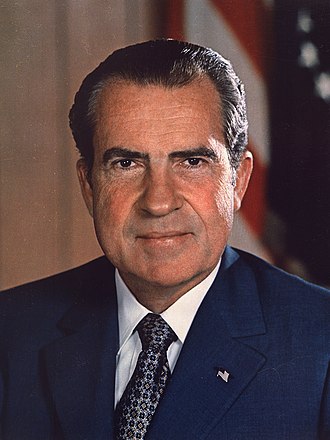
Richard M. Nixon served as the 37th President of the United States from January 1969 until his resignation in August 1974. In February 1971, he ordered the installation of a secret voice-activated taping system in the White House to preserve a historical record of his administration. Until the system's existence was revealed and dismantled in July 1973, the tapes captured Nixon directing major foreign policy initiatives, such as the opening to China, as well as his central role in the Watergate cover-up.
What Nixon talks about on the tapes
White House operations 4,718Presidential scheduling 2,225Public relations 1,784Presidential schedule 1,782Vietnam War 1,693Logistics 1,650Manolo Sanchez 1,626White House communications 1,400White House administration 1,399Presidential communication 1,243Henry Kissinger 1,191Foreign Policy 1,183
Conversations (21,010)
— Page 66 of 211In this Oval Office meeting, President Nixon and Henry Kissinger coordinate U.S. foreign policy regarding the escalating military tensions between India and Pakistan. Kissinger expresses frustration with the State Department's perceived insubordination, advocating for a firmer stance against Indian military aggression while aligning more closely with Pakistani interests and Chinese diplomatic positions. The President directs Kissinger to issue sharp, clear warnings to both India and the Soviet Union regarding U.S. expectations, while strategically delaying UN Security Council involvement to better assess Chinese objectives.
President Nixon spoke with Reader’s Digest editor Hobart D. Lewis to discuss the President’s recent appearance at the AFL-CIO convention and the ongoing tensions with union leadership, specifically George Meany. The pair also discussed a request for an exclusive interview regarding the administration's foreign policy and Nixon's upcoming trip to the People's Republic of China. Additionally, Lewis briefed the President on a legislative matter involving John Ehrlichman and George Shultz, pledging the magazine's editorial support for the White House's position.
President Nixon met with Hobart D. Lewis, the editor-in-chief of Reader's Digest, to discuss the possibility of a feature or interview piece for the magazine's upcoming 50th anniversary. The two men also touched upon political challenges, including concerns regarding board stability and legislative strategy. Nixon emphasized his commitment to maintaining a firm stance on controversial issues while coordinating with Lewis on the messaging strategy for the publication.
President Nixon initiates a brief telephone exchange with the White House operator to request a connection to Clark MacGregor. The call serves as a logistical bridge to facilitate direct communication with his aide. No substantive policy discussions or complex developments occur during this short interaction.
President Nixon utilized this session in the Oval Office to dictate a memorandum and review recorded materials. The discussion, which included brief personal commentary regarding the appearance and attire of an unidentified individual in Miami, served primarily as a private administrative exercise. No major policy decisions or significant external developments were recorded during this brief period of dictation and playback.
President Nixon consulted with the White House operator to facilitate an outgoing call. This brief interaction served as a logistical necessity for the President to connect with another party. No substantive policy discussions or significant political decisions were recorded during this connection process.
President Nixon met with his personal valet, Manolo Sanchez, in the Oval Office to address routine personal requests. During this brief encounter, the two discussed the service of tea for the President. The meeting concluded quickly without any significant policy developments or administrative action items.
President Nixon dictates a memorandum regarding aesthetic changes to the Oval Office. He notes the recent removal of white curtains from the windows and discusses the appearance of the trees visible outside. The remarks appear to be informal observations intended for administrative staff concerning the room's decor and atmosphere.
President Nixon and Clark MacGregor discussed ongoing efforts to defeat the campaign reform bill and the controversial campaign check-off provision currently moving through the Senate. MacGregor provided updates on vote counting, specifically regarding potential swing votes like Senator William B. Spong, Jr., and the intense pressure being exerted by Democratic leadership. The two men reaffirmed their shared opposition to the legislation on principle, with Nixon confirming his intent to veto the bill if it reached his desk despite the political fallout.
President Nixon and Clark MacGregor discuss the political implications of upcoming legislation and its effect on party dynamics. They examine potential strategies for managing congressional opposition and the impact of fundraising pressures on the political landscape. The conversation concludes with an assessment of the legislative timeline and the risks posed by party defections.
President Nixon instructed the White House operator to place an outgoing call to his Chief of Staff, H.R. Haldeman. This brief exchange served solely as a functional administrative request to initiate communication with a key member of the President's inner circle. No further substance or policy discussions occurred during this brief interaction.
President Nixon requested that the White House operator connect him to H. R. Haldeman, who was currently attending a meeting at the office of Treasury Secretary John B. Connally. The call served as a brief administrative bridge to facilitate direct communication between the President and his Chief of Staff. No further policy discussions occurred during this brief exchange as the operator proceeded to initiate the transfer.
President Nixon requested that the White House operator connect him to an individual located in the White House hall. This brief interaction served as a logistical bridge to facilitate an immediate follow-up conversation. No substantive policy matters were addressed during this short administrative exchange.
President Nixon held a brief administrative interaction with the White House operator to facilitate telephonic communications. The exchange served primarily as a logistical step to connect the President with a specific party. No substantive policy discussions or significant political decisions were recorded during this brief connectivity process.
President Nixon and H. R. Haldeman coordinate a follow-up briefing regarding a meeting between John Connally, George Shultz, and Henry Kissinger. Haldeman proposes a preliminary debriefing involving himself, Donald Rumsfeld, and Charles Colson, but Nixon insists on the importance of Connally’s direct participation in the final policy discussions. The President directs the group to proceed with their scheduled meeting while scheduling an interim briefing with Haldeman to prepare for a larger, formal sit-down with the full group.
President Nixon and H. R. Haldeman briefly discuss the necessity of Treasury Secretary John Connally's involvement in an ongoing matter. Nixon expresses his intent to intervene in the situation and instructs Haldeman to provide a comprehensive briefing later that evening. The exchange highlights the President's desire to manage the process personally while seeking counsel to prepare for upcoming decisions.
President Nixon dictates a memorandum analyzing current political challenges, focusing on his recent reception at the AFL-CIO convention and public reaction to foreign policy developments. He addresses concerns regarding declining public approval ratings linked to the recent United Nations vote, which he views as a significant political liability. The President also evaluates how his upcoming diplomatic trips to China and the Soviet Union might influence public perception and Democratic electoral prospects.
President Nixon and H. R. Haldeman met to discuss the administration's tense relationship with organized labor and the potential resignation of George Meany from the Pay Board. They reviewed contingency plans for replacing labor representatives and discussed the President's strategy for managing economic controls and public perception. Additionally, the two reviewed the status of pending tax legislation, upcoming media interview requests, and long-term polling trends compared to the Kennedy administration.
President Nixon met with his aide Stephen B. Bull in the Oval Office to coordinate administrative logistics. The discussion focused specifically on the scheduling and calendar arrangements for John D. Ehrlichman. The brief encounter served as a routine internal management session to align the President's staff priorities.
President Nixon held a brief, informal interaction with his personal valet, Manolo Sanchez, during which he inquired about Sanchez's personal opinion of the French. Sanchez expressed a negative view, suggesting that the French held an inflated sense of their own importance. The conversation concluded shortly after this exchange without any formal policy decisions.
President Nixon and H. R. Haldeman met to coordinate White House strategy following the President's recent, confrontational address to the AFL-CIO convention. The discussion emphasized maintaining a hard-line stance against labor leadership, while capitalizing on positive public reception of the President's perceived strength. Additionally, they reviewed domestic policy projects, including the potential creation of national parks at Catalina Island and Greenbelt, Maryland, and discussed the President's intent to express support for the FBI's success in arresting individuals involved in the murder of police officers.
President Nixon contacted the White House operator to initiate a telephone call to FBI Director J. Edgar Hoover. The brief exchange served as a logistical request to establish direct communication with the Director. No further policy discussions or substantive developments occurred during this connection.
President Nixon and FBI Director J. Edgar Hoover discussed the successful FBI investigation leading to the arrest of five Black Panther members accused of killing two New York City police officers. Nixon emphasized the importance of the FBI receiving public credit for the breakthrough and instructed Hoover to coordinate with Press Secretary Ron Ziegler to maximize the news coverage. The two also touched upon ongoing leads in the 'phantom' killings in Washington, D.C., and briefly reviewed political fallout from Nixon's recent appearance at the AFL-CIO convention.
President Nixon and Clark MacGregor discuss the administration's 52-47 defeat on a critical Senate vote regarding Title 10 of the Pastore amendment to a tax bill. Faced with this legislative setback, Nixon confirms his intention to veto the measure and coordinates a strategy session for the following morning. MacGregor advises on press messaging regarding the tax check-off provision and receives approval to bring Bill Timmons to the upcoming breakfast meeting to discuss further efforts to influence the House of Representatives.
President Nixon, Rose Mary Woods, and unidentified participants engage in a brief, informal exchange characterized by repetitive phrasing regarding specific individuals. The discussion lacks substantive policy content and appears to involve the identification or categorization of people present in the room. No formal decisions or significant developments occur during this two-minute recording.
President Nixon instructed the White House operator to place an outgoing call to National Security Advisor Henry A. Kissinger. This brief interaction served as a logistical administrative step to facilitate a direct line of communication between the President and his advisor. No substantive policy discussions occurred during this exchange.
President Nixon and Henry Kissinger discussed the escalating military tensions between India and Pakistan, specifically addressing reports of Indian involvement via guerilla forces. The two conferred on the status of communication with Pakistan and the drafting of a formal United States message. Nixon emphasized the importance of carefully crafting the language of this message to align with the upcoming deliberations in the United Nations Security Council, particularly regarding the role of the People's Republic of China.
President Nixon met with his aide Stephen B. Bull in the Oval Office to facilitate a meeting with Charles W. Colson. During this brief interaction, the President specifically requested that Bull locate and bring Colson to join him. No other substantive policy matters were recorded during this session.
President Nixon, H.R. Haldeman, and Charles Colson met to discuss legislative strategy, press management, and the administration’s public image. The conversation centered on lobbying efforts for a pending tax bill, the political necessity of adopting a firm stance against busing, and the President's confrontational approach toward George Meany and organized labor. Nixon expressed ongoing frustration with White House staff leaking information to the press and ordered a strict policy requiring all media inquiries to be funneled through Ronald Ziegler.
President Nixon met with John Connally and other key advisors to coordinate White House strategy regarding pending tax legislation, the administration's public relations response to criticism from labor leaders like George Meany, and complex international monetary negotiations. The President directed that the tax bill be handled firmly, expressing a willingness to veto unfavorable versions and potentially call a special session of Congress to force a resolution. Additionally, the participants discussed U.S. foreign policy toward the India-Pakistan conflict, agreeing to maintain a hard line while monitoring the situation through the United Nations, and established protocols for executive oversight of high-level economic missions to Europe.
President Nixon initiates a call to Senator William E. Brock III of Tennessee through the White House operator. The primary purpose of this brief communication is to facilitate a direct conversation between the President and the Senator. No further substantive policy matters are addressed in this transcript beyond the request to establish the connection.
President Nixon initiates a request to the White House operator to place a telephone call to Senator Bill Brock of Tennessee. The conversation is limited to the President providing the operator with the specific contact name for the outgoing call. This brief interaction serves as a logistical bridge to facilitate communication between the President and the legislator.
President Nixon called Senator William Brock to offer birthday wishes and express appreciation for his legislative support. The two discussed the potential presidential veto of a pending tax bill, specifically focusing on the constitutional and political concerns surrounding the inclusion of federal campaign financing. Nixon argued that such financing would subvert party structures and harm the political process, while Brock agreed that a veto might force Congress to pass a more focused tax bill containing only essential economic provisions.
President Nixon and Senator William Brock engaged in a brief discussion concerning the political implications of electoral processes and the potential for shifts in the constitutional system. The conversation centered on the nature of voter behavior and the influence of political agendas on candidate selection. The exchange concluded with informal pleasantries regarding personal relations and social engagements.
President Nixon instructed his operator to connect him with Congressman Chalmers P. Wylie of Ohio. H. R. Haldeman assisted in facilitating this call during the brief administrative exchange. The primary objective of the interaction was to secure a direct line of communication with the Congressman.
President Nixon consulted with the White House operator to coordinate a call with Representative Chalmers P. Wylie. The operator confirmed Wylie's availability in Columbus, Ohio, on November 29th. Nixon directed the operator to proceed with arranging the call for that time.
President Nixon met with H. R. Haldeman and briefly spoke with Chalmers P. Wylie to coordinate his schedule, specifically regarding a low-profile visit to a Washington Redskins practice session and upcoming travel to California. The participants discussed managing media coverage to avoid a spectacle, ensuring the President could observe the team without an intrusive press presence. Additionally, they reviewed administrative matters, including pending tax legislation, the performance of John Connally, and the foreign travel schedules of various cabinet members.
President Nixon called Congressman Chalmers P. Wylie to offer birthday greetings and express appreciation for his legislative support. During the call, the two discussed the political fallout surrounding labor leader George Meany and praised the effectiveness of John B. Connally’s recent press conference. Additionally, Nixon requested that Wylie convey his personal congratulations to a group of Boy Scouts scheduled to meet at the Congressman’s home for merit badge examinations.
President Nixon contacted the White House operator to facilitate a personal phone call to the wife of television correspondent Herb Kaplow. The primary purpose of this brief exchange was to secure Mrs. Kaplow's contact information and initiate the connection. The operator acknowledged the request and proceeded to place the call on the President's behalf.
President Nixon contacted Herbert E. Kaplow’s wife to express his and the First Lady’s condolences following the recent death of Kaplow’s father. Beyond the personal expressions of sympathy, Nixon briefly discussed the scheduling logistics for his upcoming trip to San Clemente, California. He noted that the timing remained fluid due to ongoing Senate business but suggested that the trip would likely occur late the following day or on Thursday.
President Nixon dictates a memorandum summarizing recent telephone communications with William E. Brock, III, Chalmers P. Wylie, and Betty Kaplow. The discussions focused on potential veto strategies regarding a tax bill, the political implications of the tax check-off provision for campaign financing, and reflections on the President’s recent address to the AFL-CIO. Additionally, the President recorded notes regarding administrative matters, including his honorary role with the Boy Scouts and scheduling logistics for an upcoming trip to California.
President Nixon met with staff members Stephen Bull, Alexander Butterfield, and Manolo Sanchez to address administrative matters and logistics. The discussion focused on scheduling concerns, specifically regarding a Washington Redskins practice session and a requested phone call. The meeting concluded with the staff seeking and receiving instructions from the President before departing the Oval Office.
President Nixon met with his aide Stephen B. Bull to coordinate logistical arrangements for the upcoming presidential schedule. The discussion centered on managing the schedules of both the President and H.R. Haldeman, specifically noting an interest in the Washington Redskins' practice session. The meeting served as a brief administrative update to finalize the President's immediate calendar.
President Nixon and H. R. Haldeman briefly coordinate logistics for attending a Washington Redskins practice session. The discussion centers on the President's schedule and the arrangements for Haldeman to accompany him to the event. The conversation concludes with a mutual agreement to travel to the practice site together.
President Nixon met with Robert H. Taylor to discuss logistical arrangements for an upcoming trip on Air Force One. Nixon invited Taylor’s wife and daughter to accompany them on the flight and addressed the seating preferences for the guests. The brief discussion served to coordinate the travel plans and ensure the comfort of the Taylor family during the flight.
President Nixon met with Stephen B. Bull to coordinate logistical details regarding the President’s upcoming schedule. The discussion focused on managing press attendance for a forthcoming meeting, specifically involving Press Secretary Ronald L. Ziegler. The brief exchange served as a preparatory check to ensure proper media oversight for the event.
President Nixon met with his aide Stephen B. Bull to coordinate logistical details regarding the President's schedule. The brief discussion primarily concerned an upcoming appointment with Secretary of the Interior Rogers C. B. Morton. The conversation concluded with Nixon emphasizing the need for discretion regarding the meeting's arrangements.
President Nixon met with Interior Secretary Rogers Morton to discuss the administration's policy priorities, including the development of Western water projects, management of Indian affairs, and the status of U.S. territories like Micronesia. Additionally, Massachusetts Governor Francis Sargent joined the meeting to address welfare reform legislation, state economic challenges, and potential political strategies for the upcoming 1972 campaign. The participants explored ways to enhance the President's environmental record and streamline the Administration's messaging to better appeal to young voters and the broader public.
President Nixon and Stephen B. Bull met briefly to coordinate logistical adjustments for the President's upcoming schedule. The discussion focused on managing the arrival of Mississippi Governor William L. Waller and Senator James O. Eastland. They specifically addressed the need to insert a two-minute window into the briefing process to accommodate the Senator's addition to the meeting.
President Nixon met with Ronald L. Ziegler, Alexander P. Butterfield, and Stephen B. Bull to coordinate the administration's public messaging regarding the President's upcoming travel and potential attendance at a football game. The group discussed how to handle press inquiries amidst the uncertainty surrounding pending Senate action and other legislative matters on the President's desk. Ziegler received instructions to maintain a non-committal stance with the media, clarifying that no travel plans were finalized while keeping the possibility of a last-minute appearance open.
President Nixon met with William L. Waller, Senator James O. Eastland, and John N. Mitchell to discuss potential federal assistance for developing tourist, convention, and recreational facilities in Gulfport, Mississippi. The participants also reviewed recent Supreme Court nominations, comparing the qualifications and political challenges of nominees like William Rehnquist and Lewis F. Powell, Jr. to past justices. Throughout the discussion, Nixon emphasized his appreciation for the political support provided by Mississippi's senators on national security and defense issues.
President Nixon met with his aide Stephen B. Bull to coordinate his upcoming schedule. The brief discussion focused on arranging meetings with key national security and diplomatic figures, specifically William P. Rogers, Henry A. Kissinger, and Alexander M. Haig, Jr. The primary action item was the confirmation of these appointments on the President's calendar.
President Nixon met with Henry Kissinger, H. R. Haldeman, George Shultz, and others to manage pressing foreign and domestic policy matters. Key discussions centered on the India-Pakistan conflict and U.S. strategy regarding the United Nations, as well as coordinating upcoming meetings with John Connally and Arthur Burns to address economic policy and budget planning. Additionally, the President reviewed his schedule, including travel arrangements and a potential appointment for the Council of Economic Advisers, while also discussing media relations and his desire to curb unnecessary foreign travel by staff and Cabinet members.
President Nixon contacted the White House operator to place a personal telephone call to Norman Van Brocklin, the head coach of the Atlanta Falcons. The purpose of this brief administrative request was to facilitate a direct conversation between the President and the NFL coach. No further policy or political developments occurred during this brief exchange.
President Nixon consulted with George P. Shultz regarding the status of ongoing financial or political negotiations before deciding to contact Secretary of the Treasury John B. Connally. The President expressed a desire to clarify the current situation, prompting an immediate request for the operator to connect him with Connally. This exchange reflects the administration's urgent efforts to coordinate economic policy and strategy at the highest levels.
President Nixon and Treasury Secretary John Connally coordinated their strategy for managing Federal Reserve Chairman Arthur Burns regarding monetary policy and upcoming economic discussions. They planned a two-stage approach: Connally would meet with Burns individually to prep him on the money supply, followed by a larger 4:30 PM meeting involving Nixon, Connally, Burns, George Shultz, and Henry Kissinger. This structure was designed to ensure Burns remained aligned with administration goals while providing him with a sense of inclusion in the decision-making process.
President Nixon instructed the White House operator to place an outgoing call to Secretary of the Treasury John B. Connally. The brief exchange served as a logistical request to facilitate communication with the Secretary. No further policy discussions or substantive developments occurred during this brief administrative interaction.
President Nixon consulted Secretary of the Treasury John Connally regarding the appointment of a new Council of Economic Advisers (CEA) chair to succeed Paul W. McCracken. Nixon expressed his preference for Herbert Stein, emphasizing his intelligence, loyalty, and suitability for an election year. Connally validated the choice, prompting Nixon to finalize the decision and prepare for an announcement the following day.
President Nixon called Atlanta Falcons coach Norman Van Brocklin to offer congratulations on a recent victory and to express personal appreciation for a telegram Van Brocklin sent supporting the President's recent confrontation with labor leader George Meany. The two discussed the Falcons' performance, their standing within the NFL's Western Division against teams like the 49ers and the Rams, and the development of the team's young roster. The conversation concluded with Nixon reiterating his support for the Washington Redskins while wishing Van Brocklin success in the remainder of the season.
President Nixon contacted the White House operator to place an outgoing call to George Allen, the head coach of the Washington Redskins. This brief administrative interaction served as the initiation of a personal communication between the President and the football coach. No substantive policy discussions occurred during this exchange.
President Nixon and Stephen B. Bull briefly met to coordinate the scheduling of an upcoming appointment with Charles W. Colson. The President provided specific instructions regarding the timing of Colson's arrival and departure to ensure he did not cross paths with another individual. This brief interaction served to manage the President's daily agenda and maintain confidentiality regarding visitors.
President Nixon met with Alexander P. Butterfield in the Oval Office to facilitate the delivery of unspecified materials. The brief, one-minute interaction focused solely on this exchange, concluding immediately upon the item's transfer. No further policy or administrative matters were discussed during this brief encounter.
President Nixon consulted with a White House operator to facilitate an outgoing communication. This brief interaction served as a logistical step to initiate a phone call, though the intended recipient of the call remains unspecified in the available record. No substantive policy discussions or major developments occurred during this brief exchange.
President Nixon held a brief, private meeting with his valet, Manolo Sanchez, in the Oval Office. The conversation consisted of withdrawn material classified as personal and returnable, indicating the discussion did not pertain to official administrative business. Consequently, no significant political decisions or policy developments occurred during this interaction.
President Nixon met with Press Secretary Ronald L. Ziegler to coordinate a forthcoming public statement regarding the status of the Strategic Arms Limitation Talks and ongoing Senate actions concerning the Vietnam War. The discussion also addressed administrative changes within the Council of Economic Advisors, specifically focusing on the resignation of Paul W. McCracken and the role of Herbert Stein. The brief consultation served to align the administration's messaging on these sensitive foreign policy and economic personnel matters.
President Richard Nixon spoke with Washington Redskins head coach George Allen to follow up on the President's recent visit to the team's practice facility. Allen expressed that the visit provided a significant morale boost to the players, specifically highlighting the positive impact on the offensive linemen. The two discussed team strategy and performance adjustments ahead of the upcoming game against the Philadelphia Eagles, with Nixon offering encouragement and expressing optimism about the team's future success.
President Nixon contacted the White House operator to facilitate a telephone connection with his personal secretary, Rose Mary Woods. The brief exchange served as a routine administrative request to reach a key member of his staff. No substantive policy matters were discussed, as the interaction focused solely on placing the outgoing call.
President Nixon consulted with the White House operator to locate his personal secretary, Rose Mary Woods, who was attending a reception hosted by Anna Chennault. Upon confirming her whereabouts, the President declined the offer to contact her at the event. No further action was taken regarding the inquiry.
President Nixon initiates a request for the White House operator to place a telephone call to Clark MacGregor. The interaction serves as a brief administrative directive to facilitate communication between the President and his Congressional liaison. No further substantive policy matters are discussed during this exchange.
President Nixon directs the White House operator to place a call to Clark MacGregor in order to reach him at a reception hosted by Anna C. Chennault. The brief exchange serves as an administrative request to facilitate communication between the President and MacGregor. No further substantive policy matters are discussed.
President Nixon and Clark MacGregor discuss a favorable recent Senate vote and the potential forestalling of the Cooper-Church amendment. MacGregor provides an update on the legislative schedule, noting the possibility of an early Senate adjournment, which would allow the President to depart for California sooner. Additionally, the President speaks briefly with Anna Chennault to acknowledge her ongoing fundraising efforts and express appreciation for her political support.
President Nixon initiates a brief telephone call through the White House operator to contact his Chief of Staff, H.R. Haldeman. The exchange is purely functional, serving solely as a request to connect with his top aide for further communication. No substantive policy matters or tactical decisions were discussed during this brief transition.
President Nixon and H.R. Haldeman discussed rescheduling the President's upcoming appointments to accommodate a potential early departure for California, contingent on the status of Senate adjournment. They focused on consolidating meetings with advisors like John Connally, George Shultz, and Henry Kissinger into a luncheon, while postponing or shifting other meetings with individuals such as James Schlesinger, Najeeb Halaby, and Peter Wilson. The two decided to tentatively plan for a 3:00 pm departure, maintaining flexibility based on legislative developments throughout the day.
President Nixon initiates a brief telephone call through the White House operator to contact Clark MacGregor. The communication serves as a routine administrative request to establish a line with a key administration official. No further discussion is recorded, as the exchange is limited to the procedural request for the connection.
President Nixon consulted with an aide to review and finalize adjustments to his daily schedule. The primary focus of the brief discussion was confirming arrangements for a 9:00 am meeting. The President approved the revised itinerary after briefly questioning the logistics and the proposed structure of the morning’s proceedings.
President Nixon communicated with a White House operator to facilitate an outgoing call. This brief exchange served as an administrative step in managing the President's telecommunications from the Oval Office. No substantive policy matters or political discussions were recorded during this connection.
President Nixon met with an unidentified individual to review Henry Kissinger’s upcoming schedule. This brief consultation focused on the logistics and coordination of Kissinger's itinerary. No specific policy decisions were recorded during this short exchange.
President Nixon consulted with Clark MacGregor regarding the Senate's legislative schedule and expected adjournment. MacGregor confirmed that the Senate would conclude its business by 2 p.m. following the passage of remaining minor, non-controversial bills. Due to many senators departing early, MacGregor expressed doubt that a quorum could be maintained for the remainder of the session.
President Nixon met with Clark MacGregor to briefly discuss the status of a bill that had passed the previous evening. The two men acknowledged the competitive nature of the legislative outcome. No further specific actions or policy directives were established during this brief exchange.
President Nixon met with an unidentified individual in the Oval Office to conduct a review of drafted remarks. The discussion focused on speech revision, likely centering on refining the tone or content of upcoming presidential communications. No specific policy decisions were recorded during this brief administrative session.
President Nixon dictates a memorandum regarding a recent diplomatic mission conducted by Ronald Reagan. The discussion focuses on Reagan's report of his interactions with Japanese leaders, specifically Fukuda, concerning the potential for a formal textual agreement between the United States and Japan. Nixon records these observations to preserve an account of the diplomatic tensions and negotiations surrounding the bilateral relationship just days before an agreement was finalized.
President Nixon met with his aide, Stephen B. Bull, to coordinate his daily agenda and administrative logistics. The discussion centered on managing the President's schedule, specifically addressing required revisions to an upcoming speech. They also arranged for the President to receive a haircut at a designated location.
President Nixon met with aide Stephen B. Bull to review and refine the President's daily schedule. The discussion focused on coordinating upcoming appointments, including meetings with George P. Shultz, Herbert Stein, and Peter B. Wilson. The primary outcome was the adjustment of timing for these high-level briefings to ensure an efficient morning workflow.
President Nixon and his advisors, primarily Henry Kissinger, discussed U.S. foreign policy toward the India-Pakistan conflict and the People's Republic of China, with the President emphasizing the need for a firm stance against Indian aggression. Economic matters dominated the latter half of the meeting as Nixon finalized the transition of Herbert Stein into a new leadership role within the Council of Economic Advisers to serve as a strong, assertive voice on the national economy. Additionally, the President met with Peter B. Wilson to discuss political strategy and preparations for the upcoming Republican National Convention in San Diego, aiming to maximize favorable media coverage.
President Nixon met with an unknown individual in the Oval Office to briefly coordinate his daily agenda. The primary focus of the discussion was the President's upcoming schedule, specifically regarding a meeting with Secretary of the Treasury John B. Connally. The brief encounter concluded with the unidentified participant exiting the office.
President Nixon met with John Connally, John Ehrlichman, and George Shultz to conduct a wide-ranging review of the Fiscal Year 1973 budget and political strategy ahead of the 1972 election. The group evaluated various initiatives, including revenue sharing, public housing, narcotics enforcement, and a proposed Value Added Tax (VAT), while weighing potential congressional opposition and the electoral impact of these policies. Key decisions included maintaining a firm stance on space program funding to support jobs in California and Texas, addressing federal pay increases, and finalizing a strategy for a high-profile narcotics task force.
President Nixon contacted the White House operator to facilitate a personal telephone call to his daughter, Tricia Nixon Cox. The brief exchange served as a directive for the operator to connect the President to his daughter. No further administrative or political business was conducted during this interaction.
President Nixon met with Stephen B. Bull and Manolo Sanchez to review the President’s upcoming schedule and logistics. The discussion focused on coordinating appointments with Arthur F. Burns and John B. Connally, as well as managing a White House photographer's schedule. The meeting concluded with preparations for the President’s impending departure for California.
President Nixon spoke with his daughter, Tricia Nixon Cox, to coordinate travel plans for the upcoming Thanksgiving holiday in California. During the brief exchange, they also discussed Tricia’s impressions of John B. Connally’s recent press conference. Additionally, the pair shared their perspectives on public reaction to the President’s recent address to the AFL-CIO convention and his interactions with George Meany.
President Nixon and his daughter, Tricia Nixon Cox, held a brief, informal meeting to coordinate travel arrangements and discuss the positive feedback received regarding a recent event. The President noted his satisfaction with his decision to attend the meeting personally rather than sending a representative. The conversation concluded with brief family pleasantries regarding their upcoming departure.
President Nixon contacted the White House operator to facilitate a telephone connection with Press Secretary Ronald L. Ziegler. The brief interaction served as a logistical request to initiate official communication with a key member of the White House staff. No further substantive policy discussions occurred during this exchange.
President Nixon met with Stephen B. Bull to coordinate the scheduling of Treasury Secretary John B. Connally. The discussion served as a brief administrative precursor to a follow-up meeting with the Secretary. An unidentified participant joined the conversation briefly before the group departed the Oval Office.
President Nixon met with his aide, Stephen B. Bull, to coordinate administrative logistics. The discussion focused specifically on the scheduling requirements for Secretary of the Treasury John B. Connally. No further substantive policy matters were recorded during this brief encounter.
President Nixon consulted with the White House operator to facilitate an outgoing call. This brief interaction served as a standard administrative maneuver to connect the President with another party. No substantive policy discussions or significant political decisions occurred during this brief exchange.
President Nixon met with his personal aide, Stephen B. Bull, to conduct a brief administrative review regarding the scheduling of Press Secretary Ronald L. Ziegler. The discussion centered on finalizing or adjusting Ziegler’s upcoming appointments. No major policy developments occurred during this brief interaction, which focused solely on coordinating the internal calendar.
President Nixon and the White House operator discuss the current location of Press Secretary Ronald L. Ziegler. Upon learning that Ziegler is occupied with a press briefing, the President decides not to interrupt him. Consequently, the call concludes with the operator agreeing to reach out to Ziegler at a later time.
President Nixon met with John Connally and Arthur Burns to coordinate administration strategy regarding upcoming international monetary negotiations and the President's scheduled diplomatic visits. The group discussed tactics for currency realignment and the potential for a managed devaluation of the dollar, balancing these global economic concerns with domestic political considerations. Additionally, the President and his advisors addressed the Federal Reserve's independence and communication failures regarding stock market policy, seeking to align messaging while maintaining public confidence in the administration's economic management.
President Nixon met with William P. Rogers and Henry A. Kissinger to discuss the deteriorating military situation between India and Pakistan and to formulate a strategy that minimizes U.S. blame for the conflict. Nixon emphasized a policy of symbolic neutrality—tilting slightly toward Pakistan while maintaining official diplomatic efforts—and tasked his advisors with identifying symbolic actions, such as delaying export licenses, to exert pressure on India. They further discussed the potential use of the UN Security Council to advocate for a ceasefire and international observer presence, while acknowledging the limited leverage the U.S. held over the regional powers.
President Nixon met with Stephen B. Bull to finalize scheduling arrangements for upcoming meetings with key cabinet members and advisors, including John Connally, George Shultz, John Ehrlichman, and Henry Kissinger. The brief discussion served to coordinate the sequence of these sessions and confirm logistical responsibilities for the afternoon. No major policy decisions were made, as the primary focus remained on administrative agenda management.
President Nixon met with Treasury Secretary John B. Connally and Federal Reserve Chairman Arthur F. Burns to discuss economic policy and the administrative schedules of key advisors. Henry Kissinger and George P. Shultz also joined the consultation to address matters of national policy. The discussion focused on coordinating economic objectives and personnel management during a period of transition.