Weinberger, Caspar W. ("Cap")
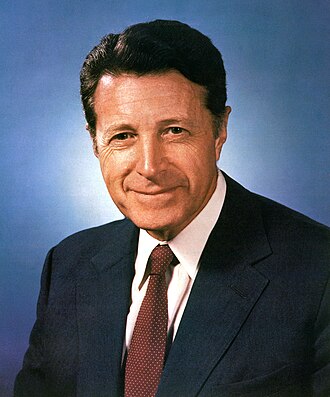
Caspar W. ("Cap") Weinberger served in several key domestic policy roles during the Nixon administration, earning the nickname "Cap the Knife" for his aggressive cost-cutting. During the White House taping period (February 1971 – July 1973), he initially served as Deputy Director of the Office of Management and Budget (OMB) before being promoted to OMB Director in June 1972. In February 1973, Weinberger transitioned to the cabinet as Secretary of Health, Education, and Welfare, a position he held through the remainder of the Nixon administration and into Gerald Ford's presidency.
President Nixon and his Cabinet met to discuss the ongoing military operations in Indochina and the development of the administration's national health reform agenda. Regarding the war, officials reviewed the progress of South Vietnamese incursions into Laos and Cambodia, noting that the strategy was successfully disrupting enemy supply lines while shifting the burden of ground operations away from American forces. The conversation then transitioned to a detailed proposal from Secretary of Health, Education, and Welfare Elliot Richardson regarding healthcare reform, with the group debating the costs, tax implications, and administrative feasibility of implementing Health Maintenance Organizations (HMOs) and national health insurance standards.
President Nixon met with a group of dairy industry representatives to discuss economic concerns regarding milk price supports and industry productivity. The participants, including legal and industry advisors, argued that current production trends were not indicative of a permanent surge and that an increase in price support was necessary for the survival of family-owned dairy farms. Nixon expressed interest in their self-help strategies and the goal of maintaining the economic viability of rural communities while weighing the inflationary risks of price adjustments.
President Nixon and a wide-ranging group of Cabinet members, advisors, and Congressional representatives met to discuss the growing national energy crisis and the necessity of transitioning to nuclear power. AEC Chairman Glenn Seaborg and other experts detailed the technological, environmental, and economic advantages of the liquid metal fast breeder reactor, emphasizing its ability to maximize fuel efficiency and provide long-term, pollution-free energy. The participants concluded that a strong national commitment, including significant federal funding and industry collaboration, is essential to accelerate the development of demonstration reactors and ensure future energy independence.
President Nixon met with members of the President's Commission on School Finance and the President's Panel on Nonpublic Education to discuss the urgent financial crises facing both public and private school systems across the country. The participants examined challenges such as the reliance on property taxes for funding, the decline of parochial school enrollment, and the necessity of maintaining educational quality and equality in inner-city and rural schools. Nixon emphasized the importance of a viable private education sector and tasked the Commission with providing actionable recommendations that focus on systemic reform, local responsibility, and restoring public confidence in the educational system.
President Nixon met with key advisors and congressional leadership to strategize on economic stimulation and political coalition-building. The discussion prioritized directing federal funds and public works projects—particularly in California—to combat unemployment and secure electoral support. Concurrently, Nixon and his aides explored strategies to form a coalition of Republicans and conservative Southern Democrats in Congress to advance key administration goals, including the revival of the Supersonic Transport (SST) program and countering anti-war legislative efforts.
President Nixon met with his Cabinet and key advisors to announce a major breakthrough in Strategic Arms Limitation Talks (SALT) with the Soviet Union, culminating in a joint statement to be released simultaneously in both nations. The agreement establishes a framework to prioritize limiting anti-ballistic missile (ABM) systems while pursuing parallel measures for offensive weapons. Nixon emphasized that the breakthrough was achieved by maintaining a strong U.S. defense posture, and he urged his administration to avoid public speculation or detailed commentary that could complicate sensitive ongoing negotiations.
President Nixon, Vice President Agnew, and a large group of Cabinet members and senior staff met to establish a strategic framework for domestic policy, budget planning for the 1973 fiscal year, and the development of the 1972 Republican legislative and election platform. Participants reviewed polling data regarding national, community, and family concerns, noting that the economy, inflation, and unemployment are primary public priorities while other issues like pollution and consumerism are often driven by media visibility. The President and attendees emphasized the need for better communication to receive credit for administration accomplishments, focusing on a limited number of 'gut issues' rather than overextending on too many programs. Ultimately, the group discussed the necessity of coordinating policy initiatives and messaging to ensure visible progress on key economic and social concerns ahead of the 1972 election.
President Nixon met with his senior staff and Caspar Weinberger to develop a political and economic strategy centered on job creation and tax policy. The discussion focused on leveraging construction projects to stimulate the economy, addressing the regressive nature of property taxes, and crafting a messaging strategy that emphasizes the President's leadership and strength. Nixon directed his team to prioritize projects that provide immediate employment and instructed them to present these efforts as a decisive counter-argument to the spending agendas proposed by Congress.
President Nixon met with his economic and national security advisors to address urgent concerns regarding the federal budget, economic growth, and the size of the government. Seeking to shift toward a balanced budget, Nixon directed his team to pursue aggressive spending cuts, including an across-the-board 10% reduction in federal personnel and significant decreases in defense and intelligence agency staffing. He emphasized that these efforts were essential for restoring confidence in the private sector and demanded a strategic overhaul of mission requirements, particularly within the Department of Defense and the CIA, to eliminate waste and redundant programs.
President Nixon met with his senior staff and economic advisors to review a comprehensive set of domestic policy issues and political strategies ahead of the 1972 election. The participants analyzed regional economic and unemployment data, explored ways to address high inflation and juvenile delinquency, and developed messaging strategies regarding veterans, environmental concerns, and the role of the "liberal establishment." The President emphasized the need for a focused, repetitive, and regionalized public relations approach to regain public confidence and successfully manage the transition from wartime to a peacetime economy.
President Nixon met with his economic advisors, including John Connally and George Shultz, to evaluate a broad range of tax reform initiatives, including a potential Value Added Tax (VAT), property tax relief, and tax simplification. The discussion focused on finding a "bold" and politically viable strategy to replace or augment the existing tax system while addressing revenue needs and economic stimulation. Nixon expressed significant skepticism toward piecemeal social programs like child care deductions, favoring instead a comprehensive structural shift that could appeal to voters and simplify the tax code.
President Nixon consulted with Caspar Weinberger regarding the status of the 1972 federal budget in preparation for an upcoming press conference. Nixon requested a precise calculation of how much Congressional spending had exceeded the administration's proposed budget to anticipate potential media inquiries. The President also briefly directed Weinberger to manage communications with the Secretary of Health to avoid premature or unauthorized public disclosures.
President Nixon and members of the National Security Council met to review the Fiscal Year 1973 defense budget and evaluate U.S. strategic capabilities relative to the USSR. The discussion centered on balancing budgetary constraints with the requirements of the Nixon Doctrine, specifically regarding troop deployments in Europe, East Asia, and the need for flexible "swing forces." The participants assessed the modernization of strategic forces, naval requirements, and the political implications of U.S. military presence abroad in the context of ongoing diplomatic negotiations with China and the Soviet Union.
President Nixon convened a large meeting with Vice President Agnew and his Cabinet to discuss the national economy and the "New Economic Policy" he had announced the previous day. Key topics included the wage-price freeze, import surcharges, tax relief, budget cuts, and the convertibility of the dollar. The administration sought Cabinet support for these initiatives and discussed their potential impact on international trade and domestic employment.
President Nixon, Vice President Agnew, and members of his Cabinet met to coordinate a unified administration strategy ahead of critical International Monetary Fund (IMF) meetings and ongoing global trade negotiations. The discussion emphasized the necessity of maintaining the recently imposed 10% import surcharge and a firm bargaining stance to address the nation's economic balance of payments and reshape the international monetary system. Nixon and his advisors agreed that while foreign partners would likely criticize U.S. policy, maintaining domestic political support and correcting long-standing trade imbalances remained the administration's primary objective.
President Nixon met with his senior advisors to strategize on federal budget planning for fiscal years 1972 and 1973, focusing on controlling expenditures, managing the national economy, and navigating pending legislation such as revenue sharing and welfare reform. A primary objective was to reconcile budgetary constraints with political priorities, including the potential for a veto strategy against unfavorable congressional initiatives. The participants also discussed the necessity of maintaining a strong defense posture, the implications of defense spending on the economy, and the administration's ongoing efforts to resolve the Vietnam War and secure the release of prisoners of war.
President Nixon and his senior advisors, including H. R. Haldeman, Henry Kissinger, and John Connally, met to discuss defense budget strategies, the political fallout from Taiwan's expulsion from the United Nations, and preparations for upcoming foreign diplomacy. Nixon emphasized the need for a leaner, more effective military posture that focuses on strategic procurement rather than broad manpower, while also debating the risks of domestic political opposition and the impact of the defense budget on the economy. The group analyzed the necessity of maintaining a strong defense to bolster negotiating positions with the Soviet Union and China, while also coordinating the administration’s measured public response to the UN vote.
President Nixon met with his budget and domestic policy advisors, including John Ehrlichman and John Mitchell, to evaluate the political and economic feasibility of a proposed Value Added Tax (VAT) as a mechanism to fund public and private education. The primary objectives of the plan were to provide federal relief for local property taxes, address the California Supreme Court’s school funding ruling, and extend aid to parochial schools to appeal to blue-collar Catholic voters. The participants debated the political risks of proposing a new federal tax in an election year versus the potential benefits of offering tangible relief to homeowners and securing support from key constituencies.
President Nixon met with key Congressional leaders and administration officials to address an impending budget crisis caused by the lack of a continuing resolution for several federal agencies, including the OEO, foreign aid, defense, and the District of Columbia. The participants debated the legality of continuing government operations without explicit authorization, with Nixon expressing a firm reluctance to engage in practices he deemed legally questionable. To resolve the standoff before the December 1st pay deadline, the group discussed legislative strategies to expedite authorization bills and tentatively set a target adjournment date of December 4th to allow Congress time to complete essential business.
President Nixon met with George P. Shultz and Caspar Weinberger to finalize the fiscal 1972 and 1973 federal budgets, focusing on managing spending and deficits. A major directive from the President was to reduce the federal civilian workforce, specifically ordering that a significant portion of these cuts be concentrated within the Washington, D.C. bureaucracy. The participants also discussed the political messaging required to frame these economic decisions and touched upon the President's recent television interview regarding foreign policy.
President Nixon recounted an anecdote about Harry Hopkins and the Works Progress Administration to George Shultz and Caspar Weinberger to illustrate his frustration with departmental budget or supply requests. The President used the story, which involved a director being told to have his workers 'lean on each other' rather than receive more shovels, as a directive for Shultz and Weinberger to relay a message of fiscal restraint to Secretary of Defense Melvin Laird. The call served as a lighthearted but firm instruction to curb administrative spending.
President Nixon met with George P. Shultz and Caspar Weinberger to discuss the visibility and media coverage of administration-related films being broadcast in Minnesota. The participants briefly noted the positive impact of this media exposure, though the brief discussion did not result in any formal policy decisions. The exchange functioned primarily as a casual briefing on public relations and ongoing outreach efforts.
President Nixon met with his Vice President and Cabinet to discuss the state of the U.S. economy, the administration's fiscal policy, and the upcoming 1973 budget. Key areas of focus included interpreting unemployment data—specifically the impact of new entrants to the workforce—and managing inflation through Phase II price and wage controls. Nixon urged his department heads to aggressively implement approved spending programs to stimulate the economy, while simultaneously directing them to more effectively communicate and promote the administration's economic achievements and social policy investments to the public.
President Nixon met with a large contingent of Office of Management and Budget (OMB) staff in the Cabinet Room for a ceremony regarding the signing of the Fiscal Year 1973 Budget Message. During the brief visit, the President expressed his appreciation for the intensive labor and dedication the staff contributed to the budgetary process. The discussion focused on acknowledging the team's professional efforts and coordinating the logistics for the formal bill-signing event.
President Nixon met with Vice President Agnew and Republican congressional leaders to discuss strategy regarding his recent speech on Vietnam and the administration's upcoming FY 1973 budget. The President and Henry Kissinger briefed the attendees on the Vietnam peace negotiations, emphasizing that the U.S. had made comprehensive offers while denouncing North Vietnamese intransigence and political maneuvering. Economic advisors, including George Shultz and Herbert Stein, presented the administration's fiscal plans, highlighting the importance of balancing the budget while supporting a transition to a peacetime economy through controlled spending and wage-price stabilization. Participants agreed on the necessity of maintaining a firm stance on defense and economic policy to solidify public support and improve the administration's negotiating leverage.
President Nixon met with his Cabinet and senior staff to debrief them on the results and implications of his recent diplomatic trip to the People's Republic of China. The President emphasized that the primary success of the visit was the establishment of a new communication channel between the two nations, which he argued was essential for managing long-term stability and reducing the potential for future conflict. Nixon shared his impressions of Chinese leadership, particularly his discussions with Chou En-lai, noting the stark ideological differences while highlighting common strategic interests, such as peace in the Pacific and balancing influence against the Soviet Union. The discussion concluded with a focus on how this opening could be leveraged to reshape international relations and manage regional tensions across Asia.
President Nixon met with Donald B. Rice, Caspar Weinberger, and George Shultz to discuss Rice's transition to a new position at the Rand Corporation. Following the personnel discussion, Nixon turned to the ongoing North Vietnamese invasion of South Vietnam, expressing resolve despite the potential impact on his upcoming Soviet summit. He emphasized a firm stance regarding potential retaliatory actions, including a blockade of Hanoi and Haiphong, while criticizing press coverage of the conflict.
President Nixon met with Charles Colson, William P. Rogers, and Caspar Weinberger to discuss strategies for managing the Vietnam War, congressional opposition, and the ITT investigation. A key focus was rallying public and congressional support for the President's military response to the North Vietnamese invasion by framing it as a necessary defense of U.S. troops and national integrity. The group also addressed the need to cut federal subsidies for higher education institutions as a budget austerity measure and considered tactics to discredit Democratic opponents who were viewed as defeatist. Additionally, the President received updates on economic figures and discussed the administration's defensive stance regarding ongoing congressional hearings.
President Nixon directs Office of Management and Budget Director Caspar Weinberger to pursue aggressive budget cuts for higher education subsidies, specifically targeting research funding at institutions like MIT. Nixon argues that these institutions are oversubsidized and advocates for a 'ruthless examination' of federal contracts, proposing that the administration simply refuse to renew them during the upcoming budget cycle. He expresses frustration with resistance from the Department of Health, Education and Welfare and White House staff, insisting that these austerity measures are necessary to control government spending.
President Nixon met with Vice President Agnew, Cabinet members, and senior staff to discuss the administration's recent escalation in Vietnam, specifically the blockade of North Vietnamese ports. The President articulated his rationale for the decision and sought unified support from his team to manage potential congressional and public opposition. He emphasized the necessity of leadership during difficult times and urged his Cabinet to present a cohesive front in defending the policy to the public.
President Nixon met with George Shultz, Caspar Weinberger, and H.R. Haldeman to discuss the immediate aftermath of the attempted assassination of George Wallace and to formalize upcoming cabinet shifts. The group reviewed the details of the shooting and coordinated the administration's public response and schedule. Additionally, Nixon confirmed the appointment of George Shultz as Secretary of the Treasury and Caspar Weinberger as Director of the Office of Management and Budget, emphasizing the necessity of a stringent fiscal policy and budget control.
President Nixon met with his Cabinet and key staff to discuss the upcoming departure of Secretary of the Treasury John B. Connally and to address broader administration matters. The discussion covered the timing of administrative changes, the transition of economic policy responsibilities to George Shultz, and the status of ongoing federal investigations following the recent shooting of George C. Wallace. Connally reflected on his tenure as Treasury Secretary and his future plans, while the President reaffirmed his commitment to his current economic program and leadership agenda.
President Nixon met with H. R. Haldeman, John Connally, George Shultz, Caspar Weinberger, and Ronald Ziegler to coordinate the logistics and press strategy surrounding Connally's resignation as Secretary of the Treasury. The participants discussed handling media inquiries regarding Connally's potential political future, including questions about the Vice Presidency and the Democratic National Convention. Following the discussion, the group planned a walk to the Treasury Department to introduce Shultz to the staff and address the transition publicly.
President Nixon met with Vice President Agnew and key Republican Congressional leaders to coordinate legislative strategy on critical administration priorities, specifically revenue sharing, the defense procurement bill, and Vietnam-related war powers resolutions. The discussion focused on overcoming Democratic resistance to the President’s revenue-sharing program and maintaining a firm legislative stance on maintaining military strength. Nixon emphasized that American foreign policy, including negotiations with the Soviet Union, remains contingent upon the credibility of U.S. defenses and a unified national commitment.
President Nixon met with Vice President Agnew and Republican Congressional leaders to analyze the current political landscape and formulate electoral strategies heading into the 1972 campaign. A significant portion of the discussion focused on the perceived bias of the media in their treatment of Democratic candidate George McGovern compared to historical GOP figures like Barry Goldwater. Nixon encouraged leadership to coordinate closely on legislative and campaign messaging, noting that the Republican party must remain disciplined to capitalize on the internal divisions within the Democratic party.
President Nixon met with his senior advisors and Cabinet members, including Elliot Richardson and Caspar Weinberger, to evaluate the legislative strategy for H.R. 1, the administration's welfare reform bill. The participants debated whether to maintain a firm stance on the original proposal or pursue a compromise with Senator Ribicoff to improve the chances of Senate passage before the Democratic National Convention. Nixon expressed concern that moving toward a compromise might blur the administration's policy distinctions from Democratic nominee George McGovern, while his advisors argued that failing to act could lead to the collapse of the legislation. Ultimately, the President deferred a final decision, requesting further analysis on the political and budgetary implications of the potential concessions.
President Nixon met with his economic advisors, including George P. Shultz, Arthur F. Burns, Caspar Weinberger, and Herbert Stein, to review the status of the U.S. economy, specifically focusing on inflation, unemployment rates, and price stability. The discussion covered the political implications of economic indicators ahead of the 1972 election, particularly regarding potential campaign issues against George McGovern, and touched upon international currency problems and foreign policy matters involving Latin America. The group debated the efficacy of various economic interventions, including wage and price controls and potential actions to address rising meat prices, while weighing the impact of these policies on business and public perception.
President Nixon met with his economic advisors, including George Shultz, Caspar Weinberger, and Herbert Stein, to address public and political concerns regarding rising food and beef prices. The group analyzed potential government interventions, such as suspending import quotas, utilizing government food stockpiles, and the political implications of implementing price controls. Following this, the President consulted with Kermit Gordon regarding the administration's economic policies and engaged in a broader discussion concerning the political orientation of intellectuals and the Brookings Institution.
President Nixon met with his economic and policy advisors, including George P. Shultz, Herbert Stein, and John D. Ehrlichman, to deliberate on fiscal strategy, federal spending constraints, and the administration's legislative priorities. The discussion focused on managing the federal budget for fiscal years 1973 through 1975, specifically addressing inflation, revenue sharing, welfare reform, and potential veto strategies to control congressional expenditures. The participants also explored the political ramifications of proposed spending cuts and tax policy adjustments ahead of the upcoming election cycle.
President Nixon met with the Cost of Living Council to address surging food and meat prices, emphasizing the need to combat inflation without imposing direct price controls. The discussion focused on managing supply-side pressures, including reduced military food stockpiles and potential adjustments to meat import policies, while coordinating a "jawboning" strategy to encourage price restraint among industry leaders and labor unions. Nixon urged the council to publicly highlight the administration's commitment to fighting inflation while cautioning against speculating on a price freeze, which he warned would destabilize the market.
President Nixon consulted with OMB Director Caspar Weinberger regarding fiscal constraints and legislative strategies. The President directed a reduction in the public broadcasting budget request from $45 million to previous levels, overriding potential objections from staff like Peter Flanigan. Additionally, they discussed the possibility of vetoing a Social Security bill due to a $3 billion amendment, with Nixon instructing Weinberger to coordinate with Clark MacGregor and George Shultz on the administration's opposition.
President Nixon met with H.R. Haldeman, Richard Kleindienst, and Caspar Weinberger to address a wide-ranging agenda including Social Security legislation, death penalty policy following Supreme Court rulings, and security preparations for the upcoming national political conventions. The discussion also covered the health of George C. Wallace and administrative personnel matters. Finally, the group engaged in a detailed dialogue regarding the burgeoning Watergate investigation, specifically focusing on the contents of E. Howard Hunt’s safe, FBI involvement, and potential strategies to manage the political fallout and legal ramifications of the break-in.
President Nixon met with Charles Colson, Ronald Ziegler, Caspar Weinberger, and others to strategize on administration policy, political messaging, and pending legislation. The conversation focused on managing the political optics of Social Security increases and federal budget cuts, as well as coordinating a firm stance on Vietnam peace negotiations and prisoners of war. Nixon directed his team to emphasize that any increased federal spending must be balanced by tax increases, and he instructed staff to challenge negative media coverage, particularly regarding Vietnam and administrative integrity.
President Nixon met with his Cabinet and senior staff to discuss strategies for achieving a balanced federal budget by 1975, emphasizing the necessity of immediate spending cuts and potential vetoes of congressional legislation to curb inflation. Budget Director George Shultz outlined the administration’s plan to issue "ceiling letters" to agency heads to enforce strict fiscal guidelines and reduce government deficits. The participants also reviewed recent positive economic indicators, including growth in the Gross National Product and declining unemployment, while noting that the public generally views government spending as a primary driver of inflation.
President Nixon met with his economic advisors and key staff, including George Shultz, Caspar Weinberger, Herbert Stein, H.R. Haldeman, and John Ehrlichman, to refine the administration's public relations strategy regarding the economy ahead of the 1972 election. The group evaluated the political impact of inflation, unemployment, and food prices, concluding that the public primarily associated rising food costs with processors and middlemen rather than the administration. Nixon directed his team to avoid getting bogged down in minor press interviews and instead focus their efforts on high-impact television appearances and providing economic talking points for political surrogates to utilize in their campaigns.
President Nixon met with a large group of Republican Congressional leaders to coordinate legislative strategy and discuss the administration's economic record ahead of the upcoming election. The conversation focused on countering Senator George McGovern's economic proposals, with the President and his advisors emphasizing that the administration's policies had fostered recovery, reduced inflation, and increased civilian employment. Key action items included distributing briefing materials to counter Democratic attacks, pushing for a government spending ceiling to avoid future tax increases, and planning strategy for upcoming votes on controversial appropriation bills and foreign aid legislation.
President Nixon met with the Cost of Living Council to review the performance of his administration's economic stabilization program, including successes in lowering inflation and fostering rapid economic growth. The discussion emphasized the necessity of maintaining fiscal discipline through a proposed $250 billion federal spending ceiling to prevent future inflationary pressure. Participants also addressed specific challenges, particularly rising food prices and the potential impact of government spending on tax rates, while strategizing on how to communicate these economic gains to the public ahead of the election.
President Nixon met with Vice President Agnew and Republican Congressional leaders to coordinate legislative strategy ahead of the upcoming election, specifically focusing on the status of pending bills and the management of the Congressional schedule. Key priorities included securing a federal spending ceiling, advancing revenue sharing, and emphasizing anti-busing legislation as a must-pass measure to counter Democratic-led policies. The President urged the leadership to maintain a unified front on fiscal restraint, framing opposition to Republican economic proposals as reckless and warning that Democrats should bear the political cost for failing to curb government spending.
President Nixon met with the Council on International Economic Policy and senior advisors to discuss U.S. trade relations with an expanding European Community. The group debated four strategic options ranging from maintaining the status quo to aggressive confrontation, with the President ultimately directing that the administration maintain a firm, "tough" stance while avoiding specific, provocative threats until after the upcoming election. Nixon emphasized that trade policy should not be viewed in isolation but as a component of a broader strategy concerning global power balances and U.S. national security commitments in Europe.
President Nixon met with his administration officials, including Elliot Richardson and John Ehrlichman, to discuss the political feasibility of passing welfare reform (H.R. 1) before the 1972 election. Given the lack of time and the potential for a hostile or obstructionist legislative environment, the participants concluded that passing a comprehensive welfare bill was unlikely and that aggressive pressure on Congress would be counterproductive. Nixon decided that the administration should maintain its formal support for H.R. 1 while simultaneously pivoting to a strategy of aiming for a decisive election mandate, intending to reintroduce the reform package in the next Congress under more favorable conditions.
President Nixon met with the Cost of Living Council to review the administration’s economic performance and coordinate strategy regarding inflation, labor relations, and food prices ahead of the 1972 election. Council members, including George Shultz and Donald Rumsfeld, discussed measures to protect Social Security recipients from illegal rent increases and highlighted the relative success of U.S. wage and price controls compared to foreign nations. The President directed his team to maintain an affirmative, disciplined public messaging campaign, emphasizing that the U.S. was achieving growth and reduced inflation without the reliance on wartime spending seen in the 1960s.
President Nixon met with Republican Congressional leaders to discuss the critical need for a $250 billion federal spending ceiling to combat inflation and prevent the necessity of tax increases. The participants strategized on how to manage the upcoming House vote on HR 16810, expressing concern that Democratic leadership was pushing irresponsible, expansive spending bills—including massive social welfare and Social Security packages—that threatened the administration's fiscal goals. The President emphasized that passing the spending cap was a vital political and economic tool to hold Congress accountable and establish a framework for the 1974 budget, while also providing leverage for future presidential vetoes.
President Nixon met with his economic advisors and staff, including George Shultz, Arthur Burns, and Caspar Weinberger, to coordinate administration messaging and planning for the post-election period. The discussion focused on maintaining a firm stance on congressional spending, specifically concerning upcoming vetoes of water and education legislation, and establishing a strategy for economic policy, including the transition of wage and price controls. Nixon emphasized the need for long-term domestic initiatives and urged his team to use the post-election period for deep reflection and strategic planning rather than immediate political reaction.
President Nixon met with his economic advisors and Republican Senate leadership to coordinate a strategy for securing congressional support for a federal spending ceiling. The discussion focused on the necessity of controlling runaway federal expenditures and the potential use of the presidential veto to enforce a $250 billion spending limit. Nixon and his team evaluated the legislative outlook for the debt limit bill, including strategies for handling amendments and managing potential political fallout regarding domestic programs.
In this meeting, President Nixon met with his Vice President, Cabinet, and senior staff to provide a briefing on the impending Vietnam cease-fire agreement, scheduled for signing on January 27, 1973. National Security Advisor Henry Kissinger detailed the arduous negotiation process, emphasizing that the agreement achieved key U.S. objectives including the return of POWs, the withdrawal of American forces, and the right of South Vietnamese self-determination. Following the Vietnam discussion, the President transitioned to a briefing on the fiscal year 1974 budget, where Director Caspar Weinberger presented plans for spending cuts and program terminations designed to maintain a full-employment balance and avoid tax increases.
President Nixon met with his Vice President, Cabinet members, and senior staff to conduct a briefing on the upcoming federal budget. The discussion focused on the necessity of fiscal restraint, including the reduction and termination of certain government programs, to avoid tax increases and curb inflationary pressures while maintaining an expanding economy. Cabinet members analyzed projections for the 1974 and 1975 budgets, emphasizing the shift in spending priorities from defense toward human resources and the importance of presenting the budget to Congress and the public as a responsible alternative to higher taxation.
President Nixon and his Cabinet members strategized on how to promote the administration’s 1974 budget and defend proposed spending cuts against inevitable Congressional and lobbying opposition. The participants emphasized shifting from a constituency-based political strategy to a national message centered on fiscal responsibility, specifically using the themes of 'jobs' and 'taxes' to appeal to working-class voters. Nixon underscored the necessity of forcing Congress to accept accountability for spending, ultimately positioning the administration to blame Democrats if tax increases become required to fund legislative priorities.
President Nixon met with Republican congressional leadership to outline his fiscal strategy for the 1974 budget, emphasizing the necessity of expenditure control to avoid tax increases and curb inflation. Nixon and his advisors discussed the use of budget impoundments to maintain a spending ceiling of $269 billion, framing this approach as a critical move for economic prosperity despite the anticipated pushback from special interest groups. The meeting concluded with a call for Republican leaders to unify behind the administration's fiscal restraint and to clearly communicate that budget cuts are essential for maintaining national economic stability.
President Nixon met with Vice President Agnew and a broad bipartisan group of Congressional leaders to outline the administration's 1974 federal budget and economic strategy. Economic advisors Herbert Stein and George Shultz presented data highlighting a strong 1972 economy and stressed the necessity of fiscal discipline to curb inflation and maintain growth. The President urged Congress to support his proposed spending ceilings, emphasizing the need to avoid the inflationary deficits experienced during the late 1960s, while briefly acknowledging progress toward a Vietnam peace settlement.
President Nixon met with bipartisan Congressional leaders, cabinet members, and staff to outline the administration’s strategy for the 1973 and 1974 federal budgets, emphasizing a commitment to avoiding tax increases. The President defended his use of impoundment to control spending and curb inflation, arguing that Congress must share the responsibility of fiscal discipline or face the political consequences of tax hikes. The discussion also addressed the economic impact of the Vietnam cease-fire, defense budget priorities, and the need for greater cooperation between the executive and legislative branches to manage spending levels.
President Nixon held a ceremonial gathering in the Cabinet Room with key staff from the Office of Management and Budget and the Department of Health, Education, and Welfare to sign the 1974 Budget Message. The meeting served primarily as an opportunity for the President to acknowledge the career civil servants in attendance, noting their years of service and the vital role they played in federal operations. Nixon shared lighthearted personal anecdotes about his own early work experience while distributing souvenir pens to those involved in the budget's development.
President Nixon met with key officials, including Earl Butz, James Lynn, Caspar Weinberger, and John Ehrlichman, to coordinate administration policy on housing, welfare reform, and government reorganization. The discussion focused on addressing the ineffectiveness of subsidized housing programs, the potential for a housing moratorium, and the need to craft a cohesive legislative agenda before the upcoming Congressional recess. Nixon emphasized the importance of presenting an aggressive, bipartisan posture to Congress and strategically managing Cabinet relations to ensure unified messaging on domestic policy.
President Nixon met with Vice President Agnew, Cabinet members, and key staff to discuss recent foreign policy developments and economic strategy. Vice President Agnew briefed the group on his recent tour of Southeast Asian nations, while Treasury officials and Cabinet members deliberated on international monetary policy, trade barriers, and the need for a more competitive U.S. industrial posture. The President emphasized the importance of maintaining international engagement, securing legislative tools for trade negotiations, and justifying reconstruction aid for Vietnam as a strategic security necessity rather than purely humanitarian relief.
President Nixon met with his Cabinet and staff to discuss legislative strategy, specifically focusing on overcoming congressional opposition to his budget cuts and vetoes. The group evaluated the political risks of opposing rural and urban programs, concluding that the administration must move away from defensive justifications and instead leverage secondary advocacy from business groups and local organizations to pressure Congress. Nixon also emphasized the need to prioritize House support over the Senate, as he deemed the latter uncooperative and inefficient, and discussed long-term political planning for the 1974 midterm elections.
President Nixon and his Cabinet met to launch a strategic public relations campaign, titled the Presidential Spokesmen program, aimed at pressuring Congress to support his budget priorities and oppose spending-heavy legislation. Nixon urged his officials to frame the budget debate not as a constitutional conflict, but as a direct choice between the economic interests of the 'New American Majority' and the fiscal irresponsibility of the opposition. The session included briefings on foreign policy, defense spending, and law enforcement, emphasizing the need for administration spokesmen to maintain a positive, disciplined narrative while avoiding defensive posturing on 'false issues.'
President Nixon hosted the recipients of the 1972 Management Improvement Award in the Cabinet Room to coordinate the logistics for a formal ceremony. Brian Usilaner facilitated a briefing for award winners and cabinet members, including William P. Rogers and Caspar Weinberger, to establish the specific order of presentation and photography arrangements. The session focused on streamlining the proceedings to manage the large group effectively while ensuring individual recognition for the agency and department representatives.
President Nixon held a ceremony in the Oval Office to present awards to various federal employees and government agency representatives for their public service. Accompanied by H. R. Haldeman and several cabinet members, the President recognized individuals from departments including Agriculture, Treasury, Defense, and the Atomic Energy Commission. During his remarks, Nixon praised the recipients for prioritizing public service over private financial gain, emphasizing that the intrinsic rewards of their work provided a satisfaction that private enterprise could not match.
President Nixon met with representatives from Alcoholics Anonymous (AA), including Tom Pike and Caspar Weinberger, to accept a ceremonial gift of the organization's one-millionth published book. The participants discussed the organization’s redemptive work, the prevalence of alcoholism in various sectors of society and the military, and the importance of recovery efforts. During the exchange, Nixon shared his own personal habits, emphasizing that he abstains from alcohol before public speaking or major responsibilities to maintain peak performance.
President Nixon met with his Cabinet and key staff to coordinate messaging and strategy on pressing administration priorities, specifically energy policy, economic inflation, and the ongoing Watergate investigations. Nixon urged his officials to actively support the administration's legislative agenda, particularly in the face of rising economic concerns and energy supply challenges. He emphasized the necessity of a unified, firm stance against political pressure, framing the current crises as manageable problems rather than catastrophic failures. Additionally, Nixon underscored his commitment to a thorough investigation into Watergate, stressing the need to maintain public order and confidence while the legal process unfolded.
In this meeting, President Nixon addressed his Cabinet and senior staff regarding the recent departures of top aides H.R. Haldeman and John Ehrlichman, framing the transition as a necessary move to restore stability amidst the escalating Watergate investigation. Nixon emphasized the importance of maintaining public trust, directed the staff to cooperate fully with investigators, and insisted that the White House avoid any appearance of a cover-up. Cabinet members and staff discussed the administration’s focus on governance, foreign policy, and economic management, reaffirming their collective commitment to the President's agenda despite the political crisis.
President Nixon and Vice President Agnew met with the Cabinet and senior staff to discuss major foreign and domestic policy priorities and internal administration management. The discussion centered on upcoming diplomatic summits with Leonid Brezhnev and Georges Pompidou, negotiations with North Vietnam regarding the ceasefire, and economic challenges including inflation and energy policy. Additionally, General Alexander Haig briefed the Cabinet on the administration's efforts to stabilize internal governance, improve relations with Congress, and manage the ongoing political fallout from the Watergate scandal.
President Nixon met with Secretary of Health, Education, and Welfare Caspar Weinberger and other officials to introduce Dr. Robert S. Stone as the new leader of the National Institutes of Health (NIH). Nixon emphasized his expectation that Stone would prioritize research results, impose greater managerial accountability, and avoid political distractions within the agency. Additionally, the group discussed the Fiscal Year 1974 budget, specifically focusing on legislative strategy for education funding and the political challenges of securing revenue sharing in Congress.
President Nixon met with his Cabinet and key legislative leaders to discuss the restructuring of domestic policy operations, the appointment of Clarence M. Kelley as FBI Director, and strategies for improving congressional cooperation. Nixon emphasized a team-based approach to policy formulation, delegating significant oversight to Mel Laird, and urged Cabinet members to actively engage with Congress to pass the administration's legislative agenda. The discussion also addressed the administration's response to inflation, the importance of maintaining public morale amidst the Watergate crisis, and the necessity of presenting a unified, forward-looking policy front to the American people.
President Nixon met with his Vice President, Cabinet members, and senior staff to announce the implementation of a 60-day price freeze as part of a strategy to combat inflation. He explained that this measure, aimed at stabilizing food and gasoline prices, was a necessary pragmatic step to preempt more extreme, mandatory controls favored by Congress. Nixon emphasized his commitment to maintaining a free-market economy and tasked his Cabinet with actively promoting this policy to the public and opinion makers. He also highlighted the administration's broader accomplishments in foreign policy, including the end of the draft and the upcoming U.S.-Soviet summit.
President Nixon met with Vice President Agnew and his Cabinet to discuss the transition from the current wage and price freeze to a "Phase IV" economic policy. The President emphasized the need to balance controlling inflation with maintaining domestic production, while acknowledging the political difficulty of removing controls due to congressional and public pressure. Key developments included the administration's resolve to move toward a free-market economy as quickly as possible, coupled with a renewed commitment to fiscal austerity and a balanced federal budget to bolster economic confidence.