Nixon, Richard M. (President)
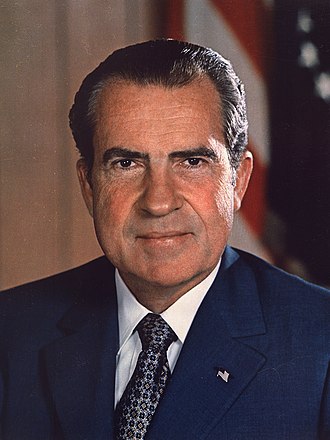
Richard M. Nixon served as the 37th President of the United States from January 1969 until his resignation in August 1974. In February 1971, he ordered the installation of a secret voice-activated taping system in the White House to preserve a historical record of his administration. Until the system's existence was revealed and dismantled in July 1973, the tapes captured Nixon directing major foreign policy initiatives, such as the opening to China, as well as his central role in the Watergate cover-up.
What Nixon talks about on the tapes
White House operations 4,718Presidential scheduling 2,225Public relations 1,784Presidential schedule 1,782Vietnam War 1,693Logistics 1,650Manolo Sanchez 1,626White House communications 1,400White House administration 1,399Presidential communication 1,243Henry Kissinger 1,191Foreign Policy 1,183
Conversations (21,010)
— Page 172 of 211President Nixon and Stephen B. Bull coordinate the President's upcoming schedule to ensure sufficient time for administrative tasks. The President directs Bull to clear his agenda for the following Monday to prioritize paperwork. This conversation serves as a logistical planning session to optimize the President's availability for internal work.
President Nixon met briefly with his personal aide, Stephen B. Bull, to discuss administrative logistics. The conversation, which lasted only one minute, focused on confirming the feasibility of a specific, albeit unidentified, task or arrangement. No major policy shifts or substantive executive decisions were recorded during this brief administrative exchange.
President Nixon instructed the White House operator to place an outgoing call to Press Secretary Ronald L. Ziegler. This brief administrative interaction served as a logistical step to facilitate direct communication between the President and his primary spokesperson. No further substantive policy matters were addressed during this short exchange.
President Nixon initiated a brief communication with the White House operator to facilitate an outgoing call. The interaction served as a routine administrative request to connect the President to another party. No substantive policy discussions or significant political developments occurred during this short exchange.
President Nixon and Press Secretary Ronald Ziegler consulted on anticipated questions for an upcoming press conference. They discussed strategies for addressing concerns regarding potential concessions in the Vietnam settlement, the status of the cease-fire, and the role of U.S. influence. Additionally, they identified likely inquiries regarding the Middle East, rising food prices, and the ongoing Watergate investigations involving L. Patrick Gray III. Nixon instructed Ziegler to prepare a prioritized list of these topics for his final review.
President Nixon and Press Secretary Ronald Ziegler met briefly in the Old Executive Office Building to discuss an unspecified, time-sensitive matter. The dialogue suggests a request for Ziegler to prepare and submit written questions for the President's review. This exchange reflects the routine administrative coordination between the President and his press secretary regarding upcoming communications or briefings.
President Nixon and H.R. Haldeman briefly met to discuss upcoming scheduling requirements and the status of the President's dictation process. During the exchange, they addressed technical difficulties regarding a malfunctioning dictation machine. The meeting concluded as they prepared to transition to the President's next scheduled engagement.
President Nixon met with his personal valet, Manolo Sanchez, in the Old Executive Office Building. The brief interaction focused on the provision of refreshments. No significant policy decisions or substantive political developments were recorded during the exchange.
President Richard Nixon met with his personal valet, Manolo Sanchez, in the Old Executive Office Building. The brief interaction focused on the service of coffee and light refreshments. No significant policy discussions or administrative decisions were recorded during this informal engagement.
President Nixon met with H.R. Haldeman and other staff members to review a wide range of personnel appointments, administrative reorganizations, and ongoing crises. The discussion covered potential candidates for posts at the Departments of Commerce and the Treasury, the Veterans Administration, and the Arms Control and Disarmament Agency, while also addressing political concerns regarding the Wounded Knee occupation and press strategy for the Watergate investigation. Nixon and Haldeman also engaged in a detailed assessment of the U.S. Secret Service, expressing significant dissatisfaction with current leadership and the professional conduct of agents, ultimately planning a management shakeup to improve the agency's discipline and loyalty.
President Nixon, H. R. Haldeman, Kenneth Cole, and Ronald Ziegler discussed administrative reactions to the ongoing occupation at Wounded Knee and the handling of the Watergate investigation. Cole clarified that the White House was distancing itself from direct management of the Wounded Knee standoff, deferring tactical control to the Justice Department and John Whitaker while maintaining a hardline stance against amnesty for the protesters until hostages are released. Additionally, the participants reviewed the status of the FBI’s Watergate inquiry and the impact of L. Patrick Gray’s testimony. Cole was tasked with providing a follow-up status report on the Bureau of Indian Affairs by the following morning.
President Nixon met with his aide Stephen B. Bull in the Oval Office to coordinate the President's upcoming schedule. The discussion focused on facilitating a meeting between Nixon and Press Secretary Ronald L. Ziegler. Bull promptly exited the office following these brief administrative instructions.
President Nixon contacted the White House operator to facilitate a telephone connection with his special consultant and speechwriter, Patrick J. Buchanan. This brief exchange served as a routine administrative request to initiate official communication between the President and a key staff member. No substantive policy matters were discussed during this initial connection phase.
President Nixon consulted with the White House operator to facilitate an outgoing call. This brief interaction served as a routine administrative step to connect the President with a specific party. No substantive policy matters or political developments were discussed during this exchange.
President Nixon and Patrick J. Buchanan coordinate preparations for an upcoming press conference by reviewing potential questions and developing strategic responses. They discuss handling sensitive political topics, including the monetary crisis, the Wounded Knee occupation, campaign fundraising controversies, and inquiries stemming from L. Patrick Gray’s ongoing FBI testimony regarding Watergate. The President decides to adopt a non-committal stance on active investigations, specifically regarding the Watergate and Gray hearings, to avoid prematurely addressing evolving controversies.
President Nixon met with Secretary of Labor Peter J. Brennan to discuss current political optics and personnel management strategies. The dialogue centered on the administration's approach to labor and economic leaders, specifically regarding the handling of individuals like Shelton and the broader implications of currency fluctuations. The discussion concluded with the President indicating a relaxed stance toward certain administrative staffers, suggesting a desire to move past recent controversies.
President Nixon held a brief meeting in the Old Executive Office Building with an unidentified individual. The recording consists entirely of an unintelligible, brief exchange, preventing the identification of any specific policy topics or administrative decisions. Consequently, no substantive outcomes or action items were captured during this three-minute interval.
President Nixon contacted the White House operator to place an outgoing call. The brief interaction served as a logistical step to connect the President with another party. No substantive policy discussions or administrative decisions occurred during this exchange.
President Nixon instructed the White House operator to place an outgoing telephone call to Kenneth R. Cole, Jr., who served as the Deputy Assistant to the President for Domestic Affairs. This brief administrative interaction served as a logistical step to facilitate direct communication between the President and a key staff member. No further substantive discussion or policy decisions were recorded during this brief connection.
President Nixon and Kenneth R. Cole, Jr. discuss strategies for addressing partisan opposition from state governors regarding special revenue sharing and potential press messaging. They evaluate the likelihood of Congress overriding presidential vetoes on various spending bills, including rural water, sewer grants, and vocational rehabilitation legislation. Nixon acknowledges the political difficulty in blocking popular spending programs while focusing on identifying bills where the administration can successfully sustain a veto, such as the Rural Electrification Administration bill.
President Nixon and Kenneth R. Cole, Jr. discuss how the administration should respond to inquiries regarding state revenue sharing and a specific story involving a governor's office. Cole seeks guidance on addressing concerns from state and city officials who remain uneasy despite federal assurances. The two agree to maintain the official stance that the administration expects to proceed with special and general revenue sharing programs.
President Nixon and Henry Kissinger met to discuss the status of Vietnam cease-fire negotiations, the upcoming release of prisoners of war (POWs), and preparations for the President's press conference. They analyzed international geopolitical trends, including the impact of foreign elections and historical lessons from the Versailles Treaty on modern power dynamics. During the meeting, Ronald Ziegler joined to coordinate messaging for the press, while administrative discussions regarding ambassadorial appointments were also addressed.
President Nixon and Henry Kissinger met to discuss the status and timing of the upcoming release of prisoners of war (POWs) held by the Vietcong. The President sought confirmation on whether the administration should maintain the March 4th deadline for these releases. They reviewed intelligence and expected timelines to ensure the North Vietnamese and Vietcong would adhere to the established schedule.
President Nixon held a brief, informal meeting with an unidentified individual in the Executive Office Building while refreshments were served. Due to the lack of a transcript and the absence of specific recorded dialogue, the substantive purpose and agenda of the encounter remain historically undocumented. The meeting concluded before 11:00 am without any publicly identifiable policy outcomes or directives.
President Nixon, along with Ronald Ziegler and Henry Kissinger, discussed strategy for an upcoming press conference, focusing on how to address questions regarding Watergate, specifically John Dean's role, Donald Segretti, and Maurice Stans, with a plan to refer inquiries about the Committee to Re-elect the President to that organization. They also touched upon the Khartoum hostage incident and the upcoming visit of President Thieu, as well as the release of POWs.
President Nixon and Press Secretary Ronald Ziegler briefly discussed the upcoming presidential press conference. Their conversation focused on potential questions, with a specific mention of Frank Cormier. The meeting was very short, with Ziegler departing after only a few minutes.
President Nixon contacted the White House operator to facilitate two urgent phone connections. He requested to reach George T. Bell, noting his location at the hospital, as well as former White House staffer Richard V. Allen. The operator acknowledged these instructions to initiate the calls on the President's behalf.
President Nixon attempted to reach George T. Bell via telephone, but the connection was unsuccessful due to Bell's declining health. The White House operator relayed information from Bell’s nurse, explaining that Bell was too weak to participate in a conversation. Nixon acknowledged the situation and accepted that a call would not be possible at that time.
President Nixon contacted the White House operator to request assistance in reaching two individuals: George Bell and Richard Allen. The President inquired about George Bell's whereabouts, learning he was at a hospital. The primary purpose of this call was to initiate contact with these individuals, though the specific reason for the calls was not detailed in the transcript.
President Nixon and Stephen B. Bull briefly discussed upcoming White House social affairs, specifically reviewing invitations and guest lists. They also touched upon the President's schedule, including arrangements for photographs and introductions. The conversation appears to be a quick check-in on administrative details related to presidential events and personnel.
This brief exchange occurred between President Nixon and the White House operator in the Oval Office. The primary purpose appears to be a routine operational matter, likely involving a phone connection or request. No significant policy discussions or decisions were recorded.
President Nixon briefly discussed a table in the residence with an unidentified individual in the Oval Office. The purpose and specific details of the table's relevance were not discernible from the limited transcript. The meeting was very short, concluding with the unknown person's departure.
President Nixon called Margeret Armiger to convey his well wishes and professional praise for George T. Bell, who was currently facing health challenges. The President expressed his admiration for Bell's effectiveness and resilience, requesting that Armiger relay these sentiments to him. This brief exchange served as a morale-boosting gesture from the President to a valued associate.
President Nixon briefly spoke with Margaret Armiger in the Oval Office. The conversation appears to be a very short, informal exchange, possibly a farewell or well-wishing, with no substantive policy discussions or decisions recorded.
President Nixon, along with Ronald Ziegler and Rose Mary Woods, discussed strategies for an upcoming press conference, including potential questions and answers regarding Nguyen Van Thieu, economic devaluation, and aid to North Vietnam. They also deliberated on the distribution of "appreciation" gifts to political supporters and White House staff, detailing costs and recipients. Additionally, the conversation touched upon White House social events, specifically a dinner for Golda Meir and the performance of Van Cliburn, as well as press relations and public relations matters.
President Nixon and his wife Pat met with representatives from the American Heart Association, including Dr. Paul Yu, Richard Ross, and James Cavanaugh, for a "Heart of the Year" award presentation. The discussion focused on the AHA's work, the impact of heart attacks on presidents like Eisenhower and Johnson, and Mrs. Nixon's advocacy. The meeting included a photograph session and the presentation of gifts, emphasizing the possibility of recovery and a useful life after a heart attack.
President Nixon met briefly with Paul Findley in the Oval Office. The purpose of the meeting appears to have been Findley's arrival and a brief interaction before he departed. Helmut Sonnenfeldt was also mentioned as being present or involved. The conversation was very short and contained no substantive discussion of policy or action items.
President Nixon briefly reviewed his upcoming schedule, which included receiving diplomatic credentials and having lunch in the Lincoln Room. The conversation was very short, with the President indicating he would change his suit and likely have lunch.
President Nixon briefly met with an unidentified man in the Oval Office. The conversation, lasting approximately ten minutes, concerned the arrival and departure of Paul Findley. No significant decisions or action items were recorded.
President Nixon met with Congressman Paul Findley and advisors Richard Cook and Helmut Sonnenfeldt to discuss a resolution on Atlantic Union. Nixon expressed his support for the principle of Atlantic Union but was hesitant to publicly endorse the specific resolution due to potential complications with ongoing European security conferences and trade negotiations. He agreed to provide a letter for Findley to use, expressing his support for the goal without becoming an active advocate, similar to his stance on the Equal Rights Amendment. The conversation also touched upon legislative challenges, including veto overrides and congressional relations.
President Nixon, Stephen Bull, and Rose Mary Woods briefly discussed an individual named Mark Goode, who was apparently undertaking a special assignment and had some "Russian warrants" related to his station. The conversation also touched upon the spelling of Goode's name and a message from the President. Rose Mary Woods' entry into the meeting was noted, along with a mention of diplomatic credentials presentation and a separate meeting with Goode.
President Nixon met briefly with Mark I. Goode, his wife, and two daughters, along with Stephen Bull, for a photo opportunity. The meeting was primarily for taking pictures, including one of the President with Mark Goode and his family, and arrangements were made for copies of these photographs. Nixon expressed appreciation for Goode's work with the White House.
President Nixon, H.R. Haldeman, and Stephen Bull discussed various personnel appointments and foreign policy matters. Key topics included the selection of an ambassador to Israel, with Kenneth Keating being considered despite age concerns, and the potential implications for Rockefeller's support. They also addressed ongoing financial activities related to the Watergate investigation, specifically how funds were being managed and distributed to defendants. Additionally, the conversation touched upon congressional relations, including invitations for lawmakers to travel abroad and the handling of diplomatic protocol for visiting dignitaries.
President Nixon briefly met with an unidentified man in the Oval Office. The primary purpose of the meeting was to discuss the order of diplomatic credentials ceremonies for Malaysia, Mauritania, Iceland, Guyana, and Paraguay. The unknown man departed shortly after the discussion.
President Nixon briefly met with Stephen Bull and later with Manolo Sanchez in the Oval Office. The conversation touched upon the expected duration of a meeting with John M. Olin, with Olin reportedly stating he only needed 50 seconds. Bull also mentioned an item for the residence.
President Nixon met with John M. Olin and Manolo Sanchez in the Oval Office to discuss Olin's long-standing support for the President, including his views on the Vietnam War bombing campaign and POWs. They also covered international trade, specifically Olin Corporation's potential dealings with the USSR and China regarding agricultural developments, and the critical issue of Atlantic salmon conservation, with Olin expressing concern over Danish and Greenlandic fishing practices. A significant portion of the conversation focused on President Nixon's opposition to proposed capital gains and estate taxes, which he believed would harm entrepreneurship and family wealth.
President Nixon met with Stephen B. Bull in the Oval Office to discuss the arrival of departing subcabinet members for an "open door hour." The conversation was brief, with Bull confirming the arrival of the individuals before departing himself.
President Nixon met with Treasury Secretary Edwin Cohen and his wife, along with Stephen Bull, to discuss Cohen's recent minor surgery and his impending departure from his government position. The President expressed his appreciation for Cohen's service and advised him to pursue lucrative opportunities in the private sector, referencing advice from George Shultz. A photograph was taken to commemorate Cohen's time in service.
President Nixon met with Harold and Mrs. Finger in the Oval Office to discuss Finger's upcoming move to a new job with General Electric. The conversation touched upon Finger's distinguished career in government, including his time at NASA and the Atomic Energy Commission, and the President expressed his appreciation for Finger's service and performance. They also discussed the importance of cross-fertilization between government and private industry, with Finger's new role involving the establishment of an energy systems center in Washington.
President Nixon met with Stephen Bull and Mr. and Mrs. Robert C. Moot to take photographs and express his appreciation for their service. The conversation touched upon Moot's new job, a significant challenge, and Nixon's acquaintance with Roger Lewis, who attended Stanford University with David Packard. The meeting concluded with the departure of the Moots.
President Nixon met with Mr. and Mrs. Richard F. Schubert and Stephen B. Bull to express his appreciation for Schubert's service and discuss his future employment. The conversation touched upon Schubert's new job with Bethlehem Steel in Pennsylvania, including its location and duties. A photograph was taken during the meeting.
President Nixon met with Charles L. Ill and Stephen B. Bull to discuss Ill’s past service during the 1968 campaign and his recent tenure working with the Navy. Ill expressed frustration regarding his forced resignation and the lack of clarity surrounding his dismissal despite his prior dedication to the administration. The conversation served as a professional exit for Ill, with the President acknowledging his frank feedback regarding personnel changes and administration staffing challenges.
President Nixon met with Samuel Jackson and his wife to discuss Jackson’s transition from his role in the administration back into private legal practice. The President expressed his appreciation for Jackson’s service and performance while reflecting on the professional opportunities awaiting him at a prestigious law firm. The conversation concluded with Nixon affirming that Jackson’s tenure in the administration provided him with valuable experience for his upcoming partnership.
President Nixon met with Spencer Schedler and his wife, accompanied by Stephen Bull, to formally express his appreciation for Schedler's past contributions to the administration and the 1968 campaign. The discussion touched upon Schedler's potential for future government service and his connections to prominent supporters like John Ruan. The meeting concluded with a photo opportunity to commemorate the visit and acknowledge Schedler's ongoing commitment to the President.
President Nixon met with Richard and Mrs. Melich, accompanied by Stephen B. Bull, for a social visit in the Oval Office. The conversation focused on the Melichs' travels to Yugoslavia, the USSR, and Sweden, as well as their long-standing history of supporting the Republican Party at national conventions since 1952. The group also discussed family backgrounds, including the Melichs' ancestral ties to the Mormon faith and the naming of their child after the President.
President Nixon met with Carlos C. Villarreal and his wife, along with aide Stephen B. Bull, to discuss potential new employment opportunities for Villarreal within the administration. The conversation focused on evaluating two Washington-based positions: Assistant Secretary of the Navy and a role within the Agency for International Development (AID). Nixon encouraged Villarreal to pursue the Navy position, specifically suggesting he coordinate an interview with Secretary of the Navy John W. Warner.
President Nixon met with James M. Beggs and his wife to discuss Beggs's tenure at the Department of Transportation and his future career prospects. The President expressed appreciation for Beggs's work under former Secretary John A. Volpe while acknowledging the immense difficulty of the department's mission. The conversation concluded with Nixon advising Beggs on potential private sector opportunities in California, specifically praising the management quality of the Howard Hughes organization.
President Nixon met with Laurence H. Silberman and his wife to formally bid farewell to Silberman as he departed the administration. During the meeting, which included commemorative photography, Nixon expressed appreciation for Silberman’s service alongside George P. Shultz and James D. Hodgson. The President further offered career advice regarding Silberman’s transition into a private law firm partnership, emphasizing the value of his government experience.
President Nixon met with FAA Administrator John H. Shaffer and his wife, accompanied by Stephen B. Bull, for a social visit in the Oval Office. The conversation consisted primarily of introductions, formal photography, and casual chitchat regarding Shaffer’s professional background at Trans World Airways. The group also discussed recreational topics, specifically their shared memberships at private golf clubs and the President’s performance on the links.
President Nixon met with Social Security Commissioner Robert Ball and his wife for a courtesy visit that included an official photograph session and an informal discussion about the Social Security program. The conversation touched upon the administration's support for the program's long-term sustainability, the necessity of addressing the impact of inflation on recipients, and the value of self-help initiatives. Nixon praised Ball’s professional competence and integrity before concluding the meeting with a brief mention of family needlepoint artwork.
President Nixon met with Charles A. Meyer to review various ambassadorial appointments and discuss U.S. policy towards Latin America. The two assessed potential candidates for diplomatic posts, including the replacement for the ambassador in Mexico and leadership in Peru, while emphasizing the need for more effective engagement in the region. Nixon encouraged Meyer to remain available for future administrative assignments and international delegations, particularly regarding Inter-American affairs, following Meyer's transition back to the private sector at Sears.
President Nixon consulted with Press Secretary Ronald L. Ziegler regarding an upcoming meeting with Timothy G. Elbourne. The discussion focused on Elbourne's recent activities, specifically his interactions concerning the People's Republic of China and his attendance at a social event featuring Sammy Davis, Jr. This exchange served as a preparatory briefing for the President to ensure he was fully informed about Elbourne's recent engagements.
President Nixon met with Timothy G. Elbourne and his family in the Oval Office to bid them farewell as Elbourne transitioned to a new position at the Disney Travel Company in California. The discussion touched upon Elbourne's prior advance work for the administration, including his contributions to the President's trip to the People's Republic of China. The meeting concluded with the President posing for photographs and providing autographs for the family.
President Nixon met with Herbert G. Klein and Donna J. Kingwell to bid farewell to Kingwell as she transitioned to a new position in California. The discussion touched upon personal matters, including Kingwell's residence and background, alongside reflections on Klein’s public relations work and his recent trip to the People's Republic of China. The meeting concluded with the President expressing his appreciation for their service.
President Nixon and Henry Kissinger met to discuss the tragic killing of U.S. diplomats in Khartoum, Sudan, and to reaffirm the administration’s firm policy against paying ransom or yielding to terrorist blackmail. The discussion touched upon the strategic challenges of protecting ambassadors in volatile regions and the necessity of maintaining pressure on Arab governments to control terrorist factions. Additionally, the President reviewed various diplomatic appointments and personnel matters, including potential candidates for ambassadorial posts in Pakistan, Thailand, and other nations.
President Nixon met with Stephen Bull and an additional staff member, likely H.R. Haldeman, to review and finalize his upcoming presidential schedule and public appearances. The discussion focused on coordinating logistics for various briefings, award ceremonies, and social functions, including an upcoming 'Evening at the White House' event featuring George Foreman. Nixon made several administrative decisions regarding his participation in these events, notably declining certain ceremonial duties, such as the swearing-in of the SEC chairman and further meetings with charity poster children.
President Nixon and H. R. Haldeman met to discuss a wide-ranging agenda including ambassadorial appointments, personnel management within the administration, and the administration's response to the recent murder of U.S. diplomats in Sudan. They reviewed the status of various staff members, discussed the political implications of John Connally's expected party switch, and evaluated the President's press strategy. During the meeting, Nixon decided to lower the White House flag to honor the slain diplomats and instructed staff to streamline ceremonial swearing-in events.
President Nixon contacted the White House operator to initiate a telephone call to his close friend and confidant, Charles G. "Bebe" Rebozo. The brief exchange served as a procedural request to connect the President with Rebozo. No substantive policy matters or further developments were discussed during this short administrative interaction.
President Nixon contacted the White House operator to facilitate an urgent communication with his National Security Advisor, Henry A. Kissinger. This brief administrative interaction served as the necessary step to initiate a direct line of consultation between the two men. No substantive policy matters were discussed during this request for connectivity.
President Nixon and Henry Kissinger spoke to discuss the hostage crisis in Sudan involving the Black September organization and the status of American and Belgian diplomats. Nixon sought clarification on conflicting reports regarding the casualties provided by Press Secretary Ronald Ziegler. Kissinger agreed to verify the details of the incident and report back to the President immediately, while the two also briefly addressed Secretary of State William P. Rogers's travel schedule.
President Richard Nixon and his close associate Bebe Rebozo discussed the recent Black September hostage killings in Khartoum, with both men affirming the administration's decision to refuse the terrorists' blackmail demands. Nixon invited Rebozo to Washington for a social weekend involving a Sammy Davis, Jr. event at the White House and a visit to Camp David. The conversation concluded with a brief reflection on the successful return of American prisoners of war from Vietnam, noting praise from Ambassador Walter Annenberg.
President Nixon and Henry Kissinger discussed the ongoing hostage crisis in Sudan involving Black September terrorists, noting the conflicting and fragmentary reports regarding the status of the American diplomats. Despite uncertainty about the hostages' fate, Nixon reaffirmed his administration’s hardline stance against negotiating ransom demands or granting concessions to terrorists. The pair also addressed the logistics of official notifications and discussed the potential need for improved safety and insurance protocols for American officials stationed in high-risk global regions.
President Nixon met with G. Bradford Cook and a large group of his family members, friends, and associates, including William J. Casey and Judge Kevin Duffy, to commemorate Cook’s recent appointment. The primary focus of the meeting was a ceremonial photo session held in the Oval Office to mark the occasion. The participants engaged in informal conversation regarding the appointment, family introductions, and brief mentions of current policy matters such as the administration's work on Latin American issues.
President Nixon met with his aide Stephen B. Bull in the Oval Office to coordinate logistics regarding the arrival of an individual named Dreyfus. The brief exchange focused primarily on managing the schedule and movements of this visitor. No further substantive policy matters were recorded during this short meeting.
President Nixon met with Jack J. Dreyfus, Jr. to discuss the therapeutic potential of the drug Dilantin (DPH). Dreyfus sought to enlist the President's help in persuading the medical establishment and government officials to re-evaluate the drug for its use in treating a wide array of conditions beyond epilepsy, including heart arrhythmias, psychiatric disorders, and emotional volatility. As a result, Nixon directed his personal assistant, Rose Mary Woods, to arrange for meetings between Dreyfus and his former physician, Dr. Arnold A. Hutschnecker, as well as high-level officials to facilitate an expert review of the drug's benefits.
President Nixon initiates a call to Secretary of Labor Peter J. Brennan through the White House operator. The brief exchange serves as a logistical coordination to establish direct communication between the President and the Secretary. No further policy discussion or substantive developments occur during this connection process.
President Nixon and Stephen B. Bull met briefly in the Oval Office to review the President’s upcoming schedule. The primary focus of the discussion was confirming the timing and arrangements for meetings with White House staffers David R. Gergen and Raymond K. Price, Jr. No major policy decisions were made during this logistical briefing.
President Nixon held a brief, unscheduled meeting with an unidentified individual in the Oval Office. Although the specific nature of the discussion remains unclear due to the brevity and indistinct content of the recording, the participant provided a name to the President before departing shortly thereafter. The exchange appears to be a quick administrative or personal update, as the meeting concluded in under seven minutes.
President Nixon initiates a request to the White House operator to place a telephone call to Secretary of Labor Peter J. Brennan. This brief interaction serves as a routine administrative step to facilitate direct communication between the President and a member of his Cabinet. No further substantive policy discussions occur during this brief exchange.
President Nixon and Stephen B. Bull reviewed logistical adjustments to the President's upcoming social schedule, specifically addressing the cancellation of a meeting with boxer George Foreman due to his wife's illness. They discussed rescheduling Foreman's visit and refined plans for an evening White House entertainment event. The conversation prioritized selecting high-profile musical guests, such as Sammy Davis Jr. or the Carpenters, to ensure the event's stature was maintained without negative press implications.
President Nixon calls Secretary of Labor Peter J. Brennan to advise him to visit the site of a recent building collapse to demonstrate the administration's commitment to construction safety. Nixon emphasizes the importance of Brennan 'showing the flag' to improve the administration's public image and suggests that Brennan announce that the President has expressed personal concern regarding potential safety regulation violations. Brennan confirms his intent to visit the site and agrees to report his findings back to the President.
President Nixon met with Secretary of Labor Peter Brennan to discuss a recent industrial accident and the administration's response to it. Nixon encouraged Brennan to personally visit the site to demonstrate federal concern for worker safety and to emphasize the administration's commitment to safety regulations. Brennan was directed to investigate whether any federal safety violations occurred and to report his findings back to the President.
President Nixon held a meeting in the Oval Office with an unidentified individual to discuss matters pertaining to Press Secretary Ronald L. Ziegler. The discussion centered on instructions for Ziegler, though the specific nature of these directives remains undocumented due to the lack of a transcript. The meeting concluded when the unknown participant departed shortly before 9:40 am.
President Nixon and H. R. Haldeman discussed several administrative and political matters, including coordinating entertainment for White House events and managing personnel issues related to the Department of the Navy. They also reviewed political strategy regarding L. Patrick Gray’s FBI confirmation hearings, the potential testimony of Maurice Stans concerning Watergate, and the media impact of the President's press conferences. Additionally, the President expressed interest in publicizing a letter from Captain Jeremiah Denton Jr. to counter anti-war narratives regarding the recent release of prisoners of war.
President Nixon met with his economic advisors—including George Shultz, Arthur Burns, and Paul Volcker—to discuss the state of the domestic economy, concerns regarding inflation, and the ongoing volatility in international monetary markets. The participants debated the merits of federal intervention in currency exchange rates versus allowing a transition to a more flexible floating regime. Nixon emphasized that any economic strategy must account for his broader foreign policy objectives and the need to maintain strong political relationships with European allies, ultimately tasking Henry Kissinger to join the group to further weigh these options.
President Nixon met with Stephen B. Bull to coordinate the logistics for an upcoming swearing-in ceremony for G. Bradford Cook. The conversation focused on the arrival status of the attendees and logistical preparations, specifically regarding the availability of a microphone for the event. Bull proceeded to manage the group's entry and ensure the necessary equipment was ready for the President.
President Nixon met with his aide, Stephen B. Bull, to conduct a brief review of the President's upcoming schedule. The discussion focused on the coordination of daily activities and administrative logistics within the Oval Office. No significant policy decisions were recorded during this brief encounter, which concluded in less than eleven minutes.
President Nixon met with his personal secretary, Rose Mary Woods, for an extremely brief administrative encounter in the Oval Office. Given the immediate departure of Woods at the same time the recording began, the interaction served as a quick exchange of instructions rather than a formal policy discussion. No significant substantive developments or policy decisions were recorded during this session.
President Nixon met with an unknown individual to facilitate a photo opportunity for Julienne L. Pinneau, a departing secretary for National Security Advisor Henry Kissinger. The brief interaction served as a formal gesture of appreciation for Pinneau's service. The President consented to the request, allowing the photograph session to proceed immediately in the Oval Office.
President Nixon, Henry Kissinger, and George Shultz met to discuss the administration's strategic response to a European proposal for a "common float" of currencies. Kissinger and Shultz expressed concern that European leaders were attempting to force a policy shift without adequate U.S. consultation, using rhetoric about European integration to obscure potential damage to American interests. The President decided to draft firm letters to Willy Brandt and Edward Heath insisting on formal consultation and asserting that European integration should not serve as a substitute for Atlantic cooperation. They also addressed Shultz's upcoming trip to Europe and the Soviet Union, specifically regarding trade authority and the Jackson Amendment.
President Nixon met with his personal valet, Manolo Sanchez, in the Oval Office to discuss matters related to the President's schedule. Due to the limited nature of the available record, the conversation is documented only as a brief administrative interaction regarding official programming. No significant policy decisions or major strategic developments were recorded during this brief encounter.
President Richard Nixon met with his personal valet, Manolo Sanchez, in the Oval Office for a brief informal interaction. The exchange consisted of routine personal discourse rather than substantive policy deliberation or administrative decision-making. No significant political developments or official actions were recorded during this segment of their meeting.
President Nixon and Stephen B. Bull reviewed various logistical and scheduling matters, including upcoming social arrangements, personal errands, and the arrival of Bebe Rebozo. The discussion included planning for a birthday gift for First Lady Pat Nixon and coordinating travel for Julie Nixon Eisenhower. Additionally, the participants addressed diplomatic protocol regarding the farewell for West German Ambassador Rolf Pauls and arrangements for a meeting with H.R. Haldeman.
President Nixon and H. R. Haldeman met to coordinate the President's upcoming travel, social obligations, and administrative personnel appointments. The discussion covered scheduling for a California trip and a potential visit to a Pittsburgh baseball game, as well as planning future White House social events for POWs and the diplomatic corps. They also evaluated recent political optics, including the perceived shift in press sentiment toward the administration and the need to fill executive vacancies with a broader, more diverse pool of loyalists.
President Nixon and Stephen B. Bull briefly conferred regarding a recent meeting between the President and Press Secretary Ronald L. Ziegler. The discussion served as a follow-up to coordinate staff movements and communications. No further policy decisions were recorded during this brief administrative exchange.
President Nixon and Ronald Ziegler discussed press relations, specifically evaluating the effectiveness of recent media coverage and planning the timing of future press conferences. They reviewed positive New York Times editorial support regarding the administration's stance against paying ransom for hostages in Sudan. Furthermore, the two discussed strategies for addressing the ongoing Watergate investigations, with Nixon emphasizing a public commitment to cooperation while maintaining institutional separation of powers.
President Nixon held a brief, three-minute meeting with an unidentified individual to discuss scheduling and logistics. The President determined that an unnamed third party did not need to arrive immediately, suggesting the individual should take time to relax instead. The discussion concluded with a brief mention of a report to be dictated.
President Nixon met with his personal valet, Manolo Sanchez, to discuss Sanchez's need for time away from his duties. Despite the President's insistence that Sanchez take a day off for rest, Sanchez declined the offer. The interaction concluded with the President acknowledging Sanchez’s decision to remain on duty.
President Nixon consulted with an unidentified individual regarding logistics for upcoming guests at the White House. The conversation specifically addressed the necessary preparations for specific rooms, including the Queen's bedroom. Nixon issued instructions to ensure these accommodations were ready for the intended visitors, tasking Rex W. Scouten with overseeing the arrangements.
President Nixon met with his personal valet, Manolo Sanchez, to discuss the logistics of his upcoming schedule, specifically dinner arrangements. The brief interaction focused on the practical management of the President's personal engagements. No major policy decisions were reached during this administrative exchange.