Nixon, Richard M. (President)
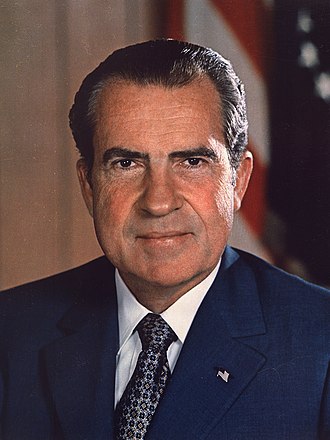
Richard M. Nixon served as the 37th President of the United States from January 1969 until his resignation in August 1974. In February 1971, he ordered the installation of a secret voice-activated taping system in the White House to preserve a historical record of his administration. Until the system's existence was revealed and dismantled in July 1973, the tapes captured Nixon directing major foreign policy initiatives, such as the opening to China, as well as his central role in the Watergate cover-up.
What Nixon talks about on the tapes
White House operations 4,718Presidential scheduling 2,225Public relations 1,784Presidential schedule 1,782Vietnam War 1,693Logistics 1,650Manolo Sanchez 1,626White House communications 1,400White House administration 1,399Presidential communication 1,243Henry Kissinger 1,191Foreign Policy 1,183
Conversations (21,010)
— Page 91 of 211President Nixon consulted with a White House operator to facilitate a telephonic connection. The brief interaction served to establish communication for an outgoing call. No further substantive policy matters or specific decisions were recorded during this exchange.
President Nixon and Charles Colson discuss the political fallout of an FBI report regarding the ITT case, which appears to contradict claims of document forgery by Dita Beard. Concerned that the FBI’s findings support allegations against the administration, Nixon and Colson strategize on using expert testimony from McCrone and Tytell to create public confusion and neutralize the report's impact. They agree on the urgency of the situation, deciding to move quickly to challenge the narrative before it is fully solidified by the Senate Judiciary Committee.
President Nixon and Charles Colson discuss the status of an FBI report and potential political maneuvering involving ITT and other figures. The participants weigh the risks of challenging the FBI's position versus utilizing external events to their advantage. They emphasize the need for rapid action to influence public perception and media coverage.
President Nixon initiates a request to the White House operator to place a telephone call to his special counsel, Charles W. Colson. The exchange serves solely as a logistical task to facilitate communication between the President and a key advisor. No substantive policy matters or decisions were discussed during this brief administrative interaction.
President Nixon met with an unknown individual and his valet, Manolo Sanchez, to coordinate preparations for an upcoming departure. The discussion focused on logistical arrangements, specifically referencing British borders and an unspecified delivery. Following these administrative checks, the President prepared to transition to his next scheduled engagement.
President Nixon held a brief, informal meeting with his personal valet, Manolo Sanchez, in the Old Executive Office Building. While no transcript is available to verify the specific substance of the discussion, the interaction reflects the routine daily contact between the President and his longtime staff member. Given the brief duration of the encounter, no major policy developments or significant administrative decisions were recorded.
President Nixon and H. R. Haldeman met briefly in the Old Executive Office Building to coordinate the Chief of Staff's daily schedule. The discussion served as a routine administrative check-in to align the President's priorities with Haldeman's upcoming agenda. No specific policy decisions were finalized during this brief encounter.
President Nixon and H.R. Haldeman discussed a wide range of political and administrative issues, including George Meany’s resignation from the Pay Board and strategies for managing media coverage of the administration. They evaluated the performance of Treasury Secretary John Connally and explored public relations tactics, such as potential fireside chats and regional media appearances. The conversation also touched on sensitive geopolitical strategies regarding the Middle East, the Soviet Union, and balancing domestic support among Jewish voters.
President Nixon met with his personal valet, Manolo Sanchez, in the Old Executive Office Building. The primary focus of the brief interaction involved relaying a message intended for John B. Connally via personal secretary Rose Mary Woods. No other substantive policy or administrative matters were recorded during this session.
President Nixon met with an unidentified individual in the Executive Office Building to review the physical presentation and binding specifications of a briefing book. The discussion focused on logistical instructions regarding the document's production and preparation. No policy-related developments were recorded, as the exchange remained limited to administrative oversight of the materials.
President Richard Nixon met with his personal valet, Manolo Sanchez, in the Old Executive Office Building. The recording is extremely brief and consists primarily of a withdrawn segment categorized as personal, indicating no substantive policy discussions occurred. Consequently, there were no significant political developments or action items resulting from this brief interaction.
President Nixon held a meeting with an unidentified individual in the Old Executive Office Building to discuss matters of unknown significance. Due to the lack of available transcripts and the presence of withdrawn material, the specific objectives and outcomes of the engagement remain unrecorded. The encounter concluded prior to 12:54 pm without any documented developments.
President Nixon met with his personal valet, Manolo Sanchez, in the Old Executive Office Building. The brief interaction concluded with Sanchez departing the office, leaving the President to inquire about his staff member's whereabouts. No significant policy discussions or administrative decisions occurred during this brief encounter.
President Nixon held a meeting with an unidentified individual in the Old Executive Office Building to conduct undisclosed administrative or policy business. Due to the lack of an available transcript or specific log details, the precise nature of the discussion remains undocumented. This interaction reflects the ongoing, private internal consultations typical of the Nixon presidency that were captured by the White House taping system.
President Nixon consulted with the White House operator to facilitate an outgoing call. This brief interaction served administrative purposes to connect the President with another party for further discussion. No substantive policy matters or decisions were recorded during this connection request.
President Nixon and Charles Colson discussed political strategy regarding the ITT antitrust controversy, the upcoming press conference, and their efforts to discredit George Meany and Democratic opposition. Colson provided updates on FBI document testing and advised that ITT should publicly release their own expert reports to create doubt, while Nixon emphasized the importance of aggressive media management and partisan messaging. The pair also explored legislative tactics, including a potential presidential veto of equal-time broadcast legislation, and discussed exploiting divisions within the AFL-CIO to damage the political standing of labor leadership.
President Nixon and Charles Colson discuss media management strategies to counter perceived negative coverage, focusing on ways to discredit critics and news organizations through orchestrated public campaigns. The two discuss mobilizing supporters to write letters to editors and network executives to protest perceived bias and unfair reporting. Nixon emphasizes the need for an aggressive, proactive communication strategy to control the narrative rather than waiting until the election cycle to respond.
President Nixon contacted the White House operator to facilitate a telephone connection with his Press Secretary, Ronald L. Ziegler. This brief administrative interaction served solely as a request to initiate communication with a key staff member. No further substantive policy matters or decisions were discussed during this specific call.
President Nixon and H. R. Haldeman discuss political maneuvering surrounding legislative efforts to address Section 315 equal-time requirements for television broadcasts. Nixon expresses concern that Democrats are manipulating these regulations to force candidate debates and gain free airtime while exploiting minority party candidates. The conversation also touches on broader strategies to attack the Democratic opposition regarding their stance on controversial social issues, including school racial balancing.
President Nixon and Press Secretary Ronald Ziegler coordinate a brief meeting to finalize preparations for an upcoming presidential press conference. The discussion focuses on reviewing last-minute questions and potential talking points to ensure the President is adequately briefed. Ziegler confirms his immediate availability to join Nixon for these final deliberations.
President Nixon and Press Secretary Ronald Ziegler discuss the strategic implications of avoiding televised presidential debates during the 1972 election cycle. Nixon expresses concern that agreeing to debates would inadvertently provide major television networks and opposing candidates with millions of dollars in free airtime. Ultimately, the President characterizes his refusal to debate as a tactical move to deny his political rivals a significant media advantage.
President Nixon met with Ronald Ziegler and H.R. Haldeman to strategically prepare for an upcoming press conference. The discussion focused on maintaining a firm but composed demeanor, particularly when addressing volatile topics like national economic policy, food prices, and busing legislation. The President also sought advice on handling potential political inquiries regarding the Soviet Union trip, the ITT controversy, and his interactions with the press corps to ensure effective communication of his administration's agenda.
President Nixon and H. R. Haldeman discussed the administration's strategic response to a recent increase in the prime interest rate. Conveying advice from John B. Connally, Haldeman suggested that the administration publicly criticize the banks' justification for the hike, which cited anticipation of future demand. Nixon agreed with this stance, emphasizing that the rate increase was premature and that the administration preferred to see interest rates decline.
President Nixon requested that the White House operator connect him with Press Secretary Ronald L. Ziegler. The brief exchange served as a logistical instruction to facilitate direct communication with his press office. No further policy discussions or significant developments occurred during this brief request.
President Nixon and Press Secretary Ronald Ziegler coordinate the sequence of questioning for an upcoming press conference. They finalize a strategy to prioritize the wire services, specifically directing that Frank Cormier of the Associated Press and the representative from United Press International be called upon first and second, respectively. Ziegler is tasked with relaying this order to the reporters and notifying the President of any necessary adjustments prior to the event.
President Nixon and Press Secretary Ronald L. Ziegler discuss strategies to counter criticism of the administration's economic policies, specifically regarding unemployment figures. Nixon emphasizes that critics are selectively highlighting specific statistical data to allege policy failure while ignoring the broader, more positive economic trajectory. They agree to adopt a more assertive messaging strategy to defend the administration's overall economic record.
President Nixon initiates a phone call to the White House operator to be connected with Senator Edward J. Gurney of Florida. The brief exchange serves as a logistical bridge to facilitate direct communication between the President and the Senator. No substantive political or policy discussions occur during this operator-assisted request.
President Nixon consulted with the White House operator to facilitate a telephonic communication. The exchange served primarily as an administrative bridge to initiate a separate call to an unnamed party. No substantive policy discussions or significant political developments occurred during this brief interaction.
President Nixon initiated this call to commend Senator Edward Gurney for his political performance and his recent support during the Florida primary. The two discussed their shared disdain for George Meany, with Nixon comparing the labor leader's perceived arrogance to 19th-century business titans. Nixon encouraged Gurney to continue his aggressive public stance, reaffirming their mutual alignment against Meany's influence.
President Nixon met with Senator Edward J. Gurney to offer encouragement regarding Gurney’s aggressive approach toward media criticism and labor unions. Nixon affirmed his support for Gurney's “hard line” stance, comparing the need to check labor power in the 20th century to the regulation of business in the 19th century. The brief exchange served as a morale-boosting gesture of solidarity between the President and the Senator.
President Nixon met with his personal aide, Manolo Sanchez, in the Old Executive Office Building to request refreshments. The brief interaction consisted solely of the President asking Sanchez to bring him a cup of coffee. No other policy matters or official business were discussed during this exchange.
President Nixon held a formal press conference in the Oval Office with a large group of journalists to address current domestic and foreign policy concerns. During the session, he discussed his administration's economic initiatives regarding inflation and food prices, defended his school desegregation and anti-busing policies, and addressed controversies surrounding ITT and the confirmation of his Attorney General nominee. Additionally, Nixon provided updates on international affairs, including the military situation in Vietnam, his upcoming trip to the Soviet Union, and ongoing Strategic Arms Limitation Talks (SALT).
President Nixon met with his senior staff, including H. R. Haldeman, Ronald Ziegler, and Charles Colson, to review the performance and content of his recent press conference. They discussed the effectiveness of his responses to various topics, specifically his firm stance on marijuana legalization, his handling of the ITT antitrust controversy, and his efforts to blame previous Democratic administrations for current economic and regulatory problems. The President and his advisors expressed satisfaction with the 'glass houses' rhetoric used to deflect criticism and finalized strategies to continue blaming the middleman for rising food prices.
President Nixon and Charles W. Colson discuss the political fallout and media coverage surrounding Dita Beard and the ongoing International Telephone and Telegraph (ITT) investigation. They specifically evaluate the implications of Senator Edward M. Kennedy’s aggressive questioning of Beard and explore potential White House strategies for managing the situation. The conversation concludes with a brief review of the President's upcoming schedule.
President Nixon and Charles W. Colson discussed the sudden collapse and reported heart seizure of Dita D. Beard during her intense questioning by Senator Edward M. Kennedy regarding the ITT case. Colson provided the President with details on the medical incident and speculated on the potential political fallout and media narrative surrounding the event. The two men agreed that the dramatic nature of the situation would likely dominate news coverage in the coming days.
President Nixon and Alexander Haig discuss the scheduling of Henry Kissinger and the President's desire to insulate him from bureaucratic distractions regarding personnel like Marshall Green and Arthur K. Watson. The conversation shifts to the military situation in Vietnam, specifically the influx of North Vietnamese aircraft and skepticism regarding recurring military predictions of enemy offensives. Nixon expresses a cautious outlook on the coming month, emphasizing the need for prepared, strategic responses to potential enemy aggression.
President Nixon met with his valet, Manolo Sanchez, to manage administrative tasks regarding the organization of presidential dictabelt memoranda. They specifically focused on the status of filing and transcribing these recordings. The discussion served as a brief procedural update to ensure the proper documentation of official presidential files.
President Nixon initiates a brief, informal interaction with a White House operator. The exchange consists of an unidentified request for telephone assistance, though the specific nature of the call is not captured in the recording. No substantive policy discussions or significant political developments occur during this brief administrative contact.
President Nixon and H. R. Haldeman coordinated the start of a private meeting following the conclusion of a staff gathering. The conversation served primarily as a logistical check-in to confirm that the staff meeting had ended. The participants agreed that Haldeman should proceed to the Oval Office immediately to begin their session.
President Nixon and H. R. Haldeman held a brief, informal check-in at the conclusion of a staff meeting. The discussion served as a logistical transition between administrative sessions to ensure ongoing coordination. No significant policy decisions or strategic developments were recorded during this brief exchange.
President Nixon and H.R. Haldeman discussed a wide range of administrative and political concerns, specifically focusing on the 1972 presidential campaign strategy and the management of high-profile political issues. Key topics included handling overtures from Ross Perot regarding POW negotiations, managing the fallout from ITT-related congressional hearings, and organizing a state-by-state campaign effort that prioritizes winning white ethnic voters in key industrial states while avoiding controversial demographics. Additionally, the pair coordinated on public relations initiatives, including the use of White House gifts for political outreach and the need for more frequent appearances by administration officials to promote the President's foreign policy successes.
Press Secretary Ronald Ziegler attempted to reach Special Counsel Charles Colson on behalf of President Nixon to discuss urgent matters regarding wire service reports and pending testimony. Upon learning that Colson was unavailable and attending to business on Capitol Hill, Ziegler requested an immediate return call once Colson became reachable. The dialogue highlights the administration's efforts to coordinate responses to sensitive press and legislative developments.
President Nixon met with his personal valet, Manolo Sanchez, in the Old Executive Office Building to review logistical details regarding the President's schedule. Their brief exchange focused on verifying the current time to manage upcoming commitments. The interaction concluded quickly without any significant policy developments.
President Nixon instructed the White House operator to urgently contact Charles W. Colson, who was reportedly en route to Capitol Hill. The brief call served as a logistical coordination effort to establish communication with Colson. No substantive policy matters were discussed, as the exchange focused entirely on locating and connecting the aide.
President Nixon and H. R. Haldeman coordinated the President's upcoming travel and media schedule, focusing specifically on preparations for the forthcoming summit in the Soviet Union. The discussion centered on timing press conferences around international travel, planning domestic political outreach regarding American ethnic groups in cities like Chicago and Cleveland, and evaluating the feasibility of a satellite press conference to discuss foreign policy. Haldeman also briefed the President on the health and political status of legislative leaders such as Leslie Arends.
President Nixon and Alexander Haig held a brief administrative exchange to coordinate an upcoming meeting at the Old Executive Office Building. The conversation served primarily as a logistical check to confirm Haig’s availability for the President's schedule. No substantive policy matters were addressed beyond the arrangement of this appointment.
President Nixon and Alexander Haig met to coordinate administrative foreign policy, specifically addressing the upcoming Moscow summit and the management of Henry Kissinger's role. They discussed delicate geopolitical issues, including Soviet-American relations, potential arms control negotiations (SALT), and the need to maneuver around domestic political pressures regarding Israel and Northern Ireland. Nixon emphasized the importance of maintaining tight control over the substance of foreign policy negotiations to ensure they align with his strategic objectives rather than becoming subject to outside interference or Congressional criticism.
President Nixon contacted the White House operator to request a telephone connection with Charles W. Colson. The President specifically instructed the operator to verify Colson’s availability, stipulating that he did not wish to interrupt him if he were currently on Capitol Hill. The exchange concluded with the operator tasked to call the President back once Colson's whereabouts were confirmed.
President Nixon requested that the White House operator locate Charles Colson to determine if he was available for a telephone conversation. Nixon specified that he only wished to speak with Colson if he was physically present in his office and not currently on Capitol Hill. The operator agreed to check his status and report back to the President.
President Nixon met with his personal valet, Manolo Sanchez, in the Old Executive Office Building for a brief informal discussion. Their conversation focused on mundane logistical matters, including current weather conditions and the presence of flowers. Sanchez also noted his plans to travel to Boston, marking the interaction as a routine exchange regarding the President’s personal schedule and domestic arrangements.
President Nixon and Charles Colson discuss strategies to counter ongoing Congressional hearings regarding the International Telephone and Telegraph (ITT) case and the confirmation of Richard Kleindienst. They focus on pressuring Republican senators Hugh Scott and Roman Hruska to launch an offensive, including a press conference that frames Senator Edward Kennedy’s questioning as a "sickbed inquisition." Additionally, Colson outlines plans to issue an affidavit from William R. Merriam to debunk allegations of a specific White House phone call to Dita D. Beard.
President Nixon and Charles W. Colson attempted to conduct a brief, informal telephonic check-in regarding scheduling and ongoing communications. The conversation was significantly hampered by severe technical difficulties, rendering the audio mostly unintelligible and preventing any substantive discussion of policy or political strategy. Consequently, no concrete decisions were reached, and the participants ended the call due to the connectivity issues.
President Nixon met with his personal valet, Manolo Sanchez, in the Old Executive Office Building to facilitate a specific delivery. While the transcript remains largely undefined, the interaction served as a brief administrative or personal exchange between the President and his staff member. Sanchez departed shortly thereafter, concluding the brief encounter.
President Nixon dictated a memorandum to formalize his stance on the proposed Alaska pipeline, weighing its domestic benefits against international and environmental complexities. He identified job creation in Alaska and the potential reduction in oil prices for the West Coast as key political advantages for the 1972 election cycle. Despite pressure from stakeholders like Senator Mike Gravel, Nixon expressed skepticism regarding the project's diplomatic implications and concluded that a final decision did not require immediate unilateral action.
President Nixon held a brief administrative exchange with an unidentified individual regarding the logistics of an upcoming telephone call. The dialogue centered on coordinating communication, with the President opting to initiate the contact himself rather than wait for a return call from the other party. The conversation concluded with a mutual agreement to postpone the interaction.
President Nixon met with his aide Stephen B. Bull to coordinate updates to his daily schedule. The conversation focused on the availability and inclusion of Charles W. Colson and H.R. Haldeman for upcoming meetings. Nixon explicitly instructed Bull to ensure these key advisors were present if their schedules permitted.
President Nixon met with his senior aides, including Charles Colson and H.R. Haldeman, to discuss the ongoing political damage and legislative obstacles created by the ITT confirmation hearings for Richard Kleindienst. The group debated strategies for responding to Democratic inquiries, particularly the aggressive questioning from Senator Edward Kennedy, and considered forcing a decisive floor vote or having Kleindienst threaten to resign if not confirmed by a specific date. Throughout the conversation, Nixon emphasized the need to distance the White House from ITT's business activities, such as their convention hotel arrangements, to maintain the administration's integrity.
President Nixon met with his advisors to discuss the political and economic complexities of the proposed Trans-Alaska Pipeline, specifically the potential for an alternative pipeline route through Canada. While facing significant pressure from environmentalists and ongoing court battles, Nixon expressed a desire to maintain administrative control over the narrative and avoid being forced into a reactive position by the Canadian government. The participants decided to handle negotiations with Canadian energy officials through Secretary of the Interior Rogers Morton and other staff rather than directly involving the White House, while keeping options open to protect U.S. oil interests and investment.
President Nixon and Stephen B. Bull coordinated logistics for an upcoming appearance by the First Lady before the Advertising Council. They discussed the flow of movement between the East Room and the State Dining Room to ensure a smooth transition for the group's cocktail reception. The primary action item involved finalizing these scheduling details to accommodate the President and Mrs. Nixon's joint departure and subsequent appearances.
President Nixon and Alexander P. Butterfield met to coordinate the President's upcoming schedule, specifically regarding meetings involving Elliot Richardson and George Shultz. They discussed whether Richardson should participate in a scheduled Republican Congressional leadership gathering, with Nixon deciding to proceed despite expected objections. The pair also briefly reviewed the timing and logistics of a subsequent nine-minute agenda item.
President Nixon met with Alexander P. Butterfield to coordinate logistical details for an upcoming meeting with Republican Congressional leadership. They discussed the agenda, which included pending legislation on welfare reform, revenue sharing, and busing, as well as the tone of Herbert Stein’s forthcoming economic presentation to the Pay Board. The discussion focused on managing the meeting's duration and ensuring the President was briefed on key policy objectives.
President Nixon met with Clark MacGregor and Alexander Butterfield to coordinate a messaging strategy for Republican members of Congress regarding the economy and the administration's price stabilization program ahead of their recess. The discussion also addressed the stalled confirmation of Richard G. Kleindienst and the ongoing ITT controversy, with Nixon pushing for a swift committee vote to resolve the matter. Finally, Nixon and Alexander Haig discussed the geopolitical risks and potential benefits of including a stop in Poland during the President's upcoming trip to the Soviet Union.
President Nixon contacted the White House operator to place an urgent call to Charles W. Colson. During the brief interaction, the President sought to determine Colson's current location to facilitate the connection. This exchange served as a logistical coordination effort to initiate a private consultation between the two men.
President Nixon contacted the White House operator to place an outgoing call to National Security Advisor Henry Kissinger. This brief administrative interaction served as the necessary logistical step to facilitate a high-level consultation between the President and his advisor. No substantive policy discussions were recorded during this connection process.
President Nixon and Henry Kissinger discuss a range of foreign policy priorities and domestic political pressures following Kissinger's recent trip to Mexico. They address the timing of a Middle East settlement relative to the 1972 election, the status of negotiations with North Vietnam, and the strategic management of U.S.-Soviet relations. Additionally, they touch upon the political fallout of the ITT case and the administrative challenges of securing diplomatic appointments without inviting scrutiny over campaign contributions.
President Nixon and Charles Colson discuss the ongoing political damage caused by the International Telephone and Telegraph (ITT) scandal and the resulting controversy surrounding Richard G. Kleindienst's Senate confirmation. They express frustration with the media's handling of the case and the unauthorized television appearances of White House staff, specifically Peter M. Flanigan. To mitigate political fallout during an election year, the President and Colson determine that they must force a resolution to the ITT matter and minimize the duration of the Senate hearings to prevent further damage to the administration.
President Nixon met with Republican congressional leaders and cabinet officials to strategize on the administration's legislative agenda, specifically focusing on revenue sharing, welfare reform, and the Equal Educational Opportunities Act. The discussion addressed the political and procedural challenges of implementing a busing moratorium and the importance of countering Democratic criticism regarding the economy. Nixon emphasized the need for a unified party strategy to leverage economic accomplishments and maintain pressure on Democratic opponents leading into the 1972 election cycle.
President Nixon met with his Deputy Assistant Alexander P. Butterfield in the Oval Office to discuss administrative logistics and staff management. While the specific transcript is unavailable, the meeting served as a standard briefing session to facilitate the President's daily operational workflow. No substantive policy decisions or developments were documented as a result of this brief exchange.
President Nixon met with Henry Kissinger and senior staff to discuss foreign policy developments, specifically focusing on Vietnam, Middle East peace strategies, and the logistics of upcoming summit travels to Russia, Poland, and Iran. The group deliberated on how to handle the political fallout from the ITT scandal and the associated legislative impacts, emphasizing the need for a more disciplined communication strategy. Nixon and his advisors also reviewed political maneuvering regarding the upcoming election, including the importance of tax rhetoric and the necessity of maintaining control over internal messaging.
President Nixon, Henry Kissinger, and King Hussein of Jordan met to discuss the volatile political and economic situation in the Middle East, specifically focusing on the Palestinian-Israeli conflict and Jordan's need for financial assistance. King Hussein detailed his proposed three-year development plan aimed at achieving economic self-sufficiency and mitigating refugee issues, while Nixon and Kissinger emphasized the importance of maintaining Jordan as a stable, independent ally. Nixon advised that any U.S. efforts to broker peace should be conducted through quiet, private diplomacy to avoid negative political blowback and obstructionism from hardline elements.
President Richard Nixon met with his personal valet, Manolo Sanchez, in the Oval Office to discuss personal matters and logistical arrangements. Given the lack of a transcript or specific agenda, the discussion likely centered on the President's daily schedule, private household affairs, or administrative tasks managed by Sanchez. No significant policy decisions or official developments were recorded during this brief encounter.
President Nixon met with his aide Stephen B. Bull to coordinate logistical details for an upcoming White House appearance featuring the 1972 Poster Child for the National Association for Retarded Children, Kevin Heald. The discussion centered on the presentation of ceremonial gifts, including a football autographed by Dallas Cowboys player Calvin Hill, and the physical staging of the event within the Oval Office. Nixon provided specific instructions regarding the signing of mementos and the management of the presentation ceremony to ensure a smooth interaction with the young guest.
President Nixon met with Dallas Cowboys player Calvin Hill, Kevin Heald, and several guests for a photo opportunity and gift exchange in the Oval Office. The discussion focused on professional football, including the Cowboys' team performance and injuries to various players in the league. Additionally, the President and Hill discussed Hill's charitable work with youth drug prevention programs, with Nixon commending his efforts to help prevent addiction.
President Nixon met briefly with his aide Stephen B. Bull to coordinate the scheduling of an upcoming meeting. The primary focus of the discussion was to arrange a session with Clark MacGregor. The interaction served as a logistical check-in to confirm the President's immediate calendar priorities.
President Nixon met with Clark MacGregor, H. R. Haldeman, and Charles Colson to strategize on ending the ongoing Senate Judiciary Committee hearings regarding the International Telephone and Telegraph (ITT) case and the nomination of Richard G. Kleindienst. The group expressed concern that the hearings were damaging the administration and discussed orchestrating a committee vote to terminate the proceedings, despite potential political blowback. They also deliberated on the best way for Kleindienst to manage his public image and address the nomination impasse, while acknowledging frustrations regarding poor communication and handling of the controversy by White House staff.
President Nixon and aide Stephen B. Bull met to coordinate the President's upcoming schedule, specifically focusing on a meeting with John B. Connally. The discussion also addressed logistics for a photo session involving individuals from Florida. Bull was tasked with managing these scheduling priorities before the President reviewed further details.
President Nixon initiated a brief telephonic interaction via the White House operator to connect with his aide, Stephen B. Bull. The dialogue reflects standard administrative coordination regarding internal communication management. No substantive policy matters or major historical developments were captured in this fragment.
President Nixon met with John Connally and H.R. Haldeman to discuss strategies for managing the national economy, specifically regarding inflation, trade deficits, and potential tax reform initiatives in response to Democratic criticism. The group also addressed the ongoing ITT controversy and the confirmation hearings for Richard Kleindienst, debating whether to force a Senate vote or have Kleindienst withdraw his nomination to preempt further political damage. The President and his advisors expressed deep concern over the lack of strong leadership within the Republican Party and discussed the necessity of adopting a more aggressive political posture to counter Democratic messaging ahead of the upcoming primaries.
President Nixon consulted with his aide, Stephen B. Bull, to inquire about the availability of his barber. The President specifically requested that Bull check the barber's schedule for the remainder of the afternoon before 6:00 pm. Bull acknowledged the request and committed to verifying the information and reporting back to the President.
President Nixon consulted with his aide Stephen B. Bull regarding the scheduling and presence of the White House barbers. The brief interaction served to confirm the barbers' current availability and status at the Executive Office Building. No further policy or administrative developments resulted from this inquiry.
President Nixon coordinates with Stephen B. Bull to delay his scheduled arrival for a meeting with Barber. Nixon instructs Bull to inform Barber that he will arrive at approximately 5:45 pm, allowing Barber to utilize the intervening fifteen minutes for other appointments. This brief exchange serves to adjust the President's daily agenda and manage his immediate scheduling logistics.
President Nixon and Stephen B. Bull briefly coordinated their schedules to facilitate the President's arrival at an upcoming engagement. The dialogue focused on logistics and timing, with Bull confirming he would reach the destination approximately ten minutes before the President. This exchange served as a routine administrative check to ensure the smooth transition of the President's movements for the evening.
President Nixon met with his valet, Manolo Sanchez, to provide specific instructions regarding the organization and transport of personal items from his desk. The dialogue focused on the proper handling and relocation of a boulder and associated documents contained within a folder. This administrative interaction highlights the routine management of the President's personal office effects by his immediate staff.
President Nixon instructed the White House operator to place a telephone call to his daughter, Julie Nixon Eisenhower. This brief exchange served exclusively to facilitate personal communication between the President and his daughter. No other official business or policy discussions were conducted during the call.
In this extensive Oval Office meeting, President Nixon and his close advisors, including H.R. Haldeman and Henry Kissinger, managed a dense agenda ranging from current legislative crises to upcoming high-stakes international diplomacy. The participants coordinated their strategy regarding the ongoing ITT hearings and confirmation battles, while simultaneously planning the logistics and public relations for the President's scheduled trips to the Soviet Union, Poland, and Canada. A significant portion of the discussion focused on managing the President's public image, refining his travel itinerary to maximize political impact, and carefully controlling the messaging surrounding his foreign policy initiatives, particularly regarding Vietnam and China.
President Nixon held a brief telephone conversation with the White House operator to facilitate an outgoing call. The interaction served as a technical step in connecting the President to another party for official business. No substantive policy discussions occurred during this brief exchange.
President Nixon and his daughter, Julie Nixon Eisenhower, coordinate logistical details for an upcoming dinner event. The discussion centers on the guest list, seating arrangements, and the total number of attendees. Additionally, the two briefly touch upon Julie's personal schedule in relation to the event.
President Nixon contacted the White House operator to place an outgoing call to Clark MacGregor, who was serving as his Congressional liaison at the time. The brief exchange served solely to initiate this administrative request. No other substantive policy discussions or decisions were recorded during this connection.
President Nixon and Alexander P. Butterfield met to coordinate the arrangements for an upcoming Organization of American States (OAS) dinner. The discussion centered on finalizing the schedule for the event and planning the presentation of the Presidential Medal of Freedom to Jose A. Mora. Nixon approved a proposal to honor Mora during the ceremony and established the specific guest list and logistical sequence for the award presentation.
President Nixon utilized this time to dictate formal correspondence expressing appreciation to Mexican President Luis Echeverría Alvarez and General William Westmoreland. The letter to Echeverría focused on strengthening bilateral relations, highlighting Henry Kissinger’s recent diplomatic outreach to Mexico, and formally inviting the President to Camp David. Additionally, Nixon dictated a separate message of gratitude directed toward General Westmoreland regarding his service and contributions.
President Nixon utilized this time to dictate several letters and a memorandum, assisted by Manolo Sanchez. He drafted correspondence expressing gratitude to Mexican President Luis Echeverria Alvarez for his hospitality, acknowledging the Army chorus's performance for Gen. William Westmoreland, and reflecting on a conversation with Norman Vincent Peale regarding the character of King Hussein of Jordan. Additionally, Nixon dictated a memorandum to Henry Kissinger concerning potential board appointments for Robert Amory, Jr. while recounting historical political anecdotes involving the Eisenhower administration.
President Nixon held a brief, repetitive exchange with an unidentified participant in the Old Executive Office Building. The dialogue consists entirely of a series of negative responses from the President, suggesting a firm rejection of a proposal or a reaction to unwelcome information. No substantial policy discussion or actionable developments are identifiable from the available audio content.
President Nixon met with his personal valet, Manolo Sanchez, in the Old Executive Office Building. The brief interaction focused on the President's personal schedule and logistical arrangements for his upcoming activities. No significant policy decisions or major developments were recorded during this informal engagement.
President Nixon instructed the White House operator to place a telephone call to Clark MacGregor. The request serves as a routine administrative coordination to facilitate a direct line of communication between the President and his staff. No further substantive discussion occurred during this brief interaction.
President Nixon met with his personal valet, Manolo Sanchez, in the Old Executive Office Building for a brief and informal interaction. The discussion primarily involved trivial matters, including a mention of the weather and the handling of a speaker or audio equipment. No significant policy decisions or official government actions were recorded during this brief exchange.
President Nixon, Clark MacGregor, and H. R. Haldeman discussed legislative progress regarding anti-busing initiatives and the ongoing Senate Judiciary Committee hearings on the ITT case. MacGregor reported successful engagement with Southern House members to solidify support for the Administration's moratorium proposal, while expressing concern over the lack of unity among Republican senators regarding the ITT hearings. The President emphasized the need to secure a vote to terminate the ITT hearings, framing the struggle as a critical political confrontation between the Administration and Senator Edward Kennedy.
President Nixon met with Clark MacGregor to debrief on a recent meeting with Southern legislators and gauge the support of House Republicans. The discussion focused on navigating legislative hurdles and ensuring party unity regarding ongoing policy challenges. The President emphasized the strategic importance of managing these political relationships and maintaining momentum during the upcoming legislative recess.
President Nixon and H. R. Haldeman met in the Old Executive Office Building to coordinate scheduling and discuss private strategic matters. The brief exchange served as a precursor to a more substantive policy discussion between the two men. No specific policy decisions were finalized during this opening segment of the meeting.
President Nixon held an brief administrative meeting with an unidentified individual to coordinate scheduling for an upcoming dinner engagement. The discussion primarily involved logistics regarding the attendance of the Deputy Secretary of Defense, identified as a person named Robert. The parties successfully finalized the timing for the event without further complications.
President Richard M. Nixon received a brief telephone call from his daughter, Julie Nixon Eisenhower. The majority of the recorded session consists of a withdrawn segment containing personal, private communication. No substantive political or administrative matters were discussed during the accessible portion of the call.