Nixon, Richard M. (President)
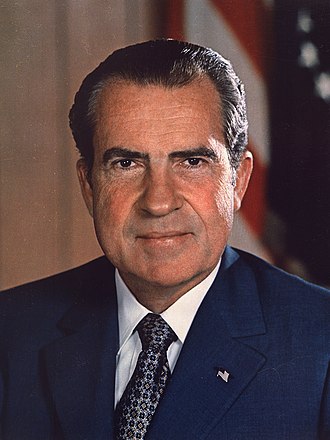
Richard M. Nixon served as the 37th President of the United States from January 1969 until his resignation in August 1974. In February 1971, he ordered the installation of a secret voice-activated taping system in the White House to preserve a historical record of his administration. Until the system's existence was revealed and dismantled in July 1973, the tapes captured Nixon directing major foreign policy initiatives, such as the opening to China, as well as his central role in the Watergate cover-up.
What Nixon talks about on the tapes
White House operations 4,718Presidential scheduling 2,225Public relations 1,784Presidential schedule 1,782Vietnam War 1,693Logistics 1,650Manolo Sanchez 1,626White House communications 1,400White House administration 1,399Presidential communication 1,243Henry Kissinger 1,191Foreign Policy 1,183
Conversations (21,010)
— Page 92 of 211President Richard M. Nixon met with his daughter, Julie Nixon Eisenhower, in his Old Executive Office Building suite for a brief personal visit. The discussion served as a momentary social interaction between family members during a period of significant presidential activity. No formal policy decisions or administrative actions were documented during this short encounter.
H. R. Haldeman coordinated a discreet meeting between President Nixon and Attorney General Richard G. Kleindienst to review the current political landscape. Following a brief exchange regarding a recent concert Kleindienst attended, the two men arranged for the Attorney General to enter the White House via the South Grounds and Diplomatic Entrance to avoid press attention. Haldeman emphasized the need for total discretion regarding the meeting, a protocol Kleindienst agreed to follow to avoid public speculation.
President Nixon and H. R. Haldeman met to discuss the precarious Senate confirmation of Richard G. Kleindienst as Attorney General, which was being jeopardized by ongoing hearings regarding the International Telephone and Telegraph (ITT) case. They analyzed the political strategies of key figures, including Senator James Eastland and John Mitchell, and evaluated the potential risks of forcing a floor vote versus withdrawing the nomination. The President ultimately decided to meet with Kleindienst to coordinate a strategy for handling the confirmation proceedings and managing political optics.
President Nixon consulted with an unidentified woman regarding potential adjustments to his daily schedule. The discussion centered on a previously planned meeting with Senator John C. Stennis, which the woman indicated was no longer required. Consequently, the President addressed the logistical implications of canceling or modifying this appointment.
President Nixon directed the White House operator to connect him with Senator John C. Stennis. Henry Kissinger was present during this request, which was facilitated to initiate communication with the influential legislator. The call serves as a logistical precursor to further discussions regarding legislative or foreign policy matters involving the Senator.
President Nixon met with H.R. Haldeman to coordinate strategy regarding the International Telephone and Telegraph (ITT) antitrust case and the contentious Senate confirmation of Richard Kleindienst as Attorney General. Nixon emphasized the need for a unified effort involving multiple political operatives, including Clark MacGregor and Charles Colson, while expressing frustration over the Justice Department's perceived lack of political acumen. The President instructed Haldeman to manage staff tensions, ensure a firm legislative strategy to end Senate hearings, and encourage key aides to take necessary breaks to maintain their effectiveness.
President Nixon and Senator John C. Stennis discuss the need for a confidential briefing regarding the upcoming U.S.-Soviet summit. Nixon directs Henry Kissinger to contact Stennis to explain sensitive strategic information necessary for managing Senate reactions before the summit. Additionally, the two men agree to arrange a future private, off-the-record meeting to discuss broader, undisclosed policy concerns away from the cabinet and aides.
President Nixon met with H. R. Haldeman and an unidentified individual in the Oval Office to address administrative tasks. The discussion centered on the processing of departmental appropriations paperwork. The meeting concluded with the President signing relevant official documents, including papers pertaining to Senator John C. Stennis.
President Nixon and his personal secretary, Rose Mary Woods, met to review planning for upcoming state dinners, specifically focusing on guest lists and the selection of high-quality entertainment. They discussed the President's desire to invite guests who are not typical government or press figures to ensure a more enthusiastic atmosphere at these events. Additionally, they coordinated a confidential plan to award a Medal of Freedom during an upcoming dinner and discussed arrangements for hosting visitors like Julia Meade.
President Nixon contacted the White House operator to facilitate a personal telephone call to his daughter, Julie Nixon Eisenhower. The brief exchange served solely as a logistical request to establish a connection with her. No substantive political or policy matters were addressed during this interaction.
President Nixon initiates a request for the White House operator to place a telephone call to his daughter, Julie Nixon Eisenhower. This brief interaction serves as a logistical bridge to connect the President with his family. No policy matters or significant executive decisions were discussed during this request.
President Nixon met briefly with an unidentified woman in the Oval Office to discuss scheduling concerns regarding upcoming appointments. He explicitly requested that she inform him more promptly if there were changes to the day's itinerary or if other individuals were scheduled to arrive. The conversation concluded shortly before the President was set to meet with Press Secretary Ronald L. Ziegler.
President Nixon met with Press Secretary Ronald L. Ziegler and personal secretary Rose Mary Woods to coordinate upcoming press logistics and limit the duration of presidential photo opportunities. Nixon expressed frustration over previous media encounters, specifically citing meetings with the American Cancer Society and King Hussein of Jordan, and directed Ziegler to keep upcoming sessions brief to avoid unproductive small talk. The group ultimately decided to restrict press coverage to wire services to ensure minimal disruption to the President’s schedule.
President Nixon and his personal secretary, Rose Mary Woods, briefly discussed the successful admission of Caroline and Alice Rudd to the Chapin School in New York. Woods highlighted her role in facilitating this outcome through personal correspondence. The exchange underscored the positive reception and gratitude expressed by the family regarding the President's influence in the matter.
President Nixon held a brief, informal social meeting in the Oval Office with Oliver W. Rudd, Jr., his wife (known as Julia Meade), their children, and Rose Mary Woods. The primary purpose was a courtesy visit that included a formal photograph session and discussion of the family's children and their schooling in New York. Before the group departed for tours of the White House and the Capitol, the President shared pleasantries and offered lighthearted advice regarding their upcoming visit with William “Fishbait” Miller.
President Nixon and Julie Nixon Eisenhower discuss Julie’s recent media appearances and upcoming campaign schedule. They review positive public feedback regarding her segment on The Dinah Shore Show and coordinate plans for the President to view the broadcast. Additionally, they touch upon logistics for future travel, including Julie’s campaign stops in Ohio, California, and New York, as well as arrangements for a weekend trip to Camp David.
President Nixon met with his aide Stephen B. Bull in the Oval Office to discuss matters regarding Julie Nixon Eisenhower. The brief interaction focused on the President's daughter, though no specific policy decisions or administrative actions were recorded beyond the nature of the visit. Bull departed shortly after the discussion concluded.
President Nixon held a brief, informal session with a White House operator to examine the presidential seal featured on the Oval Office floor and ceiling. The exchange focused on identifying and verifying the placement of these official symbols within the room. No substantive policy or administrative decisions were reached during this observation.
President Richard Nixon met with his daughter, Julie Nixon Eisenhower, in the Oval Office to discuss personal gifts and upcoming professional engagements. The brief exchange focused on a unique dwarf tree gifted from China and a custom-made item featuring the presidential seal. Additionally, the two discussed Julie’s organizational activities and her interest in the production of the musical 'Jesus Christ Superstar.'
President Nixon initiates a request to the White House operator to reach Henry Kissinger in the Map Room. This brief administrative interaction serves as a bridge to a subsequent, more substantive consultation with his National Security Advisor. No further policy discussion takes place during this specific segment of the telephone log.
President Nixon held a brief, unscheduled meeting in the Oval Office with an unidentified individual, potentially H. R. Haldeman. Due to the lack of an available transcript or audio record, the specific content and purpose of this discussion remain unknown. Consequently, no policy decisions or action items can be attributed to this exchange.
President Nixon met with an unknown woman in the Oval Office to coordinate his upcoming schedule. The brief discussion focused on logistical preparations for a forthcoming audio message to be taped by the President. No further substantive policy matters were recorded during this brief administrative encounter.
President Nixon met with an unknown woman in the Oval Office to briefly discuss his daily schedule. The exchange focused on coordinating appointments or administrative tasks, though the brevity of the encounter prevented any substantial developments. The conversation concluded quickly as the visitor departed the office shortly thereafter.
President Nixon and H.R. Haldeman discussed the ongoing political strategy regarding the confirmation of Richard Kleindienst as Attorney General and concerns over the potential release of sensitive internal documents. Nixon expressed frustration with the obsession of staffers, specifically Chuck Colson and Clark McGregor, with the Kleindienst nomination, arguing that it was distracting from more critical administration priorities like economic and labor policy. The President directed Haldeman to coordinate a unified, disciplined approach among his staff to avoid public leaks and ensure that any potential withdrawal of the nomination, if necessary, would be handled surgically to prevent political damage.
President Nixon and Stephen B. Bull meet to discuss administrative oversight regarding the President's upcoming schedule and guest management for social events. The conversation touches on the logistical handling of invitees and the strategic necessity of maintaining a professional distance in political associations. Nixon emphasizes the importance of deliberate caution in these interactions, instructing Bull to step back from certain ongoing organizational efforts to ensure proper protocol.
President Nixon met with James E. Stewart and Clark MacGregor, accompanied briefly by a White House photographer, to discuss political relations, potential travel logistics, and administrative appointments. The conversation touched upon Stewart’s history in Minneapolis, praise for Nixon’s recent trip to the People's Republic of China, and anticipation for his upcoming visit to the Soviet Union. The participants also briefly addressed pending Supreme Court nominations and the search for an Attorney General, with Nixon advising caution regarding staff travel requests.
President Nixon met with his aide Stephen B. Bull to briefly discuss administrative arrangements regarding the President’s schedule. The conversation focused on upcoming appointments with Peter M. Flanigan and Donald L. Jackson. The exchange concluded quickly after the logistical coordination was completed.
President Nixon met with Donald L. Jackson, Peter M. Flanigan, and Stephen B. Bull to discuss Jackson's impending retirement from the Interstate Commerce Commission. The conversation touched upon logistics for an upcoming White House dinner for the President of Mexico and plans for future events honoring retiring Congressmen. The President extended an invitation to Jackson for the dinner and briefly discussed the status of various ambassadorships.
President Nixon and Stephen B. Bull briefly met in the Oval Office to coordinate the President's upcoming schedule. The discussion focused on logistical arrangements for a meeting involving retiring members of Congress. No major policy decisions were reached, as the conversation served primarily as a brief administrative update regarding the President's calendar.
President Nixon met with Carl W. Tiller and George P. Shultz, along with a photographer, for a brief introductory and ceremonial session. The discussion touched upon Tiller's professional background and his transition into future relief coordination work following his government service. The meeting concluded with an exchange of gifts and brief pleasantries regarding Tiller's career.
President Nixon met with his aide Stephen B. Bull to coordinate logistical details for an upcoming appointment with representatives from the American Cancer Society, including advice columnist Ann Landers. The discussion centered on arrangements for a press photograph and the presentation of a gift during the meeting. Nixon also engaged in a brief, informal exchange regarding the distribution of Bibles to visitors at the White House.
President Nixon met with a delegation of advocates, including columnist Ann Landers and representatives from the American Cancer Society, to discuss the National Cancer Act and public support for cancer research. The conversation included a photo session and an exchange of gifts, with Nixon acknowledging the group's efforts to generate public interest and funding for the cause. The President also humorously addressed requests from visitors regarding the potential travel of the newly acquired giant pandas from the Washington National Zoo to other American cities.
President Nixon consulted with a White House operator regarding the location of an unidentified individual, who is possibly Henry Kissinger. The brief exchange focused on verifying the person's whereabouts and whether they were currently engaged in work. No major policy decisions were reached during this short administrative inquiry.
President Nixon held a brief, informal exchange with a White House operator regarding the location of American naval assets. The dialogue appears to be a fragmented conclusion to a previous communication or a transition between calls. No substantive policy decisions were made during this interaction.
President Nixon and H. R. Haldeman briefly conferred regarding the scheduling and logistical arrangements for a meeting involving Clark MacGregor. The discussion centered on confirming MacGregor's status and his recent movements to coordinate upcoming administrative business. No major policy decisions were reached during this brief exchange, which functioned primarily as a status update on personnel management.
President Nixon and H. R. Haldeman met briefly to coordinate a forthcoming meeting involving Clark MacGregor and Charles W. Colson. The discussion centered on administrative scheduling and potential personnel or strategic adjustments. The President indicated that internal changes were already too far along to alter, suggesting a firm commitment to an ongoing course of action regarding these staff consultations.
President Nixon and Henry Kissinger discuss the North Vietnamese offensive into South Vietnam, which Nixon characterizes as a violation of prior understandings. Expressing grave concern that this aggression threatens diplomatic progress, the President demands a swift and forceful American response rather than a measured retaliation. Kissinger acknowledges the directive, agreeing to convey the President's firm stance regarding these breached expectations.
President Nixon and Henry Kissinger met briefly to coordinate administrative logistics regarding a scheduled call with an individual referred to as Mark. The discussion primarily focused on finalizing communications strategy and confirming that necessary preparations had been effectively managed. The exchange served as a quick status check to ensure both parties were aligned before proceeding with the planned engagement.
President Nixon met with H. R. Haldeman and Charles Colson to discuss a wide range of political strategies, focusing heavily on managing the ongoing International Telephone and Telegraph (ITT) investigation, avoiding an anti-labor legislative trap, and finalizing the President's stance on busing and aid to parochial schools. Nixon emphasized the need for his staff to remain focused on key political issues—the cost of living, busing, and the Vietnam War—while insulating the White House from the fallout of the ITT hearings. The participants strategized on how to handle Senate Judiciary Committee Chairman James Eastland to bring the ITT investigation to a close, balancing the desire to end the hearings with the need to avoid appearing as if they are orchestrating a cover-up.
President Nixon and Alexander Butterfield review political strategy regarding the timing of upcoming electoral challenges and the potential fallout within Congress. They assess the risks of specific political narratives and discuss the status of an individual named Mr. Allen, including his recent hospitalization and the lack of a medical diagnosis. The discussion concludes with a focus on preparing for an upcoming meeting with a Mr. Lewis.
President Richard Nixon met with his personal aide, Stephen B. Bull, to review the logistics of the President’s upcoming schedule. The discussion focused on coordinating the details for a forthcoming meeting, specifically addressing the appropriate seating arrangements and placement of the various participants. This interaction served to ensure administrative readiness for the President's scheduled engagements.
President Nixon met with his staff and Teamsters President Frank E. Fitzsimmons to discuss labor policy, the status of the Pay Board following George Meany's resignation, and negotiations regarding the West Coast dock strike. Nixon emphasized his desire to maintain open communication with labor leaders to avoid being perceived as anti-labor and sought Fitzsimmons's advice on navigating these disputes. Additionally, the President received an update from Henry Kissinger regarding delicate Vietnam peace negotiations and upcoming Soviet summit preparations, while later discussing internal Teamsters matters, including the status of Jimmy Hoffa.
President Nixon met with his aide Stephen B. Bull in the Oval Office to briefly coordinate the President's upcoming schedule. The discussion centered on logistics for a forthcoming meeting, though the brief nature of the exchange resulted in no major recorded policy developments. The conversation concluded immediately after these administrative details were addressed.
President Nixon met with Phillip Sanchez, George Shultz, and Alexander Butterfield to discuss the administration's outreach efforts to the Spanish-speaking community and the operational challenges facing the Office of Economic Opportunity (OEO). Nixon emphasized that the administration must prioritize honesty, fiscal responsibility, and tangible results over the empty promises of the previous Great Society programs. Sanchez received confirmation of his standing within the administration, with Nixon encouraging him to continue his direct communication with both the President and Shultz to advocate for his initiatives.
President Nixon and Henry Kissinger met briefly in the Oval Office to coordinate logistics regarding Kissinger's travel and official calendar. The discussion focused primarily on the alignment of upcoming administrative schedules and professional commitments. No major policy shifts were recorded, as the brief exchange was restricted to administrative planning.
President Nixon and Alexander P. Butterfield met to coordinate the President's schedule and the signing of an executive order. The conversation quickly shifted to a casual inquiry regarding the status of the crab apple blossoms at the White House. Nixon requested that Butterfield investigate whether weather conditions or environmental factors had affected the blooming cycle of these trees.
President Nixon and Henry Kissinger met to discuss diplomatic leverage regarding the Soviet Union, specifically weighing how ongoing conflicts in Vietnam and economic incentives influence Soviet cooperation. Kissinger reported progress in Middle East negotiations, noting a rare departure from the Soviets' previous blanket support for Egypt, while Nixon emphasized the need for a cautious and controlled approach to these engagements. The President also confirmed his strategic decision to signal disengagement to the Israelis to maintain his negotiating position and gain greater clarity on current developments.
President Nixon and Henry Kissinger met to discuss logistics and strategic communications for upcoming foreign diplomatic missions, including a stopover in Warsaw during an upcoming Soviet trip and potential visits to Iran. The conversation centered on managing public expectations for the Moscow summit and the importance of securing prime-time television coverage for Kissinger’s media appearances. Additionally, the President reviewed the political optics of the Vietnam War, emphasizing a desire to adopt a firmer stance on the conflict as part of his broader foreign policy and 1972 campaign strategy.
President Nixon and H.R. Haldeman, later joined by Charles Colson, met to coordinate the President's upcoming schedule, focusing on the timing of a speech to the National Catholic Educational Association to maximize political impact before the Wisconsin primary. They discussed labor relations, particularly the President's relationship with Teamsters leader Frank Fitzsimmons and the maneuvering of AFL-CIO President George Meany regarding the 1972 election. Additionally, the participants reviewed international travel logistics, current economic policy, and the administration's strategy for managing the burgeoning ITT controversy.
President Nixon contacted the White House operator to facilitate a personal telephone call to his daughter, Julie Nixon Eisenhower. The brief interaction served exclusively as a request to connect the President with a family member. No policy matters or official business were addressed during this exchange.
President Nixon and his daughter, Julie Nixon Eisenhower, discuss her recent appearance on The Dinah Shore Show, which the President and First Lady Pat Nixon watched and found impressive. The conversation also covers family logistical matters, specifically coordinating travel schedules for upcoming visits to Camp David involving David Eisenhower and other relatives. Julie additionally relays a personal message to the President from Mamie Eisenhower regarding church and the late President Dwight D. Eisenhower.
President Nixon contacted the White House operator to facilitate a personal telephone call to his daughter, Tricia Nixon Cox. The exchange served exclusively as a procedural request to initiate this private communication. No policy matters or official administrative business were discussed during the brief interaction.
President Nixon and his daughter, Tricia Nixon Cox, engaged in a brief personal telephone call. The conversation primarily served as a social check-in, during which they discussed the President's recent schedule, specifically a dinner party held the previous evening featuring guests Alice Roosevelt Longworth and John B. Connally. No significant political decisions or official policy actions were documented during this exchange.
President Nixon instructed the White House operator to connect him with Charles W. Colson. The brief communication served exclusively as a logistical request to initiate this specific telephone connection. No substantive policy matters or further instructions were recorded during this brief exchange.
President Nixon and Charles Colson discussed the state of the economy, specifically analyzing positive trends in the stock market and retail sales despite negative press coverage. Nixon expressed frustration with media reporting, particularly Walter Cronkite’s interpretation of economic indicators, and directed Colson to arrange a meeting between the President and Cronkite to address the narrative. The two also touched upon 1972 campaign strategy in Illinois and Wisconsin and decided to transition toward a more aggressive, offensive political posture.
President Nixon contacted the White House operator to facilitate a telephone connection with National Security Advisor Henry A. Kissinger. This brief administrative interaction served as the necessary logistical step to initiate a high-level consultation between the President and his advisor. The call highlights the established protocol for managing the President's secure communications during the period.
President Nixon and Henry Kissinger discussed the military response to a recent North Vietnamese attack on a U.S. gunship over Laos. The two evaluated whether to justify a retaliatory strike against enemy surface-to-air missile sites under the doctrine of protective reaction. Nixon directed Kissinger to maintain pressure on Admiral Thomas Moorer to prepare for a potential strike once weather conditions improved and the nature of the North Vietnamese offensive became clearer.
President Nixon met with Henry Kissinger to discuss critical foreign policy and domestic political strategies, including the ongoing North Vietnamese offensive and potential U.S. military responses. The two reviewed preparations for the upcoming U.S.-Soviet summit, the status of diplomatic relations with various heads of state, and Nixon’s desire to delay military actions until after the Wisconsin primary to avoid negative press. Additionally, they critiqued the intellectual community's hostility toward the administration and discussed strategies for managing the 1972 campaign against Democratic opponents.
President Nixon met with his personal secretary, Rose Mary Woods, to coordinate his immediate schedule and manage upcoming appointments. The brief interaction focused on the status of specific administrative preparations and ensuring that Woods was ready to enter the Oval Office with necessary materials. This exchange highlights the routine logistical planning conducted by Nixon and his close staff to maintain the daily flow of executive operations.
President Nixon met with his personal secretary, Rose Mary Woods, and assistant Stephen B. Bull to address various administrative tasks and personal matters. The discussion covered the disposition of presidential gifts, the handling of sensitive campaign finance inquiries involving C. Arnholt Smith, and the scheduling of upcoming events, including a meeting with the National Commission on Fire Prevention and Control. Additionally, the group reviewed family photographs and handled correspondence, with the President providing guidance on how his staff should respond to unsolicited mail and inquiries.
President Nixon met with Stephen B. Bull and members of a fire prevention commission to receive a status report on their activities and efforts to reduce fire-related injuries and costs. During the session, which included a formal photo opportunity and the presentation of gifts, the commission members advocated for national attention to fire safety, specifically proposing that the White House hold a fire drill. The President accepted this proposal, directing that a fire drill be organized for the Executive Residence and offices to highlight the importance of fire safety protocols.
President Nixon met with his aide Stephen B. Bull to coordinate administrative details regarding an upcoming appointment. The discussion centered on logistics for a scheduled meeting with Eugene S. Cowen. The brief interaction concluded with Bull exiting the Oval Office to facilitate the President's itinerary.
President Nixon met with Eugene S. Cowen and Richard K. Cook to bid farewell to Cowen, who was departing his White House staff position to become a network executive. The President expressed his appreciation for Cowen’s service and presented him with a gift in the form of a money clip. A photographer was present to document the occasion, marking a formal end to Cowen's tenure.
President Nixon met with H.R. Haldeman, Ronald Ziegler, and others to strategize on public relations, specifically regarding the media appearances of Henry Kissinger and the Nixon family. They decided to postpone Kissinger's prime-time television appearances until after the upcoming Moscow summit to maximize impact and avoid premature foreign policy debates. The group also discussed the logistics of a potential television special featuring Pat Nixon's China trip, the strategy for handling press conferences, and ways to shift the narrative regarding the administration's performance.
President Nixon met with Alexander Butterfield, Rose Mary Woods, and Stephen Bull to coordinate administrative tasks and White House scheduling. Key discussions involved entertainment arrangements for an upcoming state dinner honoring Mexican President Luis Echeverria Alvarez, including deliberations on presenting a Medal of Freedom to Fred Waring. The President also dictated personal notes to Dinah Shore and Susan Alsop regarding a recent television appearance and a literary reference to Edmund Burke.
President Nixon consults with an unidentified associate regarding the handling of sensitive intelligence reports from General Creighton Abrams. The President expresses frustration with the current reporting process and mandates that all future updates from Abrams be directed to him personally. To facilitate this oversight, the President instructs the associate to ensure that they are available for immediate consultation upon request.
President Nixon and Henry Kissinger met to discuss the massive North Vietnamese spring offensive and their deep dissatisfaction with Secretary of Defense Melvin Laird's management of military reporting and operations. Nixon expressed frustration over delays in information flow and suspected Laird was obstructing aggressive military responses for political reasons. The two decided to exert direct pressure on the Pentagon to ensure a robust military counter-offensive, while simultaneously coordinating a public relations strategy to frame the North Vietnamese actions as a clear violation of international accords.
President Nixon met with H.R. Haldeman and Henry Kissinger to discuss the deteriorating military situation in Vietnam, specifically the North Vietnamese offensive and the poor performance of the Army of the Republic of Vietnam (ARVN). Expressing intense frustration with the lack of aggression from military leadership and the poor quality of information reaching the White House, Nixon ordered an immediate surge in air support and demanded more proactive reporting. He and Kissinger agreed on a new public relations strategy to preemptively manage expectations by acknowledging that the loss of certain cities was expected, thereby neutralizing potential media criticism regarding ARVN failures.
H. R. Haldeman facilitates a brief telephone connection between President Nixon and his daughter, Tricia Nixon Cox. The discussion centers on coordinating their respective schedules, specifically regarding Tricia’s participation in an upcoming Catholic event. The participants also briefly touch upon the current status of the Vietnam offensive.
President Nixon held a brief morning meeting in the Oval Office with an unidentified woman before transitioning to discussions with Chairman of the Joint Chiefs of Staff Thomas H. Moorer and Deputy Secretary of State Kenneth Rush. Henry Kissinger was also involved in the deliberations during this session. Although the specific substance of the dialogue remains unrecorded, the participants focused on high-level foreign policy and national security matters.
President Nixon met with Admiral Thomas H. Moorer, Kenneth Rush, and Henry Kissinger to express severe frustration regarding the U.S. military's handling of the North Vietnamese offensive and the poor flow of information from the Department of Defense. Nixon criticized General Creighton W. Abrams for a lack of imagination and aggressive leadership, demanding immediate, intensified use of air power and B-52s regardless of weather conditions. The President asserted his authority as Commander-in-Chief, ordering that all future military reports be provided to him directly and in an unsanitized format to bypass administrative delays.
President Nixon and Henry Kissinger discussed the implementation of air strikes in Vietnam, specifically addressing a request made by General Creighton W. Abrams. The President instructed Kissinger to investigate the specific details of the military's requests and the status of ongoing operations. The conversation emphasized the need for a clear assessment and tracking of these military actions following recent logistical concerns.
President Nixon and H. R. Haldeman met to coordinate the administration's public relations response to the North Vietnamese offensive and discuss the associated risks of increased U.S. casualties. Nixon emphasized the need for a disciplined, centralized messaging strategy involving Henry Kissinger, Ronald Ziegler, and John Scali to manage press reports and counter media distortions. Beyond the Vietnam situation, the two discussed upcoming personnel appointments, the President’s travel schedule, and the internal dynamics of the ITT antitrust case, with Nixon stressing the importance of controlling the narrative through strategic leaks.
President Nixon requested that the White House operator place a telephone call to his daughter, Julie Nixon Eisenhower. The communication was intended to establish contact with her at Camp David. The operator promptly acted on the President's instructions to facilitate the connection.
President Nixon and his daughter, Julie Nixon Eisenhower, discuss the logistics and weather conditions surrounding the White House Easter Egg Roll. The President expresses interest in the large turnout and the musical performances provided by the various military bands. Additionally, the conversation briefly touches upon the President's upcoming schedule, specifically regarding a National Security Council meeting focused on Vietnam.
President Nixon contacted the White House operator to facilitate an urgent connection to Charles W. Colson. This brief administrative exchange served solely to initiate communication with a key member of the President's staff. No substantive policy discussions or decisions occurred during this brief interaction.
President Nixon consulted with his personal valet, Manolo Sanchez, to inquire about the availability of a specific consommé recommended by Julie Nixon Eisenhower. Upon learning the item was not in stock, the President directed Sanchez to purchase the product. This brief interaction reflects the routine coordination of the President's personal provisions within the White House.
President Nixon, Henry Kissinger, and Alexander Haig met to discuss the worsening military situation in South Vietnam following a major North Vietnamese offensive across the Demilitarized Zone. The participants evaluated the effectiveness of South Vietnamese forces, criticized the lack of aggressive air support usage, and coordinated a public relations strategy to frame the conflict as an illegal North Vietnamese invasion. Nixon emphasized the necessity of using U.S. air power to inflict heavy casualties on the enemy, while the group considered the geopolitical risks of the offensive regarding upcoming diplomatic engagements with the Soviet Union and China.
President Nixon met with his personal aide, Manolo Sanchez, to discuss the retrieval of specific items and the logistics of store closures. The conversation focused on the availability of supplies and instructions regarding the secure handling and delivery of these goods. Sanchez received direct orders from the President to ensure the items were not left in a vulnerable location.
President Nixon met with his personal valet, Manolo Sanchez, in the Old Executive Office Building to discuss the President's upcoming schedule. The brief interaction focused on the day's itinerary and the pacing of the President's appointments. No major policy decisions were reached during this short administrative exchange.
President Nixon met with an unidentified individual to facilitate a mundane administrative or personal request. The participant agreed to provide the President with an envelope containing 20 cents, presumably for postage or a similar small transaction. No substantive policy matters or significant political developments were discussed during this brief exchange.
President Nixon dictates a memorandum for the file regarding his upcoming political strategy. The discussion centers on preparations for a meeting with Republican officials to outline the party's objectives for the following year. This effort reflects the administration's focus on long-term political planning and party coordination.
President Nixon met with Ronald Ziegler and Rose Mary Woods to formulate a media strategy regarding the ongoing military offensive in South Vietnam. Nixon instructed Ziegler to maintain a posture of studied ambiguity, directing him to decline day-to-day commentary on the battle and instead defer military-specific evaluations to General Abrams in Saigon. The President emphasized a narrative that the South Vietnamese line was bending but not breaking, drawing historical parallels to maintain public resolve and avoid speculation about future US ground troop involvement or bombing campaigns.
President Nixon dictates a memorandum regarding the escalating North Vietnamese offensive and the subsequent administration strategy toward bombing campaigns in Laos and Vietnam. He consults with H.R. Haldeman to coordinate his upcoming schedule, specifically regarding a planned speech and press conference. The discussion emphasizes the need for internal alignment, necessitating consultations with John Connally, Henry Kissinger, and William Rogers to manage media coverage and public messaging.
President Nixon and H. R. Haldeman coordinate the administration's public relations strategy, focusing on delegating a speech assignment to John Connally to avoid presidential overexposure. They discuss the scheduling of a press conference and determine that Vice President Spiro Agnew should handle certain public appearances instead of the President. The conversation also addresses the management of upcoming meetings with key staffers and cabinet members, including Henry Kissinger and John Ehrlichman.
President Nixon initiates a call through the White House operator to be connected to the Washington Post. The brief exchange serves as a logistical step to facilitate communication with the newspaper's offices. No further substantive discussion occurs during this interaction.
President Nixon met with his personal valet, Manolo Sanchez, in the Old Executive Office Building to discuss administrative matters. The brief interaction focused on the President's personal requests, specifically concerning a meal order for consommé. No major policy decisions or historical developments were recorded during this short exchange.
President Nixon and Charles Colson discuss administration strategy for countering negative press coverage, specifically regarding the ITT controversy and the 1972 Democratic primary. They review ongoing political efforts to mitigate concerns over food prices, busing, and the Vietnam War, while strategizing on how to maintain public support through symbolic administrative interventions. Additionally, the pair evaluates labor relations, highlighting the importance of securing the support of Teamsters and other key union leaders like James Rademacher to counter opposition from George Meany.
President Nixon and Charles W. Colson discuss political strategy regarding the 1972 primary elections and the management of media narratives surrounding political opponents. The conversation centers on undermining the credibility of critics by sowing doubt about their claims and analyzing the effectiveness of rival candidates' public exposure and media reach. Nixon expresses satisfaction with Colson’s efforts to neutralize negative charges and discusses the potential political impact of their coordinated messaging.
President Nixon and Henry Kissinger met to evaluate the ongoing North Vietnamese offensive and the United States' strategic options, including the necessity of retaliatory air strikes. They discussed the implications of the invasion for the survival of South Vietnam and the importance of maintaining a calm, calculated response to avoid jeopardizing recent diplomatic progress with China and the Soviet Union. The conversation emphasized the political necessity of ensuring the public perceives the North as the aggressor, as well as addressing ongoing challenges with military coordination and weather conditions impacting air operations.
President Nixon and Henry Kissinger debated the geopolitical implications of the ongoing North Vietnamese offensive and the potential necessity of canceling the upcoming Moscow summit. Kissinger argued against drawing parallels between the United States and France’s withdrawal from Algeria, asserting that the U.S. status as a global superpower necessitates a more resolute response to maintain international credibility. The discussion underscored the administration's concern that any perceived retreat would fundamentally undermine American influence on the world stage.
President Nixon and H. R. Haldeman meet with John Ehrlichman and others to discuss a broad range of administrative priorities, including the development of a presidential speech on the drug crisis and the use of Myles Ambrose as a public face for the administration's anti-drug efforts. They review political strategies for handling the controversial busing issue, with Ehrlichman highlighting the importance of the administration's stance on local school control, and touch upon various personnel and policy matters, including the declassification of documents and potential leadership changes at the U.S. Postal Service. Additionally, the group addresses public relations challenges involving ITT, the Population Commission, and the administration's ongoing concerns regarding media coverage and leaked government information.
President Nixon and H.R. Haldeman met to coordinate the President's upcoming travel schedule, specifically focusing on logistics for trips to Philadelphia and Florida. The discussion included the inclusion of Henry Kissinger in these plans and the management of sensitive foreign policy issues, particularly concerning the Vietnam War. Additionally, Nixon directed Haldeman to facilitate a meeting between Kissinger and Soviet Ambassador Anatoliy Dobrynin.
President Nixon contacted the White House operator to facilitate a telephone connection with his National Security Advisor, Henry Kissinger. The brief exchange served as a logistical step to initiate a high-level discussion regarding national security or foreign policy matters. No substantive policy decisions were finalized during this preliminary request.
President Nixon and Henry Kissinger discussed the military situation in Vietnam, specifically the ongoing North Vietnamese offensive and the impact of improving weather conditions on U.S. air operations. Nixon directed the immediate expansion of naval gunfire support against enemy targets along Route One in North Vietnam, expressing his willingness to escalate strikes, including potential operations near Haiphong. They also reviewed diplomatic relations with the Soviet Union, agreeing to set a 24-hour deadline for a response regarding the President’s visit to Poland to preempt further media leaks.
President Nixon initiates a request to the White House operator to place a telephone call to National Security Advisor Henry A. Kissinger. This brief interaction serves as the administrative bridge to facilitate urgent communication between the President and his top foreign policy advisor. No further substantive policy discussions occur during this specific segment of the recording.
President Nixon and Henry Kissinger discuss intensifying U.S. naval involvement in the Vietnam War to counter North Vietnamese military advances. Nixon authorizes an immediate increase in naval bombardment, ordering Kissinger to coordinate with Admiral Thomas H. Moorer to deploy all available cruisers, destroyers, and additional aircraft carriers to the region. The primary objective is to maximize firepower, including the precise shelling of coastal areas, to effectively disrupt enemy operations and signal American resolve.
President Nixon held a brief, undocumented meeting with one or more unidentified individuals in the Oval Office. The participants engaged in a fragmentary exchange regarding a document or written material that one party had reviewed. Due to the lack of transcript content, no specific policy decisions or significant administrative actions can be identified from this recording.
President Nixon met with H. R. Haldeman, Henry Kissinger, and Admiral Thomas Moorer to coordinate the U.S. military and public relations response to the massive North Vietnamese invasion. Nixon expressed intense frustration with military reporting and the lack of aggressive action, ordering naval forces to prepare for a selective blockade and authorizing expanded air strikes and naval gunfire against the invasion force. The participants discussed strategies for managing the optics of the conflict, the potential for an orderly South Vietnamese retreat to better defensive positions, and the necessity of winning the engagement to maintain U.S. global credibility.
President Nixon directs the White House operator to immediately interrupt an ongoing meeting to connect him with Admiral Thomas H. Moorer. The urgency of the request underscores a priority communication regarding military or strategic matters. The operator acknowledges the command and proceeds to facilitate the urgent connection.