Nixon, Richard M. (President)
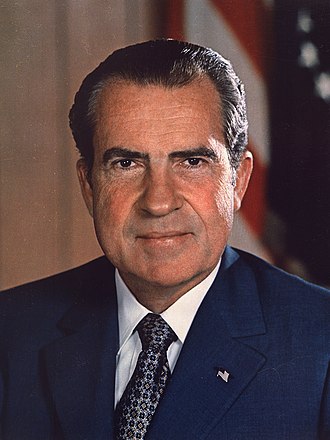
Richard M. Nixon served as the 37th President of the United States from January 1969 until his resignation in August 1974. In February 1971, he ordered the installation of a secret voice-activated taping system in the White House to preserve a historical record of his administration. Until the system's existence was revealed and dismantled in July 1973, the tapes captured Nixon directing major foreign policy initiatives, such as the opening to China, as well as his central role in the Watergate cover-up.
What Nixon talks about on the tapes
White House operations 4,718Presidential scheduling 2,225Public relations 1,784Presidential schedule 1,782Vietnam War 1,693Logistics 1,650Manolo Sanchez 1,626White House communications 1,400White House administration 1,399Presidential communication 1,243Henry Kissinger 1,191Foreign Policy 1,183
Conversations (21,010)
— Page 5 of 211President Nixon met with Senator Peter H. Dominick and Clark MacGregor to discuss ongoing legislative challenges, including the Supersonic Transport (SST) funding and environmental policy tensions. Dominick emphasized the need for more direct communication channels between Republican leadership and the White House to better coordinate political strategy, while expressing concern over the Vice President’s public relations impact on younger voters. The participants also reviewed administration efforts in farm reorganization and economic management, with the President prioritizing steady growth to avoid a potential downturn heading into the 1972 election cycle.
President Nixon and aide Stephen B. Bull reviewed the President’s upcoming schedule, specifically focusing on meetings with Louie B. Nunn and Senator Harry F. Byrd, Jr. The discussion centered on preparations for Senator Byrd’s visit and established the protocol for interrupting the President when the Senator arrived. No further substantive policy decisions were recorded during this brief administrative check-in.
President Nixon met with Senator Harry F. Byrd, Jr. and William E. Timmons to discuss pending legislation regarding the Supersonic Transport (SST) program and the political climate surrounding the Vietnam War. Nixon urged Byrd to support the SST project, arguing that American leadership in scientific and industrial innovation was vital for national defense and international prestige. While Byrd remained firm in his long-standing opposition to the SST due to fiscal and environmental concerns, he expressed strong support for the President’s Vietnam policy, specifically praising the administration's progress on troop withdrawals.
President Nixon, Jack Miller, and Clark MacGregor met to discuss the upcoming legislative vote on the Supersonic Transport (SST) project, emphasizing the importance of U.S. leadership in global competition and technological innovation. The group analyzed the vote tally, including the potential influence of uncommitted senators such as David H. Gambrell and Margaret Chase Smith. The President directed Miller and MacGregor to secure votes through parliamentary pairing, specifically mentioning Senators Karl Mundt and Clifford Hansen as potential partners for absent members.
President Nixon and Stephen B. Bull briefly conferred regarding the logistics of Senator John Sherman Cooper’s upcoming itinerary. The discussion focused specifically on determining the Senator's current location and confirming that he would be visiting an island without the presence of a witness. No major policy developments occurred during this brief administrative exchange.
President Nixon met with Louie B. Nunn, Whitney M. Young, Sr., and administration officials to discuss vocational training initiatives and the legacy of Whitney M. Young, Jr. The discussion emphasized the critical role of skill-based training and education in creating economic opportunities for minority communities. Participants shared personal anecdotes regarding the transformative impact of vocational programs, ultimately reinforcing the administration's support for expanding these efforts.
President Nixon met with George Shultz, Joseph Blatchford, and Carol Khosrovi to discuss the administration's government reorganization plans, specifically regarding the integration and future role of volunteer-based programs like the Peace Corps, VISTA, and the Teaching Corps. The participants reviewed strategies for securing legislative support and emphasized the importance of elevating the prominence of these programs within the federal structure. Additionally, Blatchford shared insights from his recent university outreach, noting that despite campus cynicism, students are receptive to government service opportunities when presented with concrete, localized ways to get involved.
President Nixon met with Alexander P. Butterfield to review the President’s upcoming schedule and administrative priorities. The discussion focused on coordinating a meeting with John A. Scali and arranging the logistics for a forthcoming signing ceremony. The brief interaction concluded with the finalization of these immediate ceremonial and professional engagements.
President Nixon met with representatives of the International Military Sports Council, led by Admiral Aldo Massarini, to accept a commemorative medal and discuss the organization's contributions to international relations. The meeting featured a brief photo opportunity with the press to highlight the role of military personnel in fostering global peace through athletic competition. Following the delegation's departure, Nixon consulted with Alexander Butterfield regarding the upcoming signing of a proclamation for USO Day.
President Nixon met with Harvey Firestone, General Emmett O'Donnell, Jr., and George T. Bell for a brief, informal session in the Oval Office that included a photo opportunity. The discussion touched on military service and the contributions of Bob Hope to the USO, with the President specifically criticizing religious leaders for their opposition to Hope's work. The participants also exchanged gifts, including photographs, and witnessed the President sign a proclamation.
President Nixon and Stephen B. Bull met briefly in the Oval Office to coordinate the President's upcoming schedule, specifically regarding a meeting with Charles R. Larson. During the interaction, Bull presented the President with gold cufflinks. The exchange served as a short administrative check-in to manage official appointments and personal items.
President Nixon met with military aides Commander Craig S. Campbell, Charles R. Larson, and Major General James D. Hughes to facilitate introductions and formal photographs. The discussion centered on Larson’s upcoming military reassignment to a submarine command based in San Diego, which Nixon noted was conveniently located near his San Clemente estate. The brief meeting concluded with the exchange of personal gifts and expressions of mutual appreciation regarding the aides' service.
President Nixon met with Alexander P. Butterfield to coordinate logistical details regarding a scheduled performance by the Creston High School Choir. The discussion focused on confirming the status of the group and finalizing the protocol for their appearance at the White House. The two briefly reviewed the agenda, which included a performance of two songs by the choir.
President Nixon met with Alexander P. Butterfield to coordinate a brief visit from the Creston High School Choir. The discussion focused on the logistics of the choir's tour of the Oval Office and the inclusion of their musical performance in the President’s schedule. Nixon provided final approval for the group to enter the office for their viewing and presentation.
President Nixon met with Gerald R. Ford and Alexander P. Butterfield in the Oval Office for a brief, informal encounter. The discussion was limited to pleasantries and casual observations regarding the weather. No substantive policy matters or official administrative decisions were recorded during this four-minute interaction.
President Nixon met with Alexander P. Butterfield to coordinate logistical details regarding upcoming White House meetings and events. They discussed scheduling for Charles W. Colson and John A. Scali, specifically addressing the appropriate location for their discussion. Additionally, the brief session touched upon arrangements for the Creston High School Choir’s tour and the handling of associated gifts.
President Nixon and Alexander P. Butterfield met in the Oval Office to review the President’s upcoming daily schedule. The conversation focused on logistical planning and the coordination of executive commitments. No specific policy decisions or significant developments were recorded during this brief encounter before the two departed.
President Nixon and Henry Kissinger met briefly in the Oval Office to conduct a preliminary check on any urgent administrative or policy matters. The conversation was informal in nature, focusing on logistical coordination rather than specific geopolitical strategies or high-level decision-making. No significant policy actions or substantive developments were recorded during this brief exchange.
President Nixon and H. R. Haldeman met to coordinate the President's upcoming schedule, specifically addressing the political fallout from the recent Senate vote against the Supersonic Transport (SST) program. They discussed the necessity of staging events, such as an aerospace meeting in California, to project executive leadership and address economic concerns in the technology sector despite a lack of substantive policy solutions. Additionally, they reviewed strategies for managing the public and congressional response to pending U.S. troop withdrawals in Vietnam and deliberated on the logistics of a potential trip to the Western White House.
President Nixon met with H. R. Haldeman and Stephen Bull to discuss strategies for improving the administration's public relations and enhancing support among Congressional allies. The discussion focused on mobilizing staff, specifically figures like Clark MacGregor and Donald Rumsfeld, to champion administration policies such as the Supersonic Transport (SST) and Vietnam troop withdrawals. Nixon emphasized the need for a more proactive, enthusiastic approach from his team to counteract negative narratives, and Haldeman presented findings from recent polling and questionnaires that highlighted the President’s perceived strengths in hard work and family values.
President Nixon met with student leaders and Robert H. Finch to discuss strategies for improving the Administration’s communication and credibility with the nation’s youth. The group addressed specific student concerns, including the military draft, loan programs, and government internship opportunities, while exploring ways to increase student participation in public service. The President emphasized his willingness to engage in dialogue and encouraged the deployment of Administration officials to college campuses to foster better relationships with the student body.
President Nixon and the National Security Council met to evaluate U.S. policy options regarding the People's Republic of China's potential admission to the United Nations and the status of Taiwan. Attendees debated the risks of a potential diplomatic defeat, weighing the benefits of "dual representation" versus maintaining the current, increasingly untenable policy of excluding the PRC. The President emphasized the need to manage domestic American public opinion carefully while assessing tactical shifts, ultimately seeking a strategy that minimizes political fallout while addressing the evolving geopolitical reality of China's status.
President Nixon met with Treasury Secretary John Connally and a large group of executive staff members to commend their intensive efforts regarding his legislative agenda for revenue sharing and government reorganization. The discussion focused on the complexities of coordinating with state and local officials, the progress of special revenue sharing task forces, and the significant administrative work required to advance these policies. The President expressed personal appreciation for the staff's dedication and prepared for a forthcoming press briefing on the reorganization strategy.
President Nixon and John B. Connally met to coordinate messaging for an upcoming press briefing, focusing on complex domestic and foreign policy issues. They discussed strategies for managing political optics regarding farm prices, welfare reform, and public skepticism toward military and space-related expenditures. The two also evaluated the geopolitical implications of U.S.-China relations and the necessity of maintaining a firm public stance despite potential domestic resistance.
President Nixon met with his aide, Stephen B. Bull, to conduct preparatory discussions regarding an upcoming press briefing. The conversation focused on refining the administration's messaging and strategy ahead of the event. No major policy decisions were recorded during this brief administrative session.
President Nixon and H. R. Haldeman met to coordinate the President's upcoming schedule, specifically focusing on his California trip and the importance of avoiding premature political maneuvers while Congress is in a volatile cycle. They discussed the administration's messaging on the Vietnam War and the Laos operation, noting the necessity of portraying the withdrawal as a strategic decision rather than a retreat. Additionally, the President and Haldeman assessed the performance of Vice President Spiro Agnew, debated the value of public appearances and campus dialogues, and touched upon personnel matters, including upcoming meetings with the Congressional Black Caucus and adjustments to presidential communication strategies.
President Nixon met with George Shultz, John Ehrlichman, and James Hodgson to finalize a plan for stabilizing rampant wage inflation in the construction industry through an Executive Order. The proposed strategy involves creating industry-specific wage stabilization boards overseen by a tripartite 'super board' to moderate strikes and wage hikes, backed by the threat of suspending the Davis-Bacon Act for non-compliant areas. Nixon directed his team to present this plan to the Cabinet and key stakeholders as a collaborative effort to ensure broader buy-in while maintaining the administration’s leverage over labor unions.
In this meeting, President Nixon, John Mitchell, and Thomas Pappas discussed domestic and international affairs, focusing on the administration's political challenges and the need to maintain American global influence. Nixon expressed frustration with domestic critics, including intellectuals and the media, while reaffirming his commitment to a principled end to the Vietnam War that would protect U.S. credibility and honor. They also reviewed geopolitical situations in Greece, Italy, and Yugoslavia, with Pappas providing advisory input on foreign relations and the political climate abroad. The President signaled his resolve to pursue his policy agenda despite domestic opposition, specifically mentioning his upcoming meeting with the Congressional Black Caucus.
President Nixon and Henry Kissinger met to discuss strategy regarding the stalled Vietnam peace negotiations and to address concerns over South Vietnamese military capabilities. Nixon directed that U.S. negotiator David K. E. Bruce be withheld from upcoming meetings to avoid participating in North Vietnamese delaying tactics. Additionally, the President expressed frustration regarding reports on military supplies, ordering that South Vietnamese forces be fully equipped regardless of bureaucratic constraints, and planned a follow-up meeting with Defense officials to ensure compliance.
President Nixon met with his aide Stephen B. Bull to coordinate the technical logistics for an upcoming telephone call to the Boeing Corporation. The discussion focused on establishing the necessary communication protocols and arrangements required for the President to connect with company leadership. This brief interaction served to ensure the technical readiness of the call prior to its initiation.
President Nixon and Henry Kissinger met to deliberate on sensitive foreign policy strategies regarding Soviet arms control and the complex implications of the People's Republic of China's potential admission to the United Nations. They discussed adopting a firmer negotiating posture while navigating the domestic political risks associated with a 'two-China' policy. The conversation reflects a strategic shift toward maneuvering through international pressures and deciding on a clear, decisive path forward for these diplomatic challenges.
President Nixon met with Stephen B. Bull to coordinate the logistics and arrangements for a scheduled telephone call to the Boeing Corporation. The discussion focused on establishing the necessary communication protocols to facilitate this outreach to the aerospace manufacturer. The meeting concluded with Bull preparing to manage the technical and administrative requirements for the call.
President Nixon met with his staff, including Robert Finch and Clark MacGregor, to coordinate logistics for an upcoming meeting with the Congressional Black Caucus and to arrange a phone call to William M. Allen of Boeing. Nixon emphasized managing the media optics of the caucus meeting by avoiding excessive press coverage and limiting the event's stature to prevent it from being framed as a major political victory for the group. Following these preparations, the President successfully connected with Allen to express his personal disappointment over Congress's decision to defund the Supersonic Transport (SST) project, while reaffirming his commitment to maintaining Boeing's role as a leader in American aviation and technological progress.
President Nixon hosted Reverend Walter E. Fauntroy and his family, accompanied by Clark MacGregor and Robert J. Brown, for a brief social meeting in the Oval Office. The encounter centered on pleasantries, a photo session, and the exchange of presidential gifts, including cufflinks and golf balls. The President also acknowledged Fauntroy’s recent political success and academic achievements during the short, informal engagement.
President Nixon met with members of the Congressional Black Caucus to receive a comprehensive position paper detailing grievances and policy recommendations regarding employment, housing, civil rights, and foreign policy. The Caucus representatives urged the administration to prioritize federal job creation, release frozen urban development funds, and address systemic issues within the criminal justice and military systems. Nixon acknowledged the significance of the meeting as a constructive starting point, promising that his staff would facilitate ongoing communication and proper consideration of the Caucus’s specific proposals.
President Nixon and his personal aide Stephen B. Bull met in the Oval Office to discuss the President’s upcoming daily schedule and agenda. The conversation focused on logistical planning and administrative arrangements for Nixon's official time commitments. The exchange concluded with the coordination of these scheduling priorities.
President Nixon and Henry Kissinger met to discuss strategies for managing public and political fallout following the Vietnam War's Lam Son 719 operation. They analyzed negative media coverage, particularly a Washington Post article, and deliberated on how to frame the operation's results as a strategic success to boost morale. Additionally, Nixon planned his upcoming April 7th speech on troop withdrawals and discussed managing congressional relations with Democratic leaders like Hale Boggs to maintain support for his Vietnam policy.
President Nixon and John Ehrlichman met to finalize the agenda for an upcoming Cabinet meeting focused on stabilizing wages and prices. They reviewed the roles of Paul McCracken and James Hodgson in presenting the administration's plan, which included a strategy to secure support from union leader George Meany. Additionally, the two discussed managing political tensions regarding California Governor Ronald Reagan's opposition to the California Rural Legal Assistance (CRLA) program.
President Nixon and his Cabinet met to discuss the ongoing challenge of inflation and rising construction costs, focusing on the administration's strategic options for economic stabilization. Dr. Paul McCracken reviewed current inflationary trends and labor market data, outlining a spectrum of potential responses ranging from maintaining current fiscal policies and targeted interventions to implementing more aggressive measures like wage and price controls. The meeting served as a forum to evaluate the efficacy of various regulatory mechanisms, such as the National Commission on Productivity and the suspension of the Davis-Bacon Act, while weighing the political and practical risks of further government intervention in the economy.
President Nixon and Stephen B. Bull reviewed the logistics for the President's upcoming meetings with the Justinian Society and religious leaders attending a White House conference on drugs. The discussion focused on scheduling details, participant logistics, and the specific roles the President would play during these events. Bull provided final instructions on greeting attendees and managing the flow of the President’s appearances in the Roosevelt Room.
President Nixon met with Stephen Bull and Alexander Butterfield to review and critique the logistical arrangements for an upcoming White House Conference on Drugs involving religious leaders. Expressing frustration with the proposed schedule, Nixon questioned the feasibility of moving attendees between the White House theater and the Oval Office within the allotted time frame. Ultimately, the President rejected the rigid planning and opted for a more spontaneous approach to his interaction with the guests.
President Nixon and aide Stephen B. Bull discussed logistical arrangements for an upcoming meeting with lawyers from the Justinian Society. The President expressed frustration regarding miscommunications about his expected participation, specifically concerns over shaking hands with a larger-than-expected group of attendees. To rectify the situation, Nixon instructed Bull to clarify the scheduling parameters and manage the event details promptly.
President Nixon met with members of the Justinian Society at the White House to exchange brief greetings. The encounter functioned as a ceremonial meet-and-greet rather than a policy discussion. No significant substantive decisions or political developments occurred during this brief interaction.
President Nixon met with his national security team and Secretary of the Treasury John Connally to discuss the ongoing Vietnamization strategy, the military situation in Laos, and the administration's efforts to manage Congressional and media opposition. Nixon emphasized the importance of maintaining his planned withdrawal schedule to ensure the stability of South Vietnam and warned that setting an arbitrary Congressional deadline would lead to a strategic failure. The group also addressed the inaccuracies in press coverage regarding South Vietnamese troop casualties and coordinated their messaging for upcoming legislative briefings.
President Nixon instructed the White House operator to connect him via telephone to Attorney General John N. Mitchell. The brief exchange served as a logistical step to facilitate direct communication between the President and his Attorney General. No further substantive policy matters were discussed during this brief connection attempt.
President Nixon coordinated a brief, last-minute meeting with George P. Shultz to take place immediately prior to the President's scheduled departure for a trip to California. The conversation served to adjust the President's logistical schedule to ensure a short discussion could occur with Shultz. The unknown participant confirmed the request and oversaw the arrangements for the meeting.
President Nixon met briefly with an unidentified male visitor in the Oval Office before placing a telephone call to Attorney General John N. Mitchell. The nature of the conversation remains obscured due to the lack of transcript content, as the recording only captures the immediate initiation of the meeting and the subsequent call. No specific policy decisions or substantive discussions were documented during this short window.
President Nixon and Attorney General John Mitchell confer briefly regarding the administration's economic policy and public relations strategy. Nixon expresses a desire to move past political distractions and firmly commit to the administration's primary economic agenda, referencing recent interactions with business leaders. The discussion emphasizes the need for a cohesive, disciplined approach to managing economic policy and public perceptions.
President Nixon and George Shultz discussed the administration's public relations strategy regarding the economy and the critical need to secure support from the business community. They emphasized the necessity of projecting confidence in their economic policies to overcome skepticism among business leaders. The conversation concluded with a focus on selecting effective spokespeople, specifically considering individuals like Paul McCracken or Ezra Solomon, to better communicate the administration's agenda to the public.
President Nixon, assisted by John D. Ehrlichman and Alexander P. Butterfield, initiated a telephone call to Secretary of Agriculture Clifford M. Hardin. The primary purpose of the contact was to facilitate direct communication with the Secretary. No further substantive policy discussions were captured in this brief exchange.
President Richard Nixon and H.R. Haldeman met to discuss administration priorities and strategic planning. While the audio quality is significantly degraded due to tape malfunctions and background noise, the participants addressed legislative relations and the sequencing of administrative objectives. The conversation ended inconclusively with no formal decisions preserved on the record.
President Richard Nixon met with his valet, Manolo Sanchez, at the Old Executive Office Building to coordinate administrative logistics for the day. The discussion focused on the President's personal schedule and the handling of specific documents, including a reference to an unknown document described as a yellow copy. The brief exchange centered on managing the President's immediate movements and operational protocols.
President Nixon and his daughter, Julie Nixon Eisenhower, discussed various public relations efforts, including the President's income tax proposal and recent press coverage regarding his meeting with film industry figures such as Charlton Heston and Jack Valenti. They touched upon the administration's initiative to return beach access to the public and the political climate surrounding Vietnam. The conversation concluded with Nixon providing instructions for aide Dwight L. Chapin and coordinating personal schedules for Julie and David Eisenhower.
President Nixon instructed the White House operator to place a call to his personal secretary, Rose Mary Woods. He explicitly directed the operator to connect to her office rather than her home residence. This exchange served as a brief administrative coordination to facilitate direct communication with a key staff member.
President Nixon consults with the White House operator to facilitate logistics regarding his personal secretary, Rose Mary Woods. The conversation serves to arrange a meeting between Woods and Marjorie P. Acker. The President confirms his availability and authorizes the operator to coordinate the scheduling.
President Nixon instructed the White House operator to place an outgoing call to Senate Majority Leader Mike Mansfield. The brief exchange served as a logistical step to facilitate direct communication between the President and the legislative leader. No substantive policy discussions occurred during this operator interaction.
President Nixon met with H. R. Haldeman and Henry Kissinger to discuss White House strategy regarding the ongoing Vietnam War, Congressional relations, and the national economic recovery. Amidst frustration over a lack of support from mainstream establishment figures, the President directed his staff to replace moderate names with stronger, conservative allies on official lists and committees. The participants also reviewed positive indicators in the economy, specifically retail and automotive sector data, to assess the Administration's standing.
President Nixon coordinated an unscheduled meeting with Senate Majority Leader Mike Mansfield to discuss an upcoming, highly sensitive announcement regarding Vietnam policy. Nixon sought to brief Mansfield privately to prevent leaks that had plagued previous communications involving South Vietnamese President Nguyen Van Thieu. The two agreed to hold a discreet meeting at the Executive Office Building that morning, while keeping the encounter off the official record to avoid political friction with Republican leadership.
President Nixon initiates a call to Congressman Gerald R. Ford through the White House operator. This brief exchange serves as the administrative bridge to connect the President with Ford for further discussion. No substantive policy matters are addressed in this short operator-assisted request.
President Nixon and Congressman Gerald Ford discuss their mounting concerns regarding House Majority Leader Hale Boggs, whom they characterize as mentally unstable and prone to substance abuse. Due to fears that Boggs cannot be trusted with sensitive information, the President decides to exclude him from an upcoming briefing with congressional leaders. Nixon instructs Ford to consult with Speaker Carl Albert to restructure the meeting to include only Ford and Albert from the House, ensuring that classified matters regarding Vietnam negotiations can be shared securely.
President Nixon and H. R. Haldeman convene for a brief morning discussion in the Old Executive Office Building. The conversation primarily focuses on managing an incoming telephone call and coordinating internal logistics regarding staff accessibility. No substantive policy decisions or major strategic developments are recorded in this brief exchange.
President Nixon initiates a request to the White House operator to be connected with Congressman Gerald Ford. The brief exchange serves as a logistical bridge to facilitate direct communication between the President and the House Minority Leader. No further substantive policy matters were recorded during this brief administrative interaction.
President Nixon and Representative Gerald Ford discuss strategy for managing sensitive legislative meetings, specifically seeking to limit attendance to key congressional leaders like Carl Albert to maintain confidentiality. Nixon expresses frustration with political criticism of the FBI and explores ways to bypass public disclosure concerns by restricting the group size for upcoming discussions. The conversation concludes with a plan for Ford to coordinate the meeting logistics while Nixon emphasizes his desire to share confidential insights without the risks associated with larger, record-heavy briefings.
President Nixon met with Henry Kissinger and subsequently Senator Mike Mansfield to refine the messaging and strategy for an upcoming major address regarding the Vietnam War. The discussion centered on balancing the public announcement of troop withdrawal plans with the need to maintain negotiating leverage against North Vietnam and manage domestic Congressional pressure. Nixon also reviewed geopolitical concerns, including the political situation in Chile under Salvador Allende and broader strategies for international arms control and the Middle East, while seeking to reassure Mansfield regarding the administration’s commitment to ending the conflict.
President Nixon contacted the White House operator to request a telephone connection with Marjorie P. Acker. The interaction served as a logistical step to facilitate direct communication with Acker. No substantive policy discussions or political developments occurred during this brief exchange.
President Nixon contacted Marjorie Acker to confirm the status of confidential typing assignments previously handled by Rose Mary Woods. Nixon emphasized the need for strict document security, instructing Acker not to distribute the materials until he personally reviewed them. The call concluded with the President promising to provide further instructions on the dissemination of the documents shortly.
President Nixon directs the White House operator to place an outgoing call to Marjorie P. Acker. This brief interaction serves as a routine administrative request to facilitate communication between the President and a private citizen. No substantive policy matters or further developments occur during this exchange.
President Nixon consulted with a White House operator to facilitate a phone connection. The brief administrative exchange focused on reaching a specific individual, identified as the actress Margie Marjack. No further policy-related discussions or significant executive decisions were recorded during this brief communication.
President Nixon met with Marjorie P. Acker to discuss the status of a specific document she had been typing. Nixon emphasized the necessity of maintaining confidentiality regarding the material, instructing Acker not to distribute it to anyone else. The President concluded the meeting by stating he would personally review the document to determine its subsequent clearance and dissemination.
President Nixon consulted with the White House operator regarding a reported fire on the premises. The brief exchange served to address an immediate emergency situation within the Old Executive Office Building. No further policy or administrative developments were recorded during this emergency notification.
President Nixon instructed his secretary, Marjorie P. Acker, to modify a draft of an upcoming speech before delivering it to Henry Kissinger. He directed Acker to revert the conclusion to a previous version of the text starting from a specific passage regarding the "long and difficult trial." This directive ensured that Kissinger received the finalized language Nixon preferred, specifically ordering that the document be provided to no one else at that stage.
President Nixon met with Marjorie P. Acker to provide specific editorial direction for a speech draft. He instructed Acker to revert to an earlier version of the text, explicitly identifying a problematic sentence that needed to be removed. Acker agreed to modify the draft for the commissioner based on the President's requested revisions.
President Nixon contacted the White House operator to place a personal telephone call to Marjorie P. Acker. The interaction was strictly administrative, serving solely as a request for the operator to connect him with the intended party. No substantive policy discussions or political developments occurred during this brief exchange.
President Nixon initiates a brief request for the White House operator to connect him with a specific individual, Miss Acker. This exchange serves as a functional administrative task to facilitate an outgoing communication. No substantive policy discussions or significant decisions occur during this brief administrative interaction.
President Nixon directed Marjorie Acker to make specific editorial cuts to a draft of an upcoming speech. The revisions required the removal of the final paragraph on page 10 and the top paragraph on page 11 regarding the testing of the Vietnam policy. These adjustments were ordered to be applied to both the President’s master copy and the version provided to an unnamed recipient.
President Nixon and Marjorie P. Acker engage in a brief, administrative discussion regarding the review and editing of a specific document. The conversation focuses on revisions to pages 10 and 11, with the President providing instructions on handling the text. The primary objective is the finalization and refinement of these pages before distribution.
President Nixon initiates a request for the White House operator to connect him with Alexander P. Butterfield. The brief exchange serves as a logistical coordination to facilitate direct communication with a key staff member. No substantive policy matters were addressed during this connection process.
President Nixon speaks with the White House operator to facilitate a telephone connection. The President requests to be put through to an individual identified as Bargill. This brief administrative interaction serves solely to initiate a requested outgoing communication.
President Nixon and Alexander P. Butterfield reviewed final preparations for an upcoming formal white-tie dinner. They coordinated the protocol for the evening, specifically confirming that the Dean of the Diplomatic Corps would be first in the receiving line and would offer brief remarks in response to the President. The event, supported by the State Department and William B. Macomber, Jr., was structured to follow the precedent set by a previous dinner for African diplomats.
President Nixon and Alexander P. Butterfield coordinate the logistics for an upcoming evening social event. The discussion focuses on the President's desire to maintain a sober, low-key appearance while ensuring a specific guest receives an opportunity to respond to previous comments. They finalize plans for a brief public appearance involving music and a crowd to conclude the engagement.
President Nixon contacted the White House operator to facilitate a direct communication link. The primary purpose of the brief call was to request that the operator connect him with his personal aide, Stephen B. Bull. No further policy or administrative matters were addressed during this transition.
President Nixon initiates a brief, informal interaction with a White House operator. The conversation consists of a short, unclear instruction regarding personnel or administrative logistics. No major policy decisions or significant developments occur during this brief exchange.
President Nixon and Stephen B. Bull coordinated the President's midday schedule, focusing on the timing of a revenue sharing meeting and a brief photo opportunity with Secretary Rogers C.B. Morton, Senator Ted Stevens, and Don Wright regarding Alaska Native legislation. Nixon emphasized his need for precise time management to ensure meetings with his work team and the Alaska Federation of Natives representatives stayed on track. Additionally, the President scheduled an appointment with his barber to take place immediately following the morning engagements.
President Nixon and Stephen B. Bull coordinate scheduling logistics for an upcoming meeting following the President's current recording session. Nixon emphasizes his need for adequate preparation time and requests clarification regarding the specific location and expected duration of his next appointment. They ultimately agree to aim for a 12:00 p.m. start time to ensure the President is properly briefed.
President Nixon contacted the White House operator to request a telephone connection with his personal secretary, Rose Mary Woods. The brief exchange served as a logistical instruction to initiate communication with a key staff member. No policy matters or substantive political issues were addressed during this brief administrative call.
President Nixon met with Henry Kissinger to review revisions to a pending report or speech. The discussion focused on finalizing these documentary changes while also coordinating Kissinger’s upcoming schedule. Nixon prompted the immediate resolution of these administrative tasks to ensure the material was ready for further action.
President Nixon initiates a brief telephonic request through the White House operator to be connected with his National Security Advisor, Henry A. Kissinger. This administrative exchange serves solely as a logistical bridge to facilitate a direct discussion between the two men. No substantive policy matters or decisions are deliberated during this brief interaction.
President Nixon and Henry Kissinger discussed the messaging strategy for an upcoming speech regarding the Vietnam War, focusing on maintaining resolve despite internal criticism. Nixon expressed frustration with administration staff—including figures like George Shultz, John Ehrlichman, and Donald Rumsfeld—whom he dismissed as being overly concerned with domestic political pressure and ignorant of foreign policy complexities. The two agreed to incorporate specific data points regarding reduced bombing and lower casualty rates to counter narratives promoted by critics and "doves" like George McGovern, while Nixon instructed Kissinger to maintain an inscrutable demeanor when interacting with skeptical White House staff.
President Nixon held a brief two-minute meeting in the Oval Office with an unidentified male visitor. Due to the lack of available transcripts or archival documentation, the specific subject matter and any resulting policy decisions remain unknown. This encounter serves as a record of the President's daily engagement with external parties during his administration.
President Nixon met with an unknown individual to coordinate visual aids for his upcoming televised address regarding the situation in Southeast Asia. The discussion focused on the technical positioning of cameras and the specific layout and design of charts to be used during the broadcast. This session served as a final production preparation for the President's speech scheduled for April 7, 1971.
President Nixon met with Stephen B. Bull to coordinate administrative details regarding an upcoming meeting with the revenue sharing working team. The discussion focused on scheduling logistics and the selection of ceremonial gifts, specifically tie bars and paperweights, for the attendees. Bull was tasked with finalizing these arrangements to ensure the proper positioning and presentation of these items during the session.
President Nixon met with a large group of staff members to express his gratitude for their dedicated efforts in preparing the administration's revenue sharing proposals. He emphasized the necessity of these legislative reforms, encouraged the team to remain confident despite inevitable political challenges, and distributed commemorative gifts to those involved. Additionally, Nixon consulted with John Ehrlichman to finalize a decision regarding the Agricultural Extension Service, ultimately deciding to support Secretary of Agriculture Clifford Hardin's position to ensure the program's stability.
President Nixon calls Secretary of Agriculture Clifford M. Hardin to announce his decision to support the Agricultural Extension Service, effectively overruling the Office of Management and Budget (OMB) staff and siding with the Secretary. Nixon emphasizes the political importance of the service to the American farm community and instructs Hardin to communicate this victory to the department. Additionally, the President speaks with Claude W. Gifford of the Farm Journal to personally encourage him to accept an appointment within the administration.
President Nixon met with his aide, Stephen B. Bull, to coordinate administrative details regarding an upcoming visit by the Alaskan Federation group. The discussion focused on the logistics surrounding the group's arrival at the White House. No major policy decisions were reached during this brief scheduling encounter.
President Nixon met with Rogers C. B. Morton, Ted Stevens, and several staff members to discuss the status and legislative strategy for the Alaska Native Claims Settlement Act. The participants reviewed the challenges of moving the bill through the House and Senate, specifically noting the roles of key legislators like John P. Saylor and James A. Haley. During the meeting, which included a photo session, the President emphasized the historical significance of the legislation and encouraged the team to continue their efforts to secure its passage.
President Nixon and aide Stephen B. Bull met briefly to discuss the President’s daily schedule, including a haircut appointment, and logistics regarding photographic records of the President. The two also deliberated on the production and distribution of official gifts, specifically evaluating the cost and appropriateness of adding a presidential signature to commemorative paperweights. The conversation concluded with Nixon expressing indifference toward the administrative costs associated with these promotional materials.
President Richard Nixon and Henry Kissinger met to finalize the Wording and strategy for the President's upcoming April 7, 1971, television address regarding the Vietnam War. They carefully reviewed casualty figures and comparisons to past conflicts, debating how to present the progress of the Vietnamization policy and the success of operations in Laos and Cambodia to the American public. The discussion also touched upon managing potential political opposition from intellectuals and the press, as well as the President's frustration with the lack of vocal support from conservative allies and business figures like the Rockefellers.
President Nixon contacts his personal secretary, Rose Mary Woods, to coordinate the review of a speech draft. He requests that she come to his office to pick up the updated document for processing. This brief administrative exchange serves to facilitate the continued development of the President's prepared remarks.
President Nixon initiates a request to the White House operator to be connected with Secretary of Health, Education, and Welfare Elliot L. Richardson. This brief interaction serves as a routine administrative step to facilitate a direct communication between the President and a cabinet member. No further substantive policy matters were discussed during this brief request for the connection.
President Nixon calls Secretary of Health, Education, and Welfare Elliot Richardson to offer well-wishes and guidance ahead of his upcoming diplomatic trip to Europe. Nixon encourages Richardson to take time for personal enjoyment, specifically urging him to visit Paris with his wife, while also coordinating potential diplomatic discussions with leaders like Alec Douglas-Home and Edward Heath. They also discuss the political importance of Richardson's attendance at an education conference in Spain, which relates to broader ongoing base negotiations.