Nixon, Richard M. (President)
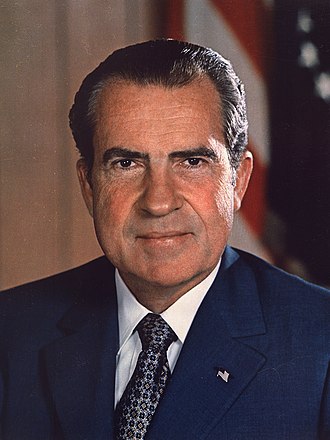
Richard M. Nixon served as the 37th President of the United States from January 1969 until his resignation in August 1974. In February 1971, he ordered the installation of a secret voice-activated taping system in the White House to preserve a historical record of his administration. Until the system's existence was revealed and dismantled in July 1973, the tapes captured Nixon directing major foreign policy initiatives, such as the opening to China, as well as his central role in the Watergate cover-up.
What Nixon talks about on the tapes
White House operations 4,718Presidential scheduling 2,225Public relations 1,784Presidential schedule 1,782Vietnam War 1,693Logistics 1,650Manolo Sanchez 1,626White House communications 1,400White House administration 1,399Presidential communication 1,243Henry Kissinger 1,191Foreign Policy 1,183
Conversations (21,010)
— Page 75 of 211President Nixon contacted the White House operator to initiate a telephone call to Chief of Staff H.R. Haldeman. This brief administrative interaction served as a logistical step to facilitate direct communication between the President and his top aide late in the evening. No substantive policy discussions occurred during this brief exchange.
President Nixon and H. R. Haldeman reviewed public and political feedback regarding the President's recent televised interview with Dan Rather. The discussion highlighted the generally positive reception of Nixon's performance and policy positions, while specifically critiquing Rather’s antagonistic interviewing style. To capitalize on the public's perception of Rather's bias, Nixon directed Haldeman to coordinate with Charles Colson to generate a campaign of letters and wires criticizing the reporter's conduct.
President Nixon contacted the White House operator to facilitate a late-night telephone call to his personal secretary, Rose Mary Woods. The brief exchange served as a logistical request to establish communication with a key staff member. No further policy or administrative matters were addressed during this interaction.
President Nixon and his personal secretary Rose Mary Woods discussed the positive public and political reception of the President's recent television interview with Dan Rather. Woods relayed enthusiastic feedback from William P. Rogers and Donald Rumsfeld, both of whom praised Nixon's composed performance and criticized Rather's unprofessional, combative questioning. The conversation also touched upon the President's firm stance regarding amnesty for draft evaders and the treatment of prisoners of war, positions that Woods felt resonated well with the public.
President Nixon initiates a request for the White House operator to place a telephone call to Secretary of State William P. Rogers. This brief communication serves as a logistical directive to establish contact with his primary foreign policy advisor. No further substantive discussion occurs during this short exchange.
President Nixon and Secretary of State William P. Rogers discuss the positive reception and impact of the President's recent televised interview with Dan Rather. Rogers praises Nixon’s composed handling of Rather's antagonistic questioning, particularly regarding sensitive domestic and racial topics. The conversation concludes with administrative planning for upcoming meetings involving Gerard C. Smith regarding the Strategic Arms Limitation Treaty and trade discussions with Peter G. Peterson.
President Nixon contacted the White House operator to facilitate an immediate telephone connection with special counsel Charles W. Colson. The brief exchange served as a logistical step to initiate a direct line of communication between the President and his aide late at night. No substantive policy discussions occurred during this brief request for the operator's assistance.
President Nixon and Charles Colson reviewed positive public and media reactions to Nixon’s January 2 interview with CBS correspondent Dan Rather. The conversation focused on the political benefits of the President's performance, particularly his firm stance on delaying amnesty until the return of prisoners of war. Nixon directed Colson to continue pressuring Rather and to coordinate with White House staff to amplify the favorable coverage.
President Nixon contacted the White House operator late at night to request a connection to his personal secretary, Rose Mary Woods. The conversation was purely administrative, serving as a directive to facilitate official communication. No other policy matters or substantive political issues were addressed during the brief exchange.
President Nixon and his personal secretary, Rose Mary Woods, held a brief late-night telephone call to coordinate the President's sleep schedule and discuss his recent interview with CBS journalist Dan Rather. Woods provided her personal assessment of the interview's reception and updated the President regarding subsequent phone calls she had received concerning the broadcast. The conversation served primarily as a debriefing session to gauge public and media reaction before the President retired for the evening.
President Nixon contacted the White House operator to place a long-distance telephone call to his close friend and confidant, Charles G. "Bebe" Rebozo. The President provided the recipient's name and location in Florida to facilitate the connection. This brief exchange served solely as a logistical request for the operator to bridge the communication to Rebozo.
President Nixon and his close associate Bebe Rebozo discussed recent professional football developments involving the Miami Dolphins and their upcoming schedule against the Dallas Cowboys. The conversation also included the President’s assessment of a recent interview with journalist Dan Rather, specifically focusing on Rather’s preparation and the quality of his questioning. This informal exchange reflects the President’s reliance on Rebozo for casual discourse on both sports and media relations.
President Nixon initiated a late-night phone call through the White House operator to reach National Security Advisor Henry Kissinger. The primary purpose of the contact was to facilitate an urgent discussion following Kissinger's prior return call. The interaction concludes with the operator confirming the attempt to locate and connect Kissinger to the President.
President Nixon and Henry Kissinger debriefed regarding Nixon’s recent television interview with Dan Rather, focusing on the President’s performance and the interviewer's combative style. They agreed that Rather’s confrontational approach inadvertently benefited Nixon, allowing him to frame complex issues like the Vietnam War, POWs, and international relations within a broader, more favorable context. The two concluded that the President effectively navigated sensitive topics, including troop withdrawals and allegations of political maneuvering regarding Moscow and the PRC, while successfully portraying himself as a steady leader under pressure.
President Nixon and H. R. Haldeman met to coordinate the daily agenda, including upcoming staff meetings and private appointments. During the exchange, the discussion briefly devolved into an incoherent, repetitive verbal confrontation between the participants regarding the truthfulness of statements. No substantive policy decisions or actionable directives were established during this brief interaction.
President Nixon and H. R. Haldeman met to review the political fallout from Nixon’s recent television interview with Dan Rather and to coordinate the administration’s strategy for handling press relations. They discussed the President’s performance regarding key issues like the Vietnam War and the economy, as well as the potential political risks associated with future press conferences and equal-time requirements for Democratic opponents. Additionally, the pair coordinated logistics for the President's upcoming schedule and established a new protocol for receiving filtered, high-level daily news summaries prepared by staff.
President Nixon and H. R. Haldeman met to coordinate the President's schedule for upcoming briefings with key administration staff. The discussion centered on organizing logistics for meetings with senior advisors, including Charles Colson, George Shultz, and John Ehrlichman. This session served as a preparatory phase for a series of high-level administrative policy consultations.
President Nixon met with his aide Stephen B. Bull to coordinate logistical details regarding his daily schedule. The two reviewed upcoming appointments, specifically noting a meeting with Gerald L. Warren. Additionally, the President discussed preparations for a forthcoming telephone call to Richard A. Moore.
President Nixon initiates a request for the White House operator to place a telephone call to Richard A. Moore. This brief interaction serves as an administrative coordination step to establish communication with a member of the administration. No further policy or strategic developments are discussed during this exchange.
President Nixon and Henry Kissinger discussed strategies for the Strategic Arms Limitation Talks (SALT), specifically focusing on necessary legislation and the coordination of upcoming meetings. They reviewed the roles of Secretary of Defense Melvin Laird and Secretary of State William Rogers in these negotiations. The President finalized plans for an imminent phone call with Rogers to align administration policy regarding the arms control process.
President Nixon held a brief, five-minute meeting in the Oval Office with one or more unidentified individuals. Due to the unintelligible nature of the recording, the specific subject matter and any substantive decisions remain impossible to discern. No actionable information or historical developments can be attributed to this exchange.
President Nixon and Richard A. Moore reviewed the President's recent television interview with Dan Rather, comparing it unfavorably to his previous appearance with Howard K. Smith. They discussed specific inquiries Rather raised regarding the administration's political timing on Vietnam, foreign summits, and economic policy, as well as the President’s traditional views on social nomenclature like the term "Ms." The two concluded the meeting by assessing the strategic value of such televised interviews versus traditional press conferences for the administration's public image.
President Nixon met with Gerald L. Warren and Rose Mary Woods to assess the fallout and public reception of his recent televised interview with CBS correspondent Dan Rather. The participants reviewed Rather's confrontational tone and the specific subject matter covered, including the Vietnam War, POWs, and race relations. Nixon and Warren concluded that the interview was ultimately favorable for the President’s interests despite Rather's critical approach.
President Nixon initiates a request to the White House operator to place an urgent call to Secretary of State William P. Rogers. The brief exchange serves as a logistical bridge to connect the President with his cabinet member for high-level government consultation. No substantive policy matters were discussed during this initial contact.
President Nixon and Secretary of State William P. Rogers coordinated their strategy for an upcoming trade initiatives meeting, emphasizing a need to appear supportive of free trade while avoiding actual legislative action during an election year. Nixon explicitly instructed Rogers to manage the presentation to ensure that controversial tariff proposals would be effectively stifled without political fallout. The two also discussed personnel matters, including the decision to decline an appointment for Frederick M. Eaton and the planned announcement of Willis C. Armstrong as Assistant Secretary of State.
President Nixon and Henry Kissinger met to coordinate the National Security Advisor's upcoming professional schedule and logistical planning. The discussion focused on managing Kissinger’s time and prioritizing essential diplomatic commitments. The meeting served to align the administration's strategic agenda with Kissinger's immediate travel and consultation requirements.
President Nixon consulted with the White House operator to gather feedback regarding the public's perception of his recent performance in a televised interview. The discussion focused on the effectiveness of his delivery, particularly his forceful stance on the issues of peace and the treatment of American prisoners of war (POWs). The operator affirmed that the President’s assertive tone successfully conveyed his message to the audience.
President Nixon and Secretary of State William P. Rogers discuss the public perception and media handling of a recent administrative statement, specifically addressing clarification of past remarks in Time magazine. The President emphasizes the importance of precise messaging to ensure their policy stance remains clear and avoids political volatility. The brief meeting concludes with a procedural note regarding an upcoming departure announcement.
President Nixon and Henry Kissinger met to coordinate strategy for the upcoming SALT negotiations and a planned foreign policy speech regarding Vietnam. They discussed maintaining a firm negotiating position on ABM and SLBM weapon systems while managing public perception and potential domestic political criticism during an election year. Additionally, the President issued a directive requiring all U.S. diplomatic contacts with Bangladesh to be cleared through the White House to avoid jeopardizing sensitive relations with China.
President Nixon initiates a brief telephone call through the White House operator to contact Gerald L. Warren. The primary objective of the communication is to establish a direct line to Warren for further discussion. No substantive policy matters are addressed in this short administrative exchange.
President Nixon met with Rose Mary Woods, Manolo Sanchez, and others in the Oval Office to discuss administrative tasks, including the location of misplaced papers and the placement of a bust of John Foster Dulles in the Executive Office Building. The conversation prominently featured a review of Nixon's recent television interview with Dan Rather, during which Woods praised the President's composed demeanor despite Rather's aggressive questioning regarding the Vietnam War and the President's use of formal honorifics. Additionally, Nixon briefly consulted Gerald L. Warren regarding the scheduling and announcement of the upcoming State of the Union address.
President Nixon and Deputy Press Secretary Gerald L. Warren coordinated the public announcement of the upcoming State of the Union address. Nixon confirmed the date of January 20th at noon but deferred to H.R. Haldeman’s instruction to delay the release while ongoing congressional relations work was finalized. The President authorized Warren to proceed with the announcement once those internal preparations were completed.
President Nixon attempted to initiate a telephone call that ultimately remained incomplete. The recording captures background noise, including the voice of an unidentified woman discussing therapy, rather than a substantive exchange. No official business was conducted or decisions reached during this brief period of activity.
President Nixon and his personal secretary Rose Mary Woods briefly consulted regarding the whereabouts of missing important papers. Nixon questioned Woods about the contents of his outbox and whether aide Alexander Butterfield had collected any materials. They also discussed potential locations for the misplaced documents, including the possibility that they were left in the White House residence.
President Nixon met with his personal aide, Manolo Sanchez, to discuss the recovery of misplaced documents. Nixon provided specific instructions for Sanchez to search the presidential residence for a particular piece of paper he recalled setting aside. Sanchez was directed to depart immediately to locate and retrieve the missing item.
President Nixon met with Stephen B. Bull to coordinate his upcoming schedule and locate critical documents. The discussion primarily focused on arranging meetings involving Gerard C. Smith, William P. Rogers, and Henry Kissinger. Nixon emphasized the importance of retrieving specific notes, some of which may have been misplaced at the White House residence, and requested a follow-up call with Kissinger.
President Nixon met with Henry Kissinger, William Rogers, and Gerard C. Smith to coordinate strategy for the upcoming Strategic Arms Limitation Talks (SALT) in Vienna. The discussion focused on balancing domestic political pressures—specifically from conservative groups and Congress—against the objective of securing a verifiable arms control agreement with the Soviet Union. Nixon directed his team to treat the ABM agreement as a formal treaty while handling other components as executive agreements, and emphasized the need to project a position of strength to maintain public and legislative support.
President Nixon met with Stephen Bull and other staff members to review his upcoming daily schedule and address the urgent search for a set of misplaced papers. During the discussion, the President also reflected on recent media coverage, expressing frustration over cynical press questions regarding the political timing of his upcoming diplomatic visits to China and the Soviet Union. He noted that despite the hostile lines of inquiry, he maintained a composed and professional demeanor during his public appearances.
President Nixon and H. R. Haldeman met to coordinate the President's upcoming schedule and manage key personnel and budgetary meetings. They specifically addressed the roles of George P. Shultz and Caspar Weinberger regarding administrative priorities. The brief exchange also included a tangential historical reflection on political perceptions surrounding Lyndon B. Johnson’s past bombing decisions.
President Nixon and George P. Shultz met to discuss pending budgetary decisions, specifically focusing on the costs and political implications of the Medicare waiting period in the administration's health bill. The two addressed internal disagreements between Elliot Richardson and Caspar Weinberger regarding whether to maintain a 10-day waiting period or accept a 31-day compromise to avoid alienating elderly constituents. Additionally, the conversation touched upon the potential appointment of Marina von N. Whitman to the Council of Economic Advisors and the President's recent media appearance.
President Nixon directs the White House operator to place a telephone call to Jody Smith, the recently inaugurated mayor of Ayrshire, Iowa. Nixon notes that Smith is distinguished as the youngest mayor in the country and provides the operator with the necessary contact information. The President's primary objective is to initiate direct communication with the young local official.
President Nixon consulted with the White House operator to clarify technical logistical information, likely regarding timing or scheduling adjustments. The brief exchange focused on verifying specific numerical data related to an ongoing operation or system coordination. No major policy decisions were reached, as the discussion remained strictly procedural.
President Nixon met with his aide Stephen B. Bull to discuss adjustments to federal economic projections and the potential appointment of a woman to the Council of Economic Advisers. Nixon expressed confidence in his economic team, specifically noting the work of Herbert Stein, while deliberating on the optics and inclusion of a female representative on the council. This brief meeting served to refine internal staffing considerations and budgetary messaging.
President Nixon and H. R. Haldeman evaluated the technical production of the President’s recent television interview with Dan Rather, expressing dissatisfaction with the camera angles and framing. They discussed potential improvements for future media appearances to avoid unflattering visual effects. Additionally, the pair strategized on the political benefits of appointing a qualified woman to a government council, with the President directing Haldeman to gauge the support of key officials for a specific candidate.
President Nixon met with Clark MacGregor to discuss legislative strategy, the President's public image, and various diplomatic considerations. MacGregor briefed the President on a proposal by Anna Chennault for a potential summit of anti-communist Asian leaders, while also reporting on legislative outlooks for revenue sharing and welfare reform. Additionally, the two addressed recent media coverage, including a Dan Rather interview, and clarified rumors regarding MacGregor's potential appointment as Attorney General.
President Nixon called Jody Smith to congratulate him on his inauguration as the youngest mayor in the nation. The two discussed their shared backgrounds in working at service stations and their perspectives on community leadership. Nixon encouraged Smith's political career and expressed his hope to see the young mayor as a delegate at the upcoming Republican National Convention in San Diego.
In this extensive series of phone calls, President Nixon coordinates legislative and public relations strategy for the upcoming State of the Union address and the administration's Vietnam policy. He consults with key officials including Secretary of State William Rogers, Secretary of Defense Melvin Laird, and Henry Kissinger to finalize the decision to announce a further troop reduction to 69,000. Additionally, the President manages personnel matters, such as selecting Kenneth Rush as a successor, while also directing staff to launch a public campaign framing Senator Edmund Muskie as a proponent of busing.
President Nixon met with George P. Shultz and Caspar Weinberger to finalize the fiscal 1972 and 1973 federal budgets, focusing on managing spending and deficits. A major directive from the President was to reduce the federal civilian workforce, specifically ordering that a significant portion of these cuts be concentrated within the Washington, D.C. bureaucracy. The participants also discussed the political messaging required to frame these economic decisions and touched upon the President's recent television interview regarding foreign policy.
President Nixon hosted Clarence C. Hoffman, his wife, and associates including Charles W. Colson and John P. McGill to honor Hoffman with the American Trucking Association's 'Driver of the Year' award. The meeting served as a ceremonial event featuring a photo session with the White House press corps and the exchange of presidential gifts, such as cufflinks and pins. Discussions also touched briefly on Hoffman’s distinguished driving record and general conversation regarding current events and weather conditions in Minnesota.
President Nixon and George E. Allen exchanged New Year's greetings and discussed the political climate, including Nixon's high popularity rankings alongside Billy Graham. Nixon specifically solicited an anecdote from Allen regarding Harry Hopkins to use against Office of Management and Budget officials during budget negotiations. Additionally, the two men discussed the political necessity of recent U.S. bombing missions in North Vietnam as a means to protect American troops and facilitate withdrawal.
President Nixon met briefly with long-time associate and confidant George E. Allen for a ceremonial exchange. During the brief interaction, the two engaged in lighthearted conversation, culminating in the President presenting Allen with a medal. The exchange functioned primarily as a social gesture rather than a substantive policy discussion.
President Nixon instructed the White House operator to facilitate a conference call with Office of Management and Budget Director George P. Shultz and Deputy Director Caspar Weinberger. The objective of the call was to coordinate a direct discussion with his two key budget advisors. The operator confirmed the request and immediately initiated the process to connect the participants.
President Nixon recounted an anecdote about Harry Hopkins and the Works Progress Administration to George Shultz and Caspar Weinberger to illustrate his frustration with departmental budget or supply requests. The President used the story, which involved a director being told to have his workers 'lean on each other' rather than receive more shovels, as a directive for Shultz and Weinberger to relay a message of fiscal restraint to Secretary of Defense Melvin Laird. The call served as a lighthearted but firm instruction to curb administrative spending.
President Nixon initiates a brief administrative interaction with the White House operator to place an outgoing call. The discussion focuses on connecting the President to a specific party, serving as a routine logistical step in the administration of executive communications. No substantive policy matters or major decisions are recorded during this brief operator-assisted bridge.
President Nixon met with his aide, Stephen B. Bull, to coordinate logistics for upcoming White House photography sessions. The discussion focused on scheduling press appearances and arranging a photo opportunity involving White House photographer Oliver F. “Ollie” Atkins. This brief administrative consultation finalized the arrangements for these visual records of the presidency.
President Nixon met with George P. Shultz and Caspar Weinberger to discuss the visibility and media coverage of administration-related films being broadcast in Minnesota. The participants briefly noted the positive impact of this media exposure, though the brief discussion did not result in any formal policy decisions. The exchange functioned primarily as a casual briefing on public relations and ongoing outreach efforts.
President Nixon consulted with an aide regarding his upcoming schedule and the logistical arrangements for a lunch meeting with Jack J. Dreyfus, Jr. The discussion centered on finalizing the timing and duration of this appointment. No formal decisions were recorded during this brief administrative exchange.
President Nixon met with his personal aide, Stephen B. Bull, to coordinate the logistics and arrangements for an upcoming item on the President’s official schedule. This brief consultation served to finalize preparations for a forthcoming engagement. No further details were recorded regarding the specific meeting or action items discussed.
President Nixon met with representatives from the medical community, including John W. Kauffman and Jack A. L. Hahn, to discuss national health insurance policy and the administration's strategy for reforming the U.S. health care delivery system. Nixon expressed his strong opposition to the Kennedy bill, characterizing it as socialized medicine that would compromise the quality of care, while affirming his support for market-based improvements to the current system. The conversation also touched upon the implementation of Phase II wage and price controls within the hospital sector and the challenges of managing rising medical costs.
President Nixon contacted the White House operator to place an outgoing call to his daughter, Tricia Nixon Cox. The brief administrative exchange served solely to facilitate this personal connection. No other policy matters or professional developments were discussed during the brief interaction.
President Nixon and his daughter, Tricia Nixon Cox, discussed the public and political reception of his recent television appearance. They analyzed the antagonistic interviewing style of journalist Dan Rather, comparing it to a previous program hosted by Howard K. Smith, and reviewed specific segments of the interview concerning the Vietnam War, foreign policy, and domestic issues. The conversation also touched upon upcoming travel schedules for the First Family and minor political planning regarding the 1972 primary season.
President Nixon met with his aide, Stephen B. Bull, to coordinate his upcoming daily schedule. The discussion centered on logistics for an afternoon meeting with Jack J. Dreyfus, Jr., specifically confirming the Cabinet Room as the designated location. Bull received instructions to ensure the meeting remained on track for the scheduled 1:30 pm start time.
President Nixon held a series of brief meetings and phone calls involving staff members Stephen Bull and Alexander Butterfield, as well as his daughter Tricia Nixon Cox. The discussions primarily addressed administrative tasks, including the routing of official documents to Cabinet members and the CIA, alongside personal messages and scheduling updates. Additionally, the President engaged in a conversation regarding the utilization of medical technicians and nurses to improve efficiency in hospital care, emphasizing the need for expanded roles for non-physician medical staff.
President Nixon and an unidentified interlocutor discuss political strategy regarding Secretary of State William P. Rogers and the administration's broader policy objectives. The dialogue centers on the political optics of current war efforts, election year preparations, and the implications of the President's scheduled travel to Moscow. These reflections underscore the administration's focus on managing perceptions of policy decisions ahead of the upcoming election cycle.
President Nixon met with his aide, Stephen B. Bull, to briefly discuss scheduling matters. The primary focus of the brief interaction was the upcoming meeting with Jack J. Dreyfus, Jr. The President’s cryptic remark regarding a potential final quote suggests a momentary reflection on his public communications.
President Nixon met briefly with Jack J. Dreyfus, Jr. and Stephen B. Bull to coordinate a scheduling adjustment regarding an upcoming meeting. The discussion functioned primarily as a logistical check-in before the President transitioned to his residence. Dreyfus also briefly mentioned his travel plans to Florida prior to his departure.
President Nixon met with unidentified staff members to discuss administrative logistics and personnel issues within the White House. The conversation touched upon the President's public image and media consumption, as well as the scheduling of the upcoming State of the Union address for January 20th. Additionally, the President expressed frustration regarding the cleanliness of the office and directed staff to locate missing notes and documents he had recently handled.
President Nixon met with Jack J. Dreyfus, Jr. and Stephen B. Bull to discuss personal matters, including physical fitness, sports, and scheduling a meeting with Kenneth R. Cole. The conversation also touched upon a gift from Ambassador Walter H. Annenberg and a portrait of George Washington. The President concluded the meeting by agreeing to review an article provided by Dreyfus during his upcoming trip to California.
President Nixon met with his personal valet, Manolo Sanchez, to discuss arrangements for an upcoming medical appointment. The brief interaction focused on logistics, specifically ensuring that medical staff were prepared for the President's scheduled visit to a facility referred to as 'Lego 3.' Sanchez confirmed his role in coordinating the preparations before departing.
President Nixon met with an unknown woman to oversee a photography session, discussing the importance of projecting a "smiling" and "fun-looking" image for upcoming political appearances and campaign optics. Following the shoot, the conversation shifted to internal personnel and administrative management, including instructions to keep the White House grounds clean and orderly for official guests. The President and the attendee also touched upon the necessity of maintaining professionalism among the staff and ensuring that various official projects were properly executed and reported.
President Nixon met with an unknown individual and Alexander P. Butterfield to discuss the President's upcoming schedule and administrative arrangements. The meeting was characterized by confusion regarding the necessity of Butterfield’s presence, resulting in a brief interaction before he departed. Discussions briefly touched upon Charles W. Colson’s role in the scheduling process.
President Nixon consulted with Stephen B. Bull regarding his upcoming schedule and the need for a briefing from Peter G. Peterson. The discussion focused on coordinating a private update from Peterson concerning a recent Council on International Economic Policy meeting and trade legislation prior to a larger scheduled gathering. Nixon approved the request for a pre-meeting session to review Peterson’s materials and ensure he was prepared for subsequent discussions with cabinet-level officials.
President Nixon met with Charles Colson and other staff members to review his recent television interview with Dan Rather, focusing on the public and political reception of his performance. Nixon discussed his strategy for handling hostile media, the necessity of maintaining dignity under pressure, and the benefits of appearing as a 'dignified statesman' compared to the 'sniping' nature of the interviewer. Additionally, the conversation touched upon the 1972 presidential campaign, the administration's stance on primaries, and concerns regarding office cleanliness and staff protocol.
President Nixon and Secretary of the Interior Rogers C. B. Morton discussed planning a post-China trip environmental tour to showcase national parks and conservation efforts. Nixon also addressed a proposal from Theodore Roosevelt III regarding the donation of a historical letter from the Empress of China to President Theodore Roosevelt. The two agreed to have Rose Mary Woods facilitate the acquisition of the document for potential inclusion in the Presidential Library.
President Nixon met with Henry Ford II, Edwin D. Etherington, and others to discuss the funding, leadership, and programming of the National Center for Volunteer Action (NCVA), emphasizing the importance of private sector involvement to maintain the organization's credibility. Following their departure, Nixon met with Peter G. Peterson to strategize on trade legislation, specifically regarding the timing of gold price negotiations and the risks of protectionist measures in Congress. Nixon instructed the team to handle sensitive trade issues by utilizing an educational approach rather than risking legislative failures, while leveraging key aides to manage congressional and business expectations.
President Nixon met with his economic advisors and cabinet members to strategize the administration's approach to pending trade legislation and international monetary negotiations. A central focus was delaying the introduction of a trade bill until February to allow for ongoing negotiations with European and Japanese partners while avoiding negative links to the price of gold in Congressional hearings. The President emphasized the need for a long-term economic strategy and directed advisors to prepare a comprehensive plan for future trade expansion that would appease domestic protectionist concerns without committing to immediate, politically risky legislative action.
President Nixon instructed the White House operator to place an outgoing call to Secretary of State William P. Rogers. The brief exchange served as a logistical bridge to facilitate a direct conversation between the President and his top diplomat. This action initiated immediate communication between the two officials regarding undisclosed administrative or foreign policy matters.
President Nixon, Secretary of State William P. Rogers, and Attorney General John N. Mitchell discuss potential candidates for the U.S. Ambassadorship to Japan. The group decides to reject Fredrick M. Eaton for the position due to concerns over his age and the likelihood of a contentious confirmation process during an election year, while agreeing to offer him a future appointment. The participants pivot to vetting Robert S. Ingersoll, with the President tasking Rogers with evaluating whether Ingersoll’s professional background and personal toughness are suitable for the diplomatic post.
President Nixon met with John Mitchell and H.R. Haldeman to manage several administrative and political crises, most notably the escalating conflict between National Security Advisor Henry Kissinger and Secretary of State William Rogers. The discussion focused on controlling leaks regarding the India-Pakistan War, resolving bureaucratic friction ahead of the upcoming Moscow summit, and managing the political fallout from Jack Anderson’s columns. Additionally, the participants addressed personnel appointments, including the search for a new Deputy Secretary of Defense and the handling of various regional primary elections.
President Nixon instructed the White House operator to place an outgoing telephone call to Henry Kissinger. The request specifically identified that Kissinger was currently located in California. No other substantive matters were discussed during this brief administrative exchange.
President Nixon held a brief, one-minute meeting in the Oval Office with unidentified individuals. Due to the extremely short duration of the encounter and the absence of a transcript or log details, the specific substance of the discussion remains unknown. No policy decisions, developments, or action items can be discerned from this recording.
President Nixon consults with the White House operator to determine the whereabouts of Henry Kissinger. The President expresses urgency in locating Kissinger, instructing the operator to provide an update within thirty minutes. The brief exchange highlights the administrative logistics involved in tracking key national security advisors during the late evening hours.
President Nixon initiates a brief telephone exchange with the White House operator to request a connection to National Security Advisor Henry A. Kissinger. This interaction serves as an administrative bridge to facilitate direct communication between the President and his advisor regarding ongoing national security matters. The conversation concludes once the operator confirms the request to place the call.
President Nixon met with his personal valet, Manolo Sanchez, in the Old Executive Office Building. The primary purpose of the brief interaction was to facilitate an upcoming telephone call to National Security Advisor Henry Kissinger. Beyond these arrangements, the majority of the brief exchange remains restricted due to the withdrawal of personal content.
President Nixon consulted with the White House operator to facilitate an outgoing telephone connection. The brief interaction served as a logistical bridge to initiate a separate call, identified in the historical record as Conversation 18-16. No further policy or substantive administrative matters were discussed during this contact.
President Richard M. Nixon met with his personal valet, Manolo Sanchez, in the Old Executive Office Building for a brief, two-minute encounter. The discussion primarily involved personal matters, as indicated by the withdrawal of the recorded content under personal privacy exemptions. No substantive policy or political decisions resulted from this interaction.
President Nixon and Henry Kissinger discussed plans to involve Secretary of Defense Melvin Laird in the upcoming announcement regarding Vietnam troop withdrawals, with Nixon intending to have Laird lead the press briefing to bolster the administration's Vietnamization policy. They also reviewed the qualifications of David Kenneth Rush for a position within the Department of Defense, noting his suitability despite potential resistance from Laird. Additionally, the pair coordinated diplomatic responses regarding Sheikh Mujibur Rahman's return to Bangladesh, monitored the deteriorating political situation in Malta and Italy, and received an update on Alexander Haig's progress during his trip to China.
President Nixon and Henry Kissinger coordinate the messaging and logistics for an upcoming administrative announcement regarding Vietnam policy. Nixon decides to involve Secretary of Defense Melvin Laird in the announcement to allow him to field press questions and receive credit for Vietnam-related developments. The two also discuss personnel management, specifically vetting a candidate for a role under Laird, and deliberate on the diplomatic protocol of withholding immediate formal recognition of a foreign government.
President Nixon initiates a brief telephone call to the White House operator to be connected with Charles W. Colson. The interaction serves exclusively as an administrative request to facilitate a direct line of communication with his special counsel. No substantive policy discussions or decisions occur during this brief exchange.
President Nixon consulted with the White House operator to facilitate an outgoing call. This brief interaction served as a logistical step to connect the President with a third party. No substantive policy discussions or significant political decisions occurred during this brief exchange.
President Nixon utilized this session to record a formal memorandum for his personal files. This dictation served as an official internal documentation process following a brief period of restricted discussion. No further collaborative exchange or external policy deliberation occurred during this specific recording.
President Nixon and Charles Colson discussed the state of the 1972 Democratic primary race, focusing on the vulnerabilities of candidates like Edmund Muskie, specifically regarding his criticism of the administration's space shuttle proposal. The two men reviewed political intelligence on candidate fundraising, polling data across key primary states, and rumors surrounding Edward Kennedy’s personal life. Additionally, they evaluated the political benefit of successfully opposing Democratic-backed campaign finance legislation, noting that denying the opposition access to tax-funded campaign subsidies would force them to struggle with financial shortages during the primary season.
President Nixon and Charles Colson discuss the political fallout and economic implications of supporting the Supersonic Transport (SST) program, particularly regarding its impact on the aerospace industry and regional voter sentiment. The two men weigh the strategic value of the project against public perception and the likelihood of its failure. Additionally, the conversation touches upon managing external political actors and the potential for leveraging industry-related issues to secure political advantages.
President Nixon contacted the White House operator to facilitate an immediate telephone connection with his personal secretary, Rose Mary Woods. The brief exchange served as a routine administrative request to locate and connect the President to a key member of his inner staff. No policy matters or substantive political issues were addressed during this brief procedural communication.
President Nixon utilized this session in his Old Executive Office Building suite to record a memorandum for the file. This process involved playing back previous audio to document or clarify specific administrative records. The action served as a self-directed effort to maintain an official account of sensitive executive deliberations.
President Nixon consults with Rose Mary Woods to pivot from sending a letter to Maj. Gen. Leslie E. Brown’s mother, Nora L. Moore, to instead initiating a direct telephone call. The President, operating from the Executive Office Building, instructs Woods to enlist White House operators to locate the mother, potentially in Los Angeles, to facilitate a personal conversation. This action reflects a preference for direct presidential outreach over written correspondence.
President Nixon and his personal secretary Rose Mary Woods briefly discuss logistical arrangements for managing his telephone communications and potential administrative support. The conversation focuses on identifying a reliable operator or general staff member to facilitate calls and ensure connectivity with specific individuals. No major policy decisions are reached, as the dialogue remains centered on internal office procedures and staffing coordination.
President Nixon met with an unknown individual to discuss international trade relations, specifically referencing a representative from the Japanese Ministry of Trade. The brief exchange focused on identifying a specific official, Kanaka, associated with the ministry. No major policy decisions were recorded during this short, fragmented interaction.
President Nixon consulted with the White House operator to facilitate a personal phone call to Nora L. Moore, the mother of Major General Leslie E. Brown. The operator informed the President that a message had been left for Mrs. Moore to contact him upon her arrival at the General's residence. This exchange served as a logistical coordination to ensure the President could successfully reach his intended party.
President Nixon consulted with the White House operator to facilitate an outgoing call. This brief interaction served as a routine logistical step in the President's telecommunications workflow. No substantive policy matters or political developments were discussed during the exchange.