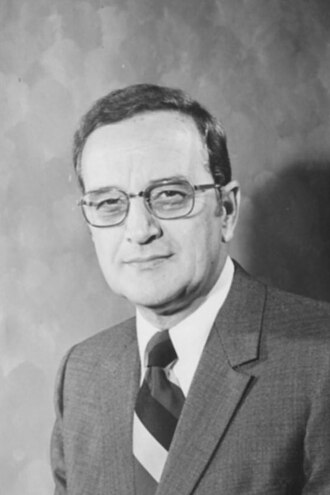
Buzhardt, J. Fred, Jr.
J. Fred Buzhardt Jr. began the Nixon administration as Special Assistant to the Assistant Secretary of Defense for Administration (February 1969 to June 1969) and Special Assistant to the Chairman of the Blue Ribbon Defense Panel (June 1969 to June 1970). During the majority of the White House taping period (February 1971 to July 1973), he served as General Counsel of the Department of Defense from August 1970 until May 1973, when he transitioned to the White House as Special White House Counsel for Watergate Matters to manage the president's escalating legal defense. In this role, he became the administration's primary legal authority on the newly revealed secret recordings, spending hundreds of hours reviewing the tapes before being elevated to White House Counsel in January 1974, a position he held until Nixon's resignation in August 1974.
President Nixon met with Alexander Haig, H. R. Haldeman, J. Fred Buzhardt, and others to strategize on the growing Watergate crisis, specifically focusing on the legal and political risks posed by Haldeman's personal notes. The group discussed the potential for these documents to be subpoenaed and the tension surrounding the use of executive privilege to protect them from grand jury scrutiny. Nixon emphasized his desire to gain control over these papers to avoid damaging misinterpretations and directed Buzhardt to serve as the primary legal counsel tasked with assessing the documents and managing the White House's defense strategy.
Alexander Haig and J. Fred Buzhardt, Jr. discuss the legal implications surrounding H.R. Haldeman’s possession of White House documents. The participants aim to clarify whether Haldeman improperly removed materials from the building, as Buzhardt expresses concern over a conflicting report from Haldeman’s lawyer. Haig emphasizes the necessity for caution regarding the defense's access to these records following his recent consultation with the President.
Alexander M. Haig, Jr. and J. Fred Buzhardt, Jr. coordinate an urgent, private meeting to take place at the Presidency office in the Executive Office Building. The brief exchange focuses primarily on logistical arrangements for their immediate face-to-face consultation. The conversation confirms that the two officials needed to convene promptly to discuss sensitive matters outside of standard telephone communication.
President Nixon met with J. Fred Buzhardt, Jr., to coordinate defense strategies and assess legal risks regarding the growing Watergate scandal and the impending Ervin Committee hearings. They discussed the potential legal implications of John Dean’s documents, the handling of White House records, and the broader fallout concerning national security wiretaps. The President emphasized the need for a rigorous, fact-based response while cautioning against any actions that could be perceived as an excessive use of executive power.
J. Fred Buzhardt, Jr. requested that the White House operator connect him to Doug Parker for an outgoing telephone call. This brief administrative interaction served as a logistical step to facilitate direct communication between legal staff. No substantive policy discussions or policy-related decisions occurred during this brief exchange.
J. Fred Buzhardt, Jr. and Doug Parker engaged in a brief check-in regarding the status of communication with Assistant Attorney General Henry E. Petersen. The primary purpose of the call was to ascertain whether Parker had received any updates or outreach from Petersen. No substantive developments occurred, as Parker confirmed he had not yet heard from him and agreed to notify Buzhardt upon receiving any further information.
Doug Parker and J. Fred Buzhardt, Jr. coordinated the delivery of sensitive documents belonging to John W. Dean, III to Assistant Attorney General Earl J. Silbert. The discussion addressed the reasons for a delay in the transfer and confirmed plans to inspect and copy the materials once they reached Silbert’s office. To resolve the lingering issues causing the holdup, Buzhardt committed to placing an immediate follow-up call to Assistant Attorney General Henry E. Petersen.
President Nixon and J. Fred Buzhardt discussed the contents of sensitive documents removed by John Dean, which Buzhardt identified as materials related to the Huston Plan concerning domestic intelligence collection rather than the Watergate scandal. Fearing that these classified records regarding U.S. intelligence capabilities could be leaked if released to the Ervin Committee, they strategized on methods to suppress the documents through the court system. Buzhardt was tasked with finalizing his identification of the materials and briefing Alexander Haig to ensure the administration was prepared for potential disclosure.
President Nixon and White House counsel J. Fred Buzhardt, Jr. discuss the contents of a mysterious 43-page document to determine if it involves sensitive national security matters or potential political liabilities. They deliberate on whether the information relates to domestic intelligence gathering and if it is appropriate or necessary to disclose these materials to a judge. Nixon ultimately praises Buzhardt's investigative progress and instructs him to provide a follow-up report on the document's implications.
President Nixon met with Alexander Haig and J. Fred Buzhardt to strategize on the burgeoning Watergate scandal, specifically focusing on John Dean's possession of sensitive documents and the potential for a damaging investigation into domestic intelligence operations. The participants discussed controlling the narrative surrounding CIA and NSA involvement, maintaining the loyalty of White House staff, and managing the political fallout of ongoing testimony. Additionally, Haig briefed the President on his recent discussions with John Connally regarding potential White House personnel changes, the appointment of a special prosecutor, and the necessity of presenting a strong, defiant front against congressional and legal pressures.
President Nixon and White House counsel J. Fred Buzhardt, Jr. discussed the identification and control of sensitive internal intelligence documents provided by John W. Dean, III. Buzhardt confirmed that he had secured materials including memos from Dean to John Mitchell and Tom Huston to H.R. Haldeman regarding 1970 intelligence operations. To mitigate potential exposure, the administration moved to secure the documents within the Justice Department and implement strict oversight for their storage.
President Nixon and legal counsel J. Fred Buzhardt, Jr. held a brief meeting to verify the status of undisclosed materials or records. Buzhardt confirmed that the requested items had been secured and reviewed, though he noted that the effort yielded unsuccessful or unproductive results. This exchange served as a status update regarding the handling of sensitive documentation amidst the unfolding Watergate investigation.
President Nixon met with his legal counsel, J. Fred Buzhardt, Jr., to address legal strategies concerning the ongoing Watergate investigation. The discussion focused on coordinating the administration’s response to inquiries and managing the complexities of potential testimony or evidence disclosure. No specific action items are detailed in the available record, as the conversation primarily served to align legal defenses during a critical phase of the scandal.
President Nixon consulted with White House counsel J. Fred Buzhardt regarding his recent meeting with Charles Colson and the ongoing evaluation of sensitive documents provided by John W. Dean. Buzhardt confirmed that the materials matched the President's description but noted they presented significant legal or political complications. The two agreed that Buzhardt should take the necessary time to complete his assessment and prepare a formal report for the President.
President Nixon met briefly with his counsel, J. Fred Buzhardt, Jr., to coordinate their schedules following an ongoing meeting. The discussion functioned primarily as a brief administrative exchange to ensure they were prepared to convene once Buzhardt became available. No substantive policy or legal strategy decisions were recorded during this brief encounter.
President Nixon initiated this brief exchange to coordinate an in-person meeting with White House counsel J. Fred Buzhardt, Jr. The President requested that Buzhardt come to the Oval Office immediately to discuss urgent matters. This logistical communication facilitated a follow-up session between the two key figures during the height of the Watergate investigation.
President Nixon met with J. Fred Buzhardt, Jr. and Alexander Haig, Jr. to discuss the legal and political implications of recently surfaced documents, specifically those related to the "Huston Plan" and its potential connection to the Watergate burglary. They analyzed how to manage the release of this sensitive, high-level intelligence information while attempting to separate the President's role from illegal activities, such as surreptitious entries. The participants concluded that they needed to identify the exact scope of past intelligence operations and develop a strategic communication plan—possibly a white paper—to justify the programs as necessary for domestic security during a period of civil unrest.
Special Counsel to the President J. Fred Buzhardt, Jr. contacted Robert C. Mardian to discuss the activities of an interagency committee formed to coordinate domestic intelligence. Buzhardt sought to clarify the committee's scope and verify whether it had conducted any surreptitious entries or illegal operations, specifically in light of documents released by the court related to John Dean. Mardian denied that the committee performed any covert actions, asserting it functioned only as an assessment group, and recommended that Buzhardt interview Bernie Welles to confirm these details.
President Nixon and J. Fred Buzhardt discussed the status of the "Huston Plan," specifically seeking evidence that the controversial intelligence program had been formally rescinded or terminated. They aimed to locate documentation of its termination to distance the White House from the plan and counter potential allegations that it provided a legal "cover" for the Watergate break-in. Nixon and Buzhardt speculated that John W. Dean may have attempted to use the document as a retroactive justification for his actions, and they agreed to coordinate with intelligence agencies to establish a clear record of the plan's cancellation.
President Nixon met with Alexander Haig and J. Fred Buzhardt to strategize their defense against emerging congressional inquiries related to the Watergate scandal and past national security operations. The participants focused on establishing that a controversial domestic intelligence plan—which had been recommended to the President—was formally suspended by White House officials shortly after its approval. They determined that they should let the Ervin Committee overreach on this issue, planning to use the resulting national security arguments to discredit the committee’s investigation while preparing witnesses to testify that the proposed operation was never implemented.
President Nixon and J. Fred Buzhardt, Jr. met to coordinate the White House's response to the Watergate scandal, specifically focusing on the 1970 'Huston Plan' and the potential release of incriminating documents held by John W. Dean III. The President and Buzhardt discussed the history of the intelligence plan's approval and subsequent suspension to ensure that the administration could argue that no illegal domestic surveillance activities were ever actually implemented. Nixon instructed Buzhardt to secure affidavits from relevant intelligence officials to establish the truth and mitigate public fallout, while emphasizing the need to maintain executive privilege regarding presidential conversations.
President Nixon met with Ronald Ziegler, Alexander Haig, and J. Fred Buzhardt to strategize the administration's response to escalating Watergate-related inquiries, specifically regarding CIA involvement, the 'Huston Plan,' and leaked documents. A central focus was managing the upcoming press briefings and public narrative to distance the President from illicit activities by framing actions as legitimate national security initiatives. They also addressed personnel moves, deciding to remove H.R. Haldeman and John Ehrlichman from the White House payroll to mitigate political optics while ensuring they remained restricted from sensitive files.
President Nixon consulted with J. Fred Buzhardt regarding the collection of affidavits from various officials to document that the Huston Plan was never fully implemented. Nixon emphasized the urgency of gathering these testimonies to prepare a defense strategy, while also discussing media efforts to highlight how upcoming Ervin Committee hearings might jeopardize ongoing legal trials. Finally, the President and Ronald Ziegler discussed countering allegations regarding a past political opponent's medical history, with Nixon demanding that negative information about the source of these rumors be leaked to the press to discredit the accuser.
President Nixon met with J. Fred Buzhardt, Jr. and Ronald L. Ziegler to develop a public relations strategy for countering the mounting pressure of the Watergate investigation. The President focused on shifting the narrative by emphasizing past threats against his family and administration, drawing parallels between current political opposition and historical radical movements. Nixon instructed his aides to compile data on violent demonstrations and security leaks to build a 'White Paper' or potential speech that would frame his actions as necessary for national security and the protection of society.
President Nixon and J. Fred Buzhardt discussed the status of their investigation into the 1970 "Huston Plan" ahead of potential scrutiny by the Ervin Committee. Buzhardt reported that records and staff recollections indicate the plan was a contingency study that was effectively abandoned following objections from J. Edgar Hoover. Nixon emphasized the importance of gathering documentary evidence and contextualizing the plan within the intense civil unrest of the era, such as the Kent State protests and threats against his administration. The two agreed on a strategy to document that the proposal never proceeded to implementation, intending to use this narrative to defend the administration’s actions.
President Nixon and J. Fred Buzhardt, Jr. discuss the ongoing gathering of affidavits and records related to the Huston Plan in preparation for potential defense strategies. The conversation also addresses the recent performance of witnesses before the Ervin Committee, with Nixon dismissing the committee's effectiveness and encouraging Buzhardt to focus on legal preparations rather than media coverage. Buzhardt reports on the status of various individuals, including Tom C. Huston and William C. Sullivan, who are assisting in the documentation process.
President Nixon and J. Fred Buzhardt, Jr. met to meticulously craft the language for a forthcoming White House "White Paper" regarding the Watergate scandal. The discussion focused on defining the President’s timeline of knowledge concerning the Daniel Ellsberg break-in and his interactions with Henry Petersen and other Justice Department officials. By emphasizing the "national security" nature of these events, they sought to clarify the President's position and minimize his direct involvement or culpability in the burgeoning cover-up investigation.
President Nixon directs White House Counsel J. Fred Buzhardt, Jr. to relocate from his office to the President's location for a private briefing. The meeting serves to coordinate their ongoing efforts regarding an unspecified administrative problem that the President is currently addressing. This brief exchange functions as a logistical prompt to facilitate an immediate, in-person consultation on sensitive legal or political matters.
President Nixon and J. Fred Buzhardt, Jr. held a brief exchange to coordinate an immediate meeting. The conversation served primarily as a logistical check to confirm Buzhardt's location following his scheduled session. The two agreed to convene shortly thereafter to review ongoing materials and case developments.
President Nixon and J. Fred Buzhardt, Jr. met to coordinate the preparation of a White House 'White Paper' intended to manage public and legal fallout from the ongoing Watergate investigation. The discussion focused on refining the document’s narrative regarding the Daniel Ellsberg break-in and defining the limits of executive privilege concerning staff memoranda and sensitive presidential communications. Nixon emphasized the necessity of a proactive, non-defensive public stance, directing Buzhardt to ensure that key internal documents and notes remain protected from congressional committee scrutiny.
President Nixon met with Alexander Haig and J. Fred Buzhardt to strategize the drafting of a White House 'White Paper' intended to manage public and legal fallout from the Watergate investigation. The discussion focused heavily on refining the document's phraseology regarding the President's knowledge of the Huston Plan, the break-in at Daniel Ellsberg's psychiatrist's office, and other controversial intelligence activities. Nixon sought to craft a narrative that assumed generalized responsibility for the actions of 'overzealous' staff members to protect the administration while distancing himself from specific authorization of illegal acts.
President Nixon met with Raymond Price, Alexander Haig, and J. Fred Buzhardt to strategize the content and presentation of a White House White Paper regarding the Watergate scandal. The group focused on drafting a cover statement that addressed specific controversies, including the funding of defendants, the Ellsberg break-in, and the involvement of key aides like H.R. Haldeman and John Ehrlichman. They also discussed plans to brief influential Congressional leaders, such as Henry Jackson and Barry Goldwater, to ensure consistent messaging regarding prior statements and wiretaps.
President Nixon consulted with William E. Timmons to discuss the effectiveness of a recent meeting with Republican Congressional leadership. Nixon explained that his earlier critical stance toward Timmons and his staff was a deliberate tactical move to address the concerns of Congressional members. The President expressed his full appreciation for the hard work of Timmons, Thomas C. Korologos, and the Congressional relations team, instructing Timmons to relay this gratitude to his staff.
President Nixon met with J. Fred Buzhardt to discuss the White House's legal strategy regarding Watergate, specifically focusing on handling subpoenas for documents and managing executive privilege. They reviewed procedural approaches to resist blanket subpoenas by arguing for case-by-case determinations based on the national interest, as well as the potential implications of John Dean’s forthcoming testimony. Nixon and Buzhardt also assessed the risks of conflicting recollections among White House staff and evaluated the President's public position regarding the ongoing investigations.
Alexander M. Haig, Jr. and J. Fred Buzhardt, Jr. discuss the administration's response to press reports regarding a potential subpoena from Samuel Dash, chief counsel for the Senate Watergate Committee. Buzhardt confirms he communicated with Dash to dispute the reports, noting that Dash denied ever stating an intention to issue a subpoena. The participants coordinate efforts to have the record publicly corrected to mitigate the political fallout.
President Nixon met with Alexander Haig and J. Fred Buzhardt to strategize on managing ongoing Watergate disclosures and to discuss potential personnel changes within the White House staff. The conversation focused heavily on the administration's public relations response to subpoenas and media coverage, specifically regarding wiretap information and the handling of presidential papers. Additionally, the participants deliberated on potential economic policies, including a possible price freeze, and considered how to integrate John Connally into a special advisory role to strengthen leadership visibility.
President Nixon directs J. Fred Buzhardt, Jr. to coordinate with Leonard Garment regarding a confrontational response to Senate counsel Samuel Dash concerning leaked information about White House cooperation with the Watergate investigation. Nixon emphasizes that the administration must manage public perception and media narratives regarding the release of materials, rather than focusing on logistical logs. The President instructs Buzhardt to demand a public statement from Dash, threatening that the White House will initiate a critical media campaign if the administration's cooperation is not properly acknowledged.
President Nixon met with his legal team and senior advisors, including Charles Wright, Alexander Haig, and J. Fred Buzhardt, to formulate a legal and public relations strategy regarding the intensifying Watergate investigation. The discussion focused on countering potential testimony from John Dean, particularly regarding his meetings with the President, and managing the risks posed by the Ervin Committee's upcoming hearings. The participants strategized on how to undermine Dean's credibility through targeted cross-examination by Fred Thompson and agreed on the necessity of maintaining a firm stance on executive privilege while preparing for further investigative challenges.
President Nixon instructed his attorney, J. Fred Buzhardt, Jr., on the strategy for an upcoming meeting with Special Prosecutor Archibald Cox regarding the Watergate investigation. Nixon directed Buzhardt to project an image of full cooperation while maintaining a firm refusal to turn over sensitive presidential papers to avoid a constitutional crisis. Furthermore, Nixon urged Buzhardt to aggressively confront Cox about allegations that his staff was motivated by a desire to target the President, while simultaneously expressing absolute confidence that John Dean's testimony would ultimately prove Nixon's innocence.
President Nixon met with his legal counsel, J. Fred Buzhardt, Jr., to discuss the administration's ongoing cooperation with investigations and to coordinate a defensive strategy. Nixon commended Buzhardt’s recent legal work and emphasized that the White House would maintain a cooperative stance while remaining prepared for a political confrontation. The President firmly asserted his innocence regarding the matters under scrutiny and instructed Buzhardt to rebuff any attempts to obstruct their legal position.
President Nixon consults with J. Fred Buzhardt, Jr. regarding his upcoming meeting with Special Prosecutor Archibald Cox to gauge the potential for a hostile confrontation. The President expresses concern that Cox might intentionally provoke a conflict to justify a resignation, prompting the two to strategize on how to manage the interaction. They conclude by scheduling a follow-up briefing to occur after the President finishes a concurrent meeting with Congressional leadership.
President Nixon and White House counsel J. Fred Buzhardt, Jr. engaged in a brief exchange to confirm the scheduling of an upcoming afternoon meeting. The conversation served primarily as a logistical check to ensure the President was aware of the pending appointment with an unidentified individual. No substantive policy discussions or significant decisions were reached during this short interaction.
President Nixon initiates a brief telephone call to J. Fred Buzhardt, Jr. to coordinate an immediate meeting at the Executive Office Building. This conversation serves as a logistical bridge to facilitate an in-person discussion regarding Buzhardt's ongoing activities, specifically his interactions with special prosecutor Archibald Cox. The primary objective is to confirm Buzhardt's availability and expedite his arrival for a private briefing.
President Nixon initiated a brief contact with J. Fred Buzhardt, Jr. to coordinate a follow-up meeting. Nixon requested that Buzhardt come to his office in the Old Executive Office Building to discuss ongoing legal or administrative matters. The conversation served primarily as an administrative bridge to facilitate a more substantive, private discussion between the two men.
President Nixon met with J. Fred Buzhardt to review the status of the ongoing Watergate investigation and discuss the aggressive, broad-ranging document and testimony requests made by Special Prosecutor Archibald Cox. Buzhardt characterized Cox’s efforts as an attempt to overstep his mandate and challenge executive privilege, leading to a strategy of forcing Cox to formally request items in writing to maintain administrative control. Nixon and Buzhardt agreed to resist these demands firmly, preparing for an inevitable future confrontation or subpoena while emphasizing the necessity of protecting the constitutional integrity of the presidency.
President Nixon met with J. Fred Buzhardt, Jr. to discuss legal strategy regarding the Watergate scandal, focusing specifically on managing the upcoming testimony of Richard A. Moore and John W. Dean. The conversation addressed the potential for Dean to secure immunity, the risks associated with various depositions, and the handling of sensitive documents related to ITT and the break-in at Daniel Ellsberg's psychiatrist's office. Nixon emphasized the importance of keeping the White House's internal documents and tapes secure while working to ensure that upcoming testimony from associates like Henry Petersen would support the administration's position.
President Nixon and J. Fred Buzhardt discussed legal strategies for managing ongoing Watergate investigations, specifically focusing on potential testimony from Henry Petersen, Richard Moore, and John Dean. They reviewed the discrepancies in Dean's memory regarding his White House meetings and discussed the risks of Special Prosecutor Archibald Cox’s requests for presidential appointment logs. Nixon emphasized that he must maintain the position that he has 'nothing to hide' while Buzhardt prepared to invoke executive privilege to protect the separation of powers and limit the scope of the inquiry.
President Nixon met with J. Fred Buzhardt to strategize the legal defense against John Dean's anticipated testimony before the Ervin Committee. The discussion focused on establishing procedures for cross-examining Dean, reviewing White House documents for inconsistencies, and addressing concerns about potential claims of tape recordings. Nixon and Buzhardt also assessed the ongoing investigation by Henry Petersen and discussed the political fallout and public perception regarding the Watergate hearings.
President Nixon and J. Fred Buzhardt discussed legal strategy regarding the upcoming Watergate hearings, specifically focusing on coordinating with Fred D. Thompson for the cross-examination of John Dean. Buzhardt reported on his recent meetings with Thompson and Henry Petersen, highlighting the potential for shifting the committee's focus toward Democratic campaign financing and the increasingly political nature of the hearings. The participants emphasized the need to prepare a detailed chronology of the President's interactions with Dean to challenge his anticipated testimony and mitigate potential legal damage.
President Nixon and J. Fred Buzhardt, Jr. discuss the legal implications of the Ervin Committee's grant of immunity to John Dean and the anticipated strategy for his upcoming testimony. They strategize on undermining Dean's credibility and decide to withhold their cross-examination plan until after his private session, allowing them to better prepare for his public testimony. Additionally, Nixon encourages Buzhardt to pressure the Government Accountability Office (GAO) to release information regarding Democratic campaign finances as a counter-offensive strategy.
President Nixon and J. Fred Buzhardt, Jr. discuss the ongoing Watergate investigation and the public perception of the administration's involvement. The two men review the political implications of the case, expressing frustration over public sentiment and the perceived bias of investigators, while emphasizing the need to frame their own narrative. Nixon explicitly rejects any possibility of delaying the proceedings, insisting that the administration must maintain a posture of transparency and innocence regarding the scandal.
President Nixon and J. Fred Buzhardt, Jr. discussed strategies for conducting a rigorous cross-examination of John Dean in anticipation of his upcoming testimony before the Ervin Committee. The President emphasized highlighting Dean’s failure to report key information to the Department of Justice, despite his regular access to officials like L. Patrick Gray and Henry Petersen. They further reviewed chronological evidence to prove that Dean’s involvement in fund-raising and obstruction predated his meetings with the President, with the goal of undermining Dean's credibility and distancing the White House from his illicit activities.
President Nixon met with his counsel J. Fred Buzhardt to strategize the administration's defense regarding the Watergate scandal, specifically focusing on John Dean's conduct and credibility. Nixon emphasized the need for a general denial strategy, suggesting that Dean's failure to report information directly to the President proves Dean withheld details of the cover-up. They discussed potential lines of questioning to undermine Dean's narrative and explored the legal defense surrounding national security claims and hush money demands.
President Nixon and J. Fred Buzhardt, Jr. discussed strategies to discredit John W. Dean III and Jeb Stuart Magruder ahead of their anticipated testimony before the Ervin Committee. They reviewed documentation, including meeting logs and briefing materials, that they believed could expose inconsistencies in Dean's timeline and claims regarding his investigation into White House involvement in Watergate. The President and Buzhardt decided to prepare a sharp public response to counter potential media leaks of Dean's testimony while planning to use cross-examination to highlight his lack of credibility and personal motive to lie.
President Nixon and White House counsel J. Fred Buzhardt, Jr. met to discuss legal defense strategies regarding ongoing investigations and potential witness reliability. The conversation centered on concerns regarding a witness's propensity for lying and the risk that their testimony could undermine the administration's legal position. They weighed the strategic implications of how specific evidence or documentation might be contested or utilized during formal proceedings.
President Nixon and J. Fred Buzhardt, Jr. coordinate a meeting to review drafts and notes related to ongoing legal or administrative matters. The President requests an hour of Buzhardt’s time to work through these materials comprehensively during the day. Buzhardt confirms his availability and agrees to head to the White House immediately to begin the session.
President Nixon and White House counsel J. Fred Buzhardt, Jr. coordinate a meeting to review ongoing legal materials. The participants discuss scheduling an hour-long session to process documentation, with the President prioritizing a thorough review over immediate speed. No specific policy decisions were finalized, but the exchange highlights the logistical planning required to manage sensitive White House records.
President Nixon met with J. Fred Buzhardt, Jr. to coordinate the White House's strategy for addressing the escalating Watergate scandal and the forthcoming Ervin Committee hearings. They engaged in a detailed review of internal chronologies and presidential recollections, focusing specifically on John W. Dean III's credibility, potential testimony, and his role in the cover-up. The conversation underscored the necessity of formulating a unified response to Special Prosecutor Archibald Cox and managing the political risks associated with the potential release of sensitive documents and recordings.
President Nixon met with J. Fred Buzhardt, Jr., Ronald L. Ziegler, and Henry A. Kissinger to manage the intensifying political fallout from the Watergate scandal. The discussion focused on countering the testimony of key figures like John Dean and Jeb Magruder, specifically addressing their allegations regarding the White House's involvement in a cover-up and potential efforts to influence civil litigation. Nixon expressed frustration over the perceived lack of support from Republican legislators and strategized with his team on how to discredit Dean's testimony while maintaining the President's public narrative of non-involvement.
President Nixon met with J. Fred Buzhardt, Jr. and others to discuss strategies for discrediting John Dean in advance of his testimony before the Senate Watergate (Ervin) Committee. The participants focused on leaking evidence regarding Dean's alleged personal misuse of funds to portray him as a common thief rather than a whistleblower motivated by principle. Nixon and Buzhardt reviewed the status of witness preparation and emphasized the importance of using these financial revelations to gain leverage and undermine Dean's credibility with both the committee and the public.
President Nixon met with Alexander Haig, Ronald Ziegler, and J. Fred Buzhardt to discuss ongoing Watergate fallout and strategy, specifically focusing on the upcoming testimony of former White House counsel John Dean before the Ervin Committee. The participants expressed frustration with the lack of aggressive public defense by Republican allies and the perceived bias of special prosecutor Archibald Cox, prompting discussions on how to better leverage allies to challenge Dean's credibility and the scope of Cox's investigation. Additionally, the President reviewed his economic recovery program and the status of Leonid Brezhnev's state visit, stressing the importance of controlling the media narrative during these high-stakes events.
President Nixon consulted with J. Fred Buzhardt, Jr. regarding his immediate schedule and availability for a meeting. The brief exchange served to coordinate the President's upcoming activities, resulting in Buzhardt being instructed to come to the Oval Office. This interaction facilitated direct access between the President and his legal counsel during the height of the Watergate-related investigations.
President Nixon met briefly with White House special counsel J. Fred Buzhardt, Jr. to discuss matters related to the ongoing Watergate investigation. The extremely brief interaction reflects the high level of urgency and concern surrounding the administration's legal defense at the time. No specific directives were recorded, as the conversation primarily served to acknowledge pressing developments in the case.
President Nixon met with Alexander Haig, J. Fred Buzhardt, and Melvin Laird to discuss ongoing challenges including the Watergate scandal and upcoming administrative transitions. They reviewed the status of John Dean's legal situation, focusing on his handling of campaign funds and the political advantage of exposing his alleged financial impropriety through press coverage. Furthermore, the group discussed personnel adjustments, including bringing Bryce Harlow onto the White House staff, and coordinated legislative strategies regarding a pending House vote on Cambodia funding and the implementation of the Phase IV economic program.
President Nixon initiates a brief telephone call to summon J. Fred Buzhardt, Jr. to the Oval Office for an immediate meeting. The discussion is strictly logistical, serving to confirm Buzhardt's location and request his presence for a follow-up consultation. No specific policy or legal matters are addressed during this brief exchange, as the conversation functions solely as a scheduling maneuver.
President Nixon summoned J. Fred Buzhardt, Jr. to his office for a brief, informal meeting. The discussion primarily functioned as a prompt to facilitate an immediate in-person consultation between the two men. No substantive policy or legal matters were detailed during this brief exchange.
President Nixon and J. Fred Buzhardt discuss the ongoing Watergate investigations, focusing on strategies to manage public perception and counter testimony from John Dean and other witnesses. They evaluate the effectiveness of the Senate committee's investigation, analyze the flow of hush money, and consider potential legal avenues to discredit damaging claims, including the possibility of a presidential press conference once the Senate hearings conclude. The conversation emphasizes the need to maintain a defensive legal posture while avoiding direct confrontation that might legitimize their political opponents' narratives.
President Nixon met with J. Fred Buzhardt, Jr. and Alexander M. Haig, Jr. to coordinate the White House's defensive strategy regarding John Dean’s anticipated testimony before the Ervin Committee. The participants discussed strategies to undermine Dean’s credibility by focusing on his financial activities, his potential misuse of funds, and his failure to adhere to conflict-of-interest standards. They also reviewed concerns regarding leaked documents, the media’s handling of Watergate coverage, and the perceived lack of objectivity by certain journalists and senators, aiming to prepare a public response to mitigate political damage.