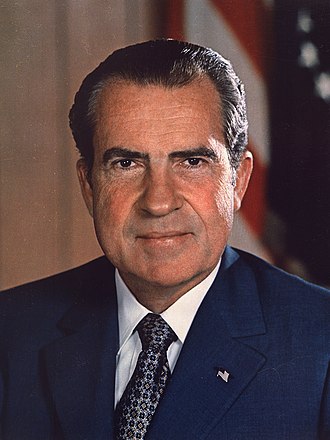
Nixon, Richard M. (President)
Richard M. Nixon served as the 37th President of the United States from January 1969 until his resignation in August 1974. In February 1971, he ordered the installation of a secret voice-activated taping system in the White House to preserve a historical record of his administration. Until the system's existence was revealed and dismantled in July 1973, the tapes captured Nixon directing major foreign policy initiatives, such as the opening to China, as well as his central role in the Watergate cover-up.
What Nixon talks about on the tapes
White House operations 4,718Presidential scheduling 2,225Public relations 1,784Presidential schedule 1,782Vietnam War 1,693Logistics 1,650Manolo Sanchez 1,626White House communications 1,400White House administration 1,399Presidential communication 1,243Henry Kissinger 1,191Foreign Policy 1,183
Conversations (21,010)
— Page 88 of 211President Nixon and Stephen B. Bull reviewed the President’s upcoming schedule to manage various executive and legislative priorities. They discussed arrangements for meetings with George H. Mahon, Otto E. Passman, and Henry Kissinger, alongside a request from John D. Ehrlichman and Edward L. Morgan to discuss the administration's stance on busing. The conversation focused on coordination of these engagements to ensure the President remains in control of key policy decisions.
President Nixon met with Representative George H. Mahon, Texas Tech University President Grover E. Murray, and other academic representatives to discuss a formal invitation for the President to address the upcoming American Society for Engineering Education conference in Annapolis. The participants also engaged in informal conversation regarding upcoming visits, the presentation of photographs and personal memorabilia for a presidential display at Odessa College, and general political pleasantries. Nixon agreed to consider the speaking invitation and facilitated a photo opportunity with the visiting delegation.
President Nixon met with an unknown individual to exchange gifts, including an item purchased in Chinatown intended for Augusta College. The conversation, which was informal and brief, also included lighthearted banter about travel plans and a missing photograph. No substantive policy or political decisions were made during this social interaction.
President Nixon met with Representative Otto E. Passman, Henry Kissinger, and Richard K. Cook to discuss legislative strategy regarding the 1973 foreign assistance bill and the administration's budget priorities. Passman, a key legislator on foreign aid, affirmed his strong support for the President's military assistance and Vietnam-related policies while expressing deep skepticism toward multilateral aid programs and the Peace Corps. The President and his team secured Passman's commitment to assist with funding for critical national security needs, specifically mentioning potential requirements for operations in Cambodia, while agreeing to keep Passman informed through Kissinger when urgent matters arise.
President Nixon consulted with his aide, Stephen B. Bull, to clarify the details and timing of an upcoming meeting with John D. Ehrlichman. The discussion centered on managing the President's daily schedule and ensuring proper coordination of his appointments. Nixon emphasized the necessity of maintaining order in his briefing agenda, tasking Bull with confirming the specific logistical arrangements for the meeting.
President Nixon and John Ehrlichman met to discuss the President's upcoming public statement on busing, specifically reviewing a draft prepared by Raymond K. Price, Jr. They also coordinated scheduling for an upcoming meeting with Nassir Assar concerning the Central Treaty Organization (CENTO). The discussion centered on balancing policy substance with the rhetorical tone of the busing announcement.
President Nixon and Stephen B. Bull reviewed the presidential schedule, focusing on the timing of upcoming meetings and the coordination of messaging. They specifically discussed the need to sharpen political talking points and confirmed a morning meeting for the following day. The dialogue underscores Nixon’s hands-on management of staff appointments and his desire to refine the administration's public presentation.
President Nixon consulted with a White House operator to manage his immediate schedule and availability for incoming calls or meetings. The discussion centered on the President's current window of free time, lasting approximately ten to fifteen minutes. The exchange highlights the logistical coordination required to manage the President's workflow and communication access during the workday.
President Nixon met with Charles Colson, Kenneth Clawson, and others to discuss public relations strategies regarding the burgeoning ITT controversy and the authenticity of the Dita Beard memorandum. The participants expressed concerns that the memo was a fabrication, likely manipulated by Jack Anderson or his staff, and strategized on ways to discredit the document while navigating negative media coverage orchestrated by political opponents, including Senator Ted Kennedy. The President emphasized his belief that the memo was logically inconsistent and forged, instructing his staff to aggressively investigate its origins and use the findings to protect the administration from scandal.
President Nixon met with his senior advisors, including H.R. Haldeman and Charles Colson, to coordinate a strategy for neutralizing the ongoing ITT controversy and the accompanying negative press coverage. The discussion focused on discrediting the 'Beard memorandum' through forensic typewriting analysis and managing the potential damage from Senate hearings regarding Attorney General Richard Kleindienst’s confirmation. Nixon emphasized a policy of aggressive pushback against smear campaigns, referencing his past experience with the Alger Hiss case, while also firming up his administration's position to avoid any personnel resignations under political pressure.
President Nixon spoke with James Keogh to acknowledge receipt of an autographed copy of Keogh's book, *President Nixon and the Press*. The conversation touched upon the content of the work, its comparison to Edith Efron's *The News Twister*, and brief mentions of personnel like Kenneth Clawson. Additionally, the two discussed research progress for Keogh's forthcoming project, including contributions from Charles "Bebe" Rebozo and Hobart Lewis.
President Nixon contacted the White House operator to facilitate a telephone call to First Lady Thelma C. (“Pat”) Nixon. The brief interaction served as a formal request to establish a connection with the First Lady. No further substantive policy matters or administrative decisions were addressed during this specific bridge call.
President Nixon and First Lady Pat Nixon discussed the logistics surrounding the arrival of giant pandas at the National Zoo, including potential media coverage and the First Lady's participation in related events. The conversation also touched upon the upcoming swearing-in ceremony for Marina von N. Whitman to the Council of Economic Advisers, specifically noting the reaction of her children. Additionally, the President briefly mentioned his schedule regarding the ongoing issue of school busing, referencing consultations with John Ehrlichman and Edward Morgan.
President Nixon dictates a series of directives to H.R. Haldeman concerning administrative scheduling, press strategy, and political messaging. The President outlines plans for an upcoming White House church service featuring the Army Chorus and suggests using Henry Kissinger's meetings with political groups to manage his schedule. Furthermore, Nixon orders research into the growth of ITT during the Kennedy and Johnson administrations to bolster the administration’s defense against antitrust criticism and requests historical precedents of media bias regarding the House Un-American Activities Committee to support his public relations efforts.
President Nixon consulted with an unidentified individual regarding the handling of specific administrative tasks and sensitive documentation. The discussion centered on the transcription process involving H.R. Haldeman, Rose Mary Woods, and Marjorie P. Acker. This brief interaction served to coordinate the secretarial responsibilities and internal processing of official memoranda.
President Nixon consulted with his personal valet, Manolo Sanchez, regarding the coordination of a specific individual's schedule. Nixon instructed Sanchez to verify the person's availability and ensure the necessary administrative clearance was obtained. The brief exchange focused on the logistical management of staff or guest appointments.
President Nixon and H. R. Haldeman consulted regarding the logistical planning and public announcement for the President's upcoming trip to Canada. A primary focus of the discussion involved determining the potential travel schedule and official participation of First Lady Pat Nixon. The pair coordinated the timing of the state visit's public release to ensure alignment with broader administrative objectives.
President Nixon met with H. R. Haldeman in the Old Executive Office Building for a brief, one-minute consultation. Given the lack of a transcript or accompanying documentation, the specific subject matter and potential action items remain unrecorded. This conversation serves as an archival record of their brief administrative interaction during the 1972 election year.
President Nixon and Henry Kissinger discussed the logistical planning for the upcoming presidential summit in the Soviet Union, specifically focusing on the composition of the official delegation and the inclusion of First Lady Pat Nixon. The pair also evaluated potential ambassadorial candidates for Cambodia, weighing the strategic benefits of a military versus a diplomatic background for the post. Nixon emphasized the importance of military experience in the context of ongoing pacification efforts and U.S. assistance programs in the region.
President Nixon and Henry Kissinger met to discuss the potential appointment or utilization of a specific military official, reflecting on the candidate's professional capabilities and personal reliability. Despite expressing reservations about trusting the individual, Nixon acknowledged the candidate's hard-working nature and expertise. The brief exchange focused on evaluating this figure's suitability for a role requiring military credibility.
President Nixon contacted the White House operator to facilitate a telephone connection with Press Secretary Ronald L. Ziegler. This brief administrative exchange served solely to initiate official communication between the President and his press office. No further substantive matters were recorded during this brief interaction.
President Nixon consulted with the White House operator to facilitate an outgoing call. The interaction served administrative purposes to connect the President with a third party. No substantive policy discussions or policy decisions were recorded during this brief logistical exchange.
President Nixon and Press Secretary Ronald L. Ziegler coordinated messaging strategies for upcoming press briefings, specifically regarding contentious political issues like school busing and the ongoing ITT controversy. They analyzed the political implications of the ITT scandal, including potential connections to Peter M. Flanigan and the role of campaign contributions in the broader debate. Additionally, they touched upon the public reception of a book by James Keogh and addressed logistical details concerning the arrival of pandas at the National Zoo.
President Nixon and Press Secretary Ronald Ziegler discuss media coverage and political strategy, specifically regarding allegations of conflict of interest involving John Flanagan and the firm Dillon Reed. Nixon expresses frustration over the perceived reach of these accusations and questions the motivations behind the negative press coverage. The conversation concludes with the President instructing Ziegler to monitor these narratives closely and respond firmly to any further public criticism.
President Nixon contacted the White House operator to place an outgoing call to special counsel Charles W. Colson. This communication served as a brief administrative bridge to facilitate a direct discussion between the President and a key political aide. No further dialogue was recorded on this specific line.
President Nixon consulted with the White House operator to facilitate a communication request. This brief interaction served as a logistical step to connect the President with another party for an official call. No substantive policy discussions occurred during this brief administrative exchange.
President Nixon and Charles Colson discuss strategies for managing negative press coverage regarding the International Telephone and Telegraph (ITT) scandal. They specifically address efforts to influence the Washington Star and journalist Smith Hempstone, as well as the investigation into Dita Beard and the involvement of White House staff. The conversation focuses on countering damaging narratives through media management and monitoring ongoing inquiries.
President Nixon and Charles Colson discuss strategies to discredit a recent media report, specifically targeting coverage by the Washington Star regarding the Grinnell divestiture case. The President expresses frustration with the article's framing and instructs Colson to pressure editorial staff and utilize subordinates like Ken Clawson to challenge the journalist's credibility. Additionally, the pair briefly touches upon the ongoing effort to use forensic typewriter analysis to undermine the document's authenticity.
President Nixon held a private meeting with an unidentified individual in his Old Executive Office Building suite. The brief recorded session included a withdrawn segment labeled as personal and returnable, indicating the discussion likely involved sensitive or non-official subject matter. Due to the lack of available transcripts and the protected nature of the dialogue, the specific substance of the exchange remains undisclosed for historical analysis.
President Richard M. Nixon met with his personal aide, Manolo Sanchez, at the Old Executive Office Building for a brief discussion. The primary substance of this interaction was withdrawn from the public record due to its personal nature. No significant policy decisions or administrative actions were documented during this private encounter.
President Nixon met with his longtime personal valet, Manolo Sanchez, in the Old Executive Office Building. While the official record includes a withdrawn personal segment, the interaction reflects the frequent informal access granted to Sanchez within the White House. No policy decisions or substantive administrative developments were recorded during this brief encounter.
President Nixon met with H. R. Haldeman to dictate a formal memorandum regarding official administrative or political business. The brief discussion was primarily focused on the recording and documentation of specific executive directives. As the conversation content remains restricted or withdrawn, the specific policy or administrative subject matter of the memorandum remains unavailable for review.
President Nixon met with his personal valet, Manolo Sanchez, during an evening session in the Old Executive Office Building. The meeting took place amidst the President's personal dictation of memoranda for his files. No transcript is available to confirm specific dialogue, as the encounter occurred during a period of administrative record-keeping.
President Richard Nixon met with his personal valet, Manolo Sanchez, in the Old Executive Office Building. The conversation, which lasted less than a minute, was categorized as a personal matter and remains restricted from the public record. No substantive policy discussions or administrative decisions were documented in the available information regarding this interaction.
President Nixon met with his personal valet, Manolo Sanchez, in the Old Executive Office Building to discuss personal matters. The discussion, which was redacted due to its private nature, reflects the routine professional interactions between the President and his long-time staff member. No policy decisions or substantive administrative developments were recorded during this brief encounter.
President Nixon met with an unidentified male visitor in the Executive Office Building for a discussion that remains restricted from the public record. Due to the withdrawal of the content for personal or sensitive reasons, the specific substance of their exchange is unavailable. Consequently, no policy decisions or action items can be corroborated from this encounter.
President Nixon met to practice his upcoming televised address regarding federal policy on busing and educational equality. He outlined his plan to propose a moratorium on new federal busing orders and introduce the Equal Educational Opportunities Act of 1972, which sought to redirect federal funding toward improving schools in disadvantaged areas. The President aimed to position his administration against busing for racial balance while emphasizing a commitment to desegregation and quality education.
President Nixon met with his personal valet, Manolo Sanchez, in his Old Executive Office Building workspace. The interaction lasted for less than a minute and was classified as personal in nature. No substantive policy discussions or administrative actions were recorded during this brief encounter.
President Nixon and John Ehrlichman reviewed a draft of an upcoming speech on school busing prepared by Raymond Price. Nixon emphasized the need to modify specific segments, particularly arguing against the characterization of black schools as inherently inferior and questioning the effectiveness of including numerous anecdotal examples. The meeting also included a brief administrative update from Stephen Bull regarding the President's schedule and an upcoming meeting with Henry Kissinger.
President Nixon met with his aide Stephen B. Bull in the Oval Office to organize the President's daily agenda. The primary focus of the discussion was the scheduling of a high-level consultation with National Security Advisor Henry A. Kissinger. This administrative coordination served to finalize the President's priorities and meeting flow for the day.
President Nixon and Henry Kissinger met to discuss foreign policy strategy, specifically focusing on managing the optics and political fallout of the Vietnam War ahead of the 1972 election and the upcoming Soviet summit. They deliberated on the timing of troop withdrawal announcements to neutralize Democratic criticism, the necessity of maintaining a residual force for POW protection, and the potential for a visit to South Vietnam. Additionally, the pair reviewed the success of the recent China trip and explored potential cabinet realignments, including the possible future roles of Nelson Rockefeller and Spiro Agnew.
President Nixon met with H.R. Haldeman, John Ehrlichman, and others to discuss managing political fallout and public relations strategy, specifically regarding the ITT case and an unflattering Jack Anderson report about Arthur K. Watson. The conversation focused heavily on drafting a television address on school busing, where Nixon emphasized his desire to adopt a firm, hard-line stance against forced busing to appeal to his political base, despite internal opposition from some administration liberals. Nixon also finalized plans for his upcoming diplomatic trips and considered ways to energize his support in key states through targeted domestic appearances.
President Nixon met with Central Treaty Organization (CENTO) Secretary General Nassir Assar and other officials to discuss the strategic importance of the alliance in maintaining regional stability. The President emphasized the ongoing value of CENTO as a counterbalance to Soviet influence and a vital link for non-Communist nations like Iran, Pakistan, and Turkey. Nixon also addressed the complexities of securing U.S. congressional support for military and economic aid, while highlighting his planned visits to Iran and the Soviet Union as symbolic gestures to reaffirm American commitment to its regional allies.
President Nixon and Stephen B. Bull briefly met to coordinate administrative logistics regarding an upcoming meeting with Senator Jack R. Miller. The discussion focused on scheduling details, including arrangements for the Senator’s daughter and the selection of appropriate ceremonial gifts for attendees. The exchange emphasized the importance of symbolic gestures in diplomatic and political interactions.
President Nixon met with representatives from Kiwanis International to discuss their community service initiatives, specifically their work on drug education and environmental projects. The participants shared perspectives on the importance of local community involvement and service organizations, with the President encouraging the group to continue their efforts to reach youth and address social challenges at the grassroots level. The conversation also touched upon Bicentennial planning and the value of active civic engagement compared to passive activities like television viewing.
President Nixon and Stephen B. Bull met briefly in the Oval Office to coordinate the President's upcoming schedule, specifically regarding a meeting with Representative George H. Mahon. During the discussion, the two transitioned into an informal conversation about the landscaping and aesthetic features of the White House Rose Garden. The exchange concluded without any major policy decisions, focusing primarily on administrative planning and grounds maintenance.
President Nixon contacted the White House operator to initiate a telephone call to John N. Mitchell. The primary purpose of this brief communication was to facilitate a direct conversation between the President and the former Attorney General. No further substantive matters were recorded during this brief administrative request.
President Nixon initiated a brief communication with the White House operator to determine the current location of John N. Mitchell. The inquiry was intended to facilitate contact with Mitchell, who was confirmed to be at the Capitol. This exchange served as a logistical step to coordinate direct communication between the President and his former Attorney General.
President Nixon contacted the White House operator to facilitate an outgoing call to speechwriter and aide William L. Safire. The brief interaction served exclusively as a logistical step to initiate communication with Safire. No further substantive policy matters or decisions were recorded during this brief administrative exchange.
President Nixon consulted with the White House operator to discuss specific landscaping plans and the horticultural arrangement of the White House grounds. The conversation focused on the anticipated seasonal bloom of various plants, including magnolias, crabapples, and tulips. Nixon expressed a clear vision for the aesthetic development of the garden, emphasizing his personal interest in the botanical display.
President Nixon held an informal, brief exchange with a White House operator regarding logistical arrangements for his upcoming schedule. The conversation primarily focused on confirming the timing for an afternoon commitment and coordinating personal errands. No substantive policy matters were addressed during this interaction.
President Nixon and H. R. Haldeman meet in the Oval Office to strategize on public relations, upcoming travel, and political damage control. They discuss media management regarding the ITT anti-trust controversy, potential strategies for the President’s upcoming busing statement, and the itinerary for the President's trip to the Soviet Union. The pair also reviews the President's schedule, focusing on balancing high-profile domestic events, such as drug policy initiatives and meetings with newspaper editors, while maintaining a controlled image for television.
President Nixon consulted with the White House operator to facilitate an outgoing call. The discussion was purely administrative in nature, serving as a logistical bridge to connect the President with another party. No substantive policy matters or political decisions were addressed during this brief exchange.
President Nixon consulted with speechwriter William Safire to outline the thematic framework and key messaging for an upcoming national address regarding school busing. The discussion focused on drafting a clear public explanation of a proposed legislative moratorium on busing, while positioning the administration's stance against the backdrop of the Brown v. Board of Education ruling and the broader goal of improving educational equality. Nixon provided specific instructions regarding the speech's rhetorical tone and directed Safire to coordinate the drafting process with Raymond Price, Leonard Garment, Elliot Richardson, and John Ehrlichman to ensure a timely completion.
President Nixon met with William Safire to provide strategic guidance on an upcoming speech regarding school busing and desegregation. Nixon emphasized the need for a simple, compelling narrative that positions his administration as decisive in curbing mandatory busing while maintaining a commitment to equal education. He directed Safire to cut technical legal jargon and focus on vivid, relatable examples of the hardship busing imposes on families to secure broader public support, particularly ahead of the Florida primary. The discussion prioritized immediate legislative action over long-term constitutional amendments to address public frustration with current court-ordered desegregation policies.
President Nixon contacted the White House operator to facilitate a telephone connection with special counsel Charles W. Colson. This administrative call served to initiate a direct line of communication between the President and a key political aide. No further details regarding the substance of the subsequent discussion were recorded.
President Nixon and Press Secretary Ronald Ziegler met to coordinate the White House's public response to ongoing controversy surrounding the ITT case. They discussed strategies for defending staff member Peter M. Flanigan against political attacks, emphasizing that White House officials must maintain contact with various sectors of society as a standard professional duty. Nixon and Ziegler also reviewed the effectiveness of John N. Mitchell's recent testimony, agreeing to maintain a firm stance and frame the criticism from senators as politically motivated harassment.
President Nixon and Stephen B. Bull met briefly in the Oval Office to review administrative matters regarding the President’s upcoming schedule. The discussion primarily focused on coordinating meetings with various guests, including Luci Johnson Nugent, Tricia Nixon Cox, Patrick Nugent, and Congressman George H. Mahon. The meeting served to ensure logistical arrangements and proper protocol for these scheduled appointments.
President Nixon held a brief, informal meeting in the Oval Office with Debbie Wright, Congressman George H. Mahon, and several associates to host a photo session and discuss personal matters. The conversation touched upon Debbie Wright’s academic studies at Texas Tech University, her upcoming international travel, and recent diplomatic developments regarding the gift of pandas from the People’s Republic of China. The meeting served primarily as a social engagement and a photo opportunity for the guests.
President Nixon met with his aide, Stephen B. Bull, to coordinate logistics for an upcoming social visit involving Luci Baines Johnson and Patrick Nugent. The discussion focused on scheduling details, including arrangements for Tricia Nixon Cox and the use of the tennis courts. Bull was tasked with managing these specific planning items for the President's guests.
President Nixon met with aide Stephen B. Bull to coordinate an upcoming meeting with Luci Baines Johnson. The discussion focused on the logistics of providing gifts, including items acquired during the President's recent trip to the People's Republic of China. Nixon also addressed arrangements for a special tour for Johnson and considerations regarding public perception of these interactions.
President Nixon met with his daughter Tricia Nixon Cox, Luci Johnson Nugent, Patrick L. Nugent, and Stephen B. Bull in the Oval Office for a social visit and an official photo session. The conversation centered on casual family pleasantries, the history and legacy of the presidency, and the exchange of gifts, including a telescope. The participants also coordinated posing for the White House photographers to capture images of the group during their time in the office.
President Nixon met with his personal aide, Manolo Sanchez, in the Oval Office to discuss logistical details regarding the transport of a gift. The discussion focused on the practical handling of an object that appeared to be a telescope or similar viewing device related to space exploration. The interaction concluded with the President ensuring Sanchez had the necessary assistance to transport the item safely.
President Nixon and Alexander P. Butterfield coordinate the distribution of photographs from a recent event, specifically requesting that copies be sent to former President Lyndon B. Johnson. The brief interaction serves to ensure that participants and relevant former officials are properly provided with visual documentation. Nixon emphasizes the importance of direct delivery to prevent these records from being misplaced or lost.
President Nixon requested that the White House operator place a phone call for him. The brief exchange focused solely on the mechanics of connecting the President to an intended recipient. No substantive policy matters or political discussions were addressed during this interaction.
President Nixon and Charles Colson discuss the ongoing political fallout surrounding the ITT antitrust investigation and the Dita Beard memo. They analyze various media reports, the potential testimony of Attorney General John Mitchell before Congress, and the strategic implications for the administration's public image. The conversation emphasizes managing congressional inquiries and media narratives, specifically comparing these investigative tactics to the historical Alger Hiss case.
President Nixon and Charles Colson discuss political strategies to deflect scrutiny surrounding the IT&T antitrust case and mitigate the influence of political adversaries in Congress. The President directs Colson to investigate the growth of IT&T during previous Kennedy and Johnson administrations to create a counter-narrative, while also discussing aggressive legal and interrogation tactics to discredit political opponents. Nixon emphasizes the need for his team to remain resilient and strategic under pressure, stressing the importance of gathering evidence to protect the administration.
President Nixon contacted the White House operator to facilitate a telephone connection with his Press Secretary, Ronald L. Ziegler. The brief exchange served as a logistical request to initiate a direct line of communication between the President and his top spokesperson. No further policy discussions or substantive developments occurred during this brief administrative interaction.
President Nixon consulted with the White House operator to determine the current whereabouts of Press Secretary Ronald L. Ziegler. The brief interaction served to facilitate internal administrative communication and locate a key staff member. No further policy or substantive matters were addressed during this call.
President Nixon contacted the White House operator to facilitate a telephone connection with his National Security Advisor, Henry Kissinger. This brief administrative interaction served as a formal request to initiate communication regarding ongoing national security matters. No substantive policy discussions occurred during this exchange as the President primarily sought to establish the link to Kissinger.
President Nixon consulted with the White House operator to determine the current whereabouts of Henry Kissinger. The operator confirmed that Kissinger was in New York and noted the presence of Alexander M. Haig, Jr. with him. This brief exchange served to locate the National Security Advisor for the President's immediate attention.
President Nixon contacted the White House operator to facilitate a direct connection to the Military Aide’s Office. This brief administrative interaction served as a logistical bridge to reach military staff for undisclosed purposes. No further substantive policy or operational developments were recorded during this brief exchange.
President Nixon consulted with the White House operator to facilitate an outgoing call. This brief interaction served as a logistical step to connect the President with another party for official business. No substantive policy discussions took place during this administrative exchange.
President Nixon consulted with a White House operator to facilitate a telephonic connection. The brief exchange served as a logistical step to initiate a subsequent conversation with an undisclosed party. No substantive policy matters or major political decisions were addressed during this short interaction.
President Nixon met with Press Secretary Ronald Ziegler and Chief of Staff H. R. Haldeman to review Ziegler's recent press briefing regarding the International Telephone and Telegraph (ITT) scandal and controversy surrounding Peter M. Flanigan. Nixon and Haldeman critiqued the media's performance and instructed the press team to adopt a more aggressive, combative stance against partisan critics rather than remaining on the defensive. They also briefly discussed the administration's upcoming television address on busing and potential strategies for the President’s participation in the Gridiron dinner.
President Nixon met with key advisors, including H. R. Haldeman, Alexander Haig, and John Ehrlichman, to discuss a range of administrative, political, and public relations concerns. The conversation focused on managing the political implications of foreign trade and business relations, specifically regarding the roles of Peter Flanigan and Henry Kissinger, as well as addressing ongoing press inquiries about campaign financial contributions. Additionally, the President reviewed his upcoming schedule, including planning for staff meetings at Camp David and strategies for the Republican National Convention.
President Nixon held a brief three-minute meeting with an unidentified individual in his Old Executive Office Building workspace. The entire content of the discussion remains classified as a personal returnable item, preventing any insight into the subjects addressed or decisions made. Consequently, no specific developments or action items are available for historical analysis.
President Nixon consulted with Commander Craig S. Campbell to coordinate travel and recreational arrangements for an upcoming trip to Camp David. The brief exchange focused on logistical preparations, specifically involving the use of a helicopter for transport and the scheduling of a movie screening at the retreat. No major policy decisions were made during this brief administrative check-in.
President Nixon consulted with Cdr. Craig S. Campbell regarding his upcoming travel plans to Camp David. The discussion centered on coordinating the logistics for the trip, including the potential screening of a movie and considerations related to the local weather conditions. No significant policy decisions were made during this brief administrative check-in.
President Nixon contacted the White House operator to facilitate an outgoing call to Commander Craig S. Campbell. The interaction served as a brief administrative request to connect the President with the Commander. No substantive policy discussions occurred during this short communication.
President Nixon consulted with Commander Craig S. Campbell to coordinate logistics for an upcoming trip to Camp David. The discussion focused on travel arrangements, specifically the timing and transportation method for the journey. H. R. Haldeman was identified as a key participant in the planning of these logistical details.
President Nixon contacted the White House operator to facilitate a telephone call to Manolo Sanchez. The interaction was limited to this specific logistical request. No further substantive policy matters or broader administrative discussions took place during this brief exchange.
President Nixon held a brief telephone conversation with his personal valet, Manolo Sanchez. The discussion consisted entirely of a withdrawn segment classified as personal and returnable. No substantive policy matters or administrative decisions were recorded during this exchange.
President Nixon consulted with the White House operator regarding a scheduling request initiated by H. R. Haldeman. The primary purpose of the brief communication was to facilitate a requested telephone conversation between the President and John B. Connally. No substantive policy discussions occurred during this brief administrative exchange.
President Nixon and John B. Connally discussed the need for greater presidential control over conflicting economic statements issued by the Council of Economic Advisors and the State Department. The pair specifically addressed concerns regarding currency controls, international monetary policy, and recent press statements made by Herbert Stein, Marina von N. Whitman, and Nathaniel Samuels. Connally briefed the President on his upcoming speech to the Foreign Policy Council in New York, aiming to align the administration's public position on economic and trade issues.
President Nixon initiated a brief administrative call to the White House operator to request a connection with H. R. Haldeman. This communication functioned as a routine logistical step to facilitate direct contact between the President and his Chief of Staff. No further policy or substantive matters were discussed during this brief exchange.
President Nixon and H. R. Haldeman coordinated the management of official statements regarding international monetary affairs. They discussed the necessity of presidential approval for upcoming remarks from administration officials Herbert Stein, Ezra Solomon, and Marina von N. Whitman. Furthermore, Nixon addressed the potential resignation of Nathaniel Samuels following a previous press conference.
President Nixon contacted the White House operator to facilitate an outgoing call to Press Secretary Ronald L. Ziegler. This interaction served purely as a request for administrative assistance to establish a connection with a key staff member. No further substantive discussion or policy decisions were recorded during this brief communication.
President Nixon consulted with the White House operator to determine the whereabouts of Press Secretary Ronald L. Ziegler. The President specifically requested that the operator connect him to H.R. Haldeman. This brief administrative interaction served as a logistical step for the President to reach his Chief of Staff.
President Nixon and H. R. Haldeman coordinated the messaging and scheduling for press briefings regarding John B. Connally’s upcoming address on international monetary policy. The discussion focused on ensuring that economic statements from the Council of Economic Advisers and other officials remained aligned with Connally’s position. Haldeman received instructions to consult with key figures, including Herbert Stein, Nathaniel Samuels, and Connally, to manage personnel concerns and maintain a unified administrative stance on economic affairs.
President Nixon contacted the White House operator to facilitate an urgent communication with his Chief of Staff, H.R. Haldeman. This brief interaction served as a logistical bridge to connect the President with his primary aide for undisclosed business. No further substantive discussion or policy decisions were recorded during this brief administrative exchange.
President Nixon and H.R. Haldeman discuss the timing and messaging strategy for an upcoming speech regarding the contentious issue of busing. They coordinate on how to frame the administration's stance for the press and prepare for potential scrutiny from major outlets like the Washington Post and New York Times. The dialogue includes considerations of how this policy will be perceived by various political stakeholders, including Congress and black voters, as well as the potential for legislative or constitutional actions.
President Nixon and H. R. Haldeman met to review the tone and content of an upcoming presidential speech. The pair expressed satisfaction with the draft, noting that it successfully emphasizes positive themes while avoiding petty or divisive rhetoric. They reached a consensus that the speech is clear and effectively framed to serve the administration's messaging goals.
President Nixon contacted the White House operator to facilitate an urgent communication with Press Secretary Ronald L. Ziegler. The brief interaction served as a logistical request to establish a telephone connection with his primary spokesperson. No further substantive policy matters were discussed during this operator-assisted call.
President Nixon met with his staff to finalize and rehearse an Address to the Nation regarding his stance on school busing and educational policy. During the session, he reviewed the speech's tone, ensuring it emphasized positive educational reforms rather than divisive rhetoric. The President decided to propose a legislative moratorium on new federal court-ordered busing and the introduction of the Equal Educational Opportunities Act of 1972 to focus federal funding on improving schools in underserved areas.
President Richard M. Nixon utilized this time to rehearse his televised Address to the Nation regarding equal educational opportunities and school busing. During the practice session, he refined his messaging to position his legislative proposals as a balanced alternative to extreme viewpoints on the controversial issue. The primary goal was to project a moderate stance that emphasized stopping busing while prioritizing improved educational quality for all children.
President Nixon consulted with his valet, Manolo Sanchez, while reviewing remarks for a public address regarding school busing and educational policy. Nixon articulated a middle-ground position that rejected the extremes of both forced busing and total inaction, positioning his proposal as a reflection of the American majority's desire for quality education. This interaction served as an informal sounding board for the President to refine the rhetorical balance of his upcoming message to Congress and the public.
President Nixon met with Mark I. Goode and television technicians in the Oval Office to prepare for a live, televised address to the nation regarding equal educational opportunities and school busing. The participants coordinated technical details, including camera placement, audio levels, and broadcast timing for the speech. Following the successful delivery of the address, the President thanked the crew and distributed presidential gifts as a gesture of appreciation.
President Nixon and Press Secretary Ronald L. Ziegler coordinated the communication strategy for an upcoming speech regarding school busing and a proposed constitutional amendment. They discussed the technical logistics of the broadcast, including lighting and delivery, while also strategizing on how to handle potential press reactions. Additionally, the pair touched upon the ongoing political fallout surrounding the ITT controversy.
President Nixon contacted the White House operator to facilitate an urgent communication with his Chief of Staff, H. R. Haldeman. The brief exchange served as a logistical request to place a telephone call to Haldeman at an late hour. No further policy or administrative matters were discussed during this brief administrative interaction.