Nixon, Richard M. (President)
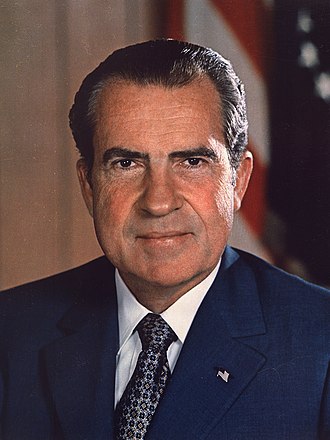
Richard M. Nixon served as the 37th President of the United States from January 1969 until his resignation in August 1974. In February 1971, he ordered the installation of a secret voice-activated taping system in the White House to preserve a historical record of his administration. Until the system's existence was revealed and dismantled in July 1973, the tapes captured Nixon directing major foreign policy initiatives, such as the opening to China, as well as his central role in the Watergate cover-up.
What Nixon talks about on the tapes
White House operations 4,718Presidential scheduling 2,225Public relations 1,784Presidential schedule 1,782Vietnam War 1,693Logistics 1,650Manolo Sanchez 1,626White House communications 1,400White House administration 1,399Presidential communication 1,243Henry Kissinger 1,191Foreign Policy 1,183
Conversations (21,010)
— Page 93 of 211President Nixon and Admiral Thomas Moorer discuss ongoing air operations and naval bombardment efforts in Vietnam, specifically focusing on strikes within the B-3 area and the DMZ. The President expresses his desire for maximum military effort, demanding that all available Seventh Fleet cruisers and destroyers be deployed to the region immediately. Moorer is instructed to disregard psychological operations and provide a detailed report on the naval deployment to Henry Kissinger by 10:00 a.m. to facilitate upcoming strategic plans.
President Nixon met with H. R. Haldeman and Henry Kissinger to discuss the administration's public relations strategy regarding the North Vietnamese offensive and the management of domestic political issues. The group addressed the need to counter defeatist rhetoric concerning the war and evaluated the effectiveness of recent bombing campaigns and news coverage. Additionally, they reviewed strategies for handling upcoming campaign contribution disclosure requirements and debated the drafting of a speech concerning aid to parochial schools.
President Nixon and Stephen B. Bull briefly coordinate the President's daily schedule and logistical arrangements for upcoming meetings. The discussion focuses on managing time constraints for appointments, including a meeting with Robert S. Ingersoll and the whereabouts of Admiral Thomas H. Moorer. Additionally, the pair touches upon the scheduling of a photo session involving Julie Nixon Eisenhower.
President Nixon met with Robert S. Ingersoll to provide final instructions and strategic guidance prior to Ingersoll's departure for his new post as Ambassador to Japan. The conversation emphasized the vital importance of the U.S.-Japan alliance, the necessity of maintaining personal channels of communication to bypass potential bureaucratic leaks, and the delicate management of economic competition between the two nations. Nixon also underscored the context of his recent opening to the People's Republic of China, assuring that this shift was not intended to undermine U.S.-Japanese relations but rather to secure regional stability.
President Nixon met with his aide, Stephen B. Bull, to coordinate the logistics of his upcoming schedule. The primary focus of the brief discussion was the timing of an appointment with Julie Nixon Eisenhower. Bull facilitated these scheduling arrangements to ensure the President's personal commitments were properly integrated into his daily agenda.
President Nixon consulted with the White House operator to facilitate an outgoing call. This brief interaction served as a standard administrative maneuver to connect the President to a specific party. No further policy discussions or significant substantive developments occurred during this short exchange.
President Nixon initiates a request to the White House operator to place an outgoing call to George P. Shultz, who was serving as the Director of the Office of Management and Budget at the time. The brief exchange serves as a logistical bridge to facilitate a direct conversation between the President and Shultz. No substantive policy matters are discussed, as the interaction is limited to connecting the telephone line.
President Nixon and George Shultz discussed the upcoming diplomatic assignment of Robert S. Ingersoll, who was preparing to travel to Tokyo to serve as ambassador. Shultz reported that Ingersoll’s decision to accept the position was directly influenced by his high regard for Shultz’s own appointment within the administration. The President confirmed that he would send private letters to Japanese leaders Eisaku Sato and Takeo Fukuda to facilitate a smooth transition for the new ambassador.
President Nixon and George Shultz discuss the successful recruitment of an unnamed individual for a significant government appointment. Nixon expresses high personal regard for the candidate's character and leadership potential, describing him as both soft-spoken and strong. The brief exchange concludes with confirmation that the administration is facilitating the hiring process through the delivery of private correspondence.
President Nixon and H. R. Haldeman engaged in a wide-ranging discussion about press relations, upcoming political strategies for the 1972 election, and public perception. They analyzed recent polls and discussed tactics to bolster the President's approval ratings, specifically through more personal media appearances and by cultivating relationships with smaller, regional news outlets rather than relying on hostile national journalists. The participants also touched upon campaign logistics, the handling of Democratic challengers, and concerns regarding public and media scrutiny of campaign contributions.
President Nixon met with representatives of the American Bar Association (ABA) to discuss their program providing legal assistance to the families of Prisoners of War (POWs) and those Missing in Action (MIAs). The ABA group sought a presidential endorsement and a White House liaison to facilitate state-level legislative efforts aimed at resolving civil and property title issues for these families. Nixon expressed his support for their legal mission while reiterating his administration's commitment to maintaining U.S. bargaining power and continued military pressure as the primary means of securing the eventual release of POWs.
President Nixon met with publishing executives, including Oscar Dystel and Samuel Schulman, to discuss the production and marketing of books documenting his historic trips to China and the Soviet Union. The President emphasized the geopolitical importance of these summits, comparing their potential impact to World War II, and explored strategies for distributing the China book through the Committee to Re-elect the President. Additionally, the group discussed logistical management of the press corps for future trips, while Nixon briefly addressed personal scheduling conflicts regarding his absence from the Gridiron Dinner.
President Nixon met with his personal aide, Stephen B. Bull, to review the details and attendance list for his upcoming daily schedule. The discussion focused on coordinating a series of meetings involving Secretary of Defense Melvin R. Laird, John H. Chafee, and LynRae McClintock. Nixon specifically noted the logistical arrangements regarding McClintock’s husband, a Justice Department lawyer, and their pending relocation to Los Angeles.
President Nixon met briefly with Stephen B. Bull, LynRae McClintock, and Gordon C. Strachan to facilitate a personal introduction. The conversation focused on McClintock's background, including her hometown of Riverside, California, and her upcoming departure to work for the campaign committee. The brief exchange concluded with the President presenting a small gift to McClintock.
President Nixon met with Henry Kissinger, Melvin Laird, and John Chafee to discuss the worsening North Vietnamese offensive and the military response required to protect South Vietnamese positions. Nixon emphasized the necessity of using intensified air and naval power to grind down invading forces, comparing the tactical retreat to historical battles like Ypres and Verdun to underscore his strategy of consolidation and counter-offensive. The President also discussed upcoming U.S.-Soviet relations and political messaging for his administration, while offering personal counsel to Chafee regarding his campaign for the U.S. Senate.
President Nixon and Henry Kissinger met briefly to address a scheduling conflict involving an unidentified individual's appointment with the President. The exchange served as a quick logistical coordination to manage the President's immediate agenda. No substantive policy matters were recorded, as the discussion focused primarily on the status of the upcoming meeting.
President Nixon met with his personal aide, Manolo Sanchez, to discuss logistics regarding his upcoming schedule. The conversation focused on coordination for a planned visit to the Old Executive Office Building. No further policy-related developments were recorded during this brief administrative exchange.
President Nixon and Henry Kissinger met to discuss the intensifying North Vietnamese offensive and strategies to counter it, including the use of B-52 strikes and naval gunfire. Nixon expressed frustration with Secretary of Defense Melvin Laird’s pessimism and perceived lack of enthusiasm, contrasting him unfavorably with the supportive Kenneth Rush. The two leaders emphasized that the United States must project an image of unpredictable resolve to pressure the Soviet Union and China while maintaining that national security decisions remain independent of the upcoming 1972 election. Consequently, they directed preparations for expanded air operations and potential mining contingencies to signal American strength.
President Nixon met with his aide Stephen B. Bull to coordinate logistical arrangements for an upcoming lunch with H. R. Haldeman. The discussion transitioned into informal geopolitical observations, with Nixon critiquing the Italian political system and government stability. Nixon expressed a preference for stronger constitutional structures, such as those found in France, to address the perceived shortcomings in Italian governance.
President Nixon met with H. R. Haldeman, Ronald Ziegler, and others to discuss a variety of administrative and policy matters, including the drafting of a speech for the National Catholic Education Association and strategies for publicizing a federal 'heroin hotline.' The participants also reviewed recent developments in the Vietnam War, particularly the North Vietnamese offensive and the government's military response, while considering the impact of upcoming diplomatic trips to the Soviet Union. Additionally, the President engaged in a wide-ranging discussion on the current state of American higher education, expressing concerns about the ideological climate on college campuses and the lack of emphasis on vocational training.
President Nixon and Alexander P. Butterfield engaged in a broad ideological discussion regarding the state of American higher education and the radicalization of the student body. The conversation explored how the depersonalization of large university campuses and the influence of young, inexperienced instructors have fostered an anti-establishment, emotional, and non-rational culture among students. Nixon contrasted this perceived instability with the perceived patriotism and moral decency of the American labor movement, questioning the long-term survival of the nation in light of these societal shifts.
President Nixon and John K. Andrews, Jr. engage in a philosophical discussion regarding the decline of character and leadership within the American business and intellectual elite. They reflect on societal shifts since 1954, specifically critiquing the implementation of Great Society programs and the deterioration of the family structure as obstacles to national progress. Nixon expresses frustration with the lack of support from mainstream media and the intellectual community for his executive decisions, particularly regarding foreign policy challenges like Cambodia.
President Nixon and aide Stephen B. Bull discussed the perceived decline of character among American leadership classes, specifically critiquing various religious and business demographics. Nixon expressed skepticism toward liberal religious groups while praising the perceived integrity and resolve of fundamentalist leaders. This informal assessment of the national social and political climate served as a framework for evaluating the President's support base within the American public.
President Nixon and Alexander P. Butterfield engaged in a wide-ranging philosophical discussion regarding the perceived decline of the American "leader class" and the erosion of traditional values. They expressed mutual concern over the negative influence of television on family life and child development, while criticizing the lack of moral courage among contemporary elites, businessmen, and politicians. The conversation concluded with reflections on the need for a national return to fundamental roots, the complexities of environmental policy, and the challenges of governing in a perceived age of decadence.
President Nixon met with his inner circle and advisors, including Henry Kissinger, John Mitchell, and H.R. Haldeman, to discuss the intensifying North Vietnamese offensive and the resulting requirements for U.S. military response, specifically air strikes. The conversation covered the necessity of maintaining national resolve and foreign policy credibility amidst political pressure and the upcoming 1972 election. They also addressed the ITT political controversy, with Mitchell advising the President to handle it with caution, and briefly touched upon diplomatic staffing changes and the upcoming Soviet summit.
President Nixon consulted with his aide, Stephen B. Bull, to coordinate his immediate schedule and manage potential interruptions. The discussion focused primarily on the logistics of an upcoming meeting, specifically addressing the whereabouts and involvement of First Lady Pat Nixon. The brief interaction served to finalize administrative arrangements for the President’s evening agenda.
President Nixon met with conservative intellectual Russell A. Kirk and his wife, Annette, to discuss Kirk’s work, *A Program for Conservatives*, and broader societal trends. Their conversation explored conservative critiques of the American education system, including concerns over vocational training, campus unrest, and the influence of television on children. The participants further evaluated the perceived decline of the American 'leader class,' comparing U.S. cultural and moral standing to other nations while emphasizing the importance of patriotism and the traditional family structure.
President Nixon, Ronald Ziegler, and H.R. Haldeman met to coordinate public relations strategies regarding the North Vietnamese offensive and potential violations of previous agreements. The discussion addressed the political implications of the ITT case and the management of 1972 campaign finances, specifically concerning donor disclosures and John Mitchell’s role in campaign control. Furthermore, the President reviewed plans for an upcoming speech to the National Catholic Education Association and assessed the broader implications of Vietnam policy on U.S. foreign credibility.
President Nixon initiated a brief telephone request to the White House operator to be connected with National Security Advisor Henry Kissinger. This administrative interaction serves as a precursor to substantive policy discussions regarding national security or foreign affairs. No further dialogue was recorded during this specific exchange.
President Nixon met briefly with his valet, Manolo Sanchez, in the Old Executive Office Building. The primary purpose of this interaction was for the President to request refreshments. The conversation was brief and concluded with the President expressing his thanks in Dutch.
President Nixon met with his personal valet, Manolo Sanchez, in the Old Executive Office Building for a brief, informal interaction. The discussion centered exclusively on the President's dogs, King Timahoe and Pasha. No administrative or political actions were taken during this short exchange.
President Nixon dictated a memorandum for the file regarding the Vietnam War, focusing on the broader geopolitical context of the conflict. He addressed reports from the Foreign Service and referenced a quotation from Charles de Gaulle to provide strategic perspective. The discussion centered on the implications and effectiveness of ongoing United States bombing operations in the region.
President Nixon met with speechwriter John K. Andrews, Jr. to review and finalize a speech prepared for the President's upcoming address at a Catholic education convention. The two discussed specific revisions, with Nixon ensuring the draft incorporated his preferred messaging and feedback. The meeting concluded after the President reviewed the document and confirmed his intention to deliver the address.
President Richard M. Nixon used this brief recording session to dictate a memorandum for the file. The transcript reflects no substantive dialogue or discussion, as the recording consists primarily of room noise and muffled background activity. Consequently, no policy decisions or action items were established during this segment.
President Nixon and H.R. Haldeman met to dictate a memorandum for the file regarding a specific administrative matter. The conversation primarily served to document internal records for future reference. No substantive policy discussions or major strategic decisions are captured in this brief recorded segment.
President Nixon consulted with a White House operator to facilitate an outgoing telephone connection. This brief interaction served administrative purposes to establish communication with an external party. No substantive policy discussions or policy-related decisions were recorded during this brief logistical exchange.
President Nixon and Henry Kissinger discuss the stalled military progress in Vietnam caused by poor weather, which has hindered effective air strikes. The two explore options for increasing pressure, including a planned strike on Haiphong and more intensive use of B-52s in the B-3 area and above the DMZ. Nixon emphasizes the necessity of a broad diplomatic offensive by U.S. ambassadors to highlight the North Vietnamese aggression across the DMZ and reaffirms his desire to maintain aggressive military momentum.
President Nixon and Henry Kissinger met to discuss military operations in Vietnam, specifically focusing on the deployment of B-52 bombers. Nixon expressed frustration regarding delays caused by weather conditions and sought confirmation that military commanders had the necessary authority to launch strikes. The President directed Kissinger to ensure that massive air strikes were carried out over the next 24 hours to maintain momentum in the conflict.
President Nixon dictated a memorandum for the file regarding the inclusion of professional baseball in a specific, unnamed deal. The President clarified his recollection of whether baseball interests were meant to be part of the negotiations. The brief recording serves as an official record to document his understanding of the agreement's terms.
President Nixon dictates a brief, cryptic memorandum for the file involving a metaphorical reference to a garden and flowers. The recording serves as a personal record or placeholder, though the content lacks specific policy or political context. No substantive administrative or strategic decisions are documented in this brief dictation.
President Nixon met with his personal valet, Manolo Sanchez, in the Old Executive Office Building. The brief interaction focused on the presence of the President's dog, Pasha. No significant policy decisions or official business were conducted during this exchange.
President Richard M. Nixon met briefly with his personal valet, Manolo Sanchez, in the Old Executive Office Building. The conversation, which lasted less than a minute, was largely dominated by a withdrawn segment categorized as personal material. No significant policy decisions or administrative actions were recorded during this brief encounter.
President Nixon met with his personal valet, Manolo Sanchez, in the Old Executive Office Building to attend to personal matters. The brief exchange focused on hospitality, with the President inquiring if Sanchez would like a beverage. No major policy developments occurred during this routine interaction.
President Nixon instructed the White House operator to contact John K. Andrews and request his presence at an Executive Office Building (EOB) office. The brief exchange served solely to facilitate a meeting between the President and Andrews. No further substantive policy matters or specific directives were discussed during this request.
President Nixon consulted with a White House operator to facilitate an outgoing call. This brief interaction served as a procedural step to connect the President with another party for official business. No substantive policy discussions or major decisions were recorded during this exchange.
President Nixon met with speechwriter John K. Andrews, Jr. to refine a draft of a major speech on education policy. The discussion focused on balancing the President's commitment to non-public school assistance and neighborhood schools against the reality of severe constitutional and legislative constraints. Nixon directed Andrews to revise the text to emphasize the administration's sincere commitment to these issues while avoiding the creation of false expectations regarding immediate solutions.
President Nixon held a brief, six-minute meeting with an unidentified individual in the Old Executive Office Building. The exchange consists of an inquiry regarding the readiness of the interlocutor, followed by a directive to conclude the discussion. No substantive policy matters, strategic decisions, or significant historical developments were documented in the available record of this brief interaction.
President Nixon met with an unidentified individual in the Old Executive Office Building for a brief morning session. The discussion focused on the President providing formal approval for an unspecified matter. The brief exchange concluded when the guest departed shortly thereafter.
President Nixon initiates a brief telephone call through the White House operator to contact Admiral Thomas H. Moorer, Chairman of the Joint Chiefs of Staff. The primary purpose of the communication is to establish a direct line to the Admiral for official consultation. No further substantive discussion occurs during this short segment, as the operator processes the request.
President Nixon and Henry Kissinger discussed the ongoing North Vietnamese offensive and their frustration with the lack of aggressive military responses from U.S. air commanders. The participants evaluated the effectiveness of current air strikes and naval gunfire while debating the potential need for a leadership shake-up, including the possible replacement of commanding officers to ensure more imaginative and vigorous tactics. Additionally, Nixon emphasized the psychological importance of massive B-52 strikes and analyzed the geopolitical risks for the Soviet Union regarding the conflict ahead of their upcoming summit.
President Nixon, Henry Kissinger, and Admiral Thomas Moorer discussed the urgent need to increase the intensity of U.S. air operations in Vietnam, specifically focusing on expanding B-52 sorties to achieve psychological impact. Nixon expressed dissatisfaction with current leadership and mandated the immediate appointment of an experienced, aggressive air commander to oversee the campaign. Moorer committed to providing a recommendation for this new commander by noon and working with the Air Force Chief of Staff to expedite the deployment of additional aircraft.
President Nixon consulted with a White House operator to facilitate an outgoing call. This brief interaction served as a routine procedural step to connect the President with an outside party. No substantive policy discussions or significant political decisions were recorded during this connection process.
President Nixon initiates a brief telephonic request for the White House operator to connect him with his personal aide, Stephen B. Bull. This exchange serves as a routine administrative task to facilitate direct communication with a member of his staff. No further policy or strategic matters were discussed during this short connection.
President Nixon contacted his aide, Stephen B. Bull, to coordinate a personal appointment with the White House barber. The President requested that the barber arrive at the White House at 1:30 pm that afternoon to provide grooming services. Bull acknowledged the request and committed to arranging the visit.
President Nixon met with his personal aide, Stephen B. Bull, for a brief administrative consultation in the Old Executive Office Building. While no transcript exists for this one-minute meeting, the interaction reflects the routine coordination of the President's schedule and staff support. The conversation served to facilitate immediate executive logistical tasks necessary for the President's daily operations.
President Nixon consulted with the White House operator to facilitate an outgoing call. This brief interaction served as a standard administrative maneuver to connect the President with another party. No substantive policy discussions or decisions occurred during this short telephonic exchange.
President Nixon and H.R. Haldeman discuss the contents of the morning news summary to determine relevant items for the President's upcoming schedule. The brief exchange focuses on identifying potential issues or political developments that require the President's attention during his daily briefing. No specific policy decisions are finalized in this short administrative consultation regarding the President's agenda.
President Nixon initiates a brief telephone request for the White House operator to connect him with Charles W. Colson. This communication serves as a logistical step to facilitate a subsequent conversation between the President and his special counsel. No further substantive policy matters or decisions were addressed during this short exchange.
President Nixon and Charles Colson discuss the political strategy surrounding the ongoing International Telephone and Telegraph (ITT) hearings and the potential for a Democratic-led filibuster. They express concern over the possibility of a quorum-denying walkout by Senators Edward Kennedy and John Tunney and emphasize the importance of maintaining Republican unity to frame the inquiry as a purely partisan vendetta. Nixon stresses the need to keep Democratic committee members like James Eastland motivated to force a vote, while Colson notes that public and press interest in the hearings is beginning to wane.
President Nixon and Charles Colson discuss administrative decisions regarding the International Atomic Energy Agency (IAEA) and the status of ongoing organizational operations. The participants briefly coordinate upcoming scheduling logistics and assess the timing for future proceedings. The conversation highlights the administration's focus on maintaining control over specific policy agendas and agency activities.
President Nixon, H.R. Haldeman, and John Ehrlichman met to coordinate various administrative and political initiatives, including speech drafting for an education convention and planning for a future 'fireside chat' on drug enforcement. Nixon emphasized the need for a high-profile, proactive strategy on drug control—potentially featuring a hotline and aggressive law enforcement imagery—to capitalize on public concern. The participants also discussed administrative scheduling, including arrangements for a dinner for retiring members of Congress, and addressed ongoing political issues such as the ITT investigation and potential legal actions against media networks.
President Nixon initiates a brief telephone call to the White House operator to request a connection to Charles W. Colson. The exchange serves solely as a logistical request to establish communication with a senior advisor. No further substantive discussion occurs during this short segment.
President Nixon consulted with the White House operator to facilitate an outgoing call. This brief interaction served administrative purposes to manage the President's telecommunications from the Old Executive Office Building. No substantive policy discussions or significant political developments occurred during this exchange.
President Nixon and Charles W. Colson coordinate a brief, in-person meeting at the Executive Office Building to facilitate progress on pending speech drafts. The call serves as a logistical bridge between the two men to maximize their availability during a gap in their respective schedules. No policy decisions were finalized, as the primary outcome was the immediate scheduling of their collaboration on administration messaging.
President Nixon and Charles Colson discuss campaign strategy regarding the potential inclusion of marijuana legalization as a political issue. Nixon seeks advice on whether to take a firm stance against legalization to appeal to parental concerns, rather than limiting anti-drug rhetoric to heroin. Colson argues that opposing legalization would resonate with a broad base, including younger individuals who do not support the drug's widespread use.
President Nixon met with Senator Henry M. Jackson to dictate a formal letter addressed to him. The discussion centered on an editorial published in The New York Times. Nixon concluded the brief interaction by providing instructions to share a copy of the correspondence with an individual named Margaret.
President Nixon and Charles W. Colson discussed the political strategy surrounding the President’s upcoming Philadelphia speech regarding federal aid for non-public schools. They evaluated potential opposition from the National Education Association and fundamentalist groups, while weighing the support of Catholic leadership, specifically Cardinal John Krol. Additionally, the participants reviewed campaign intelligence regarding the George McGovern organization and discussed the scheduling of upcoming Senate hearings concerning the ITT case.
President Nixon consults with his valet, Manolo Sanchez, regarding legislative strategy and political maneuvering related to an upcoming executive session. The discussion touches upon managing witness lists, specifically mentioning Clark MacGregor, and navigating potential biases during proceedings. The President emphasizes the necessity of taking a firm stance despite the adversarial nature of the situation.
President Nixon met with his personal aide, Manolo Sanchez, to discuss the drafting of sensitive correspondence or official documentation involving a third party named Andrew. The conversation centered on refining specific nuances, phrases, and personal background details, including religion and education, to be included in the upcoming draft. Nixon explicitly instructed that he wished to remain detached from the ongoing discussions regarding this sensitive material.
President Richard Nixon met with his personal valet, Manolo Sanchez, in the Old Executive Office Building. The recording consists primarily of a withdrawn segment classified as a personal returnable item. No significant policy discussions or administrative actions were documented during this brief interaction before the two departed the office together.
President Nixon and his valet, Manolo Sanchez, met in the Old Executive Office Building to discuss personal or domestic administrative matters. Following a brief period of redacted material, an unidentified woman joined Sanchez for a subsequent meeting. The conversation concluded without a surviving transcript or documented record of specific policy outcomes.
President Nixon directed the White House operator to connect a call between First Lady Pat Nixon and their daughter, Julie Nixon Eisenhower. This brief interaction served as a administrative request to facilitate personal family communication. No political or policy-related matters were discussed during this brief exchange.
President Nixon met with family members and senior aide H. R. Haldeman to coordinate the First Family’s 1972 campaign appearances and media strategy. The discussion centered on maximizing television exposure through talk shows and public service events, with a focus on targeting key demographics such as blue-collar and Catholic voters. Nixon emphasized the importance of projecting warmth and compassion, directed the staff to prepare better briefing materials for the family, and finalized plans for upcoming diplomatic trips and social events at the White House.
President Nixon met with his aide Stephen B. Bull in the Oval Office to conduct a brief review of his daily schedule. The discussion focused on administrative logistics and the coordination of the President's upcoming appointments. No significant policy decisions were recorded during this brief planning session.
President Nixon consulted with his aide Stephen B. Bull regarding the scheduling of upcoming meetings, specifically focusing on a planned engagement with John K. Andrews, Jr. The discussion centered on logistics and coordination for the President's calendar. The conversation concluded with Bull departing the Oval Office shortly thereafter.
President Nixon met with John K. Andrews, Jr. to review and revise the text of an upcoming speech on non-public education and school busing. The discussion focused on refining the administration's firm stance against busing while maintaining a conciliatory tone for the audience, and carefully framing the crisis facing Catholic and non-public schools. Nixon directed specific changes to the speech's language, including calls for national unity and the removal of phrases that might imply administration support for busing as a primary policy tool.
President Nixon met with Stephen B. Bull to coordinate logistical arrangements for an upcoming meeting involving Henry Kissinger and Secretary of State William P. Rogers. The discussion focused on confirming Rogers’s location and managing his arrival to ensure he could be integrated into the scheduled briefing. Nixon instructed Bull to facilitate the meeting and ensure the Secretary was promptly brought in upon his arrival.
President Nixon met with Henry Kissinger, William Rogers, and several staff members to discuss the ongoing North Vietnamese offensive and the resulting military and diplomatic response. The participants reviewed the status of air strikes, the performance of the South Vietnamese military, and the necessity of maintaining a low-profile press strategy until military actions are clearly justified by enemy provocation. Additionally, the group coordinated logistics for upcoming presidential foreign travel, specifically focusing on the USSR trip and potential stopovers in Poland and Iran, while also briefly assessing the 1972 Democratic presidential primary landscape.
President Nixon contacted the White House operator to facilitate an urgent connection to National Security Advisor Henry A. Kissinger. The brief interaction served exclusively as a logistical step to reach Kissinger for a high-level consultation. No substantive policy discussions occurred during this exchange, as its sole purpose was establishing the telephone link.
President Nixon and Henry Kissinger discuss the need for more aggressive military action in Vietnam to counter enemy supply movements and boost morale. Nixon expresses frustration with the current lack of concentrated force and instructs Kissinger to arrange a meeting with General John W. Vogt Jr. to deliver a stern directive regarding his new command. Additionally, Nixon orders an immediate escalation in naval engagement, directing the military to bypass restrictive operational boundaries and conduct heavy shelling and air strikes on supply depots like Dong Hoi to provide a necessary psychological shift in the conflict.
President Nixon contacted the White House operator to facilitate an urgent outgoing call to Charles W. Colson. The interaction served exclusively as a logistical step to connect the President with his special counsel. No further substantive policy matters or decisions were discussed during this brief exchange.
President Nixon and Charles Colson discuss strategies for managing negative economic news, specifically an anticipated rise in the unemployment rate, by emphasizing positive job growth metrics and leveraging economic spokespeople like Herbert Stein and Marina Whitman. They also review the political handling of the ITT hearings, focusing on efforts to secure Senator James O. Eastland's cooperation to end the proceedings. Nixon directs Colson to ensure Republican leadership frame any continued hearings as a partisan "political inquisition" and filibuster to minimize political fallout.
President Nixon met with Stephen B. Bull to discuss domestic political strategy and various administrative challenges. They focused on refining the administration's messaging on property taxes and tax reform, while criticizing the IRS for overly complicated withholding procedures that were negatively impacting public sentiment. Additionally, Nixon touched upon foreign policy risks, specifically the sensitivity of commenting on military operations in Southeast Asia, as he awaited further developments before committing to a public stance.
President Nixon met with his aide Stephen B. Bull to coordinate upcoming administrative schedules. The discussion focused on finalizing the arrangements for Henry Kissinger’s meeting with Soviet Ambassador Anatoliy Dobrynin and setting the timing for the President’s meeting with General John W. Vogt, Jr. No significant policy decisions were recorded during this brief administrative check-in.
President Nixon and H. R. Haldeman met to discuss political strategy for the 1972 election, focusing on leveraging economic issues and Catholic support to counter Democratic opponents following the Wisconsin primary. They analyzed the administrative failures surrounding IRS tax withholding complexities and discussed the necessity of framing property tax reform as a core Republican platform. Additionally, the President consulted with Haldeman on the risks of holding a press conference regarding the ongoing Vietnam conflict, emphasizing the need for caution based on the unpredictable military situation.
President Nixon met with H.R. Haldeman, Henry Kissinger, and John Vogt to discuss the critical need for more aggressive and imaginative aerial military operations in Vietnam. Nixon emphasized the necessity of concentrating forces for maximum impact rather than routine bombing, explicitly charging Vogt with revitalizing the 7th Air Force's performance. Additionally, the President and Haldeman addressed public relations strategies, deciding to exert tighter control over the visual framing and media headlines of all presidential appearances.
President Nixon met with his aide, Stephen B. Bull, to review and finalize the President’s upcoming daily schedule. The discussion focused on the management of his appointments and administrative agenda for the day. No further significant policy decisions or developments were recorded during this brief administrative session.
President Nixon, Henry Kissinger, and Alexander Haig met to analyze the North Vietnamese offensive and coordinate U.S. military and diplomatic responses. Nixon emphasized the necessity of using concentrated air and naval power to counter the invasion, explicitly rejecting a televised address to avoid signaling weakness or inviting domestic criticism. The participants discussed the progress of South Vietnamese forces, the effectiveness of B-52 strikes against North Vietnamese logistics, and the strategic importance of signaling resolve to the Soviet Union prior to the upcoming summit.
President Nixon met with H. R. Haldeman, Henry Kissinger, and Alexander Butterfield to manage the administration's public relations, messaging, and political strategy. Key discussions included the ITT case and the selection of the Republican National Convention site, criticism of speechwriting staff, and the administration's aggressive approach to domestic issues such as busing, crime, and morality. Nixon emphasized the need to prioritize major issues and ordered a shake-up of his speechwriting team to ensure messaging aligned with his conservative agenda.
President Nixon met with Alexander P. Butterfield to review and finalize a formal statement regarding the death of former Supreme Court Justice and Secretary of State James F. Byrnes. The discussion focused on the President's personal oversight of the document's language prior to its official release to the press. The meeting concluded once the statement was prepared for dissemination.
President Nixon and H.R. Haldeman discuss the political advisability of an Army voter participation project, which the President critiques as a poor idea similar to the Boy Scouts' civic engagement efforts. Concerned about the initiative's origins within his administration, Nixon questions if any staff members were responsible for the project's inception. Ultimately, the conversation shifts toward managing relationships with outside groups, concluding that the administration should focus on maintaining goodwill with established allies rather than pursuing questionable voter mobilization programs.
President Richard M. Nixon met with his aide Stephen B. Bull in the Oval Office to facilitate internal administrative coordination. The primary purpose of the brief meeting was for the President to issue a request for a follow-up consultation with Press Secretary Ronald L. Ziegler. Bull served as the liaison to ensure this meeting was scheduled.
President Nixon and Press Secretary Ronald Ziegler discussed the administration's strategic messaging regarding the North Vietnamese offensive and the role of great powers. Nixon highlighted his recent remarks to an Associated Press reporter, emphasizing the responsibility of nations like the USSR to refrain from encouraging aggression. The President also analyzed the military situation in South Vietnam, expressing confidence that the ongoing North Vietnamese "Sunday punch" would fail while directing Ziegler to monitor media coverage closely.
President Richard Nixon met briefly with his valet, Manolo Sanchez, in the Oval Office. This informal encounter consisted of brief greetings between the President and his personal staff member. No substantive policy discussions or administrative decisions occurred during this seven-second interaction.
President Nixon met with William J. Porter and Henry Kissinger to discuss the administration's strategy regarding the ongoing Vietnam War and the Paris peace negotiations. The President emphasized the need for a tough, firm public stance following the North Vietnamese offensive, specifically instructing Porter to expose the enemy's cynicism in breaking off talks while escalating military aggression. The group also reviewed current military intelligence, noting the poor performance of North Vietnamese forces and the significant increase in U.S. air and naval strikes intended to force a settlement. Additionally, the President expressed frustration with diplomatic formalities, reflecting on his recent signing of the Biological Warfare Treaty while criticizing Soviet support for North Vietnamese aggression.
President Nixon met with Alexander P. Butterfield and Stephen B. Bull to coordinate a brief, ceremonial meeting with the directors of the American Historical and Cultural Society, Inc. The discussion focused on logistical arrangements for the event, specifically the distribution of individual photographs and gifts to attendees, including J. Willard Marriott, Jr. and Katherine Swim. Nixon emphasized the importance of the photography session as a gesture of goodwill and oversaw final preparations for the group's visit.
President Nixon met with a delegation of business and civic leaders to discuss non-partisan outreach initiatives, specifically regarding the 'Honor America Day' ceremonies and associated promotional films. The discussion touched on the administration's efforts to reduce crime in Washington, D.C., and the ongoing legislative challenges regarding the city's baseball team. The participants also shared updates on various administrative projects, including the distribution of gifts from the People's Republic of China, such as pandas and trees.
President Nixon met with his personal aide, Stephen B. Bull, for a brief administrative exchange in the Oval Office. The discussion concluded with the President dismissing a specific concern by instructing Bull not to worry about the matter. This interaction highlights the routine nature of the President's interactions with his staff regarding minor logistical or situational concerns.
President Nixon contacted the White House operator to facilitate a personal telephone call to First Lady Pat Nixon. The exchange served as a routine administrative request to establish communication between the President and his wife. No substantive political or policy matters were addressed during this brief logistical interaction.
President Nixon and Henry Kissinger discussed the logistical arrangements for upcoming U.S.-USSR relations, including a meeting between First Lady Pat Nixon and Mrs. Anatoliy Dobrynin, and the coordination of the President's planned Moscow summit. A significant portion of the conversation focused on the North Vietnamese offensive and the administration's strategic response, which included aggressive surveillance of Soviet ships and the potential use of naval mines. Kissinger and Nixon evaluated the geopolitical stakes of the Vietnam conflict, framing it as a critical test of U.S. credibility that could influence future Soviet actions in the Middle East and the viability of the Berlin treaties.