Woods, Rose Mary
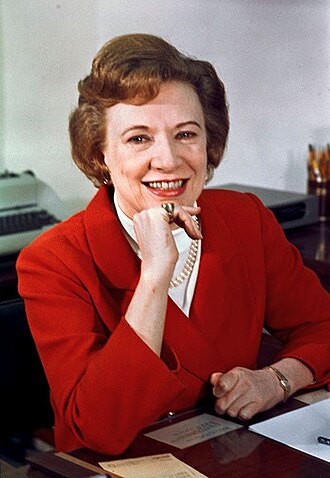
Rose Mary Woods served as President Richard Nixon's fiercely loyal Personal Secretary from January 1969 to May 1973, acting as a crucial gatekeeper to the Oval Office. During the White House taping period (February 1971 – July 1973), she maintained strict control over access to Nixon and was one of the few staff members whose daily interactions with the President were frequently recorded. Following the Watergate-related resignations of top aides H.R. Haldeman and John Ehrlichman, her responsibilities expanded and she was promoted to Executive Assistant and Personal Secretary to the President in June 1973, serving until August 1974. She later became infamous for the "Rose Mary stretch," claiming she accidentally erased 18.5 minutes of a subpoenaed June 1972 tape while transcribing it.
President Nixon and his personal secretary, Rose Mary Woods, briefly coordinated their schedules regarding the viewing of official gifts. Nixon requested that Woods ask an individual named O'Ryla to assist elsewhere, while Woods conveyed a request from Krisha for the President to inspect the gifts. The two briefly confirmed the timing of the appointment for later that evening.
President Nixon met with staff and diplomats in two distinct sessions to coordinate logistics for Tricia Nixon’s upcoming wedding and to discuss foreign policy strategy regarding the Soviet Union and China. During the first segment, Nixon and his aides finalized guest lists, entertainment plans, and security arrangements for wedding-related social events, specifically managing the inclusion of personal friends and family members. In the second portion, the President pivoted to a strategic review of trade and foreign policy with Jacob Beam and Helmut Sonnenfeldt, focusing on the potential for utilizing trade incentives, such as grain deals and commercial credits, to improve U.S. relations with Communist powers and expand American diplomatic leverage. Nixon emphasized a desire for a more assertive, hard-line administrative image while exploring the practical utility of trade restrictions as a tool for Cold War maneuvering.
President Nixon met with staff members, including H. R. Haldeman and Charles Colson, to discuss his upcoming schedule, press relations, and political strategy against Democratic opponents. The group focused on capitalizing on the rift between Ted Kennedy and Hubert Humphrey, including Nixon’s brief congratulatory phone call to Humphrey for publicly defending the President's Vietnam policy. Additionally, Nixon and Colson strategized on weakening Kennedy's presidential prospects by initiating a book project regarding the Chappaquiddick incident and highlighting the financial struggles of Edmund Muskie's campaign.
President Nixon and H.R. Haldeman discuss the potential recruitment of a new writer who is described as a "zealot" with strong, articulate views that align with the President's perspective. The conversation touches upon the effectiveness of current political messaging, the need for sharper, more focused public communication, and the strategic impact of high-profile upcoming events, specifically referencing the potential for a trip to China. They also coordinate logistics for an upcoming social event, including the President's attire and guest arrangements.
President Nixon and his personal secretary, Rose Mary Woods, met to discuss the logistics and success of recent and upcoming events related to Tricia Nixon’s wedding festivities. The conversation touched upon the attendance of various family members and friends, the scheduling of refreshments and travel, and the positive impressions made by Julie Nixon Eisenhower and the couple. The two concluded by acknowledging a sensitive personal situation regarding the First Lady, agreeing to defer addressing it until the following Monday to avoid unnecessary tension.
President Richard Nixon and his personal secretary, Rose Mary Woods, engaged in a brief late-night telephone call. The conversation consisted entirely of segments categorized as personal and returnable, resulting in no official policy discussions or administrative actions being recorded. Consequently, the substance of this interaction remains restricted due to its private nature.
President Nixon met with his personal secretary, Rose Mary Woods, for a brief administrative consultation in the Oval Office. While no transcript exists to detail the specific content, such meetings typically involved coordinating the President's private schedule, managing confidential correspondence, or handling sensitive personal files. No major policy developments were recorded during this brief three-minute interaction.
President Nixon and his personal secretary Rose Mary Woods held a brief telephone conversation to exchange pleasantries. The discussion consisted primarily of social discourse and personal logistics. No substantive policy matters or administrative decisions were addressed during this exchange.
President Richard Nixon met with his personal secretary, Rose Mary Woods, to briefly discuss a prior telephone communication. The exchange remains largely obscured due to withdrawn material, but the dialogue suggests a follow-up on a specific matter previously handled via phone. Further context for this brief interaction is linked to a subsequent conversation, 5-20.
President Nixon and Rose Mary Woods discuss the successful execution of Tricia Nixon Cox’s wedding ceremony held at the White House. The participants praise the efforts of the White House staff, specifically commending Rex Scouten and the military aides for their logistical contributions. They characterize the event as visually stunning and superior in presentation to the traditional White House Christmas decorations.
President Nixon met with various aides and associates, including Charles G. Rebozo and General Alexander M. Haig, Jr., to address administrative matters and ongoing policy concerns. The discussions involved managing the President's schedule, press coverage, and broad economic considerations regarding business leadership and market influences. The participants reviewed draft materials and organizational strategies for future meetings while ensuring the alignment of public messaging with internal policy objectives.
President Richard Nixon and his personal secretary, Rose Mary Woods, engaged in a series of telephone discussions that were entirely designated as personal in nature. Because the entirety of the communication was classified as a personal returnable item, no official administrative or political content is available for historical record. Consequently, no substantive policy decisions or executive actions were documented during these segments.
Charles G. “Bebe” Rebozo and Rose Mary Woods engaged in a brief telephone conversation regarding personal matters. The entirety of the recorded segments was classified as personal and subsequently withdrawn from public release. No substantive policy discussions or administrative actions were documented in the available transcript.
President Nixon held a brief telephone conversation with his personal secretary, Rose Mary Woods, to address personal administrative matters. The discussion was categorized as a personal returnable item and did not involve substantive policy or governmental business. Consequently, no significant political developments or official action items resulted from this exchange.
President Richard Nixon met with his personal secretary, Rose Mary Woods, to discuss administrative and strategic planning regarding upcoming personnel or policy cycles. The conversation focused on managing timelines and expectations for institutional goals, specifically referencing the need to align internal processes for the following year. The discussion highlights the President's concern with organizational discipline and the strategic pacing of objectives.
President Nixon met with H.R. Haldeman and other staff members to address the political fallout from the publication of the Pentagon Papers and to plan the administration's defensive response. The discussion centered on delegitimizing the leaks by implicating the Brookings Institution and framing the disclosure as a moral failure of the intellectual community and the previous administration. Additionally, the President and his staff managed logistical details regarding his upcoming summer schedule, including travel to California, Florida, and Camp David, while coordinating his public relations strategy for a television documentary on his drug initiatives.
President Nixon and his personal secretary, Rose Mary Woods, discussed administrative arrangements regarding his upcoming schedule and communication with First Lady Pat Nixon. Nixon directed Woods to inform the First Lady that his afternoon meeting with the Quadriad and a subsequent dinner with Secretary John B. Connally would delay his return home. The two also briefly reviewed plans for an upcoming dinner with Willy Brandt scheduled for the following day.
President Nixon, Rose Mary Woods, and Alexander P. Butterfield met to coordinate the President's upcoming travel and social schedule while managing personal frustrations regarding certain acquaintances, specifically Jack and Helene Drown. The discussion focused on changing travel plans to avoid the Drowns, balancing the President’s need for privacy with First Lady Pat Nixon's social obligations, and addressing media criticism regarding the President’s workload. Nixon and Woods also briefly touched upon White House gift policies and past administrative practices.
President Nixon consulted with his personal secretary, Rose Mary Woods, to coordinate his upcoming schedule regarding the presidential yacht Sequoia and a meeting with Secretary of Defense Melvin R. Laird and various members of Congress. The brief discussion served to finalize logistical arrangements and ensure the President’s agenda remained aligned with his legislative priorities. No further substantive policy shifts were noted during this brief administrative exchange.
President Nixon and his personal secretary, Rose Mary Woods, discuss personal staff frustrations and the management of office dynamics. The exchange reflects tension regarding internal personnel issues and concerns about the behavior of individuals with access to the President's inner circle. Woods and Nixon touch upon the difficulty of delegating these sensitive staffing matters while maintaining professional boundaries.
President Nixon and his personal secretary, Rose Mary Woods, discussed administrative scheduling matters and a gesture of condolence. They agreed that the White House should send flowers for the funeral of Lieutenant Governor J. Sargent Reynolds, a Democrat, to maintain positive political optics. Additionally, Nixon coordinated his upcoming schedule, including a meeting with union officials and a subsequent 6:00 p.m. appointment with Kenneth Rush.
President Nixon met with Republican congressional leaders, including Gerald Ford and Leslie Arends, to discuss strategies for defeating proposed legislative amendments that would mandate a withdrawal date for U.S. troops in Vietnam. The President emphasized that setting a legislative deadline would undermine sensitive, ongoing, and potentially critical negotiations, while also damaging the U.S. position regarding the return of prisoners of war. Nixon and the leadership agreed to maintain a firm stance against these anti-war resolutions to protect executive authority and preserve bargaining power, while assuring the lawmakers that the administration remained committed to ending the war and ensuring political success for the party.
President Nixon met with Henry Kissinger and U.S. negotiator Kenneth Rush to review high-stakes foreign policy developments, including progress on secret channels regarding the People's Republic of China and sensitive negotiations over Berlin. The discussion emphasized the need to link various diplomatic issues, such as the Berlin Agreement and Mutual and Balanced Force Reduction (MBFR) talks, to prevent the Soviets from isolating or dividing Western allies. Nixon directed the team to maintain strategic pressure and prepare for an upcoming meeting with West German Chancellor Willy Brandt, while acknowledging the importance of Rush's role in the ongoing negotiations.
In this meeting, President Nixon and Rose Mary Woods discuss personal and administrative matters, including the recent wedding of Tricia Nixon Cox and Edward R. F. Cox. The President and Woods exchange views on positive media coverage, specifically a recent Life magazine cover, while criticizing negative press commentary from reporters. Additionally, the President discusses upcoming scheduling logistics and expresses a desire to minimize future social contact with individuals he views as difficult, such as the Drown family.
President Nixon met with Indian Foreign Minister Swaran Singh, Ambassador Lakshmi Kant Jha, Ambassador Kenneth B. Keating, and Joseph J. Sisco to discuss the escalating refugee crisis in East Pakistan and the broader India-Pakistan conflict. While acknowledging the humanitarian urgency and pledging $70 million in U.S. financial aid, Nixon emphasized the necessity of "quiet diplomacy" over public pressure to influence Pakistani leadership toward a political solution. The discussion underscored Nixon's efforts to prevent an armed conflict and his frustration with other nations that offered rhetorical support without matching financial contributions.
President Nixon met with John M. O'Neill and other representatives of Vietnam Veterans for a Just Peace to discuss the political challenges of the Vietnam War and efforts to counter anti-war sentiment led by figures like John Kerry. Nixon expressed his appreciation for the group's public support, framing the conflict as a test of national resolve and criticizing the media and 'Eastern establishment' for their lack of patriotism. The conversation emphasized the necessity of staying the course to avoid the geopolitical consequences of abandonment, with Nixon invoking the legacy of Munich to argue for presidential leadership over public opinion polls.
President Nixon contacted his personal secretary, Rose Mary Woods, to inquire about the availability of specific historical documents, specifically Whittaker Chambers’ book *Witness* and transcripts from the Alger Hiss hearings. The President sought to locate these items within the White House, prompting Woods to investigate their current whereabouts. The brief exchange concluded with uncertainty regarding whether the materials remained in her possession or had been moved elsewhere.
President Nixon met with H. R. Haldeman and key staff members to discuss administration strategy regarding the unauthorized publication of the Pentagon Papers and the public messaging for a new drug policy. Regarding the Pentagon Papers, the participants analyzed the shifting public and press sentiment, with Nixon deciding to withhold a formal presidential statement for the moment while exploring potential leaks concerning the Kennedy administration. Simultaneously, they deliberated the format for a drug policy announcement, ultimately rejecting a request for prime-time television in favor of a concise, high-impact radio or press room statement to emphasize the administration's proactive stance. The President also evaluated political polling data and coordination efforts within the Domestic Council to ensure that upcoming legislative and public initiatives were effectively managed.
President Richard M. Nixon spoke with his personal secretary, Rose Mary Woods, during a brief evening telephone call. The conversation consisted entirely of material classified as personal and returnable, resulting in the full withdrawal of the recording from the public archive. No official business or substantive policy decisions were documented in the transcript.
President Nixon met with his personal secretary, Rose Mary Woods, for an informal end-of-day discussion in the Old Executive Office Building. The conversation primarily served as a brief personal check-in between the two regarding the day's events and logistical matters. No major policy decisions or significant administrative actions were recorded during this short exchange.
President Nixon consulted with his personal aide, Manolo Sanchez, and his secretary, Rose Mary Woods, regarding historical data or record-keeping. The brief interaction focused on retrieving specific statistics from the previous year. No significant policy decisions were recorded during this brief administrative inquiry.
President Richard M. Nixon and his personal secretary, Rose Mary Woods, engaged in a brief telephone conversation regarding personal matters. The discussion centered on administrative or private logistical arrangements as indicated by the withdrawal of the content for personal reasons. No significant policy decisions or official government actions were recorded during this exchange.
President Nixon met with H.R. Haldeman, John Ehrlichman, and Henry Kissinger to coordinate an aggressive administration response to the New York Times' publication of the Pentagon Papers. Nixon emphasized the need to frame the issue as a defense of the integrity of the presidency and the necessity of maintaining national security, rather than merely litigating the court case. The group discussed strategies to pressure the press, leak information regarding Daniel Ellsberg, and discredit the previous administrations of Johnson and Kennedy regarding their Vietnam policy.
President Nixon, Rose Mary Woods, Ronald Ziegler, and Charles Colson met to discuss press management, presidential scheduling, and the unfolding controversy surrounding the Pentagon Papers. A central focus was Nixon's insistence that former President Lyndon B. Johnson must publicly defend his administration's role in the Vietnam War, with Nixon stating he could no longer carry the political burden of defending Johnson if Johnson remained silent. Furthermore, Nixon directed his staff to exclude *The New York Times* from press access and briefings, citing his deep frustration with the publication.
President Nixon and H. R. Haldeman met to discuss the administration's response to the Pentagon Papers, focusing on delegating a team to manage the declassification process while emphasizing that the documents originated during the Kennedy and Johnson administrations. Nixon stressed the importance of framing the leaks as a national security risk, using the argument that a single compromised document could reveal codes or endanger lives to justify the administration's legal stance. Additionally, they reviewed scheduling for the President’s upcoming Midwest trip and discussed the necessity of curbing internal leaks and exerting tighter control over White House and Congressional staff regarding policy recommendations.
President Nixon and his advisors, including H. R. Haldeman and Henry Kissinger, discussed a recent New York Times leak suggesting Nixon was seeking a diplomatic opening to China. The President expressed frustration with the unauthorized disclosure and its potential impact on his delicate diplomatic strategy, deciding to postpone ambassadorial appointments as a disciplinary measure against leaks. Additionally, the group addressed the necessity of tighter control over presidential travel, the management of personal guests at the President's California home, and the political insights provided by John Connally regarding the President’s public image and the 1972 election strategy.
H. R. Haldeman consulted with Treasury Secretary John B. Connally regarding the President's strategy for an upcoming Cabinet meeting. Both men agreed that Nixon should replicate the effective, explicit conduct he displayed during an earlier morning meeting rather than following a standard agenda. This approach was intended to set a clear precedent for subsequent economic policy discussions involving Cabinet members Melvin Laird and William Rogers.
President Nixon and his personal secretary, Rose Mary Woods, discuss the potential gesture of sending flowers to Harry and Bess Truman in honor of their 52nd wedding anniversary. Nixon explicitly instructs Woods to forgo sending any floral arrangement. The brief interaction concludes with the President requesting that Woods meet him at the Old Executive Office Building.
President Nixon contacted his personal secretary, Rose Mary Woods, to request her immediate presence at his Old Executive Office Building workspace. This brief administrative interaction served as a coordination effort for the President's logistical workflow. The primary action item was the relocation of Woods to the EOB to facilitate further office operations.
President Nixon and personal secretary Rose Mary Woods met to discuss various administrative and social matters, including guest lists for upcoming White House events and logistics for presidential appointments. The conversation also touched upon the development of communication strategies regarding the Vietnam War, specifically addressing how to explain the history of U.S. involvement to young people. Additionally, they reviewed reports on personnel matters and discussed the involvement of family members in public outreach efforts.
President Nixon held a series of meetings with top advisors, including H.R. Haldeman, John Connally, and George Shultz, to discuss political messaging, economic strategy, and staff management. Key developments included a directive to stop administration officials from providing background briefings to the press and a decision to maintain a firm, non-conciliatory stance regarding the prosecution of Daniel Ellsberg. Additionally, the President and Connally strategized on the public communication of economic policy, with the President emphasizing the need for a strong, unified message that highlights economic growth while rejecting wage and price controls.
President Nixon and his personal secretary, Rose Mary Woods, discuss the distribution of cigars to political allies, specifically Congressman Alvin E. O'Konski. The President expresses appreciation for O'Konski's recent speech defending the administration's Vietnam policy. Finding that the specific Nicaraguan cigars previously gifted are out of stock, Nixon directs Woods to send a standard box of White House cigars to the Congressman as a token of gratitude.
President Nixon met with Henry Kissinger and Attorney General John Mitchell to discuss the legal and political fallout following the Supreme Court's ruling on the Pentagon Papers. The President directed his team to aggressively pursue the criminal case against Daniel Ellsberg, emphasizing that they should utilize leaks to the press to discredit him and his supporters. They also strategized on reforming the executive classification system to prevent future unauthorized disclosures of presidential memoranda and sensitive national security information.
President Nixon directs his personal secretary, Rose Mary Woods, to inform Representative Louis C. Wyman that a recent phone call the President made to a high school student in Manchester, New Hampshire, was personal in nature. Nixon emphasizes the need to clarify this detail to ensure Wyman understands the context of the interaction. The brief exchange concludes with Woods acknowledging the instruction and agreeing to relay the information.
President Nixon met with his senior advisors, including H.R. Haldeman, Henry Kissinger, John Mitchell, and Melvin Laird, to determine the administration's strategy following the Supreme Court's ruling allowing the publication of the Pentagon Papers. The President rejected the idea of broad declassification as a response to the court defeat, fearing it would appear like an admission that the government's classification system was worthless. Instead, he decided to maintain a hard line on the prosecution of Daniel Ellsberg, pursue investigations into potential leaks and conspiracies within the government, and direct his staff to target the Brookings Institution to recover classified materials.
President Nixon met with Rose Mary Woods, H. R. Haldeman, and Alexander Butterfield to manage presidential logistics, including scheduling, correspondence, and photography, while discussing high-level foreign policy and security concerns. The participants addressed the handling of autograph and photo requests to improve efficiency, and Nixon expressed frustration over the perceived disloyalty of NSC staff members like William Lake and Morton Halperin. Furthermore, Nixon and Haldeman coordinated strategy regarding Secretary of State William Rogers' potential Mideast diplomatic mission and the ongoing secret negotiations with China, ultimately transitioning into a discussion on the messaging and tone of the President's upcoming July 3rd Bicentennial speech.
President Nixon instructed his personal secretary, Rose Mary Woods, to duplicate a rough draft of upcoming remarks intended for the following evening. He directed Woods to incorporate a specific anecdote about John Brown—previously used in a speech to the J.C.'s—to serve as the speech's conclusion. Once processed, the draft was to be forwarded to John K. Andrews, Jr. for further development.
President Richard M. Nixon met briefly with his personal secretary, Rose Mary Woods, in the Old Executive Office Building. The extremely short duration of this interaction suggests it served as a perfunctory exchange or a transition between formal appointments. No substantive policy discussions or specific administrative actions were recorded during this brief encounter.
President Nixon met with his senior advisors, John Ehrlichman and H. R. Haldeman, to discuss the ongoing political and legal fallout from the publication of the Pentagon Papers. The conversation focused on managing the administration's response, specifically coordinating congressional investigations into the leak and establishing an internal White House operation to manage security and document declassification. Beyond these legal strategies, the President reviewed administrative priorities including school desegregation funding, labor union relations, and preparations for his upcoming speech at the National Archives.
President Nixon met with Alexander P. Butterfield, Rose Mary Woods, and briefly with John K. Andrews, Jr. in his Old Executive Office Building office to address internal administrative or scheduling matters. The discussion largely remained unintelligible, consisting of brief consultations with his staff before they departed. No substantive policy decisions or historical milestones were recorded during this brief administrative meeting.
President Richard Nixon met with his personal secretary, Rose Mary Woods, in the Old Executive Office Building to review and manage his personal schedule. The discussion focused on coordinating upcoming appointments and administrative logistics essential to the President's workflow. This brief meeting served to facilitate executive time management and prioritize the President's immediate agenda.
President Nixon instructed his personal secretary, Rose Mary Woods, to arrange a meeting with H.R. Haldeman and Charles Colson once they arrived at the White House. The President clarified that he had been occupied with other matters and emphasized that there was no urgency for them to be contacted at home. The call served to coordinate the President's schedule and manage the expectations of his key advisors.
President Nixon and his personal secretary, Rose Mary Woods, briefly coordinated the administrative handling and routing of incoming materials or personnel. The discussion centered on ensuring that specific arrivals were properly directed to the Coastal office for processing. This short exchange served to align their schedules and communication regarding ongoing logistical matters.
President Nixon and Charles Colson discuss methods to exert tighter control over executive branch messaging, specifically regarding unemployment figures from the Bureau of Labor Statistics and the public narrative surrounding the Pentagon Papers. The President emphasizes his constitutional obligation to enforce the law and protect national security, proposing a forceful public statement that prioritizes the lives of American servicemen and POWs over the sensationalism of the press. Additionally, they evaluate the political landscape for the 1972 election, focusing on building a coalition of labor union support and successfully managing negative press portrayals.
President Nixon and his advisors, including H. R. Haldeman and Alexander Haig, met to refine the President's upcoming speech for the Bicentennial celebrations. They focused on trimming the text to fit a 12-minute delivery, adjusting the tone to emphasize American idealism, and finalizing strategies for the presentation, including the decision to withhold the written text from the press. Additionally, the group discussed potential public relations benefits from the speech, such as the future renaming of Air Force One to the "Spirit of '76."
President Nixon instructed his personal secretary, Rose Mary Woods, to transmit a telegram to publisher William Randolph Hearst regarding his upcoming Sunday column. Nixon requested that the message commend Hearst for maintaining the tradition of prioritizing national security in his editorial content. Woods was directed to have the message phoned in or sent by mail to ensure the sentiment was conveyed promptly.
President Nixon, Rose Mary Woods, and Stephen Bull meet with unidentified guests to facilitate a brief, informal reception. The President exchanges pleasantries, reflects on past acquaintances, and presents commemorative gifts, including an item featuring the presidential seal. The meeting concludes with arrangements for the guests to tour the grounds and coordinate the arrival of additional visitors.
President Nixon met with his personal secretary Rose Mary Woods and aide Stephen B. Bull to address administrative and scheduling concerns. During the discussion, Nixon placed a call to John W. Rollins to verify his current location. The group also coordinated the departure of Stanley H. Bear from White House service and adjusted relevant scheduling matters.
President Nixon met with departing Secret Service agent Robert J. Jamison, his wife, and personal secretary Rose Mary Woods for a brief farewell visit. The discussion centered on Jamison's lengthy tenure with the Secret Service, including his experience during a Latin American trip, and his upcoming retirement plans to move to Florida. Nixon presented the couple with presidential gifts as a gesture of appreciation for Jamison's service and continued personal support.
President Nixon met with Rose Mary Woods and Dianne C. Tankoos to acknowledge Tankoos' commendable service to the administration. The President discussed her upcoming trip to Paris and expressed encouragement regarding her desire to travel and see the world. The brief exchange concluded with the President formally expressing his appreciation for her work.
President Nixon and his personal secretary Rose Mary Woods coordinate logistical details regarding upcoming social engagements and family schedules. The discussion focuses on plans for a July 28 dinner involving First Lady Pat Nixon, as well as the President’s anticipated visit with Tricia Nixon Cox on August 4. The call concludes with updates on communications between Woods and various associates, including Bebe Rebozo and J. Willard Marriott.
President Nixon and his personal secretary, Rose Mary Woods, discussed administrative details regarding White House social scheduling and guest list management. The conversation focused on inviting Lowell Watham, acknowledging Frank McCarthy, and organizing an upcoming dinner featuring Pat Nixon, Patrick and Shelley Buchanan, Raymond Price, and William Safire. Nixon instructed Woods to consult with the First Lady regarding these specific guest invitations and seating arrangements.
President Nixon and his personal secretary, Rose Mary Woods, engage in a brief, informal exchange concerning Manolo Sanchez. The dialogue centers on a lighthearted or anecdotal observation regarding a dark road and limited visibility. No policy decisions or significant administrative actions are documented during this short interaction.
President Nixon met with Rose Mary Woods and Manolo Sanchez to discuss travel arrangements for his upcoming vacations to California and New York. The conversation focused on the President's desire for genuine rest, the logistical necessity of limiting visitors to ensure privacy, and managing the expectations of friends like Jack Drown and Bebe Rebozo. The President emphasized his need for a working retreat, free from political staff, to recover from the stresses of his office while maintaining a controlled schedule for his family and guests.
President Nixon consults with his personal secretary, Rose Mary Woods, regarding the preparation of a speech draft for an upcoming trip to Iowa. He instructs Woods to oversee the final typing and formatting, specifically requesting that she emphasize certain underlined words during delivery. The discussion focuses on logistical coordination to ensure the document is prepared for his review and subsequent use.
President Nixon, Henry Kissinger, and H. R. Haldeman met to coordinate communication strategies and manage relations with various political factions and the media. Key discussions focused on neutralizing conservative opposition to the Administration's foreign policy—specifically regarding China and defense budget concerns—and crafting a narrative that prioritized the President's foreign policy successes over economic criticisms. The group also evaluated the impact of recent presidential trips on public opinion and planned upcoming public relations efforts to highlight legislative inaction by Congress and address the ongoing debate over the Pentagon Papers.
President Nixon and his personal secretary, Rose Mary Woods, engaged in an informal administrative session regarding scheduling and logistical details. The discussion focused on coordinating upcoming activities, including the arrangement of a family portrait session featuring David Eisenhower. These interactions served to manage the President's personal engagements and photographic record-keeping.
President Nixon met with Rose Mary Woods and Jim Brown to dictate personal correspondence following recent public appearances. He directed Woods to draft an encouraging letter and send an autographed portrait to a young boy who presented him with a drawing during an Iowa dam dedication. Additionally, Nixon dictated a congratulatory note to football legend Jim Brown, commending his recent induction into the Pro Football Hall of Fame and his dedication to his community.
President Nixon met with members of the Council on Environmental Quality, including Russell E. Train and John C. Whitaker, to express his appreciation for their work. The meeting began with a brief photo session, followed by casual conversation regarding the President's upcoming travel plans, pop culture references, and historical anecdotes. The meeting concluded with Nixon presenting commemorative paperweights to the council members.
President Nixon met briefly with his personal secretary, Rose Mary Woods, to address administrative matters regarding his daily schedule. The two reviewed an unspecified memorandum concerning the President's itinerary. The meeting concluded quickly after a brief exchange of pleasantries.
President Nixon met with his personal secretary, Rose Mary Woods, to discuss personal administrative matters and the logistics of recent presidential travel. The conversation touched upon the President’s recent trip to New Hampshire and Maine, including details regarding his stay on Minot Island and associated correspondence with Jack J. Dreyfus. Additionally, the participants reviewed the schedules of Tricia Nixon Cox and Julie Nixon Eisenhower, and Woods prepared for an upcoming meeting with H.R. Haldeman regarding personnel nominations and recommendations involving Herbert G. Klein.
President Nixon met with his staff and political advisors to discuss his upcoming schedule, including preparations for a press conference and strategies regarding upcoming Republican National Committee meetings. The discussion focused heavily on political optics, specifically planning disruptive tactics to target Democratic rivals Edmund Muskie, Hubert Humphrey, and Edward Kennedy at an AFL-CIO convention in Dallas. Nixon and his team strategized using public protests, such as anti-busing demonstrations, to manipulate press coverage and create political friction for his opponents.
President Nixon met with John Mitchell, H.R. Haldeman, and Henry Kissinger to address serious unauthorized leaks of sensitive government documents, specifically a Kissinger memorandum regarding talks with Chou En-lai and a proposed "gold window" economic policy. The President expressed intense frustration over the disclosures in Paul Scott’s column and directed his staff to identify the sources, suspecting potential leaks from the Treasury Department or the Council of Economic Advisers. Additionally, the group discussed political strategies for managing the Kent State grand jury announcement, handling the Teamsters' request for Jimmy Hoffa's pardon, and balancing the President's public appearances before veterans' organizations.
President Nixon met with economic advisor Paul W. McCracken to discuss the precarious state of the national economy and the impending crisis in international monetary affairs. McCracken provided a memorandum outlining potential responses to the weakening dollar, including the possibility of closing the gold window and allowing the currency to float. Nixon emphasized the need for extreme secrecy regarding these plans to prevent leaks and indicated his desire for a deliberate, rather than reactive, approach to handling the potential economic instability.
President Nixon met with George P. Shultz to orchestrate a comprehensive and dramatic economic package, including a wage-price freeze, the closing of the gold window, and potential import taxes. The President emphasized the need for strict message control to prevent leaks from officials like McCracken, Peterson, and Connally, which could trigger a run on the dollar. Shultz was tasked with preparing materials for Congressional testimony and coordinating with Arthur Burns regarding the implementation of the Wage and Price Board, with the President stressing that the effort must appear decisive to restore public confidence.
President Nixon met with his personal secretary, Rose Mary Woods, and aide Stephen B. Bull to review his upcoming schedule and manage personal administrative tasks. The discussion included brief coordination regarding upcoming meetings with key staff members, including Alexander Butterfield, Ronald Ziegler, H. R. Haldeman, and Charles Colson. A significant portion of the session involved personal matters, which were subsequently withdrawn from public record.
President Nixon dictates a letter to his personal secretary, Rose Mary Woods, addressed to Senator Norris Cotton regarding a recent trip to New Hampshire. The conversation shifts to a discussion about a recent White House church service and the President's explicit refusal to cooperate with the New York Times. Nixon expresses clear resentment toward the newspaper, emphasizing that his staff was instructed to avoid assisting them with their reporting.
President Nixon met with Billy Graham and a large delegation of religious and civic leaders, including representatives from the First Baptist Church of Dallas and various educational and charitable organizations, to engage in general conversation and group introductions. The discussion touched upon the President’s recent travels, potential future visits, and coordination for a White House church service. Additionally, the President and Graham briefly discussed the importance of foreign policy briefings and the influence of religious figures in public life.
President Nixon met with staff members, including Ronald Ziegler, Charles Colson, and H.R. Haldeman, to discuss a range of domestic and political issues, including school desegregation policy and public relations strategies. The conversation focused on exploiting political divisions among Democrats regarding the Pentagon Papers and the Vietnam War, and preparing for future economic messaging during the autumn. Additionally, Nixon addressed concerns over a potential security breach involving lost personal notes from a trip to Indiana and coordinated upcoming administrative schedules and briefings.
President Nixon consulted with his secretary, Rose Mary Woods, regarding an individual claiming to possess the President's personal notes. Nixon expressed relief after Woods confirmed the man—a government employee—had no such documentation and had fabricated his claims. The President subsequently detailed his meticulous security procedures for handling sensitive scheduling materials while traveling to prevent potential leaks or security breaches.
President Nixon met with his staff and advisors to organize a crucial upcoming strategy session at Camp David regarding his forthcoming economic program. The discussion focused on finalizing the details of his August 16, 1971, address, specifically addressing the closing of the gold window, the implementation of import taxes, and the mechanics of a wage-price freeze. Nixon emphasized the need for decisive action and strict control over the bureaucratic process to ensure a coherent policy rollout, while also addressing ongoing concerns regarding school desegregation and busing litigation.
President Nixon and his personal secretary, Rose Mary Woods, met to review and refine the text of an upcoming presidential speech. The discussion focused on evaluating specific edits and modifications to the draft. This consultation served as a final preparation stage before the President finalized the address for public delivery.
President Nixon met with his personal secretary, Rose Mary Woods, to discuss the preparation of a forthcoming presidential address. The conversation centered on the review and refinement of the speech draft, with a specific mention of Manolo Sanchez's involvement in the process. The dialogue reflects the final administrative preparations prior to the President's scheduled public remarks.
President Nixon met with his personal secretary, Rose Mary Woods, and personal aide Manolo Sanchez to focus on the final preparation of an upcoming presidential address. The discussion centered on reviewing and finalizing revisions for the speech text. Woods was tasked with managing the necessary typing and administrative updates to ensure the document was ready for delivery.
President Nixon met with speechwriter William Safire and secretary Rose Mary Woods to refine the text of his upcoming address regarding significant economic policy shifts. The discussion focused on drafting adjustments and incorporating input from advisors like Henry Kissinger and Arthur Burns, particularly concerning foreign economic aid and dollar stabilization measures. The primary goal of the session was to ensure the linguistic precision and strategic clarity of the speech.
President Nixon and his personal secretary, Rose Mary Woods, discussed the public reception of the President's televised address announcing a new wage-price freeze. Woods relayed positive feedback from her family and business contacts, reinforcing the perception that the speech effectively communicated necessary economic measures to a lay audience. The brief exchange served to confirm the initial success of the announcement following a demanding day for the administration.
President Nixon met with H. R. Haldeman and other aides to manage the political and economic response to his recently announced New Economic Policy. The discussions focused on coordinating with bipartisan congressional leadership to ensure support for the administration's program, highlighting the effectiveness of Treasury Secretary John Connally's public outreach, and monitoring the positive stock market reaction. A key objective was to frame the policy as a proactive leadership move that preempted more damaging legislative actions, while also preparing future speeches and briefings to maintain momentum and public confidence.
President Nixon met with H. R. Haldeman, John Connally, Charles Colson, and other advisors to assess the public and economic response to his recently announced domestic economic program. The participants discussed the reaction of the stock market, business community, and media to the wage and price freeze, while strategizing on managing political credibility and legislative support. The discussion also addressed necessary administrative adjustments to welfare reform and federal budget cuts, as well as preparations for upcoming briefings with Congressional leaders.
President Nixon and his personal secretary, Rose Mary Woods, discuss the logistical challenges and optics of including Tricia Nixon Cox and Edward R.F. Cox in the President's upcoming travel plans. The pair also briefly evaluates the public reception of the President's recent television address delivered the previous evening, noting uncertainty regarding initial feedback and the broadcast's reach. Ultimately, Nixon suggests skipping the inclusion of his daughter in the trip to avoid potential social awkwardness or complications.
President Nixon and his personal secretary, Rose Mary Woods, discussed the positive public reception following his announcement of a wage-price freeze. Woods reported favorable anecdotal feedback from various acquaintances, including Jack Drown, regarding the administration's new economic measures. The conversation also briefly touched upon the status of a draft speech being prepared by William Safire for the President’s upcoming address to the Knights of Columbus.
President Nixon met with his personal secretary, Rose Mary Woods, to coordinate his upcoming schedule and address preparations for an impending speech. The discussion focused on the involvement of speechwriters Raymond K. Price, Jr. and William L. Safire in drafting the address. This brief administrative consultation ensured that Woods remained informed of the President's immediate agenda and staffing priorities.
President Nixon met with his personal secretary, Rose Mary Woods, to discuss the preparation of an upcoming presidential address. The conversation centered on the status and review of a speech draft originally prepared by speechwriter Raymond K. Price, Jr. This meeting served to facilitate the administrative handling and revision process required for the President's public remarks.
President Nixon met with his personal secretary, Rose Mary Woods, to review draft materials for his upcoming address to the Knights of Columbus. The discussion focused on refining the speech's content and phrasing, specifically evaluating drafts prepared by speechwriters Raymond K. Price, Jr. and William L. Safire. The brief meeting served to coordinate administrative priorities ahead of the President's public appearance.
President Nixon met with his personal secretary, Rose Mary Woods, to discuss personal administrative matters, including the handling of a note for Chicago White Sox announcer Bob Elston and his family. The discussion also touched upon preparations for a forthcoming presidential speech. Additionally, the participants briefly addressed strategic considerations regarding the potential withdrawal schedule for ongoing negotiations.
President Nixon and his personal secretary, Rose Mary Woods, discuss the preparation and handling of materials for upcoming presidential engagements, specifically a consumer business meeting and a Veterans of Foreign Wars (VFW) address. The President issues instructions to Woods regarding the organization of specific documents, including drafts prepared by William Safire and a recording, to be secured in his briefcase. These materials were intended to facilitate the President's scheduled travel and speaking requirements in New York.
President Nixon and his personal secretary, Rose Mary Woods, discuss the final preparations and administrative logistics for his upcoming September 9th address to Congress regarding economic stabilization. The conversation centers on coordinating the typing and final review of the speech draft, which involved staff members Marjorie P. Acker, Nellie L. Yates, and Raymond K. Price, Jr. The focus remains on meeting the strict deadline to ensure the President's remarks are ready for delivery.
President Nixon met with H.R. Haldeman, Henry Kissinger, and other staff to discuss political strategies following his September 9, 1971, economic speech, specifically focusing on managing bureaucratic handling of Japanese trade negotiations and exchange rates. The group addressed concerns regarding the competency of Peter G. Peterson and the necessity of centralizing economic authority within a small White House-led group. Additionally, they reviewed positive public reaction to the President's assertive leadership tone and discussed upcoming scheduling matters, including a potential appearance at the Al Smith dinner and the terminal illness of Senator Winston L. Prouty.
President Nixon and his personal secretary, Rose Mary Woods, discuss the positive public and political reception to the President’s recent economic policy speech. Woods expresses her approval of the President’s performance, the brevity of the address, and the appearance of First Lady Pat Nixon and the Cabinet. The conversation concludes with Nixon tasking Woods to arrange for Bebe Rebozo to attend a Saturday church service featuring Reverend Ben Haden.
President Nixon and personal secretary Rose Mary Woods discuss the success of the President’s recent church service and the large crowd in attendance. They deliberate on appropriate presidential gifts to present to Dr. Raymond Bell in recognition of his contributions. The conversation concludes with a decision to send Dr. Bell and his wife a selection of items, including cufflinks, a tie pin, a compact, and a decorative Lucite object.
President Nixon and his personal secretary, Rose Mary Woods, discuss the status of an unnamed individual recovering in the hospital and coordinate viewing plans for an upcoming ABC television special. The President directs Woods to ensure his daughters, Trisha and Julie, are informed about the program and requests that Mark assist in reaching out to Julie. The conversation reflects administrative management of the family's personal schedule and social correspondence.