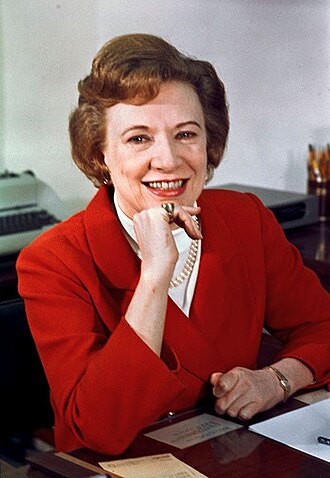
Woods, Rose Mary
Rose Mary Woods served as President Richard Nixon's fiercely loyal Personal Secretary from January 1969 to May 1973, acting as a crucial gatekeeper to the Oval Office. During the White House taping period (February 1971 – July 1973), she maintained strict control over access to Nixon and was one of the few staff members whose daily interactions with the President were frequently recorded. Following the Watergate-related resignations of top aides H.R. Haldeman and John Ehrlichman, her responsibilities expanded and she was promoted to Executive Assistant and Personal Secretary to the President in June 1973, serving until August 1974. She later became infamous for the "Rose Mary stretch," claiming she accidentally erased 18.5 minutes of a subpoenaed June 1972 tape while transcribing it.
President Nixon consulted with various staff members regarding administrative matters and staffing inquiries. The primary focus of the discussion involved evaluating the professional background and political reliability of Joseph E. Parker, a Washington insider with extensive experience in Congress and agricultural policy. Nixon sought to assess Parker's suitability for a potential role, specifically noting his Democratic affiliation and his reputation for being savvy on Capitol Hill.
President Nixon met with members of his economic team—the "Quadriad" of George Shultz, Paul McCracken, Arthur Burns, and John Connally—to refine the administration's strategy for managing the national economy. The discussion focused on persistent inflation, unemployment in the aerospace and technical sectors, and the potential use of federal authority to curb wage and price increases, particularly within the construction industry via the Davis-Bacon Act. The President emphasized the need for a unified approach to instill public confidence and ensure long-term economic stability, cautioning his team that the political viability of a conservative economic agenda depended on their collective success.
President Nixon met with H.R. Haldeman and various staff members, including Peter Flanigan, Henry Kissinger, and John Ehrlichman, to deliberate on high-level personnel appointments, government reorganization, and legislative strategy. A primary focus was identifying a strong, business-oriented candidate for an ambassadorial role to navigate international economic negotiations and counter State Department bureaucracy. The group also discussed managing the President’s public image regarding economic policy, the Alaska pipeline, and Vietnam, while addressing the need to discipline administration officials who publicly diverged from official policy. The President emphasized a preference for direct, high-level policy control and instructed his staff to bolster communication efforts and strengthen the administration’s political messaging.
President Nixon hosted Reverend Carl W. Haley and his wife for a brief, informal social call in the Oval Office. Joined by White House staff and a photographer, the participants engaged in nostalgic conversation regarding the Reverend's birthplace in Lynchburg, Virginia, and shared personal recollections. The meeting concluded with the President presenting gifts to the Haleys and offering well wishes.
President Nixon met with his personal secretary, Rose Mary Woods, and assistant Stephen B. Bull to review administrative details regarding Presidential gifts and the management of upcoming White House social functions. The group discussed the cataloging of gifts, including glassware, pen sets, and historical items, and established criteria for recognizing the birthdays of associates. Additionally, the President reviewed guest lists for an upcoming evening event and discussed the handling of personal items, such as his inaugural suit, ensuring proper documentation and inventory maintenance.
President Nixon met with George Shultz and John Ehrlichman to coordinate administration strategy on welfare reform, economic policy, and federal housing mandates. The participants discussed the political challenges of the Welfare Reform Bill, the potential suspension of the Davis-Bacon Act to curb inflation in the construction industry, and the necessity of maintaining a firm, unified administration stance on low-income housing policies. Nixon decided against proactively seeking wage and price controls while instructing his team to monitor the situation closely, emphasizing a preference for pragmatic, tested solutions over ideological commitments.
President Nixon met with his senior aides and advisors to strategize the temporary suspension of the Davis-Bacon Act, framing the move as an emergency measure to combat inflation in the construction industry rather than an attack on labor unions. The group, including H.R. Haldeman, John Ehrlichman, Charles Colson, and George Shultz, worked to refine a public statement that would justify the suspension by drawing parallels to the administration's previous interventions in the steel and oil sectors. Nixon emphasized the need to maintain credibility with his political allies while ensuring the message clearly articulated that the suspension was a necessary response to rising costs rather than a permanent repeal of labor protections.
President Nixon met with David M. Kennedy and General Alexander Haig to discuss the strategic objectives and logistical planning for Kennedy’s upcoming diplomatic tour of Vietnam, Indonesia, Micronesia, Hong Kong, and Thailand. The President emphasized the critical need for an expert evaluation of South Vietnam’s post-withdrawal economic viability and urged Kennedy to consult directly with local leaders and business figures to bypass the perceived limitations of State Department bureaucracy. Additionally, Nixon provided specific instructions for managing regional alliances, including reassuring Thai leadership of U.S. commitment and addressing the political complexities of Micronesian governance.
President Nixon and H. R. Haldeman met to coordinate upcoming staff meetings regarding domestic and foreign economic policy involving Henry Kissinger, Peter Peterson, and John Ehrlichman. Nixon also collaborated with staff members Marjorie P. Acker and Rose Mary Woods to finalize a personal letter addressed to British Prime Minister Edward Heath. The President explicitly directed that a copy of the correspondence be delivered to Ambassador Walter Annenberg for his personal files, while strictly prohibiting its distribution to the State Department.
President Nixon met with Alexander P. Butterfield and later spoke by phone with Senator John C. Stennis to discuss the public and political reception of the President's March 4, 1971, press conference. The participants focused on the effectiveness of the President's performance in defending the military operation in Laos and managing negative media coverage. They agreed on the importance of maintaining a firm stance regarding the Vietnam War despite unfavorable public opinion polls. Additionally, the President arranged for the dissemination of a private letter to British Prime Minister Edward Heath and discussed scheduling a family portrait session.
President Nixon met with his key economic advisors—John Connally, Arthur Burns, George Shultz, and Paul McCracken—to discuss urgent financial matters and the administration's public messaging strategy. The conversation covered the potential failure of the Lockheed-Rolls-Royce deal, the stability of the DuPont brokerage firm, and rising pressure to increase milk price supports for political leverage. Throughout the meeting, Nixon emphasized the need for internal discipline, a unified public stance on economic policy, and the projection of confidence to stabilize the markets and improve public perception.
President Nixon and H.R. Haldeman met with various staff members to analyze recent public opinion polls and strategize on ways to bolster the President’s credibility regarding his Vietnam War policy and foreign relations. The participants evaluated the public impact of events like the Laos operation and the President's recent press conferences, while also discussing the development of a more robust public relations effort involving key cabinet members and advisors. Additionally, the conversation addressed ongoing textile trade negotiations with Japan and administrative staffing concerns, including potential roles for Peter G. Peterson and Donald H. Rumsfeld.
President Nixon met with Alexander Butterfield and Rose Mary Woods to finalize logistical arrangements for the upcoming visit of Irish Prime Minister Jack Lynch and his wife. The participants coordinated the protocol for arrival ceremonies, receiving lines, and social events in the Yellow Oval Room. Additionally, Nixon discussed the agenda for an upcoming Cabinet meeting focused on foreign trip reports and revenue sharing, and reviewed scheduling details for a dinner hosted by Vice President Agnew.
President Nixon and personal secretary Rose Mary Woods conferred briefly to review and refine the wording of an unspecified document or correspondence. Their discussion focused on clarifying financial or payment-related terminology to ensure the language was suitable for approval. The interaction concluded with the President signaling his agreement with the suggested revisions.
President Nixon and his personal secretary, Rose Mary Woods, discuss the delivery and review process for materials designated for the President's reading. Nixon instructs Woods to arrange for the documents to be sent via courier to his location rather than bringing them to the Oval Office. This brief exchange establishes the logistical plan for the President to review these materials while traveling on an airplane.
President Nixon and his personal secretary, Rose Mary Woods, met to discuss logistical arrangements for upcoming events, including a party planned for that evening and gift-giving matters. The conversation touched upon a tie sent by David J. Mahoney, Jr. and the presentation of a photograph to First Lady Pat Nixon. Additionally, the President inquired about Woods’s personal health during the brief administrative meeting.
President Nixon and Henry Kissinger met to discuss the progress and public perception of the Laotian military operation (Lam Son 719), focusing on the strategic success of cutting enemy supply lines despite negative press reports. Kissinger provided an assessment of North Vietnamese supply decreases and current ARVN effectiveness to assist in drafting the President's upcoming April 7 speech on Vietnam policy. Throughout the conversation, Nixon emphasized his commitment to honesty regarding military data while seeking to frame the Vietnamization effort and future withdrawal timelines as evidence of a successful, principled strategy.
President Nixon and H.R. Haldeman reviewed the President's recent public relations efforts, focusing specifically on the impact of his recent eulogy for Whitney M. Young, Jr. and the need to strategically manage the President's press interviews. They discussed concerns regarding the influence and tactics of speechwriter William Safire, as well as the importance of maintaining an image of accessibility through controlled media engagements rather than traditional press conferences. Additionally, the President provided specific instructions to his staff regarding future press outreach and the upcoming funeral arrangements for Thomas E. Dewey.
President Nixon and his personal secretary Rose Mary Woods discuss the editing and reproduction of personal correspondence and remarks. They focus on maintaining discretion regarding sensitive documents, specifically agreeing that personal notes should be transcribed rather than photocopied and distributed. The discussion highlights their efforts to manage the circulation of private papers while maintaining a professional standard for official records.
President Nixon met with H. R. Haldeman, Rose Mary Woods, and briefly Ronald H. Walker to coordinate upcoming scheduling logistics and administrative briefings. Discussions involved the planning of the First Lady’s travel to New York for the funeral of Thomas E. Dewey and a review of Walker's successful management of the Whitney M. Young, Jr. funeral. The President also tasked Haldeman with monitoring economic policy consultations involving John B. Connally, George P. Shultz, and other key economic advisors to ensure effective coordination.
President Nixon and Treasury Secretary John Connally discussed economic policy and the need for better coordination with Federal Reserve Chairman Arthur Burns. Connally reported on a private meeting with Burns, during which he advised the Chairman to maintain closer cooperation with the administration and avoid public statements that undermined the President's economic program. They agreed to hold the administration's current economic course until April 15, while exploring ways to manage public perception and push back against international criticism of U.S. monetary and balance-of-payments policies.
President Nixon met with his senior advisors, including H.R. Haldeman and John Ehrlichman, to discuss domestic economic policy and management of cabinet officials. The discussion focused on addressing maneuvering by cabinet members, such as Arthur Burns and Maurice Stans, who were attempting to bypass the established Domestic Council system regarding economic issues. Nixon decided that these matters should be handled exclusively through the formal Domestic Council process rather than through uncoordinated committee meetings, effectively asserting control over his economic advisors and cabinet structure.
President Nixon met with H. R. Haldeman and Rose Mary Woods to coordinate his upcoming schedule, specifically regarding the logistics of hosting Jack and Helene Drown at Camp David and managing various social engagements for the First Lady. The discussion emphasized the President's need for privacy at Camp David to prepare for a television interview and meet with Henry Kissinger. Additionally, Nixon briefly spoke by telephone with Representative Wilbur D. Mills to acknowledge a White House tour provided to Mills' family.
President Nixon met with Federal Reserve Chairman Arthur F. Burns to discuss the state of the national economy and manage public perception of their working relationship. Nixon emphasized the importance of maintaining a united front to avoid fueling media speculation regarding potential policy disagreements, while Burns outlined his concerns over a looming international monetary crisis and interest rate strategies. The two agreed to maintain close, private coordination on economic policy while keeping their options open regarding further fiscal stimulus until April economic data became available.
President Nixon and H. R. Haldeman met to coordinate the President's upcoming schedule, specifically focusing on his California trip and the importance of avoiding premature political maneuvers while Congress is in a volatile cycle. They discussed the administration's messaging on the Vietnam War and the Laos operation, noting the necessity of portraying the withdrawal as a strategic decision rather than a retreat. Additionally, the President and Haldeman assessed the performance of Vice President Spiro Agnew, debated the value of public appearances and campus dialogues, and touched upon personnel matters, including upcoming meetings with the Congressional Black Caucus and adjustments to presidential communication strategies.
President Nixon contacts his personal secretary, Rose Mary Woods, to coordinate the review of a speech draft. He requests that she come to his office to pick up the updated document for processing. This brief administrative exchange serves to facilitate the continued development of the President's prepared remarks.
President Nixon directs his personal secretary, Rose Mary Woods, to immediately process a draft speech delivered by Manolo Sanchez for his review. The two discuss the administration's messaging strategy, specifically emphasizing the need to highlight the plight of prisoners of war (POWs) to influence public opinion regarding troop withdrawals. Woods confirms that the text already includes strong language regarding the POW issue, and she proceeds to prepare the document for the President's evening work.
President Nixon and his personal secretary, Rose Mary Woods, discuss the formatting and final revisions for an upcoming speech draft. Woods seeks clarification on whether to conclude a specific section or continue the text as written for the press copies. Nixon instructs her to maintain his preferred structural format and to ensure the draft is completed in its entirety.
President Nixon met with key White House staff and advisors to coordinate the administration's public posture regarding the Calley court-martial, the strategy for an upcoming televised Vietnam speech, and pending domestic legislation. Nixon emphasized that his review of the Calley case was consistent with the judicial process and sought to distance the White House from the prosecution's specific tactics while maintaining a firm stance on military policy. The participants also discussed the President's legislative priorities, specifically managing the potential veto of an education bill, and reviewed economic indicators to bolster confidence in the administration's domestic program.
President Nixon consulted with his personal secretary, Rose Mary Woods, regarding the handling of his forthcoming speech on Vietnam. He directed Woods to temporarily hold the distribution of the press copy as he prepared for a subsequent strategy meeting with National Security Advisor Henry Kissinger. This brief interaction served as a logistical pause to ensure the speech materials remained controlled before final adjustments were made.
President Nixon consulted with Rose Mary Woods to gauge the public and political response to his televised address on Southeast Asia. The conversation highlighted positive reactions from key figures, including Vice President Spiro Agnew, Secretary of State William P. Rogers, and Attorney General John Mitchell, while noting the President's personal emotional investment in the speech. Nixon decided to place follow-up calls to Agnew, Rogers, and Hobart D. Lewis to acknowledge their support and discuss the strategic reception of his remarks.
President Nixon and his personal secretary, Rose Mary Woods, discuss the positive feedback received from various associates following the President's recent television address regarding Southeast Asia. Woods relays laudatory comments from figures including Spiro Agnew, Nelson Rockefeller, and Freeman Gosden, noting their appreciation for the President's sincere and effective delivery. Nixon coordinates follow-up calls to several of these individuals and instructs Woods to schedule a meeting with James E. Bassett for the following day.
President Nixon and his personal secretary, Rose Mary Woods, discussed the positive public and internal reactions to the President's recent televised speech regarding the war in Southeast Asia. Woods relayed favorable feedback from Admiral Thomas Moorer, Paul Keyes, and an acquaintance named Louis, highlighting the effectiveness of the President's calm tone and delivery. The conversation underscores Nixon’s focus on assessing political support and his appreciation for loyal associates who remained steadfast during challenging periods.
President Nixon and his personal secretary, Rose Mary Woods, reviewed administrative tasks, including the organization of personal files and the ordering of letters for Cabinet members like John B. Connally and George H. W. Bush. They discussed logistical details regarding upcoming funeral arrangements for Paul W. Keyes and the scheduling of various presidential communications. Additionally, Woods provided an update on recent phone calls concerning the President's recent speech on Southeast Asia and coordinated the President's schedule with input from Julie Nixon Eisenhower.
President Nixon met with Henry Kissinger, H. R. Haldeman, and other staff members to review the positive public and political reception of his April 7, 1971, address regarding Vietnam. The President expressed frustration with staff members he perceived as lacking resolve, while praising Kissinger and Haldeman for their staunch support. They discussed strategies for promoting administration policies, including the use of improved visual charts to illustrate troop withdrawals and casualty reductions, and addressed the political implications of the Lieutenant William Calley case.
President Nixon and personal secretary Rose Mary Woods coordinate administrative logistics, including a memorandum for Ray Price and Woods' upcoming travel. Woods informs the President of Ambassador John S.D. Eisenhower's intention to resign by July 1, citing personal reasons regarding his housing. They also discuss positive public reception to a recent presidential speech and share concerns regarding the ongoing criticism and political vulnerability of J. Edgar Hoover.
President Nixon and his personal secretary, Rose Mary Woods, discuss administrative matters and potential security concerns regarding electronic surveillance. The brief exchange touches upon the activities of J. Edgar Hoover and the presence of monitoring devices within the office environment. No definitive policy decisions were reached during this informal check-in regarding office security protocols.
President Nixon met with Rose Mary Woods, Ronald Ziegler, and others to discuss administrative matters, personal gifts, and the President's public image. The conversation touched upon the positive public reception of the President's recent remarks on welfare and foreign policy, as well as the need to monitor political rivals like Ted Kennedy through informal channels. Additionally, the group coordinated scheduling details and reviewed logistics regarding upcoming travel and correspondence.
President Nixon met with H.R. Haldeman, William Safire, and Rose Mary Woods to address political strategy and administrative matters. They discussed potential public criticism regarding the President's use of military aircraft, the handling of political campaign funds, and the framing of his upcoming Chamber of Commerce speech concerning welfare reform and work ethics. Additionally, the President and his staff reviewed personnel decisions for government agencies, including the CIA and the Department of Justice, and Woods briefed the President on her media appearances and scheduling arrangements.
President Nixon dictated a memorandum to his personal secretary, Rose Mary Woods, regarding logistical adjustments to his upcoming schedule, including an invitation for Alice Lewis to attend church services. The discussion also addressed a proposal to purchase a church, which Nixon authorized contingent upon ensuring no adverse foreign policy implications. Additionally, the President reviewed his stance on the Turkish poppy crop, contrasting his position with the views of an unidentified individual.
President Nixon met with his personal secretary, Rose Mary Woods, to dictate administrative directives concerning his upcoming schedule and specific policy initiatives. The President requested arrangements for meetings with George Allen, regarding Dwight D. Eisenhower, and railroad executives, with Peter M. Flanigan tasked to coordinate. Additionally, Nixon issued instructions to prioritize the withdrawal of the Peace Corps from the Marianas Islands.
President Nixon met with various staff and associates, most notably Elmer H. Bobst, to discuss administrative matters, the President's upcoming travel schedule, and, primarily, the strategic management of federal cancer research. Bobst, a long-time advocate in the field, offered sharp criticisms of the National Institutes of Health (NIH), arguing that the organization suffers from excessive bureaucracy and a lack of accountability in allocating research grants. Nixon and John D. Ehrlichman consulted with Bobst regarding potential leadership for a new cancer program, specifically discussing the qualifications of candidates like Dr. Henry S. Kaplan to lead the initiative more effectively than existing bureaucratic structures.
President Nixon met with H. R. Haldeman and Henry Kissinger to strategize on domestic political messaging, cabinet management, and sensitive foreign policy initiatives. The discussion focused on preparing for an upcoming press conference, the need for more aggressive public relations regarding the Administration's programs, and organizational changes within the Cabinet. Additionally, Kissinger provided a detailed briefing on the status of secret diplomatic communications with the People’s Republic of China mediated through Pakistan.
President Nixon and his personal secretary, Rose Mary Woods, coordinate the delivery of sensitive administrative materials. The President requests that Woods forward his personal notes regarding the Securities and Exchange Commission, which are contained within a specific folder. Woods confirms the location of these documents and agrees to transmit them to the President immediately.
President Nixon met with his personal secretary, Rose Mary Woods, to coordinate the handling of sensitive documentation. The brief exchange focused on the delivery of specific files, referred to as "yellow sheets," and the status of final notes prepared by Woods. This interaction underscores the administrative management of executive records during the Nixon presidency.
President Nixon met with H.R. Haldeman and Charles Colson to discuss the administration's political strategy regarding recent anti-war protests and civil demonstrations in Washington, D.C. They focused on discrediting Democratic rivals—specifically Hubert Humphrey, Ted Kennedy, and Edmund Muskie—by highlighting their earlier endorsements of these movements, which the President characterized as hypocritical in light of the resulting violence and disorder. Additionally, the participants reviewed the effectiveness of local police leadership, discussed Rose Mary Woods’ recent trip to the Kentucky Derby, and touched upon logistical details for an upcoming meeting with Jeane Dixon and a gift donation from Walter Annenberg.
President Nixon met with renowned astrologer Jeane L. Dixon and his personal secretary Rose Mary Woods to discuss Dixon's recent evangelical and outreach activities among American youth. Dixon recounted her interactions with student protesters and shared her views on political leadership, spirituality, and the President's public image. The conversation concluded with discussions regarding Dixon's professional schedule, her connections to media figures like the Wallaces of Reader's Digest, and the President expressing appreciation for her patriotic efforts.
President Richard Nixon and his personal secretary, Rose Mary Woods, held an informal consultation in the Oval Office to discuss personal or administrative matters. The brief and fragmented dialogue centers on an unidentified third party’s assessment of expectations or specific information. No formal decisions were finalized during this exchange, as the conversation remains incomplete.
President Nixon coordinates with his personal secretary, Rose Mary Woods, regarding the preparation of a draft document intended for John K. Andrews, Jr. The two discuss the status of a specific quote and the timeline for delivering the text to Andrews for further editing. Nixon instructs Woods to provide the draft to Andrews so that he may begin work that evening, with the President planning to review the progress by 9:00 p.m. to offer additional guidance.
President Nixon and his personal secretary, Rose Mary Woods, coordinate their schedules regarding the timing of upcoming clerical work. Woods offers to stay late to finish typing documents, but the President dismisses the suggestion and confirms that no work will be required until the following morning. They conclude the call by agreeing to resume tasks after 10:00 am.
President Richard Nixon met with his personal secretary, Rose Mary Woods, in the Oval Office to discuss administrative or personal matters. Due to the lack of a transcript for this brief encounter, the specific dialogue remains undocumented. The meeting serves as a record of their routine office interactions during this period of the Nixon administration.
President Nixon met with Rose Mary Woods and others to coordinate his upcoming travel schedule and discuss the performance of his cabinet members. He praised John Connally for his strong, decisive leadership while criticizing Secretary of State William P. Rogers for his perceived lack of assertiveness and political fortitude. Later, the President met with political cartoonist Bob Murphy to discuss campaign memorabilia and the role of political expression in America versus restricted regimes.
President Nixon and his personal secretary, Rose Mary Woods, discuss the aftermath of a dinner held for White House correspondents the previous evening. They review reactions from attendees, including journalists such as Jerry Green and John P. Sutherland, and mention the involvement of various political figures like John N. Mitchell and Chief Justice Warren E. Burger. The conversation also briefly touches upon a communication from Senator Charles H. Percy regarding Peter G. Peterson.
President Nixon and his personal secretary, Rose Mary Woods, met to discuss a wide-ranging agenda involving administrative tasks, White House logistics, and political outreach. They addressed matters such as gift management, the potential creation of a presidential business award, the handling of archival research, and upcoming renovations to the Oval Office. Additionally, the pair touched on staffing for the 1972 campaign and personal remarks regarding recent social functions.
President Nixon met with H. R. Haldeman and John Ehrlichman to discuss domestic economic policy, the status of the Supersonic Transport (SST) program, and sensitive foreign policy issues. The President expressed frustration with Secretary of State William Rogers' handling of Middle East policy and explicitly directed that Henry Kissinger be sidelined from Israeli-related negotiations to prevent partisan complications. Nixon also finalized a decision to adopt a more confrontational approach toward the press, ending his participation in traditional social dinners with journalists.
President Nixon and his personal secretary, Rose Mary Woods, held a brief telephonic discussion regarding the administrative schedule. The primary focus of the call was to coordinate arrangements concerning Marjorie P. Acker. No significant policy decisions were recorded during this brief exchange.
President Nixon met with his staff to discuss public relations strategies, specifically focusing on improving outreach to congressional wives and managing the public perception of the administration's accomplishments. The group reviewed the President's schedule and evaluated the effectiveness of recent social events, while also debating the political implications of shifting federal facilities and promoting key initiatives like cancer research and desalinization programs. Additionally, they touched upon legislative concerns, including the potential for a volunteer army and the reaction to Senator Mike Mansfield's resolution regarding the reduction of U.S. troops in Europe.
President Nixon held separate discussions with Rose Mary Woods and Henry Kissinger regarding social, political, and strategic matters. Woods reported on her recent travel and media appearances, while Kissinger briefed the President on delicate negotiations involving Strategic Arms Limitation Talks (SALT), Soviet relations, and potential leaks regarding Vietnam defense policies. The President provided guidance on managing various political associates and addressed concerns regarding Secretary of Defense Melvin Laird’s communication tactics.
President Nixon and his advisors met to finalize the announcement of the Strategic Arms Limitation Talks (SALT) agreement and coordinate the administration's strategy for managing congressional and public reactions. The discussion focused on emphasizing the historic nature of the deal—despite its initial status as a framework—and included logistical planning for a televised address and related press briefings. Additionally, the President addressed minor White House operational concerns, such as plumbing issues in his residence, while maintaining focus on the political leverage gained through recent ABM (Antiballistic Missile) defense initiatives.
President Nixon and his senior aides, including H. R. Haldeman and Henry Kissinger, reviewed the successful public reception of the President's televised announcement regarding the Strategic Arms Limitation Talks (SALT) agreement. They analyzed press coverage, specifically the favorable reactions from media figures like Dan Rather, and discussed the strategic value of the brief, dramatic presentation to the public. Additionally, the group addressed the tepid responses from certain congressional leaders and planned a follow-up briefing for the NSC and negotiating team to reinforce the narrative of a mutual, high-level diplomatic breakthrough.
President Nixon met with key advisors including John Ehrlichman, George Shultz, and Henry Kissinger to navigate a broad agenda covering economic policy, domestic legislative priorities, and the recent Strategic Arms Limitation Talks (SALT) agreement. The participants discussed strategies for managing inflation and fiscal policy, coordinating economic messaging through the Quadriad, and securing congressional support for revenue-sharing initiatives. Furthermore, the President focused on maintaining political discipline regarding his SALT negotiations, successfully leveraging support from key figures like McGeorge Bundy to bolster the agreement's reception among Senate leadership.
President Nixon consulted with a White House operator and his personal secretary, Rose Mary Woods, regarding logistical movements. The brief exchange focused on confirming Woods' current location as she was in transit to the President's office. No significant policy decisions were made during this brief coordination call.
President Nixon, H.R. Haldeman, and Henry Kissinger discussed the recent killings of police officers in New York and Washington D.C., with Nixon expressing strong support for law enforcement and frustration over perceived inaction. They also covered upcoming presidential travel, including potential trips for Vice President Agnew and Kissinger's own international engagements, as well as the ongoing Vietnam War and the complex diplomatic situation regarding the People's Republic of China. A decision was made to schedule a press conference for Tuesday, May 25th, and Nixon emphasized the need for a strong statement on marijuana policy.
President Nixon met with his secretary, Rose Mary Woods, to address a variety of administrative tasks and personal correspondence. They discussed the logistics of book presentations, the potential for Nixon to author a book on past presidents, and the management of his future presidential papers. Additionally, the pair touched upon public sentiment regarding the funding of presidential libraries and the political climate surrounding recent police funerals.
President Nixon and John D. Ehrlichman discuss shifting federal management of water resource projects from the Department of the Interior to NASA, aiming to leverage NASA's technical and management expertise for broader social applications. The President expresses frustration with the current bureaucracy and advocates for utilizing modern scientific approaches over traditional departmental methods. Additionally, the participants coordinate a legislative strategy involving Congressman F. Edward Hébert regarding land use at Camp Pendleton and address ongoing concerns related to New York police issues and J. Edgar Hoover.
President Nixon met with H. R. Haldeman, Henry Kissinger, and others to discuss administrative matters, including the President's recent Southern trip, press strategy, and upcoming state visits. The group reviewed the success of the President's recent tour, debated the merits of using certificates of appreciation to bolster local support, and strategized on how to better leverage public relations for administration priorities like the drug crisis. Furthermore, the President and Kissinger discussed the ongoing Strategic Arms Limitation Talks (SALT), with Nixon emphasizing the need to adopt a hardline stance toward the Soviet Union to ensure progress before any potential summit.
President Nixon and personal secretary Rose Mary Woods briefly consulted regarding the logistics of an upcoming evening engagement, specifically checking on an individual's itinerary and planned activities. Nixon sought clarity on the status of this individual's participation to determine how best to proceed with scheduling or campaign-related involvement. The discussion concluded without a definitive decision, as the President remained uncertain about the appropriate course of action for this person's role.
President Nixon met with Henry Kissinger, John N. Mitchell, and other staff to refine a forthcoming speech at West Point and discuss a wide range of domestic and international political strategy. Key topics included the U.S. response to Soviet naval activity in Cuba, the ongoing effort to manage the Vietnam War in the public consciousness, and organizational strategies for the 1972 primaries, specifically concerning Ohio, California, and Texas. Nixon and Mitchell also reviewed potential personnel appointments and cabinet-level changes, including the roles of Leonard Firestone and Louie Nunn, while finalizing the administration's political positioning regarding Democratic challengers.
President Nixon instructed Rose Mary Woods to inform his speechwriting staff, including John K. Andrews, Jr. and Raymond K. Price, Jr., that the final draft of his speech was approved and they could conclude their work for the evening. He also directed Woods to coordinate with Press Secretary Ronald Ziegler regarding the distribution of the text to the press, granting authorization for an advance release to news magazines if desired. Finally, the President requested that Woods prepare a clean reading copy of the document for his personal use.
President Nixon and his personal secretary, Rose Mary Woods, discuss the President's recent press conference performance and public reception. Woods commends Nixon for his calm demeanor while addressing aggressive questioning regarding the administration's handling of May Day demonstrators. The conversation highlights the administration’s strategy of framing these protests as law and order issues, noting that Attorney General John Mitchell expressed strong approval of the President's steady approach.
President Nixon met with Alexander P. Butterfield and Rose Mary Woods to address logistical arrangements for upcoming events and resolve technical issues with his dictation equipment. The discussion covered protocols for a meeting with Anastasio Somoza Debayle, ensuring the encounter remained informal and strictly limited in scope. Additionally, they coordinated the physical arrangements and gift selection for the 80th Congressional Club reception and finalized the scheduling and venue logistics for a bipartisan congressional briefing on international economic policy.
In this extensive meeting, President Nixon and H. R. Haldeman, later joined by Henry Kissinger and other staff, discussed a broad range of administrative, political, and foreign policy matters. The conversation focused heavily on the President's recent press conference, strategies for managing the press and domestic public opinion, and the imperative to achieve foreign policy breakthroughs in Vietnam, relations with the USSR, and potential overtures to the People's Republic of China. Significant developments included internal planning for clandestine diplomatic channels and a firm resolve to maintain a "law and order" stance against anti-war demonstrators and critics of the administration.
President Nixon and Rose Mary Woods met to discuss various administrative and personal matters, including the Blair House Fine Arts Committee's proposal to create a new reception hall in honor of the President and First Lady. They also addressed concerns regarding ongoing anti-war demonstrations, with the President expressing frustration over the behavior of the protestors. Additionally, the conversation touched upon the logistics of David Eisenhower's stay at the U.S. Embassy in Athens and administrative notes regarding gifts and correspondence.
President Nixon and his personal secretary, Rose Mary Woods, coordinate the revision of a speech drafted for a dedication ceremony scheduled the following day. Finding the original text provided by staff to be excessively long and dull, Nixon instructs Woods to truncate the draft while retaining its opening and closing sections. Woods agrees to finalize the condensed version within thirty minutes so that Press Secretary Ron Ziegler can review it before the President’s 8:30 a.m. breakfast meeting with Vice President Spiro Agnew.
President Nixon met with Alexander Butterfield and Rose Mary Woods to coordinate logistical arrangements for upcoming events and personal scheduling. The discussion focused on securing a suitable venue for a reception involving the Peter G. Peterson group and clarifying the President's protocol and time commitments for a meeting with the American Committee on Italian Migration. Additionally, the participants reviewed the maintenance and use of the Tayloe House and discussed potential dinner reservations for the President and First Lady.
President Nixon met with H.R. Haldeman and other staff to review administrative, political, and foreign policy matters, including the handling of foreign cables and the management of cabinet officers. The President emphasized his desire to delegate decision-making authority to cabinet secretaries to minimize his personal involvement in routine disputes and to streamline government operations. Additionally, they discussed strategies for dealing with the press, the importance of maintaining loyalty from political allies, and the specific goal of ending federal funding for the Corporation for Public Broadcasting.
President Nixon and his personal secretary, Rose Mary Woods, met to address administrative matters regarding a draft of a dedication speech. The discussion focused on coordinating the details and necessary revisions for the document. This brief consultation facilitated the refinement of the President’s upcoming public remarks.
President Richard Nixon and his personal secretary, Rose Mary Woods, discussed scheduling and logistical arrangements for upcoming social engagements and wedding-related events. Their conversation focused on coordinating the President's personal calendar, including a photo session, a dinner at the F Street Club, and various planned activities for wedding guests throughout the week. The dialogue served to finalize the President's itinerary and clarify the sequence of events leading up to his scheduled discussion with First Lady Pat Nixon.
President Nixon and his personal secretary, Rose Mary Woods, coordinate logistics for an upcoming event or appearance, specifically weighing the suitability of a library location versus alternative sites. They discuss concerns regarding crowd sizes and potential timing conflicts, ultimately deciding to prioritize indoor arrangements due to the heat. The conversation concludes with Woods confirming she will inform First Lady Pat Nixon of the final planning adjustments.
President Nixon and his personal secretary, Rose Mary Woods, discuss the logistical challenges of scheduling tailoring appointments and addressing quality concerns regarding the work of Benjamin Freeman. The conversation focuses on coordinating future clothing needs for the President, including specific requests for lightweight suits, tuxedos, and outerwear to be prepared for upcoming television appearances and public events. Nixon tasks Woods with consulting production experts William H. Carruthers and Paul W. Keyes regarding wardrobe aesthetics to ensure optimal presentation on camera.
President Nixon and his personal secretary, Rose Mary Woods, discuss the logistical and stylistic considerations of procuring new suits for the President. The conversation touches upon the quality of previous tailoring and the desire for a lighter-colored garment for upcoming appearances. They ultimately coordinate a meeting for Wednesday to review a selection of suit options.
President Nixon and his personal secretary, Rose Mary Woods, coordinate the guest list and logistical arrangements for a dinner scheduled for that evening. They discuss the inclusion of key staff members, specifically Leonard Garment and Raymond K. Price Jr., while also addressing the need to consult with First Lady Pat Nixon regarding the final guest invitations. The call serves as a brief planning session to finalize the evening's social agenda.
President Nixon and his personal secretary, Rose Mary Woods, held a brief, informal meeting to coordinate their personal schedules for the evening. They discussed adjusting the time of a planned engagement from 7:00 pm to 6:30 pm to better accommodate the President's availability. No substantive policy matters were addressed, as the conversation focused exclusively on logistical arrangements.
President Nixon consulted with Alexander P. Butterfield and Stephen B. Bull regarding the logistics of an upcoming appearance before a group of visitors. The discussion focused on coordinating the President's brief two-minute remarks with the scheduled tour of the White House. Rose Mary Woods also joined the brief meeting, which centered on ensuring the group could efficiently transition from the President's address to their tour.
President Nixon met with Peter G. Peterson and Henry Kissinger to discuss the sensitive diplomatic implications of the upcoming Okinawa reversion, specifically addressing the Senkaku Islands sovereignty dispute and its potential impact on relations with Taiwan and Japan. To mitigate backlash from Nationalist China regarding the reversion, the group decided to offer Taiwan a low-profile, long-term commitment to provide military equipment, with formal discussions postponed until August to avoid public friction with Congress. Additionally, Peterson briefed the President on a planned bipartisan Congressional session aimed at presenting the Administration's long-term economic and technological strategies, with a particular focus on fostering innovation through unconventional, high-level scientific talent and better integrating R&D with national goals.
President Nixon and H.R. Haldeman reviewed internal administration polling data to assess public opinion on various policy issues, including the Vietnam War, SALT talks, marijuana legalization, and economic priorities. They discussed the disparity between public awareness of administration initiatives and the actual results of these polls, with the President cautioning against overestimating the public's grasp of complex foreign policy details. Following the review, Nixon instructed his staff to pause further polling efforts to avoid excessive internal focus on shifting approval numbers.
President Nixon consulted with his personal secretary, Rose Mary Woods, to verify the religious affiliation of Senator Henry “Scoop” Jackson. Nixon requested this information to confirm whether Jackson was Catholic or Protestant, likely for political or strategic vetting purposes. Woods indicated she believed Jackson was Protestant but agreed to investigate further to provide a definitive answer.
President Nixon, H. R. Haldeman, and Rose Mary Woods met to discuss logistics for an upcoming event involving California guests, alongside personal staffing concerns and household management. The conversation transitioned into a strategic review of the administration's public image, with Nixon expressing frustration over his Cabinet’s lack of focus and the administration's failure to gain political credit for its foreign and domestic policy accomplishments. Nixon and Haldeman concluded by emphasizing the need to adopt a more aggressive leadership posture, particularly by identifying and confronting political adversaries, to better resonate with the public.
President Nixon, Rose Mary Woods, and Stephen B. Bull met to coordinate the logistics and guest list for upcoming social engagements, specifically involving Jack and Helene Drown. The discussion focused on managing Helene Drown’s potential attendance at First Lady Pat Nixon’s scheduled trip to Rochester, New York, due to concerns regarding social etiquette and media exposure. Rose Mary Woods took action items to coordinate these schedules and handle communications with Bebe Rebozo to ensure the President maintained necessary time for rest.
President Nixon held a brief telephone conversation with his personal secretary, Rose Mary Woods, to address administrative or personal matters. Because the majority of the audio segment is subject to a withdrawal for personal privacy under the deed of gift, the substantive details of their discussion remain restricted. No specific policy actions or historical developments were recorded in the available portion of the transcript.
President Nixon contacted his personal secretary, Rose Mary Woods, to request her immediate presence at the Executive Office Building. This brief directive served to coordinate administrative tasks or logistical support necessary for the start of the President's workday. No specific policy matters were addressed during this short exchange.
President Nixon and his personal secretary, Rose Mary Woods, held a brief, informal meeting in the Old Executive Office Building to address administrative tasks. The exchange centered on a request for Woods to handle specific clerical duties or correspondence, referred to as 'fire' in the transcript. No major policy decisions or significant political developments resulted from this brief administrative encounter.
Rose Mary Woods contacted the White House operator to facilitate a telephone call to Marjorie P. Acker. Following a brief consultation with President Nixon regarding an unidentified man's schedule, Woods successfully connected with Acker to request a wedding guest list. This interaction functioned primarily as an administrative coordination for personal arrangements.
President Nixon met with his personal secretary, Rose Mary Woods, and others to discuss logistics and guest management for the upcoming wedding of his daughter, Tricia Nixon Cox. The conversation focused on refining the wedding guest list, coordinating social arrangements with the Drown family, and managing the President’s personal schedule amidst the event festivities. Nixon expressed a desire to minimize social distractions and interference, emphasizing his need to focus on presidential duties following the conclusion of the wedding events.
President Nixon, H.R. Haldeman, and Rose Mary Woods discuss a piece of writing by Terry McKinney that articulates a populist defense of middle-class American values against perceived "anti-American" cultural influence. Nixon praises the text, deciding it should be circulated within the White House and suggesting he may use it for a future speech. The participants also coordinate logistics for an upcoming wedding reception, including potential outings to Camp Hoover and managing the President’s family engagements.
President Nixon and his personal secretary, Rose Mary Woods, coordinated logistical details regarding an upcoming evening excursion on the presidential yacht, the Sequoia. The discussion centered on timing, the departure schedule, and the potential inclusion of First Lady Pat Nixon. Additionally, Woods relayed feedback from Tricia Nixon Cox concerning the trip's arrangements.
President Nixon and personal secretary Rose Mary Woods briefly coordinate logistical arrangements for an upcoming departure. The discussion focuses on scheduling travel plans and ensuring specific transport requirements are met. The exchange concludes with a general confirmation that the necessary preparations are being finalized to ensure a timely departure.
President Nixon consulted with his personal secretary, Rose Mary Woods, to confirm the status of correspondence sent to baseball player Luis Aparicio regarding his hitting streak. The two also discussed a personal letter and poem the President wrote to a young girl early that morning. Nixon instructed Woods to share the girl's correspondence with Richard A. Moore, emphasizing that it should be handled discreetly rather than publicized.
President Nixon met with his personal secretary, Rose Mary Woods, to finalize a piece of personal correspondence. He provided her with a letter he had authored earlier that morning for a young girl. The interaction served as a brief administrative task to ensure the delivery or processing of the document.
President Nixon and his personal secretary, Rose Mary Woods, discussed logistical adjustments to the President's upcoming schedule. The primary focus involved rescheduling an appointment with Dr. W. Kenneth Riland and arranging a time for Tricia Nixon Cox to display her wedding gifts to the President. No major policy decisions were made during this brief coordination call.